Seasonal Timeline
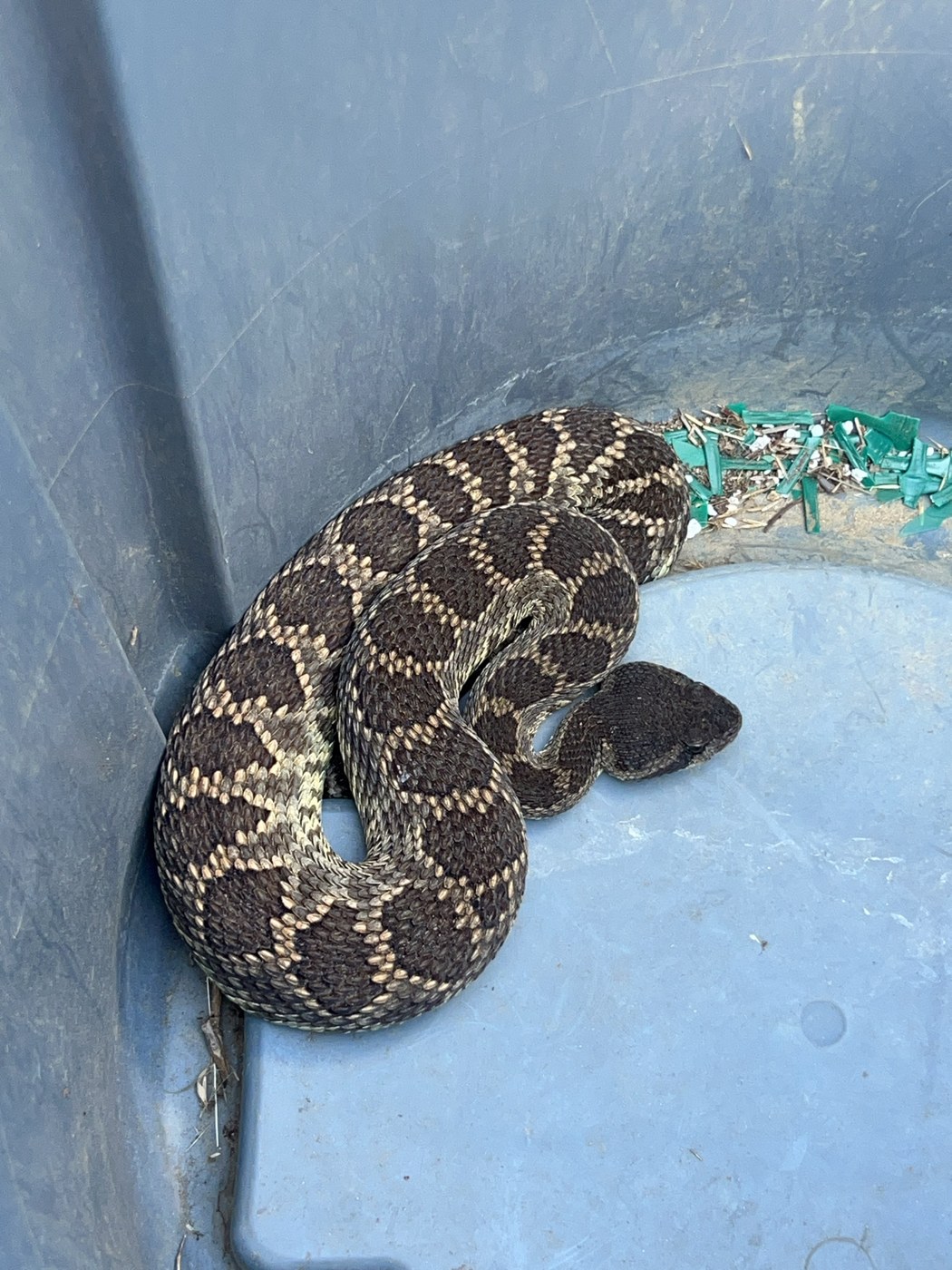
Southern Pacific rattlesnake is active through the warm months and shifts its daily schedule with the heat, moving in daylight during cooler months and around dawn and dusk once summer arrives. Statewide, most rattlesnake bites happen between April and October, when snakes and people are outdoors at the same time. Live young arrive late in the season, with births documented from August through October.
Southern Pacific rattlesnake is active through the warm months and shifts its daily schedule with the heat, moving in daylight during…
Two calendars run at once here, and one of them is specific to how old the snake is. The first is ordinary activity. Statewide guidance from California's wildlife agency puts most rattlesnake bites between April and October, which is simply when snakes and people are outside at the same time. Within that window the animal is diurnal in the cooler months and shifts toward dawn, dusk, and after dark once summer heat arrives, so a property can hold a snake nobody has seen in daylight.
The second calendar is reproductive, and community-science research on this subspecies found it is not a single spring event. Mating peaks in spring, with males searching widely for females and engaging in ritualized male-to-male combat dances that are closer to a wrestling match than a fight and usually end without injury. The same research documents a second, smaller mating period in fall, tied to the August through October birthing season, which means late summer and early fall put newly born snakes and courting adults through the same canyon edges, drainage corridors, and yard margins at the same time.
The finding worth carrying into a season is the age split. That same community-science work found juveniles were most commonly observed in spring, at 52 percent of all juvenile observations, while adult observations spread fairly evenly across all four seasons. A small snake seen in spring is therefore closer to the expected pattern than an unusual event.
Where They're Found
Southern Pacific rattlesnake is an entirely outdoor, wild species. It is not a structural invader the way a rodent or a bat is, and nothing in its biology gives it a reason to get inside a building. Its range falls entirely within California.
The range is worth pinning down, because other rattlesnakes cross state lines and this one does not. Detailed range descriptions confine the subspecies to California from an intergradation zone with Northern Pacific rattlesnake in Santa Barbara County, south through the central valley and the desert slopes of the transverse and peninsular ranges, north to the Antelope Valley and the Mojave Desert edge near Barstow, and south into the middle of the Baja California peninsula in Mexico, plus Santa Cruz and Santa Catalina Islands, with a resident population confirmed in extreme southwestern Imperial County as recently as 2022. The peer-reviewed clinical literature describes the same range independently. No source places any part of this subspecies in Nevada, Arizona, or any other state. Its only cross-border extension is into Mexico. Alaska and Hawaii have no population of this species, and no snake species is native to Hawaii at all. Elevation runs from sea level to above 9,800 feet, roughly 3,000 meters, and the high-elevation end of that range turns out to matter for the venom finding below.
The central finding is not where the species lives in the abstract. It is that it lives inside the city. A peer-reviewed emergency-medicine case series states directly that this is the only rattlesnake in the city of Los Angeles, including the southern and coastal parts of Los Angeles County. San Diego Zoo material describes it as commonly found near housing developments, parks, and even the beach. San Diego's natural history museum, writing specifically about what to do when a rattlesnake turns up on a resident's property, confirms it is the species San Diego homeowners are most likely to encounter. Field reporting from the region documents the species living inside narrow, fully developed urban drainage corridors with no access at all to open wild land. This is a materially different picture than the wilderness-interface encounters typical of the copperhead, cottonmouth, Mojave rattlesnake, prairie rattlesnake, and western diamondback rattlesnake.
The mechanism behind that is the canyon network. San Diego's own regional natural history program counts more than 150 canyons inside the city limits and describes them as wildlife corridors connecting fragments of undeveloped habitat through built neighborhoods. That is why hillside and canyon-adjacent addresses in the Los Angeles and San Diego metro areas see this species at a documented, elevated frequency while a flat inland lot several blocks away may never produce a sighting. On the property itself, the cues are the ordinary ones: rocky open ground for basking, cover to hide under, a water source, and prey. California's wildlife agency describes the broader western rattlesnake group living in rural and urban areas alike, on riverbanks, in parks, on golf courses, and around homes and yards in brushy areas and under wood piles.
Diet explains most repeat sightings, and on this species it comes with a real ecological finding attached. Prey includes small mammals, lizards, birds, other snakes, frogs, and insects, with California ground squirrels a frequently taken item. A peer-reviewed coevolution study in San Diego County found ground squirrel populations carry resistance to the venom's tissue-destroying metalloproteinases, and that the strength of that resistance tracks local Southern Pacific rattlesnake abundance and venom chemistry. Predator and prey are measurably shaping each other. The practical version for a property owner is unchanged: a rattlesnake near a house is usually there because the rodents and ground squirrels are.
Related Pests
Life Cycle
The life-cycle detail worth carrying away is that when you see a snake tells you something about how old it is. Community-science research on this subspecies, built from photo-vouchered observations, found juveniles clustered heavily in spring at 52 percent of juvenile observations, while adult sightings spread across all four seasons without a strong peak. Two things are not settled. Sources disagree on whether females here breed annually or on a roughly biennial cycle, so both figures stand rather than one being chosen. And no wild-specific maximum lifespan was confirmed, so the 10 to 20 year figure applies to protected and captive animals only.

Mating
Gestation
Birth
Neonate
Juvenile and Adult
Identification
Family first, species second
The traits that put this animal in the pit viper family are a heat-sensing pit between the eye and the nostril, vertically elliptical pupils rather than round ones, a broad triangular head on a narrow neck, keeled scales, and a segmented rattle on a short blunt tail. Those are the same family-level marks the copperhead, cottonmouth, Mojave rattlesnake, prairie rattlesnake, and western diamondback rattlesnake share.
Size runs roughly 2.5 to 4.5 feet
Adults are documented at 30 to 54 inches, most commonly in the 30 to 44 inch band, with 54 inches at the top end and newborns at about 10.5 inches. A regional aquarium gives the same typical range independently. Treat 30 to 44 inches as the working adult size and anything near 54 inches as a large individual rather than a different species.
Color is a weak place to start
Color is variable enough that it is a weak place to start. Ground color runs gray, brown, or olive, with a series of large dark brown or blackish blotches down the back that become crossbands near the tail. Both the state wildlife agency and the standard California reference note substantial individual and population variation. Do not use color alone to rule this species in or out.
The gopher snake imitates it
The look-alike that matters in Southern California is the gopher snake, and the confusion is deliberate on the gopher snake's part. Federal park material at Cabrillo National Monument in San Diego, along with regional zoo and museum sources, documents the San Diego and Pacific gopher snake as the animal people in this range actually mistake for this rattlesnake. When threatened, a gopher snake flattens and inflates its head into a triangle, hisses loudly, and vibrates its tail against dry ground or leaf litter to produce a rattling sound. Federal park material states directly that this is why they are so often mistaken for rattlesnakes. Behavior alone therefore cannot settle it, and the four physical tells below have to do the work instead.
The rattle is the cleanest tell
The rattle is the first tell and the cleanest. A gopher snake has no rattle at all. Its tail is long, thin, and tapers to a point. This rattlesnake's tail is short and blunt and ends in a physical, segmented rattle. The sound proves nothing on its own, because a gopher snake can produce a convincing imitation of it with tail vibration alone, but the structure at the end of the tail is real and visible.
Head shape and size are the second
A gopher snake's head is slender and barely wider than its neck, even when it is flattening it in a threat display. This rattlesnake carries a large, spade-shaped or triangular head sized to house venom glands and long fangs, set on a distinctly narrower neck.
Pupil shape follows the hunting
Pupil shape is the third, and it follows from how each animal hunts. Gopher snakes are daytime chase predators with round pupils. This rattlesnake is an ambush predator with vertical, cat-like slit pupils. Federal park material draws exactly this distinction.
The shape of the dorsal pattern
It is the fourth tell. Federal park material distinguishes circular or diamond-shaped blotches on the rattlesnake against a rectangular chain pattern on the gopher snake. That chain description is not an improvisation. It is built into the gopher snake's own scientific name, Pituophis catenifer, which means chain-bearing.
Not worth a closer look
None of this is worth arranging a closer look for. Every tell above requires a clear view of a live snake's head or tail, which is exactly the view a homeowner should not be trying to get. If you are close enough to be confident about pupil shape, you are closer than you should be. Treat an unresolved snake as the rattlesnake and act accordingly.
Names, and a live disagreement
Names you may hear, including a live scientific disagreement. Most Los Angeles and San Diego residents simply call this animal a western rattlesnake, which is accurate in the loose sense, since it is the only rattlesnake most of them will ever meet. The scientific name is where it gets interesting. California's wildlife agency and the standard California reference both treat it as a subspecies of the western rattlesnake, Crotalus oreganus helleri, while current peer-reviewed clinical and toxinology literature, including the case series cited here, treats it as the full species Crotalus helleri. Both conventions are given here rather than quietly picking one, the same approach taken on eastern ratsnake's taxonomy. Nothing about the disagreement changes the snake, the venom, or what to do about either.
Signs of Infestation
Nothing to inspect
The usual inspection checklist does not apply to a snake, because a snake leaves nothing behind to inspect. Southern Pacific rattlesnake builds nothing, chews nothing, and never gets inside a wall or a crawlspace, so there are no gnaw marks, entry holes, droppings trails, or odors to work backward from. A sighting, or a shed skin, is the evidence.
One of three things gets noticed
What a homeowner actually notices is one of three things. The snake itself, a shed skin, or an audible rattle and warning buzz. That is the whole list.
A rattle is a warning, not an ID
Rattling is a warning, not an identification, and it fails in both directions. The sound tells you to back away rather than telling you what you are backing away from. It also does not work in reverse, because a gopher snake vibrating its tail against dry ground produces a convincing imitation of the same sound without being able to envenomate anyone.
Burrows, woodpiles, rock piles
Look at the burrows, the woodpiles, and the rock piles. Presence near a structure traces to shelter features and to prey: rodent and ground squirrel burrows, active or abandoned, plus woodpiles, rock piles, dense brush, and unmaintained vegetation growing against fences. None of these is a sign of damage, because there is no damage mechanism here.
Repeats point at ground squirrels
Repeat sightings point at rodents and ground squirrels. Prey includes small mammals, notably California ground squirrels, along with lizards, birds, other snakes, frogs, and insects. A property producing regular snake sightings is generally a property producing regular rodent and ground squirrel activity, which reframes the problem as a food-source question rather than a snake question.
Location on the lot says more here
Location on the lot tells you more here than with most snakes. Because this species is documented living inside dense Los Angeles and San Diego development, using canyon and drainage corridors as travel routes through built neighborhoods, a property that backs onto a canyon, a hillside, a storm drainage channel, or any undeveloped strip is in a genuinely different exposure category than one that does not. A city address is not a reason to rule this species out, and the sightings tend to cluster along the corridor edge rather than scattering randomly across a neighborhood.
Prevention and When to Call a Pro
Do not handle it
This is a venomous species, so one rule comes before every other: do not handle it. Do not try to capture, move, or kill the snake yourself. Keep people and pets well away. If the animal is simply passing through, give it space and let it leave on its own, which is what the state wildlife agency's own guidance recommends. Distance ends nearly every encounter, and stepping back rather than in is the entire technique.
The defensive sequence
It explains why distance works. Federal park material specific to this species describes the order: cryptic coloration and stillness first, rattling as a warning second, and fleeing or striking only as a last resort if the animal is cornered. State guidance adds that rattlesnakes generally avoid people and that bites are uncommon outside those cornering circumstances. An animal that has room to leave usually takes it.
Habitat work starts with prey
Habitat work is the practical, homeowner-doable half, and it starts with the prey. Because presence near a structure is generally driven by food, reducing rodent and ground squirrel activity and the food sources that support them removes the reason the snake came. Fill in abandoned burrows once control is done, since those burrows double as shelter. Clear woodpiles, dense brush, tall grass, and rock piles away from the foundation, walkways, and play areas.
On a hillside lot, work the edge
On a canyon-adjacent or hillside lot, treat the corridor edge as the working perimeter. The key finding is that the species uses canyon and drainage corridors to move through built neighborhoods, so a property backing onto one is where the maintained clearance zone earns its keep. Keep that boundary strip cut back rather than letting brush and grass run up to the fence line, and check the ground-level cavities that substitute for rock crevices: the base of block walls, landscape rock and gravel beds, stacked pots and pavers, irrigation boxes and valve covers, gaps under gates and sheds, and pool equipment enclosures.
Fencing, installed correctly
Snake-proof fencing works, but only if it is installed correctly. The specification that turns up in California homeowner guidance is quarter-inch mesh, buried several inches below grade, angled outward at the base, and kept clear of vegetation a snake could climb to get over it. A fence installed without those details is a fence a snake goes under or over.
Repellents are worse than useless
Repellents do not work, and the popular ones are worse than useless. Mothballs, sulfur, and similar folk remedies are not shown to repel rattlesnakes. Money spent on them is money not spent on the rodent control and the clearance work that actually change the outcome.
What the venom does
This is where this species is most often described incorrectly. A peer-reviewed case series in an emergency-medicine journal documented seven patients envenomated by this species who developed significant neurological effects: slurred speech, unsteady movement, tingling, and myokymia, a distinctive rippling muscle contraction in the face and limbs. Six of those patients were bitten within the city of Los Angeles or southern Los Angeles County and one in the San Diego region. The same case series notes that Mojave rattlesnake's range does not include the cities of Los Angeles or San Diego, so those cases cannot be explained away as Mojave rattlesnake bites. This is this species' own documented finding.
Not the same as the Mojave
The mechanism is not the same as Mojave rattlesnake's, and the difference is specific and geographic. The case series attributes the myokymia either to a crotamine-like component, a small basic myotoxic peptide in the beta-defensin family, or to presynaptic phospholipase A2 neurotoxins. Independent peer-reviewed venom proteomics settles which one does most of the work. A 2014 study found those myotoxic beta-defensin peptides secreted in large amounts by every sampled population of this subspecies across its California range, while true Mojave-toxin-type presynaptic neurotoxic phospholipase A2, the specific toxin behind Mojave rattlesnake's own neurotoxic phenotype, turned up in only one of four sampled populations: Idyllwild, in the San Jacinto Mountains of Riverside County. The accurate statement is therefore narrow: most of this species' documented clinical neurotoxicity comes from a widespread myotoxin that is not Mojave toxin, and genuine Mojave-toxin neurotoxicity is confirmed only in one isolated mountain population rather than across the subspecies.
Venom varies by population
Venom in this species is unusually variable population to population, beyond the neurotoxin question. The same 2014 proteomics work found hemorrhagic metalloproteinase content ranging from abundant to nearly absent depending on which population was sampled, high in the Catalina Island and Phelan populations, moderate at Loma Linda, and only a trace at Idyllwild. A separate hemostasis study of Riverside and San Bernardino county specimens found some individual venoms produced high lethality with no hemorrhagic activity while others showed the reverse. The proteomics authors state this population-level variability as a documented clinical challenge for antivenom management specifically in this species, which is a species-level finding rather than a general property of all rattlesnakes.
The law has an odd shape
The law here has a real and counterintuitive shape. California's regulations state that no sportfishing license is required for the sport take of any rattlesnake in the state, with a bag and possession limit of two per day applying to the western rattlesnake listing that covers this subspecies. Separately, state law establishes a distinction that catches well-meaning homeowners out: a property owner may kill a rattlesnake on their own property without any license, permit, or authorization at all, but capturing one alive with the intent to relocate and release it elsewhere legally requires the department's written approval, in practice a scientific collecting permit. One California rattlesnake is carved out of that permissive rule, and it lives inside this species' range. The same regulation sets a bag and possession limit of zero for the red diamond rattlesnake, and University of California's rattlesnake guidance states plainly that it is prohibited from being taken or killed. Red diamond rattlesnake shares ground with this species across coastal Southern California, so a homeowner in San Diego, western Riverside or Orange County who kills a rattlesnake on the assumption that the permissive rule covers every rattlesnake may have killed the one it does not cover. Three field marks separate the red diamond rattlesnake from this species.
What that legal gap means
The practical reading of that legal gap. The homeowner who wants to do the kinder thing, catch the snake and move it, is the one who needs paperwork, while the homeowner who kills it does not. Reporting on this rule notes that the state has been described as considering a fix without enacting one, so the gap stands as current law. The state's own recommendation to residents points the same way: hire a permitted, licensed, and bonded wildlife control operator rather than attempting a do-it-yourself relocation. That is better for the snake, and it keeps the property owner out of a liability problem if an unlicensed handler they called is bitten. Verify the current rules for your own city and county before acting, since local ordinances sit on top of state law.
If someone is bitten
The immediate steps are the same ones every venomous snake page here gives. Stay calm. Remove rings and watches before swelling starts. Keep the affected limb in a neutral position at or below heart level. Get to a hospital immediately and treat it as an emergency no matter how mild it looks in the first minutes. Federal occupational safety guidance from the Centers for Disease Control and Prevention and the National Institute for Occupational Safety and Health is the source for that protocol, and it does not change based on which pit viper was involved.
The list of things not to do
All of them still get repeated and none of them help. Do not try to suck out venom. Do not apply a tourniquet. Do not apply ice. Do not cut the wound.
What to tell the hospital
What is worth telling the hospital, and it is specific to this species. Because bites here can produce neurological effects rather than only swelling and tissue damage, report any slurred speech, unsteady movement, tingling, or visible muscle twitching to emergency responders even when those symptoms feel less alarming than the pain. That does not change the first aid or the trip to the emergency department. It changes what the treating team watches for.
When a Bite Is an Emergency, Who to Call
For any bite, get emergency medical care immediately. For a snake matching this description that is holding ground near an occupied building, next to a foundation, or in a part of a yard people and pets cross regularly, the call goes to a licensed nuisance wildlife control operator, a pest control professional, or the state wildlife agency. Make the same call for any snake you cannot confidently separate from a gopher snake, since a gopher snake's threat display is built to be mistaken for this animal, and uncertainty is a reason to hand the job to someone equipped for it rather than a reason to get closer.
Frequently Asked Questions
Is the Southern Pacific rattlesnake really found inside Los Angeles and San Diego, or only in the surrounding wilderness?
Inside the cities, and the sourcing on that is unusually direct. A peer-reviewed emergency-medicine case series states plainly that this is the only rattlesnake in the city of Los Angeles, including the southern and coastal parts of the county, and six of the seven envenomated patients in that series were bitten within the city or southern Los Angeles County. Regional zoo material describes the species near housing developments, parks, and the beach, and San Diego's natural history museum names it as the species homeowners there are most likely to find on their property. The mechanism is the canyon network, with more than 150 canyons inside the city of San Diego alone serving as wildlife corridors through built neighborhoods. A city address is not a reason to rule this snake out.
Does this rattlesnake have neurotoxic venom like the Mojave rattlesnake?
Its bites can produce real neurological effects, but not usually by the same mechanism, and the distinction is worth getting right. A peer-reviewed case series documented slurred speech, unsteady movement, tingling, and myokymia, a rippling muscle contraction, in seven patients bitten by this species. Venom proteomics attributes most of that to crotamine-like beta-defensin myotoxins, which were found in large amounts in every sampled population of this subspecies across California. True Mojave toxin, the presynaptic neurotoxin behind Mojave rattlesnake's own reputation, showed up in only one of four sampled populations, at Idyllwild in the San Jacinto Mountains, and a separate molecular study traced its presence there to ancient hybridization in a population isolated from real Mojave rattlesnake. So the honest version is that the neurotoxicity is real and documented, and that it mostly is not Mojave toxin.
What is the real look-alike for this snake in Southern California?
The gopher snake, and it imitates a rattlesnake on purpose. When threatened it flattens and inflates its head into a triangle, hisses loudly, and vibrates its tail against dry ground or leaf litter to make a rattling sound, which federal park material at Cabrillo National Monument states directly is why it is so often mistaken for a rattlesnake. Behavior will not settle it. Four physical differences will: a gopher snake has no rattle and a long thin pointed tail, a slender head barely wider than its neck, round pupils rather than vertical slits, and a rectangular chain-link dorsal pattern rather than the circular or diamond-shaped blotches this rattlesnake carries. All four require a clear look you should not be arranging. If you cannot be sure from a safe distance, treat it as the rattlesnake.
Can I legally kill a rattlesnake on my own property in California?
For this species yes, with one important exception covered at the end of this answer. A property owner may kill a rattlesnake on their own property with no license, permit, or authorization at all. Capturing one alive in order to relocate and release it somewhere else is the action that requires the state wildlife department's written approval, in practice a scientific collecting permit. So the homeowner trying to do the kinder thing is the one who needs paperwork. State regulations separately state that no sportfishing license is required for the sport take of rattlesnakes in California, with a bag and possession limit of two per day on the western rattlesnake listing that covers this subspecies. The state's own recommendation is to hire a permitted and licensed wildlife control operator rather than attempt a do-it-yourself relocation. The exception, and it matters in this species' own range: the same regulation sets a limit of zero on the red diamond rattlesnake, which University of California's guidance describes as prohibited from being taken or killed, and that species shares coastal Southern California with this one. A homeowner in San Diego, western Riverside or Orange County who cannot tell the two apart should not be relying on the permissive rule at all. Check your city and county rules too, since local ordinances sit on top of state law.
Why do rattlesnakes keep turning up in hillside neighborhoods and canyons that are already developed?
Because the canyons are the roads. Southern California's urban canyon networks, more than 150 of them inside the city of San Diego alone, function as wildlife corridors connecting fragments of undeveloped habitat through fully built neighborhoods, and this species is specifically documented using them. Field reporting from the region documents the snakes living inside narrow urban drainage corridors with no access at all to open wild land. That is why a canyon-adjacent or hillside lot sits in a different exposure category than a flat inland lot a few blocks away, and why the maintained clearance strip along that boundary is the single highest-value piece of prevention work on such a property.
Sources
- Rattlesnake species page: statewide habitat including urban areas, parks and yards, April through October bite window, and guidance to give the animal space California Department of Fish and Wildlife
- Southern Pacific Rattlesnake (Crotalus oreganus helleri): size, coloration, detailed California range, elevation limit, spring mating and combat dances, litter size, birth window, and neonate size CaliforniaHerps
- We Brake for Snakes, Snakes, and Herp Field Guide: gopher snake rattlesnake mimicry, and the rattle, head, pupil, and dorsal pattern tells that separate the two, plus this species' defensive sequence U.S. National Park Service, Cabrillo National Monument
- Southern Pacific Rattlesnake species account: adult and maximum size, litter size and gestation, neonate fangs and venom, post-birth period and first molt, and captive lifespan Aquarium of the Pacific, Online Learning Center
- Rattlesnake animals and plants page: habitat including housing developments, parks, and coastal areas, plus sage scrub and grassland near rocky outcroppings San Diego Zoo
- Neurotoxicity Associated With the Southern Pacific Rattlesnake (Crotalus helleri): seven-patient case series documenting dysarthria, ataxia, myokymia and paresthesias, the only-rattlesnake-in-the-city-of-Los-Angeles finding, and the exclusion of Mojave rattlesnake as an explanation Annals of Emergency Medicine (PubMed)
- San Diego's Rattlesnakes, and What to Do When They're on Your Property: confirmation that this is the species San Diego homeowners most often encounter San Diego Natural History Museum
- Coast to Cactus, Urban Canyons: more than 150 canyons inside the city of San Diego functioning as wildlife corridors through developed neighborhoods San Diego Natural History Museum
- Quantifying Southern Pacific Rattlesnake (Crotalus oreganus helleri) Hunting Behavior through Community Science: spring mating peak, second fall mating period, and the seasonal split between juvenile and adult observations Diversity (MDPI)
- Phenotypic and functional variation in venom and venom resistance of two sympatric rattlesnakes and their prey: California ground squirrel metalloproteinase resistance coevolving with local rattlesnake abundance and venom chemistry in San Diego County Journal of Evolutionary Biology (PubMed)
- Intraspecific venom variation in the medically significant Southern Pacific Rattlesnake (Crotalus oreganus helleri): myotoxic beta-defensin peptides in all sampled populations, Mojave-toxin-type PLA2 in only the Idyllwild population, population-level metalloproteinase variation, and the antivenom management challenge Journal of Proteomics (PubMed)
- Mojave toxin in venom of Crotalus helleri (Southern Pacific Rattlesnake): molecular and geographic characterization confirming the toxin only in the geographically isolated Mount San Jacinto population via ancient hybridization Toxicon (Duke University Scholars)
- Venom variation in hemostasis of the Southern Pacific rattlesnake: Riverside and San Bernardino county specimens showing high lethality without hemorrhagic activity in some individuals and the reverse in others National Center for Biotechnology Information, PubMed Central
- Rattlesnakes homeowner and exclusion guidance: rodent and burrow reduction, clearing woodpiles, brush and rock piles, quarter-inch-mesh snake-proof fencing specification, and the finding that mothballs, sulfur, and similar repellents do not work Vertebrate Pest Control Research Advisory Committee, State of California
- California Code of Regulations Title 14 Section 5.60, Reptiles: no sportfishing license required for sport take of rattlesnakes, and the two-per-day bag and possession limit on the western rattlesnake listing Cornell Law School Legal Information Institute
- Pest Notes: Rattlesnakes, Publication 74119: California residents able to take most rattlesnake species on private land without a license or permit subject to a bag limit of two, and the separate statement that the red diamond rattlesnake is prohibited from being taken or killed by state wildlife regulation University of California Statewide Integrated Pest Management Program (UC IPM), UC Agriculture and Natural Resources
- California Code of Regulations Title 14 Section 40, General Provisions Relating to Native Reptiles and Amphibians: the written-approval requirement behind live capture and relocation Cornell Law School Legal Information Institute
- Venomous Snakes: A Neglected Hazard for Outdoor Workers, national bite first aid and what not to do Centers for Disease Control and Prevention, National Institute for Occupational Safety and Health
Image Credits
- Image: Cameron D via iNaturalist. CC BY-SA 4.0. Resized, so this version is offered under the same license.
License.