Seasonal Timeline
Cottonmouth is active through the warm season and goes inactive in the coldest months, moving away from open water to overwinter in rocky wooded hillsides, crayfish burrows, rotting stumps, and mammal burrows. Mating happens in both spring and fall, and live young arrive between August and October.
Cottonmouth is active through the warm season and goes inactive in the coldest months, moving away from open water to overwinter in rocky…
Two things set this snake's calendar, and both of them are about water. Through the warm months it works the margins of lakes, rivers, ponds, and wetlands, basking on branches, logs, and stones at the water's edge, which is where nearly every homeowner encounter happens. The North Carolina Wildlife Resources Commission calls it the most aquatic of North America's venomous snakes. When temperatures fall, it leaves the water entirely for the winter and shelters in rocky wooded hillsides, crayfish burrows, under rotting stumps, and in mammal burrows.
The second driver is reproduction, and it puts a real bump in the late-season calendar. Mating occurs in both spring and fall, and North Carolina documents live young born between August and October. That means small, brightly banded juveniles are moving through the same pond and ditch edges adults have been basking along all summer, during the weeks people are still fishing, mowing, and working near the water.
Where They're Found
Cottonmouth belongs to the warmer, wetter southeastern and south-central United States, and it is tied closely to permanent or semi-permanent water. North Carolina's wildlife agency describes it as the most aquatic of North America's venomous snakes, found in most habitats associated with water. Its range falls in two regions, South Central and Southeast.
Range is not uniform even inside those regions, and that detail matters more here than on most pages. The Virginia Department of Wildlife Resources states that cottonmouth occurs only in the southeastern portion of that state, while the harmless watersnakes people confuse it with are found statewide. In Texas, the western cottonmouth is the form present, and Texas Parks and Wildlife places it in east Texas, around Dallas and Fort Worth, along southern shoreline areas, and in parts of the Hill Country and Edwards Plateau. That is the natural western edge of the species. Alaska and Hawaii have no cottonmouth population. Every state range description reviewed, from North Carolina, Florida, Texas, and Virginia, confines the species to the southeastern and south-central states. The distribution described here is drawn from state wildlife agency and university extension sources rather than a federal range map.
On a specific property, the relevant question is not woodpiles or foundation gaps. It is water. A pond, a drainage ditch, a slow stream, a dock, or a low wet corner is the habitat, and the snake will be at its margin, on a log, a branch, a stone, or a bank, rather than anywhere near the house.
Life Cycle
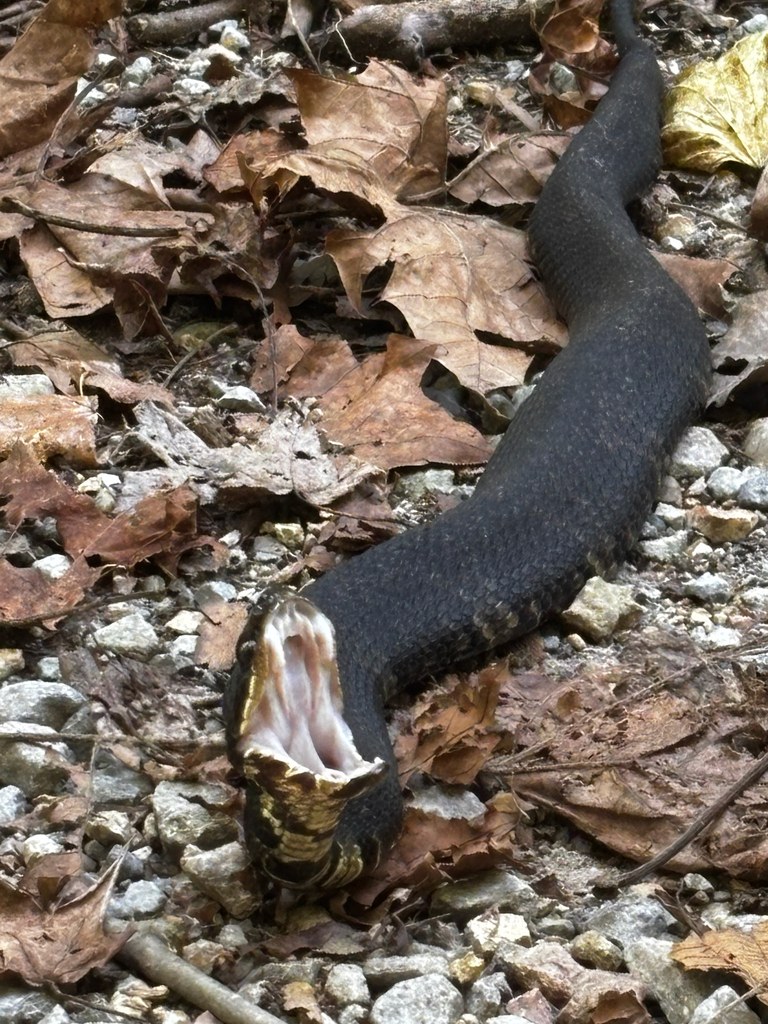
This snake gets harder to identify as it gets older, not easier. A newborn cottonmouth is brightly banded and readable at a glance. North Carolina and UF/IFAS independently report that older adults often fade to nearly uniform dark or black, with the crossband pattern barely visible. That is precisely the point in the animal's life when color and pattern stop helping and the flattened, angular head, the dark eye-to-jaw bar, and the gaping white-mouth display become the only marks worth reading. The pattern also runs the other way at the start of life, since a bright neonate looks far more like a young copperhead than like the dark adult it will become.

Mating
Neonate
Juvenile
Adult
Identification
Assume it is not one
Start from the assumption that it is not a cottonmouth. The North Carolina and Virginia wildlife agencies and UF/IFAS Extension each state independently that nonvenomous watersnakes in the genus Nerodia are the animal most often reported as a cottonmouth. Near water, in this range, a banded snake is more likely to be a harmless watersnake than a venomous one. Work through the tells below before deciding anything, and especially before deciding to act.
Crossbands, and they are inverted
Crossband shape is the strongest single tell, and it is an inverted pattern. North Carolina's wildlife agency states directly that a cottonmouth's dark crossbands are widest along the sides of the body and narrowest across the top. Watersnake bands do the opposite, running widest across the top. If you can see the bands well enough to judge where they are broadest, you have the most reliable field mark available.
The head and the eye bar
A cottonmouth's head is distinctly wider than its neck, broad and heavy, with a dark bar running from the eye to the angle of the jaw that camouflages the eye itself. Virginia's wildlife agency describes the head as flattened and angular against a watersnake's rounded head, with one honest caveat attached: a threatened watersnake will flatten its own head into a more diamond-like shape, which blurs the difference at exactly the moment you want it to be clear. Nine large scales sit on the crown, the pupils are vertically elliptical, and a heat-sensing facial pit sits between eye and nostril, the same pit viper traits a copperhead carries. There is no rattle.
Swimming posture is only a hint
Swimming posture is a hint, not a rule, and it is easy to oversell. The familiar version says cottonmouths float high on the surface like a cork while watersnakes swim mostly submerged with only the head showing. Virginia's wildlife agency does state that cottonmouths tend to float high, then immediately qualifies it: other harmless species, the eastern hog-nosed snake among them, float the same way. A snake riding high on the water is a reason to look more carefully. It is not an identification.
The white mouth it is named for
The white mouth is the behavior the species is named for. Threatened, a cottonmouth coils, vibrates its tail, and gapes its mouth wide to show the white interior. North Carolina and UF/IFAS both confirm the display independently, and no common look-alike in this range does the same thing. It is a warning, delivered instead of a bite.
The tell most people have backwards
The behavioral tell most people have backwards. Cottonmouths are documented as reluctant to strike. Given the choice, they gape or they leave. The Virginia Department of Wildlife Resources describes watersnakes as tending to be aggressive and quick to bite when handled or cornered. So the snake that lunges and bites the hand reaching for it is quite often the harmless one, and a reputation for aggression is close to the worst possible basis for telling these two apart.
Young ones look like copperheads
Young cottonmouths resemble copperheads, not adult cottonmouths. Neonates and juveniles are brightly patterned with reddish-brown crossbands and a yellow tail tip, and UF/IFAS notes the close resemblance to a young copperhead. Geography is the practical tiebreaker here. Know which venomous species is actually documented near you before settling on either name.
Water moccasin is the same snake
Cottonmouth and water moccasin are the same snake. Both names are in common use for Agkistrodon piscivorus, and neither points to a separate species. Western cottonmouth is the subspecies name Texas Parks and Wildlife uses for the Texas population.
Signs of Infestation
No damage to look for
There is no damage to look for, because this species does no damage. Cottonmouth does not chew, burrow, gnaw wiring, or enter living space the way a rodent or a bat does. No droppings pattern, no entry hole, no gnaw marks, no odor. The only sign is the snake itself, and the only question that matters is whether you identified it correctly.
Look at the water, not the house
The realistic place to encounter one is basking on a log, branch, or stone at the margin of a pond, ditch, lake, or slow stream, or moving along a bank or a dock. A property with standing or slow-moving water is the relevant context. Woodpiles and foundation gaps, which drive encounters with terrestrial snakes, are not the issue here.
The gaping white mouth is a sign in itself
A snake that coils and opens its mouth to display a white interior instead of striking is showing you the one behavior no common regional look-alike shares. A snake that flattens its head and bites readily is more likely a watersnake.
Tail buzzing tells you almost nothing
A defensive cottonmouth vibrates its tail against leaf litter or debris, but it has no true rattle, and several harmless snakes buzz their tails the same way when startled. The sound is not evidence for or against this species.
Repeats point at the water
Repeat sightings usually point at the water, not at an infestation. Cottonmouth is a generalist predator taking fish, frogs, other snakes, crayfish, small mammals, birds, lizards, and turtles. A pond or ditch producing regular snake sightings is generally a pond or ditch holding a lot of prey, which is a habitat observation rather than a pest problem.
Prevention and When to Call a Pro
Leave it alone
Most of the risk disappears when you do. North Carolina's wildlife agency states plainly that snakes are shy and pose little to no threat when left alone, and its guidance is to give an encountered snake room and time to move off on its own rather than approaching it, capturing it, or killing it. For a species already documented as reluctant to strike, distance is very nearly the whole strategy.
Do not kill a snake on sight
Do not kill a snake near water on sight, because the odds say you would be killing the wrong animal. Watersnakes are misidentified as cottonmouths constantly, confirmed independently by two state wildlife agencies and a university extension service, and the snake with the more aggressive reputation in the encounter is frequently the harmless one. Killing on sight in this range removes far more beneficial, nonvenomous snakes than it does actual hazards, and it puts a person's hands within striking distance of a snake that would otherwise have left.
Manage the water's edge
That is where the habitat actually is. Clearing debris, brush piles, and low overhanging cover from pond, ditch, and pool margins removes the basking and ambush cover that makes a water feature attractive to this species. There is no snake-specific structural exclusion work to do here, which follows from the animal not being a structural invader in the first place. Sealing a foundation does not address a snake that was never trying to get in.
Never handle one you cannot name
Never handle, move, or kill a snake you cannot confidently name. Uncertainty is not a reason to be careful with your hands. It is a reason to keep them out of it entirely. Nothing about cottonmouth removal is a homeowner project.
A bite is an emergency
If someone is bitten, treat it as an emergency regardless of what you think the snake was. Call 911 immediately, keep the affected limb at or below heart level, and get to emergency care. Federal occupational safety guidance from CDC and NIOSH and the peer-reviewed StatPearls reference on this species' venom give the same instruction independently of each other.
What not to do after a bite
The folk remedies are still circulating and every one of them makes the outcome worse. Do not apply ice. Do not use a tourniquet. Do not cut the wound. Do not try to suck out venom. Do not drink alcohol or caffeinated beverages. Do not take aspirin, ibuprofen, or other NSAIDs, which can increase bleeding risk. Federal occupational safety guidance states each of these plainly.
What the venom actually does
The answer shapes what the emergency room will be watching for. StatPearls describes cottonmouth venom as a mix of metalloproteinases, hyaluronidase, and phospholipases A2, and the damage it causes is mostly local: pain, redness, bruising, and progressive swelling at the bite. Systemic effects are the minority case, with coagulopathy and gastrointestinal symptoms reported in roughly 19 percent of cases. Antivenom, specifically Crotalidae polyvalent immune Fab, is the treatment when swelling progresses or blood clotting goes abnormal.
Dry bites are real
They are a fact for the hospital rather than a reason to stay home. StatPearls confirms that dry bites, in which little or no venom is injected, do happen with this species, and that a patient with no symptoms after 8 hours of observation is presumed to have taken a dry bite and can be discharged. Read that carefully. Those 8 hours run under medical supervision, with someone watching for the swelling that would change the answer. Waiting 8 hours at home to see what develops is a different thing entirely, and a dangerous one.
Check your state law first
Check your own state's law before doing anything to a cottonmouth, because the two regions where it lives land in different places. In North Carolina, cottonmouth is a nongame species with no open season, and collecting one requires either a scientific collection permit or staying within the state's standard amphibian and reptile bag limits. In Texas, cottonmouth is a native venomous species handled as non-game wildlife, outside the separate permit system Texas runs for nonindigenous snakes, and taking one legally requires a valid hunting license plus a Reptile and Amphibian Endorsement. Texas also protects 13 threatened and endangered snake species by law, and cottonmouth is not among them, so being venomous does not by itself make the species protected there. Those are two real state rules, not a national one.
When a Bite Is an Emergency, Who to Call
Call 911 immediately for any bite from a snake matching this description, whether or not the species was ever confirmed. Call a licensed nuisance wildlife control operator or your state wildlife agency for a confidently identified cottonmouth denning near an occupied structure, a dock, or any high-traffic spot along the water where accidental encounters are likely, and for any snake you cannot confidently rule out as this species. Given how routinely the harmless watersnake is the one that bites when grabbed, not being sure is reason enough to hand the situation to someone who is.
Frequently Asked Questions
Is every snake I see in the water a cottonmouth?
Almost certainly not. Nonvenomous watersnakes are the animal most often mistaken for a cottonmouth, and the North Carolina and Virginia wildlife agencies and UF/IFAS Extension each report this independently. The most reliable tell is crossband shape: a cottonmouth's dark bands are widest along the sides of the body and narrowest across the top, while a watersnake's are widest across the top. Swimming posture is suggestive at best, since harmless species float high on the water too.
Is a cottonmouth more likely to bite me than a watersnake?
Often it is the other way around, counterintuitive as that sounds. Cottonmouths are documented as reluctant to strike, usually gaping to display the white interior of the mouth or simply retreating rather than biting. The Virginia Department of Wildlife Resources describes watersnakes as tending to be aggressive and quick to bite when handled or cornered. Reputation is a poor guide here. Neither snake should be handled.
Does a cottonmouth always inject venom when it bites?
No. Dry bites, where little or no venom is delivered, are documented for this species. StatPearls, a peer-reviewed medical reference, notes that a patient showing no symptoms after 8 hours of observation is presumed to have taken a dry bite and can be released from care. That 8-hour clock runs in a hospital with someone watching for swelling. It is not a window to wait out at home.
What should I actually do if I get bitten?
Call 911 and get emergency care immediately. Keep the bitten limb at or below heart level. Do not use ice, a tourniquet, cutting, or venom suction, and skip alcohol, caffeine, and NSAIDs like aspirin and ibuprofen, which can increase bleeding risk. Treat every bite as an emergency, whether or not you are sure what bit you.
How bad is the venom?
Mostly local, which is not the same as minor. StatPearls describes cottonmouth venom as causing tissue damage at the bite site, pain, redness, bruising, and progressive swelling, through metalloproteinases, hyaluronidase, and phospholipases A2. Systemic effects are less common, with coagulopathy and gastrointestinal symptoms in roughly 19 percent of cases. Antivenom is the treatment when swelling progresses or clotting is affected, which is one more reason the call goes to 911 rather than to a wait-and-see.
Is it legal to kill a cottonmouth on my property?
It depends on your state, and killing on sight is a bad idea regardless, given how often the snake turns out to be a harmless look-alike. North Carolina classifies cottonmouth as a nongame species with no open season, and collecting one requires a permit or compliance with the state's reptile bag limits. Texas allows take under a standard hunting license plus a Reptile and Amphibian Endorsement, since cottonmouth is a native, non-protected species there despite being venomous. Confirm your own state's rule before assuming either applies to you.
Sources
- Cottonmouth species profile: identification, crossband shape, reproduction, habitat, and North Carolina legal status North Carolina Wildlife Resources Commission
- Cottonmouth identification: size, coloration with age, defensive display, and juvenile resemblance to copperhead University of Florida IFAS Extension
- Cottonmouth / Water Moccasin: diet, foraging strategy by life stage, and sexual dimorphism University of Georgia Savannah River Ecology Laboratory Herpetology Program
- Water Moccasin Snake Toxicity: venom components, symptom frequency, dry bites, and antivenom treatment National Center for Biotechnology Information, StatPearls
- Snakes on the Water: Cottonmouth or Watersnake? Head shape, swimming posture, and defensive behavior compared Virginia Department of Wildlife Resources
- Hunting licenses and permits, including the Reptile and Amphibian Endorsement Texas Parks and Wildlife Department
- Venomous Snakes: A Neglected Hazard for Outdoor Workers, national bite first aid and what not to do Centers for Disease Control and Prevention, National Institute for Occupational Safety and Health
Image Credits
- Image: Chris Stahl via iNaturalist. CC BY 4.0.
License.