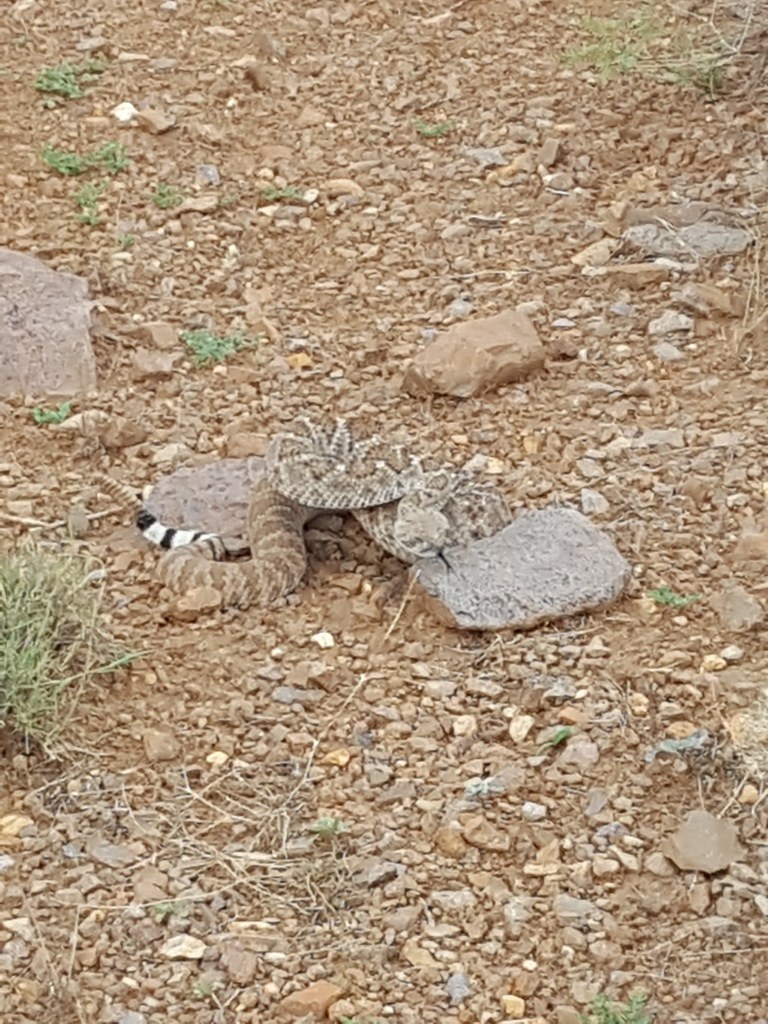
Seasonal Timeline
Western diamondback rattlesnake is active from roughly early March through late October, hunting mostly at night and in the early morning and spending the cold months dormant in caves and burrows. Live young arrive late in the season, with births documented from late July through September.
Western diamondback rattlesnake is active from roughly early March through late October, hunting mostly at night and in the early morning…
This snake keeps two calendars at once, and the daily one runs opposite to what most people expect. Through the roughly March to October active season it hunts at night and in the early morning, and it is generally sedentary between hunts. Midday sun in open desert is a hazard to a snake, not an opportunity, so the daylight hours are spent in shade, under cover, or below ground. When temperatures fall for the year the animal moves into a cave or a burrow and stays dormant from about late October until early March. The practical consequence is that a property can hold this species for an entire season without anyone seeing it in daylight.
The reproductive calendar is the second one, and it is less regular than an annual cycle. Mating happens in spring and again in fall. A peer-reviewed field and laboratory study of 46 sexually mature Arizona females found enlarged ovarian follicles from February through June, ovulating that same year, and again from September through November, ovulating the following year. In other words yolk deposition spans two full activity seasons rather than one, so an individual female produces a litter in alternating years rather than every summer. Births then fall from late July through September, with the earliest neonates recorded in the field on August 8 through 11, which means small newly born snakes are moving through the same desert scrub, burrow mouths, and yard edges the adults have used all season.
Where They're Found
Western diamondback rattlesnake is an entirely outdoor, wild species. It is not a structural invader the way a rodent or a bat is, and nothing in its biology gives it a reason to get inside a building. Its range covers the South Central and Southwest states.
The range covers central and western Arkansas, Oklahoma apart from the northeast, north central, and panhandle areas, Texas apart from the northern panhandle and the easternmost and wettest portions, southern and central New Mexico, all of Arizona, extreme southern Nevada, and a corner of southeastern California near the Chocolate Mountains, continuing south through most of northern and central Mexico. Records from extreme southern Kansas suggest a possible isolated population there. Alaska and Hawaii have no western diamondback rattlesnake population, and one general reference states that absence outright rather than leaving it to inference. Every published range description confines the species to the arid and semi-arid South Central and Southwest United States and to Mexico.
Habitat breadth is the surprising part. For a desert rattlesnake this animal is a generalist, documented from flat coastal plain to steep rocky canyons and hillsides, and across desert scrub, sandy creosote flats, mesquite grassland, and even pine and oak forest at elevation, from below sea level up to about 6,500 feet. Rodent burrows and piles of rock and debris supply both shelter and winter denning sites. The detail that matters most for a homeowner is the one that separates this species from most other rattlesnakes: it is directly documented as highly adaptable to semi-urban habitat and as a frequent presence inside the Phoenix and Tucson metro areas. This is not strictly a backcountry animal, and a city address is not a reason to rule it out.
Diet explains most of the rest. Small mammals make up 94.8 percent of the diet by weight, including prairie dogs, kangaroo rats, pocket gophers, voles, woodrats, pocket mice, white-footed mice, fox squirrels, cotton rats, ground squirrels, rabbits, and jackrabbits, with large adults able to take an adult cottontail or jackrabbit. Birds such as mockingbirds, quail, owls, larks, and sparrows are secondary prey, along with lizards and the occasional insect or other reptile or amphibian. Under normal wild conditions it feeds roughly every two to three weeks, and it can go up to two years without food in extreme conditions. A western diamondback near a house is usually there because the rodents are.
Related Pests
Life Cycle
The life-cycle finding worth remembering is the one that ties reproduction directly to the rodents in your yard. The peer-reviewed Arizona study did not just find a biennial female cycle. It found that reproductive frequency tracks prey abundance, with roughly half of females reproducing in an average year, rising to 73 percent gravid in high-rodent-abundance years and falling to 28 percent in low-abundance years. That is a measured, sourced link between how many rodents a landscape supports and how many rattlesnakes it produces two seasons later. It also turns the standard rodent-control advice from boilerplate into a mechanism: reducing the rodent population near a structure does not only remove the reason a snake showed up this week, it removes part of the reason there will be more of them later.

Mating
Yolk Deposition
Birth
Neonate
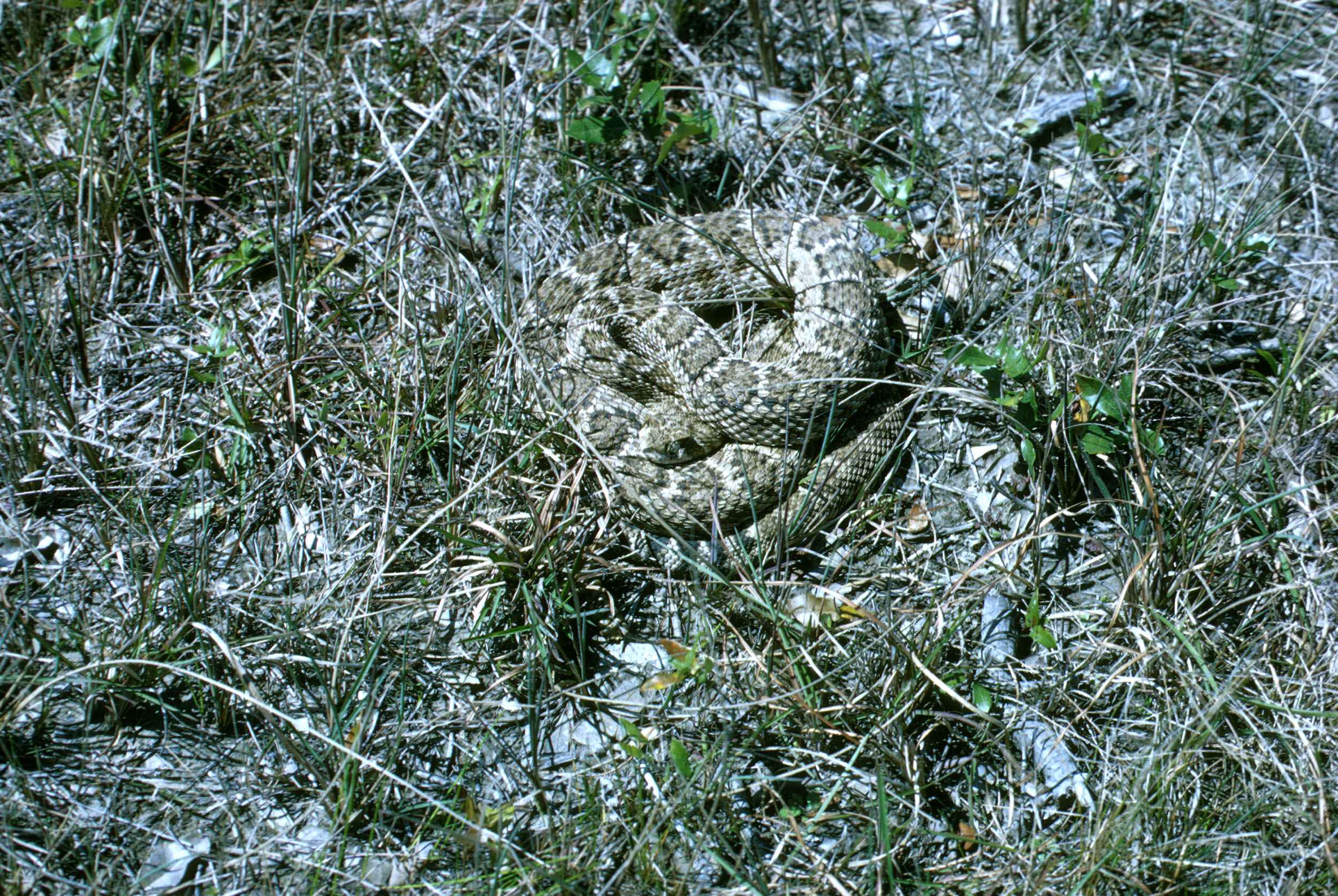
Juvenile and Adult2
Identification
Family first, species second
The traits that put this animal in the pit viper family are a heat-sensing pit between the eye and the nostril, vertically elliptical pupils rather than round ones, a broad triangular head on a narrow neck, and a functional segmented rattle on the tail past the newborn stage. The dorsal scales are rough and sharply keeled, in 25 to 27 rows at midbody. Those are the same family-level marks that copperheads, cottonmouths, Mojave rattlesnakes, and prairie rattlesnakes all share.
Size is a genuine clue here
Size is a genuine clue on this species, unlike most. This is the second largest rattlesnake in the United States, behind only eastern diamondback rattlesnake. Adults typically run 3 to 4 feet. Individuals over 5 feet are described as infrequently encountered, anything over 6 feet as very rare, and the longest reliably measured specimen was 7 feet. Weight runs 3 to 6 pounds for a medium adult and up to 15 pounds for a large one. A genuinely heavy-bodied rattlesnake in the arid Southwest or South Central states is more likely to be this species than any of the others here.
It matches the dirt
Ground color is close to useless on its own, because the snake matches the dirt. Khaki predominates, but the ground color also runs pinkish, fallow, brick red, yellowish blonde, or nearly white depending on the local substrate. Do not use color to rule this species in or out.
The pattern changes with age
The pattern changes shape as the animal ages, which trips people up. There are 23 to 45 dorsal blotches, averaging around 36. In a young snake those blotches are rectangular. They become hexagonal, and only at maturity do they become the true diamonds the common name refers to. A juvenile that does not look diamond-patterned is not thereby a different species.
The stripe behind the eye
It is a real mark and worth knowing. A gray or umber stripe runs diagonally back and down from the eye, bordered underneath by a white stripe. On this species that stripe angles downward toward the mouth rather than continuing past the jawline, which is one of the traits the identification literature uses to separate it from Mojave rattlesnake.
The tail is the signature
It is where the nickname comes from. The tail carries 2 to 8 black bands, typically 4 to 6, separated by white or gray interspaces. Sources describe those black and light bands as running close to equal width, roughly one to one, which is what earns this snake the name coontail. It is the single most repeated identification point about the species.
Mojave, and the tail rule oversold
The look-alike that matters is Mojave rattlesnake, and this is where the tail rule gets oversold. The two species overlap across much of the Southwest and the confusion runs in both directions. The usual tell is exactly the tail: this species' black and white bands sit close to equal width, while a Mojave's white bands are noticeably wider than its black ones. That difference is real. It is also not a test you can rest a decision on. The peer-reviewed paper written specifically to revisit this identification question states that tail-band width is a variable trait on both species and should never be used alone, and a herpetological comparison built to compare these two species reaches the same conclusion, recommending that the path of the stripe behind the eye, the scale count above the eyes, and overall build and proportions be weighed together instead. Anyone who tells you the tail bands settle it by themselves is repeating a simplification the underlying research does not support.
Why that mix-up needs caution
Why that particular mix-up is worth caution rather than curiosity. Mojave rattlesnake carries a documented neurotoxic venom component in some of its populations, which this species does not, so which snake delivered a bite changes what an emergency department watches for. Every trait above needs a clear, close look at a live rattlesnake's head or tail. That is precisely the look nobody should be arranging on purpose.
The gopher snake is low-stakes
The low-stakes look-alike is the gopher snake. It shares the range, is nonvenomous, and gets mistaken for a rattlesnake regularly. It has no true rattle, a rounded rather than broadly triangular head, and round pupils. Getting this one wrong is an ordinary error rather than a clinical one, which is the opposite of the Mojave situation.
Names you may hear
Coontail and coon tail are widely used and refer directly to the tail bands. In Texas and the South Central states you will hear Texas diamond-back, Texas rattler, and Texas bark. In the Southwest, Arizona diamond rattlesnake, adobe snake, desert diamond-back, and fierce rattlesnake all turn up. Buzz tail is general. Spitting rattlesnake is also in circulation and is simply wrong, because this species does not spit venom. The scientific name is Crotalus atrox, with no subspecies currently recognized.
Signs of Infestation
Nothing to inspect
The usual inspection checklist does not apply here, because a snake leaves nothing behind to inspect. Western diamondback rattlesnake builds nothing, chews nothing, and never gets inside a wall or a crawlspace. There are no gnaw marks, no entry holes, no droppings trail, and no odor to work backward from. A sighting, or a shed skin, is the evidence, and what happens next depends entirely on whether that sighting was read correctly and from a safe distance.
It comes down to three things
What a homeowner actually notices comes down to three things. The snake itself, a shed skin near a burrow mouth or a rock pile or a basking spot, or the rattle. Shed skins are general rattlesnake sign rather than anything specific to this species, and no distinctive odor has been documented for it.
Rattling is a warning, not an identification
Every rattlesnake sharing this range rattles when disturbed, including the Mojave rattlesnake most often confused with this one, so the sound tells you to move away rather than telling you what you are moving away from. It also fails in the other direction, since a newborn has no working rattle at all and silence proves nothing.
The burrows and the piles
On a property, look at the burrows and the piles. Rodent burrows, rock piles, woodpiles, and accumulated debris are the shelter features this species is documented to use, and burrows double as winter denning sites. None of these is a sign of damage, because there is no damage mechanism to find.
Repeats point at rodents
Repeat sightings almost always point at rodents. Small mammals make up 94.8 percent of this snake's diet by weight. A property producing regular snake sightings is generally a property producing regular rodent activity, which reframes the problem as a food-source question rather than a snake question.
A city address does not rule it out
A city or suburban address does not rule this species out, and that is unusual. General reference material documents this snake as highly adaptable to semi-urban habitat and as a frequent presence within the Phoenix and Tucson metro areas. Metro-area yards, alleys, block walls, landscape rock, and irrigation edges are all realistic settings for an encounter, not just open desert. Because the animal hunts at night and in the early morning, a yard can host one for weeks with nobody seeing it in daylight.
Prevention and When to Call a Pro
Do not handle it
This is a venomous species, so one rule comes before every other: do not handle it. Do not try to capture, move, or kill the snake. Keep people and pets away from it. Distance ends nearly every encounter, and stepping back rather than in is the whole technique. Retreat promptly rather than casually, and do it without turning your back on an animal you have not yet put distance between yourself and.
Never handle one you cannot name
Never handle, move, or kill a snake you cannot confidently name, and here that caution has teeth. The peer-reviewed identification literature states plainly that no single tail-band or pattern trait separates this species from a Mojave rattlesnake reliably on its own. If the research will not commit from a photograph, a homeowner should not commit from a driveway. There is a second reason not to kill on sight: which of the two species delivered a bite changes what an emergency department monitors, and a dead, misidentified snake is worse than no snake at all.
Habitat work does more than one snake
Habitat modification is the practical, homeowner-doable work, and the reproductive data says it does more than clear one snake. Because presence near a structure is driven by prey, and because this species also relies on rock piles, debris, and rodent burrows for shelter and winter denning, clearing brush, woodpiles, and rock debris away from the foundation perimeter and reducing the rodent population addresses both food and shelter in one pass. The peer-reviewed Arizona study puts a number behind the food half: 73 percent of females were gravid in high-rodent-abundance years against 28 percent in low-abundance years. Fewer rodents on a landscape is a smaller snake population two seasons out, not just a quieter week.
In Phoenix and Tucson, a yard task
In the Phoenix and Tucson metro areas this is a routine yard task, not a wilderness precaution. Because this species is documented as unusually comfortable in semi-urban habitat and is frequently encountered inside those metro areas, the perimeter walk is worth doing on an ordinary suburban lot. Check the base of block walls, landscape rock and gravel beds, stacked pavers and pots, irrigation boxes and valve covers, gaps under gates and sheds, and pool equipment enclosures. These are exactly the shaded, ground-level cavities that substitute for the rock crevices the animal would otherwise use.
Sealing and fencing, realistically
Sealing and fencing, with realistic expectations. Snake-proof fencing and sealing ground-level gaps around a structure are standard exclusion practice for rattlesnakes generally. No exclusion technique specific to this species beyond general rattlesnake practice has been documented, and none of it substitutes for the habitat and rodent work above.
Never probe a burrow by hand
Do not investigate a burrow, a rock pile, or a debris heap by hand. Rodent burrows and rock and debris piles are documented shelter and winter denning sites. Reaching into one, lifting one blind, or digging one out is the single most avoidable way to put a hand where a rattlesnake already is. Note it and leave it alone.
What the venom does
This is stated at the level the sourcing supports. It is primarily hemotoxic. Venom proteomic work puts the composition at roughly 69.5 percent snake venom metalloproteinases and serine proteinases, 25.8 percent medium-size disintegrins, phospholipase A2, cysteine-rich secretory protein, and L-amino acid oxidase, and 4.7 percent vasoactive peptides, an endogenous metalloproteinase inhibitor, and C-type lectin-like proteins. Specific proteases and hemorrhagic zinc metalloprotease toxins have been isolated and characterized directly from this species' venom in peer-reviewed biochemistry literature. Cytotoxins and myotoxins are documented as well, capable of causing muscle necrosis, fibrosis, and permanent tissue loss through loss of blood supply following local hemorrhage.
Volume and delivery, not potency
The reason this snake's bites matter clinically is volume and delivery, not raw potency. This is the mechanism behind the greatest-number-of-bites finding, and it is worth stating plainly because it corrects a common assumption. The average venom yield per bite runs 250 to 350 milligrams, with a maximum reported yield of 700 to 800 milligrams, and that is delivered despite a measured toxicity lower than several other rattlesnake species. Large fangs and large venom glands are cited as the mechanism. The peer-reviewed comparative study makes the same point from the other side: eastern diamondback's venom was more acutely toxic in the chick-embryo model used, at 3.96 micrograms per egg against 11.73 for this species, and yet this species' venom produced more pronounced bleeding with faster onset, which the authors attribute specifically to its hemotoxic component profile. Not the most potent venom in the country, then. A lot of it, from a big animal, in a populated place.
The numbers around a bite
They are the reason care matters so much. Envenomation occurs in an estimated 60 to 80 percent of bites, and untreated mortality is estimated at 10 to 20 percent. With modern antivenom and hospital care, United States rattlesnake-bite mortality overall falls to roughly 5 deaths a year out of 7,000 to 8,000 venomous snakebites nationally. The gap between those two figures is the entire argument for treating any bite as an emergency.
Its real medical standing
Where this snake's medical standing actually sits, without the oversell. A peer-reviewed comparative venom study places it second only to eastern diamondback rattlesnake among the most medically dangerous native snakes in the United States, and general reference sources credit it with the greatest total number of snakebites of any species in the country. A separate peer-reviewed study of fatal snakebites from 1989 to 2018 found rattlesnakes as a genus accounted for 90.2 percent of fatal bites with a known or inferable species, 74 of 82, out of 101 total fatal native snakebites, averaging 3.4 deaths a year. Read that 90.2 percent as a figure for rattlesnakes as a group, not for this species specifically. No source gives a fatality count specific to this species, and some place eastern diamondback ahead of it on fatalities while crediting this one with the most bites. So the accurate statement is that this is one of the two most medically significant native species and the one responsible for the most bites, not the one with the highest fatality count.
On temperament, sources disagree
On temperament, the sources genuinely disagree. Several describe this species as one of the more defensive rattlesnakes in the country, inclined to stand its ground and coil and rattle rather than flee, and characterize it as easily excited. Other general sources describe rattlesnakes broadly as shy and avoidant. The narrower and better-supported claim is that males become single-minded and aggressive toward rival males specifically during breeding season. Treat the disagreement as the honest state of the evidence and behave according to the more cautious reading, which is to give the animal room rather than test which description fits.
Dry bites
Bites in which little or no venom is injected are documented for rattlesnakes generally. It has not been independently confirmed for this species, so treat it as a general possibility rather than a species-specific expectation, and never as a reason to wait before seeking care.
If someone is bitten
The immediate steps are the same ones every venomous snake page here gives. Call 911 and treat it as an emergency no matter how mild it looks in the first minutes. Remove rings and watches before swelling starts. Keep the affected limb at or below heart level and get to emergency care. Federal occupational safety guidance from the Centers for Disease Control and Prevention and the National Institute for Occupational Safety and Health is the source for that protocol, and it does not change based on which pit viper was involved.
The list of things not to do
All of them still get repeated and none of them help. Do not apply ice. Do not use a tourniquet. Do not cut the wound. Do not try to suck out venom. Do not drink alcohol or caffeinated beverages. Do not take aspirin, ibuprofen, or other NSAIDs, which can increase bleeding risk. Federal guidance states each of these plainly.
The law is a state question
The law here is a state question, so check your own rules before you act. Trapping, relocating, killing, and possessing this species are governed by state and local wildlife regulations that differ across state lines and change over time. Verify the current rules for your state and locality before attempting any of it. For most homeowners the honest answer after reading them is the same one that applies before reading them: this is a venomous animal, and a licensed nuisance wildlife control operator or your state wildlife agency is the safer default than a trap you bought yourself.
Arizona sets the limit at four
Arizona attaches a number to it, and the number is four. Western diamondback rattlesnake is not on the Arizona Game and Fish Department's no-open-season list in its 2026 to 2030 reptile and amphibian regulations, which covers species such as rock rattlesnake, twin-spotted rattlesnake, ridge-nosed rattlesnake, massasauga, and Gila monster. It therefore falls under the General Reptiles category: open season statewide January 1 through December 31 in each of those years, with a bag and possession limit of four per year, or four in possession, live or dead, per species, and a valid Arizona hunting or combination license required. Take is permitted day or night subject to device restrictions, including no firearms at night and no artificial light operated from a vehicle. That is the same general-reptile default that applies to several other Arizona rattlesnake species, this one included, rather than a rule written for this snake specifically.
Texas runs a permit framework
One number in it is not fully verified. Texas classifies rattlesnakes as nongame wildlife. Per the Texas Parks and Wildlife Department's own regulatory material, no person may collect, possess, sell, or commercially deal in nongame wildlife, rattlesnakes explicitly included, without a valid Nongame Collection Permit from the department. Secondary summaries state that native venomous snakes including this one sit on the department's commercial white list, covering all native venomous species except timber rattlesnake, with a non-commercial possession limit of 10 of a single listed species, collectible only from private land with the landowner's permission while holding a valid Texas hunting license. That last part carries an honest caveat: the specific figure of 10 per species traces to secondary and aggregator sources rather than to verified primary regulation text. The department's own nongame page confirms the permit and white list framework in general terms without restating the number. Treat the permit requirement as settled and the numeric limit as something to confirm directly with the state before relying on it.
Rattlesnake roundups
Rattlesnake roundups are a live regulatory question in Texas, and they are not a homeowner removal option. Sweetwater, Texas hosts an annual roundup billed as the world's largest, run by the local Jaycees, and it remains an active event, with local news coverage confirming its 68th annual running in 2024 and a 2026 edition scheduled. The contested part is the collection method. Gasoline fumigation, commonly called gassing, involves pumping fumes into a den to drive snakes out. According to investigative reporting, 29 other states have banned gassing as a collection method and Texas has not, and a petition and a proposed state ban pursued between 2013 and 2016 were both set aside in favor of an industry-influenced working group, with no further reform action documented since. Wildlife advocates including the Texas Snake Initiative and the Center for Biological Diversity have raised documented concerns that gassing affects non-target burrow-dwelling species, specifically threatened burrowing owls. Snakes taken at Texas roundups carry no state-mandated catch limit, unlike regulated game species, and the same reporting notes that organizers' public position is internally inconsistent, claiming the event both controls rattlesnake populations and has no population impact. Two things belong on the record about all of that. No peer-reviewed population-impact study on gassing or roundup collection has been located, so the ecological concern is a documented controversy in journalism rather than a settled scientific finding. And a roundup is a commercial and entertainment practice, not a pest control method. Nothing here should be read as suggesting that gassing a den or handing a snake to a roundup is a way to deal with a rattlesnake on your property.
When a Bite Is an Emergency, Who to Call
For any bite from a snake matching this description, call 911 and get emergency care immediately, whether or not anyone confirmed the species. For a snake you have confidently identified that is denning near an occupied building, in a burrow next to a foundation or crawlspace, or anywhere in a yard people and pets cross regularly, the call goes to a licensed nuisance wildlife control operator, a pest control professional, or your state wildlife agency. That threshold is worth taking seriously on this species in particular, given how comfortable it is documented to be in metro Phoenix and Tucson settings. Make the same call for any snake you cannot confidently separate from a Mojave rattlesnake, because the identification research itself concludes that no single trait settles it, which makes uncertainty a reason to hand the job to someone equipped for it rather than a reason to look closer.
Frequently Asked Questions
Is the western diamondback rattlesnake the deadliest snake in the United States?
Not by the numbers the sourcing actually supports, though it is close to the top. A peer-reviewed comparative venom study states that in the United States this species trails only eastern diamondback rattlesnake among the most medically dangerous native snakes, and general reference sources credit it with the greatest total number of snakebites of any species in the country. What that does not establish is the highest fatality count, and some sources place eastern diamondback ahead of it on exactly that measure. A separate peer-reviewed study of fatal snakebites from 1989 to 2018 found rattlesnakes as a genus accounted for 90.2 percent of fatal bites with a known or inferable species, but that is a figure for rattlesnakes as a group rather than for this species alone. The accurate version is one of the two most medically significant native species and the one that bites the most people, which is reason enough for caution without inflating it.
How can I tell a western diamondback from a Mojave rattlesnake?
Not reliably from one feature, and the peer-reviewed identification research says so directly. The most-cited tell is tail-band width. A western diamondback's black and white tail bands run close to equal width, which is where the nickname coontail comes from, while a Mojave's white bands are noticeably wider than its black ones. That difference is real, but the paper written specifically to revisit this question states that band width varies on both species and should never be used alone, and a herpetological comparison of the two reaches the same conclusion. Experienced observers weigh the path of the pale stripe behind the eye, the number of scales above the eyes, and overall build alongside the tail. If you are not certain, that uncertainty is your answer. Keep your distance and call someone, because which species delivered a bite changes what a hospital watches for.
Is the Sweetwater, Texas rattlesnake roundup still happening, and is it controversial?
Yes on both counts. Local news coverage confirms the event's 68th annual running in 2024 and a 2026 edition is scheduled. The controversy centers on how the snakes are collected. Gasoline fumigation, known as gassing, pumps fumes into a den to drive snakes out, and according to investigative reporting 29 other states have banned the method while Texas has not. A petition and a proposed state ban pursued between 2013 and 2016 were both set aside in favor of an industry-influenced working group. Wildlife advocates including the Texas Snake Initiative and the Center for Biological Diversity have raised documented concerns about the effect on non-target burrow dwellers, specifically threatened burrowing owls, and snakes taken at Texas roundups carry no state-mandated catch limit. No peer-reviewed population-impact study on the practice has been published, so that concern is a documented controversy rather than a proven ecological outcome. Either way, a roundup is a commercial event, not a way to handle a snake on your property.
How far can a western diamondback rattlesnake strike?
Roughly one third to two thirds of its own body length from a coiled position, which puts a typical 3 to 4 foot adult somewhere around 1 to 3 feet. It does not jump, despite a persistent belief that it can. The practical version is that a few feet of extra distance takes the strike off the table entirely, which is why backing away is the whole technique rather than the first step in one.
Do baby western diamondback rattlesnakes have venom?
Yes. Neonates are born fully fanged and able to deliver a venomous bite from birth, measuring roughly 12 inches at the time. They stay with the mother only a few hours before dispersing on their own, and no parental care follows, so a small snake in late summer is neither harmless nor being supervised by an adult nearby. A newborn also has no working rattle yet, so the absence of a warning sound tells you nothing useful. Births run from late July through September, which is the part of the year to be most deliberate about where you put your hands and feet.
Sources
- A Comparative Analysis of the Cytotoxic and Vascular Activity Effects of Western Diamondback Rattlesnake (Crotalus atrox) and Eastern Diamondback Rattlesnake (Crotalus adamanteus) Venoms Using a Chick Embryo Model: the trails-only-eastern-diamondback medical significance ranking, the LD50 comparison, and the faster-onset hemorrhage finding National Center for Biotechnology Information, PubMed Central
- Epidemiology of fatal snakebites in the United States 1989-2018: rattlesnakes as a genus accounted for 90.2 percent of fatal bites with a known or inferable species National Center for Biotechnology Information, PubMed
- Female reproduction in the western diamond-backed rattlesnake, Crotalus atrox (Serpentes: Viperidae), from Arizona: litter size, biennial female cycle, ovulation timing, birth dates, and the link between prey abundance and the proportion of gravid females University of Arizona (Rosen and Goldberg, Texas Journal of Science)
- Crotalus atrox species account: captive lifespan, age at sexual maturity, activity pattern, social structure, feeding frequency, habitat, and burrow use Animal Diversity Web, University of Michigan Museum of Zoology
- 2026-2030 Reptile and Amphibian Regulations (Commission Order 43): the no-open-season exclusion list, the General Reptiles four-per-year bag and possession limit, season dates, license requirement, and device restrictions Arizona Game and Fish Department
- Nongame and Other Species regulations: rattlesnakes classified as nongame wildlife and the Nongame Collection Permit requirement for collecting, possessing, or selling them Texas Parks and Wildlife Department
- Mohave Rattlesnake (Crotalus scutulatus) Identification Revisited: the explicit finding that tail-band width varies on both species and must not be used as a stand-alone identification trait Wilderness and Environmental Medicine (ScienceDirect)
- Venomous Snakes: A Neglected Hazard for Outdoor Workers, national bite first aid and what not to do Centers for Disease Control and Prevention, National Institute for Occupational Safety and Health
Image Credits
- Image: Alex Abair via iNaturalist. CC BY 4.0.
- Image: Luther C. Goldman, U.S. Fish and Wildlife Service, via Pixnio. Released under CC0 1.0, no rights reserved, no attribution required.
License.