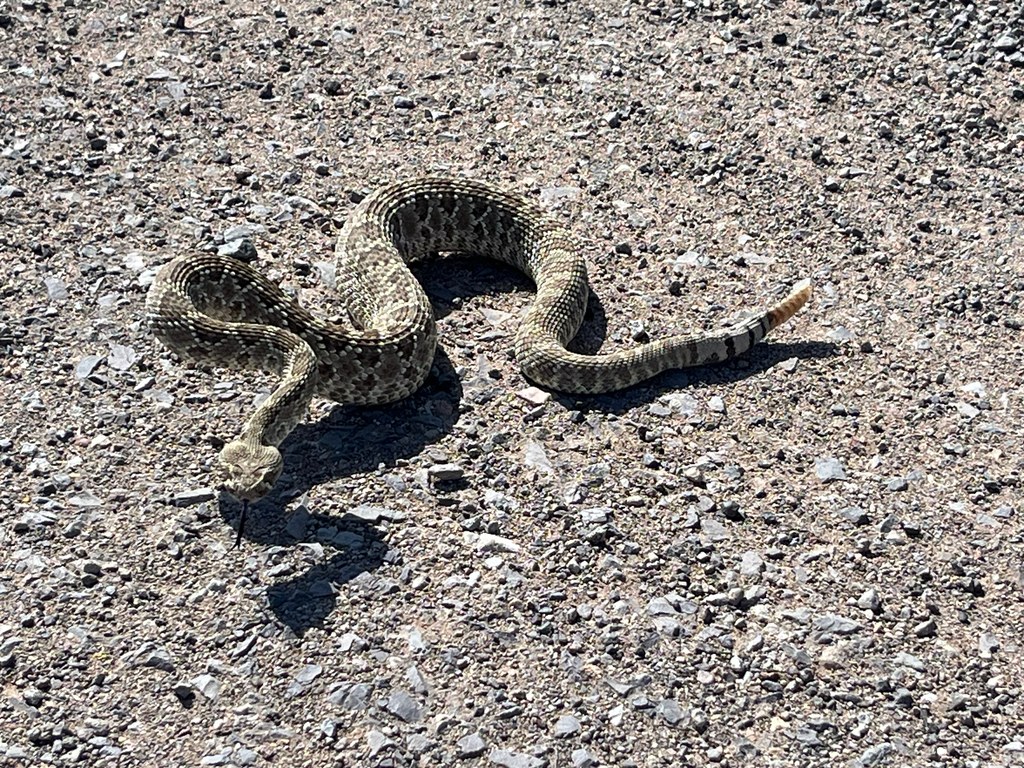
Seasonal Timeline
Mojave rattlesnake is a warm-season desert animal, described by the National Park Service as active from April through September and most active at night and during the cooler hours around dawn and dusk. It spends the cold months dormant underground, typically in rodent burrows. Live young arrive in summer, with births documented in July, August, and September.
Mojave rattlesnake is a warm-season desert animal, described by the National Park Service as active from April through September and most…
Heat sets this snake's calendar, and it sets it in the opposite direction from what most people expect. Through the April to September active season, the National Park Service describes this species as nocturnal to crepuscular, meaning the hours it is out are the hours a desert homeowner is least likely to be looking. Midday in open desert is lethal to a snake, so daytime is spent in shade, under cover, or below ground. When temperatures drop for the year, the animal moves into rodent burrows for winter dormancy and stays there.
The second driver is reproduction, and it puts a bump in the late-season calendar. Live young are born in summer, with documented births in July, August, and September, which means small newly born snakes are moving through the same desert scrub, burrow mouths, and property edges the adults have been using all season. Female Mojave rattlesnakes do not reproduce every year. A peer-reviewed reproductive study found they run a biennial cycle, completing yolk deposition across two separate activity seasons rather than one, so a given female breeds in alternating years rather than annually.
Where They're Found
Mojave rattlesnake is an entirely outdoor, wild desert species. It is not a structural invader in the way a rodent or a bat is, and nothing in its biology gives it a reason to try to get into a building. Its range covers two regions, California and the Southwest.
Published range descriptions converge: southern California, southern and eastern Nevada, extreme southwestern Utah, most of Arizona including the areas around Phoenix and Tucson, southern New Mexico, and parts of west Texas, continuing south through much of mainland Mexico. California's own wildlife agency maintains a dedicated mapped range dataset for the species inside the state, which confirms it as a recognized resident rather than an incidental record. Alaska and Hawaii have no Mojave rattlesnake population. Every published range description, from federal wildlife and park sources and from California's state agency, confines the species to the arid Southwest and to northern and central Mexico. The U.S. Geological Survey publishes a range-map dataset for this species with documented methodology, but the map itself is not available, so the range above rests on agency species descriptions instead.
On a specific property, the habitat cues are desert ones. Desert scrub and open flatland with sparse vegetation, creosote bush, cactus stands, mesquite, and Joshua tree woodland are the documented settings, and rodent burrows supply both shelter and winter dormancy sites. Diet is mostly small rodents including kangaroo rats, plus lizards, birds, and other small vertebrates. That last detail is the practical one. A Mojave rattlesnake near a house is usually there because the rodents are.
Related Pests
Life Cycle
The reproductive detail that matters most here is one this species does not share with a typical once-a-year breeder. Females run a biennial cycle, laying down yolk across two separate activity seasons rather than one, so an individual female produces a litter in alternating years rather than every summer. That is a sourced finding from a peer-reviewed study of this species specifically, not an assumption carried over from other rattlesnakes. The other thread worth following across the stages is the rattle itself. A newborn has only a button and no working rattle, and segments accumulate with each shed, which means the absence of a warning sound tells you very little about whether a snake is present.

Mating
Gestation
Birth
Neonate
Juvenile and Adult
Identification
Start with the pit viper marks
They put the snake in the right family before you argue about species. A heat-sensing facial pit sits between the eye and the nostril, the pupils are vertically elliptical rather than round, and the tail carries a functional rattle in anything past the newborn stage. Copperhead and cottonmouth carry those same family-level traits, with the rattle added here.
Color is a weak starting point
Color is variable enough that it is a weak starting point. Individuals run brown, yellow-brown, gray-green, or in some populations a distinctly pale green, which is where the nickname Mojave green comes from. A row of dark diamond-shaped blotches runs down the back. Because the green cast is a population trait rather than a species-wide one, a snake that is not green is not thereby ruled out, and a snake that is green still has to be checked against the tells below.
Against the western diamondback
The look-alike that matters is the western diamondback rattlesnake. The two species overlap heavily across the Southwest and are the central identification problem in the peer-reviewed literature covering this snake. Unlike most snake look-alike pairs, getting it wrong here has a clinical consequence rather than only an academic one, because the two species' venoms do not behave the same way in a bite.
Tail rings, and their real support
Tail rings are the most repeated tell, and they do have real support. A peer-reviewed identification paper and a detailed herpetological identification reference both describe Mojave rattlesnake's black tail rings as distinctly narrower than the white or light rings, at roughly a one to two ratio, often looking offset, and the ring nearest the rattle is usually white. On a western diamondback, the black and white tail rings sit closer to equal width. That is a real difference, and it is also the single most oversimplified claim about this snake.
The stripe behind the eye
It is the more diagnostic mark. Per the peer-reviewed identification paper, the pale stripe running back from the eye passes above the corner of the mouth and continues past the jawline on a Mojave rattlesnake, while on a western diamondback the same stripe angles downward and meets the mouth in front of the end of the jaw. It is one of the stronger traits in the literature, though it still requires a clear, close look at the head, which is not something to go arrange for yourself.
Scale count, for reference only
Scale count between the eyes, for reference rather than for field use. Mojave rattlesnake typically shows two large scales between the supraoculars, the scales sitting over the eyes, while a western diamondback shows four or more smaller scales in the same place. This is a close-up or magnified observation. It is explicitly not a naked-eye field mark, and no homeowner should be counting scales on a live rattlesnake.
No single trait is reliable on its own
The peer-reviewed paper written specifically to revisit this identification question states directly that reliable identification comes from weighing several traits together, because tail-ring width varies on both species and should not be used alone. The herpetological reference used to cross-check the individual trait descriptions reaches the same conclusion. Experienced observers combine tail pattern, the face stripe, scale counts, and overall coloration and build. Anyone telling you the tail rings settle it by themselves is repeating a simplification the underlying research does not support.
Names you may hear
Mojave green and Mojave green rattlesnake are widely used, including in National Park Service interpretive material, for the greenish color morph common in parts of the range. Mohave rattlesnake, spelled with an h, is an alternate spelling used interchangeably in the medical and toxinology literature. All of these refer to the same species.
Signs of Infestation
Nothing to inspect
The usual inspection checklist does not apply to a snake, because a snake leaves nothing behind to inspect. Mojave rattlesnake builds nothing, chews nothing, and never gets inside a wall or a crawlspace, so a homeowner has no gnaw marks, entry holes, droppings trail, or odor to work backward from. A sighting, or a shed skin, is the evidence, and everything that happens next depends on whether that sighting was read correctly.
The snake, read from a distance
The visual sign is the snake, read cautiously and from a distance. Because the peer-reviewed identification literature recommends weighing several traits together rather than trusting one, a confident call generally is not available at the range and lighting a homeowner actually gets. Shed skins near burrow entrances or basking spots are consistent with general rattlesnake biology, though no published source documents them as a species-specific sign.
Rattling is a warning, not an identification
A disturbed Mojave rattlesnake rattles vigorously. So does every other rattlesnake sharing its range, including the western diamondback it is most often confused with, so the sound tells you to back away rather than telling you which species you are backing away from. It also does not work in reverse, since a newborn has only a button and cannot make the sound at all.
Burrows, debris, and time of day
Look at the burrows, the debris, and the time of day. Rodent burrows, rock piles, woodpiles, and accumulated debris around a structure are the relevant features on a property, because they supply shelter and, in the case of burrows, winter dormancy sites. Encounters skew toward night and toward the cooler hours around dawn and dusk during the April through September active season, which is why a property can hold a snake nobody has seen in daylight.
Repeat sightings usually point at rodents
Diet is mostly small rodents including kangaroo rats, plus lizards, birds, and other small vertebrates. A property producing regular snake sightings is generally a property producing regular rodent activity, which reframes the problem as a food-source question rather than a snake question.
Prevention and When to Call a Pro
Leave it alone and step back
Step back rather than in. This is an outdoor desert animal with no interest in a building and no reason to spend venom on something far too large to eat. Distance ends nearly every encounter. The National Park Service does note that males can be more prone to aggressive chasing behavior during the breeding season, so retreating is worth doing promptly rather than casually, and it is worth doing without turning your back on an animal you have not put distance between yourself and yet.
Never handle one you cannot name
Never handle, move, or kill a snake you cannot confidently name, and with this species that caution has teeth. The peer-reviewed identification literature states plainly that no single trait separates this species from a western diamondback reliably. If the research itself will not commit from a photograph, a homeowner should not commit from a driveway. Killing on sight is discouraged here for a further reason specific to this pair of species: which one delivered a bite changes what an emergency department watches for, and a dead, misidentified snake is worse than no snake at all.
Habitat work aimed at rodents
Habitat modification is the practical, homeowner-doable fix, and it is aimed at the rodents. Because this snake's presence near a structure is generally driven by prey, removing brush piles, woodpiles, and debris from around the foundation, and reducing the rodent population that draws the snake in, takes away both the food source and the shelter at once. Rodent burrows are also the winter dormancy sites, so this work does double duty.
Sealing and fencing, realistically
Sealing and fencing, with realistic expectations. Snake-proof fencing and sealing ground-level gaps around a structure are standard exclusion practice for rattlesnakes generally. No published source gives an exclusion technique specific to this species beyond general rattlesnake practice, and none of it substitutes for the habitat and rodent work above.
What the venom actually does
This is where this snake departs from other rattlesnakes. Mojave toxin is a presynaptic neurotoxin that blocks the release of acetylcholine at the junction between nerve and muscle. That is a different mechanism from the local tissue destruction and clotting disruption documented for copperhead and cottonmouth. A peer-reviewed clinical toxicology paper describes envenomation by this species as tending to produce fewer local effects and more neurological ones, including respiratory difficulty, than a typical rattlesnake bite. In more severe cases the clinical literature describes weakness, tingling, dramatic muscle twitching known as myokymia, and progressive respiratory muscle paralysis requiring intubation and ventilatory support.
Not every one carries the toxin
Not every Mojave rattlesnake carries that toxin, and the variation is geographic and real. A peer-reviewed venom-proteomics study found at least two venom phenotypes in this species. Type A is rich in Mojave toxin and low in hemorrhagic activity. Type B lacks Mojave toxin entirely and is instead rich in the hemorrhagic enzymes and clotting-active components that make a venom behave like a more conventional pit viper's. That study located Type A populations in peripheral parts of the Arizona and New Mexico range it examined, including Graham and Yavapai counties in Arizona and Hidalgo County in New Mexico, and Type B in part of central Arizona, in Pinal County, with intergradation where the two zones meet. Both phenotypes occur within Arizona, so this does not reduce to a tidy state-by-state rule.
Clinical data backs the split
Patient data from a clinical registry backs the split up independently. A peer-reviewed analysis of the North American Snakebite Registry compared outcomes by region. Among California patients, roughly 45 percent of envenomated patients developed neurological effects, specifically tingling and muscle twitching, though notably no respiratory muscle weakness appeared in that particular case series. Among central Arizona patients, none of nine envenomated patients had any neurological toxicity, and systemic effects were prominent instead, with low blood pressure in 44 percent, vomiting in 56 percent, and diarrhea in 33 percent. The two studies line up at the sub-state level rather than the state level, which is the part worth being careful about: the registry's central Arizona patients came from the same area the venom study identified as a Type B zone, and the California patients from populations associated with Type A. That is lab venom chemistry and real patient outcomes agreeing from two entirely different directions. The study's own caveat travels with the finding: the neurotoxicity observed was milder and less consistent than this snake's popular reputation suggests, possibly because antivenom was given promptly.
If someone is bitten
The immediate steps are the same as for any venomous snake bite. Call 911 right away and treat it as an emergency no matter how mild it looks at first. Keep the affected limb at or below heart level and get to emergency care. Federal occupational safety guidance from CDC and NIOSH is the source for that protocol, and it does not change because of which species is involved.
The list of things not to do
All of them still get repeated and none of them help. Do not apply ice. Do not use a tourniquet. Do not cut the wound. Do not try to suck out venom. Do not drink alcohol or caffeinated beverages. Do not take aspirin, ibuprofen, or other NSAIDs, which can increase bleeding risk. Federal occupational safety guidance states each of these plainly.
What to tell the responders
What does change with this species is what you tell the responders. A bite here can produce neurological signs that a purely hemotoxic bite would not, so weakness, tingling, or visible muscle twitching should be reported to emergency responders even when they feel less alarming than pain and swelling. The clinical literature also reports that antivenom, specifically Crotalidae polyvalent immune Fab, has mixed efficacy against the neurotoxic component specifically, compared with its more consistent effect on swelling and clotting problems. That does not change the 911 call or the first aid. It changes what the hospital is watching for, which is a good reason to give them everything you observed.
Dry bites
Dry bites, in which little or no venom is injected, are documented for rattlesnakes generally, and for copperhead and cottonmouth specifically. No published source re-confirms it for Mojave rattlesnake, so treat it as a general possibility rather than a species-specific expectation, and never as a reason to delay emergency care.
Arizona and California differ
The law here is a state question with a numeric answer, and Arizona and California answer it differently. In Arizona, this species is not on the state's no-open-season list, so it falls under the General Reptiles category in the Arizona Game and Fish Department's 2026 to 2030 reptile and amphibian regulations: open season statewide year-round, subject to standard area closures such as municipal parks, certain preserves, and military reservations, with a bag and possession limit of four per year or four in possession, live or dead, per species. A valid Arizona hunting or combination hunting and fishing license is required, reptiles may be taken day or night, and device restrictions apply, including no firearms at night and no artificial light operated from a vehicle or motorized watercraft. In California, Title 14 Section 5.60 of the state code states that no sportfishing license is required for the sport take of rattlesnakes specifically, which is an exception among California reptiles, but species limits still apply: Mojave rattlesnake carries a limit of two per day, and rattlesnakes may be taken year-round at any hour by any method. The red diamond rattlesnake, a different species in the same state, carries a limit of zero. Rattlesnake rules are not interchangeable across species even inside one state. No published source gives a federal protection or interstate reporting requirement for this species in either region, but verify your own state and locality before acting.
When a Bite Is an Emergency, Who to Call
Call 911 immediately for any bite from a snake matching this description, whether or not anyone confirmed the species, and mention any weakness, tingling, or twitching. For a snake you have confidently identified and that is holding a burrow near an occupied building, next to a foundation or crawlspace, or in any part of a yard people and pets cross regularly, the call goes to a licensed nuisance wildlife control operator or to your state wildlife agency. Make the same call for any snake you cannot separate from a western diamondback, because the identification literature itself says a single trait will not settle it, which makes uncertainty a reason to hand the job to someone equipped for it rather than a reason to look closer.
Frequently Asked Questions
Is a Mojave rattlesnake bite worse than a bite from other rattlesnakes?
It can present differently rather than simply being worse. Some populations of this species carry a neurotoxin called Mojave toxin, which can cause muscle weakness, tingling, visible muscle twitching, and in severe cases difficulty breathing, either in addition to or instead of the local swelling and tissue damage typical of other pit vipers. Not every Mojave rattlesnake carries it. Registry data on actual patients also found the neurological effects milder and less consistent than this snake's reputation suggests, possibly because antivenom was given promptly. None of that is a reason to treat a bite as anything less than an emergency.
Do all Mojave rattlesnakes have neurotoxic venom?
No. A peer-reviewed venom-chemistry study identified at least two phenotypes. Type A is rich in Mojave toxin and low in hemorrhagic activity. Type B lacks Mojave toxin and behaves more like a conventional hemotoxic pit viper venom. The study tied each type to particular populations, finding Type A in peripheral parts of the Arizona and New Mexico range it studied and Type B in part of central Arizona, with intergradation where the two zones meet. Both types occur inside Arizona, so it is not a state-by-state rule, and there is no way to tell from looking at a snake which type it carries.
How can I tell a Mojave rattlesnake from a western diamondback?
Not reliably from one feature, and the peer-reviewed identification research says so directly. The most-cited tells are tail-ring width, where the light rings on a Mojave are usually wider than the black ones while a diamondback's are closer to equal, the path of the pale stripe behind the eye, which passes above the mouth on a Mojave and meets it on a diamondback, and the number of scales between the eyes, which is two large ones on a Mojave and four or more smaller ones on a diamondback. Experienced observers weigh several of these together plus overall build and coloring. If you are not certain, that uncertainty is your answer: keep your distance and call someone.
What should I do if I am bitten?
Call 911 and get emergency care immediately. Keep the affected limb at or below heart level. Do not use ice, a tourniquet, cutting, or venom suction, and skip alcohol, caffeine, and NSAIDs such as aspirin and ibuprofen, which can increase bleeding risk. One thing is specific to this species: because neurological symptoms can develop, tell emergency responders about any weakness, tingling, or muscle twitching even if it feels less urgent than the pain and swelling. That detail can shape what they monitor and how they treat you.
Is it legal to kill or capture a Mojave rattlesnake in Arizona or California?
It is regulated rather than simply legal or illegal, and the two states handle it differently. Arizona treats it as a general reptile with a year-round open season, a limit of four per year or four in possession, and a requirement to hold a valid hunting or combination hunting and fishing license, subject to area closures and device restrictions. California requires no sportfishing license for the sport take of rattlesnakes specifically but caps Mojave rattlesnake at two per day, while setting the limit for red diamond rattlesnake at zero, so related species are not treated alike even within one state. Beyond the law, killing on sight is a poor idea here given how easily this species is confused with the western diamondback.
Sources
- Mojave Rattlesnake (Crotalus scutulatus scutulatus) species profile: identification and size U.S. Fish and Wildlife Service
- Mojave Green Rattlesnake: coloration and naming, desert habitat, activity pattern, neonate rattle button, and breeding-season behavior National Park Service, Grand Canyon-Parashant National Monument
- Phenotypic Variation in Mojave Rattlesnake (Crotalus scutulatus) Venom Is Driven by Four Toxin Families: Type A and Type B venom phenotypes and their geographic distribution National Center for Biotechnology Information, PubMed Central
- Geographic variation in the clinical features of Mohave rattlesnake envenomations reported to the North American Snakebite Registry: neurological versus systemic outcomes by region National Center for Biotechnology Information, PubMed Central
- Presynaptic actions of Mojave toxin isolated from Mojave rattlesnake venom: neurotoxic mechanism at the neuromuscular junction National Center for Biotechnology Information, PubMed
- Mojave rattlesnake identification: clinical distinction between neurologic and local envenomation effects National Center for Biotechnology Information, PubMed
- Reproduction in the Mojave rattlesnake, Crotalus scutulatus: litter size, biennial female cycle, and mating and birth timing University of Arizona (Goldberg and Rosen, Texas Journal of Science)
- Venomous Snakes: A Neglected Hazard for Outdoor Workers, national bite first aid and what not to do Centers for Disease Control and Prevention, National Institute for Occupational Safety and Health
- Mojave Rattlesnake Range dataset (CWHR R077), California Wildlife Habitat Relationships system California Department of Fish and Wildlife
- Mohave Rattlesnake (Crotalus scutulatus) range map dataset metadata U.S. Geological Survey
- 2026-2030 Reptile and Amphibian Regulations: General Reptiles bag and possession limits, season, and license requirements Arizona Game and Fish Department
- California Code of Regulations Title 14 Section 5.60: sport take of reptiles and rattlesnake-specific bag limits Cornell Law School Legal Information Institute
Image Credits
- Image: Matthew via iNaturalist. CC BY 4.0.
License.