Seasonal Timeline
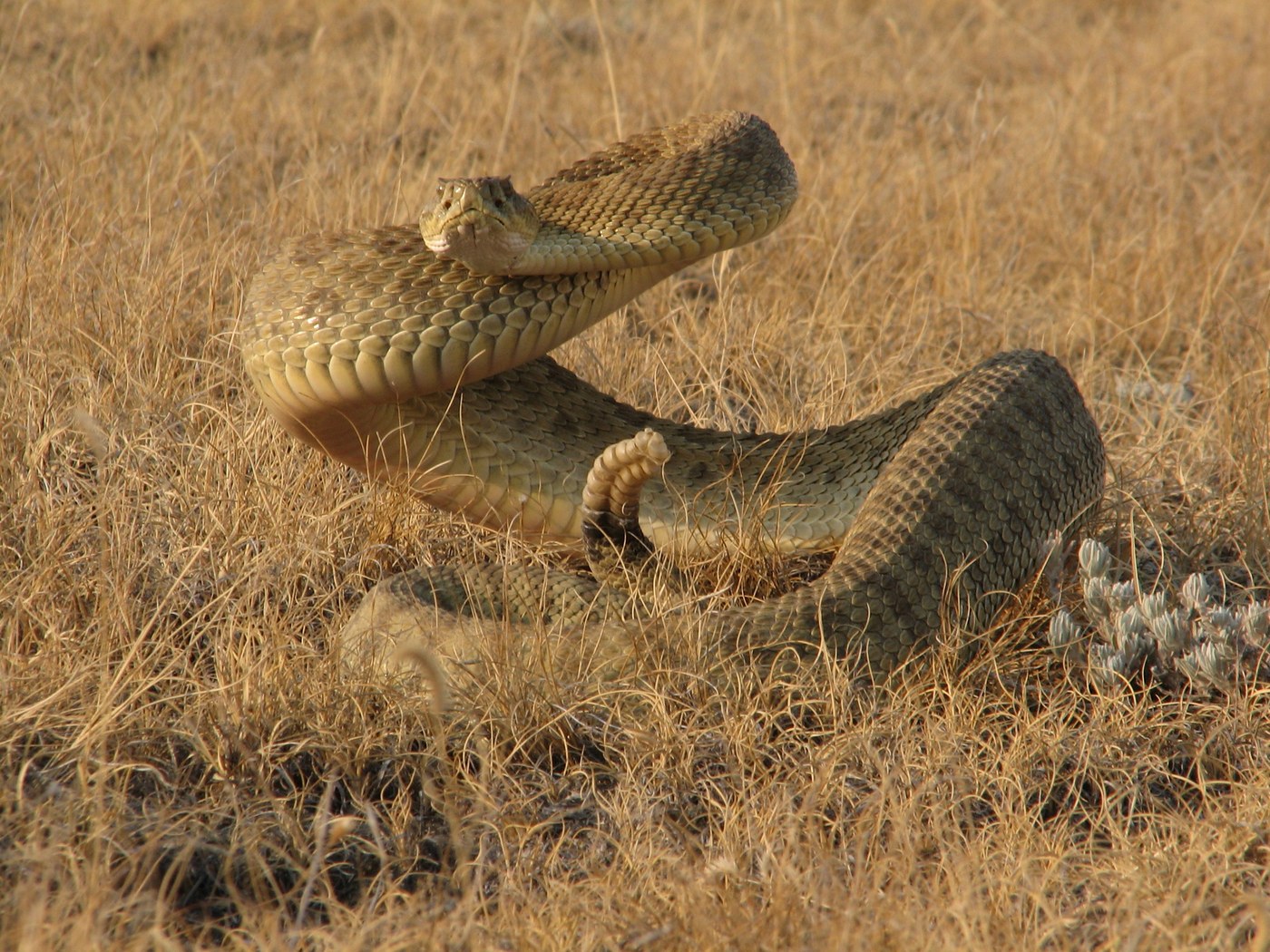
Prairie rattlesnake emerges from winter dormancy in late March or early April and migrates out from its den to hunting territory for the warm months. Live young arrive late in the season, with births documented between late August and early October. Snakes then travel back to the same den before winter, where they spend roughly five to six months dormant.
Prairie rattlesnake emerges from winter dormancy in late March or early April and migrates out from its den to hunting territory for the…
Two things drive this species' calendar, and the second one is what makes it different from other venomous snakes. The first is ordinary temperate rattlesnake seasonality. Colorado material describes the animal becoming active again in late March or early April and calls it a creature of habit, returning to consistent basking, hunting, migration, and denning locations year after year. That habit is the practical detail for a property owner. A snake seen in the same spot two summers running is probably not a coincidence.
The second driver is the den itself. This species overwinters communally rather than alone. A hibernaculum can hold a single animal or hundreds, and dens are frequently shared with other reptile, amphibian, and mammal species rather than only with other prairie rattlesnakes. Snakes migrate out to hunting territory after spring emergence and back to the same den before winter, which means a property near a known den sees predictable spring and fall movement rather than random encounters. Reproduction adds a late-season bump: young are born between late August and early October, so small newly born snakes are moving through the same grassland, burrow mouths, and property edges the adults have used all season.
One question is still open. Whether females of this species reproduce every year or on a multi-year cycle has not been confirmed by a state wildlife agency, federal, or peer-reviewed source.
Where They're Found
Prairie rattlesnake is an entirely outdoor, wild species. It is not a structural invader the way a rodent or a bat is, and nothing in its biology gives it a reason to get into a building.
The US range, state by state. This is a Great Plains and Rocky Mountain foothills animal, and each of the four regions shaded on the map is wider than the snake. Established populations sit in Montana, Wyoming, Colorado, and eastern Idaho in the Mountain West; the Dakotas, Nebraska, Kansas, and western Iowa in the Midwest; New Mexico and the extreme eastern edge of Arizona in the Southwest; and western and central Texas plus central Oklahoma in the South Central region. The snake does not reach the eastern Midwest (Ohio, Indiana, Illinois, Michigan, Wisconsin, Missouri), Nevada or Utah, or Arkansas, Louisiana, Kentucky, and Tennessee, even though the region shading extends over those states.
Federal park material describes this species as holding the largest range of any rattlesnake in the country, running from Canada to Mexico through the Great Plains. The northern edge of that range is the part worth naming, because no other rattlesnake reaches it: the species hits the northern limit of its entire range in southern Alberta and Saskatchewan, concentrated along the breaks and coulees of the South Saskatchewan, Red Deer, Bow, Oldman, and Milk River drainages in southeastern Alberta. Alberta's own government material lists it as a Species of Special Concern under Canada's Species at Risk Act and by the Committee on the Status of Endangered Wildlife in Canada, citing native prairie conversion to cropland, urban expansion near Lethbridge and Medicine Hat, road mortality during migration, and the species' slow maturation and low reproductive rate. Alaska and Hawaii have no prairie rattlesnake population. Every range source confines the species to the Great Plains, the Rocky Mountain foothills, and adjacent grassland and shrubland habitat, and no snake species is native to Hawaii at all.
Habitat breadth is unusually wide. Colorado Parks and Wildlife describes the species as occupying virtually every terrestrial habitat in the state, including grasslands, shrubland, woodlands, and riparian zones, and gives an upper elevational limit between 7,500 and 9,500 feet depending on location, with the animal found throughout most of Colorado except the high mountains. Federal park material describes open grasslands and prairie as the core habitat, with additional use of forested areas, thick prairie grasses, and shaded badlands formations for shelter. On a specific property the cues are crevices, woodpiles, brushy vegetation, rock outcrops, and mammal burrows.
The burrow detail is the one with a real mechanism behind it rather than just an overlap. Both Colorado Parks and Wildlife and federal park material confirm prairie rattlesnakes shelter and hibernate in abandoned prairie dog burrows. Den research on Colorado populations documents why that works: unoccupied prairie dog burrows used as hibernacula extend below the frost line, creating a microclimate that stays above freezing through the five to six month dormancy period. The depth and thermal stability, not merely the availability of a hole in the ground, is what makes the relationship functional. The connection runs both directions, since removing a black-tailed prairie dog colony removes a documented overwintering resource for this snake. No published study quantifies prairie dog decline as a population-level effect on prairie rattlesnake numbers in the United States.
Diet is the other reason a snake turns up near a house. Colorado material lists small mammals, lizards, birds, spadefoot toads, and occasional carrion, taken by ambush or active foraging. Federal park material adds mice, gophers, and prairie dogs specifically and describes hunting by sight, smell, and the heat-sensing facial pits. A prairie rattlesnake near a structure is usually there because the rodents are.
Life Cycle
The life-cycle detail that sets this species apart from other venomous snakes is not reproductive at all. It is the winter. Prairie rattlesnake overwinters communally, in hibernacula that can hold from one animal to hundreds, frequently shared with other reptile, amphibian, and mammal species rather than only with other prairie rattlesnakes. Colorado Parks and Wildlife describes those dens as rodent burrows or crevices in rock outcrops, and den research on Colorado populations documents that the prairie dog burrows used as hibernacula extend below the frost line, holding a microclimate above freezing through a five to six month dormancy. The animals return to the same den year after year. Two gaps remain open: whether females reproduce annually or on a longer cycle, and total lifespan, neither of which has been confirmed by an agency, federal, or peer-reviewed source for this species.

Mating
Gestation
Birth
Neonate
Juvenile and Adult
Identification
Start with the pit viper marks
They settle the family before anyone argues about the species. A heat-sensing pit sits between the eye and the nostril, the pupils are vertically elliptical rather than round, the head is broad and triangular on a narrow neck, the scales are keeled, and a rattle sits on a short, blunt tail. Those are the same family-level traits copperheads, cottonmouths, and Mojave rattlesnakes share.
Roughly 3 to 4 feet
Size runs roughly 3 to 4 feet, and the two state sources agree. Nebraska Game and Parks gives adult length as about 35 to 45 inches. Colorado Parks and Wildlife states that Colorado individuals are rarely greater than 100 cm, which is about 39 inches. Treat 3 to 4 feet as the working adult range.
Color is a weak place to start
Color is variable, so it is a weak place to start. Base color runs light brown, gray, greenish-gray, or dark brown, with a row of darker blotches down the back. Nebraska Game and Parks describes those blotches as darker and more distinct near the head, becoming crossbands that lighten toward the tail.
The bullsnake imitates it
The look-alike that matters here is the bullsnake, and it is a deliberate imitation rather than a coincidence. Bullsnake is a nonvenomous colubrid sharing the same range. Nebraska Game and Parks material describes what it does when threatened: it flattens and raises its head, hisses loudly through its glottis, and vibrates its tail against dry vegetation or loose rock to produce a rattling sound. The result is a close imitation of a rattlesnake's warning display, performed by an animal that cannot hurt you.
Four tells, and the rattle is first
Four real tells separate the two, and the rattle is the first. A bullsnake has no rattle at all. The sound is entirely produced by tail vibration against a substrate, so there is no rattle structure on the tail to find. A prairie rattlesnake's rattle is a physical segmented structure.
The facial pit is the cleanest
The facial pit is the second, and it is the cleanest one. Prairie rattlesnake carries a distinct heat-sensing pit between the eye and the nostril. Bullsnake, not being a pit viper, lacks the feature entirely. If there is no pit, it is not this snake.
Pupil shape and build finish the job
Pupils are vertically elliptical on a prairie rattlesnake and round on a bullsnake. Head shape differs too: bullsnake's head is spearhead-shaped but narrower and more streamlined than the rattlesnake's broad, thick triangle. Bullsnakes also run larger overall, at 40 to 70 inches against the rattlesnake's 35 to 45, though size alone is not a reliable tell at a distance.
Not worth a closer look
None of this is worth arranging a closer look for. Every one of the tells above needs a clear view of a live snake's head or tail, which is exactly the view a homeowner should not be trying to get. If you are close enough to count on the pupil shape, you are closer than you should be.
Names you may hear
Western rattlesnake and Great Plains rattlesnake both refer to this species in general reference sources, though western rattlesnake is also used for a genuinely different species, Crotalus oreganus, which current taxonomy treats as separate. Nebraska Game and Parks material uses prairie rattlesnake as the standard name in state. The scientific name is Crotalus viridis, with subspecies Crotalus viridis viridis across most of the Great Plains range plus C. v. nuntius, the Hopi rattlesnake, in a limited part of it.
Signs of Infestation
Nothing to inspect
The usual inspection checklist does not apply to a snake, because a snake leaves nothing behind to inspect. Prairie rattlesnake builds nothing, chews nothing, and never gets inside a wall or a crawlspace, so there are no gnaw marks, entry holes, droppings trails, or odors to work backward from. A sighting, or a shed skin, is the evidence.
One of three things gets noticed
What a homeowner actually notices is one of three things. The snake itself, a shed skin, or an audible rattle and warning buzz. That is the whole list.
A rattle is a warning, not an ID
Rattling is a warning, not an identification, and it works in neither direction. Every rattlesnake sharing this range rattles when disturbed, so the sound tells you to back away rather than telling you which species you are backing away from. It also does not work in reverse, because a bullsnake vibrating its tail against dry grass produces a convincing imitation of the same sound without being able to envenomate anyone.
Burrows, woodpiles, rock piles
Look at the burrows, the woodpiles, and the rock piles. Presence near a rural or suburban structure traces to shelter features and to prey. Crevices, woodpiles, brushy vegetation, rock outcrops, and mammal burrows, including active or abandoned prairie dog burrows, are the relevant features on a property. None of them is a sign of damage, because there is no damage mechanism here.
Repeats mean rodents and habit
Repeat sightings in the same place point at two things: rodents and habit. Diet is mostly small mammals plus lizards, birds, and spadefoot toads, so a property producing regular snake sightings is generally a property producing regular rodent activity. Colorado material also describes this species as a creature of habit with consistent yearly basking, hunting, migration, and denning locations, which means a snake in the same spot across seasons is a pattern rather than a coincidence.
A cluster in fall or spring
A cluster of snakes in fall or spring means something specific. Because this species overwinters communally, in dens that can hold from one animal to hundreds and are often shared with other reptile and amphibian species, several snakes seen together at a rock outcrop or burrow complex as the weather turns is consistent with a den rather than with an unusual coincidence. That is a call for a professional, not a closer look.
Prevention and When to Call a Pro
Do not handle it
This is a venomous species, so one rule comes before every other: do not handle it. Do not attempt to capture, move, or kill the snake. Keep people and pets away from it. Contact a licensed nuisance wildlife control operator or a pest control professional for removal. Distance ends nearly every encounter, and stepping back rather than in is the entire technique.
The law varies by state
The law is a real constraint here, not a formality, and it varies by state. Trapping, relocating, and even hunting this species is subject to state-specific rules that differ from one state to the next and change over time. Check current state and local wildlife regulations before attempting any of those actions yourself. Where you land after reading them is usually the same place: a licensed nuisance wildlife control operator, rather than a trap you bought yourself.
Colorado, a small game species
Colorado treats this snake as a small game species with numbers attached. Colorado Parks and Wildlife classifies prairie rattlesnake as small game rather than as a protected nongame species. A valid Colorado small game hunting license permits take during a defined season running June 15 through August 15, with a daily bag limit of 3 and a possession limit of 6, by any method not otherwise prohibited by law. Colorado statute separately allows any person to kill a rattlesnake outside that season when necessary to protect life or property.
Kansas takes another approach
Kansas takes a different approach, and it is specific to this species. The Kansas Department of Wildlife and Parks requires a commercial prairie rattlesnake special event permit to take prairie rattlesnakes on a commercial basis, including rattlesnake roundups, and restricts the take method to hand capture, snake hook, or snake-catcher tongs. The notable part is what sits around that permit: no other rattlesnake species may be taken commercially in Kansas at all. The permit exists because prairie rattlesnake, and only prairie rattlesnake, is treated as a commercially harvestable game species in the state.
The history behind that permit
The history behind that Kansas permit, stated at the level the sourcing supports. Prairie rattlesnake was documented as the commercially exploited focal species of an annual rattlesnake roundup at Sharon Springs, Kansas, in a university graduate thesis analyzing roundup harvest samples from 2000 and 2001 against unexploited populations. That work found demographic shifts toward smaller, younger animals and a higher proportion of females in the harvested samples, a pattern consistent with selective removal of larger breeding-age adults. Whether that specific event is currently running has not been confirmed. The permit framework itself is current law.
Habitat work starts with rodents
Habitat modification is the practical, homeowner-doable work, and it starts with the rodents. Because this snake's presence near a structure is generally driven by prey availability, reducing rodent activity and rodent food sources removes the reason it came. That work does double duty, since rodent burrows also serve as shelter and winter dormancy sites.
Clear the cover near the building
Clear the cover close to the building. Woodpiles, dense brush, and rock piles near a structure are documented shelter features for this species. Moving them away from the foundation, or removing them, takes away the places a snake would otherwise use.
Never probe a burrow by hand
Do not investigate a burrow by hand. Active or abandoned burrows near a property, including old rodent burrows and prairie dog burrows, are plausible shelter and hibernation sites. Reaching into one, or digging one out, is the single most avoidable way to put a hand where a rattlesnake is. Note the burrow and leave it alone.
What the venom does
This is where the practical risk lives. Peer-reviewed toxinology work on Crotalus viridis viridis documents a hemorrhagic metalloproteinase toxin, zinc-dependent, of roughly 54,000 daltons and 471 amino acid residues, with a minimum hemorrhagic dose of 0.11 micrograms, responsible for local tissue damage and bleeding. A separate peer-reviewed characterization independently documents myotoxin A, a phospholipase A2 myotoxin from this species' venom that causes localized muscle tissue damage. A more recent comparative venomics study of Colorado populations documents age-related shifts in the relative proportions of those hemorrhagic and myotoxic components as snakes mature, and assessed commercial CroFab antivenom immunoreactivity against the profile.
Hemotoxic, with no neurotoxin
That makes this a hemotoxic and myotoxic venom, with no neurotoxic component, which is a real difference from the Mojave rattlesnake. Expect local tissue damage, bleeding, and muscle-tissue effects. Mojave rattlesnake, a different species, carries a documented neurotoxin called Mojave toxin in some of its populations, which acts on the junction between nerve and muscle and can produce weakness, twitching, and breathing difficulty. Prairie rattlesnake venom does not work that way. National bite first-aid guidance therefore applies to this species without a neurotoxic-symptom caveat attached.
If someone is bitten
The immediate steps are the same ones every venomous snake page here gives. Stay calm. Remove rings and watches before swelling starts. Keep the affected limb at or below heart level. Get to a hospital immediately and treat it as an emergency no matter how mild it looks at first. Federal occupational safety guidance from CDC and NIOSH is the source for that protocol, and it does not change because of which pit viper was involved.
The list of things not to do
All of them still get repeated and none of them help. Do not try to suck out venom. Do not apply a tourniquet. Do not apply ice. Do not cut the wound.
When a Bite Is an Emergency, Who to Call
For any bite, get emergency medical care immediately. For a snake matching this description that is holding ground near an occupied building, next to a foundation, or in a part of a yard people and pets cross regularly, the call goes to a licensed nuisance wildlife control operator, a pest control professional, or your state wildlife agency. Make the same call for several snakes seen together at a rock outcrop or burrow complex as the weather turns, because a communal den is not a do-it-yourself situation. And make the same call for any snake you cannot confidently separate from a bullsnake, since uncertainty is a reason to hand the job to someone equipped for it rather than a reason to get closer.
Frequently Asked Questions
Is a prairie rattlesnake bite always dangerous?
Any bite needs immediate emergency medical care, so treat every one as serious. What the venom does is well documented: it is hemotoxic and myotoxic, producing local tissue damage, bleeding, and muscle injury rather than the nerve effects some other rattlesnakes cause. Peer-reviewed work on this species has characterized both a hemorrhagic metalloproteinase toxin and a phospholipase A2 myotoxin from its venom, and a more recent study documented how the proportions of those components shift as a snake matures. None of that changes the response, which is to get to a hospital right away.
How can I tell a prairie rattlesnake from a bullsnake?
A bullsnake mimics a rattlesnake deliberately. When threatened it flattens and raises its head, hisses loudly, and vibrates its tail against dry ground or loose rock to make a rattling sound. The differences are real but they all require a clear look you should not be arranging. A bullsnake has no true rattle, since the sound comes entirely from tail vibration against a substrate. It has no heat-sensing facial pit between the eye and the nostril, because it is not a pit viper. Its pupils are round rather than vertically elliptical, and its head is narrower and more streamlined than the rattlesnake's broad triangle. Bullsnakes also run larger, at 40 to 70 inches against 35 to 45. If you cannot be sure from a safe distance, treat it as the rattlesnake.
Do prairie rattlesnakes den together?
Yes, and this is one of the more surprising things about the species. Rather than overwintering alone, prairie rattlesnakes den communally in rock crevices and in rodent or prairie dog burrows. A single hibernaculum can hold anywhere from one animal to hundreds, and dens are frequently shared with other reptile, amphibian, and mammal species rather than only with other prairie rattlesnakes. The animals return to the same den year after year, migrating out to hunting territory after spring emergence and back before winter. Several snakes seen together at a rock outcrop or burrow complex in fall or spring is consistent with a den, and that is a situation for a professional.
Do prairie rattlesnakes live in prairie dog burrows?
They regularly use them, and there is a specific reason it works. Both Colorado Parks and Wildlife and federal park material confirm the species shelters and hibernates in abandoned prairie dog burrows. Den research on Colorado populations documents that the burrows used as hibernacula extend below the frost line, holding a microclimate that stays above freezing through the five to six month dormancy period. It is the depth and the thermal stability that matter, not just the presence of a hole. The practical version for a property owner: a prairie dog colony nearby, active or abandoned, is a documented overwintering resource for this snake, and burrows are not something to investigate by hand.
Is it legal to hunt or remove a prairie rattlesnake?
It depends entirely on the state, and Colorado and Kansas handle it very differently. Colorado Parks and Wildlife classifies the species as small game, with a season running June 15 through August 15, a daily bag limit of 3, and a possession limit of 6, under a valid small game hunting license, plus a separate statutory allowance to kill a rattlesnake outside that season when necessary to protect life or property. Kansas instead requires a commercial prairie rattlesnake special event permit for commercial take, restricts the method to hand capture, snake hook, or snake-catcher tongs, and allows no other rattlesnake species to be taken commercially at all. Check current state and local regulations before attempting anything, and given that this is a venomous animal, the safer default is a licensed nuisance wildlife control operator rather than a do-it-yourself removal.
Sources
- Prairie Rattlesnake (Crotalus viridis viridis) species profile U.S. Fish and Wildlife Service
- Prairie Rattlesnake species profile: size, coloration, habitat breadth, elevation limit, hibernation in rodent burrows and rock crevices, diet, spring emergence, and small game classification Colorado Parks and Wildlife
- Prairie Rattlesnakes: range, habitat, breeding season, litter size, age at maturity, communal denning, prairie dog burrow use, and hunting behavior U.S. National Park Service
- Nebraska's Venomous Snakes: adult length, blotch pattern, and the bullsnake mimicry comparison Nebraska Game and Parks Commission, Nebraskaland Magazine
- Snakes of Nebraska: prairie rattlesnake and bullsnake identification and in-state naming Nebraska Game and Parks Commission
- Prairie Rattlesnake species-at-risk material: Canadian range limit in southern Alberta and Saskatchewan, Species of Special Concern status, and documented threats Government of Alberta
- Identification of Winter Dens of Prairie Rattlesnake, research report (Mathies, 2015): communal hibernacula, den fidelity, and below-frost-line prairie dog burrow microclimate Boulder County Parks and Open Space
- Biochemical characterization of a hemorrhagic metalloproteinase toxin from Crotalus viridis viridis venom National Center for Biotechnology Information, PubMed
- Characterization of myotoxin A, a phospholipase A2 myotoxin isolated from prairie rattlesnake venom American Chemical Society, Biochemistry
- Comparative venomics of Colorado prairie rattlesnake populations: ontogenetic shifts in hemorrhagic and myotoxic components and CroFab antivenom immunoreactivity Journal of Proteomics (ScienceDirect)
- Reptiles, Amphibians and Other Species hunting regulations: commercial prairie rattlesnake special event permit, permitted take methods, and the commercial-take restriction on other rattlesnake species Kansas Department of Wildlife and Parks
- Natural History and Status of the Exploited Prairie Rattlesnake (Crotalus viridis) in Western Kansas: graduate thesis analysis of Sharon Springs roundup harvest samples, 2000 to 2001 Fort Hays State University
- Small Game and Waterfowl brochure: prairie rattlesnake season dates, daily bag limit, and possession limit Colorado Parks and Wildlife
- Venomous Snakes: A Neglected Hazard for Outdoor Workers, national bite first aid and what not to do Centers for Disease Control and Prevention, National Institute for Occupational Safety and Health
Image Credits
- Image: Doug Macaulay via iNaturalist. CC BY 4.0.
License.