Seasonal Timeline
Red diamond rattlesnake is most active March through June. In San Diego County, tracked snakes typically came out of overwintering sites in late February, though some stayed put until mid-April, and dens were repopulated in November with no movement recorded at all in December or January. Desert animals in Riverside County run a longer season, early March to late November. Within the day, the snake shifts from daylight activity in spring to dawn and dusk and then fully nocturnal as summer heat arrives.
Red diamond rattlesnake is most active March through June. In San Diego County, tracked snakes typically came out of overwintering sites in…
The best season data comes from radio-tracked animals rather than from a general field guide, and it splits by which side of the mountains you are on. California's own Species of Special Concern account puts general activity between March and June. A radiotelemetry study on a San Diego County reserve found snakes typically emerging from overwintering locations in late February, with some individuals staying inactive until mid-April, most movement happening in late spring and summer, dens repopulated in November, and no movement recorded at all in December or January. Desert animals in Riverside County were active from early March to late November, a noticeably longer window than the coastal population runs.
The mating calendar is where this species separates cleanly from its neighbor, and the finding is peer-reviewed. A radiotelemetry study of the two species living side by side at Chino Hills State Park found red diamond rattlesnake mates only in spring, and a review of the literature across the whole range turned up no published record of reproductive activity outside that spring period. Southern Pacific rattlesnake at the same site runs a bimodal system, mating in spring and again in late summer and fall. The same study found the southern Pacific animals moved 1.9 to 2.8 times farther than the red diamonds. So on shared ground, the snake you are most likely to meet crossing open yard in September is the other one.
The daily schedule shifts with the heat rather than with the calendar. California's older life history account describes the animal active in daylight early in the year, moving later into the evening as daytime temperatures rise, and eventually going fully nocturnal. That is why a property can hold a resident snake nobody has seen in daylight since May.
Where They're Found
Red diamond rattlesnake is an entirely outdoor, wild animal. It is not a structural invader the way a rodent or a bat is, it has no biological reason to be inside a building, and it leaves no damage behind.
The California range is small and it sits in the corner of the state with the most people in it. The state's own Species of Special Concern account places it in southeastern Los Angeles and Orange counties, the Morongo area of southwestern San Bernardino County, western Riverside County, San Diego County, and extreme southwestern Imperial County. The range runs from the Morongo Valley west to the coast and south along the peninsular ranges, and it spills out onto the desert floor from the eastern slope of those ranges. Rainfall across the range runs anywhere from 8 to 80 centimeters a year. Elevation is a genuine disagreement between sources: the state's 1988 life history account gives sea level to 900 meters, about 3,000 feet, the 2016 account gives usually below 1,200 meters, and San Diego's regional monitoring program gives near sea level to about 1,500 meters but usually below 1,200. Below 1,200 meters is the working figure, with the full spread stated rather than averaged.
Outside California the range runs south, not east. It continues down the Baja California peninsula to Cabo San Lucas, plus Islas Cedros and Santa Margarita in the Pacific and Islas Angel de la Guarda, Danzante, Monserrate, Pond, San Jose and San Marcos in the Gulf of California, where Mexico lists it under NOM-059 as subject to Special Protection. Alaska and Hawaii have no red diamond rattlesnakes. No published record places this species in either. Every range description found is confined to southwestern California and the Baja peninsula, which puts Alaska thousands of miles outside the northern end of the range, and Hawaii has no native snake of any kind.
On the ground, two habitat features predict this species better than anything else, and one of them is a surprise. The expected one is rock. On a San Diego County reserve, tracked snakes were associated with rock outcrops 57 percent of the time and with shrubby vegetated habitat without rocks 28 percent of the time, and Klauber's road surveys found 44 percent of animals near heavy shrub and chaparral against 21 percent near rocks and boulders. The unexpected one is cactus. At a Chino Hills State Park site that lacked large rocks, the single preferred habitat was prickly pear cactus patches, followed by chaparral, with several individuals spending most of the year inside one patch and none of the tracked snakes using oak woodland at all. The broader habitat list is coastal sage scrub, chamise chaparral, redshank, desert slope scrub, desert washes, grassy fields, orchards, cactus patches and rocky areas. This snake also climbs: there are several accounts of it in bushes and trees up to 2 meters off the ground, and of it swimming in reservoirs.
Where it spends the winter depends on whether there is rock to spend it in. Dens are in rock crevices, animal burrows, or under shrubs and cacti. In the San Diego County study, 7 of 11 radio-tracked snakes overwintered communally in crevices among granite boulders with up to 7 other snakes, and most reused those dens across multiple years. At a site where large rocks were rare, animals overwintered singly under prickly pear, showed no consistent site fidelity, and moved farther from their overwintering spots after emergence. That variability matters, because it means this species is not universally tied to a single irreplaceable den the way the more northern rattlesnakes are.
Home range is small on the coast and large in the desert. On the San Diego County reserve, average home range was 2.8 hectares for males and 0.9 hectares for females. At Chino Hills, male ranges ran 0.3 to 4.5 hectares. In the Riverside County desert the same measurements came out at 25.7 hectares for males and 5.9 hectares for females. Resident coastal snakes are described as having relatively restricted movements for a rattlesnake of this size, typically never occurring more than 300 meters in a straight line from their winter dens. For a homeowner that is the useful number: if you are seeing this species, the den is probably closer than you think.
Diet explains most repeat sightings. The primary dietary study examined 272 individual snakes across the full range and recorded 227 prey items from 219 of them, finding the diet was 91.6 percent mammals, 7.5 percent lizards and 0.9 percent birds. There was no shift in prey type with age, mammals being taken by every size class, though adults took larger prey than juveniles and coastal snakes averaged longer and ate a higher proportion of rodents than desert snakes. Wood rats are reported as the most abundant single prey item, followed by kangaroo rats, pocket mice and deer mice, with rabbits and ground squirrels also taken. The presence of prey was independent of the month a snake was collected, which points to year-round feeding, backed by direct observations of occasional winter feeding in California. A property producing regular sightings is generally a property producing regular rodent and wood rat activity.
One last thing about where it is not. Radiotelemetry found this species avoids human development, and in one study an adult male actively avoided a road edge, with turning movements away from that edge detectable up to 50 meters out. Roughly 20 percent of historical sites in California are estimated extirpated, coastal populations are the most reduced, particularly in southern San Diego County, and pitfall surveys have failed to find animals at localities where Klauber once recorded them as common. This is a snake with a shrinking address list, which is the reason for its legal status.
Related Pests
Life Cycle
The life-cycle detail that actually distinguishes this animal is the mating calendar, and it only shows up when you study it next to its neighbor. A radiotelemetry study at Chino Hills State Park tracked red diamond and southern Pacific rattlesnakes on the same ground and found the red diamonds mated exclusively in spring, with a range-wide literature review turning up no published record of reproductive activity outside that period, while the southern Pacific animals ran a bimodal spring and fall system. The same work found the southern Pacific snakes moved 1.9 to 2.8 times farther during the active season. Two species, one hillside, two genuinely different calendars.
Three numbers here should be read as ranges rather than settled figures, and the reason is stated rather than hidden. Litter size: mean of about 8 across every source, but a range given variously as 3 to 20, 5 to 13, or 4 to 8 depending on whether the count came from litters, from an older account, or from ovarian follicles. Gestation: 141 to 173 days from three captive animals, or 141 to 190 days averaging 165 in a broader summary. Elevation: 900 meters, usually below 1,200 meters, or to about 1,500 meters but usually below 1,200, depending on which account you read. Each is stated with its spread.
Reproduction here is probably not annual, and that is a conservation fact rather than a trivia one. An examination of 43 specimens found only 7 of 15 females showing evidence of reproductive activity, which points at a roughly every-other-year cycle. Put that next to an estimated 20 percent of historical California sites already extirpated and a range confined to the most heavily developed corner of the state, and the state's decision to set the take limit at zero stops looking like an oddity.

Mating
Gestation
Birth
Neonate
Juvenile and Adult
Identification
Start with the pit viper marks
They settle the family before anyone argues about the species. A heat-sensing pit sits between the eye and the nostril on each side, the pupils are elliptical rather than round, the head is large and triangular on a thin neck, the dorsal scales are keeled, and a segmented rattle sits on the tail. Those are the same family-level traits shared by copperheads, cottonmouths, and the Mojave, prairie, western diamondback, southern Pacific and northern Pacific rattlesnakes. Stopping at the family level and backing away is a complete and correct outcome.
Three marks, working together
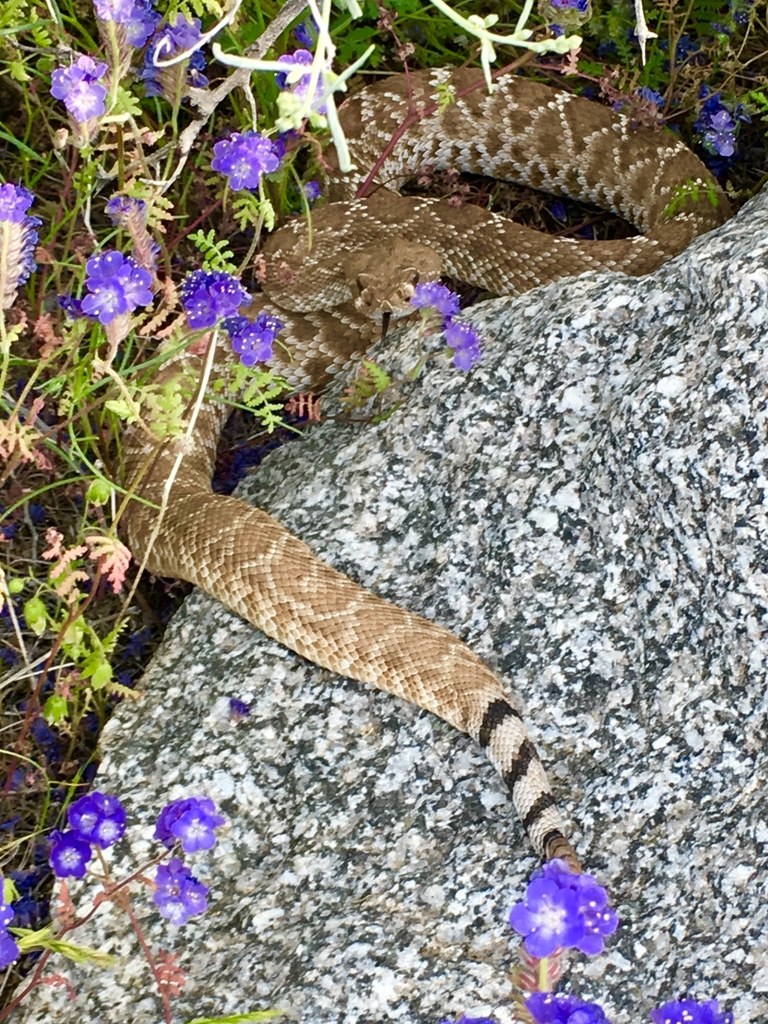
Three marks identify this species, and they work best together. First, the ground color is tan, brick-red, reddish or pinkish-brown, which is what the common name refers to and the fastest read at distance. Second, an average of 35 light-edged diamonds run down the back, reported across sources as anywhere from 20 to 42 and typically 33 to 35. Third, the tail is ringed with alternating bands of black and white or gray before the rattle, with the rings similar in width or the white ones slightly wider, and the ring next to the rattle usually black. Supporting marks are two light stripes on the sides of the head, a light unmarked belly, and 29 keeled scale rows.
Size matters again at the bite
Size is part of the identification, and it matters again when it comes to the bite. California's own account describes a large, heavy-bodied rattlesnake at 165 centimeters total length. Adults typically run 2 to 4.5 feet, the maximum recorded is 68.3 inches, and unconfirmed reports go higher. Males are notably larger than females. This is one of the largest rattlesnakes in California, which is the single most important thing to know about its bite.
Against southern Pacific rattlesnake
The look-alike that matters is the southern Pacific rattlesnake, and the two really do share ground. A radiotelemetry study describes the two species as broadly sympatric across large portions of southern California and northern Baja, and California's own 1988 life history account notes the western rattlesnake is sympatric with red diamond in coastal areas and the two may compete. This is not a theoretical overlap. A federal and state herpetofaunal monitoring report for the San Diego preserve region went as far as recommending that public educational materials in San Diego open space specifically show residents how to tell the southern Pacific rattlesnake from the red diamond rattlesnake, because both are widespread in the region and both prefer using trails.
All three marks point one way
Here is that comparison, and all three marks point the same way. Color: red diamond is reddish, rust or pinkish; southern Pacific runs gray, brown or olive. Pattern shape: red diamond carries roughly 35 light-edged diamonds; southern Pacific carries large dark brown or blackish irregular blotches that turn into crossbands toward the tail. Tail: red diamond's rings are crisp, high-contrast black and white of roughly equal width; southern Pacific's tail bars and rings are duller and lower contrast. If two of the three read red diamond, treat it as red diamond, and remember that either way you are looking at a venomous snake.
The tail will not separate them
Western diamond-backed rattlesnake is the textbook look-alike, and the tail is useless for separating them. Both carry the black and white banded tail, so that mark works against southern Pacific rattlesnake and not against this one. California's own account says neonates of the two species look similar and that adults are separated by coloration and behavior, red diamond being much redder and less aggressive, adding that in California the ranges of the two barely meet. Western diamond-backed does not typically show a red color phase, and red diamond has divided first infralabial scales where western diamond-backed usually does not. In practice this confusion is close to theoretical inside California: the state calls western diamond-backed rare here and confines it to the far southeastern desert, and its occurrence in San Diego County is unconfirmed, resting on two questionable museum records from 1931 and an unlocatable place name, with no confirmed county records in the public observation databases.
Speckled rattlesnake can be pink too
Southwestern speckled rattlesnake deserves a mention because it can also be pink. San Diego's natural history museum lists it as one of the county's rattlesnakes alongside western, red diamond and sidewinder, and its color range genuinely includes pinkish and pale orange phases, which makes a reddish rattlesnake ambiguous. The tell is pattern texture rather than color: speckled rattlesnake carries a vague, dark, speckled banded pattern that blends into local rock, not a row of roughly 35 light-edged diamonds.
Not worth a closer look
None of this is worth arranging a closer look for. Every mark above needs a clear view of a live snake's body, head or tail, which is exactly the view a homeowner should not be trying to get. Treat an unresolved snake as venomous and back away.
A live scientific disagreement
Names, and a scientific disagreement that is still live. Red rattlesnake and red diamond rattler appear in the older literature, and regional conservation agencies use northern red-diamond rattlesnake for the United States population, reflecting the historical subspecies name. On the scientific name, a 1995 analysis of morphology and mitochondrial DNA proposed merging this animal with the Cedros Island diamond rattlesnake Crotalus exsul, and because that name was published first, proposed renaming this species. The proposal was opposed in favor of nomenclatural stability and settled by the international commission in 2000, so California's wildlife agency uses Crotalus ruber for all California animals. Some taxonomists still write Crotalus exsul ruber. The older split into a northern C. r. ruber and a Cape C. r. lucasensis is described as tenuously supported and possibly better treated as pattern classes than subspecies.
Signs of Infestation
Nothing to inspect
The usual inspection checklist does not apply here, because this animal leaves nothing behind to inspect. Red diamond rattlesnake builds nothing, chews nothing, and never gets inside a wall or a crawlspace to live. There are no gnaw marks, entry holes, dropping trails or odors to work backward from, and no published account documents any structural or landscape damage mechanism at all. A sighting, or a shed skin, is the evidence.
One of three things gets noticed
What a homeowner actually notices is one of three things. The snake itself, a shed skin, or an audible rattle. The rattle is the least reliable of the three, because rattlesnakes often choose stillness and camouflage over sound, and because a harmless gopher snake vibrating its tail against dry ground makes a convincing imitation of it.
The rock, then the cactus
Look at the rock, and then look at the cactus. On a San Diego County reserve, tracked snakes were associated with rock outcrops 57 percent of the time. At a Chino Hills site with no large rocks, the preferred habitat was prickly pear cactus patches, with several individuals spending most of the year inside a single patch. Granite boulder clusters and a stand of prickly pear are the two features on a southern California property that most reliably predict this species, and the cactus half is the part every generic snake page leaves out.
It did not dig the burrows
Look at the burrows, because the snake did not dig them. Dens and daytime cover are rock crevices, rodent and wood rat burrows, and the base of shrubs and cacti. An abandoned burrow is still shelter.
Repeats point at wood rats
Repeat sightings point at rodents, and specifically at wood rats. Roughly 92 percent of this species' prey items are mammals, with wood rats reported as the most abundant single item, followed by kangaroo rats, pocket mice and deer mice, plus rabbits and ground squirrels. Lizards make up 8 percent and birds 1 percent. A property producing regular snake sightings is generally a property producing regular rodent activity, which reframes the problem as a food-source question rather than a snake question.
Distance from a boulder field
Location on the lot tells you a lot, and so does distance from a boulder field. Resident coastal snakes in the San Diego study typically never occurred more than 300 meters in a straight line from their winter dens. A property that backs onto a preserve, a canyon, an undeveloped hillside or a rocky slope in San Diego, western Riverside or Orange County is in a genuinely different exposure category than a flat inland lot, and the sightings tend to cluster along that boundary rather than scatter across the yard.
It does not push into developed ground
What you will not find is this snake pushing into developed ground. Radiotelemetry found the species avoids human development, and in one study an adult male avoided a road edge closely enough that its turning movements away from the road were detectable up to 50 meters out. That is worth knowing in both directions: it means a sighting near the house is usually a snake passing along an edge, not a snake moving in.
Prevention and When to Call a Pro
Do not handle it, or kill it
This is a venomous species and it is also a protected one, so the first rule is doubled: do not handle it, and on this species do not kill it either. California Code of Regulations Title 14 section 5.60 sets the bag and possession limit for red diamond rattlesnake at zero, against a limit of two for western diamond-backed, Mohave, western, speckled, sidewinder and Panamint rattlesnakes. University of California's own rattlesnake guidance states it independently and in plain words: California residents can take most rattlesnake species on private land in any legal manner without a license or permit subject to a bag limit of two, and additionally the red diamond rattlesnake is prohibited from being taken or killed by state wildlife regulation. That is the opposite of the rule for the southern Pacific rattlesnake, where a property owner may legally kill a rattlesnake on their own property. On this species, the killing is the prohibited act.
Handling is how people get bitten
Attempting it is also one of the most common ways to get bitten. University of California's guidance reports that more than half of venomous snakebites in the United States happen because a person was bothering, handling or harassing the snake, and that roughly half of snakebite patients report drinking alcohol beforehand. The same guidance notes that if left alone, a snake is likely to move on to another area on its own.
Three conservation designations
This species also carries three separate conservation designations, which is why the take rule exists. It is a California Species of Special Concern at Priority 3, scoring 48 of a possible 110 on the state's risk-factor ranking, and it held that designation in the previous evaluation as well. It is a Covered Species on the state's Western Riverside County habitat conservation plan species list. It is a monitored species in the San Diego preserve region, where agency herpetofaunal monitoring detected it at 8 study sites and named it among the sensitive species whose long-term viability depends on habitat linkage. Mexico separately lists it as subject to Special Protection. It is not federally listed, and older monitoring literature calling it a federal species of concern is referring to an informal, non-regulatory category rather than a listing.
Start with the rodents
Start prevention with the rodents, because that is what the snake came for. With roughly 92 percent of the diet being mammals, reducing wood rat, ground squirrel, kangaroo rat and mouse populations and the food sources supporting them removes the reason the snake is there. Then do the step people skip: fill in the abandoned burrows with soil or sod and pack them down firmly, since an empty burrow is still shelter.
Then take away the right cover
Then take away the cover, and know which cover matters for this species specifically. Clear heavy brush, tall grass, rock piles, boulder clusters, logs and lumber piles back from the foundation, walkways and play areas. Two features are unusually predictive here rather than generic: rock outcrops and boulder clusters, and prickly pear cactus patches. A cactus stand up against the house is doing more work as snake habitat on this species than a woodpile is.
Seal gaps over a quarter inch
Seal openings larger than a quarter inch. University of California's guidance gives a quarter inch as the exclusion threshold for beneath buildings, basements, garages and equipment enclosures, and specifically calls out the gap beneath a garage door and breaks or gaps in crawlspace access doors. Ground-level cracks in foundations and exterior walls count too.
Fencing works if details are right
Snake-proof fencing works if the details are right. Quarter-inch mesh or a solid barrier, three feet high, buried a few inches, angled outward at the base, with tight-fitting gates and all vegetation cleared from the perimeter and off the fence itself, because a snake will climb accumulated vegetation to get over the top. The gates and the vegetation matter more than the height does.
Repellents do not work
Both a university program and a natural history museum say so independently. University of California's guidance states that mothballs, sulfur dust, horsehair rope and the folk remedies generally do not work, that no plants repel snakes, and that no commercially available chemical snake repellent has been shown to work well enough to recommend. San Diego's natural history museum makes the same point from the other direction, noting that no repellent exists that would not also harm children, pets and wildlife, and recommending reducing rodents and removing hiding spots instead.
Do not relocate it yourself
Do not relocate the snake yourself, and this is the rare species where there is actual research behind that rather than a general rule. Two radiotelemetry studies have been run on translocated red diamond rattlesnakes in southern California. The first tracked 11 resident and 6 relocated snakes over 11,090 and 3,858 radio-days at a protected San Diego County site, and found relocated snakes used significantly more land, a mean activity range of 5.86 hectares, and moved farther in their first year, with short-distance relocates moved 97 to 314 meters turning up back near their original capture site while long-distance relocates moved 856 to 1,090 meters did not. Critically, there was no detectable difference in survivorship between residents and relocates. A 2022 peer-reviewed study of 30 snakes near a residential development found the same shape: every additional meter of translocation distance cut the risk of returning to the original conflict site by 1.6 percent and the risk of moving back into a human-modified area by 1.2 percent, with no detected effect on body mass change or survival.
What those two studies mean
The practical reading of those two studies. Relocation, done at the right distance, appears to be a genuinely viable option for this species, which is not true of every rattlesnake. The authors of the 2022 work suggest the difference is that low-elevation southern California snakes do not depend on specific communal overwintering sites the way colder-climate rattlesnakes do. Both teams urge caution about generalizing, and the first study's own top recommendation was more public education so that fewer snakes need moving at all. None of that makes it a homeowner job. It makes it a job for a permitted operator who knows the distance is the variable that decides the outcome.
When a Bite Is an Emergency, Who to Call
For any snake matching this description holding ground near an occupied building, next to a foundation, or in a part of the yard people and pets cross regularly, the call goes to a licensed nuisance wildlife control operator, a pest control professional experienced with snake removal, or the state wildlife agency. Because state regulation prohibits killing this species and because relocation distance measurably changes the outcome, the do-it-yourself options here are either illegal or documented to fail. Make the same call for any snake you cannot confidently separate from a southern Pacific rattlesnake or a gopher snake. Verify your own city and county rules as well, since local ordinances sit on top of state law and a property inside a habitat conservation plan area may carry extra requirements.
What the venom does
The calm reputation does not change the answer. This snake is widely described as having a mild disposition and one of the least potent rattlesnake venoms. The disposition half is genuinely documented: California's own Species of Special Concern account describes it as much redder and less aggressive than western diamond-backed rattlesnake, and a university museum account summarizing the primary herpetological literature reports a generally peaceful disposition, rarely aggressive, with many animals staying quiet or hiding the head rather than rattling. The same account is equally clear that a provoked or cornered animal will coil, rattle and strike. What the popular version adds on top, that it hardly ever rattles, seldom strikes even when cornered, and has unusually mild venom, is not supported at that strength by any authoritative source.
The clinical evidence
It is where the reputation stops being reassuring. Two published analyses of southern California snakebite admissions each found, on their own data, that bite severity tracks the size of the snake rather than the species. A review of 145 charts from 1995 to 2004 found severity scores rising with snake size while species had no statistically significant effect on overall severity; species did differ on the local wound component specifically, where sidewinder produced the greatest local wound severity and red diamond rattlesnake the least. A larger review of 354 cases admitted to the same academic hospital between 1990 and 2010, a window that contains the earlier study's, reached the same conclusion: severity was positively associated with snake size, negatively associated with patient mass, and independent of snake species, and the standard antivenom was found clinically effective for all southern California species. Because the later study's patient pool overlaps the earlier one's, these are two analyses rather than two separate samples, and the case counts should not be added together. What matters is that both landed on size rather than species. Red diamond rattlesnake is one of the largest rattlesnakes in California. A milder venom delivered by a much larger snake is not a milder bite.
The venom yield number
It closes the argument. A study of seven rattlesnake species from the Baja California region measured venom yield, protein content, lethal toxicity, Mojave toxin content and hemorrhagic activity, and found venom yield was highest of all seven species in this one. That same study found only speckled rattlesnake among the seven carried a toxin antigenically related to Mojave toxin, and it was the only one lacking hemorrhagic activity, which means red diamond venom in that sample was hemorrhagic and not the Mojave-toxin type. On the mechanism, three hemorrhagic toxins with proteolytic activity have been isolated from this species' venom; all three are metalloproteins, all three degrade fibrinogen, and all three raised creatine kinase in mice, indicating muscle damage confirmed on histology. Proteolytic activity of the crude venom is 6 to 15 times greater in adults than in juveniles. Documented clinical effects include swelling, pain, discoloration, hemorrhagic blebs, nausea, coagulopathy, bleeding, hemolysis and necrosis. This species accounts for about 5.9 percent of rattlesnake bites in southern California.
One quoted number needs a caveat
One number people quote that deserves a caveat. A widely repeated figure holds that 25 to 50 percent of rattlesnake bites are dry, with no venom injected. In the 145-patient southern California hospital series, only one patient with a credible rattlesnake bite scored zero on the severity scale, putting dry bites under 1 percent of that population. Those two figures measure different things, all bites against bites that reached a hospital, but a homeowner who has heard the 25 to 50 percent number should know the hospital figure exists. Treat every bite as envenomated until a clinician says otherwise.
If someone is bitten
The protocol is the same as for any venomous snake bite. Stay calm and act quickly. Remove rings, watches and anything else constricting before swelling starts. Keep the affected limb in a neutral position at or below heart level. Transport to the nearest medical facility immediately and treat it as an emergency no matter how mild it looks in the first minutes. Poison control is reachable at 1-800-222-1222 anywhere in the United States. A dog or other animal bitten by a rattlesnake needs a veterinarian immediately.
The list of things not to do
All of them still get repeated and none of them help. Do not apply a tourniquet. Do not pack the bite in ice. Do not cut the wound. Do not use your mouth to suck out venom.
Frequently Asked Questions
Is it legal to kill a red diamond rattlesnake in California?
No, and this is the one California rattlesnake where that is true. California Code of Regulations Title 14 section 5.60 sets the bag and possession limit for red diamond rattlesnake at zero, against a limit of two for western diamond-backed, Mohave, western, speckled, sidewinder and Panamint rattlesnakes. University of California's rattlesnake guidance states the same thing independently: residents can take most rattlesnake species on private land in any legal manner without a license or permit subject to a bag limit of two, and additionally the red diamond rattlesnake is prohibited from being taken or killed by state wildlife regulation. It is also a California Species of Special Concern at Priority 3 and a Covered Species on the state's Western Riverside County habitat conservation plan list. If you have this snake on your property, the call goes to a licensed wildlife control operator or the state wildlife agency, not to a shovel. Check your city and county rules too, since local ordinances sit on top of state law.
How do I tell a red diamond rattlesnake from a southern Pacific rattlesnake?
Three marks, and you want at least two of them. Color: red diamond is reddish, rust or pinkish-brown; southern Pacific is gray, brown or olive. Pattern: red diamond carries an average of about 35 light-edged diamonds down the back; southern Pacific carries large dark irregular blotches that become crossbands near the tail. Tail: red diamond has crisp, high-contrast black and white rings of roughly equal width just before the rattle; southern Pacific's tail bands are duller and lower contrast. The two species genuinely share ground across coastal southern California, which is why a federal and state monitoring report for the San Diego preserve region specifically recommended that public materials in open space show residents how to tell them apart. Either way you are looking at a venomous snake, so make the identification from a distance or not at all.
Is the red diamond rattlesnake really calmer and less dangerous than other rattlesnakes?
The calm part is genuinely documented. California's own species account describes it as much redder and less aggressive than the western diamond-backed rattlesnake, and a university museum account summarizing the primary herpetological literature reports a generally peaceful disposition, rarely aggressive, with many animals staying quiet rather than rattling. The same account is equally clear that a cornered animal will coil, rattle and strike. The stronger popular version, that it hardly ever rattles and seldom strikes even when cornered, is not supported at that strength by any authoritative source. And the safety conclusion does not follow at all. Two published analyses of southern California snakebite admissions, the later covering 354 cases from 1990 to 2010 at the same hospital as the earlier 145-chart study, each found bite severity tracks the size of the snake rather than the species, and this is one of the largest rattlesnakes in California. A study of seven Baja California rattlesnake species measured the highest venom yield of all seven in this one. Treat any bite as a medical emergency.
Should I have a rattlesnake relocated off my property?
For this species there is actual research instead of guesswork, and the distance is the variable. Two radiotelemetry studies in southern California tracked translocated red diamond rattlesnakes. Snakes moved short distances, roughly 100 to 300 meters, tended to turn up back near where they started; snakes moved farther generally did not. In the 2022 study, every additional meter of translocation distance cut the risk of returning to the original conflict site by 1.6 percent. Neither study found translocated snakes died at a higher rate than untouched residents, which is unusual, and the authors suggest it is because low-elevation southern California snakes do not depend on specific communal winter dens the way colder-climate rattlesnakes do. So relocation is a real option for this species. It is still a job for a permitted professional, both because the distance decides the outcome and because state regulation protects the animal. The first study's own leading recommendation was more public education so that fewer snakes need moving in the first place.
Why do rattlesnakes keep showing up in the same part of my yard?
Because of what is in that part of the yard. Roughly 92 percent of this species' prey items are mammals, with wood rats the most abundant single item, followed by kangaroo rats, pocket mice and deer mice, plus rabbits and ground squirrels. So rodent activity is usually the driver. Beyond food, two habitat features predict this snake better than anything else: rock outcrops and boulder clusters, which accounted for 57 percent of located snakes on one San Diego County reserve, and prickly pear cactus patches, which were the single preferred habitat at a study site without large rocks, with individuals sometimes spending most of a year inside one patch. Reduce the rodents, fill the abandoned burrows and pack them down, and pull the rock, brush and cactus back from the house.
When are red diamond rattlesnakes active, and when should I be careful in the yard?
March through June is the peak. In San Diego County, tracked snakes typically emerged from overwintering sites in late February, though some individuals stayed inactive until mid-April. Most movement happened in late spring and summer, dens were repopulated in November, and no movement at all was recorded in December or January. Desert animals in Riverside County run longer, early March to late November. Within a day, the animal shifts from daytime activity in spring to dawn and dusk and then fully nocturnal as summer heat arrives, which is why a property can hold a resident snake nobody has seen in daylight since spring. Mating is a spring-only event for this species, unlike the southern Pacific rattlesnake, which also mates in late summer and fall.
Sources
- Red Diamond Rattlesnake, Crotalus ruber Cope 1892, in California Amphibian and Reptile Species of Special Concern (Thomson, Wright and Shaffer 2016): Priority 3 designation and 48 of 110 score, the 165 cm size and reddish coloration, the average of 35 light-edged diamonds, the black and white tail banding and head stripes, the western diamond-backed comparison and the much-redder-and-less-aggressive wording, the Crotalus exsul taxonomy dispute, activity and denning, home range by region, mating February to May, gestation, litter size and neonate size, the 92 percent mammal diet, rock outcrop and prickly pear habitat findings, county distribution and elevation, the 20 percent extirpation estimate, and the road-edge avoidance finding California Department of Fish and Wildlife
- Red Diamond Rattlesnake life history account R073, California Wildlife Habitat Relationships System: county distribution, sea level to 900 meters, habitats, diet, cover, the shift from diurnal to fully nocturnal with rising heat, copulation in March and April, birth mid-August to October, litters averaging 8 and ranging 5 to 13, and the note that the western rattlesnake is sympatric with this species in coastal areas California Department of Fish and Wildlife, California Interagency Wildlife Task Group
- Rattlesnake species page: California's seven rattlesnake species, the statement that red diamond rattlesnake is a Species of Special Concern, western diamond-backed rattlesnake described as rare in California, and rattlesnake bite first aid including what not to do California Department of Fish and Wildlife
- Pest Notes: Rattlesnakes, Publication 74119: the statement that the red diamond rattlesnake is prohibited from being taken or killed by state wildlife regulation, the two-snake bag limit for other species, the harassment and alcohol snakebite findings, quarter-inch exclusion threshold, snake-proof fencing specification, burrow filling, and repellent ineffectiveness University of California Statewide Integrated Pest Management Program (UC IPM), UC Agriculture and Natural Resources
- California Code of Regulations Title 14 Section 5.60, Reptiles: no sportfishing license required for sport take of any rattlesnake, a bag and possession limit of two for the other listed rattlesnakes, and a limit of zero for red diamond rattlesnake Cornell Law School Legal Information Institute
- Western Riverside MSHCP Covered Species List, April 2023: red-diamond rattlesnake Crotalus ruber listed by name and binomial as a Covered Species California Department of Fish and Wildlife
- Herpetofaunal Monitoring in the MSCP Region of San Diego (Rochester, Hathaway, Brown, Pease and Fisher): red diamond rattlesnake detections at 8 study sites, its inclusion among sensitive species dependent on habitat linkage, and the recommendation that public educational materials show how to differentiate the southern Pacific rattlesnake from the red diamond rattlesnake U.S. Geological Survey, hosted by the California Department of Fish and Wildlife
- Crotalus ruber, Red Diamond Rattlesnake, Amphibian and Reptile Atlas of Peninsular California: full range from southern Los Angeles and San Bernardino counties to Cabo San Lucas, the Pacific and Gulf of California island populations, listed similar species, California Species of Special Concern status, and Mexico NOM-059 Special Protection San Diego Natural History Museum
- FAQs on Rattlesnakes: the rattlesnake species present in San Diego County, general rattlesnake identification, the position that no safe repellent exists, and the recommendation to reduce rodents and remove hiding spots San Diego Natural History Museum
- Crotalus ruber species account: dorsal diamond counts of 20 to 42 typically 33 to 35, island dwarfism and mainland size, captive longevity, gestation of 141 to 190 days, the peaceful disposition finding citing Klauber and the cornered coil-rattle-strike finding citing Ernst and Ernst, home range, diet, venom effects and estimated lethal dose, the 6 to 15 fold adult versus juvenile venom potency figure, and the finding that this species accounts for about 5.9 percent of rattlesnake bites in southern California Animal Diversity Web, University of Michigan Museum of Zoology
- Large Snake Size Suggests Increased Snakebite Severity in Patients Bitten by Rattlesnakes in Southern California, Wilderness and Environmental Medicine: 145 charts from 1995 to 2004, severity rising with snake size, snake species having no significant effect on overall severity, red diamond rattlesnake producing the least relative local wound severity and sidewinder the greatest, and dry bites under 1 percent of that population Wilderness and Environmental Medicine (DOI registry)
- Factors that influence the clinical severity of venomous snakebites in Southern California, Toxicon: 354 cases admitted between 1990 and 2010, with severity positively associated with snake size, negatively associated with patient mass, and independent of snake taxon, and the standard antivenom found clinically effective for all southern California taxa Toxicon, Loma Linda University (DOI registry)
- Venom properties of the rattlesnakes (Crotalus) inhabiting the Baja California region of Mexico, Toxicon 23(5): venom yield highest of seven species in Crotalus ruber ruber, and speckled rattlesnake the only one of the seven carrying a Mojave-toxin-related antigen and the only one lacking hemorrhagic activity Toxicon, Glenn and Straight (DOI registry)
- Fractionation of red diamond rattlesnake (Crotalus ruber ruber) venom: proteolytic activity of crude venom 6 to 15 times greater in adults than in juveniles Toxicon, Mackessy (ScienceDirect)
- Biochemical characterization of hemorrhagic toxins with fibrinogenase activity isolated from Crotalus ruber ruber venom: three hemorrhagic metalloprotein toxins that degrade fibrinogen and raise creatine kinase, indicating muscle damage confirmed histologically PubMed, National Library of Medicine
- Human-Wildlife Conflict at a Suburban-Wildlands Interface: Effects of Short- and Long-Distance Translocation on Red Diamond Rattlesnakes, Diversity 14(2):130: 30 radio-tracked snakes, every additional meter of translocation distance reducing return risk by 1.6 percent to the original conflict site and 1.2 percent to human-modified areas, no detected effect on body mass or survival, and the conclusion that long-distance translocation may be viable for this species Diversity (MDPI)
- Spatial ecology, habitat use, and survivorship of resident and translocated Red Diamond Rattlesnakes (Crotalus ruber), in The Biology of Rattlesnakes, Loma Linda University Press: 11 residents and 6 relocates over 11,090 and 3,858 radio-days, resident movements rarely exceeding 300 meters from winter dens, relocate activity range of 5.86 hectares, the short-distance return finding against the long-distance non-return finding, no survivorship difference, the subspecies pattern-class note, and the recommendation for public education over removal Brown, Lemm, Montagne, Tracey and Alberts, hosted by the San Diego Management and Monitoring Program
- Diet and Feeding Ecology of the Red Diamond Rattlesnake, Crotalus ruber (Serpentes: Viperidae), Herpetologica 68(2):203-217: 272 individuals examined and 227 prey items recorded from 219 snakes across the full range, a diet of 91.6 percent mammals, 7.5 percent lizards and 0.9 percent birds, no shift in prey type with age, adults taking larger prey than juveniles, coastal snakes longer and taking more rodents than desert snakes, prey presence independent of collection month indicating year-round feeding with occasional winter feeding observed in California, and heavy reliance on ambushing mammal prey Herpetologica, The Herpetologists' League (DOI registry)
- Comparative Biology of Sympatric Red Diamond and Southern Pacific Rattlesnakes in Southern California, doctoral dissertation incorporating Dugan, Figueroa and Hayes (2008): the broad sympatry of the two species across southern California and northern Baja, southern Pacific rattlesnake moving 1.9 to 2.8 fold farther than red diamond rattlesnake, and red diamond mating exclusively in spring against southern Pacific's bimodal spring and fall system Loma Linda University Scholars Repository
- Red Diamond Rattlesnake, Crotalus ruber: adult and maximum size, tail ring widths and the black ring next to the rattle, 29 keeled scale rows and divided first infralabials, the western diamond-backed comparison and the unconfirmed status of that species in San Diego County, the Crotalus exsul ruber naming variant, county distribution, activity pattern, wood rats as the most abundant prey, and the widely quoted 25 to 50 percent dry bite figure CaliforniaHerps
- Southwestern Speckled Rattlesnake, Crotalus pyrrhus: the color range including pinkish and pale orange phases, the vague dark speckled banded pattern, contrasting tail rings, size, and southern California county distribution CaliforniaHerps
- Red Diamond Rattlesnake species page: range and elevation to about 1,500 meters but usually below 1,200, management category, and known occurrences on conserved lands in San Diego County San Diego Management and Monitoring Program
- Species Spotlight: Shy, But Dangerous, The Northern Red-Diamond Rattlesnake: regional agency characterization of the species as tending to avoid humans and retreating given the opportunity, while capable of biting without sounding the rattle Western Riverside County Regional Conservation Authority
- Venomous Snakes: A Neglected Hazard for Outdoor Workers: national bite first aid protocol and the list of what not to do Centers for Disease Control and Prevention, National Institute for Occupational Safety and Health
Image Credits
- Image: Chris Brown via iNaturalist. CC BY 4.0.
License.