Seasonal Timeline
Gopher snakes surface once temperatures allow and stay out through the warm months, roughly late March or early April into late October in the northern part of the range, longer in California and the low deserts. The daily schedule shifts with the heat rather than the calendar: mid-day activity in the cooler parts of spring and fall, then early morning and late evening once summer days turn hot. Winter is spent below ground in rodent burrows and deep rock fissures.
Gopher snakes surface once temperatures allow and stay out through the warm months, roughly late March or early April into late October in…
Temperature runs the schedule, not the month. California's own life history account states that gopher snakes may be active on the surface whenever temperatures are favorable, that most activity in the cooler parts of spring and fall happens mid-day, and that when summer days are hot the activity shifts to early morning and late evening. Washington's state wildlife agency gives the northern bookends: animals emerge from overwintering sites in late March or early April, and activity continues into late October depending on location and weather. Nevada's state wildlife agency describes the Great Basin subspecies as mostly diurnal and frequently seen in daylight. That combination is why a homeowner meets this snake in the middle of a spring afternoon and then, two months later, at 7 in the morning.
Most of the year, most of the day, the snake is not visible at all. A species account puts gopher snakes underground for up to 90 percent of their time, in mammal burrows they did not dig. California's account describes them sheltering in rodent burrows and under flat rocks, logs, and boards when inactive, and hibernating at high elevations with long cold winters in rodent burrows and deep rock fissures, sometimes alongside other snake species. National Park Service material for the Grand Canyon says the same thing in plainer terms: in winter, gopher snakes hibernate in burrows abandoned by other animals.
The fall hatch has an unusual consequence. California's account states that hatchlings emerge in the fall and may not feed until the next spring. A young gopher snake can therefore go into its first winter without ever having eaten, which is a genuinely different first-year picture than a spring-hatching snake's. The same account notes communal nesting has been reported for this species, and the study behind that finding documented an egg-laying aggregation of five different Oregon reptile species sharing one site.
Where They're Found
Three regions matter for this snake: California, the Pacific Northwest, and the Southwest. Those three regions hold four of the western subspecies of Pituophis catenifer, and knowing which one is local is the fastest way to make sense of conflicting descriptions.
California is the center of the picture, and the state's own account is unusually blunt about it. The California Wildlife Habitat Relationships life history account calls the gopher snake California's most widespread and common snake, found throughout the state including the Channel Islands, absent only from the high mountains of the Sierra Nevada, present in all habitats, and reaching up to 2,740 meters, about 9,000 feet. Five of the recognized subspecies occur in California. The Pacific gopher snake, P. c. catenifer, holds the ground north of roughly Santa Barbara County east to the Sierra Nevada and north through much of the state. The San Diego gopher snake, P. c. annectens, holds the southern coastal counties. The Great Basin subspecies intergrades into the eastern part of the state, and a dwarf subspecies is confined to Santa Cruz Island.
The Pacific Northwest carries a documented local loss, which is why this region is not a simple presence claim. Washington's Department of Fish and Wildlife states that the gopher snake is common and widespread in eastern Washington, occurring east of the Cascades primarily in the Columbia Basin and Okanogan ecoregions, in dry habitat types such as shrub-steppe, Oregon white oak, and ponderosa pine. The eastern Washington animal is the Great Basin gopher snake, P. c. deserticola. The Pacific subspecies historically occupied western Washington and the agency describes that western population as possibly extirpated, most likely no longer in existence, with no confirmation since the 1800s. Oregon's Department of Fish and Wildlife describes the species statewide in a wide variety of habitats, from deserts and grasslands to woodlands and open forests, and notes it frequents agricultural regions, especially where there is brushy cover such as fence rows. Washington's own state conservation status for the species is secure.
The Southwest is where the Sonoran subspecies enters. P. c. affinis, the Sonoran gopher snake, holds Arizona and New Mexico, and National Park Service material for the Grand Canyon splits the park cleanly by subspecies: Sonoran on the South Rim, Great Basin on the North Rim, with the two distinguishable by neck blotch color. Nevada's Department of Wildlife records the Great Basin subspecies in all 17 Nevada counties, in cold desert shrubland and sagebrush, desert washes, and Mojave desert, and specifies the habitat requirement as open hunting ground plus rocky areas and soils soft enough for animals to burrow in. Utah falls inside the same Great Basin subspecies range.
Bullsnake is the same species, but a different subspecies. The bullsnake, Pituophis catenifer sayi, is a subspecies of this species, not a separate one. It is the Great Plains form, and it holds the Mountain West, the Midwest, and South Central country that the four subspecies described above do not. The bullsnake is covered separately, because the two sit in different regions, differ in adult size and blotch pattern, and carry genuinely different state legal treatment. If you are in Colorado, Kansas, Nebraska, Oklahoma, or Texas and you have a large blotched snake hissing at you, read up on the bullsnake instead. The defensive display, the larynx, and the diet are the same in that animal too, because it is the same species.
You will see an older scientific name, and it is not an error. Much of the literature published before roughly the 1990s places this entire complex in Pituophis melanoleucus, and the subspecies appear as P. melanoleucus deserticola, P. m. affinis, and so on. That name is now reserved for the eastern pine snakes, and the western animals sit in Pituophis catenifer. Both names refer to this snake in the sources. The species name itself is a description: catenifer means chain-bearing, for the chain-like pattern of dorsal blotches.
Subspecies counts do not agree across sources. Published totals for Pituophis catenifer range from seven to eleven depending on the source and the date. A museum-run species account gives 11 recognized subspecies; a standard California reference works from eight; other current summaries say nine. The disagreement is about how finely to split intergrading western populations, not about which snake is in your yard, and none of the four subspecies named above is in dispute.
Alaska and Hawaii are both confirmed absent, on two different grounds. No published source of any kind places this species in Alaska, and Alaska has no native snake of any species, a consequence of a climate that will not support a temperate ectotherm through the year. Hawaii has no native land snake either. The one established terrestrial snake there is an introduced, worm-like blind snake, and Hawaii state law makes importing or possessing a snake without a permit an offense with heavy penalties. Neither state holds this snake.
Related Pests
Life Cycle
One clutch a year in most accounts, two in some, and the numbers genuinely disagree. Clutch size is the field where sources diverge most on this species: 3 to 18 averaging 7 or 8 in California's state account, 3 to 9 in a National Park Service account for the Pacific subspecies, and 2 to 24 species-wide with occasional double clutches in broader accounts. The full range is more honest than averaging three incompatible figures into one number nobody measured. The likeliest explanation is that the narrower figures describe one subspecies in one region and the wider ones pool the whole complex, including the larger Great Plains bullsnake.
Adult size disagrees the same way, and by a wider margin. A National Park Service account for the Pacific subspecies gives adults at 2.5 to 7 feet, 76 to 213 centimeters. A standard California reference gives typical adults at 4.5 to 5 feet with a species-wide span of 2.5 to 9 feet. A museum-run species account gives body length as 180 to 275 centimeters, roughly 5.9 to 9 feet, which sits entirely above the low end of every other published source and reads as a maximum-size figure rather than a typical range. Treat 4 to 5 feet as the animal you will actually meet, and anything past 7 feet as exceptional.
The fall hatch and the first-winter fast are the details worth remembering. Hatchlings emerge in autumn and, per California's own account, may not feed until spring. That single sentence explains why hatchling gopher snakes turn up in September and October, why they are so small next to the adults people are used to seeing, and why a very small blotched snake in fall is far more likely to be this species than a young rattlesnake.

Courtship and mating
Egg
Hatchling
Adult
Identification
Keeled scales are the positive ID
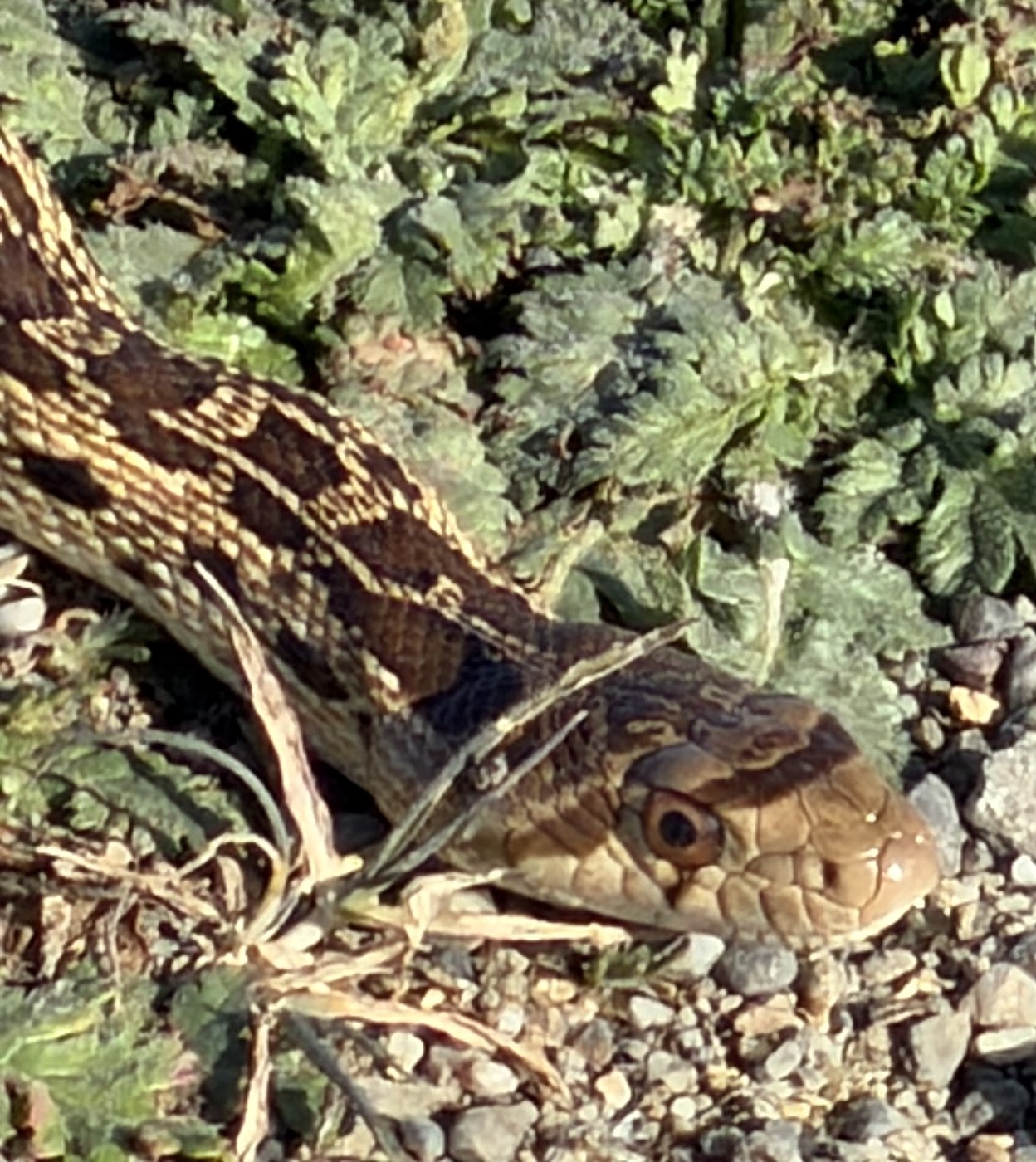
Keeled scales are the positive identification, and they are the fastest field mark on this snake. Gopher snake dorsal scales are heavily keeled, meaning each scale carries a raised ridge down its center, which gives the whole animal a rough, matte, slightly ridged look rather than a polished one. That is the opposite of the glossy snake, the pale blotched species this one is most often confused with in the desert Southwest and California, whose scales are smooth and unkeeled. Scale texture settles that pair faster than pattern does.
Head scale count confirms it
Head scale count is the technical confirmation when texture is hard to judge. California's own species-of-special-concern account for the glossy snake states the difference from the other direction: the gopher snake has keeled scales and usually two pairs of prefrontal scales on top of the snout, against the glossy snake's single pair. Beyond the scale count, the gopher snake's rostral scale, the plate at the very tip of the snout, protrudes and is bluntly rounded, an adaptation for pushing through soil and into burrows.
Square saddles in a chain
Pattern: large square dark saddles on a pale ground, in a chain running down the back. Ground color runs straw, tan, cream, yellow, or orange-brown, with large square or rectangular blotches in dark chocolate, brown, red, black, or olive down the spine, plus smaller spots in rows along each side. The chain-like arrangement is what the species name records: catenifer means chain-bearing. Subspecies differ inside that scheme. National Park Service material for the Grand Canyon separates the two subspecies there by neck color: Great Basin animals carry black blotches on the neck and red or brown blotches over the rest of the body, while Sonoran animals carry uniform-colored blotches throughout.
A narrow head, even in display
The head is narrow and only slightly wider than the neck, and it stays that way even during the display. This is the single most useful structural difference from a rattlesnake, because the display is designed to defeat exactly this check. A gopher snake flattens and widens its head into something triangular, but the underlying head is still slender and barely wider than the neck. A rattlesnake's head is genuinely broad and spade-shaped, sized to house venom glands, set on a distinctly narrower neck.
Round pupils, no pit, no rattle
Round pupils, no facial pit, no rattle, and a long tail tapering to a point. Washington's state wildlife agency lists exactly this set: dark blotches, a distinct eye stripe, a tail that tapers to the tip, round pupils, and no rattle or facial pits. The tail is worth a second look, because National Park Service material for the Grand Canyon notes that gopher snakes carry a series of black bands on the tail that mimic the banded rattle of a rattlesnake. The mimicry is partly built into the animal's markings, not only into its behavior.
The threat display explains the mix-up
The threat display is the whole reason this snake gets misidentified, and four independent agency sources describe it. Threatened, a gopher snake inflates its body, flattens and widens its head, hisses loudly, vibrates its tail rapidly against dry vegetation or debris to produce a buzzing sound, coils, and strikes. Washington's state wildlife agency states the gopher snake is often mistaken for a rattlesnake owing to its coloration and its display of coiling, striking, and loud hissing, and states plainly that it is not venomous. The National Park Service describes the inflation, head flattening, and vigorous tail shaking that produces a rattling sound in dry vegetation. Nevada's state wildlife agency describes the head flattening as making the animal look more like a rattlesnake in order to scare predators. The University of California's statewide pest management program says the harmless gopher snake appears similar to rattlesnakes and can alter its posture to mimic the triangular head shape, but will always lack a rattle.
The hiss is anatomically special
The explanation for it changed. The volume is a genuine anatomical specialization rather than an ordinary hiss, and it is shared only with this snake's close relatives, the pine snakes and the bullsnake, all of them members of the same genus. The reason sits in the larynx rather than the lungs. A 1971 study attributed the volume to a peculiarly modified epiglottis, thin, erect, and flexible, set vibrating by air forced out of the trachea. A 1995 study in the Journal of Experimental Zoology re-examined the same genus and reached a different conclusion: the epiglottal keel, a dorsal expansion of the cricoid cartilage, plays only a small role in increasing amplitude, and the structure that matters is a flexible horizontal shelf of tissue dividing the front of the larynx, which that paper described as the first vocal cord ever documented in a snake. The same work distinguished two separate sounds, a hiss with no frequency or amplitude modulation, and a bellow that opens with a brief burst of high-amplitude broad-frequency sound and then settles into a longer, quieter, constant-frequency tone. Both explanations agree the loudness is a real anatomical specialization. They disagree only about which piece of the larynx produces it.
Do not rule out a rattler at range
Do not rely on these field marks to rule out a rattlesnake from a distance. Every tell above needs a clear view of a live snake's head, tail, or individual scales. That is the exact view nobody should be arranging on purpose. If you are close enough to count prefrontal scales, you are closer than the identification is worth. The reliable direction of this comparison is one-way: a visible, segmented rattle on a short blunt tail means rattlesnake, and everything else means take the safe assumption and move away.
Signs of Infestation
A daylight sighting in the open
It is the normal encounter, and that alone narrows the field. This is a day-active snake that a standard California reference calls one of the most commonly seen snakes on roads and trails. Nevada's state wildlife agency calls the Great Basin subspecies mostly diurnal and frequently spotted during the day. A large blotched snake crossing a driveway at 2 in the afternoon is far more likely to be this species than a nocturnal look-alike such as the glossy snake.
A hiss and buzz from cover
A loud, sustained hiss and a buzzing tail from cover, with no snake visible. This is the most distinctive audible sign any harmless snake gives, and it is also the one that sends people to the internet convinced they have a rattlesnake. The sound is produced against dry leaves, gravel, or debris and is genuinely convincing. It identifies a threatened snake, not a species, which is why the physical marks above have to do the work.
Activity around rodent burrows
Activity concentrated around rodent burrows, and specifically around pocket gopher workings. The snake is named for its prey. California's own account lists mice, kangaroo rats, gophers, ground squirrels, rabbits, quail, ducks, and their eggs among recorded food items, and describes adults foraging inside mammal burrows. National Park Service material states that pocket gophers make up a large portion of the diet. If your yard has fresh pocket gopher mounds, it has the food supply this snake is looking for.
Shed skins near cover
Shed skins near burrow entrances, flat rocks, boards, or woodpiles. California's account lists rodent burrows and cover under flat rocks, logs, and boards as the places gopher snakes shelter when inactive. Those same spots are where sheds turn up.
No damage and nothing to smell
No structural damage, no droppings pattern, no chewing, and nothing to smell. This species does not gnaw, does not burrow into a building, does not nest in walls or attics, and leaves no odor. Noise or smell from inside a wall, attic, or crawl space is a different animal, most likely one of the rodents this snake eats.
Rodent activity dropping off
After a snake moves in, that is a real sign rather than a coincidence. Nevada's state wildlife agency describes gopher snakes as playing an important role in managing small rodent populations in urban areas, and a museum-run species account lists them as important predators on crop pests. Presence usually means the snake found something worth eating on the property.
Prevention and When to Call a Pro
Leave it alone, says the state
The correct default is to leave it alone, and one state agency puts that in unusually strong terms. Washington's Department of Fish and Wildlife states that snakes should be left alone, and that except for a rattlesnake posing an immediate danger to people or pets, no snake should ever be killed. The University of California's statewide pest management program says nonvenomous snakes should also be left alone wherever found. This snake carries no venom, damages nothing, and eats the rodents most homeowners are already paying to control.
Take the rodents away
The snake leaves on its own. This is the specific prevention step for this species rather than a generic one, because the diet is so narrow. Washington's agency frames it directly: reduce the food supply, shelter, and encourage natural predators, and keep food including spilled birdseed inaccessible so mouse and rat numbers fall. On a property with active pocket gopher workings, addressing the gophers is the intervention that actually changes the snake situation.
Remove the flat, low cover
Remove the cover this species actually uses, which is flat and low rather than dense and tall. California's own account names rodent burrows and the undersides of flat rocks, logs, and boards as its shelter. Washington's agency names rock piles, woodpiles, and tall grass. Stacked lumber, sheet material lying flat on soil, and rock piles against a foundation are the features to deal with first, and they matter more for this snake than clearing brush at the back of a lot, where the snake is doing useful work.
Seal gaps and door bottoms
Seal openings of a quarter inch or larger, and treat door bottoms as a separate job. The University of California's program puts the threshold at one quarter inch and singles out garage door gaps. Washington's agency specifies the materials: quarter-inch mesh hardware cloth, caulk, mortar, or a concrete patch for cracks and holes in foundations and exterior walls, metal flashing over door bottoms, and tight-fitting weather stripping on garage and other exterior doors.
A broom and an open door
If one is inside a building, the removal method is a broom and an open door, not a hand. Washington's agency describes opening a nearby door and gently herding the animal out, or using a long pole, stick, or golf club to lift a snake into a box, or hiring a wildlife control company. A gopher snake will bite if it is threatened and the bite is not venomous, but it is still a puncture wound from a large animal, and there is no reason to take one.
Five states, five different rules
Check your own state's rule before you move, hold, or collect one, because the same snake is treated five different ways across California, the Pacific Northwest, and the Southwest. This is not a generic caveat. In Washington, collection or transport of native amphibians and reptiles is permitted only for research and educational activities and requires a state Scientific Collection Permit, and native amphibians and reptiles cannot be kept as pets. In Oregon, the Pacific gopher snake is named specifically on the state's list of nongame wildlife that may be held, with a Wildlife Holding Permit required to hold three or more animals of a listed species per household or facility. In California, the gopher snake is one of the reptiles that may be taken under the authority of a sportfishing license, with a limit of four and an open season all year. In Arizona, a hunting or combination license is required to take reptiles, and the general reptile bag and possession limit that covers this species is four per year, live or dead, under the current Commission Order. In Nevada, the state wildlife agency lists the Great Basin gopher snake's conservation status as unprotected and its game status as non-game.
Do not extend a rule past its state
Do not extend any of those five rules to a state it does not cover. Utah and New Mexico both fall inside this snake's range, and no published source gives a state-specific take or holding rule for this species in either. That is a gap in the record, not permission. Check with the state wildlife agency before doing anything beyond looking.
Call if you cannot rule out a rattler
Call a professional when a snake cannot be confidently separated from a rattlesnake and it is in a place people or pets use. This is the threshold that matters for this species, and it runs in the direction people get wrong. The risk is not that a gopher snake hurts someone. It is that a real rattlesnake gets treated as a gopher snake because it buzzed and flattened its head, or that a harmless gopher snake gets killed at close range by someone who decided to handle the problem personally. Either way the correct move is the same: back off, and call a licensed nuisance wildlife control operator, a pest control professional, or the state wildlife agency.
Call for one that will not leave
Call as well for a snake inside living space that will not leave, or for repeated sightings that point to a rodent problem you have not found yet. The second one is the more valuable call. A gopher snake that keeps returning is telling you there is a reliable food supply on the property, and the underlying rodent or gopher population is the thing worth paying someone to deal with.
Frequently Asked Questions
Is a gopher snake venomous?
No. It is a non-venomous constrictor that kills prey by wrapping around it and squeezing. It will bite if it is threatened and the bite is not venomous, amounting to a puncture wound rather than an envenomation. The confusion comes entirely from its defensive display, which four separate state and federal agency sources describe as a rattlesnake imitation.
My snake rattled and flattened its head. How do I know it is not a rattlesnake?
You cannot tell from the sound or the posture, because both are exactly what a gopher snake is imitating. The structural marks are the ones that hold: a gopher snake has no rattle and its tail tapers to a point, its head is narrow and only slightly wider than its neck even when flattened, its pupils are round, and it has no facial pits. All of those need a clear look at a live snake's head or tail, which is not a look worth arranging. If you cannot verify from a safe distance, treat it as a rattlesnake and call a professional.
Why is it called a gopher snake?
Because pocket gophers are a large share of what it eats. National Park Service material states pocket gophers make up a large portion of the diet, and California's own life history account lists mice, kangaroo rats, gophers, ground squirrels, rabbits, quail, and ducks and their eggs among recorded prey, with adults foraging inside mammal burrows. A gopher snake on a property with fresh gopher mounds is there for the mounds.
Is a bullsnake the same thing as a gopher snake?
Yes, at the species level. The bullsnake is a subspecies, Pituophis catenifer sayi, of the same species. It is the Great Plains form and holds different country, the Mountain West, Midwest, and South Central, while the four western subspecies hold California, the Pacific Northwest, and the Southwest. The defensive display, the specialized larynx, and the rodent diet are the same animal's traits. Adult size, blotch pattern, and state legal treatment differ, which is why the bullsnake is covered separately.
Why does a gopher snake hiss so much louder than other snakes?
Because its larynx is specialized for it, and this is one of the few cases where the scientific explanation was later revised. A 1971 study credited a modified epiglottis, thin and erect, vibrating in the outgoing air stream. A 1995 study found the epiglottal keel plays only a small role and identified the real amplifier as a flexible horizontal shelf of tissue in the front of the larynx, which it described as the first vocal cord documented in any snake. Both agree the loudness is genuine anatomy rather than an ordinary hiss.
Is it legal for me to catch or relocate a gopher snake?
It depends entirely on which state you are in, and the answers are not close to each other. Washington allows collection or transport of native reptiles only for research and education under a state Scientific Collection Permit and does not allow them to be kept as pets. Oregon names the Pacific gopher snake on its list of nongame wildlife that may be held, with a Wildlife Holding Permit required at three or more animals. California allows take under a sportfishing license with a limit of four, open all year. Arizona requires a hunting or combination license and sets the general reptile limit covering this species at four per year, live or dead. Nevada lists it as unprotected and non-game. No published source gives a state-specific rule for this species in Utah or New Mexico, so verify locally there rather than assuming.
Should I get rid of a gopher snake in my yard?
Generally no, and one state agency argues against it outright. Washington's wildlife agency states that no snake should ever be killed except a rattlesnake posing an immediate danger, and the University of California's pest management program says nonvenomous snakes should be left alone wherever found. Nevada's wildlife agency credits gopher snakes with an important role in managing small rodent populations in urban areas. If you want fewer snakes, reduce the rodents and the low flat cover, and the snake loses its reason to stay.
Sources
- Life history account for Gophersnake (R057), California Wildlife Habitat Relationships System: California distribution and abundance, 9,000 foot elevation limit, prey list, burrow and flat-object cover, hibernation in rodent burrows and rock fissures, temperature-driven activity pattern, March to May courtship, June and July egg laying, clutch of 3 to 18 averaging 7 or 8, communal nesting, fall hatch with no feeding until spring, male combat, and the rattlesnake-mimicry note California Department of Fish and Wildlife, California Interagency Wildlife Task Group
- Gopher snake (Pituophis catenifer): eastern Washington range in the Columbia Basin and Okanogan ecoregions, Great Basin subspecies identity, western Washington population possibly extirpated, 6 foot adult length, round pupils and absence of rattle and facial pits, full defensive display, late March to late October activity, and secure state conservation status Washington Department of Fish and Wildlife
- Living with wildlife: Snakes: the statement that no snake should ever be killed except a rattlesnake posing immediate danger, the gopher snake mistaken-for-rattlesnake note, quarter-inch hardware cloth and door flashing exclusion specifications, rodent food-supply reduction, and the broom-and-open-door removal method Washington Department of Fish and Wildlife
- Amphibians and reptiles of Washington: Scientific Collection Permit requirement for collecting or transporting native amphibians and reptiles, and the prohibition on keeping native amphibians and reptiles as pets Washington Department of Fish and Wildlife
- Gopher snake in Oregon: statewide habitat from deserts and grasslands to woodlands and open forests, use of agricultural regions and brushy fence rows, and the shift in diet from insects and lizards in young animals to prey as large as rabbits in adults Oregon Department of Fish and Wildlife
- OAR 635-044-0480, Holding of Nongame Wildlife: Wildlife Holding Permit required to hold three or more animals of a listed nongame species per facility or household, with Pacific Gopher Snake (Pituophis catenifer) named on the list of holdable species Oregon Department of Fish and Wildlife rule text, read via a private mirror of the Oregon Administrative Rules
- Gopher Snake (Pituophis catenifer catenifer), Klamath Inventory and Monitoring Network: hatchling size to 20 inches, adult range 2.5 to 7 feet, grassland and open woodland habitat below about 2,000 feet, spring mating with 3 to 9 eggs in early summer hatching in 2 to 2.5 months, the inflate-flatten-shake defensive display, and the statement that the species is not aggressive or harmful to humans U.S. National Park Service
- Gopher Snake, Grand Canyon National Park: longest snake in the park at up to 92 inches, the black tail bands that mimic a rattle, rapid tail vibration as the defensive behavior, pocket gophers as a large portion of the diet, constriction as the killing method, subspecies split by rim with neck-blotch color as the tell, and winter hibernation in burrows abandoned by other animals U.S. National Park Service
- Great Basin Gopher Snake: presence in all 17 Nevada counties, cold desert shrubland, sagebrush, desert wash and Mojave habitats, the requirement for rocky areas plus soils soft enough to burrow in, mostly diurnal activity, head flattening as rattlesnake mimicry, the role in managing small rodent populations in urban areas, and the state listing of unprotected conservation status and non-game status Nevada Department of Wildlife
- Pest Notes: Rattlesnakes, UC ANR Publication 74119: the statement that the harmless gopher snake appears similar to rattlesnakes and can alter its posture to mimic the triangular head shape but will always lack a rattle, the instruction to leave nonvenomous snakes alone wherever found, the quarter-inch sealing threshold, and habitat cleanup guidance University of California Statewide Integrated Pest Management Program
- Pacific Gophersnake (Pituophis catenifer catenifer): typical adults 4.5 to 5 feet with a species-wide range of 2.5 to 9 feet, hatchlings around 15 inches, heavily keeled scales, narrow head slightly wider than the neck, five California subspecies and their ranges, elevation to 9,186 feet, day activity plus night activity in hot weather, pocket gophers and moles in the diet, 1 to 2 clutches of 2 to 24 eggs June through August, and head-flattening and tail-rattling described as rattlesnake mimicry CaliforniaHerps
- Pituophis catenifer (gopher snake) species account: subspecies count, range from southwestern Canada to northern New Mexico and into Mexico, keeled scales and midbody scale rows, wild lifespan of 12 to 15 years against 33 years in captivity, clutch of 2 to 24 with occasional second clutches, 65 to 75 day incubation, hatchlings 30 to 35 cm, sexual maturity at 4 years in females and 1.5 years in males, up to 90 percent of time spent in underground burrows, behavioral rattlesnake mimicry, prey list including pocket gophers, and the note that the species is often killed as a rattlesnake Animal Diversity Web, University of Michigan Museum of Zoology
- Sound production in Pituophis melanoleucus (Serpentes: Colubridae) with the first description of a vocal cord in snakes, Journal of Experimental Zoology 273: the finding that the epiglottal keel contributes only a small increase in bellow amplitude, the description of the laryngeal septum as a vocal cord, and the distinction between the unmodulated hiss and the two-part bellow Young, B. A., and Sheft, S., Journal of Experimental Zoology (indexed at PubMed, National Library of Medicine)
- The Function of the Epiglottis in Sound Production (Hissing) of Pituophis melanoleucus, Copeia: the earlier explanation attributing the loud hoarse hiss to a thin, erect, flexible modified epiglottis set vibrating by air forced from the trachea, revised in part by the 1995 laryngeal work above (record page for the paper) Martin, W. F., and Huey, R. B., Copeia (American Society of Ichthyologists and Herpetologists)
- California Amphibian and Reptile Species of Special Concern, California Glossy Snake account: the statement that the gopher snake carries keeled scales and usually two pairs of prefrontal head scales, against the glossy snake's single pair, which is the technical tell separating the two species California Department of Fish and Wildlife
- California Code of Regulations Title 14, Section 5.60, Reptiles: gophersnake (Pituophis catenifer) listed among reptiles that may be taken under the authority of a sportfishing license, with a limit of four and an open season all year California Fish and Game Commission, via Cornell Legal Information Institute
- Arizona Reptile and Amphibian Regulations 2026 through 2030, Reptiles Commission Order 43: hunting or combination license required for take of reptiles, general reptile season open January 1 through December 31 statewide subject to area closures, and a bag and possession limit of four per year of each species live or dead for all reptiles other than the specifically named exceptions, which do not include Pituophis Arizona Game and Fish Department
- San Diego Gopher Snake (Pituophis catenifer annectens) and Sonoran Gopher Snake (Pituophis catenifer affinis) taxonomic records confirming subspecies rank under Pituophis catenifer U.S. Fish and Wildlife Service, Environmental Conservation Online System
Image Credits
- Image: Irina Mitine via iNaturalist. CC BY 4.0.
License.