Seasonal Timeline
California ground squirrels are active by day, mainly from midmorning through late afternoon and especially on warm, sunny days. They are true hibernators in colder inland areas, they take a second and separate summer dormancy called estivation during the hottest stretches, and populations in mild coastal areas may stay active all year.
California ground squirrels are active by day, mainly from midmorning through late afternoon and especially on warm, sunny days. They are…
Two separate dormant periods sit inside one year here, and mixing them up is the most common reason a control effort fails. Winter hibernation is the one people expect. Summer estivation is the one they do not expect, and most adults enter it during the hottest part of the year. UC IPM describes estivation as a period of inactivity during the hottest weather that can last a few days to a week or more, and adds the detail that makes it deceptive: the burrow entrance still looks open, because the animal plugs the tunnel with soil near the nest rather than at the mouth. The 1994 wildlife damage handbook produced by the University of Nebraska Extension and USDA confirms the same summer dormancy across the genus.
Both dormant periods matter for one practical reason. A dormant, plugged-in squirrel is out of reach of both fumigation and bait, because its metabolic rate is low and it has sealed itself off. That is why UC IPM specifies about 2 to 3 weeks after the first squirrels emerge from hibernation as the effective fumigation window, and why grain bait is generally not effective until late spring. Prevention below carries the full timing.
Hibernation is not uniform across the range, and UC IPM says so on its own page. Most ground squirrels hibernate through winter, but some young stay active, particularly where winters are not severe, and true hibernation is an inland, colder-temperature pattern. Populations in milder areas may hibernate little or not at all. So a squirrel out in January is not evidence of some other species. It is evidence of a mild winter.
The contrast with the two other burrowing rodents is worth naming, because all three get treated as one animal. Botta's pocket gopher is active year-round with no hibernation documented at all. Black-tailed prairie dog does not truly hibernate either and only drops into brief torpor in hard cold. California ground squirrel is the one genuine hibernator of the three.
In Oregon, the damage calendar is tighter than the activity calendar. Oregon State University Extension puts crop damage in the window from green-up until early to mid-July, after which the animals begin hibernating and damage falls off sharply.
Where They're Found
California ground squirrel is not a California-only animal. Its documented range covers California, the Pacific Northwest, and the Southwest. UC IPM's own page states the range as found throughout most of California and extending south into the northwestern part of the Baja peninsula, and separately names populations throughout western Oregon, in south-central Washington north of the Columbia River, and in western Nevada. Western Oregon and south-central Washington put the species in the Pacific Northwest. Western Nevada puts it in the Southwest.
The Pacific Northwest population is confirmed by more than one source, and by a state extension service in the state itself. Oregon State University Extension's own publication on ground squirrel damage to forages, field crops, ditches, and dams names California ground squirrel as one of five ground squirrel species causing documented agricultural damage in central and eastern Oregon, alongside Belding's, Columbian, Townsend's, and Washington ground squirrels, and gives it its own species-specific breeding season and litter size row in the publication's data table. That is a state extension service treating it as an established, named local pest, not a stray record. The 1994 wildlife damage handbook chapter, written at the University of California, Davis and published through the University of Nebraska Extension with USDA, independently describes the range as running along the far west coast from northern Mexico north through much of California, the western half of Oregon, and a moderate distance into south-central Washington.
The Nevada part of the range rests on the more current sources. UC IPM names western Nevada, and a 2016 peer-reviewed Mammalian Species monograph published by the American Society of Mammalogists describes the species' range as having relatively recently extended into Washington and northwestern Nevada. The 1994 handbook does not mention Nevada for this species. Read together, that is most consistent with a real range expansion documented after 1994 rather than a disagreement between sources.
Alaska and Hawaii carry no population. Every range source keeps the species on the Pacific coast and interior West, and the grassland and oak savanna habitat it depends on does not occur in either state.
Habitat is specific, and one of the most useful facts about it is a negative. The 1994 handbook describes the species occupying grasslands and savanna-like areas with mixtures of oaks and grasslands, avoiding moderate to heavily forested areas and dense brushlands, and states directly that it is absent from the desert regions of California. It is a grassland and oak savanna animal, not a desert generalist. What it is very good at is disturbed ground: the same source describes it as highly adaptable and notes it will infest earthen dams, levees, irrigation ditch banks, railroad rights-of-way, and road embankments. UC IPM adds that it is usually found in open areas, sometimes using brush for cover, with a home range within about a 75 yard radius of the burrow, and that populations reach the central Sierra Nevada at altitudes over 7,000 feet.
Diet swings hard with the season, and the swing is fast. UC IPM describes feeding almost exclusively on green grasses and herbaceous plants from mid-January to mid-May, then switching to seeds, grains, and nuts from mid-May through October, when the animals also begin storing food. The 1994 handbook confirms the same switch and adds the detail that makes it useful: with the California ground squirrel the switch is dramatic, and a complete change can occur over as short a period as 2 weeks. Acorns are a favorite food in oak savanna, thistle seeds are highly preferred, and in cultivated ground the animal is an opportunistic feeder taking all grains and a wide variety of other crops.
On working land, the infrastructure damage is the expensive part, and Oregon State University Extension quantified it. That publication reports that burrows in irrigated fields often cause water loss, which makes flood irrigation of alfalfa impossible, that burrows may weaken earthen stock dams and levees and cause them to leak or wash away, and that burrowing on hilly ground can accelerate soil erosion by channeling runoff. It also gives a timeline worth acting on: burrow building for 2 to 5 years can lead to collapse. On the crop side, the same publication reports that 45 percent or more of the first cutting of alfalfa may be lost to ground squirrels in some years, and that mounds interfere with mowing equipment and reduce harvestable yield when a mower has to be raised to clear them.
Related Pests
Life Cycle
One litter a year, and the whole calendar hangs off hibernation. Males come out of hibernation 10 to 14 days before females, breeding starts shortly after, gestation runs 28 to 32 days, and the young are underground for about 6 to 7 weeks before anyone sees them. That is the entire cycle. Litters run 5 to 8 typical, with means slightly over 7 in California and 7.2 in Oregon, and observed litters as large as 15.
Why the emergence date is the number to write down. Every effective control window is measured from it. UC IPM puts the effective fumigation window at about 2 to 3 weeks after the first squirrels emerge from hibernation, and notes that grain bait is generally not effective until late spring, because the animals are still feeding almost exclusively on green vegetation and will not take seed bait until the diet switches. Miss the window and the same product applied later does less.
One figure stated with its limitation. The 4 to 5 year life span rests on a single publication, the 1994 wildlife damage handbook, and has not been independently confirmed. No source gives a competing number, so treat it as the best available figure rather than a settled one.

Mating
Gestation
Birth and nursing
Juvenile
Adult
Identification
Start with whether you can see it
Start with whether you can see the animal at all, because that one question sorts this species from the other burrower people confuse it with. California ground squirrels are diurnal and colonial. UC IPM describes them active during the day, mainly from midmorning through late afternoon and especially on warm, sunny days, foraging close to their burrows. A pocket gopher spends nearly its whole life underground and is almost never seen. If the animal is sitting upright at the mouth of a burrow in daylight, it is the ground squirrel.
Size and build
UC IPM gives 14 to 20 inches in total length including the tail, and 21 to 30 ounces in weight, with males somewhat larger than females. The 1994 wildlife damage handbook gives the same animal as a 10 inch body plus a 6.5 inch semi-bushy tail, which agrees once the tail is counted.
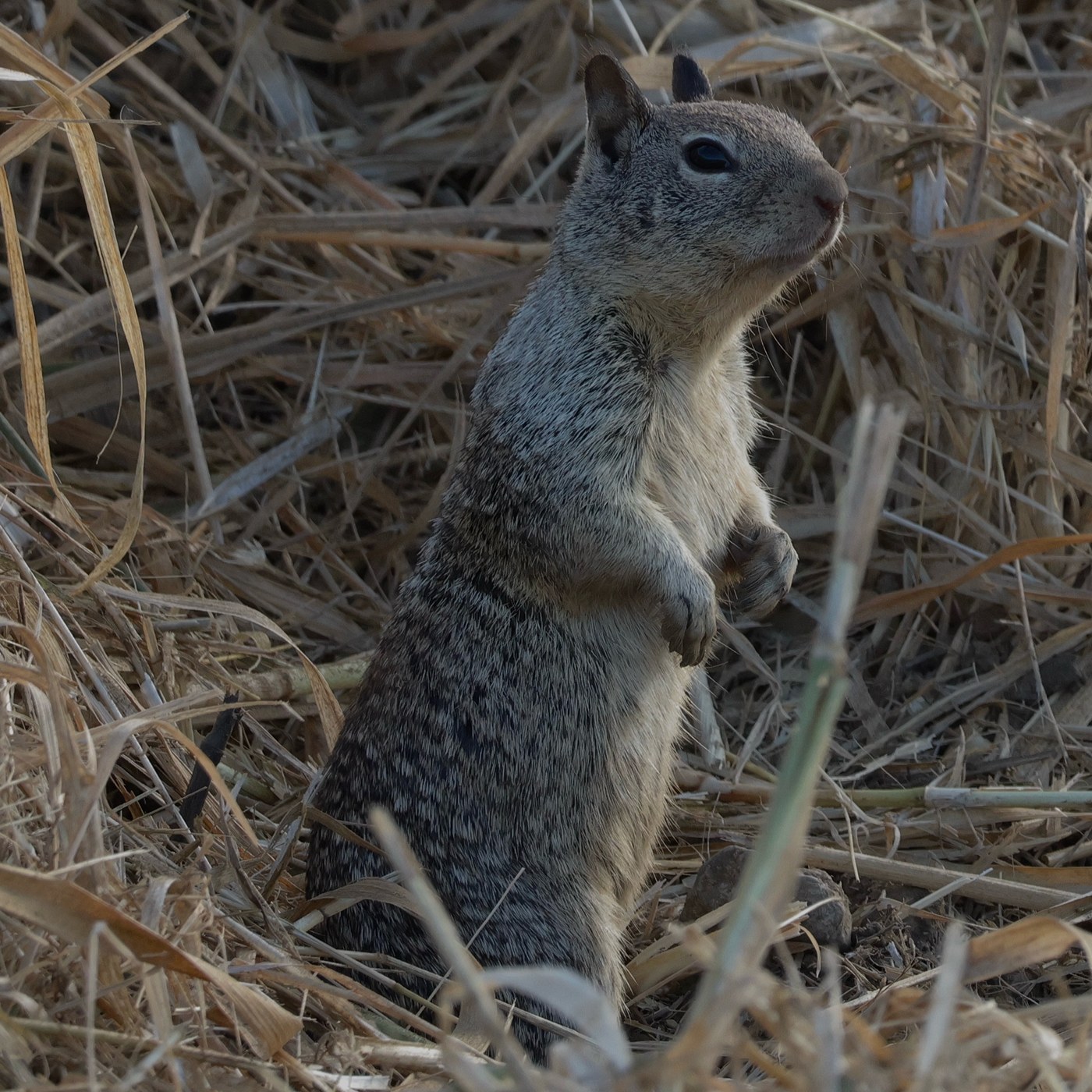
Color and the eye ring
Mottled brown with some white and gray markings on the back, and lighter browns, grays, and white on the belly and underside, with a distinctive white ring around each eye. The 1994 handbook describes the overall effect as brownish gray and dusky with a flecked, mottled, grizzled appearance, and notes that markings vary by subspecies. The Douglas subspecies specifically carries a blackish brown wedge-shaped patch in the middle of the back between the shoulders.
The tail and the ears
The tail is somewhat bushy, but shorter and less full than a tree squirrel's. The ears are erect and conspicuous, with some exceptionally long hairs at the tips per the 1994 handbook.
Tree squirrel is the look-alike
The tell is behavioral rather than visual. UC IPM states it directly: although similar in appearance to tree squirrels, ground squirrels will always retreat to a burrow when frightened, while tree squirrels will climb a tree or other tall structure and never use a burrow. The 1994 handbook confirms the same pattern from the other side, describing ground squirrels as rapid runners and good climbers that always retreat to their burrows when scared by humans or predators. This is a binary test, not a judgment call about coat color.
Against Botta's pocket gopher
The tell is the burrow opening and the animal's visibility. Ground squirrel burrow entrances are round, about 4 inches across and larger at older well-used openings, and per the 1994 handbook's description of the genus they are normally left open and never plugged with soil during ordinary activity. They get plugged only during dormancy. A gopher mound is crescent or horseshoe shaped seen from above, with the entrance set off to one side and usually plugged. Round and open points to this species. Crescent and plugged points to a gopher.
One error carries a legal consequence
One identification error carries a legal consequence, and it is worth reading before anyone sets a trap. UC IPM's own page names the Mohave ground squirrel and the San Joaquin antelope squirrel as protected animals classified as threatened species, sharing range with California ground squirrel in parts of the state. Nevada separately protects the Mojave ground squirrel. Misidentifying a protected species as this unprotected one before taking lethal action is a real exposure, not a technicality. If there is any doubt about which squirrel is present, that doubt gets resolved before anything else happens.
Signs of Infestation
New burrows, and the opening itself
New burrows are the primary sign, and the opening itself is diagnostic. Entrances are round and about 4 inches in diameter, larger at older well-used openings, and normally left open rather than plugged. UC IPM gives the system behind them: individual burrows run 5 to 30 feet long, 2.5 to 4 feet below the surface, and about 4 to 6 inches in diameter, occasionally reaching 6 feet or more deep.
The animal in plain sight, by day
The animal itself, in plain sight, during the day. Because this species is diurnal and colonial, the strongest available sign is usually a squirrel sitting upright at a burrow mouth. The 1994 wildlife damage handbook makes the point in operational terms: since ground squirrels are active during daylight hours and their burrow openings are readily discernible, damage identification is generally uncomplicated. This is not a hard pest to confirm.
Mounds that make mowing hard
Mounds and burrows that make a lawn or a field difficult to mow. UC IPM lists this outright. Oregon State University Extension adds the working-land version: mounds interfere with mowing equipment and cut harvestable yield when a mower has to be raised to clear them.
Gnawed bark and girdled tree trunks
UC IPM lists both among its signs of infestation. On young fruit and nut trees, vines, and shrubs, girdling is what turns a nuisance into a dead planting.
Damage to sprinklers and irrigation
Damage to plastic sprinklers and irrigation lines. UC IPM names this specifically. The animals chew flexible plastic components in the ordinary course of foraging and burrowing, so unexplained wet spots, pressure loss, or a zone that quit working are all worth checking against nearby burrow activity.
Burrowing around roots and structures
That includes under buildings. This is where the honest framing matters. UC IPM's own signs list includes burrowing beneath buildings and other structures, sometimes producing damage that necessitates costly repair. This species will not live in your attic or your walls the way a rat will. The burrow is what reaches the foundation, not the animal moving indoors.
On irrigated ground, water going wrong
On irrigated ground, water going where it should not. Oregon State University Extension reports that burrows in irrigated fields often cause water loss, which can make flood irrigation of alfalfa impossible, and that burrows may weaken earthen stock dams and levees until they leak or wash away. That same publication puts 2 to 5 years of unaddressed burrow building as enough to lead to collapse.
Holes where people and animals walk
That is a safety sign rather than a damage sign. The 1994 handbook is specific: burrow entrances in school playgrounds, parks, and other recreational areas are responsible for debilitating falls, occasionally resulting in sprained or broken ankles or limbs, and burrows in horse exercising or jumping arenas or on equestrian trails can cause serious injuries to horses and to their riders if thrown. UC IPM likewise notes burrows present hazards to machinery, pedestrians, and livestock.
Prevention and When to Call a Pro
Identify it, then check the rule
Two things get checked before any trap, bait, fumigant, or firearm comes out. Identification first, then the local rule. Confirm the animal is actually a California ground squirrel and not a protected look-alike active in the same area, meaning the Mohave ground squirrel or the San Joaquin antelope squirrel in parts of California, or the Mojave ground squirrel in parts of Nevada. Then check current state and local wildlife regulations, because the rules vary by state, they vary by location inside a single state where a protected species overlaps, and they change over time. A licensed nuisance wildlife control operator, or the state wildlife or agriculture agency, is the safer default than lethal control undertaken on your own reading of a general article. The 1994 wildlife damage handbook states the same caution in its own words: the ground squirrels it covers are generally regarded as pests and are not protected, but local laws or regulations should be consulted before undertaking lethal control, and any control effort must take into account that several of the numerous ground squirrel species are on threatened or endangered species lists.
California's rule, precisely
California's classification is genuinely permissive, and it is worth knowing precisely. UC IPM states that the California Fish and Game Code classifies ground squirrels as nongame mammals, and that no license is required for the management of California ground squirrels if it is the owner or tenant taking squirrels that are damaging growing crops or other property. A trapping license from the California Department of Fish and Wildlife is required only for those trapping squirrels for hire or profit. That permissiveness does not extend to the protected species above. UC IPM's same page names the Mohave ground squirrel and San Joaquin antelope squirrel as threatened, alongside other endangered species sharing the ground, including the San Joaquin kit fox, kangaroo rats, riparian brush rabbit, riparian wood rat, and endangered amphibians and reptiles. One further current detail if shooting is being considered: UC IPM states that effective July 1, 2019, nonlead ammunition is required when taking any wildlife with a firearm anywhere in California. This describes California only.
Oregon, with its sourcing shown
Oregon covers the Pacific Northwest part of this range, and the two halves of the Oregon picture carry different levels of certainty. On the damage side, the citation is primary and direct. Oregon State University Extension's own publication names California ground squirrel as one of five ground squirrel species causing documented agricultural damage in central and eastern Oregon, so this is a recognized local agricultural pest in the state, not a stray record. On the legal side, the best available reading is that California ground squirrel is classified in Oregon as an unprotected mammal, with no closed season and no bag limit though a hunting license is still required for the take itself, that Oregon's Wildlife Control Operator program can address nuisance unprotected mammal activity inside incorporated city limits and associated urban development areas, and that Oregon law separately defines most rodents other than beaver as predatory animals, a distinct legal category from unprotected mammal. That legal reading comes from secondary summaries of Oregon Department of Fish and Wildlife material rather than from the department's own regulations page, and how the two categories interact in practice is not settled. Confirm it with the Oregon Department of Fish and Wildlife before acting on it. This describes Oregon only.
Nevada, by elimination
Nevada covers the Southwest part of this range, and the reasoning behind its status is worth showing rather than summarizing. Nevada Administrative Code 503.035 defines unprotected mammals as all species of mammals which are not classified as game, fur-bearing, protected, sensitive, threatened, or endangered animals. No ground squirrel species is enumerated by genus or common name in Nevada's game mammal, fur-bearing mammal, or protected, sensitive, threatened and endangered mammal sections. By elimination, that places California ground squirrel in Nevada's default unprotected mammal category. That conclusion comes by elimination, because the code does not name the species directly. Nevada also has its own protected look-alike. The Mojave ground squirrel is protected in Nevada, and a resident who is not certain which squirrel is present should contact the Nevada Department of Wildlife rather than attempt removal. That look-alike caveat comes from secondary material rather than a department-hosted page, so confirm it with the department, though it parallels UC IPM's own documented California caveat closely. This describes Nevada only. Every other state sets its own rule.
Federal status
Not federally listed, and that is not the same as unregulated. The U.S. Fish and Wildlife Service maintains a species profile page for California ground squirrel, and no source documents any current Endangered Species Act listing, candidate status, or petition history for the species. Not federally listed is not the same as unregulated, which is the entire reason the three state examples above are written out.
Habitat modification, no permit needed
Habitat modification is the first real step and requires no permit. UC IPM's guidance, echoed by the 1994 handbook, is to remove the cover this species actively seeks: brush, rock piles, piles of field-cleared rocks, abandoned irrigation pipe, and idle farm equipment near a property's edges. Mowing is where the usual advice goes wrong. UC IPM states that California ground squirrels generally dislike dense vegetation, because it stops them seeing a predator coming, so avoiding mowing and grazing can discourage them. Clear the harborage above, but do not expect a close-mown fence line to keep a colony out.
Where exclusion fencing falls down
Exclusion fencing has a real limitation, and it is worth knowing before anyone spends money learning it. The 1994 handbook calls exclusion fencing of limited usefulness and costly for this species specifically, because ground squirrels can readily dig beneath fences buried several feet deep. Where fencing is used at all, a 4 foot wire mesh fence topped with a sheet metal cap prevents climbing over, but it stays ineffective unless the squirrels already burrowing near the fence line are dealt with first. Sheet metal cylinders around individual trunks are the more practical targeted measure for protecting fruit and nut trees.
Flood irrigation as a deterrent
Irrigation method is a low-effort deterrent with a source behind it. The 1994 handbook reports that flood irrigation, as opposed to sprinkler or drip, discourages ground squirrels in orchards, alfalfa, and pasture. It will not clear an established colony on its own. It is a real mechanism rather than a generic seal-the-openings instruction that does not apply to an open-field burrowing animal.
Timing decides if bait works
Timing decides whether bait and fumigation work at all. UC IPM puts effective fumigation at about 2 to 3 weeks after the first ground squirrels emerge from hibernation, and states that poisoned grain baits are generally not effective until late spring, because the animals feed almost exclusively on green vegetation early in the season and will not take grain until the diet naturally switches to seeds. Oregon State University Extension confirms the dormancy problem from the other direction: fumigants will not work effectively when the animals are hibernating, because their metabolic rate is low and they sometimes build earth plugs to seal themselves in. The same logic applies to summer estivation. The 1994 handbook adds a caching caveat that argues for the earlier end of the window: bait caching does occur, especially with California ground squirrels, and is more prevalent in late summer and fall, so earlier-season application wastes less material.
The baits are restricted-use
The bait products themselves are restricted-use in California. UC IPM states that zinc phosphide and the multiple-dose anticoagulants chlorophacinone and diphacinone are currently registered and available for this use, but are restricted-use pesticides requiring a county agricultural commissioner permit for purchase or use in California. That is a licensed applicator pathway, not a shelf purchase.
Trapping, and the relocation trap
Trapping works at residential scale, with one hard caution about what happens next. Modified pocket gopher style kill traps, Conibear traps, and live-catch traps can all be effective against smaller populations. The 1994 handbook is direct about relocation: releasing live-trapped ground squirrels elsewhere is illegal in some states, uneconomical, and rarely biologically sound. Live trap and relocate is not a safe default here, which is another reason the local rule gets checked first.
What does not work
Per the 1994 handbook, frightening devices including propane exploders and flagging are not effective against this species, and chemical taste and odor repellents do not cause squirrels to leave an area or reliably prevent crop damage.
Call if you are unsure which squirrel
Call for any uncertainty about which squirrel is present. Given the documented legal exposure of taking a protected species by mistake, this is a hard trigger rather than a homeowner judgment call. A licensed operator or the state wildlife agency confirms the identification before lethal control begins.
Call for burrows in a dam or levee
Call for any burrow activity on a dam, a levee, or an irrigation ditch bank, and treat it as time-sensitive. Oregon State University Extension's own finding is that 2 to 5 years of burrow building can lead to collapse. That is an infrastructure safety decision with a clock on it, not a nuisance control preference. It is also the highest-cost damage category this species causes.
Call for a colony on cropland
Call for an expanding colony on cropland or pasture, and here are the numbers behind that. The 1994 wildlife damage handbook states that in spite of control, the California ground squirrel has caused an estimated 30 to 50 million dollars of agricultural and other damage annually in California alone. The same source gives the forage competition mechanism in concrete terms: 12 California ground squirrels were found to consume about 1,000 pounds of range forage, and 200 ground squirrels consumed the same amount as a 1,000 pound steer. UC IPM names the vulnerable crops directly, including grains along with nut and fruit trees such as almond, apple, apricot, avocado, orange, peach, pistachio, prune, and walnut, plus seedling vegetables. This is a forage and crop trigger, separate from the health trigger below.
Call for restricted-use materials
Call for anything requiring aluminum phosphide fumigation or a restricted-use rodenticide. Both are restricted-use materials requiring permitting or licensing in each of the states reviewed. That is licensed applicator territory.
Report a sudden die-off, do not touch it
Call, and report it, for a sudden unexplained die-off. Do not handle the animals. UC IPM states this without hedging: if you find unusual numbers of squirrels or other rodents dead for no apparent reason, notify public health officials, and do not handle dead squirrels under these circumstances. That instruction exists because the documented plague exposure routes are flea bites and contact with sick or dead animals. A peer-reviewed 2016 investigation published in the CDC journal Emerging Infectious Diseases, covering two confirmed human plague cases at Yosemite National Park, names this species directly: the California ground squirrel plays a major role in human exposure in California because its predominant flea species, Oropsylla montana, is a competent Yersinia pestis vector that is often abundant on this rodent and in its burrows and will readily bite humans. That investigation found evidence of exposure or infection across several co-occurring rodent species at the site, including golden-mantled ground squirrel, lodgepole chipmunk, Douglas squirrel, and deer mouse, with California ground squirrel identified as the primary concern, and genetic evidence that at least two distinct Y. pestis strains were circulating at the same time. UC IPM states the same finding in the field's own language, noting that ground squirrels can harbor diseases harmful to humans, particularly when squirrel populations are high, naming bubonic plague caused by Yersinia pestis and transmitted to humans, pets, and other animals by fleas associated with the squirrels, and adding that the squirrels are themselves susceptible to plague, which has wiped out entire colonies. California Department of Public Health material describes almost all California plague cases as associated with wild rodent activity, often involving California ground squirrels, chipmunks, and their fleas.
Keep the plague risk in proportion
Respect it, but know that the exposure route is specific. The CDC investigation puts national context on it: 16 human plague cases were reported across the western United States in 2015. Rare, but real, and tied to this species. Just as important is what no source claims. None of them describe casual proximity to a healthy, active colony as a meaningful risk. Every documented exposure pathway runs through flea bites or handling sick and dead animals. The practical version: do not handle carcasses, keep pets from working a colony, use flea control on animals that go where squirrels go, and report an unexplained die-off to public health officials rather than going out to look at it.
Call when they come straight back
Call when the same area is reoccupied after a correctly timed trapping or baiting effort has already failed. Oregon State University Extension's Klamath County study data shows that even maximum-effort control programs can see significant reinvasion the following year from migration off untreated neighboring land. Repeating the same single-property effort a third time is usually the wrong response. A larger, coordinated professional approach is the right one.
Frequently Asked Questions
Do California ground squirrels carry the plague?
Yes, and this species is named specifically rather than lumped in with rodents generally. A peer-reviewed 2016 investigation in the CDC journal Emerging Infectious Diseases, examining two confirmed human plague cases at Yosemite National Park, states that the California ground squirrel plays a major role in human exposure in California because its predominant flea, Oropsylla montana, is a competent Yersinia pestis vector that is often abundant on this rodent and in its burrows and will readily bite humans. UC IPM independently names bubonic plague as a disease ground squirrels can harbor, transmitted to people, pets, and other animals by the fleas associated with the squirrels, and notes the squirrels themselves are susceptible to it and that it has wiped out entire colonies. California Department of Public Health material describes almost all California plague cases as associated with wild rodent activity, often involving California ground squirrels, chipmunks, and their fleas. Keep the scale in view: the CDC article reports 16 human plague cases across the western United States in 2015. And keep the route in view, because it is specific. No source treats being near a healthy colony as a meaningful risk. The documented pathways are flea bites and handling sick or dead animals. So do not handle carcasses, keep pets out of burrow areas, and if you find unusual numbers of squirrels or other rodents dead for no apparent reason, UC IPM's instruction is to notify public health officials and not handle the animals.
How can I tell a California ground squirrel from a pocket gopher?
By whether you see the animal at all. Ground squirrels are diurnal and colonial, and UC IPM describes them active through the day and foraging close to their burrows, so a squirrel sitting upright at a burrow mouth in daylight is the ordinary sight. A pocket gopher spends nearly its entire life underground and is almost never seen. If no animal is in view, the opening is the tell. A ground squirrel burrow entrance is round, about 4 inches across, and normally left open, plugged only during hibernation or summer estivation. A gopher mound is crescent or horseshoe shaped seen from above, with the entrance off to one side and usually plugged. Getting this right matters, because the traps and the control timing for the two animals are not the same.
Is a ground squirrel just a tree squirrel that got into my yard?
No, and the test is behavioral rather than visual, which makes it reliable. UC IPM states it plainly: although similar in appearance to tree squirrels, ground squirrels will always retreat to a burrow when frightened, while tree squirrels will climb a tree or other tall structure and never use a burrow at all. The 1994 wildlife damage handbook confirms the same pattern, describing ground squirrels as rapid runners and good climbers that always head for their burrows when scared by humans or predators. Watch where the animal goes when it is startled. That answers it. Coat color and tail bushiness are much weaker signals, though a ground squirrel's tail is noticeably shorter and less full than a tree squirrel's.
Do I need a permit to remove ground squirrels from my California property?
Not in the ordinary case. UC IPM states that the California Fish and Game Code classifies ground squirrels as nongame mammals, and that no license is required for the management of California ground squirrels if it is the owner or tenant taking squirrels that are damaging growing crops or other property. A trapping license from the California Department of Fish and Wildlife is required only for those trapping for hire or profit. Two caveats belong with that answer. UC IPM's own page names the Mohave ground squirrel and the San Joaquin antelope squirrel as protected, threatened-listed species sharing range with this one in parts of the state, so the permissive rule depends on the animal actually being a California ground squirrel. And if a firearm is involved, UC IPM notes that effective July 1, 2019, nonlead ammunition is required when taking any wildlife with a firearm anywhere in California. Rules also change, so confirming the current one with the state agency is worth the phone call.
Are California ground squirrels found outside California?
Yes. The range covers three regions rather than one. UC IPM's own page describes the species as found throughout most of California and extending south into the northwestern part of the Baja peninsula, and separately names populations throughout western Oregon, in south-central Washington north of the Columbia River, and in western Nevada. Oregon State University Extension independently treats the species as one of five ground squirrel species causing documented agricultural damage in central and eastern Oregon, with its own species-specific breeding and litter data. The 1994 wildlife damage handbook independently describes the range as running from northern Mexico north through much of California, the western half of Oregon, and a moderate distance into south-central Washington. A 2016 peer-reviewed Mammalian Species monograph describes the range as having relatively recently extended into Washington and northwestern Nevada, which is consistent with the 1994 source not mentioning Nevada at all. There is no population in Alaska or Hawaii. Within its range, the species is a grassland and oak savanna animal, and the 1994 handbook notes it is absent from the desert regions of California.
Why do ground squirrels keep wrecking my sprinkler lines, dam, or ditch bank?
Because the burrow system is the mechanism, not incidental damage around the edges. UC IPM lists damage to plastic sprinklers and irrigation lines among the standard signs of infestation, and burrows run 5 to 30 feet long and 2.5 to 4 feet deep, which puts them straight through the soil layer buried irrigation occupies. On larger ground, Oregon State University Extension reports that burrows in irrigated fields often cause water loss and can make flood irrigation of alfalfa impossible, and that burrows may weaken earthen stock dams and levees until they leak or wash away. That publication also gives the number worth acting on: burrow building for 2 to 5 years can lead to collapse. Which is why burrow activity on a dam, a levee, or a ditch bank is the one situation that justifies calling early rather than watching it for another season.
Do California ground squirrels hibernate?
Usually yes, and they also take a second dormant period in summer that most people do not know about. UC IPM states that most ground squirrels hibernate through winter, though some young can be active at that time, particularly where winters are not severe, and true hibernation is associated with colder inland conditions rather than being uniform across the range. Populations in milder areas may hibernate little or not at all, so an animal out in January does not mean you are looking at a different species. The second period is estivation. UC IPM describes most adults going into a period of inactivity during the hottest weather that can last a few days to a week or more, and adds the detail that makes it deceptive: the burrow entrance still looks open, because the squirrel plugs the tunnel with soil near the nest instead. Both dormant periods matter for one practical reason. Fumigation and bait do not reach a dormant, plugged-in animal, which is why UC IPM specifies about 2 to 3 weeks after the first squirrels emerge from hibernation as the effective fumigation window.
Will a ground squirrel get under my foundation or into my house?
The burrow can reach under a building. The animal does not move in. UC IPM's own signs of infestation list includes burrowing beneath buildings and other structures, sometimes producing damage that necessitates costly repair, and it notes that burrows present hazards to machinery, pedestrians, and livestock. So this is a genuine near-structure risk rather than a purely landscape problem. What it is not is an indoor rodent situation. No source describes this species living in a wall void, an attic, or a crawl space the way a rat or a mouse does. The fix is on the burrow side of the wall, not inside it.
Sources
- Ground Squirrel, Pest Notes: identification, size and color, tree squirrel behavioral distinction, protected look-alike species, life cycle and litter size, burrow dimensions, range, habitat and home range, seasonal diet switch, hibernation and estivation, colony size, signs of infestation, crop damage list, nongame mammal legal classification, nonlead ammunition requirement, restricted-use bait status, fumigation and bait timing, plague risk, and die-off reporting guidance UC Statewide Integrated Pest Management Program, University of California Agriculture and Natural Resources
- Belding's, California, and Rock Ground Squirrels, in The Handbook: Prevention and Control of Wildlife Damage (1994, Rex E. Marsh, University of California, Davis): range description, size, subspecies color variation, gestation period, litter mean, dispersal distance, life span, hibernation and estivation, colonial habits, habitat and infrastructure infestation, diet switch and caching, agricultural damage estimate and forage competition figures, playground and equestrian injury hazard, habitat modification, exclusion limitations, flood irrigation deterrent, relocation caution, ineffective methods, and the general unprotected-but-verify-locally caveat University of Nebraska-Lincoln Extension with USDA APHIS Animal Damage Control
- Controlling Ground Squirrel Damage to Forages and Field Crops, Ditches, and Dams, EC 1429: confirmation of California ground squirrel as a named agricultural pest in central and eastern Oregon, Oregon-specific breeding season and litter figures, irrigation water loss and flood irrigation impact, dam and levee weakening, the 2 to 5 year collapse timeline, soil erosion channeling, alfalfa first-cutting loss figure, damage window from green-up to early or mid-July, mowing interference, fumigation failure during hibernation, and Klamath County reinvasion data Oregon State University Extension Service
- Otospermophilus beecheyi (Rodentia: Sciuridae), Mammalian Species, 2016: the recent range extension into Washington and northwestern Nevada American Society of Mammalogists
- Investigation of and Response to 2 Plague Cases, Yosemite National Park, California, USA, 2015, Emerging Infectious Diseases volume 22 number 12: the California ground squirrel and Oropsylla montana human exposure mechanism, co-occurring rodent species findings, multiple circulating strains, and 2015 national case count U.S. Centers for Disease Control and Prevention
- Plague: statewide framing that almost all California plague cases are associated with wild rodent activity, often involving California ground squirrels, chipmunks, and their fleas California Department of Public Health
- California Ground Squirrel (Otospermophilus beecheyi) species profile, reviewed for federal listing status U.S. Fish and Wildlife Service
- Nevada Administrative Code Chapter 503, section 503.035 unprotected mammals definition, read alongside the enumerated game (503.020), fur-bearing (503.025), and protected, sensitive, threatened and endangered (503.030) mammal sections Nevada Legislative Counsel Bureau
Image Credits
- Image: Ben via iNaturalist. CC0 1.0.
License.