Seasonal Timeline
In most of its range, copperhead activity runs on two peaks rather than one. Spring emergence brings the first wave, and a second wave follows in late summer and early fall when mating and live birth put newly born young on the move. At the northern edge of the range, the pattern flattens into a single warm-season window.
In most of its range, copperhead activity runs on two peaks rather than one. Spring emergence brings the first wave, and a second wave…
Two things drive the calendar. Copperheads are cold-blooded and spend the coldest months underground in rocky dens, so the first peak is simply emergence: snakes come out to bask as temperatures rise, then disperse into the surrounding woods and fields. The second peak is reproductive. Mating happens in both spring and fall, and young are born live in late summer or early fall, which puts newly born juveniles in yards, leaf litter, and mulch beds during the same weeks that people are still working outside. That second peak is best documented in the Southeast, where it runs from about mid-August into early October.
Where copperheads actually occur inside each region matters as much as when. In the Midwest, activity concentrates in wooded river-valley terrain in southern Missouri and the southern edges of Illinois, Indiana, and Ohio, and the species is largely absent from the region's northern and western states. In South Central, it concentrates in the wooded eastern part of the region, East Texas, Arkansas, and Louisiana, and is largely absent from West Texas and drier Oklahoma, where the western diamondback is the venomous species of concern instead.
The Northeast is the exception in two ways. Populations there sit at the species' northern range edge, are much smaller, and are localized to rocky ridges and hillsides in southern New York, New Jersey, Pennsylvania, and Connecticut rather than spread across the region. Most of New England has none at all. The timing for those populations is also held to a lower confidence: a single warm-season window rather than the dual peak documented farther south. Massachusetts's own wildlife data describes copperheads there as generally active April through October and overwintering in rocky talus from November through March, with occasional emergence on warm days in the shoulder months.
Where They're Found
Copperhead is an outdoor species, not a structural invader in the way raccoons or bats are. Its documented range runs from southern New England west to Illinois and south to Georgia and neighboring states. Rocky, wooded terrain is the consistent theme everywhere it occurs: hillsides, ridgelines, exposed bedrock, rock ledges, rockslides, and talus for denning and basking, with deciduous forest and damp low areas nearby. Dens are typically associated with hilly, rocky ground, and snakes disperse from them into surrounding forest, fields, and marsh edges during the active season.
Copperheads thermoregulate by moving rather than by tolerating whatever the air temperature happens to be. They bask in sunny clearings, canopy gaps, and forest edges to warm up for digestion, shedding, and gestation, then retreat to damp spots, cool crevices, or below-ground shelter when it gets too hot. That is why the same property can produce sightings in a sunny rock pile in the morning and none at midday.
Around a house, the list narrows to a handful of predictable spots: woodpiles, leaf litter, mulch beds, foundation gaps, garages, and toolboxes. Snakes do occasionally turn up inside a garage or a house when following prey or seeking shelter. They also den communally, sometimes alongside garter snakes, black rat snakes, and timber rattlesnakes, so a known den site is rarely a single-snake situation.
Life Cycle
The reproductive calendar is why fall matters as much as spring. Young are born live, in late summer or early fall, which is exactly when homeowners report small snakes in mulch beds and leaf litter. A female needs at least a year or two after giving birth to rebuild the reserves to reproduce again, since gravid females return to their dens thin and underweight, so at most one litter per female per year and often less. Ambush hunting is the other thread that runs through every stage. A copperhead's default is to stay still and stay hidden, which is precisely why the most common bite scenario is a hand or a foot placed too close to a snake that was never going to move.

Mating and Denning
Neonate
Juvenile
Adult2
Identification
Crossband shape, not color
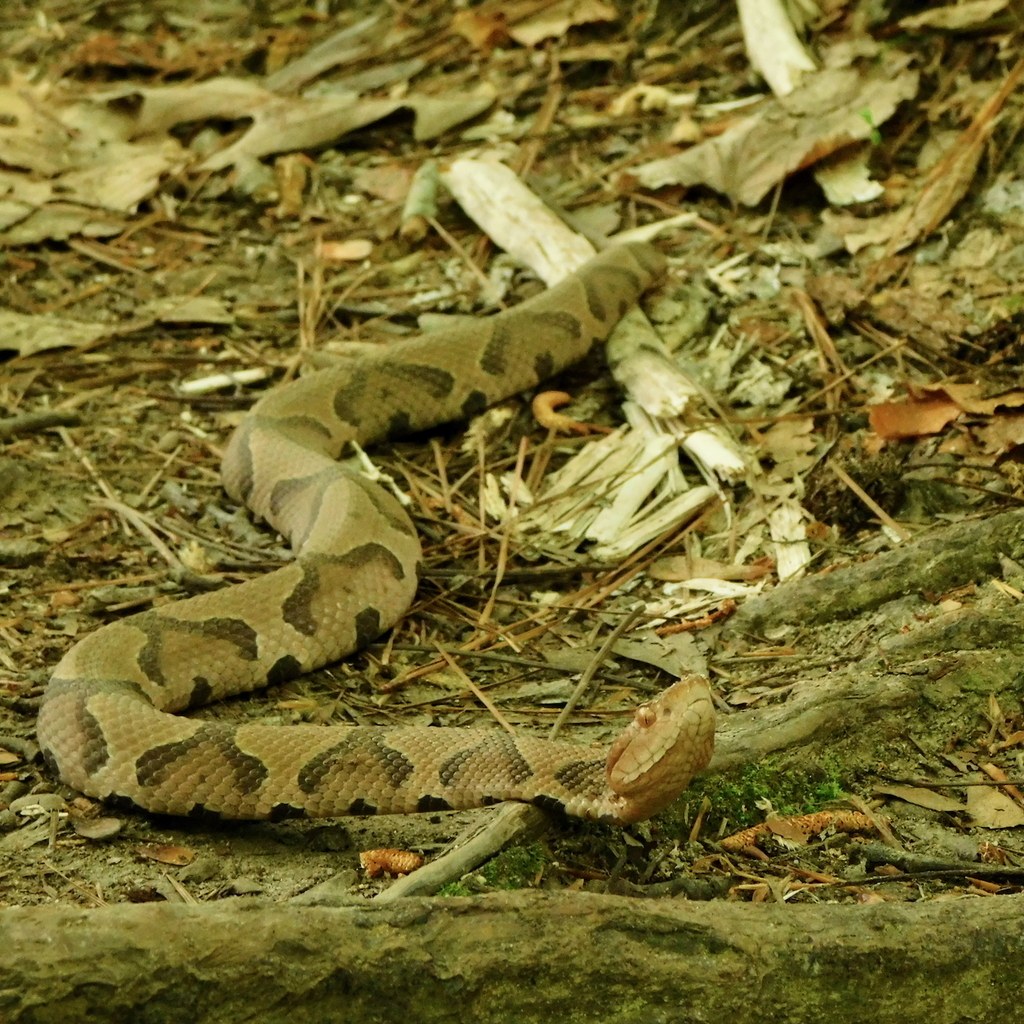
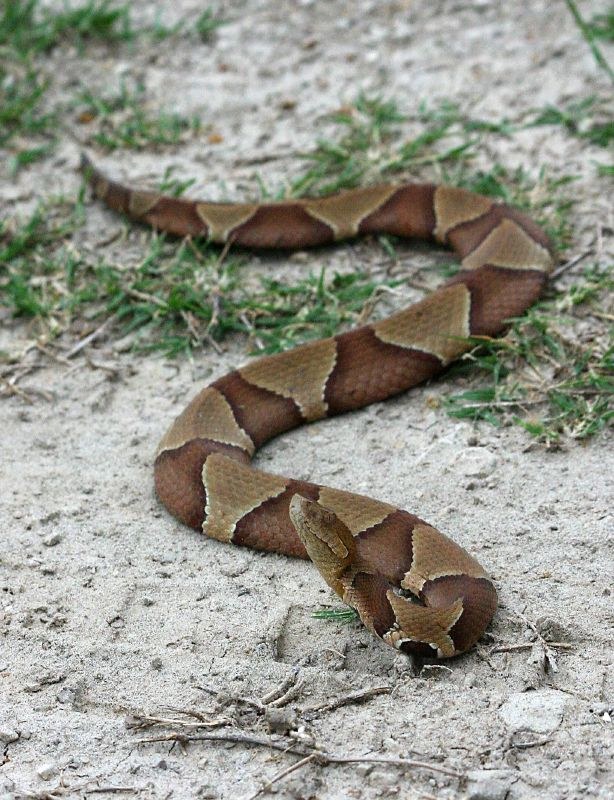
The crossband shape is the tell, not the color. The background is light brown, coppery, or tan, sometimes grayish or pinkish-tan, crossed by strongly contrasting chestnut-brown bands shaped like an hourglass or a dumbbell: narrow at the center of the back, wide along the sides. Patterns vary between individuals, and some snakes show small dark spots between the bands, but nearly all keep at least some complete hourglass-shaped crossbands. A banded snake whose markings are blotches rather than hourglasses is almost certainly something else.
Two pit viper marks on the head
The head carries two family-level pit viper marks. The head is somewhat triangular and distinct from the neck, tan or copper-colored, with no pattern on top and a thin dark line running from the eye to the rear of the jaw. The pupils are vertical and elliptical, and a heat-sensing pit sits between the eye and the nostril. Those last two traits are the most reliable regional tell, and the harmless look-alikes have neither.
Build, belly, and scales
Rather heavy-bodied and slightly triangular in cross-section, with adults averaging 2 to 3 feet. The belly is usually whitish or yellowish-white, sometimes mottled or stippled with brown or gray, with dark spots or smudges along the sides. Dorsal scales are keeled, and the scales beneath the tail are usually undivided except at the tip. The fangs are hinged, recurved, and hollow, set at the front of the upper jaw.
Most reports are wrong
Most reported copperheads are not copperheads. State sources say plainly that most reported sightings are misidentifications of more common banded species. The two frequent culprits are the northern water snake and the eastern milk snake, with occasional confusion involving the eastern hognose snake and immature black racers or black rat snakes. In the Southeast, corn snake gets added to that list, driven by shared coloring rather than any real match in pattern shape.
How to rule out each look-alike
Milk snakes have round pupils, no heat pit, blotchy rather than true hourglass bands against a lighter background, a black-and-white checkered belly, and they buzz their tails in leaf litter when threatened. Northern water snakes have a narrow, dark head rather than a reddish-brown one and turn up in wetter habitat than copperheads prefer. Eastern hognose snakes have a uniformly wide head with an upturned snout and no hourglass pattern. North American racers are glossy black with no coppery tone, a whitish chin, and smooth, unkeeled scales.
It is a conservation question too
Getting the identification right is a conservation question too, not only a safety one. In parts of the Northeast, intentional killing and human disturbance are named as an ongoing threat to copperhead populations that are already small and isolated, and harmless snakes misidentified as copperheads become collateral victims of the same fear. In Massachusetts, copperhead is state-listed as Endangered with only two known populations. That makes a correct identification worth something beyond peace of mind.
Regional and local names you may hear
In North Carolina, copperhead is documented locally as pilot, chunkhead, poplar leaf, and highland moccasin. Highland moccasin in particular shows up across the Southeast. All of them refer to the same species.
Signs of Infestation
No structural damage to find
This species leaves no structural damage, so there is nothing to find after the fact. Copperheads do not chew, burrow, gnaw wiring, or damage buildings. There is no droppings pattern, no entry hole, and no odor a homeowner can work from. The sign is the snake itself, seen or not seen, which is why identification and habitat awareness carry the whole load.
The hourglass crossbands
The visual sign is the hourglass crossband pattern. Narrow at the center of the back, wide along the sides, in chestnut brown against a light brown, coppery, or tan background. Seen clearly, that shape separates copperhead from every regional look-alike. Newborn and young snakes are grayer overall and show a bright yellow tail tip.
Where you actually run into one
Coiled and motionless in leaf litter, under or beside woodpiles, in mulch beds, along rock piles and stone walls, or near foundation gaps. Because copperheads are ambush hunters that hold position rather than flee, most encounters happen by putting a hand or a foot too close to a snake you never saw move.
Silence is itself a small data point
Copperhead has no rattle and no documented warning sound. Several of the harmless look-alikes, including eastern milk snake and North American racer, buzz their tails against leaf litter when startled. A buzzing sound in the leaves is evidence against copperhead, not for it.
It often points at another problem
A copperhead on the property often points at a different problem. Snakes are drawn to properties by prey, and a copperhead's presence commonly signals an existing rodent population rather than an unrelated nuisance. If you are seeing snakes, it is worth checking what they are eating.
Prevention and When to Call a Pro
Leave it alone
That single instruction prevents the great majority of bites. North Carolina's wildlife agency states directly that most bites can be prevented by exercising common sense and leaving copperheads alone, and New Jersey and Massachusetts both independently describe the species as docile, not aggressive, and unwilling to bite unless provoked, handled, or cornered. Humans are far too large to be prey, so a copperhead has no reason to spend venom on a person. Bites are self-defense. A related point that cuts against the panic framing: copperheads frequently deliver a dry bite, striking in self-defense without injecting venom at all, because venom is metabolically expensive and reserved for prey.
Never handle one, small or not
Never try to handle, capture, or kill a copperhead yourself, and never make an exception for a small one. This is where the preventable bites come from. Federal occupational safety guidance states that most snakebites happen specifically when people try to catch or kill a venomous snake, and North Carolina reports the same pattern for copperhead: a large percentage of bites occur during attempted capture, killing, or handling. Separately, and just as important, a juvenile copperhead's venom is just as potent as an adult's. That is CDC occupational safety guidance, which says not to disregard the bite of a small or juvenile venomous snake. North Carolina's wildlife agency reaches the same practical answer by a different route: young copperheads carry less venom than adults and are no more or less dangerous for it. Small size, young age, and the possibility of a dry bite are not reasons to relax caution.
The bucket method is not for this
The bucket-and-board removal method is for confirmed non-venomous snakes only. Virginia's wildlife agency describes a homeowner procedure for a snake found indoors: cover it with a bucket or wastebasket, slide a board underneath, and release it outside on the same property. That procedure applies only when the snake has already been confirmed non-venomous, and no published guidance extends it to a venomous species. If you are not certain, treat the snake as venomous and do not attempt it. For a cold, sluggish snake sitting on a doorstep or driveway, North Carolina's guidance is to encourage it to move along with a garden hose from a safe distance rather than handle it at all.
Habitat modification is the fix
Habitat modification is the practical, homeowner-doable fix. Remove rock piles and brush piles, keep grass mowed short near the house, seal foundation gaps around pipes and vents, and cut back overhanging vegetation along the roofline that could give a climbing snake access to an attic. Then address the reason the snake came: copperheads and other snakes are frequently drawn to a property by an existing rodent population, so removing rodent food and shelter takes away the food source that put the snake there.
Do not buy a snake repellent
North Carolina's extension service states that commercial snake repellents are sold, can be harmful to people and pets if misused, and have not been scientifically shown to work. Spend the money on the rock pile and the rodent problem instead.
If someone is bitten
Do this immediately. Move away from the snake, out to at least half to two-thirds of its body length, so a second strike is not possible. Call 911 right away. Treat every snakebite as an emergency no matter how mild it looks at first. Keep the bitten limb still and at or below heart level. Remove rings, watches, and tight clothing before swelling starts. Wash the bite with soap and water if you can, and cover it with a clean, dry bandage. If you can photograph the snake from a safe distance for identification, do that, but never attempt to catch or kill it. Do not wait for symptoms to decide, and do not treat the absence of visible fang marks as proof that no venom was injected, because the punctures can be too small to see.
What not to do after a bite
Several folk remedies are still in circulation and all of them make things worse. Do not apply ice. Do not apply a tourniquet. Do not cut the wound or try to suck out venom. Do not immerse the bite in water or any other liquid. Do not drink alcohol or caffeinated beverages. Do not take aspirin, ibuprofen, or other NSAIDs, since they can increase bleeding risk. Federal occupational safety guidance states each of these plainly.
How the risk actually scales
Copperhead accounts for probably more than 90 percent of venomous snakebites in North Carolina, because it is widespread and tolerates living near people, and that agency describes a copperhead bite as painful and to be taken seriously but not life-threatening. New Jersey's extension service reports that fewer than 0.0001 percent of copperhead bites between 1983 and 2010 resulted in death, and that no one has ever been killed by a copperhead in that state. Nationally, roughly 65,695 reported venomous snake exposures between 2006 and 2015 produced 31 deaths, a low rate credited to the availability of antivenom and advanced medical care. None of that is a reason to skip the 911 call. It is a reason not to panic while you make it.
Check your state law first
Check your own state's law before doing anything to a copperhead, because the answer changes sharply by state. North Carolina is the baseline case: copperhead is a nongame species with no open season, and it is unlawful to take or possess any nongame reptile there unless you hold a Scientific Wildlife Collection License, or are collecting fewer than 5 reptiles that are not themselves endangered, threatened, or of special concern. That is North Carolina's rule and no one else's. Parts of the Northeast are considerably stricter. In Massachusetts, copperhead is listed as Endangered under the state Endangered Species Act and fully protected from harassment, collection, or killing, with only two known small, isolated populations statewide. In New Jersey, it is listed as a Species of Special Concern, and disturbing, harassing, or harming one is illegal. New Jersey also runs a dedicated Venomous Snake Response Team with regional phone numbers specifically for copperhead encounters. Those are three real state examples, not a national rule.
When a Bite Is an Emergency, Who to Call
Call 911 immediately for any bite from a snake you cannot positively identify as non-venomous. Call a licensed pest control company or wildlife control operator for any snake inside a structure that you are not comfortable identifying or removing yourself, and confirm the company holds whatever state permit snake removal requires where you live. In a state that runs a dedicated venomous snake response service, that service is the correct first call for a copperhead specifically rather than a general pest control line. And call before doing anything that involves handling, trapping, or killing the snake, because that is both the most common way people get bitten and, in some states, against the law.
Frequently Asked Questions
How dangerous is a copperhead bite, really?
Painful and serious, but rarely fatal with modern medical care. North Carolina's wildlife agency, which deals with more copperhead bites than any other state, describes them as painful and to be taken seriously but not life-threatening, and national data shows fewer than 0.0001 percent of copperhead bites result in death. That is not a reason to wait it out. Treat every bite as an emergency and call 911 immediately rather than seeing how it feels.
I found a snake with reddish-brown bands. Is it a copperhead?
Probably not. Most reported copperhead sightings turn out to be a common, harmless look-alike, most often a northern water snake or an eastern milk snake. The real tell is the shape of the bands: a true copperhead's crossbands form an hourglass or dumbbell, narrow at the center of the back and wide along the sides. Copperheads also have vertical, elliptical pupils and a heat-sensing pit between the eye and the nostril. The common look-alikes have round pupils and no pit.
Are baby copperheads less dangerous than adults?
No, and this is a genuinely common misconception. Federal occupational safety guidance says the venom of a small or juvenile venomous snake is just as potent as an adult's. North Carolina's wildlife agency reports that young copperheads carry less venom than adults and are no more or less dangerous for it. Never handle or approach a small or newly born snake on the assumption that it is a lower-stakes situation.
What should I actually do if I get bitten?
Move away from the snake immediately, call 911, and treat it as an emergency no matter how the bite looks at first. Keep the bitten area still and at or below heart level, remove jewelry or tight clothing before swelling starts, and wash the bite with soap and water if you can. Do not apply ice, do not use a tourniquet, do not cut the wound or try to suck out venom, and skip aspirin and ibuprofen, since they can increase bleeding risk. Also keep in mind that punctures can be too small to see, so no visible fang marks does not mean no venom.
Is it legal for me to kill a copperhead I find on my property?
It depends on your state, and in parts of the Northeast the answer may be a firm no. Copperhead is a protected nongame species in North Carolina, an Endangered species in Massachusetts, and a Species of Special Concern in New Jersey, where disturbing, harassing, or harming one is against the law. Check your own state's rules. Also weigh this: most bites happen specifically when people try to catch, handle, or kill a copperhead, not during an unprovoked encounter, so leaving it alone is both the safer choice and, in some states, the legally required one.
Sources
- Copperhead species profile (legal status, identification, behavior, bite statistics, handling guidance) North Carolina Wildlife Resources Commission
- Snakes (AG-472-02): venom biology, pit viper identification, common myths, repellents, and management NC State Extension
- Copperhead species profile (identification, life cycle, distribution, threats, conservation) Massachusetts Division of Fisheries and Wildlife, Natural Heritage and Endangered Species Program
- Eastern Copperheads in New Jersey (Fact Sheet FS1320) Rutgers New Jersey Agricultural Experiment Station Cooperative Extension
- Venomous Snakes: A Neglected Hazard for Outdoor Workers (bite symptoms, first aid, what not to do) Centers for Disease Control and Prevention, National Institute for Occupational Safety and Health
- Problems with Snakes (exclusion, homeowner removal procedure, professional referral) Virginia Department of Wildlife Resources