Seasonal Timeline
Texas coral snakes are most active on cool, sunny mornings in spring and fall. In hot summer weather, activity shifts toward dawn, dusk, and nighttime hours, and the snake spends the coldest months underground.
Texas coral snakes are most active on cool, sunny mornings in spring and fall. In hot summer weather, activity shifts toward dawn, dusk…
This species does not follow the same dual-peak reproductive calendar copperhead and the rattlesnakes do, because it lays eggs rather than giving live birth. Eggs are laid underground or under leaf litter, typically in June, and hatch in September, which puts newly hatched young in ground cover during exactly the weeks people are still out working in yards and gardens. Outside of that egg-laying window, the clearest pattern is simple thermoregulation: cool, sunny spring and fall mornings bring the snake above ground to warm up and hunt, while summer heat pushes it toward dawn, dusk, and nighttime activity instead.
No source publishes seasonality data specific to this species, so this calendar is built directly from cited biological sources. It should be treated as a solid general pattern for Texas rather than a region-by-region breakdown.
Where They're Found
Texas coral snake is found across most of Texas, with the heaviest concentration in the eastern half of the state, in woodlands, canyons, and coastal plains. Its range thins out toward the Panhandle and the far western Trans-Pecos, though it does reach into oak-juniper woodland on the Edwards Plateau and the eastern edge of the Trans-Pecos. Beyond Texas, its documented range extends into western Louisiana, southwestern Arkansas, and south through northeastern Mexico.
Habitat is genuinely varied: mixed pine and hardwood forest, thornscrub, tall-grass prairie, riparian woodland along creeks, rocky canyons, live oak woodland, sandy grass and mesquite country, and even gardens, wooded lots, and undeveloped parkland inside cities. The one constant is ground cover. This snake spends most of its time underground, under leaf litter, logs, stumps, boards, or other debris, rather than out in the open. In the drier western part of its Texas range, it sticks closer to watercourses and streamside vegetation than it does in the wetter eastern half.
Unlike copperhead, the rattlesnakes, or cottonmouth, this species does not seek out structures, woodpiles, or crawl spaces the way a rodent-eating snake does. Its diet is almost entirely other reptiles, so a Texas coral snake sighting is not the same reliable sign of a rodent problem that a copperhead or rattlesnake sighting can be. It more plausibly points to a healthy local population of small ground snakes, skinks, or other reptiles nearby.
Related Pests
Life Cycle
Nearly every stage of this snake's life happens out of sight. Eggs are laid and incubate underground, hatchlings emerge already independent and self-sufficient, and adults spend most of their time under leaf litter, logs, or other ground cover rather than moving in the open. That is the biggest reason this species is genuinely rare to encounter despite being common across most of Texas: it is not hiding from people specifically, it simply lives most of its life below the surface. The one stage most likely to put a homeowner and a Texas coral snake in the same place at the same time is right after the September hatch, when newly emerged young are moving through the same leaf litter and ground cover people are working in during early fall yard cleanup.

Eggs
Juvenile2
Adult
Identification
Where red meets yellow
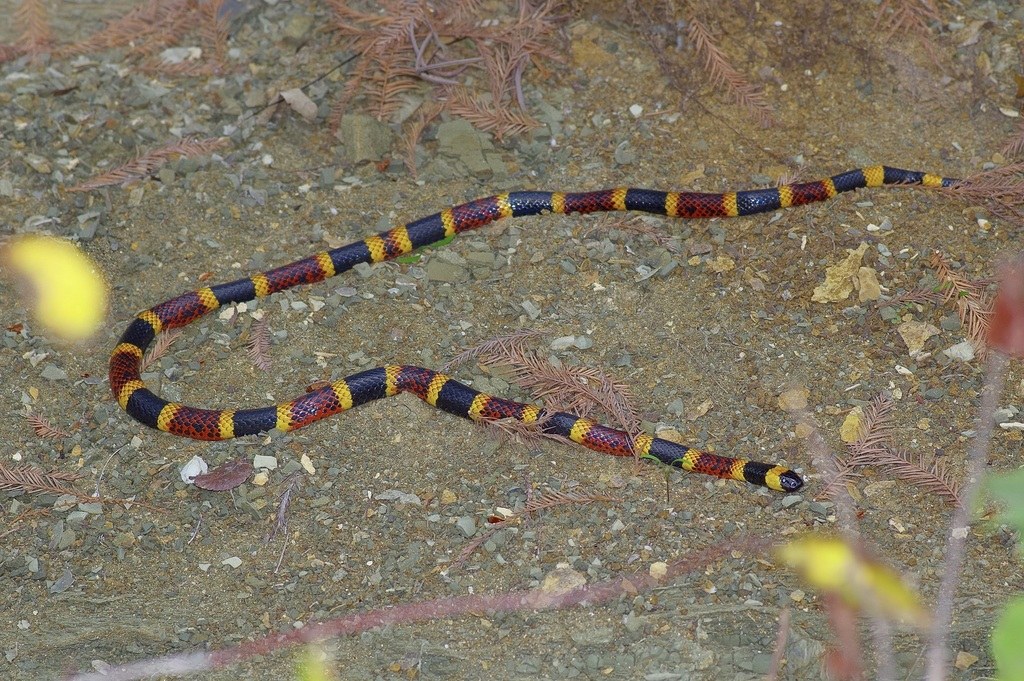
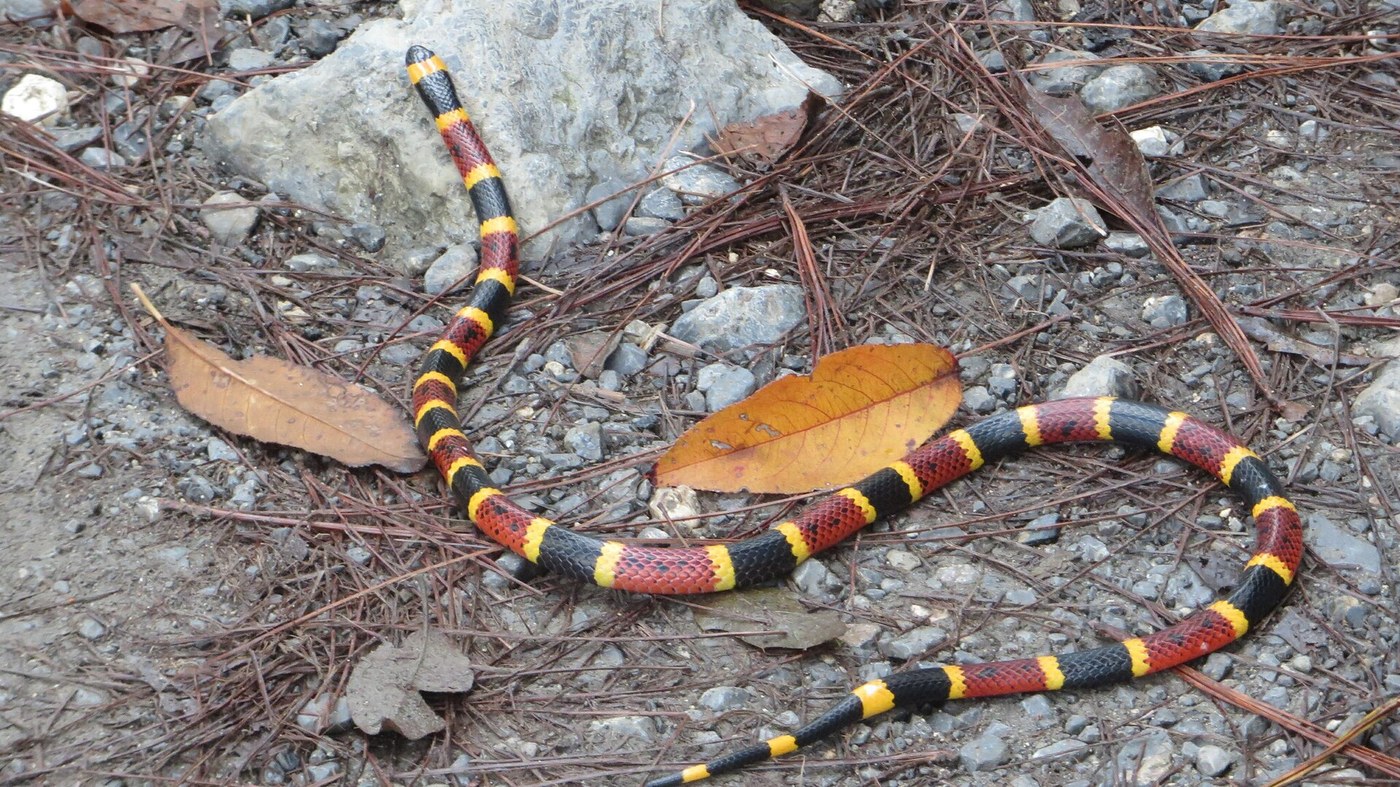
The tell is where red meets yellow, not the colors themselves. Black, yellow, and red bands completely encircle the body and continue onto the belly. The broad black bands run roughly as wide as the broad red bands, separated by narrower yellow rings, and on a true Texas coral snake the red bands always border the yellow bands directly. The head and tail carry only black and yellow, never red.
The rhyme is not an absolute rule
The rhyme is a good starting point, not an absolute rule. "Red touch yellow, kill a fellow" holds for the Texas look-alikes and matches state wildlife guidance, but the herpetologists who work with these animals do not like it. One says plainly that the saying is wrong in two ways, and another that using it is dangerous. It is not foolproof even within Texas: rare albino and all-black (melanistic) individuals exist that do not show the standard banding at all, and the rule becomes considerably less reliable outside the United States, where other coral snake species can show red touching black or lack yellow bands entirely. Treat the rhyme as a strong first check, not a substitute for a full, confident look at the snake.
Build and head rule out pit vipers
Build and head shape rule out the pit vipers fast. Smooth, glossy scales, a small rounded head not clearly distinct from the neck, and round pupils, in contrast to the vertical, elliptical pupils and broader, triangular heads of copperhead, cottonmouth, and Texas's rattlesnakes. The mouth and fangs are small, and the fangs are short and fixed at the front of the jaw rather than long, hollow, and hinged like a pit viper's.
Size and shape
Adults typically run 20 to 30 inches, with most individuals closer to 24 inches and a record specimen just under 4 feet. The tail is short and blunt.
Commonly confused with
Louisiana milk snake and Mexican milk snake, both similarly banded but with red touching black instead of yellow, and with the colored rings stopping at the belly line rather than wrapping all the way around, leaving the underside a uniform lighter color. Texas scarlet snake is a third, frequent look-alike. The Texas scarlet snake is itself a Texas state-Threatened species, which means correctly identifying a coral snake mimic protects a genuinely rare native species, not just a homeowner's peace of mind.
Signs of Infestation
No structural damage
This species leaves no structural damage, since it is a wild reptile with a reptile-based diet, not a structural pest. There is no droppings pattern, no gnaw marks, and no odor to work from. The sign is the snake itself.
The visual sign is the full band pattern
Red, yellow, and black rings completely encircling the body, red touching yellow. Seen coiled, moving through leaf litter, or tucked under a log, board, or debris pile.
No rattle, no sound
This species has no warning rattle and no documented warning sound of any kind.
A sighting is not a rodent signal
A sighting is not the same rodent-problem signal a copperhead or rattlesnake sighting can be. Because this species eats almost exclusively other reptiles rather than rodents, finding one is more likely a sign of a healthy local reptile population than of a rodent issue on the property.
Prevention and When to Call a Pro
Never pick one up
That single behavior explains the great majority of bites. A Texas herpetologist's own strongest piece of advice on this species is simple: never pick it up, since roughly 90 percent of bites happen specifically when someone does exactly that. State wildlife safety material independently confirms the same pattern, noting bites most often follow someone touching or handling the snake, including children drawn in by its bright coloring.
Do not identify it up close
If you find one, do not try to identify it up close, handle it, or kill it yourself. Official state safety guidance is direct: if you cannot identify a snake with confidence, do not pursue it. This species' small mouth and fixed fangs are not a reason to treat it as lower-risk to handle. No published guidance extends a do-it-yourself capture method to a venomous elapid.
General ground-cover habits
They reduce the odds of a surprise encounter. Keep woodpiles, brush piles, and debris away from the house. Check under logs, boards, and overturned objects with a stick or tool before reaching underneath. Use a flashlight when moving around outdoor areas after dark. Because this species is not drawn to structures or to rodent prey the way copperhead and the rattlesnakes are, that is close to the full extent of useful exclusion advice here; there is no rodent-control angle that applies the way it does for those other snakes.
A quick bite is not a safe bite
Do not assume a quick bite is a safe bite. Sources genuinely disagree on whether this species needs prolonged contact to inject venom, and some describe a chewing motion as necessary. Others state plainly that a coral snake can deliver venom in a single, brief bite. Because the sources do not agree, treat any bite as a possible envenomation no matter how quick or minor it looked.
Assume envenomation
If someone is bitten, assume envenomation has occurred even before symptoms appear. This species' symptoms are characteristically delayed, in some documented cases by 12 to 18 hours, and mild pain or swelling at the bite site does not rule out a serious envenomation. Keep the victim and yourself as calm as possible. Treat for shock: elevate the feet and loosen restrictive clothing. Wash the bite area with soap and water. Call 911 or the Texas Poison Center Network at 1-800-222-1222 and get to an emergency department immediately. Expect at least 24 hours of hospital observation given how delayed symptoms can be.
What not to do after a bite
Several folk remedies are still in circulation and all of them make things worse. Do not cut between the puncture marks. Do not try to suck out venom. Do not apply a tourniquet. Do not apply ice. Do not apply electric shock. Texas Parks and Wildlife's own safety material names and rejects each of these directly.
Antivenin supply is not a given
Antivenin exists, but its supply is not something to take for granted. The only FDA-approved treatment for this species' bite has not been actively manufactured since 2003. The FDA has repeatedly extended the shelf life of the existing stock rather than letting it run out, most recently through mid-2026 as of this writing, but there is no guarantee that pattern continues indefinitely, and there is currently no alternative approved product. This is one more reason prevention, not home treatment, carries almost the entire weight. Whatever the supply situation, any bite still belongs at an emergency department immediately, since hospitals locate and dose antivenin through regional poison control networks in real time.
Killing one on your property
This species is not state-listed as threatened or endangered in Texas, but collecting, possessing, or commercially handling any native Texas wildlife, coral snake included, is regulated under Texas Parks and Wildlife's nongame wildlife rules, and the specific rules can vary and change. Check current Texas Parks and Wildlife regulations before assuming any particular action is automatically allowed, and consider that the behavior that actually causes bites, picking the snake up, is the same behavior a legal question would be raised about in the first place. Leaving it alone answers both questions at once.
When a Bite Is an Emergency, Who to Call
Call 911 or the Texas Poison Center Network immediately for any bite from a snake matching this pattern, or from any snake you cannot positively identify as non-venomous, and go to an emergency department rather than waiting to see if symptoms develop. Call a licensed pest control company or wildlife control operator for a snake found inside a structure, or one that keeps turning up on a property you are not comfortable identifying or handling yourself, and confirm the company holds whatever permit Texas requires for native snake removal.
Frequently Asked Questions
How do I tell a Texas coral snake from a harmless look-alike?
Check whether the red bands touch the yellow bands. On a true coral snake they do, and the pattern fully encircles the body onto the belly. On the harmless mimics, the Louisiana and Mexican milk snakes and the Texas scarlet snake, red touches black instead, and the colored rings stop at the belly line rather than wrapping all the way around. The rhyme "red touch yellow, kill a fellow" is a reliable starting point in Texas, but rare albino or all-black individuals exist that don't show the standard pattern at all, so it isn't a substitute for a confident, full look at the snake.
Do coral snakes have to chew on you to inject venom?
Sources genuinely disagree on this. Some clinical references describe coral snakes as needing prolonged contact and a chewing motion to deliver venom through their small, fixed fangs. Texas's own state health department and emergency medicine sources say this is a myth and that a coral snake can deliver venom in a single, quick bite. Because sources don't agree on which is true, the safe assumption is that any bite, however brief, could be a real envenomation.
How dangerous is a Texas coral snake bite?
Genuinely serious, but rare, and with prompt treatment, rarely fatal. The venom is neurotoxic and can cause muscle weakness, difficulty breathing, and paralysis, sometimes many hours after a bite that looked mild at first. Before antivenin existed, fatality rates ran as high as 10 to 20 percent. Since it became standard treatment, deaths are very uncommon. That said, treat every bite as an emergency and get to a hospital immediately rather than waiting to see if symptoms appear.
Is coral snake antivenin still available?
The only FDA-approved treatment for this species' bite hasn't been actively manufactured since 2003. The FDA has repeatedly extended the shelf life of the existing stock rather than letting supply run out, most recently through mid-2026 as of this writing, but supply is not unlimited going forward. This is one more reason prevention, never handling the snake, matters more than it might for a species with a more secure antivenin supply.
Is it legal to kill a Texas coral snake on my property?
This species isn't state-listed as threatened or endangered in Texas, but collecting, possessing, or commercially handling any native Texas wildlife, coral snake included, is regulated under Texas Parks and Wildlife's nongame wildlife rules, and specific rules can vary and change. Rather than guess, check current Texas Parks and Wildlife regulations or call a licensed wildlife control operator. It's also worth knowing that the great majority of bites happen specifically when someone tries to pick the snake up, so leaving it alone is both the safer and the simpler choice.
Sources
- Venomous Snake Safety (identification, range, safety guidance) Texas Parks and Wildlife Department
- Snake FAQ (identification, mimic species, behavior) Texas Parks and Wildlife Department
- Texas Venomous Snakes safety brochure, PWD BR W7000-693 (first aid, prevention) Texas Parks and Wildlife Department
- Texas Nongame and Rare Species Program, listed reptiles table (legal/regulatory status) Texas Parks and Wildlife Department
- Micrurus tener (taxonomy, range, habitat, conservation status) NatureServe Explorer
- Coral Snake Toxicity (venom mechanism, symptoms, antivenin) National Center for Biotechnology Information (NIH), StatPearls
- Snake (venomous snake bite guidance) Texas Department of State Health Services
- Expiration Date Extension for North American Coral Snake Antivenin U.S. Food and Drug Administration
Image Credits
- Image: Michelle W. (鍾偉瑋) via iNaturalist. CC BY 4.0.
- Image: Rogelio Reyna-Hernández via Wikimedia Commons. CC BY-SA 4.0. Resized, so this version is offered under the same license.
License.