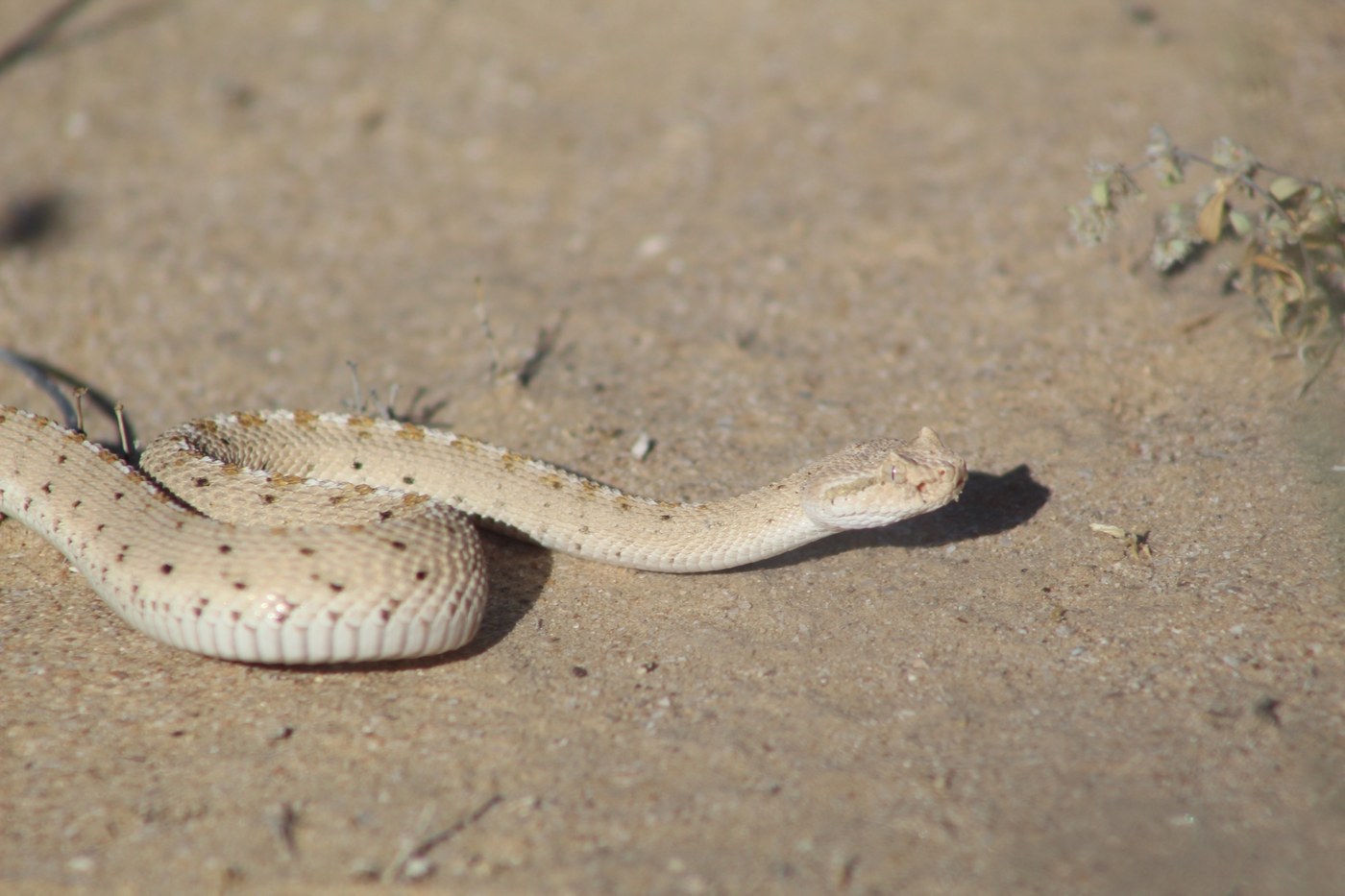
Seasonal Timeline
Sidewinder breeds in spring and summer, bears live young in summer following a four to five month gestation, and is primarily nocturnal in warm weather, shifting toward dawn and dusk activity or occasional daytime movement in cooler months. It can go quiet entirely through the hottest stretch of mid-summer, and during the day or extreme heat it retreats into rodent or tortoise burrows or buries itself in sand through a behavior called cratering.
Sidewinder breeds in spring and summer, bears live young in summer following a four to five month gestation, and is primarily nocturnal in…
Heat and season both bend this snake's schedule in the same direction. Through the warm months it hunts and moves mostly at night, shifting to the cooler hours around dawn and dusk as temperatures ease, and it can stop moving altogether during the worst heat of mid-summer. Daytime is spent in a rodent or desert tortoise burrow, or buried in sand up to the eyes and horns through a behavior called cratering, which cools the animal and doubles as an ambush position.
Reproduction adds its own late-season bump. Mating happens in spring and summer, and live young arrive in summer after a gestation of roughly four to five months. Females feed heavily early in the reproductive cycle to build reserves, then eat less as gestation continues, and sources disagree on what happens after birth. One account has the newborns staying with their mother in a burrow for 7 to 10 days, with the mother thought to guard them. The Nevada Department of Wildlife states that the young receive no parental care at all. Birth itself takes about two to three hours.
Where They're Found
Sidewinder is an entirely outdoor, wild desert species with no reason to enter a structure and nothing to gain from one.
Its range is narrower and more sand-specific than most rattlesnakes, and the available sources converge tightly on it: southeastern California, southern Nevada, southwestern Utah, and western Arizona, continuing south into northwestern Mexico. No published record places this species in New Mexico, Alaska, or Hawaii. Its entire range sits in hot, low desert.
What actually matters on a property is the ground itself. This snake needs fine, wind-blown sand, sandy washes, sand dunes, and open, unobstructed flats, sometimes hardpan or rocky hillsides, but always terrain open enough to allow its sideways gait. Rodent and desert tortoise burrows supply shelter, winter dormancy, and ambush positions near the entrance. A property sitting directly on or next to active dune or wash terrain is a meaningfully different risk picture than one that is not, which is not true of most other rattlesnakes.
Life Cycle
What happens to the newborns after birth is the reproductive detail sources disagree on most. One account has the young staying with their mother in a burrow for 7 to 10 days, with the mother thought to guard them, while the Nevada Department of Wildlife states the young receive no parental care after birth. Birth itself takes about two to three hours. The energetic cost of reproduction is the leading explanation offered for why wild females live only about five years on average while males can reach 13, an unusual life-history split for a rattlesnake.

Mating
Gestation
Birth and Neonate
Juvenile and Adult
Identification
Two traits do all the work
Start with the two traits that do essentially all the work here, because neither is shared with any other United States rattlesnake. Above each eye sits a raised, horn-like supraocular scale, the reason this snake is also called the horned rattlesnake, most likely there to shade the eyes and keep drifting sand out of them, and possibly to protect the eyes from abrasion while the snake moves through burrows. The scales fold flat under direct pressure, and many older adults show worn or missing horns after a lifetime underground, so their absence on an older individual does not rule the species out.
The gait itself
The second trait is the gait itself, and it is worth learning even without seeing the snake. Sidewinding lifts sections of the body up and rolls them sideways across the sand, keeping only two or three points of the body touching the ground at any instant. A peer-reviewed 2014 study published in Science, run by researchers at Georgia Tech, Carnegie Mellon, Oregon State University, and Zoo Atlanta, found that as a sandy slope gets steeper, the snake increases how much of its body stays in contact with the sand, matching the reduced holding strength of steeper loose sand and letting it climb close to the steepest angle the sand itself can support without sliding out. A published follow-up comment refines the original picture into three distinct phases of body-sand contact rather than one simple rule, a real scientific refinement rather than a contradiction.
The track is easier to find
That gait leaves a track that is often easier to find than the snake. Sidewinding produces a distinctive reverse J-shaped track pattern in sand, frequently ending in a shallow circular depression where the snake has cratered itself. The National Park Service specifically recommends looking for these tracks in dune areas as the reliable sign of a sidewinder's presence.
Size and build
This is a small rattlesnake, roughly 17 to 31.5 inches as an adult, with a triangular head, elliptical pupils, heat-sensing facial pits, and a segmented rattle, the same family-level pit-viper traits shared across the pit vipers. One genuinely unusual, sourced fact: females grow larger than males, which is unique among United States rattlesnakes.
Color
Ground color runs cream, buff, yellowish-brown, pink, or ash gray, with 28 to 47 darker blotches down the back, and the belly is white in the most common subspecies. The species can also shift shade somewhat with temperature.
No documented look-alike
No well-documented look-alike species has been reported. The combination of small size, raised horns, and sand-specific habitat is distinctive enough among United States rattlesnakes that no published account frames the sidewinder as commonly confused with another species in the field.
Signs of Infestation
Nothing to inspect
The usual inspection checklist does not apply to a snake, because a snake leaves nothing behind to inspect the way an insect or rodent does. Sidewinder builds nothing, chews nothing, and never gets inside a wall or crawlspace, so there is no gnaw mark, entry hole, dropping trail, or odor to work backward from. The sighting, or the track, is the evidence, and reading it correctly is what matters.
The track is the most useful sign
The most useful sign, and one this species offers that most rattlesnakes do not, is its track. A reverse J-shaped pattern in sand, often ending in a shallow circular depression where the snake buried itself, is specifically recommended by the National Park Service as the thing to look for in dune areas, and it can confirm a sidewinder's presence even when the animal itself is never seen.
The snake, from a safe distance
The visual sign is the snake, read from a safe distance. It is often visible only as eyes and horns above the sand line when cratered, or as a small, sand-colored, coiled body near a burrow entrance.
Rattling is a warning, not an identification
A disturbed sidewinder rattles like any other rattlesnake sharing its range, so the sound says back away, not which species is present.
Location narrows the search
More than for most rattlesnakes. Because this species needs open, fine, wind-blown sand to sidewind effectively, a property directly on or adjacent to active dune or sandy-wash terrain is a materially more likely encounter site than a property on rocky or densely vegetated ground, where this particular snake is far less at home.
Prevention and When to Call a Pro
Leave it alone and give it room
Sidewinder is documented across sources as a shy animal, and accidental bites happen mainly when someone steps on or reaches for a snake it cannot escape from. Distance ends nearly every encounter without incident.
Never handle one you cannot name
Never handle, move, or kill a snake you cannot confidently identify. No specific look-alike species has been documented for sidewinder, but the standing caution still applies: misjudging a small desert rattlesnake in poor light or brief view is a real risk, and the wrong call costs far more than walking away does.
Habitat work is specific here
Habitat work is more specific for this snake than generic snake advice allows, because its needs are specific. Sidewinder is drawn to loose sand, sandy washes, and active mammal burrows, and it hunts rodents and lizards near them. Reducing rodent activity and limiting open, undisturbed sand right around a structure, rather than generic advice to seal cracks, is the step actually supported by this species' own documented habitat needs. General yard cleanliness, keeping cover down, and not letting birdseed or spilled feed build up under feeders, all of which draw the rodents this snake hunts, is standard state wildlife agency guidance for rattlesnakes broadly and applies here too.
Fencing and sealing gaps
Snake-proof fencing and sealing ground-level gaps around a structure is the standard rattlesnake exclusion approach generally. No exclusion method specific to this species beyond that general practice has been documented.
What the venom actually does
It also compares differently to other rattlesnakes. Published venom-yield figures place the sidewinder's typical dose well below several other rattlesnakes, and venom-composition research describes its venom as comparatively uniform across its range, unlike the geographic variability documented for the Mojave and Southern Pacific rattlesnakes. Composition is described as mainly hemotoxic, with minor neurotoxic and minor or absent myotoxic components, so a neurotoxic component is documented even though it is a minor one. None of that makes a bite minor. It is a real, sourced difference in typical dose and severity driven mainly by the snake's small body and smaller venom glands, not a claim that this bite can be safely ignored, and no dedicated clinical patient-outcome study specific to this species has been published to confirm how that plays out in real bites.
If someone is bitten
The immediate steps are the standard ones for any venomous snakebite. Call 911 right away and treat it as an emergency regardless of how mild it looks at first. Keep the affected limb at or below heart level and get to emergency care. This protocol comes from federal occupational safety guidance from CDC and NIOSH and does not change based on which rattlesnake species delivered the bite.
What not to do
It still gets repeated and none of it helps. Do not apply ice. Do not use a tourniquet. Do not cut the wound. Do not try to suck out venom. Skip alcohol and caffeinated drinks. Do not take aspirin, ibuprofen, or other NSAIDs, which can increase bleeding risk. Federal guidance states each of these plainly.
Dry bites
Dry bites, where little or no venom is injected, are documented for rattlesnakes generally. No published account confirms them specifically for the sidewinder, so treat it as a general possibility rather than a species-specific expectation, and never as a reason to delay care.
The law is a state question
The law here is a state question, and the answers are specific. In California, Code of Regulations Title 14 Section 5.60 names sidewinder directly, grouping it with the Mojave, western diamond-backed, western, and speckled rattlesnakes at a limit of two per day, taken year-round at any hour by any method, with no sportfishing license required for rattlesnake take specifically. The red diamond rattlesnake, a different species in the same state, carries a limit of zero, a reminder that rattlesnake rules are not interchangeable across species even within one state. In Nevada, the state wildlife agency's own species profile lists sidewinder as a Priority Species that is Unprotected, with a Non-Game classification, meaning the state tracks it as a conservation interest while placing no legal protection on taking it. Arizona also falls inside this species' documented range. Arizona's reptile and amphibian regulations place species not on the state's short no-open-season list under a General Reptiles category with a year-round season and a four-per-year bag and possession limit under a valid hunting license, and the sidewinder is not on that no-open-season list. No federal protection or interstate reporting requirement was found for this species, but rules vary and change, so verify your own state and locality before acting.
When a Bite Is an Emergency, Who to Call
Call 911 immediately for any bite matching a rattlesnake description, whether or not the species is confirmed. For a snake confidently identified and holding ground near an occupied structure, especially on a property bordering active dune or wash terrain, or anywhere people and pets cross regularly, call a licensed nuisance wildlife control operator or your state wildlife agency rather than attempting removal yourself.
Frequently Asked Questions
Why do sidewinder rattlesnakes move sideways?
A peer-reviewed 2014 study published in the journal Science, run by researchers at Georgia Tech, Carnegie Mellon, Oregon State University, and Zoo Atlanta, found that sidewinders increase how much of their body stays in contact with the sand as the slope gets steeper, matching the reduced holding strength of steeper loose sand and letting the snake climb close to the steepest angle the sand can support without sliding. At any given instant, only two or three points of the body actually touch the ground, which also limits both slipping and the time any one part of the body spends against hot sand.
What are the horns above a sidewinder's eyes for?
They are enlarged, raised supraocular scales, not true horns. The leading explanation is that they shade the eyes and keep windblown sand out of them while the snake lies buried or partly buried in sand, with a secondary possibility that they protect the eyes from abrasion while the snake moves through burrows. The scales fold flat under direct pressure, and many older adults show worn or missing horns from years underground.
Is a sidewinder rattlesnake bite as dangerous as other rattlesnake bites?
Any rattlesnake bite is a medical emergency and should be treated as one immediately. That said, sourced venom-yield figures and venom-composition research indicate sidewinder generally injects a smaller, comparatively less potent dose than many larger rattlesnakes, mainly because of its smaller body and venom glands, which makes its bites generally less severe on average. No dedicated clinical study specific to sidewinder bite outcomes was found to confirm this in real patients, and none of it is a reason to delay care.
Where do sidewinder rattlesnakes live?
They occupy a narrower niche than most rattlesnakes: fine, wind-blown sand dunes, sandy washes, and open desert flats in southeastern California, southern Nevada, southwestern Utah, and western Arizona, plus adjacent northwestern Mexico. Because sidewinding needs open, unobstructed ground, this species is far less likely on rocky or densely vegetated terrain than on active sand.
How can I tell if a sidewinder has been nearby without seeing the snake?
Look for its tracks. Sidewinding leaves a distinctive reverse J-shaped pattern in sand, often ending in a small circular depression where the snake buried itself. The National Park Service specifically points to these tracks as the reliable sign to look for in dune areas, even when the snake itself is never spotted.
Sources
- Crotalus cerastes: taxonomy, size, sex-based size difference, venom yield, lifespan, and subspecies range Wikipedia (cross-checked against cited primary literature: Klauber 1956, Glenn and Straight 1982, Norris 2004, Secor 1994)
- Crotalus cerastes HALLOWELL, 1854: species and subspecies distribution, taxonomic authority record The Reptile Database
- Sidewinder species profile: Nevada state conservation status, game status, size, lifespan, habitat, litter size Nevada Department of Wildlife
- Sidewinder (Mojave Desert sidewinder subspecies): color, size, diet, reproduction, habitat, cratering behavior, J-shaped tracks U.S. National Park Service, Death Valley National Park
- Crotalus cerastes (Sidewinder): mating system, gestation, litter size, maternal guarding behavior, neonate independence, caudal-luring predation Animal Diversity Web, University of Michigan Museum of Zoology
- Sidewinding with minimal slip: Snake and robot ascent of sandy slopes (Science, 2014) - peer-reviewed sidewinding locomotion biomechanics study Georgia Institute of Technology, CRAB Lab
- Snakes and Snake-like Robots Show How Sidewinders Conquer Sandy Slopes: news coverage of the peer-reviewed sidewinding biomechanics study Carnegie Mellon University
- California Code of Regulations Title 14 Section 5.60: sport take of reptiles and rattlesnake-specific bag limits, sidewinder named at a 2-per-day limit Cornell Law School Legal Information Institute
- Venomous Snakes: A Neglected Hazard for Outdoor Workers - national bite first aid and what not to do Centers for Disease Control and Prevention, National Institute for Occupational Safety and Health
- Living with Rattlesnakes: general homeowner prevention guidance for yard cleanliness and rodent-attractant reduction Nevada Department of Wildlife
Image Credits
- Image: Tereso Hernández Morales via iNaturalist. CC BY 4.0.
License.