Seasonal Timeline
Northern Pacific rattlesnake is a warm-season animal that spends roughly half the year underground. Washington's wildlife agency has snakes emerging from communal dens in April, dispersing to summer foraging ground within two to three weeks, and returning to those same overwintering sites from late September through October. British Columbia's own species account puts the winter period at about 180 days, longer in the cooler parts of the range. In California the working window most sources give is April through October. Live young arrive at the tail end of it, August through October.
Northern Pacific rattlesnake is a warm-season animal that spends roughly half the year underground. Washington's wildlife agency has snakes…
The season is really two movements, out and back, and both are aimed at the same rock. Washington's Department of Fish and Wildlife describes snakes emerging from communal hibernacula in April, spending a couple of weeks basking near the den entrance, then dispersing to summer foraging areas, with the return trip starting in late September and running through October. British Columbia's provincial species account gives the same shape in more detail: a winter period of about 180 days or longer, emergence in March through April, considerable time spent basking at den entrances before anything disperses, and a fall retreat that is fast once temperatures drop, with virtually all snakes back at the hibernaculum by mid-October.
How far they go, and what that means for where you meet one. A peer-reviewed radio-telemetry study in the Thompson-Nicola and Okanagan-Similkameen regions of British Columbia implanted transmitters in 35 male snakes, tracked 30 complete migrations across 10 different denning sites, and measured a mean maximum migration distance of 1,847.8 meters, plus or minus 930.0, with individuals ranging from 373.0 to 3,985.7 meters from the den. The study split its animals cleanly in two. Fifteen snakes climbed into higher-elevation forest and traveled an average 2,359 meters. Fifteen stayed in grassland and traveled 1,337 meters. The forest travelers' routes averaged near the 80th percentile for thermal quality against the 50th percentile for the grassland group, which is to say the longer trip bought a better temperature. Migration direction was den specific rather than random, meaning snakes from one hibernaculum tended to head the same way year after year. A separate genetic study of the same northern populations found males ranging a maximum of roughly 4 kilometers from their den of origin.
The practical version. A property within a kilometer or two of a rocky south-facing slope, a rimrock band, or a talus outcrop is inside the normal summer range of whatever snakes den in that rock, even if the rock is not visible from the yard. Spring and fall are when the two ends of that trip cross yards, driveways, and roads, which is also why Oregon's own snake guidance notes that vehicles account for more snake deaths than any other cause.
One seasonal figure is missing from the record. No published source gives an air-temperature or soil-temperature threshold for local emergence, which would be the genuinely useful number for a homeowner trying to time yard work. What the sources give instead is the calendar, and the calendar shifts with elevation and latitude across a range that runs from sea level in coastal California to valley bottoms in southern interior British Columbia. Treat April through October as the working window and expect the edges to move.
Where They're Found
Northern Pacific rattlesnake is an entirely outdoor, wild animal. It is not a structural invader in the way a rodent or a bat is, and it has no biological reason to be inside a building. Its range covers California and the Pacific Northwest, and the interesting parts are all at the edges.
California is the southern two-thirds of the story. California's Department of Fish and Wildlife calls the western rattlesnake the most widespread rattler in the state and places this particular subspecies, Crotalus oreganus oreganus, throughout Central and coastal Northern California. University of California's own integrated pest management program puts the same animal from the northern part of the state as far south as Santa Barbara County. That southern terminus is not a hard line: the standard California herpetological reference describes this subspecies intergrading with Southern Pacific rattlesnake, Crotalus oreganus helleri, in Santa Barbara County, which is exactly where Southern Pacific rattlesnake takes over. In the Sierra Nevada foothills and the Bay Area it is usually the only venomous snake present at all. The National Park Service states that Yosemite National Park is home to only one rattlesnake, and this is it.
Elevation is genuinely disputed across sources. California's wildlife agency gives the western rattlesnake from sea level to 7,000 feet. University of California's pest management program gives the same 7,000-foot ceiling for this species specifically, while noting the state's rattlesnakes as a group reach about 11,000 feet. The National Park Service puts Yosemite's animals up to about 9,000 feet. The standard California herpetological reference goes higher still, to roughly 11,000 feet with a 2010 record above 12,000 feet in Nevada, although a record that far east is more plausibly a Great Basin animal than this subspecies. Treat 7,000 feet as the well-supported working figure, understand that 9,000 feet is documented by a federal park source, and treat anything above that as contested.
Pacific Northwest, where the Cascade crest does the sorting. Washington's Department of Fish and Wildlife is specific: the western rattlesnake occurs only east of the Cascade Mountains, across the East Cascades, Columbia Basin, Okanogan, and Blue Mountain regions, with the westernmost documented point about one mile west of Dog Mountain in the Columbia Gorge. Habitat there is shrubsteppe, plus Oregon white oak and ponderosa pine, with talus and basalt outcroppings used for overwintering. British Columbia's provincial account independently describes the species as occupying Washington east of the Cascades. The standard California herpetological reference words Washington differently, placing the animal west of the Cascades there, and the two agency sources are the better guide, because they agree with each other and are jurisdiction-specific.
Oregon splits between two subspecies, and getting that split right matters. Oregon's Department of Fish and Wildlife states that the western rattlesnake is Oregon's only indigenous rattlesnake and recognizes two subspecies in the state: this one, in southwestern Oregon, the mid to southern Willamette Valley, and the Columbia Plateau, and the Great Basin rattlesnake in south central and southeastern Oregon. That means the arid southeast corner of Oregon, along with Nevada and Utah, belongs to a different animal entirely. Oregon also carries the only conservation designation this species holds anywhere in California or the Pacific Northwest.
Two range edges at the margins. Idaho is real but poorly pinned down. Idaho Fish and Game lists Crotalus oreganus as native and present in the state and ranks it apparently secure, and the sources disagree on how far in this particular subspecies reaches: British Columbia's provincial account says west-central Idaho, the standard California reference says extreme northwestern Idaho, and a state-specific account associates it with the Salmon, Clearwater, and Snake River drainages. British Columbia is the other edge. The species reaches the dry southern interior valleys of the province, the Similkameen, Okanagan, Kettle, Nicola, and Thompson, and the Fraser around Lytton and Lillooet, typically below 800 meters, and it is the only rattlesnake and the only truly venomous snake in the province. That population is federally threatened in Canada and blue-listed provincially, and much of the best research on the species comes from it.
Alaska and Hawaii. No published record places this species in either. Every range description found runs from northern Mexico up the Pacific slope and interior valleys to southern British Columbia, which puts Alaska hundreds of miles beyond the northern terminus even in the most generous reading, and Hawaii outside the continental range entirely. Neither region should be treated as within this species' distribution.
On a property, the thing to find is rock, and the thing to remember is that this snake cannot dig. University of California's pest management program states it plainly: rattlesnakes cannot dig burrows, so they use burrows dug by rodents. That single limitation explains most of what a homeowner actually sees. Add to that rock crevices, talus, dense brush, tall grass, woodpiles, lumber piles, rotten stumps, and the gap under a garage door, plus the dampness around fountains, ponds, and pool and hot tub equipment enclosures, which draws snakes in summer heat. In the arid interior the highest-value feature by far is a south-facing or warm-aspect rock outcrop with deep fissures, because that is a hibernaculum, and hibernacula are the single most critical habitat feature this species has.
Diet is why a snake keeps coming back. Adults eat mostly small mammals, and the northern-range diet studies are specific: meadow voles, montane voles, and deer mice dominate, with 10 kinds of mammals plus a few small birds recorded, and adults taking animals as large as red squirrels, northern pocket gophers, and young yellow-bellied marmots. Juveniles eat mostly mice, shrews, and lizards. In California, ground squirrels are a staple. Because the main prey animals are active from dusk to dawn, that is when most foraging happens, which is a large part of why a property can hold a snake nobody has seen in daylight. A property producing repeat sightings is usually a property producing rodents.
Related Pests
Life Cycle
The reproductive calendar on this species is not one calendar, it is a latitude gradient, and the sources genuinely disagree because they are describing different ends of it. The California reference, following the foundational rattlesnake research, has females first bearing young around three years old and breeding annually. British Columbia's provincial account states that females there appear to breed only every third year, and provincial materials add that a female must double her body weight before she can breed again, which frequently takes two summers, and that the fasting period around a pregnancy runs 19 months or more. One non-agency British Columbia reference reports females maturing at 5 to 7 years and often not having a first litter until 7 to 9. Those are not contradictions so much as the same animal at two ends of a 1,500-mile range.
Why that gradient matters more for this species than for most snakes. A southern population that breeds every year recovers from losses. A northern population where a female breeds perhaps three or four times in a life, from a den that its whole local group returns to for generations, does not. British Columbia's own materials say it directly: areas where rattlesnakes or their dens have been eliminated will not be readily reoccupied, and if a hibernaculum is destroyed while the snakes are away, most individuals will be unable to find a suitable replacement and will die as winter approaches. Genetic work on those northern populations found 11 genetically distinct complexes of dens across five regions with generally low migration between them, and concluded that treating all Canadian animals as a single unit should be reconsidered. Take that as the reason a den is a different kind of object than a snake.
Two counts that are not what people think they are. Rattle segments do not give age, because a new segment is added at every shed, sheds can happen more than once a year, and terminal segments break off on older animals. Fangs are on their own schedule entirely: Oregon's guidance states that rattlesnakes are born with multiple sets of fangs which are shed and replaced roughly every two months, one side before the other so the snake is never without a working fang, with replacement taking a couple of days.

Mating
Gestation
Birth
Neonate
Juvenile and Adult
Identification
Start with the pit viper marks
They settle the family before anyone argues about the species. A heat-sensing loreal pit sits between the eye and the nostril on each side, the pupils are vertically elliptical rather than round, the head is broad and triangular and noticeably wider than the neck, the dorsal scales are heavily keeled, and a segmented rattle sits on a short blunt tail. Those are the same family-level traits that copperheads, cottonmouths, Mojave rattlesnakes, prairie rattlesnakes, western diamondback rattlesnakes, and Southern Pacific rattlesnakes all share. Stopping at the family level and backing away is a complete and correct outcome.
Size runs a wide range
The regional averages differ. The California reference gives adults 15 to 36 inches, occasionally to 48 inches, with a maximum record near 60 inches. Washington's wildlife agency puts the largest Northwest specimen at 59 inches but says most adults encountered in Washington are much closer to 2 feet. A university museum account for Washington gives about 36 inches as typical. British Columbia's provincial account gives a maximum of 1.2 meters, roughly 47 inches, and notes animals that large are rarely encountered. Treat 2 to 3 feet as what you will actually see and 4 feet plus as a large individual rather than a different species.
The pale-bordered blotch is better
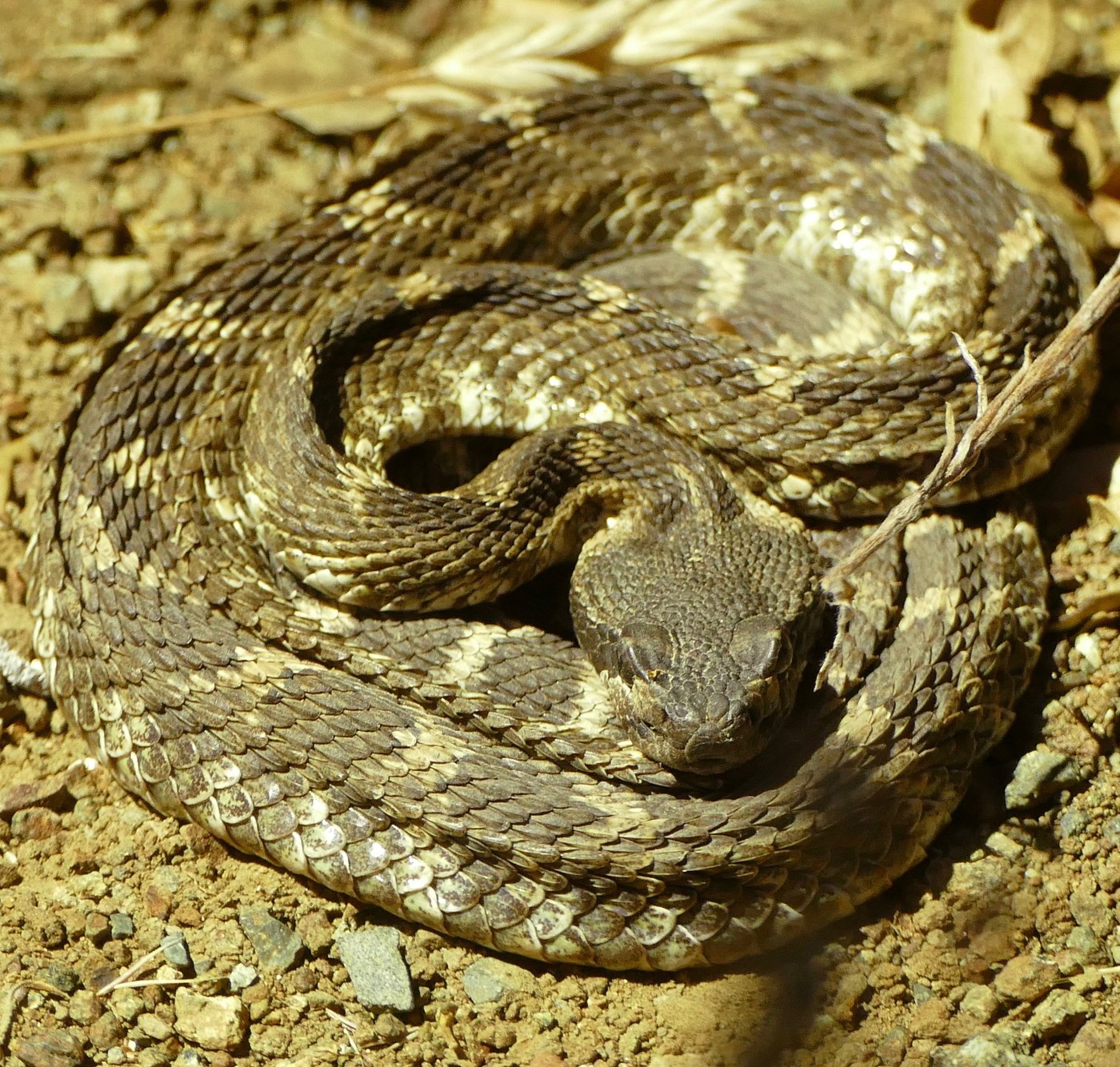
Color is variable enough to be a weak starting point, and the pale-bordered blotch is the better feature. Ground color runs olive-green, gray, brown, golden, reddish-brown, yellowish, or tan depending on where the animal lives. What holds across the range is the pattern: large dark brown to black blotches down the back, each edged with a lighter border, changing to dark bars on the rear third of the body and then to rings on the tail. British Columbia's account adds that in older animals those blotches may be ringed in white or cream, and that juveniles are usually lighter with more contrast than adults.
The diagonal face stripe
It is the tell most pest-control pages leave out. A light-bordered dark stripe runs from behind or below the eye back to the corner of the mouth or jaw. Washington's wildlife agency lists a distinct eye stripe among its three headline features. British Columbia's brochure describes a broad dark stripe on each side of the face from below the eye to the corner of the jaw. It is a more consistent feature than any color name on this list.
The gopher snake imitates it
The look-alike that matters across this whole range is the gopher snake, and its imitation is deliberate. Oregon's own guidance describes the gopher snake flattening its head, coiling, striking, hissing loudly, and vibrating its tail tip to complete the impression, and states outright that this aggressive display is why so many people believe it is a rattlesnake. Two subspecies do this in Oregon alone, the Pacific gopher snake in the Willamette Valley and southwest Oregon and the Great Basin gopher snake east of the Cascades. University of California's pest management guidance describes the same mimicry in California and adds physical separators: a gopher snake is usually thinner throughout the body, glossy rather than dull, with round pupils and a head only slightly larger than the neck.
The tail separates them
The tail is the cleanest way to separate them, and Oregon says why. A gopher snake's tail comes to a fine point and has no rattle. A rattlesnake's tail is blunt and carries the rattle. Sound proves nothing, because a gopher snake vibrating its tail against dry ground makes a convincing buzz, but the structure at the end of the tail is real and visible from a safe distance.
One precise Oregon detail on pupils
It is worth carrying. Oregon's guidance notes that among Oregon's snakes the only ones with elliptical cat-eye pupils are rattlesnakes and night snakes. That is a narrower and more useful statement than the usual generic "venomous snakes have slit pupils," and the night snake exception is exactly the kind of thing a generic identification page skips.
Rattle segments are not an age
Rattle segments do not tell you the animal's age. A new segment is added each time the snake sheds, shedding can happen several times a year, and terminal segments break off on older snakes. Newborns carry only a button. University of California's guidance makes the practical point in the other direction as well: because rattles shorten or break off entirely, the absence of a visible rattle does not prove a snake is not a rattlesnake.
It often does not rattle at all
This snake often does not rattle at all, which is the single most dangerous assumption people make about it. The National Park Service, writing about Yosemite's animals, states that they rarely rattle even around predators and instead remain still to avoid being seen. British Columbia's brochure describes them departing or seeking cover when approached and rattling mainly when cover is not available. Silence is the default behavior of a well-camouflaged ambush predator, not evidence that nothing is there.
The mechanism is fast
When it does rattle, the mechanism is faster than most people picture. The National Park Service gives a rattling rate of 20 to 100 times per second, varying with temperature. That temperature dependence is a real detail: the same animal sounds different on a cool morning than on a hot afternoon.
The scientific name disagrees
It disagrees three ways among sources that are all currently in use. Washington's wildlife agency, California's wildlife agency, British Columbia's provincial account, Idaho Fish and Game, and the US Fish and Wildlife Service all use Crotalus oreganus, with the federal service carrying this animal specifically as the subspecies Crotalus oreganus oreganus. Oregon's own published snake guidance still uses the older lumped name Crotalus viridis and calls this animal Crotalus viridis oreganus. University of California's pest management program goes the other direction and treats the neighboring forms as full species alongside it, listing Crotalus helleri and Crotalus lutosus separately, which is why its California rattlesnake count is nine species where the state wildlife agency's is seven. The underlying history is that everything here was once lumped into a broad Crotalus viridis, and genetic work split off the western animals as Crotalus oreganus; a 2016 study has since proposed elevating this subspecies again. Nothing about the disagreement changes the snake or what to do about it, but it does mean two official state documents can look like they are describing different animals.
A naming artifact about range
One naming artifact worth catching, because it will otherwise mislead you about the range. British Columbia's older public brochure states that in Canada western rattlesnakes are found in southern British Columbia, southeastern Alberta, and southwestern Saskatchewan. Under current taxonomy that sentence is describing the old lumped species: the Alberta and Saskatchewan animals are prairie rattlesnake, Crotalus viridis, a different species. Under the current name this animal reaches only British Columbia in Canada, and the province's own species account says it is the only rattlesnake species there.
The boundaries are fuzzy
The southern and eastern boundaries of this subspecies are genuinely fuzzy, and experts say so. It intergrades with Southern Pacific rattlesnake in Santa Barbara County. Near its southern limit in Kern and Tulare Counties its markings can resemble Great Basin rattlesnake, and no confirmed contact zone between the two is established. A recognized regional authority quoted in the standard California reference advises against identifying animals in those areas on color and pattern alone. There is also a distinct "Carrizo Yellow" form on the west side of the San Joaquin Valley that may eventually warrant its own subspecific standing.
Names you will hear
Northern Pacific rattlesnake and western rattlesnake are both correct and both used by agencies. Pacific rattlesnake, black rattlesnake, and California rattlesnake all appear as alternates. Timber rattlesnake and Mojave green are both applied to this animal in casual use and both are wrong: those names belong to genuinely different species.
Signs of Infestation
Nothing to inspect
The usual inspection checklist does not apply, because this animal leaves nothing behind to inspect. Northern Pacific rattlesnake builds nothing, chews nothing, and does not get inside a wall or a crawlspace to live. There are no gnaw marks, entry holes, droppings trails, or smells to work backward from. Oregon's own guidance states that native snakes do not damage property. A sighting, or a shed skin, is the evidence.
One of three things gets noticed
What a homeowner actually notices is one of three things. The snake itself, a shed skin, or an audible buzz. That is the entire list, and the buzz is the least reliable of the three, because this species frequently chooses stillness over rattling.
It cannot make its own burrow
Look at the rodent burrows, because the snake cannot make its own. University of California's pest management program states that rattlesnakes cannot dig burrows and use those dug by rodents. Ground squirrel, vole, gopher, and rat burrows next to a foundation, a shed, or a retaining wall are therefore both the shelter and the food supply in one feature. Abandoned burrows count.
Which way the rock faces
Look at the rock, and look at which way it faces. A hibernaculum is the most important habitat feature this species has, and British Columbia's provincial account describes them at the base of rock outcroppings within large areas of coarse talus, usually in very deep fissures, on warm aspects from east through northwest. Washington's agency describes talus and basalt outcroppings used for overwintering. A south-facing or warm-aspect rock band with deep cracks, within a kilometer or two of the property, is the feature that explains repeat sightings better than anything in the yard itself.
The travel corridor, not the destination
Look at the travel corridor, not just the destination. British Columbia's account describes snakes following vegetated gullies, ravines, and similar terrain when moving between dens and foraging areas, because those features give cover. A yard that sits on or beside such a corridor will see snakes in spring and fall specifically, during the two migration movements, rather than at random through the summer.
Woodpiles, stumps, and the door gap
Woodpiles, lumber, stumps, tall grass, and the gap under the garage door. These are the cover features both California and Washington guidance name, and the garage-door gap in particular is called out as often wide enough for a snake to enter, especially a young one. In summer heat, damp and cool spots draw snakes as well: under buildings, in basements, around fountains, ponds, and pool or hot tub equipment enclosures.
Your dog may find one before you do
University of California's guidance notes that dogs, and also peacocks and turkeys, can be good sentinels for rattlesnake presence, and that unusual barking or whining is worth investigating rather than dismissing. A dog bitten by a rattlesnake needs a veterinarian immediately.
A dead rattlesnake is not a safe rattlesnake
University of California's guidance states that even after death a rattlesnake can still inject venom for an hour or more by reflex action. Never handle a freshly killed one, and never assume a motionless snake is dead.
Prevention and When to Call a Pro
Do not handle it
This is a venomous species, so the first rule comes before everything else: do not handle it. Do not try to capture, move, or kill it yourself. Keep people and pets well away. University of California's guidance notes that more than half of venomous snakebites in the United States happen because a person was bothering, handling, or harassing the snake, and that roughly half of snakebite patients report drinking alcohol beforehand. Those two numbers together describe most preventable bites in this country.
Give it room and it will leave
Give it room and it will usually leave. Washington's guidance describes a rattlesnake coiling into a defensive posture only when it cannot escape by crawling away, and states that snakes should be left alone. Oregon's guidance adds the detail worth having if you hear one before you see it: stay calm, locate the direction of the rattle, and then move away in the opposite direction rather than moving blindly and risking stepping on the animal. British Columbia's materials put it best, noting that the last thing the snake wants is to bite something too big to swallow.
Start with the rodents
Start prevention with the rodents, because that is what the snake came for. University of California's guidance names ground squirrels, meadow voles, deer mice, rats, and house mice as the populations to reduce, and then adds the step people skip: after controlling the rodents, fill in all the burrows with soil or sod and pack them down firmly. An empty burrow is still shelter.
Then take away the cover
Clear heavy brush, tall grass, rock piles, logs, rotten stumps, and lumber piles away from the foundation, walkways, and play areas, and keep weeds mowed close to the ground or removed. This is the same list in both the California and Washington guidance.
Seal gaps and the crawlspace door
Seal openings larger than a quarter inch, and check the crawlspace door. University of California's guidance gives a quarter inch as the threshold for exclusion from beneath buildings, basements, garages, and pool and hot tub equipment enclosures, and specifically calls out the gap beneath a garage door and breaks or gaps in crawlspace access doors. Oregon's guidance makes the same point for ground-level cracks in foundations and exterior walls including warped siding.
Fencing, two agency specs
Snake-proof fencing works, and the two agency specifications differ enough to state both. Washington's guidance gives quarter-inch mesh, 30 inches high, buried 3 to 6 inches. University of California's guidance gives solid or small-holed mesh three feet high buried a few inches, with tight-fitting gates and all vegetation cleared from around the perimeter and off the fence itself, because a snake will climb accumulated vegetation to get over the top. Both sources stress the gates and the vegetation more than the height. Check the fence before the active season starts rather than after.
Repellents do not work
This is not a close call. University of California's guidance states that mothballs, sulfur dust, horsehair rope, and the folk remedies generally do not work, that no plants repel snakes, and that none of the commercially available chemical snake repellents have been shown to work well enough to recommend. Money spent there is money not spent on the rodent control and clearance work that actually change the outcome.
Do not destroy a den
Understand why that is a different action from removing a snake. British Columbia's provincial materials state that if hibernacula are destroyed while the snakes are away, most individuals will be unable to find suitable hibernacula elsewhere and will die as winter approaches, and that areas where dens have been eliminated are not readily reoccupied. Genetic work on those populations found 11 distinct den complexes across five regions with low movement between them. Blasting or clearing a rock outcrop in the offseason is therefore a population-scale action taken at a moment when it looks like nothing is there.
California's law, with one carve-out
California's law is permissive, with one species carved out. University of California's guidance summarizes it: rattlesnakes are classified as native reptiles, none of California's rattlesnake species are endangered or threatened, and residents can take most rattlesnake species on private land in any legal manner without a license or permit, although a bag limit of two applies. The exception is the red diamond rattlesnake, which state regulation prohibits taking or killing. That said, the same guidance recommends against automatic killing, both because attempting it is a common way to get bitten and because these are important predators.
Oregon's trap is relocation
Oregon's law is the one most likely to catch a homeowner out, and the trap is relocation. Oregon's guidance states that relocation of any wildlife, including snakes, for any reason requires a permit from the state wildlife agency. You may move a snake outside on the same property if it is inside a building, or install a one-way door that lets it exit without reentering, and the state publishes a list of permitted Wildlife Control Operators for the job. Western rattlesnake is not one of Oregon's four protected nongame snakes, so killing it is not the prohibited act; carrying it somewhere else is. Releasing any snake into the wild is separately illegal under state law.
Oregon carries the one designation
Oregon also carries the only conservation designation this species holds in California or the Pacific Northwest. Oregon lists western rattlesnake as a Sensitive Critical species in the Willamette Valley and as a state conservation strategy species there, and notes that in densely populated western Oregon rattlesnake populations are declining from extermination efforts and habitat loss. That is a genuine regional distinction: the same animal is a common shrubsteppe resident on the dry side of the Cascades and a declining valley remnant on the wet side.
Washington regulates handling
Washington regulates the handling of every snake, not just this one. Washington's guidance states that it is unlawful to import into the state, hold, possess, offer for sale, sell, or release any snake species into the wild without the proper license. Its position on killing is explicit: snakes should be left alone, and except for a rattlesnake posing an immediate danger to people or pets, no snake should ever be killed. It also discourages relocation on biological grounds, noting that snakes have well-developed homing instincts and that a relocated snake usually leaves the unfamiliar area and dies on a road or to a predator. Collection of this species in Washington is permitted only under a scientific collection permit.
Three regimes conflict, verify
Because these three regimes conflict, verify locally before you act. A homeowner in Oregon and a homeowner in California one state apart face genuinely different rules on the same animal, and city and county ordinances sit on top of state law in all three. If a snake is not an immediate threat, the call to the state wildlife agency or a licensed wildlife control operator is both the safer and the simpler answer.
A bite is an emergency
If someone is bitten, treat it as an emergency regardless of how mild it looks. Keep the person calm and still, remove rings and anything constrictive before swelling starts, keep the bitten area below heart level, gently wash the site with soap and water, and get to a hospital immediately, calling ahead so the emergency department is ready. Poison control is reachable at 1-800-222-1222 anywhere in the United States. Where safe to do so, a photograph of the snake helps the treating team.
The list of things not to do
All of them still get repeated and none of them help. No tourniquet. No ice. No cutting the wound. No suction by mouth. No commercial snakebite kit, which University of California's guidance says do not work and can cause additional damage. No alcohol. No electric shock. No raising the bite above heart level, and no walking around on it.
What the venom actually does
Two independent sources do not fully agree. Washington Poison Center describes bites from this species as often causing bleeding and muscle damage but rarely producing serious nerve or brain effects of the kind seen with species elsewhere in the country, and says most people who reach care within a few hours recover well. British Columbia's provincial brochure describes rattlesnake venom as acting in two ways, blocking nerve conduction to cause muscular paralysis and containing tissue-digesting enzymes. Those two descriptions do not sit comfortably together. The practical guidance is the same either way: this is a hospital problem, symptoms can begin within minutes or take hours to appear, and the response does not change based on which effects you expect.
Dry bites, two figures
Dry bites are real, and the two figures on record differ. Washington Poison Center puts about 20 to 25 percent of western rattlesnake bites in the dry category, with no venom injected. The National Park Service, writing about Yosemite, gives 30 percent of adult rattlesnake bites as delivering no venom. Either way, roughly a quarter to a third is not a number to gamble on, and University of California's guidance notes rattlesnakes can meter venom deliberately through one or both fangs.
Fatalities are rare
The volume is modest, which is worth stating plainly. University of California's guidance reports about 1,000 rattlesnake bites annually in the United States with typically fewer than four deaths in a year, while noting that bites can still be extremely painful and cause severe tissue loss. Washington Poison Center treated 21 people for rattlesnake bites in a single recent year, concentrated in Benton, Chelan, Grant, Spokane, and Whitman counties, and noted the real number is probably higher because providers are not required to report. The National Park Service records no deaths from rattlesnake bite in Yosemite's history aside from one disputed 1931 case. Oregon's guidance states the same balance: deaths are rare, and a doctor should still be consulted immediately because a bite can be lethal.
When a Bite Is an Emergency, Who to Call
For any bite, get emergency medical care immediately, human or animal. For a snake matching this description holding ground near an occupied building, a foundation, or a part of the yard people and pets cross, the call goes to a licensed wildlife control operator, a pest control professional experienced with snake removal, or the state wildlife agency. Make the same call for any snake you cannot confidently separate from a gopher snake, because the gopher snake's display is built to be mistaken for this animal and uncertainty is a reason to hand the job over rather than a reason to look closer. In California, a county agricultural commissioner or a University of California Cooperative Extension office can point you at professionals who do this work.
One thing not to do as control
One thing not to do as a control strategy, because it gets suggested. University of California's guidance specifically advises against relocating kingsnakes onto a property to control rattlesnakes. Kingsnakes do eat rattlesnakes and are immune to the venom, but the number taken is insignificant against a yard-scale problem, and moving one animal to solve another is not control.
Frequently Asked Questions
Is the northern Pacific rattlesnake the only venomous snake where I live?
Across most of its range, yes. Washington's Department of Fish and Wildlife states that of the dozen or so snake species in Washington, only the western rattlesnake can inflict a venomous bite. Oregon's Department of Fish and Wildlife states that of Oregon's 15 native snakes, only the western rattlesnake has venom dangerous to humans, and that it is Oregon's only indigenous rattlesnake. In California the picture is more crowded statewide, with the state wildlife agency listing seven rattlesnake species, but this subspecies is the one that covers Central and coastal Northern California, and the National Park Service states that it is the only rattlesnake in Yosemite National Park. British Columbia's provincial account calls it the only rattlesnake and the only truly venomous snake in the province.
Why do I keep seeing rattlesnakes in spring and fall but not much in between?
Because those are the two ends of a migration. This species winters in communal dens and returns to the same one year after year. Washington's wildlife agency has snakes emerging in April, dispersing to summer foraging ground within two to three weeks, and heading back from late September through October. A radio-telemetry study of 30 complete migrations in British Columbia measured a mean maximum distance of about 1,848 meters from the den, with individuals ranging from 373 to nearly 3,986 meters, and found the direction was den specific rather than random. Snakes that climbed into forest traveled farther, about 2,359 meters against 1,337 for those staying in grassland, and their routes ran through measurably warmer ground. If your property sits on that route, you see snakes in spring and fall specifically.
Are baby rattlesnakes more dangerous than adults?
Not in the way the myth says, but they are not harmless either, and the real answer is more interesting. Newborns have functional fangs and venom from the first day, and they are born with only a button rather than a rattle, so the audible warning does not exist until after the first shed. That alone justifies more caution around a small snake, not less. What the peer-reviewed venom work actually found is a compositional change rather than a simple potency ranking: in the Pacific rattlesnakes, phospholipase A2 activity falls and metalloproteinase activity rises as the animal matures, tracking a diet shift from lizards and other cold-blooded prey in youth toward mammals in adulthood. That is a change in what the venom is built to do, not evidence that a juvenile bite is worse for a person. Treat every rattlesnake of every size as a medical emergency and skip the comparison.
Can I legally kill or relocate a rattlesnake on my own property?
It depends entirely on which state you are in, and California, Oregon, and Washington do not agree. In California, University of California's guidance summarizes state law as allowing residents to take most rattlesnake species on private land in any legal manner without a license or permit, subject to a bag limit of two, with the red diamond rattlesnake specifically prohibited. In Oregon, western rattlesnake is not one of the four protected nongame snakes, so killing is not the prohibited act, but relocating any wildlife including a snake requires a permit from the state wildlife agency, and releasing any snake into the wild is illegal under state law. In Washington, the guidance is that no snake should ever be killed except a rattlesnake posing an immediate danger to people or pets, it is unlawful to hold, possess, or release any snake species without the proper license, and collection of this species requires a scientific collection permit. Verify locally, because city and county rules sit on top of state law, and in every one of the three the practical recommendation is to call a licensed wildlife control operator rather than to do it yourself.
There is a rocky slope behind my house. Should I have it cleared?
Talk to the state wildlife agency before anyone brings equipment, because that rock may be the den. Hibernacula are the single most critical habitat feature this species has, typically deep fissures at the base of a rock outcrop or in coarse talus on a warm aspect, and the snakes using one return to it for generations. British Columbia's provincial materials state that when a hibernaculum is destroyed while the snakes are away, most of those individuals will be unable to find a suitable replacement and will die as winter approaches, and that areas where dens have been eliminated are not readily reoccupied. Genetic work on the northern populations found 11 genetically distinct den complexes across five regions with low movement between them. Clearing brush, filling rodent burrows, and fencing the yard are all reasonable homeowner actions. Blasting out a rock band in the offseason, when it looks like nothing is there, is a different order of action.
It did not rattle. Does that mean it was not a rattlesnake?
No, and this is the assumption most likely to get someone hurt. The National Park Service, writing about Yosemite's animals, states that they rarely rattle even around predators and instead stay still to avoid being seen. Silence is the normal behavior of a camouflaged ambush predator. Two other traps run the same direction. Rattles shorten or break off on older animals, so University of California's guidance notes that the absence of a visible rattle does not prove a snake is not a rattlesnake. And the sound cuts the other way too, because a harmless gopher snake vibrating its tail against dry ground produces a convincing buzz while flattening its head into a triangle and striking, which Oregon's guidance says directly is why people mistake it for a rattlesnake so often. If you cannot resolve it from a safe distance, treat it as the rattlesnake.
Sources
- Pest Notes: Rattlesnakes, Publication 74119: California species and ranges, biology, the cannot-dig-burrows finding, dead-snake reflex envenomation, US bite and fatality figures, the harassment and alcohol findings, quarter-inch exclusion threshold, fencing specification, repellent ineffectiveness, California legal status and bag limit, and the advice against relocating kingsnakes University of California Statewide Integrated Pest Management Program (UC IPM), UC Agriculture and Natural Resources
- Rattlesnake Season, The Real Dirt: April through October activity window in Northern California and identification of this subspecies as the Northern California form of the western rattlesnake University of California Agriculture and Natural Resources Cooperative Extension
- Rattlesnake species page: California's seven rattlesnake species, the western rattlesnake as the most widespread and its statewide sea level to 7,000 foot range, this subspecies placed in Central and coastal Northern California, and bite first aid California Department of Fish and Wildlife
- Western rattlesnake species page: Washington range strictly east of the Cascades and the Dog Mountain record, shrubsteppe and talus habitat, 59 inch Northwest maximum against roughly 2 feet typical, April emergence and late September to October return, the eye stripe, and scientific collection permit requirement Washington Department of Fish and Wildlife
- Living with wildlife: Snakes: western rattlesnake as Washington's only venomous snake, the unlawful-to-hold-possess-or-release rule, the position on killing and on relocation, snake-proof fencing specification, and bite first aid Washington Department of Fish and Wildlife
- Living with Wildlife: Snakes: the only-venomous-snake statement for Oregon's 15 native snakes, the two Oregon subspecies and their ranges, gopher snake mimicry and the tail and pupil tells, fang replacement every two months alternating sides, the ODFW relocation permit requirement, protected nongame snake list, Sensitive Critical status in the Willamette Valley, and rattlesnake encounter guidance Oregon Department of Fish and Wildlife
- Western rattlesnake in Oregon: statewide habitat, south-facing rocky den sites, diet, and Oregon Conservation Strategy Species designation in the Willamette Valley with declining populations in densely populated western Oregon Oregon Department of Fish and Wildlife
- Rattlesnakes: the only rattlesnake in Yosemite finding, elevation to about 9,000 feet in the park, the rarely-rattles behavior, the 20 to 100 per second rattling rate varying with temperature, 30 percent of adult bites delivering no venom, and the park's bite fatality record U.S. National Park Service, Yosemite National Park
- Northern Pacific Rattlesnake (Crotalus oreganus oreganus) species profile: federal use of the trinomial and the subspecies-level taxonomic listing U.S. Fish and Wildlife Service
- Ready, Set, Sssssummer: Snake Safety: 21 rattlesnake bites treated in a recent year, the Benton, Chelan, Grant, Spokane and Whitman county concentration, the April through August bite window, the 20 to 25 percent dry bite figure, and the bleeding-and-muscle-damage venom description Washington Poison Center
- Western Rattlesnake brochure: communal den fidelity and the non-reoccupation finding, the 19 month or more fasting period for gravid females, the doubling of body weight before rebreeding, roughly 25 percent first-year survival near Vernon, abundance of 1.5 to 2.5 snakes per hectare in good habitat, BC Wildlife Act protection and Blue List status, the two-part venom description, and the diet record Province of British Columbia, Ministry of Environment, Lands and Parks
- Western Rattlesnake, Accounts and Measures for Managing Identified Wildlife (Identified Wildlife Management Strategy): the taxonomy revision note, global range including Washington east of the Cascades and west-central Idaho, BC valley distribution and sub-800 meter elevation, late-summer mating with delayed spring fertilization, average of five embryos, breeding every third year in BC, 24 to 100 percent neonate first-winter mortality, roughly 180 day hibernation, hibernaculum structure and aspect, home range figures, travel corridors, and the hibernaculum destruction finding Province of British Columbia, Ministry of Environment and Parks
- Rattlesnake migrations and the implications of thermal landscapes, Movement Ecology: 35 radio-tracked males across 10 hibernacula in the Thompson-Nicola and Okanagan-Similkameen regions, mean maximum migration of 1,847.8 plus or minus 930.0 meters with a 373.0 to 3,985.7 meter range, forest versus grassland migration distances and thermal percentiles, den-specific migration direction, and the northernmost viper in the Western Hemisphere description National Center for Biotechnology Information, PubMed Central
- Genotyping-in-Thousands by sequencing reveals marked population structure in Western Rattlesnakes to inform conservation status: 11 genetically distinct den complexes across five British Columbia regions, low migration among complexes, males ranging a maximum of about 4 kilometers from the den, and the recommendation to reassess the single Canadian designatable unit National Center for Biotechnology Information, PubMed Central
- Venom ontogeny in the Pacific rattlesnakes Crotalus viridis helleri and C. v. oreganus, Copeia 1988: the ontogenetic shift in venom composition, with phospholipase A2 activity declining and metalloproteinase activity rising with maturity alongside a diet shift from cold-blooded prey to mammals Copeia, American Society of Ichthyologists and Herpetologists (DOI registry)
- Northern Pacific Rattlesnake, Amphibians and Reptiles of Washington: typical adult length near 36 inches, coloration and pattern, eastern Washington range, habitat, live birth of 4 to 21 young between August and October, communal denning and birthing sites, and the rattle-segment-per-shed relationship Burke Museum of Natural History and Culture, University of Washington
- Crotalus oreganus (Western Rattlesnake) species catalog entry: native and present in Idaho, IDAPA predatory classification, state conservation rank S4 apparently secure, and global rank G5 Idaho Department of Fish and Game
- Northern Pacific Rattlesnake (Crotalus oreganus oreganus): size range including the 60 inch maximum and 10.5 inch neonate, coloration and the eye-to-mouth stripe, activity pattern, spring mating and combat dances, litter of 4 to 12 born August to October, elevation figures, the Santa Barbara County intergrade zone with helleri, the unresolved southern boundary with lutosus and the expert caution against pattern-only identification, the Carrizo Yellow form, current SSAR usage, the 2016 elevation proposal, and the historical Crotalus viridis oreganus name CaliforniaHerps
- Western Rattlesnake species page: the only truly venomous species in British Columbia, provincial S2S3 and Blue List status with COSEWIC Threatened and SARA listing, hibernacula description, multi-kilometer migration between foraging grounds and dens, male maturity at 3 or more years and female maturity at 4 to 7 years with first litters reported later still, and breeding every 1 to 3 years B.C. Reptiles and Amphibians (British Columbia reptile and amphibian species resource)
- Venomous Snakes: A Neglected Hazard for Outdoor Workers: national bite first aid protocol and the list of what not to do Centers for Disease Control and Prevention, National Institute for Occupational Safety and Health
Image Credits
- Image: Jonathan Curley via iNaturalist. CC BY 4.0.
License.