Seasonal Timeline
Woodrats are active year-round with no dormancy, and they are nocturnal, most active in the half hour after sunset and again near dawn. What shifts through the year is breeding, which runs roughly January through September depending on species and latitude, producing 1 to 3 litters a year.
Woodrats are active year-round with no dormancy, and they are nocturnal, most active in the half hour after sunset and again near dawn.…
Because the animal never goes dormant, there is no off-season for prevention. The practical calendar is nightly rather than seasonal. Scratching and gnawing in an attic, a wall void, or a parked vehicle's engine bay after dark is the usual first clue, because that is when the animal is working.
Where They're Found
This is a genus, not a species, and that is the first thing to get straight. Roughly 20 or more Neotoma species and subspecies occur across North America, and a different one is locally dominant in each region. Nobody outside a biologist calls the specific species by name, so the same complaint about a pack rat means a different animal in Tucson than it does in Spokane or Tallahassee.
Southwest. The white-throated woodrat is the dominant and most commonly reported species across Arizona, New Mexico, Nevada, and Utah, and it is what Southwest homeowners mean by pack rat. The desert woodrat and Stephens' woodrat are also present.
Mountain West. The bushy-tailed woodrat's range runs from the Yukon and Northwest Territories south through Idaho, Montana, Wyoming, and Colorado into northern Arizona and New Mexico. The Mexican woodrat is also present in Colorado.
California. Desert woodrat and big-eared woodrat occur statewide in appropriate habitat, the bushy-tailed woodrat holds the Sierra Nevada and northeastern California, and the white-throated woodrat reaches the extreme southeast corner in Imperial, San Bernardino, Riverside, and San Diego counties.
Pacific Northwest. A bushy-tailed woodrat subspecies is established in southern Washington and Oregon. Federal species accounts document populations in wet Douglas-fir and western hemlock riparian forest in western Washington and in streamside forest in southwestern Oregon, which matters because this animal is usually written about as a desert species.
South Central. The southern plains woodrat occurs across Texas and Oklahoma. The white-toothed woodrat holds the Trans-Pecos region of Texas and eastern New Mexico, and it was only split out as its own species in 1988, having previously been treated as a white-throated woodrat variant east of the Rio Grande. The eastern woodrat covers Tennessee, Kentucky, Arkansas, and Louisiana.
Southeast. The eastern woodrat is established and secure across the Southeast lowlands and is documented as far south as central Florida. Two areas inside this region are carve-outs rather than ordinary pack rat territory. The Florida Keys hold the Key Largo woodrat, a federally endangered eastern woodrat subspecies that is not a target for removal anywhere in the Keys. And the Appalachian counties of Virginia, West Virginia, North Carolina, and Alabama overlap the range of the declining Allegheny woodrat, which is listed Threatened in West Virginia and Alabama, Endangered in North Carolina, and a Species of Concern in Virginia.
Midwest. Coverage here is patchy and disjunct rather than uniform. Eastern woodrat populations are documented in Kansas, central Missouri, and southern Illinois, plus a separately noted disjunct population in Nebraska. Most of the region has no woodrat at all.
Northeast, and this one comes with a real complication. The only Neotoma species in the Northeast is the Allegheny woodrat, and it is in serious multi-state decline. It is already extirpated from Connecticut, Massachusetts, and New York. It is listed Endangered in New Jersey and Maryland and Threatened in Pennsylvania, which holds the healthiest remaining populations in its southwestern, south-central, and north-central counties. The population is genuinely established in parts of the region, but the standard removal approach does not apply there. If you are in the Northeast and think you have a pack rat, the first call is your state wildlife agency, not a trap purchase.
Two regions are confirmed absent. No record places any Neotoma species in Alaska. The bushy-tailed woodrat's northern limit is the Yukon and Northwest Territories in Canada, short of the Alaska line. Hawaii has no native woodrat either. Its only wild rodents are introduced Norway rats, roof rats, Polynesian rats, and house mice.
On the ground, this is a rock-and-brush animal that borrows human structures. Woodrats use rocky outcrops, cliffs, talus slopes, caves, mine tunnels, brush piles, cactus stands, and abandoned burrows. Around people that translates to garages, sheds, attics, crawl spaces, wood piles, dense landscaping, and vehicle engine compartments. Desert species get all the water they need from succulent plant tissue and tolerate extreme aridity, while the bushy-tailed woodrat is the most cold-tolerant of the group and is found at elevations above 12,000 feet.
Life Cycle
One to three generations a year, not the runaway multiplication of a commensal rat. Litters are small, typically 2 to 4 young, and the bushy-tailed woodrat carries only 4 mammary glands, so larger litters probably see higher early attrition. What that means practically is that a woodrat problem is usually a den problem rather than a population explosion. Removing the structure and the materials that built it does more than chasing individual animals.

Gestation
Newborn
Juvenile
Adult
Identification
The furred tail is the whole identification
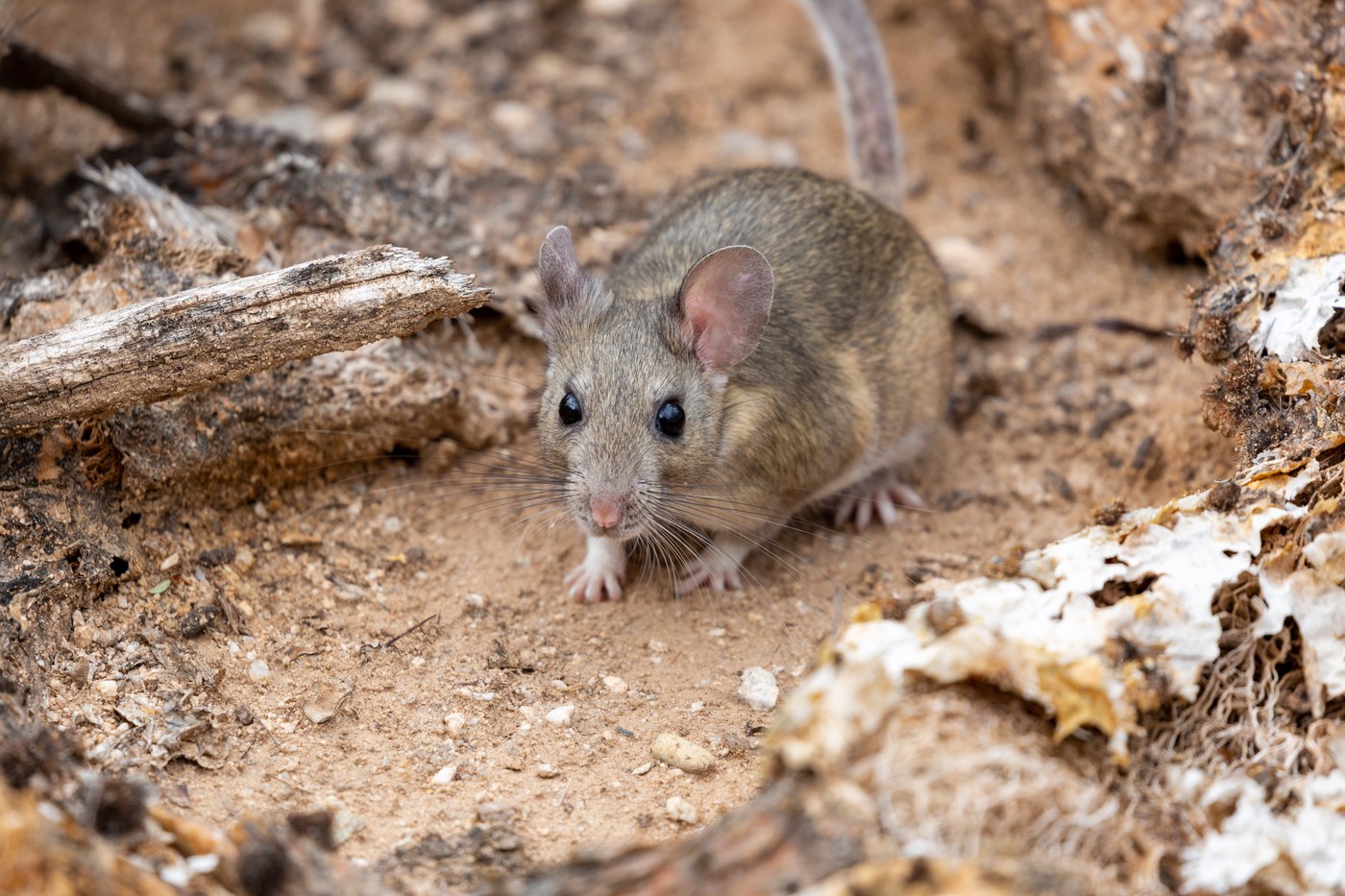
Every woodrat species has a haired tail. The Norway rat and the roof rat, the two rats that commonly live alongside people, both have a naked, scaly tail. If you can see the tail clearly, the question is answered. The bushy-tailed woodrat takes this furthest, with a squirrel-like tail flattened and bushy top to bottom, while other species carry a shorter, less bushy but still clearly haired tail.
Big black eyes and rounded ears
Large protruding black eyes and large rounded ears back it up. Both are noticeably bigger than on either commensal rat, and combined with long whiskers they give a woodrat a softer, more wide-eyed look than the animal most people picture when they hear the word rat.
Larger than a deer mouse
Size runs larger than a deer mouse, in true rat territory. Total length nose to tail tip is roughly 11 to 18 inches depending on species, with the tail making up close to half of that, and adults weigh roughly 0.3 to 1.3 pounds. The bushy-tailed woodrat is the largest of the group, with males averaging around 405 grams and reaching up to 21 ounces.
Brownish-gray with a pale underside
Color is brownish-gray to buff on the back with a white to light gray underside and feet. The bushy-tailed woodrat runs darkest and can approach near-black at the high end of its range.
The midden identifies it
The midden identifies the animal even when you never see it. A large mounded pile of sticks, cactus segments, bones, debris, and small shiny objects wedged against a shed, a wood pile, a rock crevice, or a vehicle is not trash and it is not a squirrel's nest. It is a woodrat den, active or long abandoned. Southwest homeowners regularly write these off as junk piles.
Neotoma is not a true rat
The genus is Neotoma, in the family Cricetidae, which is not the family true rats belong to. That matters more than it sounds. A woodrat is a native North American rodent, not an introduced commensal pest, and it behaves like one.
Signs of Infestation
The midden is hard to miss
The midden is the primary sign and it is hard to miss once you know what you are looking at. Look for a pile of sticks, cactus segments, and debris, often mixed with stolen shiny objects like coins, jewelry, bottle caps, and tool parts, packed into a rock crevice, wood pile, shed corner, attic space, or engine bay. The habit of dropping whatever it is carrying in favor of a shinier find is where both the pack rat and the trade rat names come from.
A nest in an engine compartment
A nest in a parked vehicle's engine compartment, with chewed wiring. This is the signature woodrat complaint, and it is what separates this animal from every other rodent. Sticks and debris packed around the engine, gnawed insulation on wiring, chewed hoses, and damaged air-intake components are all part of the same pattern.
Scratching and gnawing after dark
Scratching, gnawing, and rustling after dark from wall voids, attics, or under the hood of a parked vehicle, which is when the animal is most active.
A strong ammonia-like urine odor
It sits around an active den. Woodrat urine is unusually viscous, and the same fluid that hardens into a glassy crust outdoors saturates indoor nesting material.
Chewed cactus near a den mouth
Chewed cactus fragments near a den mouth in the desert regions, particularly cholla and prickly pear pads, since desert species gnaw succulent tissue for its water content and build the spiny joints straight into the den wall as a predator deterrent.
Droppings like a Norway rat
Droppings similar in size and shape to Norway rat droppings, which on their own will not tell you which animal you have. Read them alongside the tail evidence and the presence or absence of a midden.
Prevention and When to Call a Pro
Clear the building materials away
That means the material stacked against it. Remove or trim cactus, especially cholla, along with wood piles, brush piles, and debris accumulations sitting directly against a foundation, shed, or garage. For desert species this takes out the food source and the midden-building supply in one pass, which is why it is first on the list.
Seal entry points at every level
Seal building entry points at every level, including the attic. Woodrats are agile climbers, so sealing at ground level alone is not exclusion. Roof lines, soffits, vents, and utility penetrations need the same attention as the foundation.
Protect the parked vehicles
Protect parked vehicles, because this is where the money goes. When a vehicle is going to sit for an extended period, leave the hood up. The moonlight and airflow make the engine bay far less attractive as a den site, and if you do leave it up, pull the hood-light bulb so you are not draining the battery. Check regularly for nesting material, droppings, or chew marks on wiring, because finding a nest is much cheaper than finding a breakdown. One documented owner account put a single repair bill at $1,200 after woodrats chewed a NOx sensor and an air-intake sensor wire. Rodent-chewed vehicle wiring generally, not woodrats specifically, is documented running from around $150 to $2,500 for moderate damage and past $7,000 for severe cases needing a full harness replacement. Comprehensive auto coverage, not liability-only, typically pays for it after a deductible that averages around $500.
Do not lead with poison bait
Wildlife damage sources are consistent on this point. Poisoned bait functions as rodent food and can pull more woodrats onto a property than it removes, and an animal that dies inside a wall void or an engine bay hands you a second problem worse than the first.
Snap traps are the standard
Bait them with nut meats, peanut butter, oatmeal, or dried fruit, according to the published wildlife damage bulletin. Live-catch traps are an option, but releasing a trapped animal somewhere else is often against state fish and game regulations and tends to go badly for the animal. Trapping and relocation rules vary by state and change over time, so verify your current state and local wildlife regulations before you start, and treat a licensed nuisance wildlife control operator as the safer default rather than a do-it-yourself trap purchase.
In the Northeast, call the state
If you are in the Northeast, stop and call your state wildlife agency before you do anything. The advice above does not apply to that region. The only woodrat species in the Northeast is the Allegheny woodrat, which is already extirpated from Connecticut, Massachusetts, and New York, is listed Endangered in New Jersey and Maryland, and is Threatened in Pennsylvania. Confirm the species with the agency first. Trapping or killing a state-listed species carries legal consequences that have nothing to do with your pest control intent, and a homeowner has no reliable way to tell one woodrat species from another by sight.
Two parts of the Southeast too
The same caution applies in two specific parts of the Southeast. In the Appalachian mountain counties of Virginia, West Virginia, North Carolina, and Alabama, the local animal may be the Allegheny woodrat, which is Threatened in West Virginia and Alabama, Endangered in North Carolina, and a Species of Concern in Virginia. And in the Florida Keys, the animal is the Key Largo woodrat, a federally endangered subspecies that is not a target for removal anywhere in the Keys. Everywhere else in the Southeast lowlands, and throughout the Southwest, Mountain West, California, Pacific Northwest, South Central, and the Midwest populations, the eastern, white-throated, desert, bushy-tailed, southern plains, and white-toothed woodrats are common and unprotected, and the standard approach above is appropriate.
Handle nests like a deer mouse site
Handle nesting material and droppings with the same care you would give a deer mouse site. University of Arizona Cooperative Extension states that while deer mice are the primary reservoir for Sin Nombre hantavirus, multiple small mammal species including woodrats and hispid cotton rats can carry and shed virus in saliva, urine, and droppings. Woodrats also carry a wide range of fleas, lice, ticks, and mites. One Oregon sample of bushy-tailed woodrats turned up 37 species of external parasites, which is an exposure route independent of any virus.
Who to Call, and When
Call a professional when the den is inside the structure, when the vehicle damage keeps repeating, or when you are anywhere the protected-species caution above applies. A midden in an attic, wall void, or crawl space means the animal is working inside your building envelope, and removing the structure without reopening the entry point is the part that gets done wrong. In the carve-out regions, species confirmation is a legal question before it is a pest question, and it belongs with your state wildlife agency or a licensed operator.
Frequently Asked Questions
Are pack rats and woodrats the same animal?
Yes, completely. Pack rat and woodrat are two common names for the same genus, Neotoma, and both are used interchangeably by homeowners, pest control companies, and even state wildlife agencies. Trade rat is a third name for the same animal. What complicates it is that the genus holds more than 20 species across North America, so the animal behind the name changes with the region. In Arizona it is usually the white-throated woodrat. In the northern Rockies and the Sierra Nevada it is the bushy-tailed woodrat. Across the Southeast it is the eastern woodrat. The habits are close enough that one page covers all of them, with the important exception of the Allegheny woodrat in the Northeast and the Appalachians.
Why do pack rats get into car engines?
Because a parked vehicle's engine compartment is warm, dry, sheltered, and enclosed, which is a close match for the rock crevice a woodrat would otherwise pick. Once it decides the engine bay is a den site, it builds a stick-and-debris nest in there and chews wiring insulation, hoses, and air-intake components in the process. This is the most costly and most frequently reported woodrat complaint, and it is genuinely different from the wall-void and attic pattern that describes house mice and commensal rats. If a vehicle is going to sit for a while, leave the hood up and pull the hood-light bulb, and check under the hood periodically for nesting material and chew marks.
Do pack rats carry hantavirus?
They can. University of Arizona Cooperative Extension states that multiple small mammal species, including woodrats and hispid cotton rats, can carry and shed hantavirus in their saliva, urine, and droppings. That does not change the main picture, which is that deer mice remain the primary Sin Nombre hantavirus reservoir in the United States. Woodrats are a documented additional carrier, not the leading one. Separately, the CDC has documented white-throated woodrats in southeastern Colorado as the confirmed rodent reservoir for Whitewater Arroyo virus, an arenavirus from a different virus family that has been associated with fatal hemorrhagic infections in people. That finding is specific to those studied populations and rests on a single federal source, so treat it as documented rather than as a general statement about pack rats everywhere. The practical takeaway is the same either way. Do not sweep or vacuum a dry nest site, and handle nesting material and droppings the way you would at a deer mouse site.
What is a pack rat midden?
It is the den, and it is the reason for the name. A woodrat builds a large, defensible structure of sticks, cactus joints, bones, debris, and whatever objects it has picked up along the way, then cements the whole thing together with its own unusually viscous urine. In dry climates that urine crystallizes into a hard, glossy, asphalt-like material called amberat, which seals the contents against decay. That is where it stops being a pest story and becomes a genuinely remarkable one. Preserved middens hold plant fragments, pollen, insect parts, and bones for tens of thousands of years. More than 2,000 fossil packrat middens have been collected, radiocarbon dated, and analyzed across western North America since 1960, some of them exceeding 40,000 to 50,000 years old, and researchers still use them to reconstruct how vegetation and climate in the arid West changed from the Ice Age to the present. It is also the direct explanation for why an occupied den looks like a pile of trash rather than a tidy burrow.
Should I use poison to get rid of pack rats?
Most wildlife damage sources advise against it as a first option, for two concrete reasons. Poisoned bait works as rodent food, so it can attract more woodrats to a property than it removes. And a poisoned animal that dies inside a wall void, a crawl space, or an engine compartment leaves you with a decomposing carcass in a place you cannot easily reach. Snap traps baited with nut meats, peanut butter, oatmeal, or dried fruit are the standard and more reliable method. Pair the trapping with removing the midden and the wood, brush, and cactus that supplied it, or the site simply gets reoccupied. If you are in the Northeast, in the Appalachian counties of Virginia, West Virginia, North Carolina, or Alabama, or in the Florida Keys, do not trap at all until your state wildlife agency has confirmed which species you have.
Sources
- Woodrats (B-133, Prevention and Control of Wildlife Damage series): identification against commensal rats, midden and den behavior, signs, exclusion, trapping methods and baits, and cautions on poison bait Nevada Department of Agriculture, with University of Nebraska-Lincoln Cooperative Extension and USDA APHIS Wildlife Services
- Neotoma albigula species account: white-throated woodrat range, habitat, den structure, development and weaning timing, and dispersal USDA Forest Service, Fire Effects Information System
- Neotoma cinerea species account: bushy-tailed woodrat range from the Yukon to the Southwest, Pacific Northwest riparian populations, elevation limits, size, activity pattern, and reproduction USDA Forest Service, Fire Effects Information System
- Hantavirus and Disease Prevention: deer mice as the primary Sin Nombre reservoir, and woodrats and hispid cotton rats as additional species that can carry and shed virus University of Arizona Cooperative Extension
- Transmission of an Arenavirus in White-Throated Woodrats, Southeastern Colorado, 1995 to 1999: Whitewater Arroyo virus reservoir finding Centers for Disease Control and Prevention, Emerging Infectious Diseases
- Allegheny Woodrat species profile: Pennsylvania Threatened status, remaining population strongholds, and Appalachian rock outcrop habitat Pennsylvania Game Commission
- Allegheny Woodrat Species Status Assessment, SWAP 2025: historical range, extirpation from New York, Connecticut, and Massachusetts, and multi-state listing status New York State Department of Environmental Conservation
- Packrat Middens life history reference: midden construction, amberat formation from crystallized urine, and long-term preservation of midden contents California Department of Fish and Wildlife
- Paleo Packrat Middens: the fossil midden collection, radiocarbon dating, and reconstruction of past vegetation and climate in the arid West University of Arizona, Desert Laboratory on Tumamoc Hill
- Studying the Past and Predicting the Future Using Rat Nests: packrat middens as a paleoecological record National Park Service
Image Credits
- Image: Adobe Stock, licensed.