Seasonal Timeline
California kingsnakes are active on cool days and warm nights, shifting toward nighttime movement as summer heat builds, which is why so many sightings happen at dusk or after dark in the hot months. Mating happens in spring, and females lay eggs typically between May and August.
California kingsnakes are active on cool days and warm nights, shifting toward nighttime movement as summer heat builds, which is why so…
Spring is the mating season and the start of the active period. Egg-laying runs from roughly May into August, incubation takes about 6 to 8 weeks, and hatchlings around 12 inches long turn up from midsummer into fall. One clutch per season is the pattern the sources describe. No source documents more than one clutch from a single female in a year.
Temperature drives when you see this snake more than the calendar does. On cool days it moves in daylight. In hot weather it shifts to warm nights. Both patterns belong to the same animal, so a daytime sighting in April and a porch-light sighting in July are not two different kinds of snake.
Where They're Found
This is a California snake, and effectively only a California snake. Every source places Lampropeltis californiae squarely in California. Range fringes do extend into adjoining Baja California and into small parts of southern Oregon and western Arizona and Nevada, and those are real, but they are too marginal to count as a Pacific Northwest or Southwest presence. Alaska and Hawaii have no population. No published account places this species in either state.
Inside California, the habitat range is unusually broad for a single snake. It is documented from sea level up to about 7,100 feet of elevation, across forest, woodland, chaparral, grassland, marshes, farmland, ranch land, desert, and brushy suburban areas. In practical terms there is very little of the state where a homeowner can rule this snake out on habitat alone, and that breadth is one of the more remarkable things about the species.
On a specific property, this is a wild, non-structural animal. It does not occupy attics or wall voids the way rodents and bats do. Where it shows up around buildings it is at the brushy margins: garden beds, woodpiles, rock and debris piles, outbuildings, and sheds or garages that open straight onto cover. Ranch and farm edges concentrate its prey, and the snake follows the prey.
Life Cycle
Age tells you almost nothing about how this snake looks. Geography tells you everything. A hatchling wears the same pattern its parents wear, so there is no juvenile form to learn separately, which is unusual and helpful. What does change is where in California the animal came from. A striped snake from the southern coast, a dark one carrying an unusually high band count elsewhere along the coast, a desert animal in stark black and bright white, and a plain unbanded one from the northern San Joaquin Valley are all the same species, and none of them looks much like the others.

Mating
Eggs
Hatchling
Adult
Identification
Size first, because it rules a lot out
Adults typically run 2.5 to 3.5 feet and seldom exceed 4 feet, with hatchlings emerging at about 12 inches. The scales are smooth, which gives the animal a polished look in sunlight and separates it by feel and by shine from the keeled, matte-scaled rattlesnakes it gets confused with.
Pattern varies more than expected
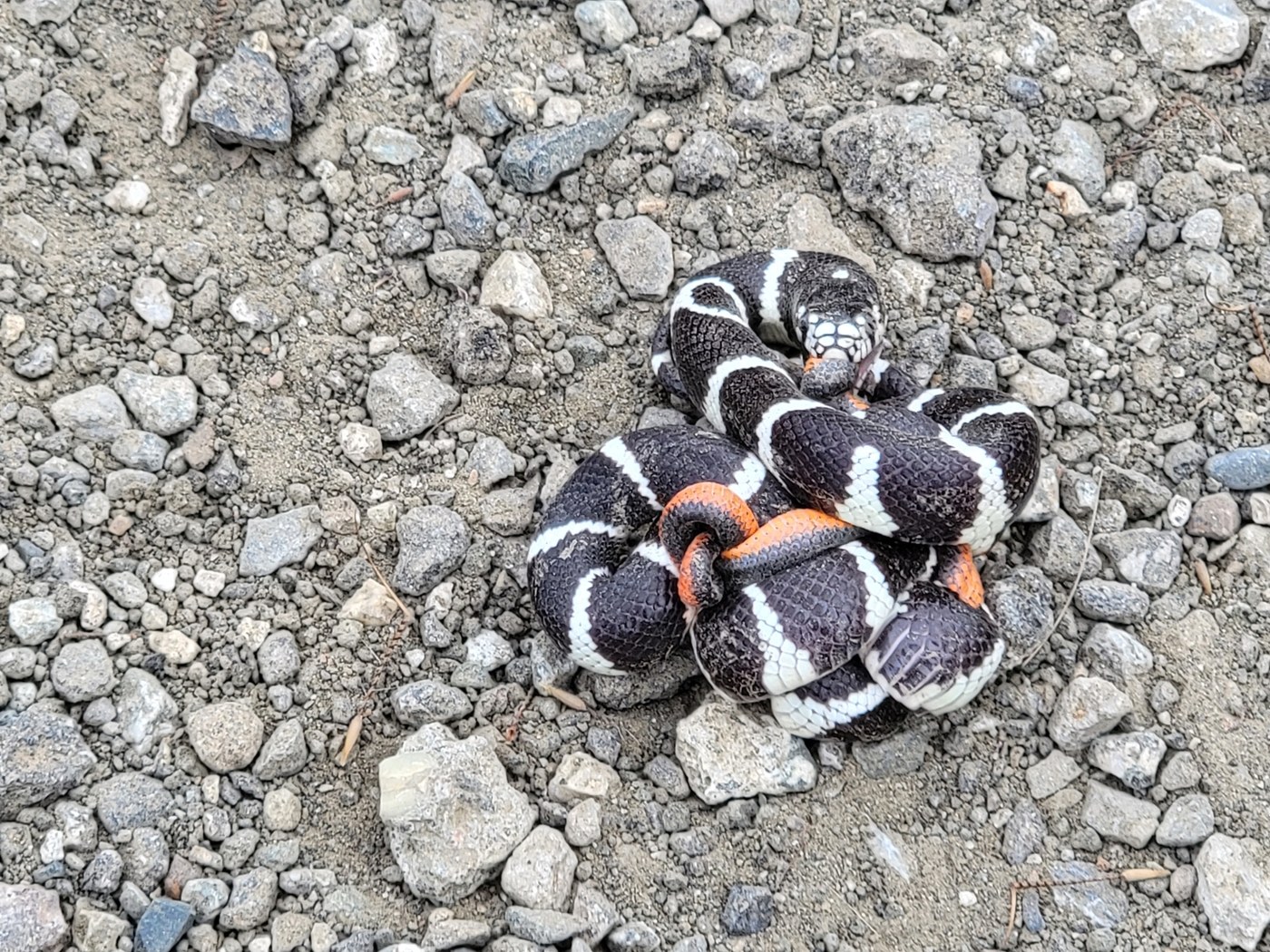
Pattern varies more in California than most people expect, and that is where most confusion starts. The usual look is alternating bands of black or brown against white or pale yellow. Past that, a striped phase occurs along coastal southern California, a darker form carrying a high band count occurs on the coast, a desert phase pairs wide black bands with narrow bright white ones, and an unbanded phase occurs in the northern San Joaquin Valley. If an animal in your county does not match the pattern you expected, check the phase before deciding it is a different species.
Check the head, not the pattern
The fast non-venomous check is the head, not the pattern. A California kingsnake has round pupils and a smooth face with no heat-sensing pit set between eye and nostril. The state's rattlesnakes have vertical, elliptical pupils, an obvious pit on each side of the face, and usually a rattle on the tail. Those head features hold across every color phase this snake comes in, which is exactly why they beat pattern as a test.
Look-alikes worth knowing
Within California, this snake is most often mixed up with the California mountain kingsnake, the western long-nosed snake, and the Mojave shovel-nosed snake, each of which overlaps it in range or pattern or both. The costlier confusion runs toward rattlesnakes: the banding is a documented reason homeowners take a kingsnake for a venomous animal and kill it as a precaution. That is why the pupil and pit checks above are worth committing to memory before you need them.
Not the common kingsnake
A closely related group of snakes still goes by a similar name. Before a 2009 phylogenetic revision, this snake was treated as the western piece of one wide-ranging species known as the common kingsnake. Current taxonomic authority recognizes it as a full species, Lampropeltis californiae, and the U.S. Fish and Wildlife Service's current species page uses that name. The common kingsnake name now applies to the eastern and central members of that same historical group, which live in other regions of the country. Different snakes, different range.
Signs of Infestation
Nothing to inspect
Skip the damage checklist. There is nothing to inspect. This snake takes nothing from a structure and leaves nothing behind. No chewed wire or insulation, no tunneling at a footing, no soiled attic insulation, no repair estimate. With most nuisance animals you read the evidence they left behind. Here the animal is the evidence, and the only real question is whether it was identified correctly before somebody acted.
A banded snake close to cover
What you actually see is a banded snake at ground level, close to cover. Most first encounters happen in a yard, a vegetable bed, a woodpile, or an outbuilding, with the snake either crossing open ground or tucked under a board, a rock, or a debris pile. A cast skin nearby says the same thing the snake does, that one is living in the area, and no more than that.
A dry buzz is a bluff
A dry buzz in the leaf litter is a bluff, not a warning rattle. Disturbed, a California kingsnake shakes its tail fast against dry leaves or debris, and the noise convinces plenty of people they are hearing a rattlesnake. There is no rattle on the animal. What you hear is tail against dry material. The rest of the display, hissing and then coiling into a tight ball, is nothing a rattlesnake does, so a snake that balls up has just told you what it is.
No odor around a property
A resident California kingsnake leaves no odor around a property. Pick one up and that changes. Like most harmless snakes it musks when it feels threatened, and the smell is genuinely unpleasant, which is one more reason to leave it alone. If there is a smell coming from a crawlspace, a wall, or an attic, something else is responsible, and a rodent or another wildlife species is the more likely cause.
Prevention and When to Call a Pro
Read the head, not the pattern
Identify before you act, and read the head instead of the pattern. Round pupils and a smooth face with no pit between eye and nostril mean the snake in front of you is not a rattlesnake. Even rings running down the body are not the diamonds or dark saddles California's rattlesnakes wear. Both checks are possible from several feet away in a couple of seconds, and they decide whether a rattlesnake-eating snake stays on the property or gets killed for nothing. If the answer does not come clearly, treat the animal as venomous, give it room, and stop guessing.
Change the yard, not the snake
Fewer sightings comes from changing the yard, not from removing the snake. Sealing a house against this species is close to meaningless, since it is not trying to get inside in the first place. What actually reduces encounters is taking away the two things that hold it: food and shelter. Bring rodent numbers down around the property, then thin out the ground clutter that gives a snake somewhere to sit, particularly woodpiles, stacked lumber, loose boards, rock piles, and heavy low growth alongside paths, doorways, and anywhere children play.
Hire the relocation
If a snake has to leave a garage, shed, or crawlspace, hire the relocation rather than doing it by hand. Two reasons, and both are practical. A cornered kingsnake will bite in self-defense, and while that bite carries no venom and is medically insignificant, it still breaks skin and it is completely avoidable. Beyond that, picking up and keeping a native California reptile puts you inside a regulated activity, in a way that having one carried off the property does not. A licensed nuisance wildlife control operator resolves both concerns at once, which is why that is the recommendation here instead of buying a trap.
California's legal status
Legal and regulatory status, specific to California. The state generally forbids capturing, collecting, possessing, or transporting native reptiles except where regulation specifically allows it, and the California kingsnake carries a take limit of 4 individuals under Title 14, Section 5.60 of the California Code of Regulations. That rule aims squarely at anyone tempted to keep a found snake as a pet or a specimen. It is not an argument against professional relocation off a property, and this species carries no threatened or endangered listing. Wildlife rules differ between states and get revised, so confirm the current California Department of Fish and Wildlife regulations yourself before collecting, keeping, or moving one.
When to Call a Wildlife Control Operator
Bring in a licensed nuisance wildlife control operator whenever you cannot confidently separate the snake from one of California's native rattlesnakes, because the uncertainty alone is reason enough to keep your distance. Call as well if snakes keep turning up inside a garage or crawlspace instead of out in the open, since a repeating indoor pattern points at a gap worth sealing rather than a chance encounter. If a bite happens and there is any possibility a venomous snake delivered it, that is a 911 call, made immediately, without stopping to work out which species it was.
Frequently Asked Questions
Is a California kingsnake dangerous?
No. It has no venom, and a defensive bite from one is not medically significant beyond a minor puncture that should be cleaned and watched for infection. It is not an aggressive animal by nature either. The more interesting half of the answer is that this snake is itself immune to rattlesnake venom, which is what lets it prey on rattlesnakes.
Why does the tail vibration sound like a rattlesnake?
Because it is a bluff, and an effective one. Threatened, a California kingsnake shakes its tail fast against dry leaves or debris, and what comes back can pass for a rattle if you have never compared the two. The snake has no rattle on it anywhere. The sound is tail against dry material, not an organ, and it means the animal is frightened. Hissing and coiling into a tight ball usually come with it, and neither is rattlesnake behavior.
Do California kingsnakes actually eat rattlesnakes?
Yes. This is a snake-eating generalist that also takes rodents, lizards, birds, eggs, and frogs, and rattlesnakes are specifically on the list. It can do that because it is immune to rattlesnake venom, which proteins in its own blood neutralize. In practical terms, an established kingsnake population on a property is working in the owner's favor on rodents and venomous snakes at the same time.
Can I legally keep a California kingsnake I found?
Assume not, and check before you act. California generally prohibits capturing, collecting, possessing, or transporting native reptiles except where regulation specifically allows it, and this species carries a take limit of 4 individuals under Title 14, Section 5.60 of the California Code of Regulations. Rules like that get revised, so confirm the current California Department of Fish and Wildlife regulations before collecting or keeping one. Having a snake professionally relocated off your property is a separate matter and does not raise the same question.
How can I tell a California kingsnake from a rattlesnake?
Read the head, not the pattern. A California kingsnake has round pupils and a smooth face with no heat-sensing pit between the eye and the nostril. A rattlesnake has vertical, elliptical pupils, a visible pit on each side of the face, and usually a rattle. Pattern is the weaker test here, because California kingsnakes come in banded, striped, high-band-count, and unbanded forms depending on where in the state you are, while the head features hold across all of them.
Sources
- California Kingsnake, Lampropeltis californiae: size, the regional color and pattern phases, round pupils and absence of heat-sensing pits, habitat range from sea level to 7,100 feet, clutch size and incubation, cool-day and warm-night activity, defensive tail vibration, look-alike species, and the snake-eating diet with immunity to rattlesnake venom CaliforniaHerps.com
- California Kingsnake (Lampropeltis californiae) species page: current species-level taxonomy following the 2009 revision U.S. Fish and Wildlife Service
- Cal. Code Regs. Tit. 14, Section 5.60, Reptiles: the take limit of 4 individuals for California kingsnake and the regulatory framework covering native reptiles Cornell Law School Legal Information Institute
- Reptiles and Amphibians, Prohibited Actions and Protections, California: the general prohibition on capturing, collecting, possessing, or transporting native reptiles except as specifically provided Association of Fish and Wildlife Agencies
Image Credits
- Image: Theo Summer via iNaturalist. CC0 1.0.
License.