Seasonal Timeline
Rubber boas are mainly active from spring through fall, at their most visible during the crepuscular hours of dusk and dawn, and are inactive underground through the cold season, roughly mid-October through April in California populations and a similar window across the rest of its range.
Rubber boas are mainly active from spring through fall, at their most visible during the crepuscular hours of dusk and dawn, and are…
This species runs on a slower, cooler calendar than most snakes in its range. State and university sources describe it as active at lower temperatures than nearly any other snake in its range, with documented surface activity down into the mid-50s Fahrenheit and one recorded body temperature below 44 degrees. Surface activity is most likely during periods of high humidity and can be triggered directly by rain showers, which is part of why it is seen far less often than a typical yard snake even where it is common.
Breeding happens in spring, from April into June. Gestation runs roughly 90 to 100 days by one university account, and live young are born anywhere from late summer into late November depending on the population and the year. There is no egg stage at all. Winter is spent underground in a hibernaculum, often a rock crevice with good depth, and the snake is not seen again on the surface until temperatures allow.
Where They're Found
The widespread Northern Rubber Boa occurs across four regions: California, the Mountain West, the Pacific Northwest, and the northern edge of the Southwest. The overall documented range runs from southern California north to British Columbia, with populations in Idaho, western Wyoming, central Montana, northern Nevada, and Utah, per the Burke Museum of Natural History and Culture at the University of Washington. On the map the Southwest shows only Nevada and Utah, and the Mountain West shows Idaho, Wyoming, and Montana but not Colorado, which has no documented population. Washington's own population occurs in all of that state's ecoregions, with fewer records from coastal forest, high Cascade elevation, and the central Columbia Basin.
The Mountain West portion of this range is well documented on its own. The Utah Division of Wildlife Resources places established populations from northern Utah along the Idaho border, south through the Wasatch Plateau, and east through the Uinta Mountains, in forest and alpine habitat across northern and central Utah. Colorado is a genuine edge case worth stating honestly rather than smoothing over: Colorado Parks and Wildlife's own species page notes the boa has been reported from Dinosaur National Monument in northwestern Colorado only "without adequate documentation," so there is no established Colorado population on record.
In California, the species occupies the Sierra Nevada from Kern County across the northern part of the state, and south in the Coast Ranges to Point Buchon, per the California Department of Fish and Wildlife's life history account, with elevation ranging from sea level to about 3,000 meters (roughly 9,840 feet). A separate, geographically isolated population in the San Bernardino and San Jacinto Mountains of Southern California is treated differently under the law, and is covered on its own in the prevention section below.
There is no established population on the Southwest fringe. No source places an established rubber boa population in Arizona or New Mexico. A different, similarly-named species, the rosy boa, does range into southwestern Arizona, and the two should not be confused. Alaska and Hawaii are both absent as well. No source places rubber boa in either state, the documented range stays well south and east of Alaska, and Hawaii has no established wild snake population of any kind.
Life Cycle
Total wild lifespan is an open question. Neither the California Department of Fish and Wildlife's life history account nor the University of Oregon's natural history account gives a lifespan figure for wild rubber boas, and no other published source settled the question either. No wild lifespan figure is established, so any number you find should be treated with caution.

Mating
Gestation
Birth
Juvenile2
Adult
Identification
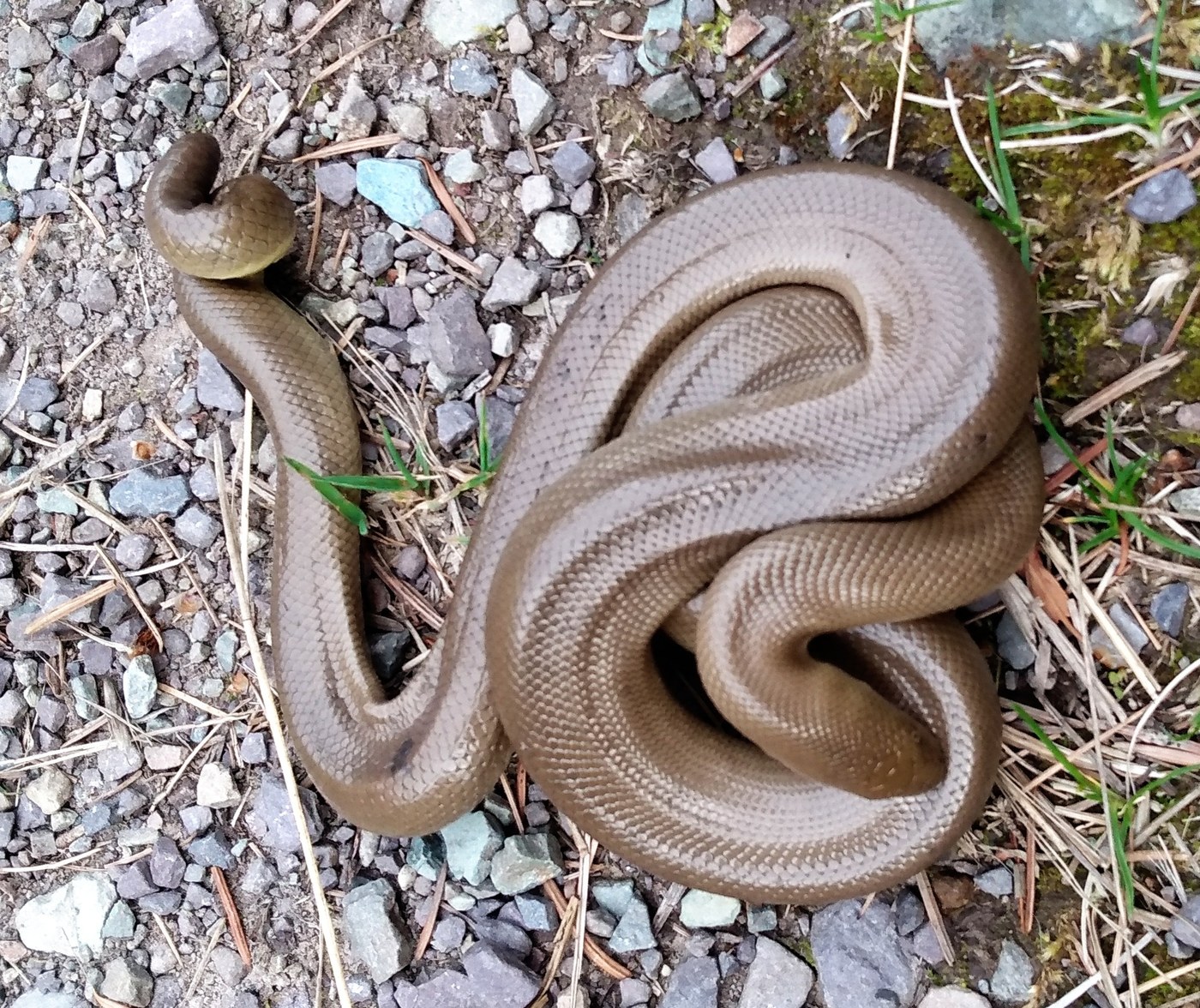
A blunt tail that looks like a head
The blunt tail that resembles the head is the strongest identification feature this species has, and it is also the reason for its main survival strategy. The tail is short and blunt, giving the animal a genuine two-headed look. When threatened, a rubber boa tucks its true head under its coiled body and raises and waves the tail instead, so a strike lands on the tail rather than anything vital. The scars most wild individuals carry on the tail come from a narrower version of that. The University of Oregon's natural history account describes a mother rodent chewing the snake's tail and flanks while the snake goes on eating her young in the nest, and reports heavier scarring on females, which forage more often.
Build and skin texture
The build and skin texture are distinctive on their own. It is a thick-bodied snake with small eyes and tiny, smooth scales, and its skin is loose and wrinkled, giving the animal its namesake rubbery look and feel. Color runs tan, brown, olive, gray, or charcoal above, occasionally rosy pink, with a yellow, orange, or cream belly, sometimes with dark mottling.
Size sets expectations only
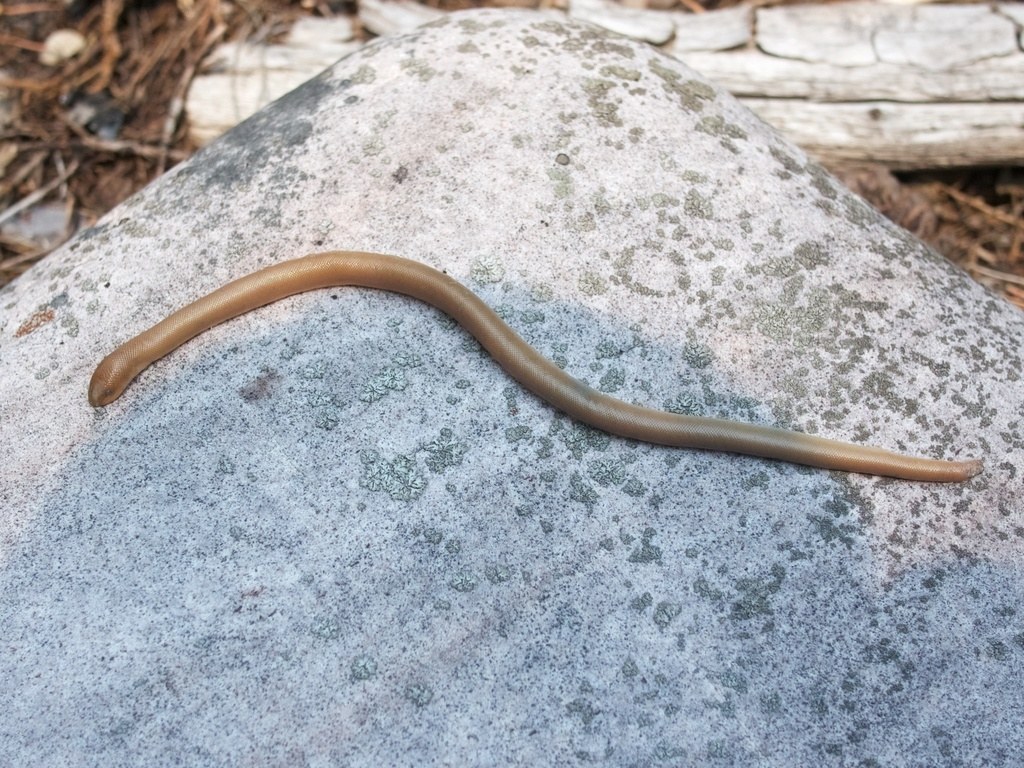
Size sets expectations rather than confirming identity on its own. Adults typically run 14 to 33 inches, with most individuals in the 21 to 26 inch range. Newborns are notably small and distinctively colored: 7 to 11 inches, pink, and nearly translucent, darkening toward adult tones as they age.
The western yellow-bellied racer
It is the look-alike that actually matters, and wildlife agencies spell out the tell. The Washington Department of Fish and Wildlife distinguishes the two directly: a racer has larger eyes, larger scales, and a tail that tapers to a point, while a rubber boa has small eyes, small scales, and a blunt, non-tapering tail.
A softer, informal mix-up
Because of its smooth scales, blunt tail, and gray-brown coloring, a rubber boa is sometimes mistaken by casual observers for a large earthworm rather than a snake at all. No published source documents a common confusion with gopher snakes specifically, so that pairing is not an established one even though it might seem intuitive.
Signs of Infestation
A sighting is the only sign
A direct sighting is essentially the only sign, because this species leaves no infestation evidence. It does not chew, burrow into structures, or leave droppings patterns worth tracking. Because it is extremely secretive and spends most of its time underground or under cover, most people who share a property with one never see it at all.
Lifting cover
Lifting cover is the classic way people encounter one. A rubber boa turning up under a board, rock, or log, or in loosened garden soil, is the typical way this animal is found. It is not drawn out by food or shelter inside a home the way a rodent or insect would be.
Nothing to hear
Rubber boas are silent. There is no rattle, hiss, or scratching sound to listen for.
Musk only when handled
A musk odor only occurs during handling, not as a lingering sign. Like many harmless snakes, a rubber boa handled roughly will release a strong-smelling musk from glands near the tail, but this is detectable only in the moment, not as an ongoing indicator of presence.
Prevention and When to Call a Pro
Coexistence, not removal
The honest, source-backed answer for this species is coexistence, not removal. Everything documented about this snake points the same direction: no property damage, no structural intrusion, and no meaningful bite or venom risk. This is not a pest-control problem the way a rodent, a termite, or even a venomous snake is, and the accurate guidance reflects that rather than manufacturing urgency the facts do not support.
Take away the cover
If you would simply rather not encounter one close to the house, take away the cover it shelters in. Rubber boas use bark, boards, rocks, surface debris, and rotting logs as cover, with rock crevices serving as winter hibernacula. Clearing loose woodpiles and debris away from a foundation, and not stacking rotting logs directly against a structure, reduces the odds of a close encounter, the same approach that works for other harmless snakes.
One population is protected
One documented population is legally protected, and it is worth knowing before assuming every rubber boa-type snake in California is the common, secure population described above. A geographically isolated population restricted to the San Bernardino and San Jacinto Mountains of Southern California, generally treated today as its own distinct taxon, the Southern Rubber Boa, was listed as Threatened by the State of California in 1971 and has separately been considered for federal listing. Anyone encountering a rubber boa-type snake specifically in that mountain range should not handle, move, or disturb it, and should contact the California Department of Fish and Wildlife rather than treat it as routine.
Call if you are not sure
If you are simply not sure what you are looking at, that is the one reason to make a call. Uncertainty over identification, particularly telling this species apart from a young venomous snake in the same region, or confirming whether a boa found in the San Bernardino or San Jacinto Mountains is the protected population, is a legitimate reason to contact a wildlife control professional or the state wildlife agency for an identification. That call closes a question, it is not a response to any danger the animal itself presents.
Frequently Asked Questions
Is a rubber boa dangerous or venomous?
No. It is entirely non-venomous, and a University of Oregon natural history account of the species states it has never been known to bite or strike, even when antagonized.
Why does a rubber boa's tail look like a second head?
Its tail is short and blunt and closely resembles its head. When threatened, it hides its real head under its coiled body and raises and waves the tail as a decoy, so a strike lands on the tail instead of anything vital. The tail scars most wild individuals carry come from a defending mother rodent chewing the tail while the snake eats her young in the nest.
Will a rubber boa get into my house?
No. It is a secretive, semi-fossorial animal that burrows through loose soil and shelters under logs, bark, and rocks. No source documents this species entering structures or living space.
What does a rubber boa eat?
Mostly nestling rodents and shrews taken directly in their underground burrows, along with occasional salamanders, lizards, small snakes, and eggs. It is a constrictor and kills prey by squeezing rather than with venom.
Are all rubber boas the same, or is one population protected?
The widespread Northern Rubber Boa is secure across California, the Mountain West, and the Pacific Northwest. A separate, geographically isolated population in Southern California's San Bernardino and San Jacinto Mountains, generally treated as its own distinct Southern Rubber Boa, was listed as Threatened by California in 1971 and should never be handled or disturbed.
Sources
- Northern rubber boa (Charina bottae) Washington Department of Fish & Wildlife
- Northern Rubber Boa, Charina bottae bottae (life history account R046a) California Department of Fish and Wildlife, California Interagency Wildlife Task Group
- Rubber Boa (Charina bottae) species profile U.S. Fish & Wildlife Service
- Northern Rubber Boa Burke Museum of Natural History and Culture, University of Washington
- A Natural History of the Rubber Boa, Charina bottae University of Oregon
- Utah Species Field Guide: rubber boa (Charina bottae) Utah Division of Wildlife Resources
- Rubber Boa species page Colorado Parks and Wildlife
- Southern Rubber Boa species account San Bernardino County Public Works, Endangered Species Program
Image Credits
- Image: John Powers via iNaturalist. CC BY 4.0.
License. - Image: Christopher Eliot via iNaturalist. CC BY 4.0.