Seasonal Timeline
Midget faded rattlesnake emerges from winter dens in April and May, per federal survey work in Wyoming, and stays near the den entrance for roughly two to three weeks before dispersing. Colorado material gives a slightly earlier late March or early April window for the western rattlesnake group in that state. Breeding runs July into August, and live young arrive from late August through early October.
Midget faded rattlesnake emerges from winter dens in April and May, per federal survey work in Wyoming, and stays near the den entrance for…
The calendar is ordinary high-desert rattlesnake seasonality, with one movement pattern worth knowing about. Federal survey work in Wyoming documents that after emerging in April or May, snakes hold near the den entrance for about two to three weeks, then move to shedding habitat, typically large flat rocks that help the animal work out of its old skin, before dispersing further into summer foraging range. The same work found the distance traveled depends on reproductive status: adult males and non-gravid females migrated an average of roughly 2,100 and 1,950 meters respectively, while gravid and post-partum females moved an average of about 300 meters. The practical version is that most of the ground covered in a season is covered by animals that are not pregnant.
Wyoming Game and Fish Department material adds that individuals travel considerable distances through summer looking for water, which is a real behavioral difference from more sedentary rattlesnakes and one reason a snake can turn up on a property with no permanent population on it.
Two things are not settled. No state wildlife agency, federal or peer-reviewed source confirms whether females reproduce every year or on a longer cycle, and none gives a total lifespan.
Where They're Found
Midget faded rattlesnake is an entirely outdoor, wild species. It does not chew, does not burrow into living space, and does not damage building materials. There is no structural risk here at all, only the bite.
The range is small. The whole population sits in the Green River Basin, Flaming Gorge, Colorado Plateau, and Uinta Basin high desert, across three states and no further. In Wyoming that means Sweetwater County, with the towns of Green River and Rock Springs marking the northern limit of the subspecies. In Colorado it is mainly Mesa, Delta, and Garfield counties. In Utah it runs east of roughly 111 degrees west longitude, across most of the Colorado Plateau and the Uinta Basin. The species covers far less ground than the Mountain West as a whole. Alaska and Hawaii both have no population. Every range source confines the subspecies to that tri-state arid basin, a habitat type with no Alaskan equivalent, and no snake species is native to Hawaii.
Within the range, the terrain cues are consistent. Colorado Parks and Wildlife describes sandhills, semidesert shrubland, mountain shrubland, riparian zones, pinyon-juniper woodland, and montane woodland, with the animal sheltering in rock crevices, woodpiles, vegetation, or mammal burrows. The common thread across sources is cold, high desert with sagebrush and abundant rock outcrops or exposed canyon walls. Elevation runs up to roughly 7,000 feet. Individuals will occasionally climb into shrubs and low trees.
Diet explains most of the encounters. Lizards are the primary prey, which ties the animal directly to the rock outcrops lizards use, with small mammals and birds taken as well, plus occasional spadefoot toads and carrion per Colorado material. Hunting is ambush work, done mainly in late afternoon and evening after the snake has warmed up. A midget faded rattlesnake near a structure in sagebrush country is usually there because the lizards and rodents are.
Winter shelter is communal and site-specific. Snakes overwinter in mammal burrows, rock crevices, and caves, sometimes congregating in numbers at shared dens tied to rock outcrops and canyon walls rather than to prairie dog towns. Gravid females likewise share basking sites through gestation. Both of those matter beyond biology: Wyoming state and federal land agency material documents that destroying a communal den or a shared gestation site can wipe out a local population, which is part of why this subspecies is protected across its range.
Life Cycle
The stage that matters most for identification is the one before adulthood. This snake is named for something that happens with age rather than for something it is. Juveniles carry a bold, well-defined blotched pattern. Adults lose it, the blotches fading toward the base color until they are faint or effectively gone. That means the pattern you would use to recognize the animal is strongest on the smallest, youngest snakes and weakest on the ones most likely to be encountered. Two other points belong here. Young are born fully venomous with no parental care, so a small snake is not a safe snake. And gravid females hold at shared basking sites through gestation and travel a fraction of the distance other adults cover, which is why several snakes on one warm rock outcrop in late summer is a pattern rather than a coincidence.

Emergence
Breeding
Gestation
Birth
Neonate and Juvenile
Adult
Identification
Size does real work here
Size is the first tell, and on this species it does real work. Adults run roughly 19 to 30 inches. Colorado Parks and Wildlife states they rarely exceed 26 inches, and Wyoming Game and Fish Department gives a working maximum around 2.5 feet against the prairie rattlesnake's four feet in the same state.
The family is enough to act on
Getting the family right is enough to act on, and on this species it is also all you may reliably get. The pit viper checklist is standard: a heat-sensing pit between eye and nostril, vertically elliptical pupils, a broad triangular head on a narrow neck, keeled scales, and a rattle on a short blunt tail. Because the species-level tells here are unusually weak, stopping at the family level and backing away is a legitimate outcome rather than a failed identification.
Base color is close to useless
It runs the full desert palette. Gray, tan, reddish-brown, orange, pinkish, straw, cream, and yellow-brown are all documented. The color that matters is the relationship between the blotches and the background, not the background itself.
The fade is the actual species mark
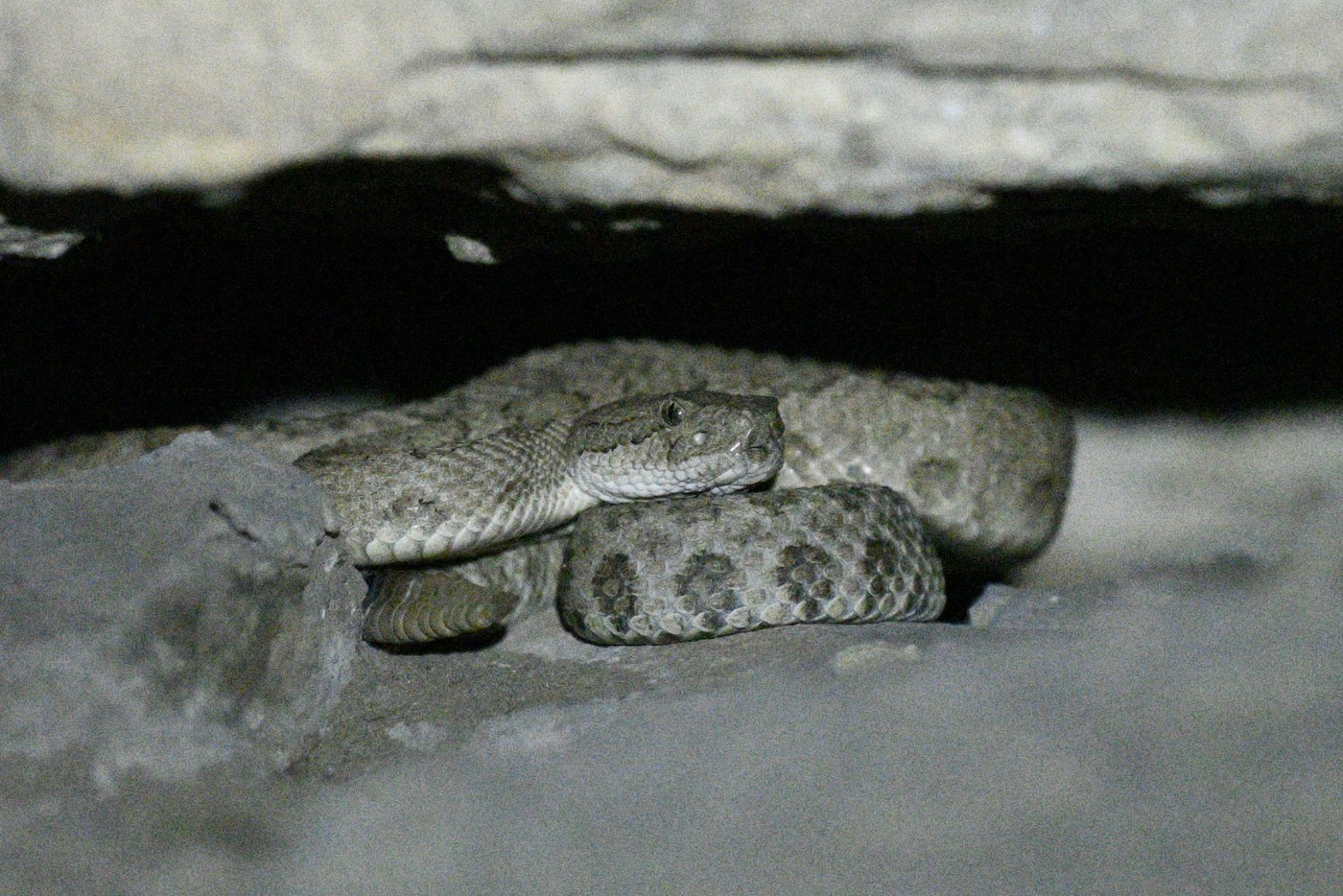
Dorsal blotches sit only slightly darker than the base color and are described as reduced, very faded, or absent in adults. A juvenile shows them boldly and loses definition with age. A dark bar sometimes runs from behind the eye to the jaw, and the tail near the rattle base is often dark brown or black.
Against the prairie rattlesnake
The look-alike that matters is the prairie rattlesnake, and the two are genuinely different animals. Current taxonomy puts them in different species. Prairie rattlesnake is Crotalus viridis. This snake is Crotalus oreganus concolor, on the other side of the molecular split that divided the old western rattlesnake complex, and in the same species group as the southern Pacific rattlesnake. It was called Crotalus viridis concolor for decades, which is why older references, including most of the venom literature, file it under the wrong species name.
Size plus pattern fade, in the field
In the field, size plus pattern fade are what separate the two. Midget faded rattlesnake tops out near 30 inches with blotches that wash out with age. Prairie rattlesnake runs 35 to 45 inches or more and keeps a distinct, well-defined blotch pattern into adulthood.
The honest caveat
That clean-sounding rule has a real limit. Where ranges overlap, notably near Lake Powell, midget faded rattlesnake is documented interbreeding with neighboring rattlesnake populations, and the resulting animals are described as very difficult to identify in the field even for specialists. In an overlap zone, treat species-level identification as something you do not have, and back away from the animal on the family-level pit viper marks alone.
The gopher snake, nonvenomous
The nonvenomous look-alike across this range is the gopher snake. Gopher snake has no rattle and a pointed rather than blunt tail tip, a more slender body, round pupils, no facial pit, and a flatter head that blends into the neck instead of a broad triangle. It is a colubrid and cannot envenomate anyone.
None of it is worth a closer look
None of these tells is worth arranging a closer look for. Pupil shape, facial pit, and blotch definition all require a view of a live snake's head that a homeowner should not be trying to get. Size is the one tell readable from a safe distance, and even that one runs into the interbreeding problem in overlap areas.
Signs of Infestation
Rodent inspection habits do not apply
Skip the inspection habits that work on rodents and insects, because none of them apply to this animal. A midget faded rattlesnake occupies terrain rather than a structure, so a property never accumulates the physical record a pest normally leaves. Within its narrow tri-state range, the evidence is the animal itself or a shed skin.
The snake, or a shed skin
What a homeowner actually notices is the snake or a shed skin. A small, pale, low-contrast rattlesnake on rock or sagebrush ground, or a shed skin left behind at a flat rock the animal used to work out of its old skin. Those are the two visual signs.
You may not get a rattle
A rattle is a warning, and on this species it is one you may not get. Wyoming Game and Fish Department describes this snake as usually less irritable and less likely to bite than its larger relatives. That is a reason to be less alarmed by an encounter, not a reason to rely on hearing one coming. Absence of a rattle is not evidence of absence of a snake.
Read the terrain instead
Looking for damage will not help. Rock outcrops, exposed canyon walls, rock piles, woodpiles, crevices, and mammal burrows in sagebrush high desert are the features that put this animal near a structure. None of them is a sign of damage, because there is no damage mechanism.
Repeat sightings usually trace to prey
Lizards are the primary food, with small mammals and birds also taken, so a property producing regular sightings is generally a property producing regular lizard and rodent activity on and around its rock features.
Several on one outcrop
Several snakes together on one outcrop means something specific. This subspecies dens communally through winter and females share basking sites through gestation. A cluster at a rock outcrop or canyon wall in late summer or as the weather turns is consistent with a gestation site or a den, and both are situations for a professional rather than a closer look.
Olfactory signs do not exist here
There is no odor associated with this species' presence, the same as other snakes.
Prevention and When to Call a Pro
A neurotoxic venom, so keep back
Before anything else: this animal carries a venom with a confirmed neurotoxic component, so nobody should be approaching it or putting a hand near it. No capture, no killing it, no getting close enough for a photograph. Colorado does allow a resident to move a rattlesnake off a road or out of a building to an unconfined spot nearby, but that is work for a licensed operator or the state wildlife agency, not for a homeowner. Move people and pets away and leave the snake the space it needs. Nearly every encounter with this species ends by itself once someone stops closing the distance.
Killing it is restricted range-wide
Killing or collecting this snake is restricted across its entire range, which is a stronger legal protection than most wildlife carries. Wyoming Game and Fish Department is quoted directly on the point: the subspecies is protected in Wyoming, Colorado, and Utah, and killing them is not an option. That covers every state the animal lives in.
The specific designations
Wyoming Game and Fish Department classifies it a Species of Concern and restricts collection to permit only, and the Bureau of Land Management's Wyoming office lists it a Sensitive Species at an S1 rank, meaning a high likelihood of disappearing from the state. Both are agency designations rather than listings under any federal wildlife statute. Colorado Parks and Wildlife designates it State Special Concern. Utah's protection is documented by that same Wyoming agency statement, though no primary Utah source names Utah's own listing category.
It is not federally listed
Midget faded rattlesnake is not currently protected under the federal Endangered Species Act. The protections above are entirely state-level. That distinction gets muddled in circulating summaries, and it matters, because the practical constraint on a property owner comes from three state agencies rather than from a federal statute.
The state guidance is short
The guidance from the state wildlife agency itself is short. Wyoming Game and Fish Department's information specialist puts it plainly: "If it's minding its own business in a place where it's not causing problems, and you can safely move away, just let it be." For most encounters in this animal's range, that is the entire correct response.
Reduce the lizards and rodents
Reduce what the snake came for, starting with lizards and rodents. Lizards are the primary prey and small mammals the secondary, so cutting rodent activity and rodent food sources near a structure, and removing the debris and clutter that hold lizard populations against a foundation, takes away the reason the animal is there.
Treat rock piles as occupied
Treat rock piles, woodpiles, crevices, and burrows as occupied until proven otherwise. In sagebrush and canyon country these are documented shelter features for this subspecies. Move them away from the foundation or remove them, but do not investigate one by hand and do not dig one out. Reaching into a crevice is the single most avoidable way to put a hand where a rattlesnake is.
Leave dens and basking sites
Leave dens and communal basking sites alone entirely. Destroying a shared winter den or a shared gestation outcrop is documented as capable of eliminating a local population, and it is precisely the kind of action the state protections above exist to prevent. If a den is identified on a property, that is a conversation with the state wildlife agency, not a project.
The venom finding, with its caveat
The venom finding, and the caveat that has to travel with it. Three independent peer-reviewed Toxicon studies spanning four decades agree this is an unusually potent venom. A 1977 paper measured crude venom lethality in mice near 0.25 micrograms per gram. A 1981 follow-up isolated the most lethal fraction, concolor toxin, near 0.12 micrograms per gram, and identified it as a presynaptic phospholipase A2 neurotoxin that blocks acetylcholine release at the junction between nerve and muscle, alongside a separate potent myotoxin. A 2010 comparative study found up to a fifteenfold toxicity spread across the western rattlesnakes and ranked this subspecies the most toxic tested, and a 2020 clinical case report documents a human envenomation with matching myoneurologic symptoms. The caveat is equally well sourced. A snake this small delivers a much smaller total venom volume per bite and has far less fang reach, and Wyoming Game and Fish Department's information specialist has said the animal is usually less irritable and less likely to bite than larger rattlesnakes. High potency per unit and lower practical bite severity are both true here, and neither one should be quoted without the other.
What the neurotoxin changes
What that neurotoxic component changes about a bite. Prairie rattlesnake venom is hemotoxic and myotoxic with no neurotoxic component, so its bites present as local tissue damage, bleeding, and muscle injury. This subspecies can add nerve effects on top of that. Practically, it means a bite from this small snake is never a wait-and-see situation no matter how minor it looks in the first hour, and no matter how docile the animal appeared.
If someone is bitten
The immediate steps are the same for any venomous snake bite. Stay calm. Remove rings and watches before swelling starts. Keep the affected limb at or below heart level. Get to a hospital immediately. Federal occupational safety guidance from CDC and NIOSH is the source, and it does not change based on which pit viper was involved.
The list of things not to do
None of them help. Do not try to suck out venom. Do not apply a tourniquet. Do not apply ice. Do not cut the wound.
When a Bite Is an Emergency, Who to Call
For any bite, get emergency medical care immediately. For a snake that is inside a structure, or holding ground in a yard area that people, children, or pets cross regularly, the call goes to a licensed nuisance wildlife control operator, a pest control professional, or your state wildlife agency. Because all three states in this animal's range restrict killing and collection, a do-it-yourself capture or relocation carries real legal exposure here that a general call-a-pro suggestion understates. Removal by a permitted professional is the correct default, not merely the cautious one.
Frequently Asked Questions
Is the midget faded rattlesnake's venom really more dangerous than other rattlesnakes'?
Per unit of venom, it is genuinely among the most toxic rattlesnake venoms measured. Peer-reviewed work published in Toxicon put crude venom lethality in mice near 0.25 micrograms per gram, isolated a presynaptic neurotoxin called concolor toxin near 0.12 micrograms per gram, and a later comparative study ranked this subspecies the most toxic of the western rattlesnakes tested, with up to a fifteenfold spread across the group. That neurotoxic component is real and most rattlesnake venoms lack it. The practical side is just as well documented and belongs in the same answer. This is a small snake, so the total venom volume delivered in a bite is much lower and the fang reach much shorter than a four-foot rattlesnake's, and Wyoming Game and Fish Department describes the animal as usually less irritable and less likely to bite than its larger relatives. Potent venom, smaller dose, calmer animal. Any bite is still an emergency.
How do I tell a midget faded rattlesnake from a prairie rattlesnake?
Size and pattern fade are the two tells. Midget faded rattlesnake tops out around 30 inches, with Colorado Parks and Wildlife noting adults rarely exceed 26 inches, while prairie rattlesnake runs 35 to 45 inches or more. And this snake's blotches fade toward the base color as it matures, sometimes to the point of being nearly absent, where prairie rattlesnake keeps a well-defined pattern into adulthood. There is an honest limit on that. Where ranges overlap, notably near Lake Powell, this subspecies is documented interbreeding with neighboring rattlesnake populations, and the resulting animals are difficult to identify even for specialists. In an overlap area, stop at the pit viper family marks and back away rather than trying to reach a species.
Where does the midget faded rattlesnake live?
In a narrow high-desert basin and nowhere else. The range covers the Green River Basin and Flaming Gorge area of southern Wyoming, largely Sweetwater County, with Green River and Rock Springs marking the northern limit of the subspecies; western Colorado, mainly Mesa, Delta, and Garfield counties; and eastern Utah across most of the Colorado Plateau and Uinta Basin. The habitat is cold, high, rocky desert with sagebrush and abundant outcrops or canyon walls, up to roughly 7,000 feet. Outside that tri-state basin, a rattlesnake is a different species.
Is it legal to kill or relocate a midget faded rattlesnake?
No. Wyoming Game and Fish Department is quoted directly saying the subspecies is protected in Wyoming, Colorado, and Utah and that killing them is not an option, which covers its entire range. Wyoming classifies it a Species of Concern and restricts collection to permit only, and the Bureau of Land Management's Wyoming office lists it a Sensitive Species at an S1 rank. Colorado Parks and Wildlife designates it State Special Concern. Utah's protection is documented by that same Wyoming agency statement, though Utah's own specific listing category has not been confirmed against a primary Utah source. The state agency's own practical guidance is to leave the animal alone if it is not causing a problem, and to bring in a licensed wildlife professional if it genuinely has to be moved.
Is the midget faded rattlesnake federally endangered?
No. It is not currently listed under the federal Endangered Species Act. Its protections come entirely from state-level designations in Wyoming, Colorado, and Utah. Summaries circulating online sometimes describe it as federally threatened, and no primary federal source supports that. The constraint on a property owner is real, but it comes from three state wildlife agencies rather than from a federal listing.
Sources
- Midget Faded Rattlesnake (Crotalus oreganus concolor) species profile U.S. Fish and Wildlife Service
- Midget Faded Rattlesnake (Western Rattlesnake) species profile: size, coloration, habitat, elevation, diet, spring activity, birth season, and State Special Concern designation Colorado Parks and Wildlife
- Midget Faded Rattlesnake (Crotalus oreganus concolor) introduction: Wyoming range, Species of Concern status, denning and gestation site threats, and conservation partnership Wyoming Game and Fish Department
- Ecology and behavior of the Midget Faded Rattlesnake (Crotalus oreganus concolor) in Wyoming: den emergence timing, post-emergence residency, shedding habitat, and migration distances by reproductive status U.S. Geological Survey
- Reporting on Wyoming Game and Fish Department guidance, carrying the department's direct statements on three-state legal protection, adult size, breeding season, elevation, summer water-seeking movement, and temperament Cowboy State Daily
- Crotalus concolor Woodbury, 1929: synonymy record placing the taxon under Crotalus oreganus, with Crotalus viridis concolor as a superseded name The Reptile Database
- The midget faded rattlesnake (Crotalus viridis concolor) venom: lethal toxicity and individual variability Toxicon (ScienceDirect)
- Fractionation of midget faded rattlesnake venom: lethal fractions and enzymatic activities, isolating concolor toxin as a presynaptic phospholipase A2 neurotoxin Toxicon (ScienceDirect)
- Evolutionary trends in venom composition in the western rattlesnakes (Crotalus viridis sensu lato): toxicity vs. tenderizers Toxicon (ScienceDirect)
- Crotalus oreganus concolor: envenomation case with venom analysis and a diagnostic conundrum of myoneurologic symptoms Toxicon (ScienceDirect)
- Venomous Snakes: A Neglected Hazard for Outdoor Workers, national bite first aid and what not to do Centers for Disease Control and Prevention, National Institute for Occupational Safety and Health
Image Credits
- Image: Joshua Smith via iNaturalist. CC0 1.0.
License.