Seasonal Timeline
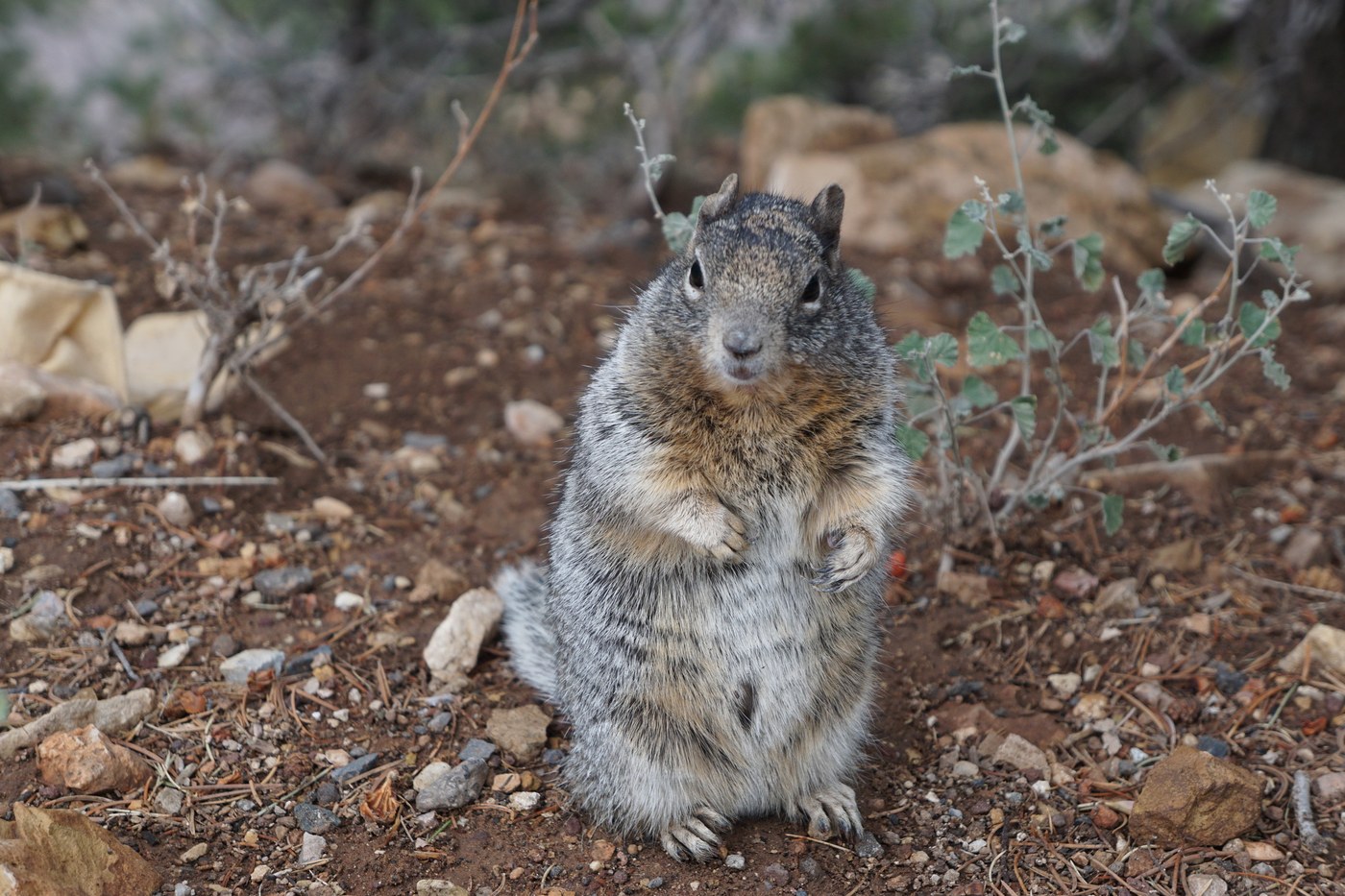
Rock squirrels are active only during daylight and are easiest to spot from spring through summer, when breeding, foraging, and above-ground activity all peak. In the cooler and higher-elevation parts of their range they hibernate through winter, emerging in spring to feed on new green growth. In the warmest, southernmost parts of the range some populations stay active year-round.
Rock squirrels are active only during daylight and are easiest to spot from spring through summer, when breeding, foraging, and…
Hibernation is not uniform across the range. Cooler and higher-elevation populations go into true winter hibernation and emerge in spring, while populations in the warmest, southernmost parts of the range may stay active all year. A rock squirrel out and about in January is not evidence of anything unusual, just a mild local winter or a warmer part of the range.
Breeding and litter timing are consistent across two independently sourced university extension circulars: one litter a year, typically 5 to 7 pups, born after roughly 30 days of gestation. A broader academic range of 3 to 9 pups, averaging under 5, is also documented and does not conflict with the typical figure, it simply brackets it.
Where They're Found
Rock squirrel is a Southwest animal whose documented range also reaches into southeastern California and into the South Central states. New Mexico State University Extension states the species occupies nearly all of Arizona and New Mexico, with the exception of very high elevations, and that core Southwest range is well established. A university museum natural history database lists the fuller range as Arizona, New Mexico, Colorado, Utah, western Texas, southern Nevada, the Oklahoma panhandle, southeastern California, and extreme southern Idaho, plus northern Mexico. Texas Tech University's own Mammals of Texas reference independently confirms a real, named Texas population with two recognized subspecies concentrated in the Trans-Pecos, central Texas, and the Texas Hill Country, which places this species in South Central. The same range sources place a documented population in southeastern California, which places it in California as well. A further population reaches into Colorado, Utah, and extreme southern Idaho, in the Mountain West. The map is drawn to the state level: within the South Central region it lights Texas and Oklahoma only, since the squirrel holds western Texas and the Oklahoma panhandle rather than the wetter eastern half of that region, and within the Mountain West it lights Colorado and southern Idaho rather than Wyoming or Montana.
Rock squirrels prefer rocky terrain, canyons, hillsides, boulder fields, and cliffs, and are well adapted to suburban and urban environments built on or near that kind of ground. Burrow entrances are round and left open rather than plugged, in contrast to a pocket gopher's closed, soil-plugged system, but true to the species' rock-loving habits those entrances are typically tucked into rock crevices, under boulders, or against the base of a wall or foundation rather than out in open turf. Burrow systems are colonial, with several individuals sharing one system and multiple entrances, and a system is extended in length and complexity year after year. The species needs very little free water, drawing moisture from dew, succulent vegetation, bulbs, and bark, and individuals have been documented surviving up to one hundred days in the desert without drinking.
No source found placing an established rock squirrel population in Alaska or in Hawaii. Every range description keeps the species confined to the arid Southwest and South Central United States and northern Mexico, terrain that does not occur in either state.
Life Cycle
One litter a year, occasionally two. Litters run 5 to 7 typical, with a broader academic range of 3 to 9 and an average under 5, and both figures are given here rather than collapsed into one, since the wider range does not conflict with the typical figure, it brackets it. A small number of documented observations describe a possible second litter in a year, noted here as a genuine but lower-confidence nuance rather than a settled fact.
Lifespan is another figure with a disclosed range rather than one clean number. University extension sources put it at up to 4 to 5 years. A separate academic source states wild individuals are known to survive at least 2.5 years, with captive individuals averaging considerably longer, a difference consistent with wild lifespans generally being shorter and less completely observed than captive ones rather than a real disagreement.
Hibernation is a facultative, range-dependent trait, not a universal one. Populations in colder, higher-elevation parts of the range hibernate through winter after building up fat reserves. Populations in the warmest, southernmost parts of the range stay active year-round.

Mating
Gestation
Birth and Nursing
Juvenile
Adult2
Signs of Activity
Identification
Size
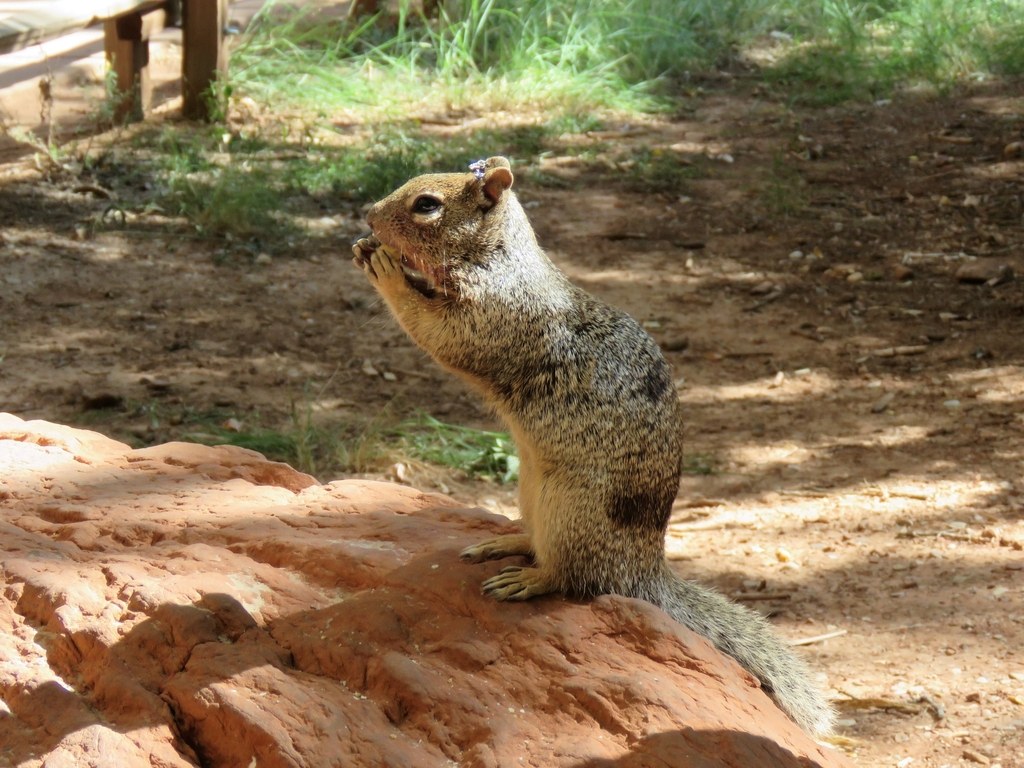
Head and body length around 10 and a half inches, with an 8 inch tail, for a combined nose to tail length of 17 to 21 inches. Weight runs up to about 1 and a quarter pounds, making this the largest of the desert ground squirrel species found in the region.
Color
Brownish-gray, mottled with white spots, sometimes described with patches of cinnamon brown, a range of variation rather than a conflict between sources.
Large, with a long bushy tail
A relatively large, heavy-bodied ground squirrel with a genuinely long, bushy tail for a ground squirrel. Large, conspicuous ears that extend above the top of the head are a specific field mark, useful for telling this species apart from a prairie dog.
Size beats the smaller squirrels
Against smaller Southwest ground squirrels, size is the fastest, most reliable tell. Rock squirrel weighs up to 1 and a quarter pounds, while the round-tailed ground squirrel weighs only 6 to 7 ounces and Harris's antelope squirrel weighs 4.3 to 5.3 ounces, roughly 3 to 5 times lighter than a rock squirrel. Coloring is the secondary tell: the round-tailed ground squirrel is light beige with a long, black-tipped tail, and Harris's antelope squirrel carries a white stripe on its side and a bushy black tail often arched over the back.
Prairie dogs: tail and ears
Against prairie dogs, tail length and ear size settle it. A prairie dog's tail runs only 1.5 to 4 inches, dramatically shorter than a rock squirrel's roughly 8 inch bushy tail, and prairie dogs have small, reduced ears where rock squirrels have fairly large ones.
Tree squirrels: den type
Against tree squirrels, the underlying difference is den type, not appearance. Rock squirrels can climb rock outcrops and occasionally trees, but remain true ground squirrels that den in an underground burrow system, while a tree squirrel such as Abert's squirrel builds a spherical nest high in the forest canopy and relies on trees rather than burrows for shelter. This burrow-versus-canopy-nest contrast is well documented for ground squirrels as a group, though it has not been separately confirmed in a source naming rock squirrel specifically, so treat it as a strong, well-supported pattern rather than a directly double-sourced fact for this exact species.
Vocal
Rock squirrels have several distinct calls, most often a chirp given singly or as several regularly spaced calls, along with whistles that are sometimes mistaken for bird calls, a useful auditory clue when the animal itself is out of sight.
Signs of Infestation
Open burrows, never plugged
Round, open burrow entrances that are never plugged, unlike a pocket gopher's closed, soil-sealed mound. Because this species seeks rocky cover, entrances are typically tucked into rock piles, boulder fields, retaining walls, foundation edges, or the base of an outbuilding rather than sitting out in open turf. Burrow systems are colonial, with multiple entrances, and a system is extended in length and complexity year after year.
The animal in plain sight, by day
The animal itself, in plain sight, during the day. Rock squirrels are diurnal and often bold around structures, so a squirrel sunning on a rock, sitting upright at a burrow mouth, or foraging in a garden bed in daylight is a strong, easily observed sign.
Dug-up seedlings and damaged fruit
Gnawed or dug-up garden seedlings, and damaged flowers, vegetables, and fruit. Newly planted seeds get dug up and eaten, and cropland is damaged the same way.
Chirps mistaken for bird calls
Chirps and whistles, sometimes mistaken for bird calls. A genuinely useful, specific auditory sign for this species.
No odor sign is documented
No specific odor sign is documented for this species. Nothing usable as a smell-based clue has been published.
Prevention and When to Call a Pro
Remove the harborage
Remove harborage near valued structures and plantings. Eliminate debris piles, abandoned irrigation pipe, pallets, and loose rock piles that offer cover and a place to start a burrow, since rock squirrels actively seek out exactly this kind of harborage.
Close the ground-level gaps
Close the gaps at the structure-to-ground interfaces this species actually uses. Because rock squirrels burrow into and under rock walls, retaining walls, foundations, and rip-rap rather than open turf, the practical homeowner step is installing hardware cloth or wire mesh beneath and behind dry-stacked rock walls and retaining walls where a burrow could start, and inspecting foundation edges, sidewalk gaps, and outbuilding perimeters for the open, unplugged holes this species leaves. Extension guidance is explicit that unaddressed burrowing under sidewalks, dwellings, and outbuildings can weaken structural integrity over time.
Exclusion fencing has a limit
Exclusion fencing has a real, documented limitation. Fences are generally ineffective at excluding ground squirrels on their own. Where fencing is attempted, a 4 foot fence of small wire mesh topped with a 16 to 20 inch sheet metal band, buried and flared outward at the base to prevent digging under it, is the documented design. Sheet metal cylinders around individual tree trunks are a more practical, targeted option for protecting specific plantings.
Irrigation method as a deterrent
Irrigation method is a genuine, low-effort deterrent. Flood irrigation, rather than sprinkler or drip systems, may discourage populations in agricultural or landscape settings. It will not clear an established colony on its own.
What does not work
Propane exploders and flagging do not frighten rock squirrels from their burrow sites, and chemical taste or odor repellents are not effective at causing them to leave or avoid an area.
Never feed rock squirrels
Habituated food begging at places like the Grand Canyon and Zion National Park has led to squirrels raiding backpacks and picnics and biting visitors who try to hand-feed them, and human food itself has caused fatal digestive problems in the animals. Both national park guidance and university extension sources are explicit on this point.
Arizona and New Mexico agree
Both core states, Arizona and New Mexico, classify the rock squirrel as unprotected and non-game, so a property owner can legally use lethal trapping without a hunting license. That does not extend to every control tool. Restricted-use pesticides such as zinc phosphide and aluminum phosphide require a licensed applicator, and one extension warning is worth repeating directly: never fumigate a burrow near a home or outbuilding, because the fumes can seep into the building and create a real health hazard. Discharging a firearm is illegal inside city limits and may be illegal elsewhere, so local law enforcement should be checked before that method is considered. The regulatory detail above covers Arizona and New Mexico only. A property owner in the California or Texas part of the range should confirm the current state classification before assuming the same rules apply.
Relocation rarely helps the animal
Live trapping and relocating is legal to attempt but rarely helps the animal. A rock squirrel released near its original burrow, within about half a mile, often finds its way back, and one released farther away is frequently unfamiliar with the new area and vulnerable to predation or starvation. Releasing an animal unharmed in no way ensures it will survive.
Call for a burrow under concrete
Call for any burrow found under a foundation, retaining wall, sidewalk, dam, or irrigation ditch bank. This is a documented structural-integrity and water-diversion risk, not just a nuisance-control decision.
Call before a restricted fumigant
Call before using a restricted-use fumigant or rodenticide. Zinc phosphide and aluminum phosphide both require a licensed pesticide applicator, and DIY fumigation near an occupied home or outbuilding is a genuine safety risk given the seep-in hazard noted above.
Call, and get care, after a bite
Call, and seek medical care, after any bite, particularly from a squirrel that has been fed by park visitors or is otherwise used to people. Rock squirrels are an independently confirmed plague vector, so a bite deserves medical evaluation rather than a wait-and-see approach. New Mexico's Department of Health states that rock squirrels are extremely susceptible to plague and have been the source of infection for almost one third of United States plague cases since 1970, transmitted mainly by their flea, a finding confirmed independently by University of Arizona Cooperative Extension and CDC surveillance literature. As with any documented plague-vector rodent, casual proximity to a healthy colony is not the concern here. The exposure route is flea bites and handling sick or dead animals, so do not handle a dead or obviously ill squirrel and keep pets away from active burrow areas.
Call for burrows in a playground
Call for burrow activity in a playground, school, park, or equestrian area. These are locations where an active burrow entrance should not be allowed to exist at all, given the documented fall and injury hazard.
Call if a colony comes back
Call if a colony reestablishes after your own trapping attempt. Burrow systems are extended and enlarged year over year, so a persistent, well-established colony is better handled with a coordinated professional approach than repeated DIY trapping.
Frequently Asked Questions
Do rock squirrels carry the plague?
Yes, and this species is named specifically rather than lumped in with rodents generally. New Mexico's Department of Health states that rock squirrels are extremely susceptible to plague and have been the source of infection for almost one third of United States plague cases since 1970, transmitted mainly through their flea. University of Arizona Cooperative Extension and CDC surveillance literature independently confirm the species' role by name. The documented exposure route is flea bites and handling sick or dead animals, not casual proximity to a healthy colony, so do not handle a dead or ill squirrel and keep pets out of active burrow areas.
Is a rock squirrel the same as a tree squirrel?
No. Despite being able to climb rocks and occasionally trees, it is a true ground squirrel that dens in an underground burrow system, unlike a genuine tree squirrel such as Abert's squirrel, which builds a nest in the forest canopy instead.
Why do I have burrow holes near my foundation or rock wall?
Rock squirrels prefer rocky terrain and readily burrow under human-made structures, sidewalks, dwellings, and outbuildings. Extension guidance is direct that this tunneling can weaken structural integrity over time, which is a different property-damage story than the open-field agricultural damage other ground squirrels cause.
Do I need a permit to remove rock squirrels in Arizona or New Mexico?
No. Both states classify the rock squirrel as an unprotected, non-game species, so a property owner can legally use lethal trapping without a hunting license. Restricted-use toxicants and fumigants still require a licensed applicator, and discharging a firearm within city limits is illegal in most areas.
Why did a rock squirrel bite me at a national park?
Rock squirrels at parks like the Grand Canyon and Zion have become habituated to begging for and stealing food from visitors. Bites from a habituated animal carry a real disease-exposure risk given the species' documented plague-vector status, which is exactly why feeding them is discouraged.
Are rock squirrels found outside Arizona and New Mexico?
Yes. Beyond the Southwest core of Arizona and New Mexico, documented populations reach into southeastern California and into western Texas, central Texas, and the Texas Hill Country, with additional range extending into Colorado, Utah, and extreme southern Idaho. No source places the species in Alaska or Hawaii.
Sources
- Controlling Rock Squirrel Damage in New Mexico, Circular 574 New Mexico State University Extension
- Backyard Gardener #24: Rock Squirrels University of Arizona Cooperative Extension, Yavapai County
- Spermophilus variegatus (rock squirrel) Animal Diversity Web, University of Michigan Museum of Zoology
- Mammals of Texas, Online Edition, Otospermophilus variegatus species account Texas Tech University Natural Science Research Laboratory
- Plague in New Mexico New Mexico Department of Health
- Rock Squirrel species page National Park Service, Zion National Park
- Plague, United States, 1992, Morbidity and Mortality Weekly Report U.S. Centers for Disease Control and Prevention