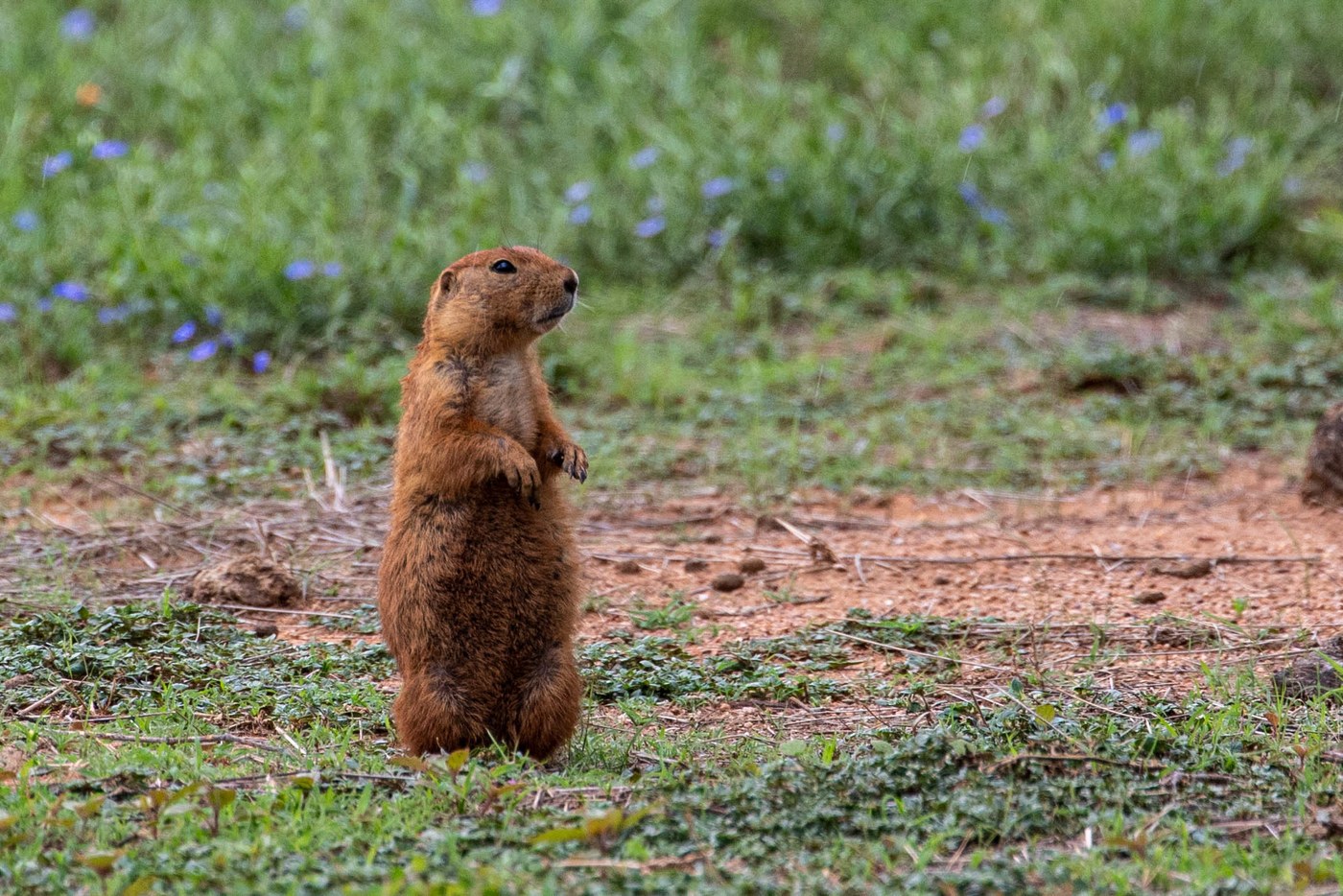
Seasonal Timeline
Black-tailed prairie dogs are active above ground year-round and by day, with no hibernation period, dropping into brief torpor only during especially cold winter stretches. The calendar that matters is reproductive: breeding runs late winter into early spring, and pups first appear above ground from May into early June.
Black-tailed prairie dogs are active above ground year-round and by day, with no hibernation period, dropping into brief torpor only during…
The winter answer is the one people get wrong, and they get it wrong for a defensible reason. Two of the other prairie dog species in the United States, white-tailed and Gunnison's, are true hibernators. This one is not. Wyoming Game and Fish Department states it plainly: black-tailed prairie dog does not hibernate, but will undergo periods of temporary torpor during especially cold winter episodes. Oklahoma State University Extension arrives at the same conclusion independently, describing animals that do not hibernate but may become dormant for short periods. So a colony seen working in January is behaving normally, and "they must be down for the winter" is not a reason to expect a quiet season.
The breeding window is where two agency sources give two slightly different answers, and both are worth knowing. Wyoming Game and Fish gives February to March. Federal park material at Wind Cave National Park gives March and April. They describe different parts of a range that runs from southern Canada to northern Mexico, so a spread rather than a single month is the honest reading.
What follows from either figure is the same, and it is the part that governs timing decisions. Young are born underground and stay there 5 to 7 weeks. Federal park material puts first emergence from May into early June. That means a colony can hold a full generation of dependent pups through spring while showing nothing unusual at the surface.
Where They're Found
Black-tailed prairie dog range covers four regions, Mountain West, Southwest, Midwest, and South Central. Wyoming Game and Fish Department describes the species as currently occupying all 11 states of its range, and federal park material names those states outright: Arizona, Colorado, Kansas, New Mexico, Oklahoma, Texas, Montana, Nebraska, North Dakota, South Dakota, and Wyoming. Sorted by region, that is Colorado, Wyoming, and Montana in the Mountain West; Arizona and New Mexico in the Southwest; Kansas, Nebraska, North Dakota, and South Dakota in the Midwest; and Oklahoma and Texas in the South Central. Range descriptions confine the species to short-grass and mixed-grass prairie from southern Saskatchewan to northern Mexico, and from the front ranges of the Rocky Mountains east to roughly the Nebraska and Iowa border. Arizona is a genuine special case inside that list: federal park material reports the species is not currently known from any National Park Service unit in the Sonoran Desert Network, though it notes a recent reintroduction at Sonoita. Arizona's place in the Southwest range rests on that reintroduction rather than on a continuous historical population, and New Mexico alone puts the Southwest in the species' current range regardless of how Arizona is read.
Alaska and Hawaii carry no population. Every range source keeps the species inside the continental Great Plains and Rocky Mountain front corridor, and the habitat it requires does not exist in either state.
The habitat requirement is unusually specific and unusually self-created. Wyoming Game and Fish describes persistent grazing by black-tailed prairie dog maintaining short vegetation on and near occupied colonies, and shrublands and tall grasses being avoided. Read that in order. The animal selects short grass, then keeps it short by eating it, which both feeds the colony and preserves the sightlines it needs to spot a predator. That grazing habit is the mechanism behind almost everything else about this species, including the forage competition with cattle and the open-ground habitat that other prairie species depend on.
Diet follows from the same behavior. Wyoming Game and Fish describes a strongly herbivorous animal feeding on stems, leaves, seeds, and roots of a variety of plants, with prickly pear cactus pads and roots a major winter food source, and occasional insect feeding reported without its nutritional role being understood. Soil matters too, at least in the negative: heavy or waterlogged ground works against a burrow system that has to hold its shape.
Range has not been stable. Wyoming Game and Fish reports occupied range down more than 95 percent from historic levels, a figure the account itself notes has been challenged in the literature while still reflecting a major real decline. A range-wide 2015 survey estimated 1,932,826 acres of potential colonies across the 11 occupied states.
Life Cycle
The reproductive calendar is simple. The social structure is not, and it is what makes this animal unusual. One litter a year, 1 to 8 pups, born underground, out at 5 to 7 weeks. That is the whole cycle. What sits around it is a three-level social hierarchy documented by the USDA Forest Service's Fire Effects Information System species review: a coterie is typically composed of 1 adult male, 3 to 4 adult females, and several yearlings and juveniles of both sexes, holding roughly one acre; individuals within coteries are amicable with each other and hostile towards non-coterie individuals; coteries group into wards defined by the terrain, and wards group into colonies that range from 5 to thousands of individuals. Colorado Parks and Wildlife uses the same term at the state level, stating that a family group is called a coterie.
Why that matters outside a biology discussion. The dispersal pattern, males out at a year and females staying for life, is what keeps a coterie related and territorial. It also means a colony is not a loose aggregation that thins out when part of it is disturbed. It is a set of defended acre-scale family territories packed side by side, which is why colony extent, not individual animal counts, is the useful measure of the situation on a given piece of ground.
Two numbers nobody has published reliably. Total lifespan and the exact percentage breakdown of animals breeding at one, two, and three years old both circulate widely, and both trace to aggregated secondary academic material rather than a directly sourced primary document. The sourced version is that most animals first breed in their second winter.

Mating
Gestation
Birth and nursing
Juvenile
Adult
Identification
How big it is
Size is the first cut, and it separates this animal from every ground squirrel sharing its range. Wyoming Game and Fish Department gives total length around 370 mm and weight around 820 g as its reference figures, with commonly cited ranges of 14 to 17 inches and roughly 1 to 3 pounds. The same account notes that co-occurring ground squirrels reach only about 75 percent of that total length and less than 50 percent of the weight. If it is markedly bigger than a ground squirrel, that is most of the answer.
Build and proportions
The build is stocky and low. Robust body, short muscular legs, small ears, and relatively large black eyes. Nothing about the proportions suggests a climber.
Why color will not do it
Color is a poor identifier here, and for a specific reason. The pelage is buff-brown and, in Wyoming Game and Fish Department's words, often blends with the color of the soil. Two colonies on different ground can look like different animals.
What the name is describing
The tail tip is the identification, and it is what the name is describing. The tail runs about 2 to 3 inches and is tipped black for roughly the last quarter to third of its length. That black tip is the namesake feature and the one detail worth getting a clear look at.
The look-alike that matters
White-tailed prairie dog is the look-alike that matters, where the two ranges approach each other in Wyoming and Colorado. Wyoming Game and Fish Department states the tell directly: the black-tipped tail distinguishes black-tailed prairie dog from the otherwise similar white-tailed prairie dog. White-tailed prairie dog's tail is shorter, about 1 to 2 inches, and tipped white or gray rather than black.
A winter tell that needs no tail
There is a second, non-visual tell between those two species, and it works in winter when nobody is close enough to study a tail. White-tailed prairie dog is a true hibernator. Black-tailed prairie dog is not. An active colony in deep winter is consistent with this species and not with its look-alike.
Being out in daylight means nothing
Daytime activity is normal and is not diagnostic on its own. These animals are diurnal, so seeing them out in full sun says nothing unusual about the colony.
Signs of Infestation
Three mound shapes, not one
Mound shape comes in three documented forms, not one. Oklahoma State University Extension describes dome mounds of loosely packed, vegetated soil; rimmed crater mounds that are cone-shaped and compacted; and unstructured entrances, typically on slopes steeper than 10 percent. A single colony can show all three, so a survey that only counts one mound type undercounts the colony.
What the density tells you
Density is the number that tells you what you are looking at. Oklahoma State University Extension puts burrow numbers at 4 to 100 per acre, varying with soil type and colony size. That is a different order of magnitude from the one-animal, one-tunnel-system arithmetic that applies to a pocket gopher or a groundhog.
Seeing the town before the animal
The colony is usually visible before any animal is. A town reads from a distance as a patch of closely cropped, short vegetation standing out against taller surrounding grass, and that contrast is created by the animals' own grazing rather than by soil or drainage.
The lookout posture and alarm call
Animals in an upright alert posture at burrow entrances during the day are the ordinary above-ground sign, and federal park material describes exactly that lookout behavior. Alarm calling through the colony when something approaches is part of the same behavior.
No indoor sign, and that is a finding
This species has no biological reason to enter a building, and no published source documents indoor presence, gnawed structural material, or burrowing that threatens a foundation. If something is in a wall void or a crawl space, it is not this animal.
On working land, watch the pasture
On working land, the sign to take seriously is what the pasture looks like rather than what the mounds look like. A colony expanding across grazing ground is a forage question with quantified numbers behind it.
Prevention and When to Call a Pro
Check your state rule first
Check your state and local wildlife regulations before trapping, poisoning, or relocating this animal. That step comes before anything else. The rules for this species vary by state, they are not consistent even within a single state, and they change over time. A licensed nuisance wildlife control operator or your state wildlife agency is the safer default than a trap or a poison bought on your own reading of a general article. That is not a formality here. At least one state in this species' range attaches a permit requirement specifically to moving a live animal, described below.
Wyoming, and why the caveat holds
Wyoming is the clearest illustration of why the generic caveat above is not hedging. Wyoming Game and Fish Department states that black-tailed prairie dog is classified as both a pest and a nongame species in Wyoming, and that both the Wyoming Department of Agriculture and the department itself hold shared management authority as a result, which the agency says makes management difficult. The same account lists the animal simultaneously as Wyoming nongame wildlife, Wyoming pest, U.S. Forest Service Region 2 sensitive, and Wyoming Bureau of Land Management sensitive. Four classifications, one animal, one state, at the same time. This describes Wyoming only.
Colorado splits the question
The split is worth reading carefully. Colorado Parks and Wildlife's own landowner guidance states that because prairie dogs are labeled a nuisance species in the state, a landowner may lethally remove them from their property at any time without a license, and that landowners or their agents may hunt, trap, or lethally remove prairie dogs when they are causing damage to crops, real or personal property, or livestock. The same guidance states the opposite constraint on the other half of the question: it is unlawful to capture, transport, and relocate black-tailed prairie dogs without a permit from Colorado Parks and Wildlife, with a stated 40 dollar permit fee, and separate paperwork attaches to donating a carcass to a wildlife rehabilitator or delivering live animals to the federal black-footed ferret recovery program or a licensed raptor rehabilitator. Lethal removal without a license, relocation only with one. This describes Colorado only.
Kansas, in two halves
Kansas covers the Midwest part of this range, and its framework has two halves worth reading separately. On the hunting side, Kansas treats black-tailed prairie dog as wildlife carrying a year-round season with no bag limit, taken under a standard hunting license. That season detail comes from secondary reporting of Kansas Department of Wildlife and Parks regulations rather than from the department itself, so confirm it with the department before acting on it. The half that matters more to a landowner is the department's Nuisance Wildlife Damage Control permit system. Under it, a licensed operator who live-captures a nuisance animal may release it in suitable habitat at least 10 miles outside city limits, and only after obtaining prior written permission from the landowner at the release site, or may euthanize the animal instead. Relocation is described as tightly regulated and often discouraged. That relocation rule also comes from a secondary summary of Kansas nuisance wildlife law rather than from the department itself. Confirm it with the department before anyone acts on it. For historical context only, Kansas passed township laws in 1901 and 1903 authorizing organized prairie dog eradication programs. That is a measure of how long the animal has carried a pest reputation in the state, not a description of current operative law. This describes Kansas only.
Oklahoma, easy to misread
Oklahoma covers the South Central part of the range, and it carries a designation that is easy to misread. The Oklahoma Department of Wildlife Conservation's own field guide page for this species lists its hunting season as year-round, referring readers to the regulations for details, and separately designates the animal a Species of Greatest Conservation Need. Read that second item precisely. Species of Greatest Conservation Need is a state wildlife action plan conservation-priority category, not a legal protection, and no published source states that Oklahoma's designation carries any take restriction or protective effect. Separately from the open season, Oklahoma statute at Title 29, section 4-135 authorizes the state's Wildlife Conservation Commission to issue nuisance and damage control permits to landowners, agricultural lessees, or their designated agents to control wildlife causing damage, without limitation by statewide season regulations, bag limits, or methods of taking. That is a general wildlife mechanism rather than a prairie-dog-specific one, and the citation is worth confirming against Oklahoma's own published code before relying on it. This describes Oklahoma only.
Arizona is a different case
Arizona covers the Southwest part of the range, and it is the one state where the whole picture changes. Do not read Wyoming's or Colorado's rules across to it. Black-tailed prairie dog was extirpated from Arizona and last documented there in 1960. What exists in the state now is the product of an Arizona Game and Fish Department reintroduction program running since 2008, centered on the Las Cienegas National Conservation Area near Sonoita, and a September 2022 department survey found the two colony sites there had each doubled in size over the prior four years. The department's own Wildlife Conservation Strategy species page lists the animal as a Species of Greatest Conservation Need, which again is a state wildlife action plan category rather than a legal protection. That same page states the legal-status criterion behind the listing as one of three conditions: listed endangered or threatened, or no open season in Arizona, or a signed conservation agreement, strategy, or plan. That listing does not say which of the three applies, so it cannot be read as a flat claim that there is no open season in Arizona. The practical point does not depend on resolving it. In Wyoming and Colorado the live question is removal versus relocation of an animal already present in numbers. In Arizona the population is a state-agency-managed conservation and reintroduction effort, so a resident or landowner near a documented Arizona colony should contact Arizona Game and Fish Department directly rather than assuming the default nuisance-removal framework that applies elsewhere in the range. This describes Arizona only.
Federal status is settled
It is the one piece of this that does not vary by state. The U.S. Fish and Wildlife Service issued a final determination on December 2, 2009 that the species does not warrant protection as a threatened or endangered species under the Endangered Species Act, following a petition history running back to 1998. Wyoming Game and Fish Department confirms that 2009 decision is still the latest official federal action. Not federally listed does not mean unregulated, which is the whole point of the four state examples above.
Habitat modification needs no permit
Habitat modification is the prevention step that applies broadly and requires no permit. Because this animal actively selects short-grass conditions and avoids tall grass and shrubland, letting grass and low shrub cover grow tall and dense along a property edge works against colony establishment or expansion onto that ground. This is the opposite of the seal-the-openings advice that applies to a structural pest, and it is the one measure that addresses the animal's actual habitat preference rather than fighting it.
Buried mesh, a general practice
Buried mesh barriers at an advancing colony edge are a general practice for burrowing rodents rather than a specification for this species. No published source gives a barrier depth specific to black-tailed prairie dog, so no depth is stated. Burrow systems in this family are commonly described at 4 to 5 feet deep and deeper in loose soil, which is context for why a shallow barrier is unlikely to accomplish much, not a design spec.
A land-management conversation
For a property with livestock or cropland, the honest framing is that this is a land-management conversation about colony size and location, not an exclusion job. There is no wall void, no crawl space, and no entry point to close. What there is instead is a question about how much of a pasture a colony occupies, which has real numbers attached.
Call before any control action
Call before taking any control action beyond passive habitat modification. Because state rules vary this sharply and at least one state attaches a permit specifically to relocation, the threshold for professional involvement is not "after do-it-yourself fails." It is before removal, relocation, or lethal control is attempted at all. Contact a licensed nuisance wildlife control operator or your state wildlife agency to confirm the current local rule first.
Call for a colony near cropland
Call for an active, expanding colony near cropland or pasture, and here is the number that justifies it. USDA Agricultural Research Service research published in 2021 found that prairie dog grazing reduces the amount of forage while improving its quality, with measurably better protein content and dry-matter digestibility in what remains. The same research quantified the livestock cost: at 30 percent prairie dog occupancy of a pasture, summer cattle weight gain declined 4 percent, and at 60 percent occupancy it declined 8 percent. The researchers also found cattle preferentially grazing along colony edges and resting in colony centers, a pattern they compare to the historical bison and prairie dog relationship. This is a forage-competition trigger, separate and unrelated to the health trigger below.
Report a die-off, do not approach
Call, and report it, for a sudden colony die-off. Do not approach it. Many carcasses appearing across a colony over a short period is consistent with a plague event and should go to a state wildlife or public health agency rather than being investigated in person. Peer-reviewed research by U.S. Geological Survey scientists defines a plague epizootic in these colonies as the death of more than 90 percent of a population within 3 months across at least 10 hectares, and describes an infected colony collapsing within just a few weeks. The exposure routes are the reason for the keep-your-distance instruction: South Dakota Department of Health states plague is most commonly spread by exposure to infected fleas, and warns separately about handling tissues from infected animals and about pets picking it up from infected rodents and passing it to people. Montana Fish, Wildlife and Parks independently confirms the same mechanism, citing bites from infective fleas as the usual route, infection while skinning or field dressing an infected animal, and documented cases of dogs and cats developing plague through oral mucous membrane exposure to infected rodent tissue. Both agencies name prairie dogs specifically.
Keep the plague risk in proportion
South Dakota Department of Health describes plague as relatively rare in the United States and limited to the western part of the country, and reports that since 2004 plague has been detected in southwestern South Dakota rodents and caused die-offs in local prairie dog colonies. Montana Fish, Wildlife and Parks notes most U.S. cases occur in the warmer months while cases can occur in any month, and that its own most recent documented human case in Montana was in 1992, contracted from a bobcat carcass rather than from a prairie dog. The practical reading: do not handle carcasses, do not let a dog work a colony, and report a die-off rather than walking into it.
Frequently Asked Questions
Do black-tailed prairie dogs hibernate?
No, and this is the most common wrong assumption about the species. Wyoming Game and Fish Department states that black-tailed prairie dog does not hibernate but will undergo periods of temporary torpor during especially cold winter episodes, and Oklahoma State University Extension independently describes animals that do not hibernate but may become dormant for short periods. The assumption is understandable, because two of the other prairie dog species in the United States, white-tailed and Gunnison's, genuinely are hibernators. This one is not. A colony active in January is behaving normally, and it is also a clue to which species you are looking at.
Is the black-tailed prairie dog found outside Colorado, Wyoming, and Montana?
Yes, and by a wide margin. Wyoming Game and Fish Department describes the species as currently occupying all 11 states of its range, and federal park material names them outright: Arizona, Colorado, Kansas, New Mexico, Oklahoma, Texas, Montana, Nebraska, North Dakota, South Dakota, and Wyoming. That footprint spans four regions rather than one. Colorado, Wyoming, and Montana are the Mountain West share of it, with Arizona and New Mexico in the Southwest, Kansas, Nebraska, North Dakota, and South Dakota in the Midwest, and Oklahoma and Texas in the South Central. Arizona is the exception worth naming, because the animal was extirpated there and last documented in 1960, and the population present now comes from an Arizona Game and Fish Department reintroduction program running since 2008 rather than from a continuous historical one. Range has also not held steady: Wyoming Game and Fish reports occupied range down more than 95 percent from historic levels.
Do prairie dogs carry the plague?
Yes. Black-tailed prairie dog colonies are a documented reservoir for sylvatic plague, and the effect on the colony itself is severe. Peer-reviewed U.S. Geological Survey research defines a plague epizootic in these colonies as the death of more than 90 percent of a population within 3 months over at least 10 hectares, with an infected colony collapsing in just a few weeks. Human exposure works through specific routes rather than through casual proximity. South Dakota Department of Health cites exposure to infected fleas as the most common route, plus handling tissues from infected animals, and warns that pets can pick it up from infected rodents and transmit it to people. Montana Fish, Wildlife and Parks confirms the same mechanisms independently, including cases in dogs and cats exposed to infected rodent tissue. Both agencies describe plague as rare in the United States and confined to the west. The practical version: do not handle carcasses, keep pets out of colonies, and report a sudden die-off to a state wildlife or public health agency instead of going to look at it.
Are black-tailed prairie dogs protected, or can they be removed as a pest?
Both answers are true depending on where you are standing, which is exactly why checking your own state's rule comes first. Federally, the species is not listed. The U.S. Fish and Wildlife Service determined on December 2, 2009 that Endangered Species Act protection was not warranted, and Wyoming Game and Fish Department confirms that remains the latest federal action. State-level status is where it gets contradictory. Wyoming classifies the same animal as both a pest and a nongame species at once, with the state agriculture department and the state wildlife department holding shared authority, which the wildlife agency itself says makes management difficult. Colorado allows a landowner to lethally remove prairie dogs causing damage without a license, while making it unlawful to capture, transport, and relocate them without a permit from Colorado Parks and Wildlife. Those are two states' rules, stated as those two states' rules. Confirm the current rule where you are before doing anything.
Why are prairie dogs called a keystone species?
Because other animals are documented as depending on their colonies by name, not because the phrase sounds impressive. Federal park material lists American badgers, prairie rattlesnakes, burrowing owls, and the federally endangered black-footed ferret among animals that prey on prairie dogs or use their burrows for shelter, and notes that horned larks and mountain plovers prefer the open habitats these rodents maintain. Colorado Parks and Wildlife independently calls the species a keystone species integral to the health of the Colorado ecosystem, and names burrowing owls, golden eagles, ferruginous hawks, thick-billed longspurs, and mountain plovers among species affected when plague wipes out a colony, since they depend on it for food or habitat without being susceptible to plague themselves. The USDA Forest Service's species review separately confirms the black-footed ferret relationship, describing the ferret as once a major predator relying on colonies for both food and shelter. The mechanism is the grazing: by keeping vegetation short, prairie dogs maintain the open-ground structure those birds require.
How do you tell a black-tailed prairie dog from a white-tailed prairie dog?
Look at the tail tip. Wyoming Game and Fish Department states the tell directly: the black-tipped tail is what distinguishes black-tailed prairie dog from the otherwise similar white-tailed prairie dog. Black-tailed prairie dog's tail runs about 2 to 3 inches with the last quarter to third tipped black. White-tailed prairie dog's tail is shorter, about 1 to 2 inches, and tipped white or gray. There is a second tell that does not require a close look at all, which helps in winter: white-tailed prairie dog is a true hibernator and black-tailed prairie dog is not, so an active colony in deep cold points to this species. Separating either one from a ground squirrel is easier, since a black-tailed prairie dog is markedly larger, and co-occurring ground squirrels reach only about 75 percent of its total length and under half its weight.
Sources
- Black-tailed Prairie Dog species account: size and weight reference figures, black-tipped tail identification, white-tailed prairie dog distinction, no hibernation, breeding season, litter size, underground period, sex-based dispersal, diet, habitat and grazing behavior, range decline, dual pest and nongame classification, and 2009 federal status confirmation Wyoming Game and Fish Department
- Prairie Dogs species page: coterie terminology, keystone species role, dependent bird and raptor species, small game classification, and nuisance designation Colorado Parks and Wildlife
- Living with Prairie Dogs: landowner lethal-removal allowance without a license, the relocation permit requirement and fee, and the separate paperwork for rehabilitators and the black-footed ferret recovery program Colorado Parks and Wildlife
- Prairie Dogs of the Southwest, Introduction: 11-state distribution list, Arizona park absence and Sonoita reintroduction, and the named dependent species including burrowing owl, prairie rattlesnake, American badger, and black-footed ferret U.S. National Park Service
- Black-tailed Prairie Dog (Cynomys ludovicianus): breeding season, gestation as 4 to 5 weeks, pup emergence from May to early June, and above-ground lookout behavior U.S. National Park Service, Wind Cave National Park
- Prairie Dog Ecology and Management in Oklahoma: the three documented burrow mound forms, burrow density per acre, and confirmation that the species does not hibernate Oklahoma State University Extension
- Fire Effects Information System species review for Cynomys ludovicianus: coterie composition and territory size, ward and colony organization, colony size range, and the black-footed ferret and prairie rattlesnake relationships USDA Forest Service, Research and Development
- A Truce Between Prairie Dogs and Livestock Farmers? Forage quantity and quality findings and the quantified cattle weight-gain declines at 30 and 60 percent pasture occupancy (Augustine et al. 2021, Journal of Wildlife Management) USDA Agricultural Research Service
- Prairie Dogs, Persistent Plague, Flocking Fleas, and Pernicious Positive Feedback (Biggins and Eads, 2019, Frontiers in Veterinary Science): the quantified epizootic definition and colony collapse timeframe U.S. Geological Survey, Fort Collins Science Center
- Plague: flea-bite and carcass-handling exposure routes, pet transmission, western U.S. distribution, and documented South Dakota prairie dog colony die-offs since 2004 South Dakota Department of Health
- Plague: infective flea-bite transmission, field-dressing exposure, documented dog and cat cases, seasonal case pattern, and the state's most recent human case Montana Fish, Wildlife and Parks
- Black-Tailed Prairie Dog field guide page: the year-round hunting season and the Species of Greatest Conservation Need designation cited for the Oklahoma example Oklahoma Department of Wildlife Conservation
- Arizona Wildlife Conservation Strategy species page for Cynomys ludovicianus: the Species of Greatest Conservation Need designation and the three-part federal or state legal status criterion cited for the Arizona example Arizona Game and Fish Department
- Endangered Species Act Protection for Black-Tailed Prairie Dog Not Warranted, final determination of December 2, 2009 U.S. Fish and Wildlife Service
Image Credits
- Image: Shawn Taylor via iNaturalist. CC BY 4.0.
License.