Seasonal Timeline
Thirteen-lined ground squirrels are diurnal and most active on warm, sunny days, foraging heavily from spring emergence through late summer to build fat reserves ahead of hibernation. Emergence shifts with latitude, running from late March to early May and arriving later the farther north you go. Sex matters too: males both enter hibernation and emerge ahead of females.
Thirteen-lined ground squirrels are diurnal and most active on warm, sunny days, foraging heavily from spring emergence through late summer…
Hibernation timing is best given as a range rather than a single date, because the sourced figures genuinely differ by region and that difference is real, not a disagreement to resolve. In Nebraska, animals typically enter hibernation in October and emerge in late March or early April. In Illinois, entry runs September into early October, with emergence stretching from late March into May. In Kansas, animals enter torpor in October and November. In Texas, at the warm southern edge of the range, hibernation runs roughly 240 days, entered in July or August and ending in February or March. Read together, that is a clear latitude gradient: the warmer the climate, the earlier hibernation starts and the earlier it ends, not a conflict between sources.
Within any single population, males typically begin hibernation earlier in fall and emerge earlier in spring than females, and females return to the den for another one to two weeks after their own emergence before mating begins.
Every one of these dates traces to a university extension publication or a state wildlife or conservation agency.
Where They're Found
Thirteen-lined ground squirrel occupies three regions, Midwest, Mountain West, and South Central. The University of Nebraska-Lincoln's own reprint of the standard wildlife-damage-handbook chapter for this species states the current range runs from central Alberta, Manitoba, and Saskatchewan in the north to Texas and New Mexico in the south, and from central Ohio in the east to Colorado in the west, language independently mirrored on the Internet Center for Wildlife Damage Management's identification page. That places a real, established Colorado population in the Mountain West and a real, established Texas population in the South Central region, not marginal edge-of-range records.
The Midwest core of the range is the best documented part of it. The species is common throughout Nebraska, occurs statewide in Kansas across 68 recorded counties, and is found across the northern two-thirds of Illinois, concentrated in black soil prairie and edge habitat. It also occurs, in smaller and now-declining numbers, in localized populations in northwest Missouri, where the state's own conservation department currently lists it as a Species of Conservation Concern after a documented range and population decline in that state specifically. That Missouri-specific decline is called out because it does not apply to the species as a whole: populations elsewhere in the Midwest and southern Great Plains are not described as declining in any source, and agricultural and residential development has actually expanded this species' range in parts of the Great Plains by creating more of the short, open grass habitat it prefers.
The Mountain West population centers on Colorado's eastern plains and short-grass prairie, including documented occurrence at Pawnee National Grassland in Weld County. The South Central population is well documented in two states. In Texas, the Natural Science Research Laboratory at Texas Tech University documents two established subspecies, one in the Panhandle and one across the rest of the state, with a range running from the Dallas-Fort Worth area south to the Gulf Coast. In Oklahoma, the species is common statewide except along the state's eastern edge, concentrated in prairie, shortgrass fields, cemeteries, and roadside rights-of-way in the northern and western parts of the state.
New Mexico is named at the far southern edge of that Alberta-to-Texas range description, but no source confirms an established, rather than marginal, New Mexico population, so the Southwest is not claimed. A single documented introduced colony also exists in Venango County, Pennsylvania, dating to 1919. That is a genuine, sourced population, but it is a one-county introduced colony rather than an established regional presence, so it does not count as an established Northeast population.
Alaska and Hawaii carry no population. Every range source keeps the species inside the belt described above, running the Canadian prairie provinces south to Texas and central Ohio west to Colorado, and the dry, short-grass prairie habitat it depends on does not occur in either state.
Within its range, the species favors dry, well-drained soil and avoids wet ground with heavy clay. It is found in open areas with short, closely cropped grass: golf courses, cemeteries, parks, lawns, athletic fields, fencerows, roadsides, earthen dikes, and overgrazed or heavily mowed pasture. The vegetation has to be short enough for the animal to see over it while sitting upright, which is the actual mechanism behind its preference for manicured turf rather than a matter of taste.
Life Cycle
One litter a year, and the whole calendar bends around a genuinely extreme hibernation. Gestation is the single most consistent figure sourced for this species, 28 days everywhere it was checked. Litter size is the figure that varies most, reported anywhere from 2 to 14 young depending on the source and the region, most often clustering around 7 to 10. None of that changes anything practical about identification or timing, so the range is the honest answer rather than a single number.
The hibernation figures deserve to be read carefully rather than averaged. Two independent sources describe the metabolic slowdown in different but compatible terms: one reports heart rate falling from a normal roughly 200 beats per minute to as low as 20 during torpor, another reports a resting rate as low as 5 beats per minute. Both describe the same phenomenon, a dramatic, order-of-magnitude drop, even though the low-end numbers differ. Both figures stand rather than being averaged into one.
The regional hibernation-timing spread is a real latitude gradient, not a data conflict. Animals in Texas, at the warm southern edge of the range, hibernate roughly 240 days, entering in July or August. Animals in Nebraska and Illinois, farther north, stay active into September or October and hibernate for a shorter stretch. A ground squirrel active in a Texas August and one that has already gone underground in a Nebraska September can both be behaving completely normally.

Mating
Gestation
Birth and nursing
Juvenile
Adult
Hibernation
Identification
The name is literal
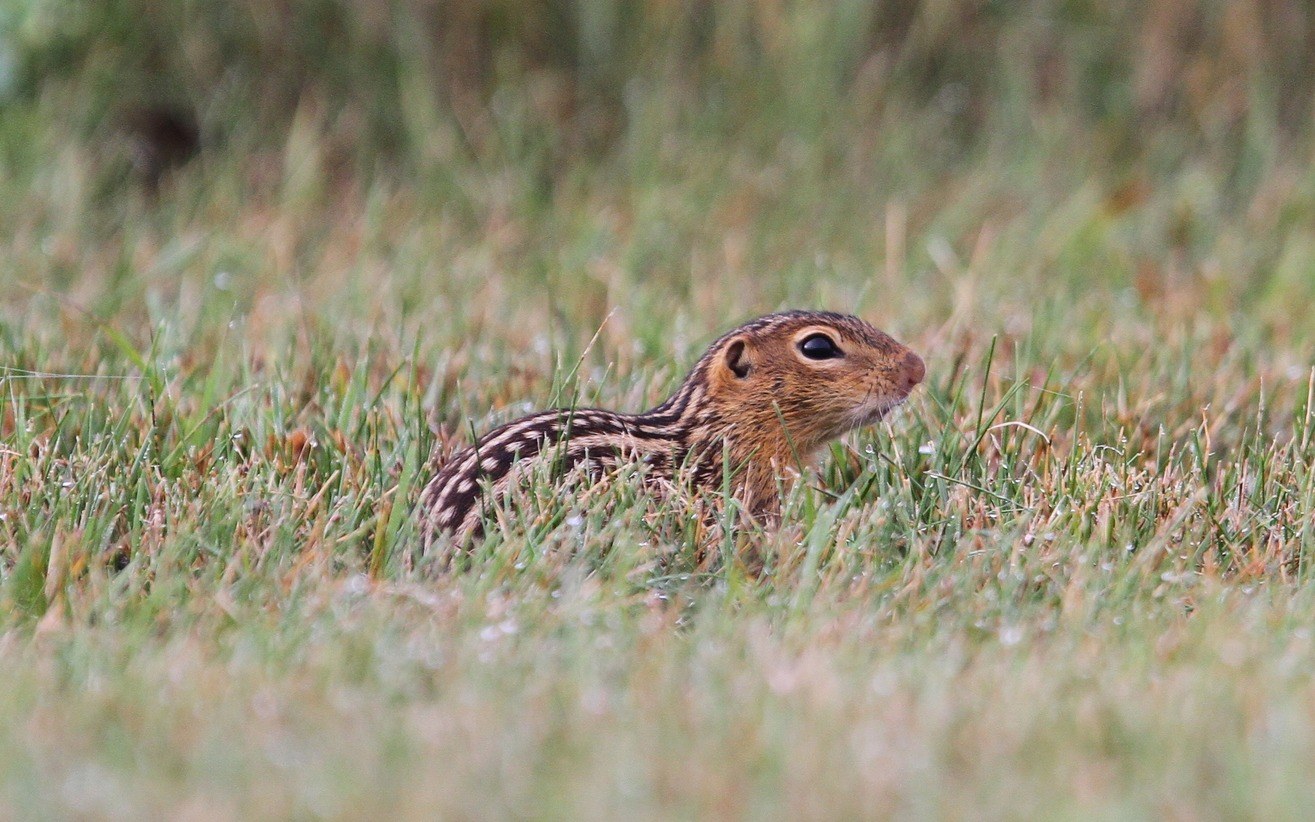
The pattern is the identification. Thirteen alternating light and dark stripes run the length of the body from shoulders to rump. Several of the light stripes break into rows of spots rather than running solid, and 5 light plus 4 dark stripes extend along the top of the head, ending between the eyes. Cheeks, body, and legs run yellow to tan with an orange cast, and the belly is thinly covered in light tan fur.
Size varies by season and region
It varies more than most people expect. Total length runs roughly 7 to 12.5 inches including a 2.5 to 6 inch tail, with weight around 4 to 5 ounces in spring rising toward 8 to 9 ounces by fall as the animal fattens up for hibernation. Large eyes and small ears set low on the head are both consistent field marks.
Behavior settles most of it
Behavior settles most identification questions on its own, without a single stripe needing to be counted. This species sits bolt upright on its haunches, front paws held close to the chest, surveying its surroundings in full daylight, on warm, sunny days when the temperature is comfortably above 80 degrees Fahrenheit. If danger threatens, it runs for the nearest burrow holding its tail flat and horizontal along the ground.
Eastern chipmunk: tail carriage
Eastern chipmunk is the closest look-alike, and the tell that works even at a dead run is tail carriage. A startled ground squirrel holds its tail horizontal against the ground; a chipmunk carries its tail upright. Stripe pattern is the backup tell if a clear look is available: a chipmunk has only 5 dark stripes, including stripes on the face, versus this species' denser, spotted, 13-stripe, body-only pattern.
Franklin's, by size and pattern
Franklin's ground squirrel is the second look-alike, and it is mostly ruled out by size and pattern rather than a close inspection. It is larger and stockier, brownish gray speckled with black rather than clearly striped, closer in overall look to a small eastern gray squirrel with smaller ears and a less bushy tail. It also favors tall-grass prairie and abandoned fields rather than the close-cropped turf this species prefers, so habitat alone is often a useful first clue.
Signs of Infestation
An unmounded burrow entrance
A small, unmounded burrow entrance is the single most useful visual sign, and its lack of a mound is itself diagnostic. Entrances run about 2 inches across, are usually tucked into and concealed by surrounding vegetation, and rarely have a visible soil pile at the opening, because the animal scatters excavated dirt rather than heaping it. An active hole looks clean and well-used, with the grass around it visibly worn down from repeated traffic.
The tunnel system is bigger
The tunnel system underneath is more extensive than the small entrance suggests. The main burrow plunges 6 inches or more before angling into a branching gallery system running 15 to 20 feet, typically with more than one entrance. A separate, shorter escape burrow has just a single opening. The underground nest chamber, roughly 9 inches across and lined with fine dry grass, sits deeper than the main tunnel run. Entrances are commonly plugged with grass or soil overnight.
Divots and disturbed rows
Divots and disturbed planting rows are the standard crop and garden sign. Small excavations in freshly planted soil where seed has been dug up, clipped emerging shoots, and pulled-over grain stalks stripped of their heads are all documented, specific damage patterns rather than generic "something dug here" evidence.
The animal upright in daylight
The animal itself, sitting upright at a burrow mouth in broad daylight, is one of the more reliable direct signs available for any burrowing rodent. This species is diurnal and visible rather than secretive, so an actual sighting, front paws held to the chest, is common wherever the habitat is right.
Six documented calls
Six distinct calls are documented, the most common a high-pitched trill used to warn neighbors and young of danger. Do not rely on hearing it, though. The same research documenting the call also found the species inconsistent about actually using it, so its absence is not evidence the animal isn't present.
No distinctive odor is documented
Nothing usable as a smell-based sign has been found for this species.
Prevention and When to Call a Pro
A lawn problem, not a structural one
This is a lawn, garden, and cropland problem, not a structural one, and that changes where effort belongs. No source documents this species damaging a foundation, wall void, attic, or crawl space, in direct contrast to chipmunks, which can burrow under patios and retaining walls in numbers. Standard seal-the-entry-points advice for structural pests does not apply here. Everything worth doing happens outdoors, at ground level.
Tall grass deters, with a tradeoff
Letting grass grow tall is a real deterrent, with a real tradeoff. This species needs short, open sightlines to feel safe foraging, so allowing grass and other vegetation to grow tall and dense in roadside ditches, field edges, earthen dams, and pasture discourages it from establishing there in the first place. Property owners bordering ground-squirrel-heavy areas can do the same with dense shrub, tall grass, or flower plantings along a border. The honest tradeoff: taller, denser vegetation can create a new problem with voles, which prefer exactly that cover.
A persistent myth, corrected
A persistent myth is worth correcting directly, since it wastes real effort. Repeatedly filling or blocking burrow entrances does not cause this species to abandon the area. It simply re-digs.
Time crop protection to a calendar
Timing crop protection to the calendar works better than reacting to the first sighting. Deep tilling before spring emergence destroys dens and disrupts the burrow network outright. Sowing cold-resistant seed strains in March or early April lets plants mature past their most vulnerable stage before the animals become active. A distraction ration of cracked corn, roughly 4 bushels per acre broadcast over the outer 4 to 8 rows nearest known ground squirrel habitat, can pull feeding pressure away from the crop itself.
Fencing protects a single bed
Fencing protects individual garden beds, with a real limit on how far it goes. Half-inch wire mesh or sheet metal fencing, at least 18 inches high and buried 6 inches deep, is the standard barrier for gardens and flowerbeds. Persistent animals have been documented climbing over or digging under fencing to reach a strongly preferred food source, so fencing works as a partial measure rather than a guarantee, especially where pressure is high.
Some chemicals need a license
Registered chemical options exist, and some genuinely require a license. Thiram seed treatment (75 percent concentration) is EPA-registered specifically to reduce this species' seed damage. Zinc phosphide bait (2 percent) is the only bait registered for this species and works best applied in spring and late summer when the animals are actively gathering seed. Aluminum phosphide burrow fumigant is a Restricted Use Pesticide requiring a written fumigation management plan, and it must never be used in or near an occupied building. Homemade repellents such as mothballs and dried blood meal are documented as having only limited success and are not recommended as a substitute for the options above.
Do not try to catch one by hand
This species is evasive and has a powerful bite. Trapping, baiting, or fumigation, not hand capture, is the right approach whenever direct removal is warranted.
When to Call a Pest Control Professional
The right framing here is population management, not eradication, since this species also eats real numbers of crop-damaging grasshoppers and other insects, a documented benefit worth preserving rather than eliminating outright. Bring in a licensed pest control operator or wildlife damage specialist once burrowing and feeding activity moves past tolerable nuisance into real turf, dike, or crop loss that fencing, tilling, and seed-timing measures on their own can no longer contain, or whenever a Restricted Use Pesticide such as aluminum phosphide would be needed, since that requires a fumigation management plan and licensed handling rather than a homeowner application.
Frequently Asked Questions
Why does it have 13 stripes?
The number is literal and is exactly where the name comes from. It carries 13 alternating light and dark stripes running the length of its back, and several of the light stripes break into rows of spots rather than running solid, which is one of the more distinctive, easy-to-verify field marks of any backyard wildlife species.
Is a thirteen-lined ground squirrel the same thing as a chipmunk?
No, and the fastest way to tell them apart works even when the animal is moving too fast to count stripes. When startled, a ground squirrel runs for its burrow holding its tail flat and horizontal against the ground, while a chipmunk carries its tail upright. If a clear look is available, chipmunks also have only 5 dark stripes, including stripes on the face, versus this species' denser, spotted, 13-stripe pattern running the full body without facial stripes.
Do thirteen-lined ground squirrels really hibernate?
Yes, and unusually deeply for a mammal this size. It is one of the few mammals described as a true, deep hibernator: body temperature drops to just above freezing and heart rate falls to a small fraction of its normal rate for months at a time, with the animal above ground for only roughly 3 to 4 months of the year on the shorter end of its documented range. Exact timing shifts by latitude, running earlier and longer in the warm southern part of the range and later and shorter farther north.
Will thirteen-lined ground squirrels damage my house or foundation?
No structural damage of that kind is documented for this species. It is not known to burrow under patios, foundations, or retaining walls, unlike chipmunks, which can cause that kind of damage in large numbers. The real damage this species causes is limited to lawns, gardens, golf courses, cemeteries, and cropland, where it digs up planted seed, clips emerging shoots, and pulls over grain stalks to reach the heads.
Can I just fill in the burrow holes to make them leave?
No, and it wastes effort that would do more good elsewhere. Repeatedly filling or blocking burrow entrances does not cause this species to abandon an area; it simply digs back out or re-digs nearby. More effective steps are timing-based (working before spring emergence, when dens are easiest to disrupt), habitat-based (letting grass grow tall where the animal is unwanted), or, for real crop or turf loss, EPA-registered baits and fumigants applied strictly per label.
Do thirteen-lined ground squirrels carry disease?
The documented risk to people and pets is minimal, and one commonly repeated claim about this species does not hold up well under a closer look. A single wildlife-damage source states it may contract bubonic plague, but no independent source corroborates that claim specifically for this species, unlike California ground squirrel, where a peer-reviewed CDC investigation directly documents that species as a plague-exposure route. National plague ecology instead concentrates around other reservoir species farther west and southwest. The better-supported risk is property damage to lawns, gardens, and crops, not disease.
Sources
- The Thirteen-Lined Ground Squirrel: Controlling Damage (NebGuide G1964, 2009): physical description, general biology, hibernation timing, reproduction, diet, economic significance, and prevention and control methods University of Nebraska-Lincoln Extension
- Thirteen-lined Ground Squirrels: identification, physical description, range, voice, and tracks and signs Internet Center for Wildlife Damage Management (University of Nebraska-Lincoln with USDA APHIS Wildlife Services)
- Thirteen-lined Ground Squirrel Biology: reproduction, denning cover, behavior, habitat, and food habits Internet Center for Wildlife Damage Management
- Thirteen-lined Ground Squirrel Damage Identification: structural, livestock and pet, and landscape damage, and health and safety concerns Internet Center for Wildlife Damage Management
- Thirteen-Lined Ground Squirrel field guide entry: physical description, Missouri range and conservation status, life cycle, and hibernation physiology Missouri Department of Conservation
- Ictidomys tridecemlineatus species account, Mammals of Texas Online Edition: Texas subspecies, range, physical description, habitat, and reproduction Natural Science Research Laboratory, Museum of Texas Tech University
- Thirteen-lined Ground Squirrel species account: Kansas distribution, habitat, physical description, and reproduction Kansas Mammal Atlas, Fort Hays State University
- Thirteen-lined ground squirrel: Illinois hibernation timing, physical description, habitat, and range Illinois Department of Natural Resources
- Spermophilus tridecemlineatus (thirteen-lined ground squirrel): size, lifespan, hibernation physiology, and home range Animal Diversity Web, University of Michigan Museum of Zoology
- Maps and Statistics: US plague-endemic regions and historical case counts by state U.S. Centers for Disease Control and Prevention
Image Credits
- Image: Christoph Moning via iNaturalist. CC BY 4.0.
License.