Seasonal Timeline
Pocket gophers are active year-round and at all hours of the day and night. Digging activity itself peaks twice, in spring as the soil loosens and again in fall as the animal prepares for winter.
Pocket gophers are active year-round and at all hours of the day and night. Digging activity itself peaks twice, in spring as the soil…
There is no season when a pocket gopher goes quiet. Unlike a groundhog, which seals itself in and sleeps through the winter, this animal stays awake and stays underground all twelve months, at all hours. What changes through the year is how much dirt it moves. Digging picks up in spring, when soil is workable, and again in fall as the animal extends tunnels and stocks its food chamber ahead of winter. Those are the two stretches when a homeowner is most likely to walk out and find several new mounds that were not there the day before. A single gopher can throw up several mounds in one day.
Irrigation is the one variable that changes the reproductive math, and it matters because it is a variable you control. On dry, nonirrigated ground, the research is consistent at one litter a year, bred in late winter and early spring. On irrigated ground, breeding runs year-round and a female may produce up to three litters a year. Litters run 5 to 6 young. That means a watered lawn, a drip-irrigated orchard row, or a green landscaped yard in an otherwise dry Southwest neighborhood is not just attracting gophers, it can support up to three times the reproduction of the dry ground around it.
Where They're Found
Botta's pocket gopher occupies most of the southern half of the western United States and is the most widespread of the five pocket gopher species found in California. The U.S. Geological Survey maintains its own species-specific habitat model for this animal, mapped separately from every other Thomomys species. The species is not found in Alaska or Hawaii. The pocket gopher family is entirely continental North American, and no range description or federal habitat model places any pocket gopher species in either state.
What limits this animal is soil, not climate. It needs friable, light-textured, well-drained ground with a good supply of plants that put down fleshy taproots, bulbs, or tubers. Heavy clay and waterlogged soil are unsuitable, because a tunnel system needs gas exchange to work. That is a genuinely different limiting factor than the one that bounds most yard wildlife, which is usually cold tolerance or access to water. It also explains why gopher pressure can stop cold at a property line: your neighbor's heavy clay may simply be unworkable ground while your amended garden beds are ideal. Elevation is not a barrier. Botta's pocket gopher is found from low coastal areas to above 12,000 feet.
Arizona carries one conservation nuance worth stating precisely, because it is easy to misread. Arizona Game and Fish Department's Wildlife Conservation Strategy lists a single Botta's pocket gopher subspecies, Thomomys bottae subsimilis, the Harquahala southern pocket gopher, as a Species of Greatest Conservation Need at Tier 2. That is a state wildlife action plan category, not a legal protection. The department's own vulnerability analysis states that this subspecies does not meet the criteria for federal or state legal listing, and the population in question is a disjunct one, separated by a long distance from the species' main range. It does not change anything a homeowner may legally do about gophers in an Arizona yard, and it should not be read as "this species is protected," because it is not.
One more point of confusion worth clearing up. Three other pocket gopher species get discussed in the same breath as this one: the northern pocket gopher of the Mountain West, the plains pocket gopher of the Midwest, and the Mazama pocket gopher of the Pacific Northwest. They are genuinely different species, each with its own separately mapped federal range, and the Mazama pocket gopher in particular carries protections this one does not. None of the three overlaps California or the Southwest, so in California and the Southwest they are not a practical identification problem. Moles are.
Life Cycle
Irrigation, not climate, sets the breeding rate. One litter a year on dry ground, up to three a year on irrigated ground where breeding runs year-round, at 5 to 6 young per litter either way. That is the single most actionable number for anyone weighing whether a gopher problem in a watered landscape is going to resolve on its own. It generally will not.
A note on the numbers above. The litter, lifespan, and irrigation figures come from the University of California Statewide Integrated Pest Management Program, which is California specific and Botta's specific. Broader wildlife damage sources publish per litter and per year figures for other pocket gopher species, the plains and yellow-faced gophers in particular, and those numbers circulate loosely as if they applied here. They are different animals. Keep them separate rather than blending them into an average that describes no real species.

Pup
Juvenile
Adult
Identification
Start with the mound
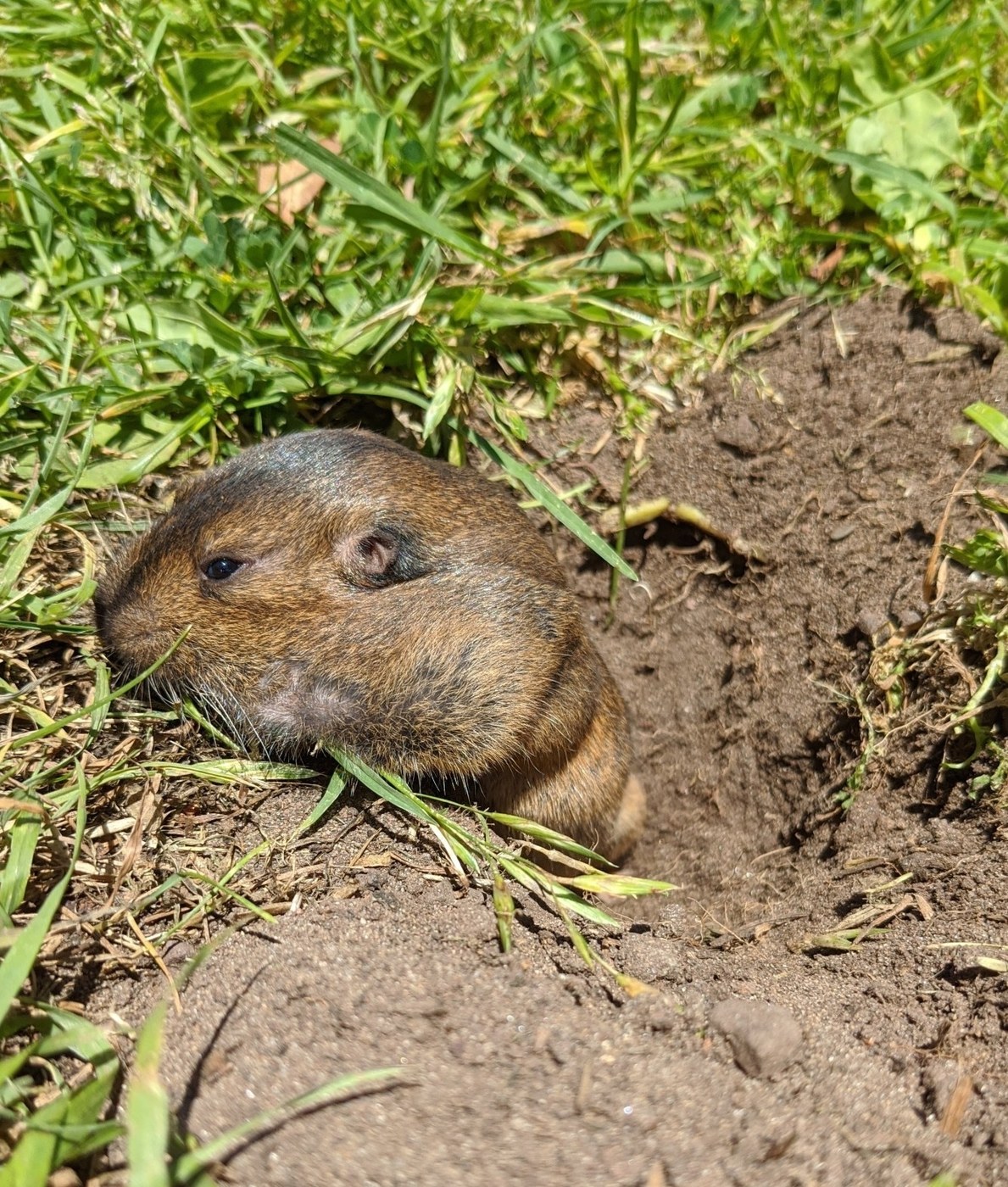
You will almost never see the animal, so start with the mound. A pocket gopher spends nearly its whole life underground and surfaces only briefly, typically within about one body length of a tunnel opening. Identification in the field is mound identification. See the signs section below for the specific shape test.
Size and build
5 to 14 inches across the genus, with California pocket gophers generally running 6 to 10 inches including the tail. Males run larger than females. The body is built for one job: powerful forequarters, large-clawed front paws for digging, small ears and eyes, sensitive facial whiskers for navigating in the dark, and a sparsely haired tail the animal uses as a guide when it backs up through a tunnel.
The namesake cheek pouches
The cheek pouches are the family's namesake feature. External, fur-lined pouches sit on each side of the face and open outward. They are carrying bags for food, not part of the mouth, and the animal does not chew in them. If you get a close look at a gopher and see loaded pouches bulging on both sides of the face, that is the identification settled.
Why color will not do it
Color will not identify this animal, and that is worth knowing before you try. Botta's pocket gopher ranges from white to black depending on where it lives, and coat color typically matches the local soil color. Populations disperse very little and exchange few genes, so the animal in one valley may look nothing like the animal two valleys over. Color alone neither confirms nor rules out the species.
The look-alike is a mole
Moles are the real look-alike here, not other gophers. The northern, plains, and Mazama pocket gophers do not range into California or the Southwest, so in these two regions the animal your gopher gets confused with is a mole. The two leave different mounds, and the mound shape is what separates them, since neither animal is often seen above ground. A gopher is a strict herbivore working on roots and fleshy plant parts, and the plant damage that comes with it is the second confirmation.
Active year round, and all day
There is no quiet season and no time of day that rules this animal out. Pocket gophers are active year-round and around the clock. Fresh mounds appearing in January, or overnight, are entirely normal and do not point to some other animal.
Signs of Infestation
Fresh mounds, and their shape
Fresh soil mounds are the primary sign, and the shape is the tell. A gopher mound is crescent shaped or horseshoe shaped viewed from above, with the entrance hole set off to one side and usually plugged. A mole mound is more circular, volcano shaped in profile, with the plug in the center. That one distinction is the most useful thing to learn, because it decides which animal you are dealing with before you spend a dollar on control. A single gopher can push up several mounds in a day, which is why one animal can make a yard look overrun.
Clipped vegetation ringing a hole
A circular band of clipped vegetation around a small hole. This is a feed hole. The gopher comes partway out, clears everything it can reach without leaving the opening, and goes back down, leaving a neatly grazed ring roughly one body length across.
Plants wilting or vanishing
Plants wilting, dying, or disappearing entirely. Gophers eat roots and fleshy plant parts as they tunnel, and they will pull an entire small plant down into the tunnel from below rather than grazing it from the top. A seedling that vanishes overnight without a trace above ground is a gopher signature.
Chewed sprinkler and drip lines
Broken sprinkler lines and chewed drip tubing. Pocket gophers gnaw flexible plastic water lines, and drip irrigation tubing running through the same soil as the tunnels is directly in the path. Unexplained wet spots, pressure loss, or a zone that stopped working are all worth checking against nearby mound activity.
Girdled bark at ground level
Girdled bark on trees and vines at or just above ground level. The animal strips bark where the trunk meets the soil. In snow country it can tunnel through snowpack and girdle several feet up a trunk, well above where anyone thinks to look. Girdling is what turns a nuisance into a dead orchard row or a dead landscape tree.
Slumping ditch banks and dams
Soft, slumping, or leaking ditch banks and earthen dams. Tunnel networks running through a bank create paths for water to move where it should not. The documented consequences are water loss, piping through the bank, and outright bank failure. On any property with irrigation infrastructure, a pond dam, or a canal bank, this is the most expensive sign on the list and the one most worth acting on early.
Prevention and When to Call a Pro
A low public health risk
Pocket gophers are a low public health risk, and that is a real distinction rather than a reassurance. California vector control sources rank pocket gophers as low risk and contrast them directly against the California ground squirrel, which is a separate species and carries moderate to high risk as the Pacific states' primary plague vector through its fleas. Homeowners routinely lump every burrowing yard rodent into one category, and this is the place to unlump them. No published source attributes plague, rabies, or any other vector-borne disease risk to pocket gophers. The realistic hazard is a bite. Strong jaws and sharp incisors are the reason to wear gloves during any hands-on control work.
Trapping is the best home method
Trapping is the most reliably effective homeowner-level method. Two-pronged pincer traps, sold under names like Macabee, Cinch, and Gophinator, or a choker-style box trap, are the standard tools. Probe to find the main tunnel and set there, not in a lateral tunnel branching off it, because a lateral is not on the animal's regular route. Use at least 2 traps rather than one. Check them often, and if nothing is caught within 1 to 2 days, pull the set and try a different location in the tunnel system.
Exclusion, with real dimensions
Exclusion works underground, and the dimensions are specific. For existing plantings, bury 1/2 to 3/4 inch mesh wire or hardware cloth at least 2 feet deep, bend an additional 6 inches outward at a 90 degree angle away from the planting at the bottom of the trench, and extend the fencing at least 1 foot above ground. For raised beds, underlay the soil with mesh wire before you fill them. For individual plants, use wire baskets made from light gauge, 3/4 inch, non-galvanized steel wire.
Sprinkler lines have their own spec
Sprinkler lines get their own specification. Surrounding buried irrigation lines with 6 to 8 inches of coarse gravel, 1 inch diameter or larger, discourages tunneling through that zone. It is the one targeted fix for the single most common and most annoying category of gopher damage in a residential landscape, and it is worth doing while a system is open for any other reason.
What does not work
This is worth stating plainly, so you do not spend money finding out. No repellent product currently sold has been shown to protect plants from gophers. Plants marketed as gopher repellent, including gopher purge, castor bean, and garlic, have not been shown to work in research trials. Frightening devices have not proven effective either, and that covers vibrating stakes, ultrasonic devices, and wind-powered pinwheels alike. Installing owl boxes does not provide sufficient control on its own. Encouraging predators is a fine thing to do for other reasons. It is not a control plan.
Baiting rules have changed
Baiting has real current restrictions, and older advice on this is out of date. Where bait is used it must go into the main tunnel, never a lateral. Two active ingredients remain legal for this use: strychnine treated grain or pellets at 0.5 percent strychnine, and zinc phosphide baits at 2.0 percent. Multiple-feed anticoagulants, chlorophacinone and diphacinone, were once standard for this animal and are no longer legal for residential pocket gopher use in California. A great deal of older gopher advice still names them, so check the label and the date on anything you read.
Fumigation is where DIY stops
Fumigation is where do-it-yourself stops. Standard smoke and gas cartridges are largely ineffective, because a gopher detects the gas and plugs the tunnel before it takes effect. Aluminum phosphide does work, but it is a restricted-use material and applications must be kept more than 100 feet from any building where people or domestic animals may be present. That distance requirement alone rules it out on most residential lots. Pressurized exhaust machines can exceed 70 percent removal rates but are expensive, professional-grade equipment.
California is unusually permissive
The legal baseline in California is unusually permissive, and it is worth knowing. California's Fish and Game Code classifies pocket gophers as nongame mammals. No trapping license is required, and they may be controlled at any time and by any legal method. There is no season to wait for and no permit to pull before setting a trap in your own yard.
Arizona: unprotected, with a caveat
Arizona does not protect this gopher at the species level. Pocket gophers are not protected under Arizona law and may be controlled on private property. The Harquahala southern pocket gopher subspecies' Tier 2 conservation need listing is a wildlife action plan category and does not meet the criteria for legal protection, per the state's own analysis. That said, confirm the current rule with Arizona Game and Fish Department before you act. Wildlife rules change, and a state agency's own current answer is worth more than any summary of it.
When to Call a Pest Control Professional
Call for any ditch bank, earthen dam, pond, or irrigation structure showing tunnel damage. That is the highest-cost damage category and the one where do-it-yourself trapping is least likely to clear an established network on its own. Call for anything that would require aluminum phosphide, because the restricted-use classification and the 100 foot building distance make it licensed applicator territory rather than a homeowner purchase. And call when mound activity keeps spreading across a large area after a genuine trapping effort has failed, since trapping works best against a single animal in a contained space and repeated failure usually means the area is bigger than the tool.
Frequently Asked Questions
How can I tell a gopher mound from a mole mound?
Shape is the tell, and it is reliable. A gopher mound is crescent or horseshoe shaped when you look straight down at it, with the entrance hole off to one side and usually plugged. A mole mound is more circular, volcano shaped in profile, with the plug right in the center. Since neither animal is often seen above ground, the mound is what you identify, not the animal. Getting this right matters, because the control methods and the traps for the two are not the same.
Do I need a permit to remove a pocket gopher in California?
No. California's Fish and Game Code classifies pocket gophers as nongame mammals, so no trapping license is required and they may be controlled at any time by any legal method. There is no closed season and no permit step before you set a trap on your own property.
Are pocket gophers a health risk the way ground squirrels are?
No, and this is a genuine documented difference rather than a guess. California vector control sources put pocket gophers in the low public health risk category. The California ground squirrel, which is a different species, is the moderate to high risk animal, because its fleas are the primary plague vector in the Pacific states. The two get lumped together as one yard rodent problem all the time, and on the health side they are not the same problem at all. The realistic risk with a gopher is a bite during handling, which is why gloves are the standing advice.
Will a repellent, a vibrating stake, or an ultrasonic device get rid of gophers?
No. No repellent product currently sold has been shown to protect plants from gophers, and plants marketed as gopher repellent, including gopher purge, castor bean, and garlic, have not held up in research trials. Vibrating stakes, ultrasonic devices, and wind-powered pinwheels have not proven effective either. Owl boxes are a nice thing to have and do not provide sufficient control on their own. Trapping and physical exclusion are what actually work.
Why do gophers keep destroying my sprinkler lines specifically?
Because your irrigation runs through the exact soil layer they tunnel in, and they gnaw flexible plastic water lines, drip tubing in particular. It is not targeted behavior so much as a collision between a tunnel network and a buried pipe. The specific fix is to surround the lines with 6 to 8 inches of coarse gravel, 1 inch diameter or larger, which discourages tunneling through that zone.
Will a gopher get into my house or under my foundation?
No. This animal stays entirely outdoors and entirely underground. Pocket gophers do not enter structures and do not burrow beneath foundations the way a groundhog will. They stay in soil and turf. Every kind of damage they cause, from broken irrigation to girdled trees to a mound-covered lawn, comes out of that one tunnel system in the landscape, not out of the building.
How many gophers do I have if my yard is covered in mounds?
Probably fewer than you think. Pocket gophers are solitary, one animal maintains and defends one burrow system, and that system can cover 200 to 2,000 square feet. A single gopher can throw up several mounds in one day. A yard that looks overrun is frequently one animal. That is also why trapping is worth attempting: the job is often smaller than it appears.
Sources
- Pocket Gophers: biology, damage identification, and damage prevention and control methods Internet Center for Wildlife Damage Management (University of Nebraska-Lincoln / USDA APHIS Wildlife Services)
- Pocket Gophers, Pest Notes Publication 7433: identification, biology, reproduction, damage, legal status, trapping, exclusion specifications, baiting, and fumigation UC Statewide Integrated Pest Management Program, University of California Agriculture and Natural Resources
- Botta's Pocket Gopher (Thomomys bottae) mBOGOx_CONUS_2001v1 Habitat Map U.S. Geological Survey
- Thomomys bottae subsimilis (Harquahala Southern Pocket Gopher) species profile and vulnerability analysis, Arizona Wildlife Conservation Strategy Arizona Game and Fish Department
- Vector Control District surveys ground squirrel burrows for disease-carrying fleas: species-level plague risk comparison Santa Clara County Vector Control District
- Plague: ground squirrel flea vector risk and burrowing rodent risk comparison San Diego County Department of Environmental Health
- California Plague Compendium: ground squirrel and Oropsylla montana as the Pacific states' primary plague vector California Department of Public Health
Image Credits
- Image: Will Sides via iNaturalist. CC BY 4.0.
License.