Seasonal Timeline
Meadow voles are active year-round and do not hibernate, so there is no true off-season. What changes is when the damage shows up. Bark-girdling of trees and shrubs begins in fall as green vegetation runs out, continues all winter under the snowpack, and the accumulated damage becomes visible at spring snowmelt along with the runway trails worn through the lawn.
Meadow voles are active year-round and do not hibernate, so there is no true off-season. What changes is when the damage shows up.…
No source establishes region-specific peak and shoulder windows for this species. Treat the fall and snowmelt windows as the damage calendar rather than a fixed set of dates.
Where They're Found
The meadow vole (Microtus pennsylvanicus) is primarily an outdoor grassland animal. Look for it in grassy fields, meadows, pastures, orchards and nursery plantings, wooded swamp edges, and stream and lake margins with thick grass or sedge cover. It strongly prefers moist ground with heavy vegetative cover over short, closely mowed turf, and population density tracks the density and moisture of that grass and thatch layer. It does occasionally slip into ground-level structures such as sheds, unheated outbuildings, and greenhouses when tall grassy cover runs right up to the foundation, but it does not establish indoor infestations the way a house mouse does.
The winter behavior is the detail that matters most in the Northeast: meadow voles live under the snow, not beneath it in burrows but inside it. Once the snowpack is deep enough, a shallow air layer called the subnivean zone forms between the frozen ground and the underside of the snow, and temperatures in that layer hold close to 32 degrees even during a hard freeze above. Meadow voles spend New England winters there, fully active, maintaining networks of surface runways about 1.5 inches wide that can run for dozens to hundreds of feet, connecting feeding areas where they gnaw grass and tree bark. They do not hibernate and they do not slow down. This is why a lawn that looked fine in November can emerge in March laced with trails, and why tree damage appears at the height the snow happened to reach that winter.
The meadow vole has the widest range of any Microtus species in North America. Its confirmed range runs from Labrador and northeastern Canada west across nearly all of Canada into Alaska, south through the Rocky Mountains into New Mexico, across the northern Great Plains, and east to the Atlantic seaboard. The Northeast is core range. The Midwest presence sits in the northern Great Plains and upper Midwest portion of that range, and the Mountain West presence follows the Rocky Mountain corridor into Colorado and New Mexico, including a documented disjunct population running from central Colorado into northwestern New Mexico.
The Southeast presence is real but narrow. The eastern range extends south along the Appalachian chain into South Carolina and extreme northeastern Georgia, which federal Forest Service documentation describes as the species' southeastern range limit, with South Carolina wildlife sources placing meadow voles through the upper piedmont. That is an Appalachian corridor and upper piedmont presence, not a Gulf Coast or coastal plain one, and it should not be read as the species being common across the whole Southeast. Alaska is confirmed range, though not uniformly. Meadow voles occur in Interior and Southcentral Alaska west to Bristol Bay, are absent from Kodiak Island and the Alaska Peninsula, and in Southeast Alaska are limited to the mainland and Admiralty Island. Hawaii is not included. No source places meadow voles, or any Microtus species, in Hawaii.
Related Pests
Life Cycle
A frequently repeated curiosity says a single female vole could produce as many as 17 litters in one year. That figure is a theoretical maximum under ideal laboratory conditions, not anything that happens in a field. The honest working number from extension and wildlife-damage sources is 4 to 8 litters per year for meadow voles specifically, with a broader 5 to 10 range appearing elsewhere in the literature. The counterweight is lifespan: average wild survival is measured in months, with a documented maximum in the wild around 12 to 16 months, so most wild females realistically raise only 1 or 2 litters in their entire lives even though the species is built to do far more. What actually produces a boom year is not any one super-mother. It is the combination of a one-month age at first breeding, conception immediately after each birth, and a good vegetation year across the whole population at once.

Newborn Pup
Juvenile
Adult
Vole vs. Mouse
Signs of Activity
Identification
The tail is the field mark that settles it
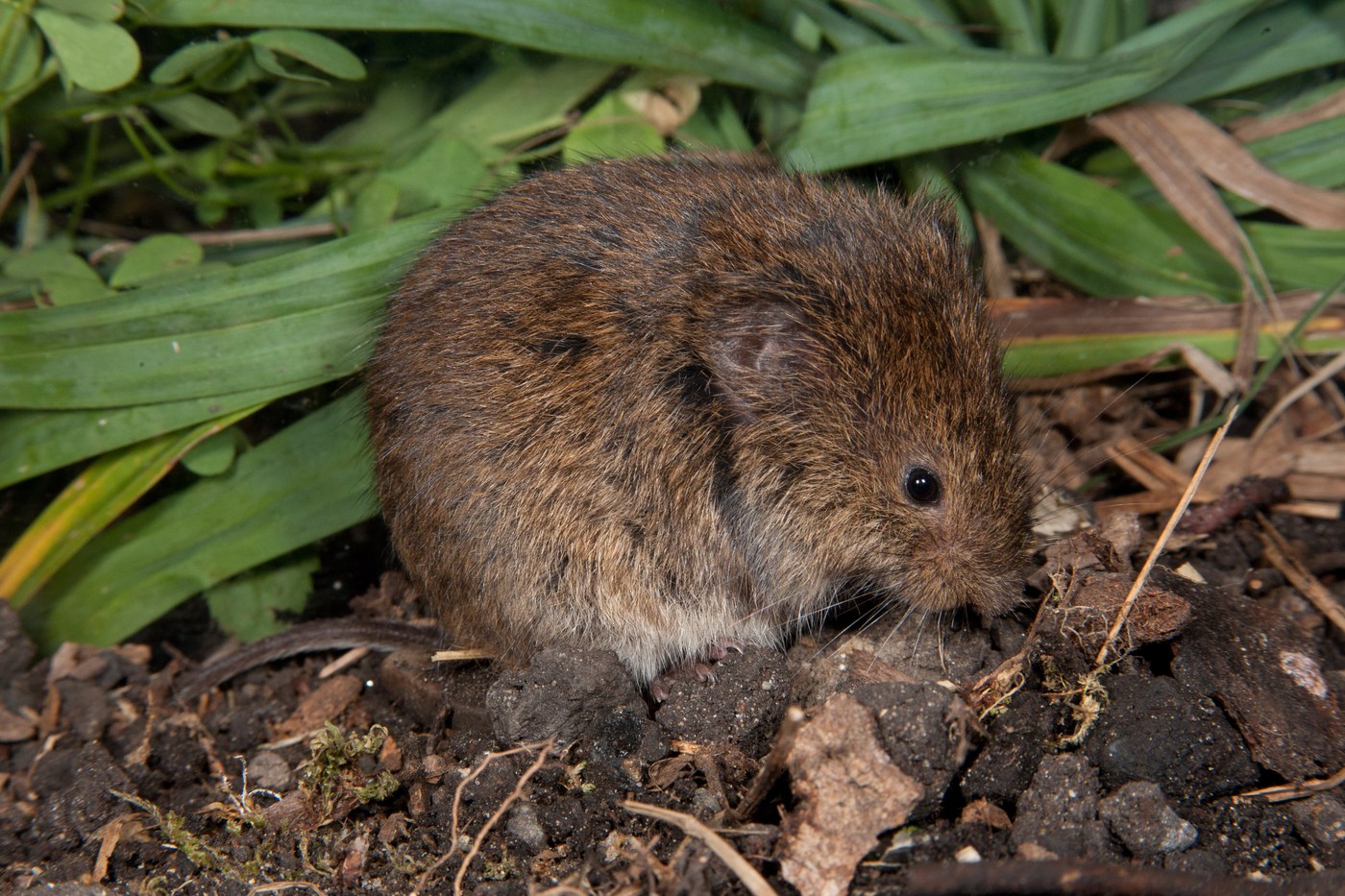
A meadow vole's tail is short, thick, and furry, only about 1 to 2 inches long, roughly the length of the hind foot and somewhere between a third and a half of body length. A house mouse or deer mouse tail is long, thin, sparsely haired, and nearly as long as the animal's whole body. If the tail is short and furry, it is a vole.
A blunt nose and buried ears
Blunt, rounded nose, small eyes, and small ears nearly buried in the fur, all set on a stocky, robust, almost rotund body. Mice look sharp-faced and bright-eyed by comparison, with a pointed snout and prominent ears.
Length and weight
Total body length runs about 5.5 to 7.7 inches including the tail, with weight around 1.2 to 1.8 ounces. Extension sources commonly round this to 5 to 7 inches and about an ounce and a half.
The coat
Dense, soft fur, dark chestnut-brown to blackish-brown above with grayish-buff to silvery-gray underparts. Individual hairs carry dark gray roots with orange or yellow banding in the middle.
Against the house mouse
The vole has the short hairy tail, small ears and eyes, and blunt nose.
Against the deer mouse
Meadow voles have no crisp white belly and no long tail.
Folk names, not identifications
Field mouse and meadow mouse are folk names, not identifications. Field mouse in particular gets applied to several different small rodents, so it tells you nothing about which animal is actually in the yard. Go by the tail.
Signs of Infestation
Surface runways
Worn trails about 1 to 2 inches wide through grass and thatch, where the grass is matted, discolored, or dead along the path. They are most obvious right after snowmelt in spring or when grass is dormant, and they connect feeding areas into a network rather than radiating from one spot.
Small burrow entrance holes
Roughly 1.5 inches across.
Girdled bark at the base of trees and shrubs
Look for small, irregular, non-uniform tooth marks, about 1/8 inch wide, 3/8 inch long, and 1/16 inch or deeper. The damage typically turns up after snowmelt at or near whatever height the snow line reached, because that is as high as the animals could reach while working under the snowpack.
Disturbance in mulch
Digging and disturbance in mulch and ground cover pushed up against trunks, where the cover gives voles both concealment and direct access to bark.
No useful sound
No audible sign is documented as a practical way to identify vole activity. Do not wait to hear something.
No useful smell either
No distinctive vole odor is documented as a reliable identification cue. The runways and the bark damage are what you go on.
Prevention and When to Call a Pro
Mow it short and keep it short
Especially near the plants you care about. Extension guidance commonly cites holding grass and brush under about 3 inches near structures, tree bases, and orchard rows. Cover is the whole game for this animal. Removing it exposes voles to predators and is repeatedly cited as the single most effective habitat step available.
Clear a bare zone at each trunk
Clear a bare zone around every trunk. Pull mulch, weeds, and ground cover back at least 2 feet from the base of trees and shrubs. Mulch piled against a trunk is not a mulch problem, it is a covered feeding station with the bark already inside it.
Guard trunks, sized to the snow
Guard young trunks with hardware cloth, and size the guard to the snow, not to the ground. Quarter-inch mesh hardware cloth or heavy plastic mesh, embedded 4 to 6 inches into the soil and extending 18 to 24 inches above ground, is the standard barrier. Extend it at least 4 inches higher than the snow depth you normally get, because voles will girdle bark at whatever height the snowpack lets them stand.
Skip the plastic wrap-arounds
Skip solid plastic and paper wrap-arounds. They trap moisture against the bark and can shelter bark-boring insects and scale. Mesh and hardware-cloth designs are the preferred build.
Pick up the dropped fruit
Pick up dropped fruit and clear garden and orchard debris promptly. It feeds voles and hides them at the same time.
Sealing the house is not the answer
Treating this like a mouse problem wastes the effort. Meadow voles are not a structural pest and do not set up indoor infestations. The exception is narrow: a ground-level shed, unheated outbuilding, or greenhouse with tall grass running to the foundation can pick up an occasional animal, and the fix for that is the mowed strip outside, not a caulk gun inside.
Bait is an escalation step
Treat bait as an escalation step, not a first move. Extension sources describe rodenticide use for meadow voles as fall-timed control for high-population years, delivered through bait stations or as a broadcast application, and note that first-generation anticoagulants carry lower secondary-poisoning risk to pets and predators than second-generation products. This is not the place a homeowner should start.
When to Call a Pest Control Professional
Bring one in when mowing, clearing ground cover, and trunk guards have not stopped repeated girdling losses in an orchard, nursery, or ornamental planting. Call when runway damage runs across a whole property rather than a few isolated trails, which usually means a population boom rather than routine background activity. And call when a high-population year lines up with heavy expected snow cover, since extension guidance specifically flags that combination as the point where professional bait-station control gets considered instead of exclusion alone.
On health risk, reassuring
On health risk, the honest answer is reassuring. No significant zoonotic disease concern is documented for meadow vole specifically. The two well-documented risks from this animal are property risks: bark-girdling that can kill young trees, and runway damage across lawns and turf.
Frequently Asked Questions
What is the difference between a vole and a mouse?
The tail. A vole's tail is short, thick, and furry, only 1 to 2 inches long. A house mouse or deer mouse has a long, thin, sparsely haired tail nearly as long as its whole body. Voles are also stockier, with a blunt nose and smaller eyes and ears than a mouse.
Do voles come out during the day?
Yes. Meadow voles are active both day and night rather than strictly nocturnal, and they stay active all year with no hibernation.
Why are there trails in my lawn after the snow melts?
Those are meadow vole surface runways. Voles spend the winter in the subnivean zone, the shallow air layer between the ground and the underside of the snowpack, wearing paths through the grass as they travel and feed. The snow hides the trails all winter. When it melts, the whole network shows up at once.
Can voles kill a tree?
Yes. By girdling the bark all the way around a trunk, usually in fall and winter when other food is scarce, voles cut off the tree's nutrient flow. Complete girdling can kill a young tree outright, which is why orchards and nurseries treat vole damage as a serious economic risk rather than a cosmetic one.
How many babies do voles have?
A female meadow vole can have 1 to 11 pups per litter, most commonly 4 to 6, reach breeding age in as little as 3 to 5 weeks, and produce roughly 4 to 10 litters per year under favorable conditions. That math is why vole numbers can climb so fast in a good season.
Do voles carry disease?
No significant zoonotic disease concern is documented for meadow vole specifically. The documented risks from this species are damage to property: girdled trees and shrubs, and runway damage through lawns and turf.
Do voles get into houses?
Rarely, and not the way mice do. Meadow voles are outdoor grassland animals that live at ground level and do not establish indoor infestations. One can occasionally turn up in a shed, unheated outbuilding, or greenhouse when tall grass runs right up to the foundation, but the fix is mowing outside rather than sealing inside.
Sources
- Orchard Wildlife: Integrated Management of Voles in Orchards Penn State Extension
- Voles, New England Tree Fruit Management Guide University of Massachusetts Amherst Extension
- Voles in Turf, TurfFiles NC State Extension
- Field Rodents: Mice, Voles, Chipmunks, and Moles University of Connecticut Home & Garden Education Center
- Microtus pennsylvanicus, meadow vole, Fire Effects Information System USDA Forest Service
- Meadow Vole Species Profile Alaska Department of Fish and Game
- Meadow Vole Range Map Alaska Department of Fish and Game
- Meadow Vole (Microtus pennsylvanicus) species page U.S. Fish & Wildlife Service
Image Credits
- Image: Adobe Stock, licensed.