Seasonal Timeline
Creeping voles do not hibernate. They are active in every month of the year, mainly at night but foraging near the nest during the day as well. What has a season is the damage. Bark feeding on young conifers happens generally in winter, under cover, which is why the girdling is usually discovered in spring after the harm is already done.
Creeping voles do not hibernate. They are active in every month of the year, mainly at night but foraging near the nest during the day as…
Nothing about this animal shuts down for the winter, and that is the whole problem. California's own wildlife habitat account records yearlong activity, mainly nocturnal with some daytime foraging near the nest. Washington habitat records place the species from sea level to about 6,000 feet on the west side of the Cascade crest, in every habitat except bare ground and permanent ice. Meanwhile Washington State University Extension notes that the region's voles turn to the bark and roots of woody plants during winter, when other food is scarce, and Oregon State University Extension states plainly that vole damage to conifer seedlings occurs generally in winter. Put those together and you get an animal working under dense grass cover through the wet months, girdling seedlings that nobody will inspect until spring.
The breeding calendar has two versions in the record, and both are worth knowing. California's account has the species breeding from January to late November, peaking April to May. A NatureServe-derived record gives the season as mainly March through September in Oregon and British Columbia. These do not reconcile. The likeliest reading is that one reports observed extremes and the other reports the productive core, but no published source says so.
Whether the population runs on a cycle is genuinely disputed. Sullivan and Krebs concluded in 1981 that creeping vole populations in old-field habitat, and possibly in early forest seral stages where Townsend's vole is absent, follow a 3 to 4 year cycle. Hawes, working the same region in 1975, concluded that this species does not undergo the typical cycles described for other voles. Gashwiler's 15-year record showed density peaks at years 3, 8 and 11 on clearcuts and years 4, 9, 10 and 12 in virgin forest. The species monograph adds a fair criticism: except for Gashwiler's, the studies claiming a cycle ran for less time than the cycle they proposed. The practical takeaway holds either way. A quiet year is not evidence the problem has gone away.
Where They're Found
This is a west-side Pacific Northwest animal, with a real but small foothold in the far northwest corner of California. The documented range runs from Port Moody in southern British Columbia south to Mendocino City, California, reaching east in Washington to Lake Chelan, Mount Aix and Signal Peak, in Oregon to the north base of the Three Sisters and Crater Lake, and in California to Beswick and South Yolla Bolly Mountain. Altitudinally it runs from sea level to nearly 2,400 meters, about 7,900 feet.
Pacific Northwest is the core. Washington habitat records place the creeping vole in all habitats except bare ground and permanent ice from the Cascade crest west to the coast, usually very abundant in clearcuts and short-grass fields but also present in every kind of forest, in meadows, in alpine meadows and in riparian areas, from sea level to about 6,000 feet. East of the crest it holds coniferous forest only, down to about 2,000 feet. That west-side bias matters, because it is what separates this animal from the montane vole, which is the east-side species.
The California foothold is narrow. The state's own wildlife habitat relationships account describes the creeping vole in the northwest corner of California, from Del Norte and Siskiyou counties south to Mendocino County, including the extreme western portions of Tehama and Shasta counties, and calls it common to abundant in the herbaceous and shrubby understories of riparian and coniferous forest there, including burned and clearcut areas. That is a state agency primary source describing an established population. It is a narrow foothold, though, not a statewide presence, and it should not be read as putting this animal anywhere near the Central Valley or the southern coast.
One Oregon range question is unresolved in the literature. Goertz in 1964, and Maser and Storm in 1970, indicated the species does not occur in the Willamette Valley. The species monograph counters that specimens collected in a coppice on the valley floor are on deposit in the Oregon State University mammal collection. Nobody has settled it.
Two states are outside the range. No source places this species in Alaska. The northern limit of its documented range is Port Moody, in the Vancouver area, with roughly 1,500 kilometers of British Columbia coast between there and the Alaska border. Alaska's voles are a different set of species. Hawaii has no vole of any kind, and the rodents established there are commensal rats and mice.
On the ground, look at disturbed ground rather than at old forest. California's account is direct about it: early successional stages of burned and cutover areas at the edge of coniferous forest support the highest densities. The species turns up in herbaceous and shrubby understories, in grassland and wet meadow at times, and in cropland. Cover comes from ground litter, dense herbaceous undergrowth, burrows and log cavities, with burrows excavated in soft soil and mole burrows sometimes taken over outright. Federal forest research from the Pacific Northwest Research Station points the same direction from several independent angles: creeping vole numbers rose after variable-density thinning of second-growth Douglas-fir, rose significantly after logging in every treatment along western Washington headwater streams, and ranked third in thinned Puget Trough stands against seventh in legacy-retention stands. One region-wide retention study captured 656 creeping voles across 50 treated clearcut stands, making it the third most abundant of 24 small mammal species recorded.
Related Pests
Life Cycle
Three different figures exist for how many litters a year this animal produces, and nobody has reconciled them. California's wildlife habitat account gives 4 to 8 litters per year. A NatureServe-derived record estimates a maximum of 4 or 5. Oregon State University Extension's forestry bulletin says up to 13 litters of four to eight young a year, but states it generically for both of Oregon's conifer-damaging voles and states it as a ceiling rather than an average. The best-supported figure is 4 to 8 litters annually, with the 13-litter number understood as an extension-published upper bound for the pair rather than a measured creeping vole average. Litter size is more settled: 3 to 4 young on average, range 1 to 8.
Density is where the forestry story actually lives. Hooven's 1973 study of this species on a Douglas-fir clearcut reported annual catches of 9.5 individuals per hectare in a 125-year-old stand, 27 per hectare in an unburned clearcut, and 54 per hectare in a clearcut where the slash had been burned. Summarizing that literature, the species monograph states that clearcuttings, especially slash-burned ones, support 3 to 8 times more of this vole than mature forest. Peak recorded densities run to 72 per hectare in old-field habitat, with about 138 per hectare in British Columbia standing as the highest figure on record.
One genuinely strange fact, because it belongs to this species alone. In 2021 a team publishing in Science, and indexed by the Forest Service's Pacific Northwest Research Station, showed that the creeping vole has lost its Y chromosome outright. Females carry a single, maternally transmitted X. Males carry that same X plus a second, male-specific X that took over the male-determining job, with fragments of the ancestral Y still riding on both. The anomaly was first spotted in 1963 and took nearly six decades to explain. The mammalian XX and XY system is otherwise one of the most stable arrangements in biology, which makes this small brown rodent of the Oregon coast range a genuine outlier among mammals.

Newborn Pup
Juvenile
Adult
Creeping Vole vs Townsend's Vole
Seedling Damage Signature
Identification
Two names, one animal
Oregon vole and creeping vole are one animal, and two extension services say so independently. Oregon State University Extension names it "the Oregon vole (creeping vole)" in its conifer seedling bulletin. Washington State University Extension names it "the creeping, or Oregon, vole" in its regional gardener's handbook. Both mean Microtus oregoni. A third name, Oregon meadow mouse, is the original common name published with the 1839 description, and the compound form Oregon creeping vole appears in the peer-reviewed forestry literature. None of these are different species.
The smallest vole in its range
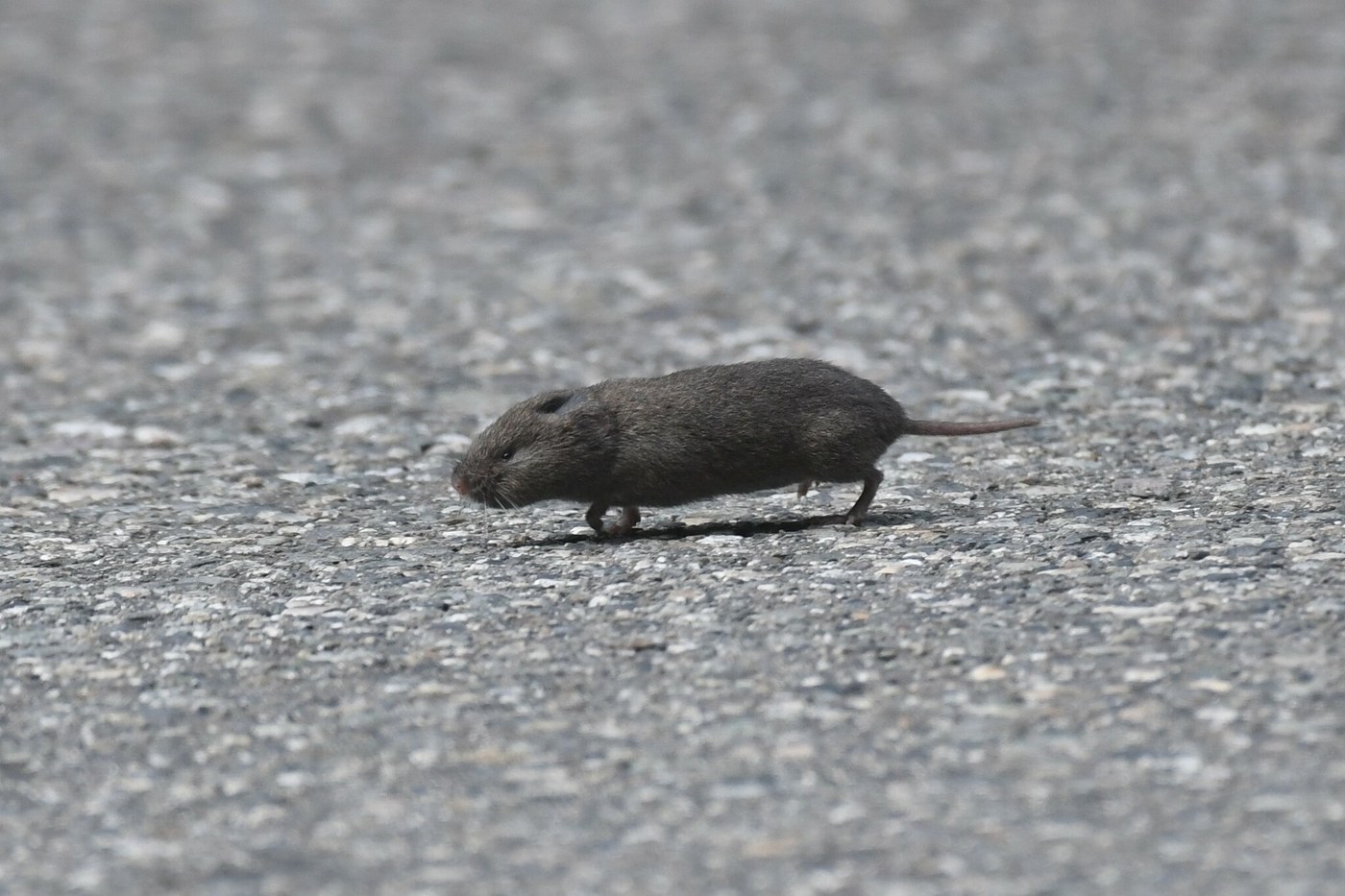
Size is the headline: this is the smallest vole in its range. Total length runs 129 to 154 millimeters, about 5.1 to 6.1 inches, averaging around 140 millimeters or 5.5 inches. The tail is 32 to 42 millimeters, under 30 percent of total length. Body mass runs 14.5 to 27.5 grams and averages about 19 grams, roughly two thirds of an ounce. Both the species monograph and the American Society of Mammalogists state the smallest-in-range point in exactly those words.
Published sizes disagree at the edges
The 129 to 154 millimeter range comes from Hall. Maser and Storm, and Taylor before them, give noticeably wider extremes: total length 124 to 161 millimeters, tail 32 to 52, hind foot 16 to 21, ear 9 to 14. The two extension sources round differently again, OSU Extension giving 5 to 6 inches and Washington State University giving 6.5 inches. None of these is wrong so much as rounded from a different underlying figure, and the measured millimeter range is the one to trust.
The eye is unmatched in the region
The eye is the tell that nothing else in the region matches. The eye opening is about 2 millimeters in diameter, smaller than in any other vole that shares or borders this species' range. It is the first item in the formal diagnosis, ahead of anything else.
Five plantar tubercles
They sit on the hind feet, and it is a two-species club. Adult creeping voles are the only Microtus in the Pacific Northwest with five rather than six plantar tubercles, other than the much larger water vole. For anyone with the animal in hand, that plus the eye settles it.
Color and build
Reddish to blackish brown on the back, light gray to light brown underneath, on a stocky body with a short thick furred tail. Eight mammae, two pectoral pairs and two inguinal pairs. Flank glands obscure or absent. Molars are unrooted, and the third upper molar carries three loops of enamel on the tongue side.
The ears, described two ways
The ears are described two ways and both are useful. Oregon State University Extension says the ears of both Oregon conifer voles are so small they are hidden in the fur. The species monograph is more precise and slightly different: short, scantily haired, protruding slightly from the fur. In practice a homeowner reads them as hidden and a specimen in the hand shows them just clearing the coat.
Townsend's vole: size plus location
Townsend's vole is the look-alike that matters, and the split is size plus location. Oregon State University Extension frames Oregon's entire conifer-damage problem as this two-species pair. Townsend's vole is 6 to 9 inches with a 1 to 3 inch tail and sits primarily on the coast and in the Coast Range. The creeping vole is 5 to 6 inches and runs from the coast to the Cascades. Washington State University gives the same split as up to 9.5 inches against 6.5. Where the two overlap, creeping vole densities are measurably lower and the population stops cycling.
Three similar voles are easy to separate
Montane vole is the animal east of the Cascade crest, nearly 8 inches, and is the east-side Washington garden species. California vole is a much larger grassland, orchard and vineyard animal found across most of that state, where the creeping vole holds only the far northwest corner. Meadow vole is not a west-side animal at all; in Washington it is confined to the northeast corner of the state.
Moles get blamed for its work
Moles get blamed for what this vole does, and there is a clean tell. Creeping voles routinely take over coast mole burrows, so the sign gets misread constantly. Oregon State University Extension gives the rule: unlike moles or pocket gophers, voles do not mound dirt at their tunnel entrances, so small burrow openings connected by trails and lacking soil mounds are a sure sign of voles.
Time underground is contested
How much of this animal's life is spent underground is genuinely contested. Several older accounts describe it as a burrower that tunnels in soft forest soil and sometimes pushes up ridges like miniature mole ridges, with one claiming it tunnels among grass roots and seldom leaves those tunnels. Against that, Hooven, studying this exact species on a Douglas-fir clearcut, reported he could not find burrows or surface tunnels attributable to the vole on his study area at all, and the species monograph concludes that its activities are not wholly subterranean as some authorities seemingly implied, pointing to how heavily it turns up in owl pellets. Oregon State University Extension, for its part, does not distinguish the two Oregon voles on this point and says both build extensive underground burrow systems with many entrances. The working position: a genuinely burrowing, tunnel-using vole of soft forest soil that will occupy mole tunnels, but not demonstrably more subterranean than its neighbors. Note also that a ridge and a mound are not the same thing. A ridge is soil pushed up along a shallow tunnel. A mound is a cone of spoil dumped at an opening, and this vole does not make those.
Signs of Infestation
Girdled conifer seedlings
The signature is unusually specific. Bark removed from ground level to about 5 inches up the stem with a typically fuzzy appearance, and always less than 12 inches above the ground. Only seedlings under 2 inches in diameter get girdled at the base, though sapling and pole-size conifers are occasionally damaged.
Minute tooth marks
The teeth are tiny. Voles can only take small portions of bark per bite, so the bark comes off in small pieces and close inspection of the exposed wood shows minute tooth marks and small gashes. Feeding starts on one side of the seedling and works upward, so trees tend to be peeled on one side before the girdling goes all the way around and up to the lower lateral branches.
Droppings piled at the seedling base
Dark brown oval droppings, an eighth to a quarter inch long, piled at the base of damaged seedlings. Voles defecate where they eat, so the droppings and the damage are found together.
Dense overhead grass cover, every time
Voles will not work without cover from predators, so grassy cover plus fuzzy girdling is a strong combined indicator. No cover, no vole damage.
Open burrows with no soil mounds
Small open burrow entrances connected by trails, with no soil mounds. This is the sign that separates voles from moles and pocket gophers, both of which mound excavated soil at their openings. Surface runways worn through and under vegetation are part of the same picture, and open tunnels run roughly three quarters of an inch to two inches across with one to two inch trails through grass.
Crisscross tooth scars
About a sixteenth of an inch wide, on woody plants. That is the general vole damage spec Washington State University publishes, and it applies here.
What it is not, one suspect at a time
What it is not, ruled out one suspect at a time. Large burrowing insect larvae such as strawberry root weevil produce damage that looks identical, but those insects also strip bark from underground rootlets and leave no burrows or burrow entrances. Rabbits and mountain beaver clip seedlings at ground level or take the upper branches and leader rather than girdling the base. Pocket gophers do girdle, but leave much larger tooth marks, and they pull small seedlings underground or clip them off at ground level. Deer and elk in spring strip bark from the bottom upward and usually take small needles and lateral branches with it; voles typically do not eat needles and their damage does not run as far up the stem.
Do not expect an indoor problem
What you should not expect is an indoor problem. No source documents creeping voles entering or nesting in structures. This is an outdoor forest and field animal, not a house rodent. A rodent found inside with a long thin tail nearly as long as its body is a mouse, not a vole of any kind.
Prevention and When to Call a Pro
Take away the cover
That is what the animal actually depends on. Oregon State University Extension is direct about it: voles are so dependent on protective cover from predators that removing that cover is one of the most effective controls available. On a reforestation site, burning and scarifying logging slash before planting is the standard way to do it.
Control the grass in year one
If you are converting an old pasture or grass field to a plantation, control the existing grass in the first year. Those sites carry the highest vole damage risk of any planting ground, because the vole population is already established and at strength before a single seedling goes in.
No plastic squares on old pasture
Do not put 2 to 3 foot squares of black plastic or kraft paper around seedlings on old pasture. They are used to suppress competing vegetation, but they make excellent vole cover, concentrate vole activity right at the seedling, and produce girdling. This is a case where the standard vegetation-control tool actively creates the animal problem.
If you mow, keep it under 6 inches
If mowing is the tool, keep grass and forb cover under 6 inches. That is the Oregon State University Extension threshold, used mainly in Christmas tree plantations. Its reforestation guidance adds that mowing alone does nothing for moisture competition but may reduce vole problems if it is close to the ground and frequent.
Foil collars work, exact spec
Aluminum foil collars are the cheap option that actually works, and the spec is exact. Cut a 12 inch roll of foil in half with a hacksaw to make two 6 inch rolls. Wrap the base of the seedling twice with 4 to 5 inches of foil and crimp it loosely. Oregon State University Extension reports nearly 100 percent reduction in vole damage at low cost, lasting about 2 years, with no evidence of scalding or pathogen attack. One limit: do not use foil on seedlings under 10 inches tall, because it catches wind and whips the seedling, rubbing the bark off at the base.
Rigid tubes handle everything
Rigid plastic tubes or netting handle voles and everything else at once. If deer, elk or mountain beaver are also on the site, tubes installed for those animals will control vole girdling as well, which makes them the better buy where more than one pest is present.
Do not count on hawks and owls
They will not solve the problem. Leaving standing snags on clearcut sites gives raptors somewhere to hunt from, and raptors work far more effectively over open ground, so anything gained depends on cutting cover first. Washington State University Extension is blunt about the limit: providing nest boxes and roosts for hawks and owls is a nice gesture, but predators rarely keep vole populations below damaging levels.
Poison bait fails in this region
Do not count on poison bait in this region, and the reason is specific to Pacific Northwest winters. Seedling damage happens generally in winter, and winter baiting here fails. Baits degrade rapidly in constant moisture and go unpalatable before voles find them. Bait stations do not solve it either, in Oregon State University Extension's own words, because voles do not enter the bait stations but rain does.
That bulletin dates to 1992
One caveat on that extension bulletin: it dates to 1992 and its chemical section is stale. It names herbicides that have since changed status, and flags that most atrazine products are now restricted-use requiring a licensed applicator. Anyone acting on the chemical portion should check current product labels and current extension guidance rather than the 1992 text. The non-chemical guidance in it has not been superseded.
In a garden, mow short
In a yard or garden, mow short and control thatch. Tall grass is both the primary food and the safe harborage. Add a vegetation-free buffer of thin mulch, no more than 1 or 2 inches deep, around garden perimeters and around trees and shrubs. Avoid thick organic mulch and weed-barrier cloth, both of which encourage tunneling. Crushed rock works as a vole-resistant mulch in some situations.
The exclusion spec, from WSU
Exclusion spec, from Washington State University. A vole fence of galvanized quarter-inch hardware cloth buried in a trench at least 8 inches deep with the bottom 6 inches bent outward at a 90 degree angle, standing 6 to 12 inches above ground. Taken to 24 inches deep it also excludes pocket gophers, ground squirrels and moles. A second Washington State University fact sheet gives a shallower version, about 12 inches high with the bottom buried 6 to 10 inches. The two publications disagree on burial depth; deeper is the safer choice.
Guard trunks with hardware cloth
Protect individual trunks with quarter-inch hardware cloth cylinders, or a double layer of aluminum foil rolled into a cylinder as a cheap temporary substitute. Guards set only at the ground surface do not always work, because voles feed largely below ground in winter.
Monitor with apple slices
Monitor with apple or carrot slices, and use the published threshold. Place slices at 4 to 8 stations per acre in damaged areas, tunnels and runways, covered with roof shingles or 12 by 12 inch cardboard staked down. No feeding within 24 to 48 hours means probably no voles in the immediate few square yards. If 20 to 25 percent or more of the slices are chewed, there is a high probability of plant damage. Do this in late summer and early fall, because the serious damage comes over winter.
Predators will not fix it
Predators will not fix a vole problem, and Washington State University says so bluntly. Building habitat for hawks and owls is a nice gesture, but predation cannot keep up with the breeding rate and predators seldom hunt in home gardens. Domestic cats kill large numbers of voles and also kill a great deal of other wildlife, and still do not provide adequate control.
Oregon's permissive statute
Oregon law is permissive on this animal, by statute rather than by agency policy. Oregon Revised Statutes define predatory animals to include rodents that are or may be destructive to agricultural crops, products or activities, and authorize any person owning, leasing or occupying land infested with ground squirrels and other noxious rodents to control them by poisoning, trapping or other appropriate and effective means. Oregon's wildlife agency confirms that no wildlife control operator permit is required for onsite capture and euthanasia of species defined as predatory animals. The creeping vole is neither on the state's enumerated unprotected mammals list nor classified as protected wildlife.
Washington is narrower
It is specific about rodenticide. Common mouse snap traps, baited with apple or peanut butter or set unbaited, are legal in Washington. Other body-gripping traps are not, following voter passage of Initiative 713 in 2000. And the sharper point: there are no home-use rodenticides registered for voles in Washington yards and gardens, with one exception for the meadow vole, which occurs only in the northeastern corner of the state and is a different species. That exception does not cover this animal.
Rules change, verify first
Rules change and vary locally, so verify before acting. Check current state and local requirements before trapping, relocating or applying anything, and route anything beyond snap trapping to a licensed wildlife control operator rather than improvising.
Call for girdling on seedlings
Call a professional when fuzzy girdling below 12 inches shows up on more than a few seedlings. By the time damage is visible across a planting, the population is established and the cheap window, cover removal before planting and foil collars at planting, has already closed. A consulting forester or an extension forester is the right call, and the chemical portion of the 1992 bulletin specifically needs a current-label check.
Call when you cannot tell the animal
The look-alike damage is what makes it hard. Minute tooth marks against large ones, girdling against clipping, bark stripped from rootlets against bark stripped from the stem. These distinctions are real but fine, and misidentifying the animal means buying the wrong control and losing another season.
Call when damage continues
That means after cover reduction and physical barriers. With predators ruled out as a solution and no home-use rodenticide registered for this species in Washington, the remaining options narrow fast to professional habitat management, and there is no point discovering that in February.
Frequently Asked Questions
Is the Oregon vole the same animal as the creeping vole?
Yes. They are two common names for one species, Microtus oregoni. Oregon State University Extension writes it as "the Oregon vole (creeping vole)," and Washington State University Extension writes it as "the creeping, or Oregon, vole." A third old name, Oregon meadow mouse, comes from the species' original 1839 description, published from a specimen taken near the mouth of the Columbia River. The compound form Oregon creeping vole also appears in the forestry literature. All of these are one animal.
What is the difference between a creeping vole and a Townsend's vole?
Size, and where in the state you are standing. Oregon State University Extension gives Townsend's vole as 6 to 9 inches long with a 1 to 3 inch tail, found primarily on the coast and in the Coast Range, and the smaller Oregon or creeping vole as 5 to 6 inches, found from the coast all the way to the Cascades. Washington State University gives the same split as up to 9.5 inches against 6.5. In the hand, the creeping vole also has a distinctly tiny eye, an opening only about 2 millimeters across, which is the smallest of any vole in the region. One more clue is ecological: where Townsend's vole is present, creeping vole numbers are lower and the population stops cycling.
Do creeping voles get into houses?
No source documents creeping voles entering or nesting in structures. This is an outdoor forest and field animal, not a house rodent, and its documented pest role in the Pacific Northwest is girdling conifer seedlings on reforestation sites and Christmas tree plantations. Washington State University does not even name it among the state's primary backyard-damage voles; it names Townsend's vole west of the Cascades and the montane vole east of them. If a rodent turns up indoors with a long thin tail nearly as long as its body, that is a mouse, not a vole.
How do I tell vole damage on a young tree from something else?
Look at the height and at the tooth marks. Vole girdling runs from ground level to about 5 inches up the stem, is always below 12 inches, has a fuzzy edge, and shows minute tooth marks because vole teeth are so small. Pocket gophers leave much larger tooth marks and pull small seedlings underground. Rabbits and mountain beaver clip the stem rather than girdling it. Deer and elk strip bark bottom to top in spring and usually take needles and lateral branches, which voles do not. Expect dense grassy cover overhead and small piles of dark brown oval droppings, an eighth to a quarter inch long, at the base.
Do creeping voles carry hantavirus?
No reservoir status is documented for this species, but the honest answer is that almost nobody has looked. The one regional study that included it, a 2026 federal survey of 189 rodents in the Palouse region of eastern Washington and western Idaho led by Washington State University's veterinary college, sampled just two creeping voles and found no Sin Nombre virus in them. Two animals is far too small a sample to conclude anything in either direction. That same study found montane voles on farmland at 50 percent seroprevalence and 22.2 percent actively infected, and recovered full virus genomes from them. Treat the creeping vole finding as an untested absence rather than a clearance. Standard precautions around any rodent droppings or nesting material still apply: ventilate the space, wet-clean, and do not sweep or vacuum.
Can I trap voles myself in Oregon or Washington?
In Oregon, yes. State law treats rodents destructive to crops as predatory animals and lets a landowner or occupant control them by trapping, poisoning or other effective means without a permit, and the state wildlife agency confirms no wildlife control operator permit is needed for onsite capture and euthanasia of those species. In Washington, common mouse snap traps are legal, but other body-gripping traps are not, following Initiative 713 in 2000. There are also no home-use rodenticides registered for voles in Washington yards and gardens, apart from one exception covering the meadow vole in the northeastern corner of the state, which is a different animal. Rules change, so verify locally before acting.
Why are there more of these voles in a clearcut than in the forest next to it?
Because this species is an early-succession specialist, not a mature forest animal. Hooven's study on a Douglas-fir site counted 9.5 individuals per hectare in a 125-year-old stand, 27 per hectare in an unburned clearcut, and 54 per hectare in a clearcut where the slash had been burned. The species monograph summarizing that literature puts it at 3 to 8 times more voles on clearcuttings than in mature forest. Federal forest research from the Pacific Northwest points the same way from several independent angles, finding creeping vole numbers rising after thinning and after logging in every treatment tested. That is exactly why newly planted seedlings are the ones at risk: the harvest that creates the planting site also creates ideal vole habitat.
Sources
- Controlling Vole Damage to Conifer Seedlings, EC 1256, The Woodland Workbook: names the Oregon vole and creeping vole as one animal, gives the size split against Townsend's vole, and supplies the full damage signature, the aluminum foil collar spec, the raptor perch spec, and why winter baiting fails in this region Oregon State University Extension Service
- Chapter 20, Vertebrate Pest Management, The Pacific Northwest Gardener's Handbook: second independent extension source naming the creeping, or Oregon, vole; the hardware cloth vole fence spec; the apple slice monitoring threshold; and Washington trapping law Washington State University Extension
- Vole Management in Home Backyards and Gardens, FS094E, Home Garden Series: names Townsend's and montane vole rather than the creeping vole as Washington's primary garden-damage species, plus tooth scar dimensions, mulch and thatch guidance, and the finding that no home-use rodenticide is registered for voles in Washington yards Washington State University Extension
- Vertebrate: Voles, Hortsense fact sheet: about 16 vole species in the Pacific Northwest, winter feeding on roots, bark and bulbs, and hardware cloth burial depth Washington State University
- Enhancing Reforestation Success in the Inland Northwest, PNW 520: dense grass provides good habitat for voles, which often girdle the base of and kill seedlings, and mowing close and frequent may reduce vole problems Oregon State University Extension Service
- Successful Reforestation: An Overview, EC 1498: grass provides habitat for voles that can severely damage or kill tree seedlings, and grass must be kept away from newly planted seedlings for several years Oregon State University Extension Service
- Creeping Vole, Microtus oregoni, M137, California Wildlife Habitat Relationships System: the northwest California range, early successional habitat preference, diet including underground fungi, home range on Oregon clearcuts, breeding season, gestation, litter size, litters per year, and age at sexual receptivity California Department of Fish and Wildlife, California Interagency Wildlife Task Group
- Creeping Vole, Microtus oregoni: species page confirming the binomial and subgenus U.S. Fish and Wildlife Service
- Microtus oregoni, Mammalian Species No. 233: the species monograph, source of the 2 millimeter eye opening, the five plantar tubercles, the exact measurements and their published disagreements, Hooven's clearcut density figures, the population cycling dispute, the burrowing dispute, and the barn owl pellet predation data American Society of Mammalogists, via Oxford Academic
- Creeping Vole species account: smallest vole in Oregon, moist coniferous forest range from southwestern British Columbia to northwestern California, tiny tunnels among grass roots, and diet of green vegetation and fungi American Society of Mammalogists
- Microtus oregoni in Mammal Species of the World, third edition: family and subgenus placement, taxonomic history including the Chilotus type species status, the Astoria type locality, and the range summary Bucknell University, hosting Wilson and Reeder
- Species: Microtus oregoni: NatureServe-derived record giving family Cricetidae, the March to September breeding window, roughly 23 day gestation, and 4 to 5 litters per year Encyclopedia of Puget Sound, University of Washington Puget Sound Institute
- Creeping Vole, Microtus oregoni: trait records giving solitary herbivore status, the fossorial and ground dwelling classification, and the 15 month recorded lifespan Encyclopedia of Life
- Distribution Map, Creeping Vole (Microtus oregoni): Washington habitat and elevation detail including the Cascade crest split, sea level to 6,000 feet on the west side and coniferous forest only down to about 2,000 feet on the east side NatureMapping Foundation, with the University of Washington
- Induced spatial heterogeneity in forest canopies, responses of small mammals, Journal of Wildlife Management 65(4): variable-density thinning of second-growth Douglas-fir produced larger creeping vole populations, a species associated with herbaceous vegetation U.S. Forest Service, Pacific Northwest Research Station
- The riparian ecosystem management study, response of small mammals to streamside buffers in western Washington, PNW-GTR-880: creeping vole abundance increased significantly after logging in all treatments, described as the early-seral microtine U.S. Forest Service, Pacific Northwest Research Station
- Legacy retention versus thinning, influences on small mammals, Northwest Science 74(2): creeping vole ranked third in thinned Puget Trough stands against seventh in legacy stands, and is commonly associated with early seral stages but found in all seral stages in Washington U.S. Forest Service, Pacific Northwest Research Station
- Sex chromosome transformation and the origin of a male-specific X chromosome in the creeping vole, Science 372(6542): the species has lost its Y chromosome, females carry a single maternally transmitted X, and males carry a second male-specific X, resolving an anomaly first described in 1963 U.S. Forest Service, Pacific Northwest Research Station, indexing Couger and colleagues in Science
- Genomic Analysis of Sin Nombre Virus Sequences, Northwestern United States, 2023, Emerging Infectious Diseases 32(5): the 189 rodent Palouse survey that sampled two creeping voles with no detections, against montane voles on farmland at 50 percent seroprevalence and 22.2 percent PCR positive, plus the 864 national cases and 109 regional cases figures Centers for Disease Control and Prevention, with Washington State University College of Veterinary Medicine
- WSU study finds high prevalence of hantavirus in some parts of Pacific Northwest: plain-language summary of the Palouse survey, the roughly 30 percent past-infection and 10 percent active-infection figures, and rodent cleanup precautions Washington State University News
- Wildlife Control Operators, WCO Permit: the predatory animal definition covering rodents, confirmation that no WCO permit is required for onsite capture and euthanasia of predatory animals, and the enumerated unprotected mammals list that does not include this species Oregon Department of Fish and Wildlife
- Oregon Revised Statutes Chapter 610, Predatory Animals, including ORS 610.002 defining predatory animals to include destructive rodents and ORS 610.105 authorizing landowners to control noxious rodents by poisoning, trapping or other appropriate and effective means Oregon State Legislature
- Oregon Administrative Rules Division 435, Wildlife Control Operators, OAR 635-435-0005 definitions of predatory animals, unprotected mammals and protected wildlife Oregon Secretary of State
- Trapping nuisance wildlife: mouse and rat snap traps excepted from the body-gripping trap restriction, humane euthanasia requirement, and referral to certified wildlife control operators Washington Department of Fish and Wildlife
Image Credits
- Image: Tristan Jobin via iNaturalist. CC BY 4.0.
License.