Seasonal Timeline
Voles are active year-round with no true hibernation. In the region's snowier northern tier, damage builds up unseen under winter snow cover and becomes dramatically visible all at once at snowmelt; in the milder southern tier, spring and fall are the more visible peaks.
Voles are active year-round with no true hibernation. In the region's snowier northern tier, damage builds up unseen under winter snow…
Voles breed and stay active essentially year-round. The seasonal months describe when damage is most visible to a homeowner, not when the animals are inactive the rest of the year, and reflect a real regional split between the Midwest's snowier northern states and its milder southern tier.
Where They're Found
Both species are entirely outdoor, ground-level animals. Neither is a structural home invader, and neither nests inside walls, attics, or crawl spaces. Look for them in lawns, garden beds, orchards, pastures, roadsides, alfalfa fields, and prairie remnants with dense grassy or weedy ground cover.
Prairie vole favors drier upland grassland and old fields, while meadow vole favors moister lowland sites, wet meadows, and areas near water. Across the Midwest that split roughly follows the region's own drier-west to wetter-east gradient: prairie vole is more common toward the western and central part of the region, meadow vole more common toward the wetter eastern states, with real overlap in between. Both species build networks of shallow surface runways, about 1 to 2 inches wide, connecting small burrow entrances, nest chambers, and cached food, with underground tunnels typically only 4 to 6 inches deep.
Prairie vole's broader range runs from the Canadian Prairies south through the Great Plains into the eastern Rockies and east to West Virginia. Meadow vole has one of the widest ranges of any North American vole, reaching from the Northeast across the northern half of the country into Alaska, though it is notably absent from Oklahoma, Kansas, and most of Missouri. Meadow vole is confirmed established in Alaska by Alaska's own state wildlife agency. No source places either species in Hawaii.
Life Cycle
Prairie vole and meadow vole share essentially the same life cycle timeline. Both produce 5 to 10 litters a year averaging 3 to 5 young each, both wean around 3 weeks, and both reach sexual maturity around 35 to 40 days. The genus as a whole is cited with a wider range in some sources, up to 1 to 11 young per litter and as few as 1 to 5 litters a year, but the narrower figures above are specific to these two species.

Newborn
Weanling/Juvenile
Sexually Mature Sub-adult/Adult
Signs of Activity
Identification
Both run the same size
Both species run 4.5 to 7 inches in total body length, including the tail, and weigh 1 to 2 ounces as adults. They overlap enough in size that body length alone will not reliably separate the two species in the field.
Prairie vole is grizzled
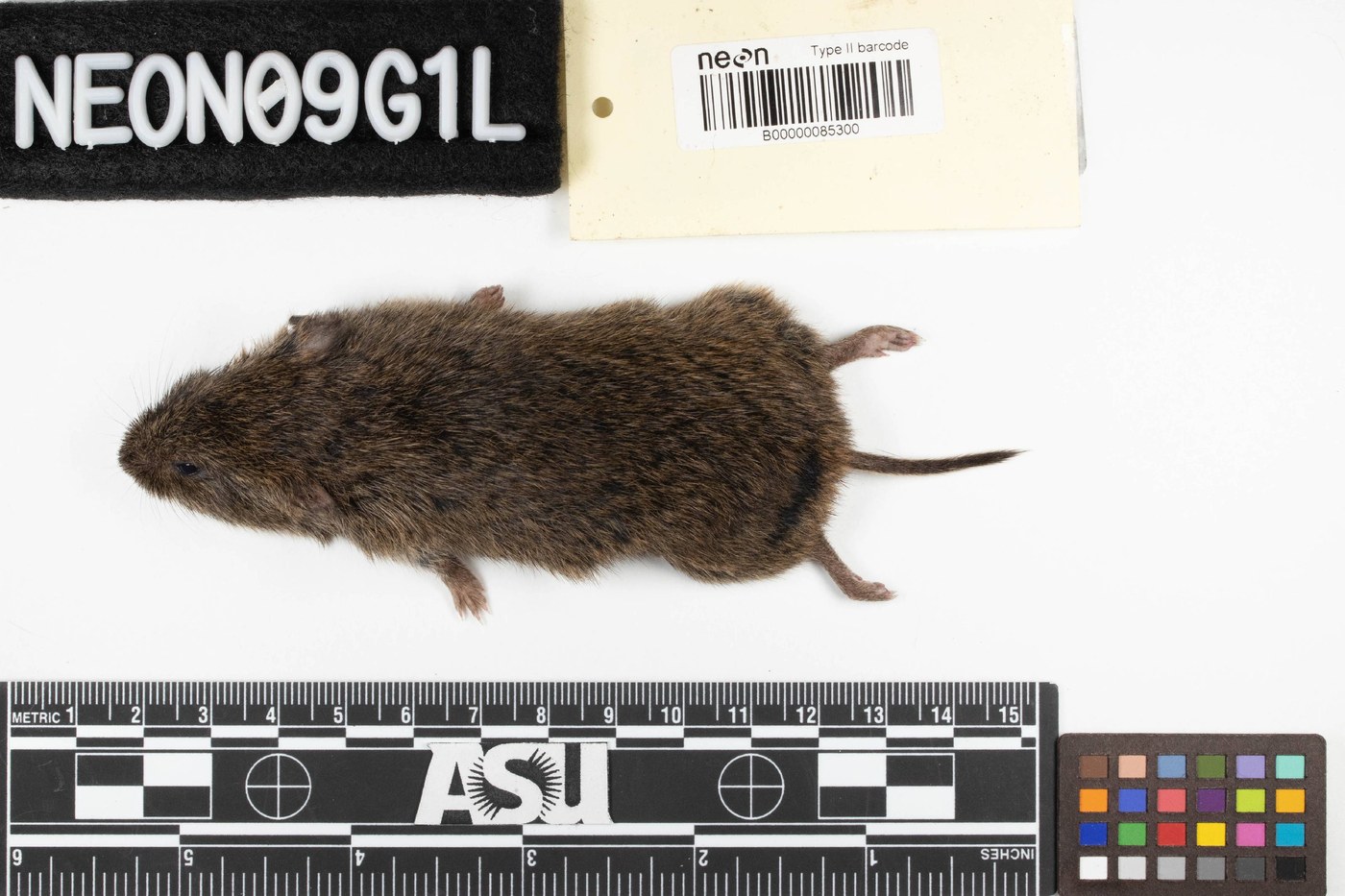
Prairie vole has a distinctive salt-and-pepper grizzled back from mixed tan and dark guard hairs, with an underside that runs golden to yellowish or reddish, and a tail that is dark on top and pale underneath.
Meadow vole is chestnut and black
Meadow vole runs chestnut-brown mixed with black on the back, with dark gray underparts. Both are compact, stocky-bodied, and short-legged, with small eyes and small ears mostly hidden in the fur.
The short tail is the fastest mark
The short tail is the single fastest field mark. Both species carry a tail about 1 inch long, roughly a quarter of body length, a fraction of a house mouse's tail.
A blunt snout, not a pointed one
A blunt, rounded snout and chisel-shaped front incisors, not the pointed snout of a mouse or shrew.
Commonly confused with the house mouse
House mice have a long, thin, mostly hairless tail near half their body length, larger prominent ears, and a pointed snout. They also nest indoors, while voles live entirely outdoors in surface runways and rarely establish a true indoor infestation.
Commonly confused with shrews
Shrews are smaller, have a long pointed snout and tiny pointed teeth (shrews eat insects, not plants), and their eyes and ears are nearly invisible in the fur, unlike a vole's blunt snout and small but visible eyes and ears.
Commonly confused with the eastern mole
Moles have oversized, paddle-like digging forefeet and no visible external ears, and they push up raised ridge tunnels below the surface rather than leaving a matted-down surface path. Voles have ordinary mouse-like feet and travel visible, worn-in trails through the grass. Mole and vole damage on the same lawn is routinely mistaken for each other, and the fix for one does nothing for the other.
Signs of Infestation
Narrow surface runways
About 1 to 2 inches wide. In the region's snowier northern tier these runways build up unseen under snow cover and become dramatically visible in a single wave right after snowmelt.
Girdled bark on young trees
Shrubs take it too. A girdle that runs all the way around the trunk can kill the plant.
Clipped stems and cached vegetation
Clipped grass stems, chewed bulbs and tubers, and small piles of dried cached vegetation near burrow openings.
No distinctive sound
No characteristic vocalization or audible sign is documented for either species as something a homeowner would actually notice.
No distinctive smell either
No odor a homeowner would notice is documented for either species.
Prevention and When to Call a Pro
Habitat modification works best
Habitat modification is the most effective long-term step. Mow lawns regularly and keep grass and ground cover short, remove brush piles and heavy ground litter near lawns and beds, and keep mulch pulled back at least 2 feet from the base of young trees. Deep mulch and unmown grass are exactly the cover voles need to run their surface network undetected.
Protect young trees directly
Protect individual young trees and shrubs directly rather than trying to protect the whole yard at once. Wrap trunks with 1/4 inch or smaller hardware cloth cylinders, 12 to 24 inches tall so they clear typical local snow depth, buried 2 to 6 inches into the soil so voles cannot tunnel underneath.
Confirm the runways are active
Confirm active runways before treating anything. A small tented board or shingle placed over a half-inch apple cube along a suspected runway, checked after 24 hours, tells you which spots are actually active so effort goes where it is needed.
Ordinary snap traps
Ordinary snap-type mousetraps, baited with peanut butter-oatmeal or apple and set directly across an active runway, are the standard homeowner-level direct control for both species. No digging or bait station is needed.
Toxicant baits carry restrictions
Toxicant baits carry real restrictions. General-use products can be applied by a homeowner following label directions, but zinc phosphide and similar restricted-use products require a certified applicator. Treat any broadcast bait application as licensed-professional work rather than a DIY step.
When to Call a Pest Control Professional
Bring in a licensed pest control or nuisance wildlife professional when runway damage keeps reappearing season after season despite habitat cleanup, when girdling has already killed or is actively threatening a valued young tree, orchard planting, or ornamental bed, or when a population surge, a documented cyclical event for these species, makes trapping alone impractical.
Frequently Asked Questions
How do I know if I have voles instead of moles?
Voles leave visible, worn-down surface runways in grass with small round burrow entrances, while moles push up raised ridge tunnels below the surface and leave no visible surface path. Voles are rodents that eat plants, while moles are insectivores that eat earthworms and grubs.
How do I know if I have voles instead of mice?
Voles have a short, roughly 1 inch tail, a blunt snout, and small hidden ears, and live outdoors in surface runways. House mice have a long, thin tail near half their body length, larger ears, a pointed snout, and typically nest indoors.
Why does my lawn look destroyed as soon as the snow melts?
Snow cover gives voles safe, hidden runway access all winter, so damage that built up unseen for months becomes visible in a single wave right after snowmelt, a pattern most pronounced in the region's snowier northern tier.
Can voles actually kill my trees?
Yes, if they girdle the bark all the way around the trunk, especially at the snow line on young trees in winter, which cuts off the tree's ability to move nutrients and water and can kill it.
Are voles dangerous to touch or be around?
Direct danger is low. Voles are a documented host species for the bacterium that causes tularemia, but the typical human exposure route is handling or dressing an infected animal, tick or deer fly bites, or inhaling contaminated dust, not incidental yard contact, so ordinary lawn activity carries little real risk.
Sources
- Prairie Vole (Microtus ochrogaster) U.S. Fish & Wildlife Service
- Prairie Vole Illinois Department of Natural Resources
- Meadow Vole species profile and range map Alaska Department of Fish and Game
- Vole Biology Internet Center for Wildlife Damage Management (University of Nebraska-Lincoln / USDA APHIS Wildlife Services)
- Controlling Voles in Horticulture Plantings and Orchards in Missouri (G9445) University of Missouri Extension
- Vole Damage University of Minnesota Extension
- Voles Pennsylvania State University Extension
- Moles and Voles - What's the Difference? Purdue Extension (Whitley County)
- Controlling Vole Damage (NebGuide G887) University of Nebraska-Lincoln Extension
- About Tularemia Centers for Disease Control and Prevention
Image Credits
- Image: Rosie Liao via GBIF. CC BY-SA 4.0. This resized copy is offered under the same license.