Seasonal Timeline
California voles are active day and night, year-round, with no hibernation and no true off-season. Spring and fall vegetation growth periods bookend the state's dry summer and make surface runway damage most visible in lawns, orchards, and agricultural field margins. Populations also swing through documented multi-year boom-and-bust cycles, so a given year's damage pressure can look very different from the last.
California voles are active day and night, year-round, with no hibernation and no true off-season. Spring and fall vegetation growth…
Population cycles matter more than the calendar for this species. University of California IPM research documents California vole numbers running in cycles of roughly 3 to 6 years, climbing to peak densities before crashing back down, with outbreak years recorded at several thousand voles per acre. A property with light, background-level activity one year can be dealing with a genuine population boom the next, independent of the season alone.
Where They're Found
The California vole (Microtus californicus) is an outdoor grassland species first and last. The University of California's own pest management program describes it as the most widespread vole in the state, found in the Owens and Central valleys and nearly the entire length of the coastal range, though it is absent from the state's deserts and from the extreme northeastern and northwestern corners of California. Look for it wherever there is dense grass cover: lawns, garden beds, orchard and vineyard row middles, and agricultural field margins, plus marshy and wetland ground, wet meadows, coastal wetlands, and dry grassy hillsides. It is a poor climber that stays at ground level, building burrows and a connected network of surface runways, and its foraging range typically covers no more than a few hundred square feet per animal.
The confirmed range extends north of California, into Oregon. Independent university and museum natural history sources place the range running from central Oregon south to northern Baja California, with the northern edge reaching as far as Eugene, Oregon, well up the Willamette Valley rather than a narrow border sliver. That range extension puts the species in the Pacific Northwest alongside California, though it does not reach Washington.
A note on subspecies, since it affects legal status. Roughly 17 subspecies are recognized across the full range, and a handful carry their own protected status distinct from the species as a whole: several are California species of special concern, and the Amargosa vole, an isolated population restricted to about 10 miles of bulrush marsh near Shoshone and Tecopa in Inyo County, is both federally and state listed as endangered. That is a separate, geographically isolated subspecies with only a few hundred individuals left in the wild. It does not change the status of the common California vole found across the rest of the state, which carries no special protection and remains classified under state law as a nongame mammal that a property owner may control when it is damaging crops or property.
Related Pests
Life Cycle
The population math behind an outbreak year adds up fast. A female California vole can begin breeding at about five to six weeks old, conceive again within about 15 hours of giving birth, and produce anywhere from 5 to 10 litters a year of 3 to 6 young each. University of California research documents this compounding into cycles of roughly 3 to 6 years, with outbreak densities recorded at several thousand voles per acre before the population crashes back down. No single animal drives that number. Fast maturity, near-immediate re-breeding, and a good vegetation year across the whole population at once do.

Newborn Pup
Juvenile
Adult Breeding Female
Identification
The tail is the field mark that settles it
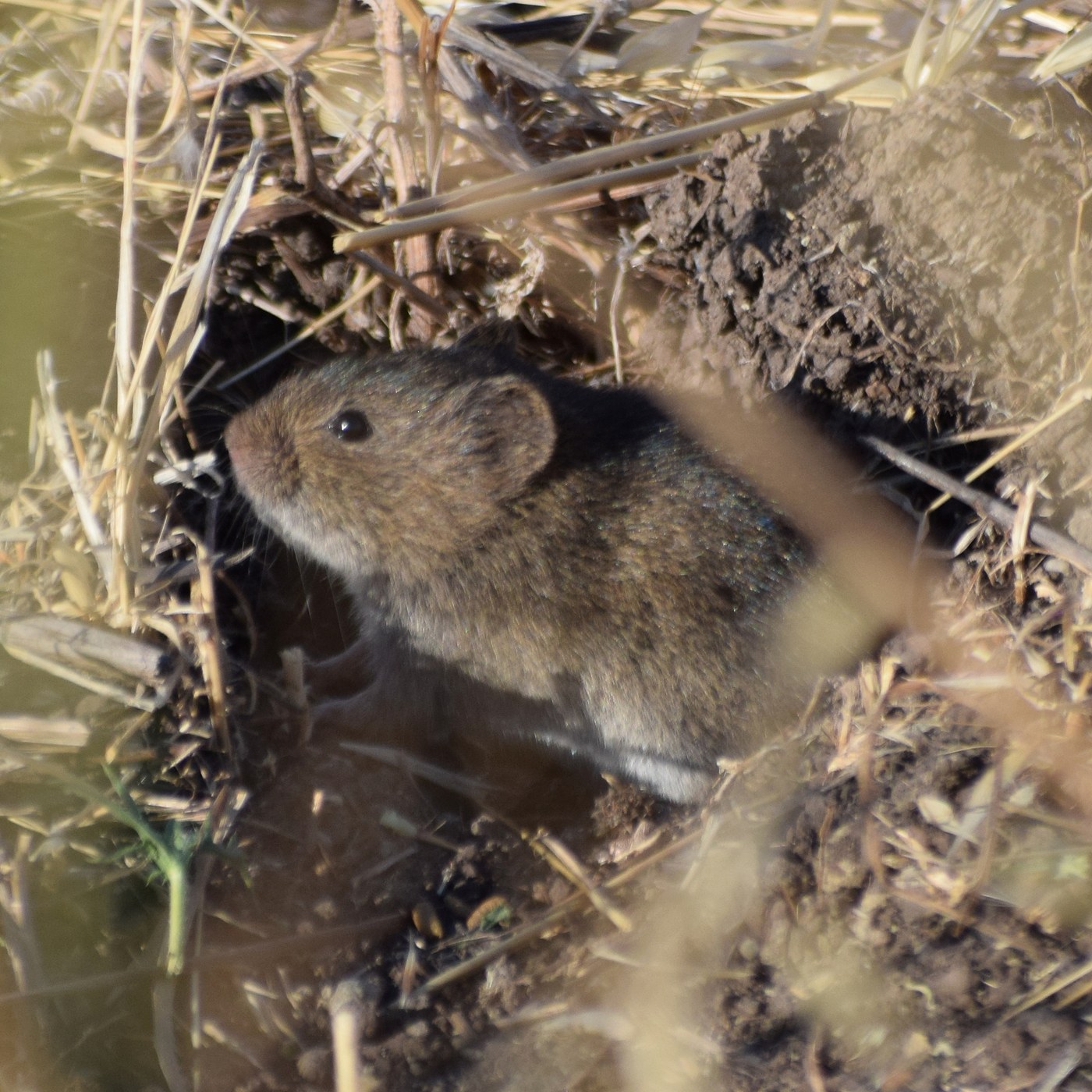
A California vole's tail is short, thick, and furred. A house mouse or deer mouse carries a long, thin, nearly hairless tail almost as long as its whole body. If the tail is short and furred, it is a vole.
Compact body, hidden ears
A compact, heavy body, short legs, small eyes, and ears mostly hidden in the fur. Mice look sharp-faced and bright-eyed by comparison, with a more pointed snout and larger, more visible ears.
Length and coat
Adults run about 5 to 8 inches long including the tail, slightly larger on average than the meadow vole found in the Northeast and Midwest. Fur is blackish brown to grayish brown.
Against the house mouse
The vole has the short, furred tail and stockier, rounder build.
Against the deer mouse
The California vole has no crisp white belly and no long tail.
"Field mouse" is a folk name
It is not an identification. It gets applied to several different small rodents in everyday use, so it does not tell you which animal is actually in the yard. Go by the tail.
Signs of Infestation
Well-traveled surface runways
Worn trails connecting burrow openings to feeding areas, often with fresh grass clippings piled right in the path. Most obvious in lawns and turf where the grass is matted or thinned along the route.
Burrow openings
Burrow openings about 1.5 to 2 inches across at ground level, usually opening directly into the runway network.
Gnaw marks on bark and roots
Look for irregular gnawing about 1/8 inch wide and 3/8 inch long, running from a few inches above ground to a few inches below it. Complete girdling around a trunk can kill the tree.
Droppings
Droppings about 3/16 inch long, typically found along the runways and near burrow entrances.
No useful sound
No audible sign is documented as a practical way to identify vole activity.
No useful smell either
No distinctive odor is documented as a reliable identification cue. The runways, burrows, and gnaw marks are what you go on.
Prevention and When to Call a Pro
Clear ditch banks and field edges
Clear the ditch banks and field edges, not just the garden. University of California guidance specifically recommends mowing, tilling, grazing, or spot-herbiciding the grassy cover along ditch banks, rights-of-way, and field margins next to gardens and landscaped ground, since that vegetation is exactly what feeds the invasion route into managed areas.
A bare zone around young trees
Clear a bare zone around every young tree. Keep a roughly 4-foot-diameter circle of bare, unvegetated ground around the base of young trees so cover and bark access do not sit right next to each other.
Guard the young trunks
Guard young trunks with a physical barrier. Cylinders of hardware cloth, sheet metal, or heavy plastic, buried 4 to 6 inches into the soil, block girdling at the ground line where damage is most common.
Fence or flash the beds
Fence or flash vulnerable beds. Wire fencing or aluminum flashing at least 12 inches above ground, with a mesh size of 1/4 inch or smaller, keeps voles out of vegetable and ornamental beds they would otherwise feed on directly.
Trapping for light activity
Trapping works for light, contained activity. Snap traps set at right angles to the runways, trigger end in the runway itself, are the standard homeowner method. Plan on a dozen or more for a small garden and 50 or more for a larger area.
Rodenticide is a licensed step
Rodenticide is a licensed, restricted step, not a first move. Zinc phosphide is the only toxicant registered for vole control in residential settings in California, and it is a restricted-use material that requires a licensed applicator. This is not a product a homeowner buys and applies on their own.
You may control voles yourself
You are legally allowed to control voles on your own property. California's Fish and Game Code classifies voles as nongame mammals, so if they are injuring or threatening crops or other property, the owner or tenant has permission to control them at any time and in any legal manner.
Sealing the house is not the fix
Sealing the house is not the answer here. This is an outdoor grassland species that does not establish indoor infestations the way a house mouse does. Manage the yard and the field margins, not the walls.
Never handle a vole bare-handed
Never handle a live or dead vole, its nest, or its droppings bare-handed. California vole is a documented carrier of hantavirus and can serve as a plague reservoir, with additional tularemia and Lyme disease associations. Use gloves, wash your hands afterward, and treat any large nest disturbance or die-off as a job for a professional rather than a bare-hand cleanup.
When to Call a Pest Control Professional
Bring one in when mowing and exclusion have not stopped repeated damage to trees, ornamentals, or crops, when runway and burrow damage covers a wide stretch of lawn, orchard row, or field margin rather than a few isolated trails, when rodenticide is on the table at all since the only registered product for this use is restricted to licensed applicators, or when a die-off or large nest disturbance needs cleanup given the documented disease risk.
Frequently Asked Questions
What is the difference between a California vole and a mouse?
The tail. A vole's tail is short, thick, and furred. A house mouse or deer mouse has a long, thin tail nearly as long as its whole body. Voles are also stockier, with small eyes and ears mostly hidden in the fur.
Why do I have trails and tunnels in my lawn or garden?
Those are California vole surface runways, worn paths connecting burrow openings, roughly 1.5 to 2 inches across, to feeding areas. Fresh grass clippings piled inside the runway are a strong confirming sign.
Can vole populations really explode that fast?
Not overnight, but fast. University of California research documents California vole numbers running in cycles of roughly 3 to 6 years, and outbreak years have been recorded at several thousand voles per acre before the population crashes back down.
Do California voles damage orchards and vineyards?
Yes. They gnaw bark on fruit trees including almond, apple, avocado, cherry, citrus, and olive, and are documented in orchard and vineyard row middles and agricultural field margins across California, where full girdling of a trunk can kill the tree.
Am I allowed to control voles on my own property in California?
Yes. California's Fish and Game Code classifies voles as nongame mammals, so a property owner or tenant may control voles that are injuring or threatening crops or property at any time, using any legal method. The one exception is rodenticide bait, since the only product registered for this use is restricted to licensed applicators.
Do California voles carry disease?
Yes. Published research on this species confirms it as a carrier of hantavirus and as a plague reservoir species, with additional tularemia and Lyme disease associations, and a confirmed hantavirus-positive California vole has been logged in San Diego County public health surveillance data. Avoid bare-hand contact with live or dead voles, their nests, or droppings.
Sources
- Voles (Meadow Mice), Pest Notes Publication 7439 University of California Statewide Integrated Pest Management Program
- Microtus californicus (California vole) Animal Diversity Web, University of Michigan Museum of Zoology
- Amargosa Vole (Microtus californicus scirpensis) U.S. Fish & Wildlife Service
- Microtus californicus (Rodentia: Cricetidae), Mammalian Species 42(868) American Society of Mammalogists
- Rodent-Borne Hantavirus Surveillance San Diego County Department of Environmental Health
- California Wildlife Habitat Relationships System, California Vole (M134) California Department of Fish and Wildlife
Image Credits
- Image: Anne Parsons via iNaturalist. CC0 1.0.
License.