Seasonal Timeline
Townsend's voles do not hibernate and are active in every month of the year, day and night. What changes with the season is where the damage lands. Green grass and forbs carry them through the growing season, and in winter, when other food is scarce, they turn to bulbs, roots and the bark of woody plants. That is when bulb beds get emptied and young trees get girdled. The runway network in a lawn is usually most visible in late winter and early spring, when the grass is flat and the worn trails are exposed.
Townsend's voles do not hibernate and are active in every month of the year, day and night. What changes with the season is where the…
Nothing about this animal shuts down for winter, and the winter is when it costs you money. Washington State University Extension states that these voles prefer succulent grasses, forbs, roots and bulbs but will readily feed on the bark and roots of woody plants during winter when other food sources are scarce. Its Hortsense fact sheet is blunter: bulbs and roots are often completely eaten over winter, and trees can be completely girdled. California's own wildlife habitat account records the species as active year-round, mostly nocturnal but sometimes active throughout the day, and the species monograph agrees that it is active both day and night.
Breeding has two versions in the record, and neither should be blended into the other. California's account gives breeding primarily from March to September, with year-round breeding possible in lowland areas and at least two litters a year, noting that large voles are able to breed in winter. The species monograph makes a more interesting point: the length of the breeding season in this species is tied to where the population sits in its multiannual abundance cycle. On one British Columbia island, breeding ran from May to October in one year, from early February to mid-August the next, and from mid-February to May the year after that. There is no fixed calendar to give, and the monograph's position is that there should not be one.
The 3 to 5 year cycle is the number a homeowner should actually plan around. Washington State University records periodic vole population explosions in the open grassland, field and forest-edge ground that borders yards, commonly occurring every 3 to 5 years, with populations that may number more than 1,000 voles per acre before crashing. The research literature backs the scale: a review of long-running British Columbia populations identified four probable cycles with peaks between 525 and 800 voles per hectare, averaging 697. A quiet year is not evidence the problem has gone away.
Where They're Found
This is a west-side, low-elevation, wet-ground animal, and its eastern boundary is the point. The documented range runs from Triangle Island, British Columbia south to Humboldt Bay, California, reaching east in British Columbia only to Chilliwack, in Washington to Sauk, Nisqually Flats and Clark County, and in Oregon to Salem, Eugene and Prospect. That is the Willamette Valley floor and the coastal lowlands, not the Cascade crest. Altitudinally the species runs from sea level to about 1,830 meters, roughly 6,000 feet, in the Olympic Mountains, and to about 914 meters, roughly 3,000 feet, in the Oregon Cascades.
The Pacific Northwest is the core of its range. Washington State University Extension names Townsend's vole as the west-of-the-Cascades half of the pair of species most often responsible for backyard and garden damage in Washington, and lists its habitat as lawns, gardens, orchards, cropped areas, open grasslands, farms, meadows and young forested plantations. Oregon State University Extension places it primarily on the coast and in the Coast Range, in meadows, marshy areas, pastures and riparian areas with dense ground cover. Older survey work fills in the picture: the nominate subspecies lives in marshes or damp meadows under deep rank vegetation and avoids forested areas, while along the Oregon coast it occupies deflation plains, willow and sedge marshes, wet pasturelands and tidal river habitats. In the Willamette Valley it has been called chiefly riparian, but it also holds moist meadows and irrigated fields with dense sedge, bracken fern and wild rye.
The California range rests on a state agency source, and it is a narrow one. The California Department of Fish and Wildlife's own life history account states that in California this species is found in coastal Humboldt and Del Norte counties, and that it is abundant in valley foothill riparian, wet meadow and pasture habitats and common in fresh and saline emergent wetlands, croplands, grasslands and early successional forest stages. The species monograph independently puts the southern range limit at Humboldt Bay and Eureka. That is a two-county coastal foothold, not a statewide presence, and it should not be read as putting this animal anywhere near the Central Valley or southern California.
The San Juan Islands hold a named subspecies with its own conservation status. The Shaw Island Townsend's vole is the subspecies Microtus townsendii pugeti, found only in the San Juan Archipelago. Washington's Department of Fish and Wildlife reports confirmed populations on Lopez, Orcas, San Juan and North Finger islands and describes them as robust where they occur, and lists the subspecies as a Species of Greatest Conservation Need under the state's wildlife action plan. That is a planning designation rather than a threatened or endangered listing, and no take prohibition attaches to it, but it is worth knowing before doing anything in the islands. On the ground, that subspecies occupies meadows, salt marshes, driftwood on sea beaches, rock piles and sparse dry grass.
Two states are outside the range. No source places this species in Alaska. Its northern limit is Triangle Island, off the north end of Vancouver Island, with the entire British Columbia coast between there and the Alaska border. Hawaii has no vole of any kind. There is also no fossil record for this species at all, which is unusual enough to say out loud.
On a property, look at the wet, grassy, low ground. Dense herbaceous growth over soft soil is what this animal needs, and it takes the lawn edge, the unmowed margin, the ditch bank, the pasture and the bed with thick mulch over the bare, dry, or forested parts of a yard every time.
Related Pests
Life Cycle
The reproductive numbers do not agree across regions. Litter size runs to a mean of 4 with a range of 1 to 9 in British Columbia, a mean of 7 with a range of 5 to 8 in Washington, and a range of 2 to 10 in Oregon. California's wildlife account summarizes the whole picture as averaging 4 to 7 with a range of 2 to 10, and at least two litters a year. Mean embryos per pregnant female came in at 6.0 in one British Columbia sample, and embryo counts differed significantly by season, running 4.96 in one autumn, 5.42 the following spring and 4.92 that summer, with the count correlated to the mother's own body mass. Oregon State University Extension's forestry bulletin gives a much higher ceiling, up to 13 litters of four to eight young a year, but states it generically for both of Oregon's conifer-damaging voles and states it as a maximum rather than a measured average. Treat it as a published upper bound for the pair.
Density is where this species is genuinely exceptional. The species monograph calls it one of the largest voles in North America, not the largest. The superlative that is species-specific is a different one: Townsend's vole attains the highest average density of any North American Microtus. A review of long-running British Columbia study populations identified four probable multiannual cycles with peaks between 525 and 800 voles per hectare, averaging 697, alongside 13 annual fluctuations running 94 to 239 per hectare. California's account cites densities as high as 1,320 per hectare, about 519 per acre. Washington State University's homeowner-facing version of the same phenomenon is more than 1,000 voles per acre during irruptions that come around every 3 to 5 years.
One number in the extension literature does not match the primary sources. Washington State University illustrates the breeding rate with an arithmetic example: one pregnant female produces an average of five female offspring in a first litter, those produce 25 more, then 125, then 625, ending at 3,125 females within 4.6 months if none die. The illustration is useful and the point is sound. But it puts gestation at 28 days in a parenthetical, and every primary source gives 21 to 24 days. The 21 to 24 day figure is the better-supported one, and the growth arithmetic is an illustration rather than a measurement.
What actually ends a population boom is contested, and the fight is worth knowing about. One British Columbia study tagged voles and searched raptor pellets and carnivore droppings, estimated that predation accounted for under 8 percent of losses in one winter-spring decline and under 20 percent the next, and concluded predation was not necessary to cause a decline at all. A second researcher, reanalyzing the same data and working a nearby island, concluded avian predation was density dependent and recorded a 25 percent loss to birds in a single week. A later study split the difference for one spring decline: predation drove the first six weeks, density-dependent dispersal the last four. There is also the fence effect. When researchers fenced a high-density population to stop dispersal, it climbed to even higher densities, severely overgrazed its own vegetation, and then crashed. That is the best single argument against treating a garden fence as population control.

Newborn Pup
Juvenile
Adult
Townsend's Vole vs Creeping Vole
Lawn Runway and Bulb Damage
Identification
Bog rat is the same animal
It is an extension service using the name, not folk usage. Oregon State University Extension writes it as "Townsend's vole (bog rat)" in its conifer seedling bulletin. The name is a better habitat description than the formal one: this is the vole of wet meadow, marsh edge, pasture and soggy lawn. Meadow mouse and field mouse also get applied to it, as they get applied to every Microtus, and Washington State University notes that voles are sometimes called meadow mice based on the resemblance. None of these are different species.
Size, as total length
Size, stated exactly, and read it as total length. Total length runs 169 to 225 millimeters, about 6.7 to 8.9 inches nose to tail tip, with a 48 to 70 millimeter tail already included in that figure. Hind foot 20 to 26 millimeters, ear 15 to 17. Body mass 47 to 82.5 grams, about 1.7 to 2.9 ounces. The extension inch figures are easy to misread: Oregon State University gives 6 to 9 inches long with a 1 to 3 inch tail, Washington State University gives up to 9.5 inches, and Washington's wildlife agency gives 6 to 10 inches with a 2 to 3 inch tail at 1.4 to 3.5 ounces. Adding a tail onto those inch figures would put the animal at a foot long, which no measured source supports.
The size superlative, as stated
The size superlative, stated the way the source actually states it. The species monograph says Townsend's vole is one of the largest voles in North America. It does not say the largest, and that wording matters, because the water vole is a larger Microtus in the same region and is one of the species the monograph's own diagnosis separates this animal from. What is defensible and useful: it is the largest of the west-side lowland garden voles, at up to 9.5 inches against the creeping vole's 6.5 and the montane vole's nearly 8. And the superlative that really belongs to it is a different one entirely, covered in the life cycle notes: it reaches the highest average density of any Microtus in North America.
Descriptions of the ears disagree
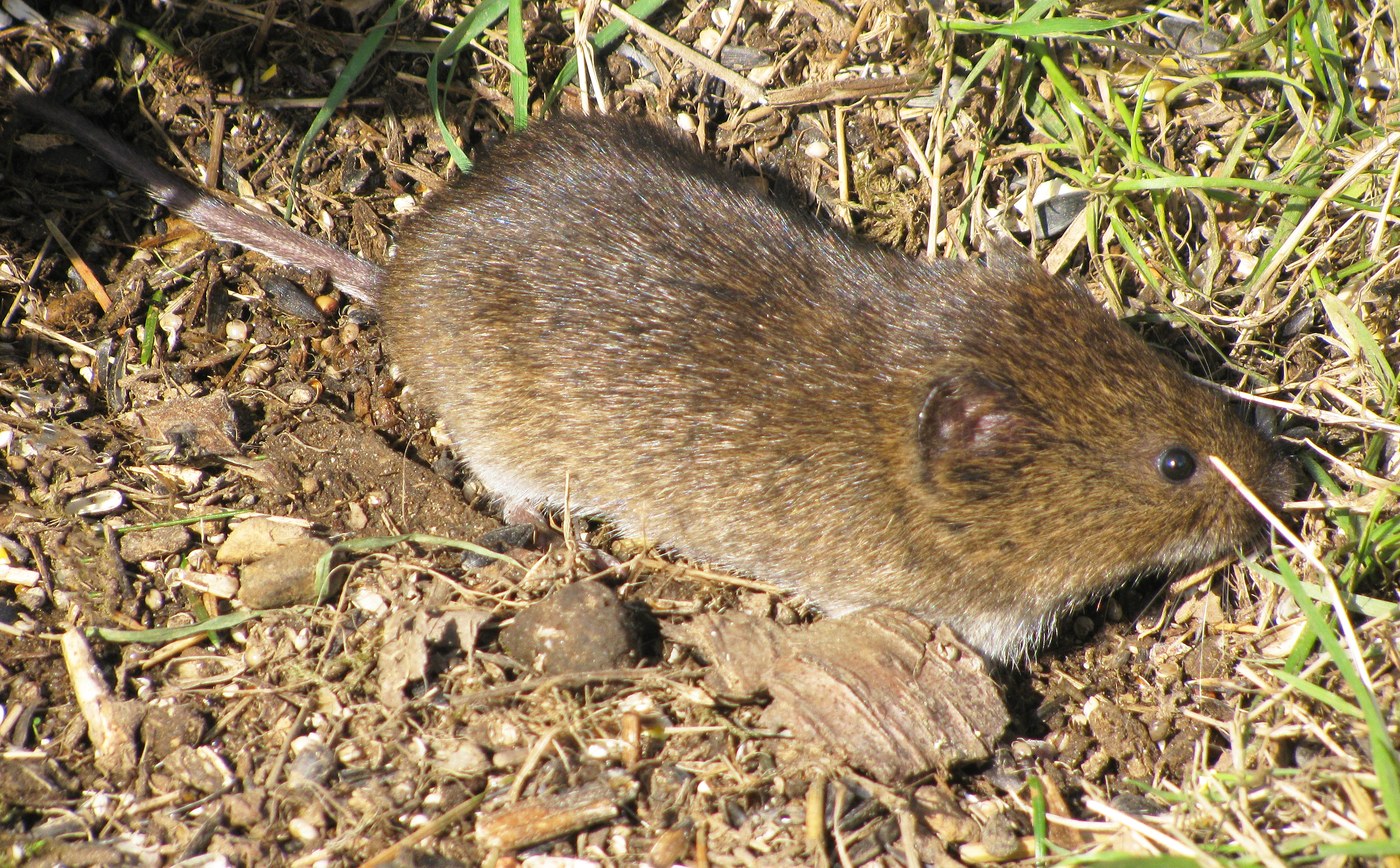
Published descriptions of the ears flatly disagree. The species monograph describes a large dark-brownish vole with large broad ears that extend above the fur, and separately notes that the fur is thin and harsh with the ears extending conspicuously. Oregon State University Extension describes both Oregon conifer voles as having ears so small they are hidden in the fur. Those two cannot both be right about this animal. The monograph is the primary morphological description written specifically for this species, while the extension bulletin is generalizing across a two-species pair for foresters. Because the record says it both ways, treat ear size as a supporting cue against the creeping vole rather than a decisive one, and confirm with size and location.
The eye, against the creeping vole
The eye is the cleanest in-hand tell against the creeping vole, and the two are exact opposites. The monograph's first listed character separating this species from the creeping vole is an eye greater than 4 millimeters in diameter. The creeping vole's eye opening is about 2 millimeters, the smallest of any vole in the region. Two voles side by side west of the Cascades: the one you can see the eye on is Townsend's.
Tubercles and molar loops
Six plantar tubercles on the hind feet, and four enamel loops on the third upper molar. The creeping vole has five tubercles and three loops. For anyone with the animal in hand, those two characters plus the eye settle it without any judgment call about size.
Color and build
Dark brownish above with a heavy mixture of black-tipped guard hairs, a slightly bicolored tail that is blackish above, and lead-colored feet. Young are darker than adults with a dusky belly and blackish feet and tail. Stocky body, short thick furred tail. Males carry conspicuous hip glands, and one study found recognizable hip glands in 56 percent of nonbreeding and 91 percent of breeding females as well, with gland length correlated to breeding condition. The creeping vole's flank glands, by contrast, are obscure or absent.
Townsend's chipmunk is not this
Townsend's chipmunk is a completely different animal, and the shared name is a coincidence of history rather than biology. Townsend's vole is Microtus townsendii, family Cricetidae, subfamily Arvicolinae: stocky, short-tailed, ground-bound, and tied to wet grassy lowland. Townsend's chipmunk is Neotamias townsendii, family Sciuridae, the squirrel family: striped, long bushy tail, a climber, and an animal of dense western conifer forest. Both are named for the naturalist John Kirk Townsend. The overlap runs further than the name, which is exactly why it fools people. John Bachman described both species in 1839, from Townsend's own specimens, taken at nearly the same spot on the lower Columbia River near the mouth of the Willamette. Same collector, same describer, same year, nearly the same place, two animals with essentially nothing else in common.
Townsend's mole gets the blame
Townsend's mole is a third animal with the same namesake, and it is the one that actually gets blamed for this vole's damage. Washington State University Extension states it directly: damage to flower bulbs and roots in the garden or landscape is often attributed to moles, but it is usually caused by voles. Moles are not rodents at all and eat mostly invertebrates, and while the same publication concedes that some Townsend's moles do take a liking to bulbs, seeds or grass roots, it says that in general voles cause the most damage of this sort. The tell is on the ground: voles do not mound dirt at their tunnel entrances, so small openings interconnected by trails and lacking soil mounds mean vole, and cones of excavated soil mean mole or pocket gopher.
Gray-tailed vole takes the blame too
Gray-tailed vole is the look-alike that most often gets this animal blamed for damage it did not do. The gray-tailed vole is this species' sister species under genetic reconstruction, and it holds the Willamette Valley floor. Oregon's high-profile vole story, the grass seed and pasture irruptions that drew drone mapping and detection-dog field days from Oregon State University Extension, belongs to that animal, not this one. In the hand, Townsend's vole has a nearly uniformly blackish or dark-brownish tail against the gray tail, a U-shaped palate margin, and incisive foramina over 6 millimeters long. In practice, range settles it: the gray-tailed vole reaches only two known localities north of the Columbia, in Clark County, Washington.
The other regional voles
They are separated cleanly. Montane vole is the east-of-the-Cascade-crest counterpart, and Washington State University pairs the two explicitly as the state's two garden-damage voles split by the crest. Meadow vole is not a west-side animal; in Washington it is confined to the northeast corner. California vole meets this species' range only in northwestern California and is separated by tail color, incisive foramen shape, and incisors not entirely hidden by the nasals from above. Water vole is the larger regional Microtus and is separated by plantar tubercle count and incisor angle.
Signs of Infestation
Worn surface runways in the grass
Worn surface runways cut through the grass, and they are deeper and more permanent than most people expect. Runways are used by successive generations and are often worn 2.5 to 5 centimeters deep, about 1 to 2 inches. Washington State University describes voles cutting runways through grass and feeding on vegetation as they move, and notes the damage is especially common where snow cover lasts. These voles keep to their runways in autumn, winter and spring, and may abandon them only when vegetation gets dense enough for total concealment. California's account adds a detail worth looking for: the runway tunnels are lined with cut green vegetation.
Open tunnels with no soil cone
Open tunnel entrances with no cone of soil at the opening, connected by trails. This is the single most useful sign, because it is what separates a vole problem from a mole or pocket gopher problem. Washington State University notes that vole tunnel entrances remain open unless a mole or gopher has also moved in, and Oregon State University gives the rule directly: unlike moles or pocket gophers, voles do not mound dirt at their tunnel entrances, so small burrow openings interconnected by trails and lacking soil mounds are a sure sign of voles.
Latrine heaps at intersections
Latrine heaps at runway intersections, with published dimensions. Droppings turn up throughout the runways, but heaps build up specifically where runways cross, and after repeated use those latrines reach about 18 centimeters long, 8 centimeters wide, and form a ramp up to 13 centimeters high. Almost nothing else in a yard produces that.
Crisscross tooth scars
Tooth scars about a sixteenth of an inch wide, in a crisscross pattern on woody plants. That is Washington State University's published damage spec. Herbaceous plants are cropped just above the soil surface rather than gnawed. Gnawed roots show the tiny paired grooves left by the two front incisors.
Bulbs eaten out over winter
Bulbs and roots eaten out over the winter, and young trees girdled. Washington State University's Hortsense fact sheet states that bulbs and roots are often completely eaten over winter and trees can be completely girdled. Its vole publication illustrates the same with a girdled fir Christmas tree and gnawed roots on semi-dwarf apple trees at the university's own Mount Vernon research orchard. There is a documented species-specific precedent for the bulb behavior: near Olympia, Washington, single caches were found holding 13.2 liters or more of wild mint bulbs, stored and eaten even while green food was abundant, and California's account notes that bulbs may be found in abundance concealed in the runways.
A grass nest above standing water
A grass nest on a hummock or high point above standing water. During wet periods this species nests on or above the soil surface rather than underground, often on a hummock, and researchers have suggested that this exact habit is what allows it to hold seasonally flooded ground that excludes other species. In the Willamette Valley it lives in flooded areas for most of the winter, in some places with burrow entrances underwater. During dry spells it maintains ordinary subterranean burrows and underground nests.
Do not expect an indoor problem
What you should not expect is an indoor problem. No source documents Townsend's voles entering or nesting in structures. This is an outdoor animal of wet meadows, pastures, marsh edges, lawns and garden beds. A rodent found indoors with a long thin tail nearly as long as its body is a mouse, not a vole.
No reliable sound or smell cue
What you should also not expect is a reliable audible or smell cue. No published source documents an audible sign for this species, and the only smell reference is a dissection note about the contents of certain stomachs, which is not something anyone will notice in a yard.
Prevention and When to Call a Pro
Mow short and pull the thatch
Mow short and get the thatch out, because tall grass is both the food and the cover. Washington State University states it plainly: tall grass is the primary food and safe harborage for these rodents, so grass must be kept mowed short around gardens and between trees subject to attack, and accumulations of thatch should be reduced because they let voles hide from predators. This is the cheapest control available and the one most often skipped.
Buffers, and the mulch to avoid
Put in vegetation-free, thinly mulched buffers, and know which mulch to avoid. Vegetation-free buffers of thinly mulched soil, no more than 1 or 2 inches deep, around garden perimeters and around trees and shrubs help reduce migration of new animals in. Avoid thick layers of organic mulch and avoid weed-barrier cloth, both of which encourage tunneling. Crushed rock works as a vole-resistant mulch in some situations.
Three publications, three depths
Exclusion spec, and three university publications disagree on the depth. Washington State University's vole publication gives a quarter-inch hardware cloth fence or cylinder about 12 inches high with the bottom buried 6 to 10 inches. Its Pacific Northwest gardener's handbook gives quarter-inch galvanized hardware cloth buried in a trench at least 8 inches deep with the bottom 6 inches bent outward, away from the garden, at a 90 degree angle. Its Hortsense fact sheet gives quarter-inch mesh buried 24 to 30 inches deep with 6 inches above ground. Those three do not agree on depth. Deeper is the safer choice, and the deepest version also excludes moles and pocket gophers.
What a fence does and does not
Understand what a fence does and does not do. The same publication that gives the fence spec is honest that fences reduce root damage when populations are not extreme, but tunneling species may still get to vulnerable plants. There is a research reason to be careful here too: when researchers fenced a high-density population to block dispersal, it climbed to a much higher density, overgrazed its own vegetation and then crashed. A fence is a barrier around a bed. It is not population control.
The trapping spec, with numbers
Trapping spec, and it is unusually specific about numbers. Common mouse traps, baited with apple pieces or peanut butter or set unbaited, are legal in Washington. Set them at right angles to runways and tunnels, cover them so birds are not caught, and use at least one trap per 100 square feet. For a large backyard or garden it may take 80 or more traps per acre to actually reduce numbers. Check traps at least once a day, remove captured animals, and bury carcasses. Other body-gripping traps are not legal in Washington.
Trapping is harder for this one
Expect trapping to be harder for this species than for other voles, because it is. The species monograph calls Townsend's vole among the most difficult voles to capture and census, notes that several weeks of prebaiting may be needed before animals will enter traps at all, and records that live traps caught only 55 percent of a known population. Snap traps set crosswise in runways do work. An empty trap line, though, is weak evidence of an empty yard.
Monitor with apple slices
Monitor with apple or carrot slices instead of counting traps. Place pieces in damaged areas, tunnels and runways, keep the bait as dry as possible to encourage feeding, and if nothing is fed on within 24 to 48 hours there probably are no voles within the immediate few square yards.
No poison to buy in Washington
There is no poison to buy for this, in Washington. Washington State University states that there are no home-use rodenticides registered for voles in yards and gardens, and its Hortsense fact sheet lists no recommended chemical control at all. That is not an oversight in the guidance. It is the actual registration status.
Repellents are a maybe
The extension service says so. Few data are available on whether vole repellents work. Homeowners willing to test them under local conditions should use the highest label rates of products containing blood meal or castor oil, or both, and treat the result as an experiment.
Predators will not fix it
Predators will not fix a vole problem, and Washington State University is blunt about it. Building habitat for hawks, owls and other predators is a nice gesture, but predators rarely keep vole populations below damaging levels, predation cannot keep up with the breeding rate, and predators seldom hunt in home gardens. Domestic cats kill large numbers of voles and also a great deal of other wildlife, and still do not provide adequate control. Worth knowing how much predation is already happening: a 1964 Oregon study of barn owl pellets found that 31.9 percent of 2,886 recovered skulls were this species, rising to 76.3 percent of the December diet, and it is still the animal at the highest average density of any Microtus on the continent.
Oregon's permissive statute
Oregon law is permissive, by statute rather than agency policy. Oregon Revised Statutes define predatory animals to include rodents that are or may be destructive to agricultural crops, products or activities, and authorize any person owning, leasing or occupying infested land to control noxious rodents by poisoning, trapping or other appropriate and effective means. Oregon's wildlife agency confirms that no wildlife control operator permit is required for onsite capture and euthanasia of species defined as predatory animals.
Washington restricts the method
It restricts the method rather than the species, with one island caveat. Mouse and rat snap traps are excepted from the body-gripping trap restriction that followed voter passage of Initiative 713 in 2000; other body-gripping traps are not legal. Separately, the San Juan Islands subspecies, the Shaw Island Townsend's vole, is listed by Washington's wildlife agency as a Species of Greatest Conservation Need under the state wildlife action plan. That is a planning designation, not a threatened or endangered listing, and no take prohibition attaches to it, but anyone controlling voles in the islands should confirm current rules with the state agency rather than assuming mainland practice carries over. Rules change and vary locally, so verify before trapping, relocating or applying anything.
Call for runways across a lawn
Call a professional when runways and open unmounded holes show up across a lawn rather than in one patch. By that point the population is established, and the extension service's own figure, 80 or more traps per acre, is the honest scale of what a homeowner response would take.
Call during a regional irruption
These come every 3 to 5 years, with more than 1,000 voles per acre in the open ground next to yards, and research peaks of 525 to 800 per hectare. Nobody out-traps that alone, and the crash that follows is not a control strategy you can schedule.
Call if you cannot tell mole from vole
Call when you cannot tell mole from vole. This is the most common misdiagnosis in western Washington, it sends people to the wrong product in the wrong season, and getting it wrong costs a full year of damage. Soil mounds mean mole or gopher. Open holes joined by worn runways mean vole.
Frequently Asked Questions
Is Townsend's vole the same thing as a Townsend's chipmunk?
No, and they are not even close relatives. Townsend's vole is Microtus townsendii, family Cricetidae, a stocky short-tailed ground rodent of wet meadows, pastures and lawns. Townsend's chipmunk is Neotamias townsendii, family Sciuridae, the squirrel family: striped, bushy-tailed, a climber, and an animal of dense western conifer forest. They share a name because they share a namesake, the naturalist John Kirk Townsend. The coincidence runs deeper than most people realize: John Bachman described both species in 1839, from Townsend's own specimens, collected at nearly the same place on the lower Columbia River near the mouth of the Willamette. There is a third animal in the same confusion set, and it matters more day to day. Townsend's mole, Scapanus townsendii, is the animal western Washington homeowners most often blame for damage this vole actually causes.
What is the difference between a Townsend's vole and a creeping vole?
Size, habitat, and the eye. Oregon State University Extension gives Townsend's vole as 6 to 9 inches long with a 1 to 3 inch tail, found primarily on the coast and in the Coast Range, and the smaller Oregon or creeping vole as 5 to 6 inches, running from the coast all the way to the Cascades. Washington State University gives the split as up to 9.5 inches against 6.5. In the hand, Townsend's vole has an eye more than 4 millimeters across against the creeping vole's roughly 2, six plantar tubercles on the hind feet against five, and ears that stand clear of the fur. Habitat is the fastest tell of all: Townsend's vole is the wet meadow, pasture, marsh edge and lawn animal, and the creeping vole is the forest floor and clearcut animal. Where the two meet, California's wildlife account states that Townsend's vole outcompetes the creeping vole and reduces its density.
Something ate all my flower bulbs. Was that a mole?
Almost certainly not. Washington State University Extension states it directly: damage to flower bulbs and roots in the garden or landscape is often attributed to moles, but it is usually caused by voles. Moles are not even rodents, and they eat mostly invertebrates. The same publication allows that some Townsend's moles will take bulbs, seeds or grass roots, but says that in general voles cause the most damage of this sort, and the university's Hortsense fact sheet records that bulbs and roots are often completely eaten over winter. West of the Cascades in Washington, Townsend's vole is the species named as most often responsible for backyard and garden damage, and there is documented precedent for bulb hoarding in this exact species: near Olympia, single caches were found holding 13.2 liters or more of wild mint bulbs. Check the ground to settle it. Cones of soil mean mole or pocket gopher. Open holes joined by worn runways through the grass mean vole.
How many voles could actually be in the field behind my yard?
More than most people expect, and this is the species that holds the record. Washington State University documents periodic vole population explosions in open grassland, field and forest-edge ground, commonly every 3 to 5 years, with populations that may exceed 1,000 voles per acre before crashing. The research literature agrees on the scale: a review of long-running British Columbia populations found cyclic peaks between 525 and 800 voles per hectare, averaging 697, and concluded that Townsend's vole attains the highest average density of any Microtus in North America. California's wildlife account cites densities as high as 1,320 per hectare, about 519 per acre.
Can I use poison bait on voles in my yard?
Not in Washington. Washington State University Extension states there are no home-use rodenticides registered for voles in yards and gardens, and its Hortsense fact sheet lists no recommended chemical control at all. What is legal there is common mouse snap traps, baited with apple or peanut butter or set unbaited, placed at right angles to runways and covered so birds are not caught, at a rate of at least one trap per 100 square feet, or 80 or more per acre for a large yard. Other body-gripping traps are not legal in Washington. Oregon is more permissive: state law treats crop-destructive rodents as predatory animals and lets a landowner, lessee or occupant control them by poisoning, trapping or other effective means without a permit. Rules change, so verify locally before acting.
I set traps and caught nothing. Does that mean the voles are gone?
Not necessarily, and this species is a specific reason to be skeptical. The species monograph calls Townsend's vole among the most difficult voles to capture and census, notes that several weeks of prebaiting may be needed before animals enter traps at all, and records a study in which live traps caught only 55 percent of a population that was known to be there. Different trap types also catch different size classes, so one method alone undersamples. A better check is the bait test Washington State University publishes: put apple or carrot pieces in damaged areas, tunnels and runways, keep them dry, and if nothing is eaten within 24 to 48 hours there probably are no voles in the immediate few square yards.
Why do these voles thrive in a soggy winter yard when other rodents do not?
Because they nest above the water. During wet periods Townsend's vole builds its nest on or above the soil surface rather than underground, usually on a hummock or high point, and researchers have suggested that this habit is exactly what lets it occupy seasonally flooded habitat that excludes other species. In the Willamette Valley it lives in flooded ground for most of the winter, in some places with its burrow entrances underwater. It is also a strong swimmer and diver, readily enters water when pursued, and has been caught in traps set underwater. That is why the lowest, wettest, grassiest corner of a property is the one to inspect first.
Do Townsend's voles get into houses?
No source documents Townsend's voles entering or nesting in structures. This is an outdoor animal of wet meadows, pastures, marsh edges, lawns, orchards and garden beds, and its documented damage is to turf, bulbs, roots, bark and pasture rather than to a building. If a rodent turns up indoors with a long thin tail nearly as long as its body, that is a mouse and not a vole of any kind.
Sources
- Vole Management in Home Backyards and Gardens, FS094E, Home Garden Series: names Townsend's vole as the species most often responsible for backyard and garden damage west of the Cascades, with its habitat list, the 3 to 5 year irruption cycle and the 1,000 voles per acre figure, the reproductive arithmetic, tooth scar dimensions, runways and open tunnel entrances, mulch and thatch guidance, the trap spec and densities, the exclusion fence spec, the no-registered-rodenticide finding, and the statement that predators will not control voles Washington State University Extension
- Controlling Vole Damage to Conifer Seedlings, EC 1256, The Woodland Workbook: source of the bog rat name, the 6 to 9 inch with 1 to 3 inch tail size figure, the coast and Coast Range distribution, the meadow, marsh, pasture and riparian habitat statement, breeding at 3 weeks of age, the 13 litter ceiling stated for the two-species pair, and the rule that voles do not mound dirt at their tunnel entrances Oregon State University Extension Service
- Chapter 20, Vertebrate Pest Management, The Pacific Northwest Gardener's Handbook: independent extension source giving Townsend's vole at up to 9.5 inches as the most commonly seen west-side vole against the creeping vole at 6.5 and the montane vole at nearly 8, plus the paired incisor grooves on gnawed roots, the apple and carrot monitoring threshold, the hardware cloth trench spec, and Washington trapping law Washington State University Extension
- Vertebrate: Voles, Hortsense fact sheet: about 16 vole species in the Pacific Northwest with Townsend's vole named, the finding that bulbs and roots are often completely eaten over winter and trees completely girdled, the deeper hardware cloth burial spec, and no recommended chemical control Washington State University
- Mole Management in Washington Backyards, FS146E, Home Garden Series: the mole versus vole misattribution finding that damage to flower bulbs and roots is usually caused by voles rather than moles, the note that some Townsend's moles take bulbs but voles cause most of that damage, and the reminder that moles are not rodents Washington State University Extension
- Microtus townsendii, Mammalian Species No. 325: the species monograph, source of the measured size range, the one of the largest voles in North America wording, the highest average density of any North American Microtus finding with the 525 to 800 per hectare cyclic peaks, the greater than 4 millimeter eye and six plantar tubercles separating it from the creeping vole, ears clearing the fur, runway depth and reuse, latrine dimensions, above-ground nesting on hummocks, swimming and underwater trap captures, the Olympia mint bulb caches, the 1964 Oregon barn owl pellet data, gestation and litter size by region, weaning and growth figures, the field versus laboratory puberty mass difference, the fence effect, the predation dispute, trapping difficulty, the six subspecies, the full documented range, and the etymology naming John Kirk Townsend American Society of Mammalogists, Cornely and Verts 1988, full text via Internet Archive
- Life history account for Townsend's Vole, Microtus townsendii, M135, California Wildlife Habitat Relationships System: the coastal Humboldt and Del Norte county range, the wet meadow and pasture abundance statement, diet including bulbs cached in runways and runways lined with cut green vegetation, nesting on hummocks in high-water winters, year-round activity, home range, densities to 1,320 per hectare, the breeding season and litter figures, and the statement that this species outcompetes the creeping vole and reduces its density California Department of Fish and Wildlife, California Interagency Wildlife Task Group
- Shaw Island Townsend's vole (Microtus townsendii pugeti): the 6 to 10 inch size figures for Townsend's vole, the San Juan Archipelago subspecies range and confirmed island populations, and the Species of Greatest Conservation Need designation under the state wildlife action plan Washington Department of Fish and Wildlife
- Gray-tailed vole (Microtus canicaudus) Washington Department of Fish and Wildlife
- Species: Microtus townsendii: NatureServe-derived record giving family Cricetidae, the Triangle Island to Humboldt Bay range, the cycle-dependent breeding season, gestation of 21 to 24 days, litter size averaging 4 to 7, several hundred per hectare at peaks, and Least Concern with a global rank of G5 Encyclopedia of Puget Sound, University of Washington Puget Sound Institute
- Townsend's Vole (Microtus townsendii): federal species page confirming the binomial U.S. Fish and Wildlife Service
- Microtus townsendii Bachman, 1839, TSN 180316: taxonomic record confirming the authorship and the sister species relationship with the gray-tailed vole under cytochrome b reconstructions Integrated Taxonomic Information System
- Tamias (Neotamias) townsendii subsp. townsendii Bachman 1839: nomenclatural treatment giving the original 1839 publication and the type locality on the lower Columbia River near the lower mouth of the Willamette, which establishes that Townsend's chipmunk and Townsend's vole share a describer, a publication year and very nearly a type locality Plazi TreatmentBank, from Mammal Species of the World and Handbook of the Mammals of the World treatments
- Tamias townsendii, Mammalian Species No. 435: the companion species account for Townsend's chipmunk, cited to establish that the two Townsend's rodents have separate formal species accounts in the same series American Society of Mammalogists, Sutton 1993
- Hantavirus: Sin Nombre virus, the North American hantavirus of concern, is carried by deer mice, which is the baseline against which this species' untested status is stated Washington State Department of Health
- Genomic Analysis of Sin Nombre Virus Sequences, Northwestern United States, 2023, Emerging Infectious Diseases 32(5): the eastern Washington and western Idaho rodent survey that found high seroprevalence in montane voles, outside this species' range, cited to establish that no comparable survey covers Townsend's vole Centers for Disease Control and Prevention, with Washington State University College of Veterinary Medicine
- Wildlife Control Operators, WCO Permit: confirmation that no wildlife control operator permit is required for onsite capture and euthanasia of species defined as predatory animals Oregon Department of Fish and Wildlife
- Oregon Revised Statutes Chapter 610, Predatory Animals, including ORS 610.002 defining predatory animals to include destructive rodents and ORS 610.105 authorizing landowners to control noxious rodents by poisoning, trapping or other appropriate and effective means Oregon State Legislature
- Trapping nuisance wildlife: mouse and rat snap traps excepted from the body-gripping trap restriction, and the humane euthanasia requirement Washington Department of Fish and Wildlife
- Vole population explosion concerns grass seed growers Oregon State University News
- OSU Extension research using drones takes flight to detect vole activity: names gray-tailed voles, not Townsend's vole, as the Willamette Valley grass seed species behind the recent irruptions Oregon State University Extension Service
Image Credits
- Image: Vickie J Anderson via Wikimedia Commons. CC BY-SA 4.0. Resized, so this version is offered under the same license.
License.