Seasonal Timeline
Deer mice breed in every month of the year, with documented peaks from January through April and again from June through November. Unlike the house mouse, they are not primarily a cold-weather indoor problem; they are a year-round risk wherever their range overlaps a structure.
Deer mice breed in every month of the year, with documented peaks from January through April and again from June through November. Unlike…
No published source gives region-by-region peak and shoulder activity windows for this species. Treat the breeding-season dates as the working baseline instead.
Where They're Found
Documented across eight regions: Alaska, Southwest, Mountain West, Pacific Northwest, California, Midwest, South Central, and Northeast. The Southwest and Mountain West carry the heaviest documented case burden, including the Four Corners region where U.S. hantavirus surveillance began in 1993. The Midwest's risk concentrates in its Great Plains states rather than spreading evenly across the region, and the South Central risk concentrates in the western and northern parts of Texas and in Oklahoma rather than the Gulf Coast. The Northeast carries a real but minor risk; the large majority of U.S. hantavirus cases occur west of the Mississippi River. Alaska is native range too, established across Southeast and Southcentral Alaska up to the northern tree line, though documented hantavirus incidence there is very low, attributed to less human-rodent contact in subarctic wildlands and lower viral prevalence in northern populations compared to the arid Southwest. The Southeast and Hawaii are outside the range. The deer mouse's documented range does not extend into the southeastern United States, and federal case data shows that region as the weakest of all the mainland regions. Hawaii has no native Peromyscus population at all; the islands' only rodents are introduced Norway rats, roof rats, Polynesian rats, and house mice.
Life Cycle
The home range is the real contrast with the house mouse, not the litter math. A deer mouse's home range runs from about 240 to 3,000 square meters, dramatically larger than the house mouse's roughly 30-foot radius. A homeowner treating this like a house mouse problem, on a house mouse's scale, will underestimate how far the population actually reaches.

Pup
Juvenile

Adult2
Deer Mouse vs. House Mouse
Identification
Coat and size
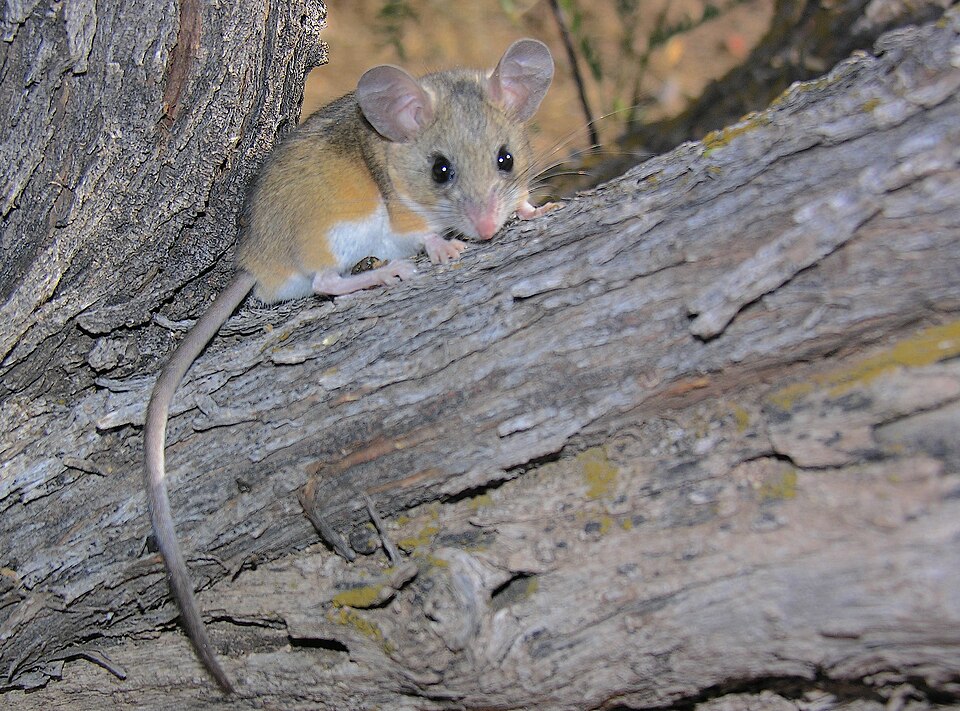
Grayish to reddish brown above with white underparts, short soft dense fur. Typically 3 to 4 inches, occasionally reaching 7 inches.
Three tells against a house mouse
Three tells separate a deer mouse from a house mouse, and any one is enough. A deer mouse has a white underside with a sharp line where the dark back stops. A deer mouse has noticeably larger eyes. And the tail is furred and sharply two-toned, dark on top and light underneath, where a house mouse tail is nearly bare and uniform. The tail is easiest to read on a trapped animal.
The white-footed mouse is harder
A second, harder comparison exists with the white-footed mouse (Peromyscus leucopus), a close relative common in parts of the Northeast and Southeast. The two are genuinely difficult to separate by eye in some areas. The most useful field difference is the tail's color division: sharply defined on a deer mouse, less distinct on a white-footed mouse.
Signs of Infestation
The usual rodent signs
The same general rodent signs as a house mouse apply: droppings, gnaw marks, and nesting material. What differs is where the nest turns up.
Outbuildings and woodpiles
Outbuildings, cabins, sheds, and woodpiles are the classic deer mouse entry point, more so than the interior of an occupied home. Nests turn up in stumps, logs, brush piles, and stored materials as often as inside walls.
A far larger home range
A deer mouse works roughly 240 to 3,000 square meters, far more ground than a house mouse covers. Sign can turn up well away from where the animals are actually nesting.
Prevention and When to Call a Pro
Seal any pencil-width gap
Seal any gap that would let a pencil or pen fit through. A pencil is roughly a quarter inch across, so this is the same threshold given for house mice rather than a narrower one. Use concrete, rodent-resistant mesh, or steel wool, never lightweight materials a rodent can gnaw through.
Trap choice matters more here
House mice are more forgiving on this point. Avoid glue traps and live cage traps. A scared, live rodent voids urine and defecates, which increases the very exposure risk you are trying to avoid. Use a containerized snap trap or an electronic trap instead.
Cleanup is the centerpiece
It is not an afterthought, and the protocol inverts normal instinct. Never sweep or vacuum rodent droppings, urine, or nesting material dry. Disturbing it dry is exactly what sends the virus into the air. Ventilate the space for 30 minutes first, with doors and windows open, and stay out of the area while it airs out.
Wet everything before you touch it
Spray droppings, urine, nests, and dead rodents with an EPA-registered disinfectant or a fresh bleach solution (roughly 1 part bleach to 9 or 10 parts water) and let it soak at least 10 to 15 minutes. Wipe up with paper towels, double-bag the waste, and seal it in the trash.
Heavier infestations need PPE
Heavier infestations call for real protective equipment, not a dust mask: disposable coveralls, rubber boots or shoe covers, gloves, goggles, and a respirator with a HEPA filter.
When to Call a Pest Control Professional
Any sign of deer mouse activity in or near a structure is worth acting on given how serious an untreated infection can become. Heavy infestations specifically should go to a professional cleanup crew rather than a homeowner with a spray bottle.
Frequently Asked Questions
Do deer mice really carry hantavirus?
Yes. The deer mouse is the most common carrier of the hantavirus strain that causes hantavirus pulmonary syndrome in the United States, and roughly 38 percent of people who develop respiratory symptoms from it may die.
How do I clean up after deer mice safely?
Never sweep or vacuum droppings, urine, or nesting material dry, since that can send the virus airborne. Ventilate the space for 30 minutes first, then wet everything down with a bleach solution or disinfectant and let it soak before wiping it up with paper towels and double-bagging the waste.
How do I tell a deer mouse from a house mouse?
Three tells, and any one is enough. A deer mouse has a white belly with a sharp dividing line, larger eyes, and a furred, sharply two-toned tail. A house mouse is gray all over with a nearly bare tail.
Are deer mice only a Southwest or Mountain West problem?
No, though that is where the documented risk is highest. They range through most of the country except the Southeast, with real but lower risk in the Great Plains portion of the Midwest, parts of Texas and Oklahoma, and the Northeast.
Sources
- Hantavirus and Disease Prevention, Publication AZ2158 University of Arizona Cooperative Extension
- About Hantavirus Centers for Disease Control and Prevention
- How to Clean Up After Rodents Centers for Disease Control and Prevention
- Reported Cases of Hantavirus Disease Centers for Disease Control and Prevention
- Peromyscus maniculatus (deer mouse) Animal Diversity Web, University of Michigan Museum of Zoology
- Mammals of Texas: North American Deermouse Natural Science Research Laboratory, Texas Tech University