Seasonal Timeline
Townsend's chipmunks are active by day, mostly March through late November, with the visible peak in summer and early autumn as animals work berries and then seed. Winter depends entirely on where you are. High-elevation animals in the Cascades hibernate for about 4 to 4.5 months on cached food, while animals in the mild low country and along the coast may stay active all winter, digging up fungi.
Townsend's chipmunks are active by day, mostly March through late November, with the visible peak in summer and early autumn as animals…
The seasonal timing for this species comes from published biology. Where two published accounts disagree, both figures are given below.
The hibernation figure here is measured, not estimated. A study of four rodent species living side by side in the Washington Cascades found Townsend's chipmunk hibernating for 4 to 4.5 months, against 6 to 8 months for the Cascades golden-mantled ground squirrel sharing the same ground. The same study found the mating period compressed into one to two weeks between late March and early May, males emerging one to two weeks ahead of females, and mating happening within a week of female emergence. The neighboring yellow-pine chipmunk bred about a month earlier than Townsend's did.
Two accounts disagree on one point. Oregon State's extension pamphlet on this species says that where it snows, these chipmunks hibernate after putting on extra body fat, and that in the Coast Range, where there is less snow, they usually do not hibernate. The second half of that is well supported. The body-fat half is not. The study that actually measured it found chipmunk body fat staying under 7 percent, against over 30 percent for the ground squirrel next door, and concluded that chipmunks rely on food caches through hibernation rather than on fat. The measured finding is the one to trust. The pamphlet is a 4-H publication written by two undergraduate students, and it remains the best source available for several homeowner-level details nothing else covers, but on a physiological question the peer-reviewed measurement wins.
Where They're Found
Townsend's chipmunk is an outdoor, ground-level forest animal, and the single most useful thing a homeowner can know is that no published source documents it nesting in an attic, a wall void, or a crawl space. Anything scratching overhead at night is a different animal, because this one is strictly day-active.
The range is narrow and coastal. It runs along the Pacific coast from extreme southwestern British Columbia south through western Washington and western Oregon, ending at the Rogue River in southern Oregon and running south in the western Cascades only as far as the headwaters of the Rogue. In Oregon that means the Cascade Range west to the coast. In Washington it means the forested western lowlands and similar dense habitat up to treeline in the Olympics and the Cascades, and it means the animal is absent from the more open ponderosa pine country on the east side.
California is outside the current range, and the reason is taxonomic rather than geographic. Older field guides show Townsend's chipmunk ranging well into northern California. That is because three animals once treated as its subspecies, the yellow-cheeked chipmunk, Allen's chipmunk, and the Siskiyou chipmunk, were later raised to full species. Any California record labeled Townsend's chipmunk refers to one of those. The species as currently defined stops at the Rogue River. The species does not occur east of the Cascade crest, and no published source places it in Alaska or Hawaii.
Habitat is dense forest, which is a genuinely different niche than the chipmunks of the interior West occupy. The least and Colorado chipmunks of the Mountain West select ground that is relatively open near the surface. Townsend's chipmunk does the reverse. It holds dense hardwood forest and humid coniferous forest of fir, hemlock, and pine, riparian strips along streams inside those forests, and areas of thick shrub cover, and it will use a clear-cut once the shrubs have come back several years after the cut. It stays in the shadows and behind thick vegetation, and when you do see one it is usually sitting on a stump, a log, or a low branch.
Old growth and big snags, with numbers. A Forest Service Pacific Northwest Research Station study in the central Oregon Cascades live-trapped 2,344 Townsend's chipmunks between 1987 and 1990 across five old-growth Douglas-fir stands over 400 years old and five young second-growth stands 30 to 60 years old in the Willamette National Forest. Densities ranged from 0.4 to 10.3 per hectare and ran nearly twice as high in old growth, 5.1 per hectare against 2.8, in both spring and autumn. In the old-growth stands chipmunk density tracked the density of large hard snags 50 centimeters in diameter and up almost perfectly. In the second-growth stands there was no relationship with any snag class at all. Animals in old growth also moved shorter distances in autumn and included a greater proportion of young of the year.
The Coast Range works differently, and that is worth knowing. A separate study across mature Coast Range forest and Douglas-fir plantations found densities from 0 to 23.8 per hectare with no significant difference between young and mature stands. What density tracked there was the percentage of salal in the understory. The authors put the Coast Range's unusual suitability down to mild winters, high plant productivity, stand structure, and very little competition from other squirrels.
Around a house, the equivalents are obvious once you know what to look for. Stumps, snags, downed logs, rock piles, retaining walls, woodpiles, brush piles, and unbroken salal or shrub cover running from the forest edge straight to the foundation. Burrows are small, about 2 inches across and roughly 5 feet long, and the animal also shelters in talus and loose rock.
Related Pests
Life Cycle
One litter a year, and the whole calendar hangs off snowmelt rather than a date. Every published source agrees that individual females produce a single litter per year. Emergence and therefore mating shift with elevation and snow, which is why the same species can be breeding in late March at low elevation and in early May higher up.
On the numbers above. Litter size is reported as 3 to 6 by both the Oregon extension account and a university museum account, and the one study that counted them in the field measured a mean of 3.8 in the Washington Cascades. The honest answer is 3 to 6, averaging about 3.8, rather than a blend of those into a figure nobody measured. Lifespan is treated the same way: published wild figures run 2 to 7 years, with about 5 years given as an average and 7 years given repeatedly as the practical ceiling. One captive record of 10.2 years exists and is flagged as inadequately documented by the account that carries it, so it is not used here.
A note on measurements, because the published record has a visible error in it. The standard species account gives measured museum series from Portland, Oregon and from the southern Washington Cascades, both averaging about 249 to 250 millimeters total length. The digitized text of the Portland series prints its range as 235 to 363 millimeters, which cannot be right against a mean of 249 and is almost certainly a typographic corruption of 263, matching the Cascade series exactly. The extension and museum figures of roughly 8 and three quarters to 11 inches are the ones to use, rather than a number that does not add up.

Spring Emergence and Mating
Newborn Nest Young
Juvenile
Adult2
Hibernation and Cached Food
Identification
Reduced stripe contrast
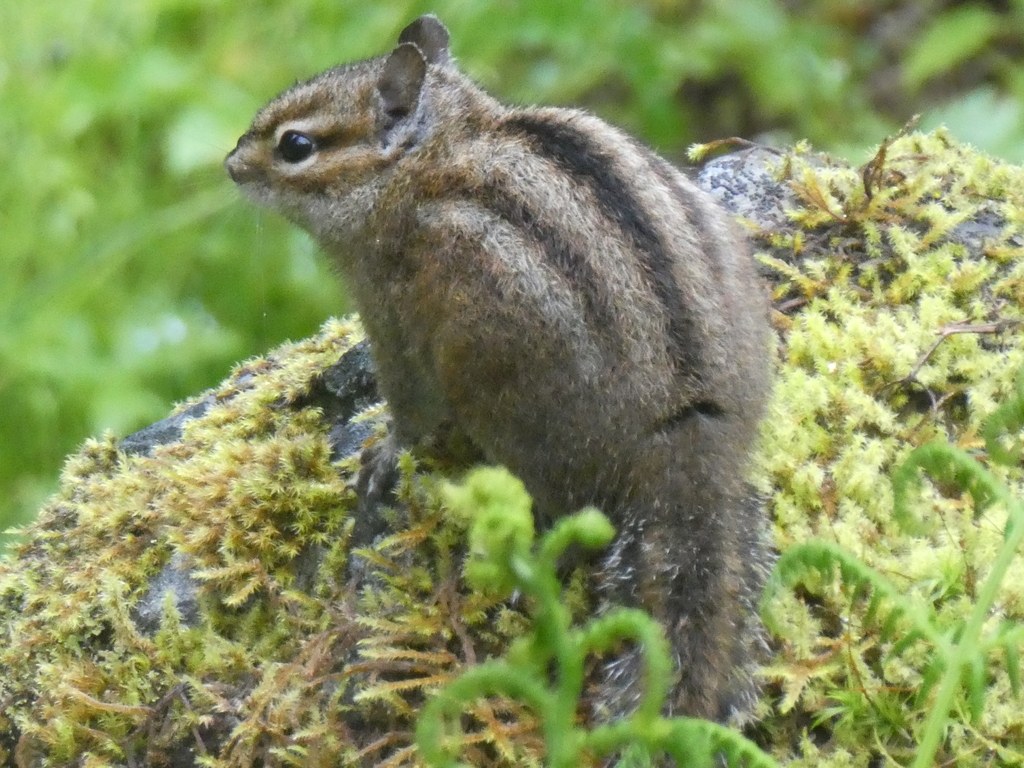
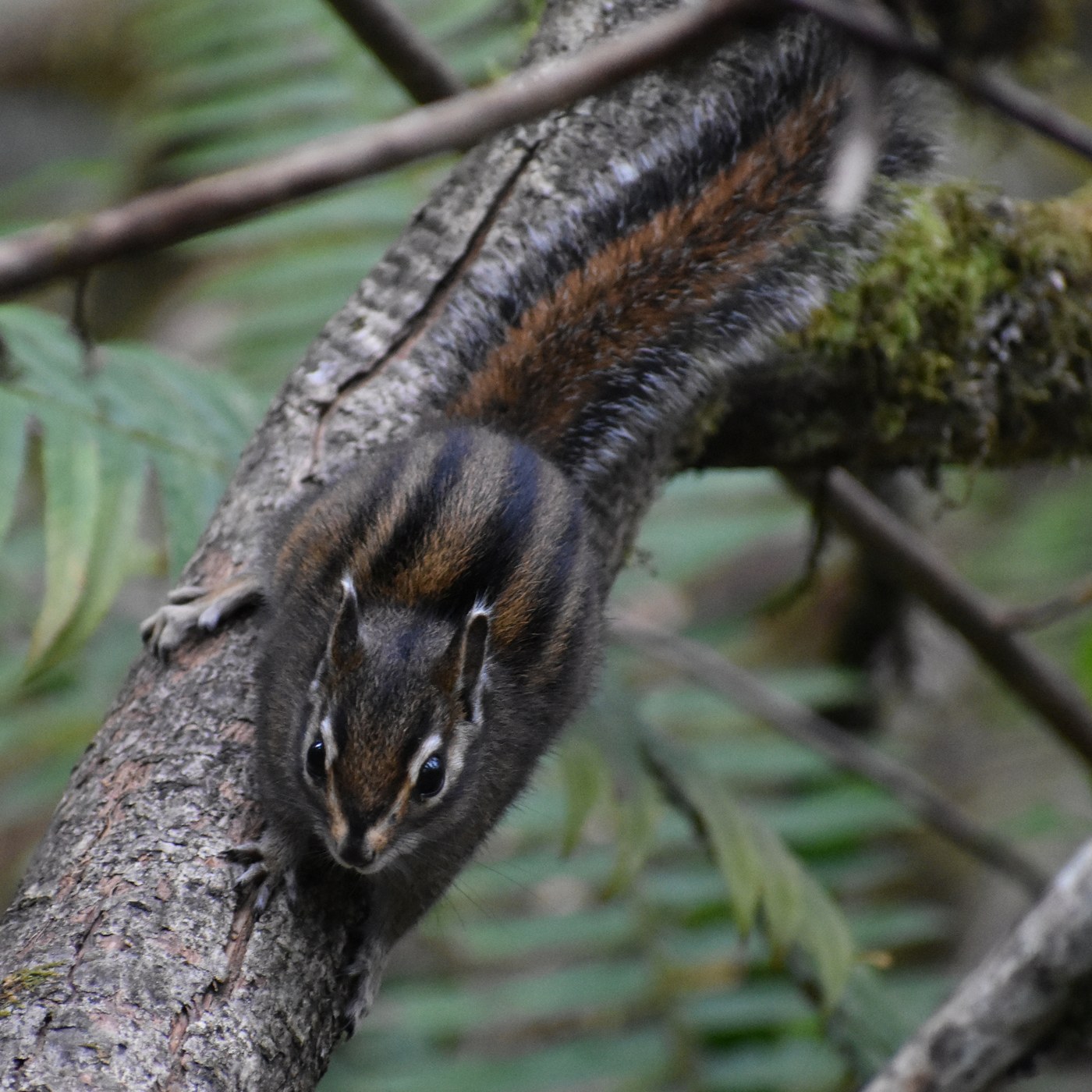
It is the whole identification story, and three independent sources say so. Oregon's wildlife agency describes the pelage as dark and dull. The American Society of Mammalogists species account is more precise: apart from the middorsal stripe, the dark body stripes are mostly obsolete toward the front of the animal, and the light body stripes are narrow and may be nearly obsolete. The Slater Museum of Natural History at the University of Puget Sound calls it larger and darker, not as brightly marked, than Washington's other chipmunks. The stripe formula is still the standard five dark and four light, but on this animal the outer ones wash out.
The middle stripe stays sharp
The one stripe that stays sharp is the middle one. The middorsal stripe is fuscous black and runs the full length from the crown of the head to the rump. If you can see one hard black line down the spine and everything on either side of it is soft and brown, that is this species.
The biggest one in the region
Size, and it is the biggest one in the region. Roughly 8 and three quarters to 11 inches nose to tail tip including a 3 to 5 inch tail, at 2 to 4 ounces. It is the largest chipmunk in Oregon and the largest of Washington's four chipmunk species. Females average 2 to 6 percent larger than males.
Color changes by mountain range
Color varies by subspecies and by mountain range. Dark brown to reddish brown above and on the sides, creamy white to grayish below, ears black in front and smoke gray behind, and a long bushy tail that is blackish above with gray or whitish tipped border hairs and tawny to reddish brown underneath. The coastal form is the darker, browner, more olive one; the inland Cascade form is lighter, redder, and somewhat orange-shaded. In the Coast Range and the western valleys the light stripes are cinnamon brown, and in the Cascade Range they are dull white to cream. Two molts a year, one starting in May and one in August, so summer animals look brighter than winter ones.
The tail carried straight up
Tail carried straight up while running, and large internal cheek pouches that open inside the mouth ahead of the molars and reach back to the base of the ears.
Yellow-pine chipmunk: brightness
Yellow-pine chipmunk is the look-alike that actually matters, and brightness is the tell. The yellow-pine chipmunk is smaller, roughly 8 inches to Townsend's 10, and it is brightly colored with sharply contrasting light and dark back stripes and strongly marked facial stripes. Habitat usually keeps them apart, since the yellow-pine chipmunk holds the ponderosa pine zone east of the Cascade crest plus the subalpine and alpine country and is absent from the dense western lowland forest. The two really do meet, though, in ecotones where open subalpine or pine ground runs up against dense conifer forest. Washington Pass is one named example, and a live-trapping study in the subalpine zone of Mount Rainier National Park found the two overlapping home ranges, with Townsend's males notably more abundant in talus slides.
Douglas squirrel reaches homeowners
Douglas squirrel is the confusion that actually reaches homeowners, and it is a squirrel-versus-chipmunk mistake rather than a chipmunk-versus-chipmunk one. The rule is the face: chipmunks have stripes on the head and face, and no squirrel does. Beyond that, a Douglas squirrel is bigger at roughly 10 to 14 inches, carries a tawny to bright orange belly and a white eye ring, has no back stripes at all, and spends far more of its time in trees.
One face-stripe tell, with a warning
One face-stripe tell comes with a warning attached. The Slater Museum states that Townsend's chipmunk differs from all the other Washington chipmunks in not having a clearly defined dark stripe running from nose to eye. That would be a genuinely useful field mark, but it rests on a single source, and it sits in unexplained tension with Oregon's wildlife agency, Oregon State Extension, and a university museum account, all three of which describe three dark and two light stripes on the side of the face. Treat it as an unresolved single-source observation rather than a settled diagnostic.
A note on the scientific name
You will see three of them. Neotamias townsendii is used here and by current taxonomic databases. Tamias townsendii is what the federal taxonomic database and Washington's own wildlife rule still use, and older literature uses Eutamias townsendii. All three names refer to the same animal.
Older field guides get the range wrong
Older field guides get this species' range wrong, and there is a real reason. Three animals once treated as subspecies of Townsend's chipmunk, the yellow-cheeked chipmunk, Allen's chipmunk, and the Siskiyou chipmunk, were later raised to full species. That is why old maps run Townsend's chipmunk down into northern California. As currently defined it stops at the Rogue River in southern Oregon.
Townsend's vole is a different animal
The shared name catches researchers as well as homeowners. Townsend's chipmunk is Neotamias townsendii, family Sciuridae, the squirrel family. Townsend's vole is Microtus townsendii, family Cricetidae, a stocky short-tailed ground rodent of wet meadows, pastures and lawns west of the Cascades, with no stripes, no bushy tail and no climbing. Both are named for the naturalist John Kirk Townsend, and the coincidence runs further than the name: John Bachman described both species in 1839, from Townsend's own specimens, taken at nearly the same spot on the lower Columbia River near the mouth of the Willamette. Townsend's mole, Scapanus townsendii, is a third animal with the same namesake. If you are trying to identify something in a yard rather than in dense conifer forest, a vole is almost certainly what you are looking at.
Signs of Infestation
A burrow at the base of something
A burrow entrance about 2 inches across at the base of something, not out in the open. Look at stumps, snags, downed logs, rock piles, retaining walls, woodpiles, and brush piles rather than at open lawn. The tunnel runs roughly 5 feet, with longer systems reported.
Tracks, if the ground will hold them
The front feet leave small round four-toed prints. The hind feet leave roughly inch-and-a-quarter five-toed prints. A track line will often lead you straight to a burrow.
A feeder emptying too fast
A bird feeder emptying faster than it should, with an animal working the spilled seed underneath it.
Small excavations in forest duff
Small excavations in the forest duff, where the animal has smelled out and dug up underground fungi. This is mostly a winter sign and it is more characteristic of this species than of most chipmunks, since fungi make up a large share of its winter diet.
The chip call
A fast, high-pitched repeated chip, chip, chip. Oregon State's own description is that it can sound like a bird call muffled by bushes. It is a daytime sound, since the animal is diurnal.
No characteristic odor
No smell-based sign is documented for this species.
One useful negative
It cuts the other way from most wildlife signs. Oregon's wildlife agency notes this species is more secretive than most chipmunks and is heard more often than seen, keeping to shadows and thick vegetation. Not seeing one is not evidence there is not one. Listen instead of looking.
Prevention and When to Call a Pro
It is protected where others are not
Start with the legal status, because this species is protected where many other chipmunks are not. Washington rule WAC 220-200-100 lists Townsend's chipmunk by scientific name under other protected wildlife, in a section titled wildlife classified as protected shall not be hunted or fished. Oregon's furbearer regulations put chipmunks in the protected mammals table rather than on the unprotected mammals list, and Oregon administrative rule names this species by binomial among nongame wildlife. That is the direct opposite of the picture for the chipmunks of the interior West, where Wyoming names the least chipmunk among mammals takeable without a permit and Utah allows take year round with no bag limit.
Washington's record is inconsistent
Washington's own record is not fully self-consistent, and that is worth knowing before you act. The state's trapper education manual lists the unclassified wildlife that may be hunted or trapped year round, and chipmunks are not on that list. Yet the state wildlife agency publishes a chipmunk cage-trap specification, a single or double door trap 5 by 5 by 16 inches baited with unroasted peanuts, sunflower seeds, grain, popcorn, or apple slices, and it lists chipmunk among the species a certified Wildlife Control Operator may handle. No published source reconciles a protected classification with published trapping guidance for the same animal. Do not read that trap spec as permission. Call the state wildlife agency or a certified Wildlife Control Operator first.
Break the cover corridor
It runs between forest edge and foundation. Unbroken salal, shrub, and ground cover running from wild ground straight to the house is exactly the condition this species selects, and in the Oregon Coast Range chipmunk density tracked the percentage of salal in the understory rather than the age of the stand. An open, unplanted strip between the two removes the travel corridor.
Close entry points with mesh
Close entry points with heavy wire mesh. Oregon State Extension's specific instruction for this species is that chipmunks sometimes enter buildings and that holes and cracks should be covered with thick wire mesh screens to keep them out. That is the only structure-related guidance published for this animal, and it is exclusion, not removal.
Move the bird feeders
Move bird feeders away from the house. Oregon State names the bird feeder directly as the place you are most likely to see this animal picking up seed, which puts it on the exact ground next to your foundation.
Read the habitat guidance backward
Read the habitat-building guidance backward. Oregon State Extension publishes precise instructions for attracting this species: stack logs half a foot to a foot apart in perpendicular layers, or build a rock pile with large rocks at the base and smaller ones on top, then pile fallen leaves over the whole thing to encourage animals to overwinter there. Also leave thick ground vegetation, berry-producing shrubs, old-growth trees, and standing dead snags. Every one of those items is a thing not to build within 30 feet of a house.
Do not cut snags as control
Do not cut snags or old trees as a control measure. Chipmunk density in old-growth Cascade stands tracked large hard snags 50 centimeters in diameter and up almost perfectly, so the connection is real. But those elements take centuries to develop, they are important habitat for a long list of other species, and this chipmunk carries no documented structural-damage risk to justify removing them. Habitat work belongs in the yard, not in the woods.
Bell the cat
House cats are named among this species' predators alongside long-tailed weasels, mink, bobcats, foxes, martens, skunks, hawks, owls, and snakes, and putting a bell on a cat's collar is the extension service's own recommendation.
Hantavirus is not documented
The regional data actively point somewhere else. The reservoir for Sin Nombre virus in the western United States is the deer mouse, and Washington's own health department names the deer mouse as the main reservoir and eastern counties as the main exposure area, which is outside this chipmunk's range entirely. The most recent Pacific Northwest rodent surveillance, published in 2026, sampled 189 rodents in the Palouse of eastern Washington and western Idaho and reported results species by species, including one yellow-pine chipmunk and nine least chipmunks. Townsend's chipmunk does not appear in that dataset at all, and the study area sits east of the Cascade crest, outside where this animal lives. Stated precisely: no reservoir role is documented for this species by name, and the nearest regional surveillance did not sample it. That is not proof of zero risk, so ordinary precautions around rodent droppings and nesting material still apply.
Plague is not documented either
Plague is not documented for this species by name either. A published table of rodent plague reservoirs in the western United States names lodgepole chipmunk in California, along with California ground squirrel, golden-mantled ground squirrel, woodrats, rock squirrel, white-tailed antelope squirrel, and prairie dogs, with distributions confined to California and the Four Corners states. Townsend's chipmunk is not on it, and neither Washington nor Oregon appears in those distributions. Oregon does record rare human plague cases, so the disease exists in the state, but no published source connects it to this animal. The genus-level plague concern documented for chipmunks in the semi-arid interior West does not carry over here.
No aggression is documented
No published source records a bite, a charge, or defensive aggression for this species. General wild-mammal caution applies by default: do not handle, do not corner, do not feed.
Call before you trap
Not after. Because the species is protected in both states of its range, the threshold for a phone call is earlier than for most rodents. In Washington, that call goes to the state wildlife agency or a certified Wildlife Control Operator.
Call if exclusion is not holding
Call a professional if an animal is inside a structure and exclusion is not holding. Sealing openings with heavy mesh once the animal has left is the correct fix, but repeated entry after exclusion, or an animal that cannot be encouraged out, is a job for someone certified to handle it legally.
Frequently Asked Questions
Is that a chipmunk or a baby squirrel?
Look at the face. Chipmunks have stripes on the head and face, and no squirrel does, at any age. If the animal has a bright orange belly, a white eye ring, no back stripes, and runs 10 to 14 inches long, it is a Douglas squirrel, sometimes called a chickaree, and it is a tree squirrel rather than a chipmunk.
Why does this chipmunk look so much duller than the ones I see in the mountains?
Because it is a different species. Townsend's chipmunk is the dark forest chipmunk of western Washington and western Oregon, and it is genuinely less boldly marked than the yellow-pine chipmunk of the east-side pine country. Its middorsal black stripe stays sharp, but the dark stripes flanking it are mostly obsolete toward the shoulders and the light stripes between them are narrow enough that they can be nearly absent. Oregon's wildlife agency simply calls the pelage dark and dull. It is also the largest chipmunk in both states.
Do Townsend's chipmunks hibernate?
Yes, but not the way a ground squirrel does. In the Washington Cascades they hibernated for a measured 4 to 4.5 months, against 6 to 8 months for the Cascades golden-mantled ground squirrel living on the same ground. And they barely fatten. Measured body fat stayed under 7 percent, against over 30 percent for that ground squirrel, so they run the winter on cached food instead. In the mild low country and along the coast, where there is less snow, they may not go under at all and can be seen through winter digging up fungi.
Can I trap the chipmunk in my yard in Washington or Oregon?
Check before you do anything, because this one is protected in both states. Washington rule WAC 220-200-100 names Townsend's chipmunk by scientific name under protected wildlife, and Oregon's furbearer regulations put chipmunks in the protected mammals table rather than on the unprotected mammals list. Washington's own record is not fully consistent here, since the state also publishes a chipmunk cage-trap size and certifies Wildlife Control Operators to handle chipmunks, and no published source reconciles those with the protected listing. The safe move is a phone call to the state wildlife agency or a certified operator, not a trap purchase.
Can these chipmunks give my family hantavirus?
No reservoir role is documented for this species by name. Sin Nombre virus in the western United States is carried mainly by deer mice, and Washington's health department names the deer mouse as the main reservoir with exposures concentrated in eastern counties, outside this animal's range. The most recent Pacific Northwest rodent surveillance sampled 189 rodents in the Palouse of eastern Washington and western Idaho, reported results species by species including yellow-pine and least chipmunks, and did not include Townsend's chipmunk at all. Take normal precautions around any rodent droppings or nesting material, but do not assume this animal is a carrier.
Will they get into my house or my attic?
They are ground-level forest animals, and no published source documents this species nesting in an attic, a wall void, or a crawl space. Oregon State Extension does note that chipmunks sometimes enter buildings, and its remedy is exclusion: cover holes and cracks with thick wire mesh. Anything you hear scratching overhead at night is a different animal, because this one is strictly day-active.
Why are there so many of them at the edge of the woods behind my house?
Because dense forest, and especially old forest, is genuinely good habitat for this species rather than incidental to it. A Forest Service study in the central Oregon Cascades trapped 2,344 of these chipmunks and found nearly twice the density in old-growth Douglas-fir stands over 400 years old as in second-growth stands 30 to 60 years old, 5.1 per hectare against 2.8, with old-growth density tracking the number of large standing dead trees. In the Oregon Coast Range, density tracked the amount of salal in the understory instead, ranging as high as 23.8 per hectare. Unbroken shrub cover from that forest edge to your foundation is the corridor worth breaking.
Sources
- Townsend's Chipmunk, EC 1580: size and weight, five dark and four light back stripes, regional stripe color in the Coast Range versus the Cascades, burrow about 2 inches across and 5 feet long, litter size and newborn development, tracks, diet including winter fungi, predators including house cats, the enters-buildings note and the wire mesh remedy, and the habitat-building instructions Oregon State University Extension Service
- Townsend's chipmunk in Oregon: the largest member of the genus in Oregon, the dark and dull pelage description, stripe counts on the body and face, west-slope Cascade localities, old-growth and clear-cut habitat, and the secretive, heard-more-often-than-seen behavior Oregon Department of Fish and Wildlife
- WAC 220-200-100, Wildlife classified as protected shall not be hunted or fished, subsection 3: Townsend's chipmunk listed by binomial among other protected wildlife Washington State Legislature, Washington Administrative Code
- Trapping nuisance wildlife: the published chipmunk cage-trap specification of 5 by 5 by 16 inches with bait recommendations, and the general nuisance-trapping requirements Washington Department of Fish and Wildlife
- Hiring a Wildlife Control Operator: chipmunk listed among the authorized species a certified operator may handle, and the certification requirement for trapping on another person's property for a fee Washington Department of Fish and Wildlife
- Washington State Trapper Education Student Manual: the list of unclassified wildlife that may be hunted or trapped year round, which does not name chipmunks Washington Department of Fish and Wildlife
- Furbearer trapping and hunting: the definition of unprotected mammals, which excludes chipmunks, and the protected mammals table, which includes them Oregon Department of Fish and Wildlife
- OAR 635-044-0430: nongame wildlife listing naming the chipmunks by binomial, including Tamias townsendii Oregon Secretary of State, Oregon Administrative Rules
- Differences in Townsend's Chipmunk Populations Between Second- and Old-Growth Forests in Western Oregon, Journal of Wildlife Management 57(2): 2,344 chipmunks captured 1987 to 1990, densities of 0.4 to 10.3 per hectare, 5.1 per hectare in old growth against 2.8 in second growth, and the relationship with large hard snags 50 centimeters diameter and up USDA Forest Service, Pacific Northwest Research Station, with Oregon State University
- The Biology of Arboreal Rodents in Douglas-fir Forests, General Technical Report PNW-GTR-276: Townsend's chipmunk within the Douglas-fir arboreal rodent community west of the Cascade crest, and shared use of hypogeous fungi USDA Forest Service, Pacific Northwest Research Station
- Townsend's chipmunk populations in Douglas-fir plantations and mature forests in the Oregon Coast Range, Canadian Journal of Zoology: densities of 0 to 23.8 per hectare, no significant difference between young and mature stands, and the correlation with percentage of salal in the understory Canadian Journal of Zoology, Hayes, Horvath and Hounihan 1995
- Seasonal Reproductive Patterns in Four Coexisting Rodent Species from the Cascade Mountains, Washington, Journal of Mammalogy 69(2): hibernation of 4 to 4.5 months against 6 to 8 months for the Cascades golden-mantled ground squirrel, chipmunk body fat under 7 percent with reliance on caches, the one to two week mating period between late March and early May, male emergence ahead of females, mean litter size of 3.8, and delayed first breeding to age two in some animals American Society of Mammalogists, Kenagy and Barnes 1988
- Tamias townsendii, Mammalian Species No. 435: the diagnosis that dark body stripes other than the middorsal stripe are mostly obsolete anteriorly and light stripes are narrow and may be nearly obsolete, the fuscous black middorsal stripe from crown to rump, coastal versus inland subspecies coloration, measured museum series from Portland and the southern Washington Cascades, cheek pouch anatomy, the two annual molts, and the taxonomic history separating ochrogenys, senex and siskiyou American Society of Mammalogists, Sutton 1993
- Tamias townsendii, Animal Diversity Web: total length and mass ranges, female size advantage over males, facial and dorsal stripe description, dense forest and riparian habitat, talus nesting, gestation, litter size, weaning and independence, home range and defended core area, diurnal activity window, mycophagous winter diet, density in mature versus recently cut stands, predators, and lifespan University of Michigan Museum of Zoology
- Neotamias townsendii species account reproducing the NatureServe global record: range from southwestern British Columbia to the Rogue River, average litter size of 3.8 and one litter per year, young above ground by July in the Washington Cascades, home range of 0.8 hectares at 2.6 adults per hectare and 0.6 to 1.1 per hectare in Oregon virgin forest, weasels mink and bobcats as important predators, longer inactivity at higher elevation with possible winter activity near the coast, and the importance of fungi in the diet Encyclopedia of Puget Sound, University of Washington Puget Sound Institute
- Washington Chipmunks, Northwest Nature Notes: Townsend's chipmunk as the largest of Washington's four chipmunks, restricted to the forested western lowlands and dense habitat to treeline in the Olympics and Cascades, larger and darker and not as brightly marked, the single-source nose-to-eye stripe observation, and the ecotone overlap with yellow-pine chipmunk at places such as Washington Pass Slater Museum of Natural History, University of Puget Sound
- Mammal Species of the World, third edition, entry for Tamias townsendii: distribution from southwestern British Columbia through western Washington and Oregon to the Rogue River, subgenus Neotamias, and the note that the species formerly included ochrogenys, siskiyou and senex Bucknell University, hosting Wilson and Reeder
- Tamias amoenus, Animal Diversity Web: yellow-pine chipmunk range excluding coastal areas, elevation band, and the size and color comparisons used to separate it from similar chipmunks University of Michigan Museum of Zoology
- Subalpine Cover Associations of Eutamias amoenus and Eutamias townsendii in the Washington Cascades: live-trapping in the subalpine zone of Mount Rainier National Park, overlapping home ranges within and between the two species, and Townsend's chipmunk males significantly more abundant in talus slides American Midland Naturalist, Meredith 1972
- Genomic Analysis of Sin Nombre Virus Sequences, Northwestern United States, 2023, Emerging Infectious Diseases 32(5): species-level sampling of 189 rodents in the Palouse region of eastern Washington and western Idaho, including one yellow-pine chipmunk and nine least chipmunks, with no Townsend's chipmunk line item Centers for Disease Control and Prevention
- Hantavirus Pulmonary Syndrome notifiable condition page and epiTRENDS: the deer mouse as the major reservoir for Sin Nombre virus, and Washington exposures concentrated in eastern counties Washington State Department of Health
- Regional Rodent-Borne Infectious Diseases in North America, Wilderness and Environmental Medicine: the table of rodent reservoirs of plague in the western United States, naming lodgepole chipmunk in California and confining listed distributions to California and the Four Corners states, with no Townsend's chipmunk entry Wilderness Medical Society, Diaz 2021
- BC Species and Ecosystems Explorer species summary for Neotamias townsendii: provincial status S4S5, general description, and the global range comment placing the northern limit in extreme southwestern British Columbia British Columbia Ministry of Environment