Seasonal Timeline
Round-tailed ground squirrels are active by day, roughly March through late summer, and their dormant period is the reverse of what most people expect. They go underground in late August or early September, at the peak of desert heat and drought, and stay down until January or February. Sources disagree on whether to call that hibernation, summer estivation, or winter torpor. The calendar is settled, the label is not.
Round-tailed ground squirrels are active by day, roughly March through late summer, and their dormant period is the reverse of what most…
The dormancy on this animal runs backward from the pattern most homeowners expect. California's own wildlife agency states it plainly: the round-tailed ground squirrel is diurnal and is dormant from late August or early September to January or February. Nothing about that window is driven by cold. Late August in the low Sonoran Desert is the hottest, driest stretch of the year, after the spring bloom has burned off and often before the monsoon has done any good. The animal disappears at the moment the desert stops producing green forage, not at the moment the weather turns.
Why green forage is the trigger rather than temperature. This species needs food averaging about 80 percent water content, and green vegetation is in its diet in every month of the year. In spring the diet runs roughly 80 percent green vegetation, 15 percent seeds, and 5 percent insects. In summer it is essentially all green vegetation. Population density tracks winter rainfall directly, above-average winter rain increases litter size, and extra rain in December and January pulls the whole breeding season earlier. Water and green growth, not the thermometer, set this animal's calendar.
Three respected sources call the same behavior three different things. California's account uses the word hibernation for the whole late-August-to-January window. Animal Diversity Web describes the identical window but states the species does not hibernate and instead enters torpor through the winter months, resuming inactivity from August or September through January after juveniles disperse in June and July. The Arizona-Sonora Desert Museum splits it into two episodes, a short summer estivation during the drought until the monsoon brings new growth, plus winter hibernation with emergence in early February. All three agree on when the animal is underground. They disagree on what to name it. The honest version is that the calendar is settled and the terminology is not.
One thing that is not unique to this animal. Summer estivation is not unusual among ground squirrels. California ground squirrel takes a summer dormancy too, described by University of California researchers as a period of inactivity during the hottest weather lasting a few days to a week or more. What separates the round-tailed ground squirrel is not that it rests in summer. It is that the summer rest and the winter rest run together into one long absence starting in late August, in an animal whose whole seasonal cycle is set by desert rainfall.
The practical consequence. The only documented successful control program for this species started its monitor trapping in March, early in the active season, specifically to find the active spots before the population built. A treatment aimed at this animal in October is aimed at an empty burrow.
Where They're Found
Round-tailed ground squirrel occupies two regions, the Southwest and California. The Southwest covers the Arizona and Nevada portion of the range. California belongs in the range as well, documented by the state's own wildlife agency.
Why California belongs in the range. The California Department of Fish and Wildlife's own life history account states the species is found in desert regions of California from the Mexican border to southern Inyo County, gives its optimum California habitats as desert succulent shrub, desert wash, desert scrub, alkali desert scrub, and levees in cropland habitat, and notes it is also found in urban habitat. The standard taxonomic distribution statement for the species reads deserts of southeastern California, southern Nevada, and western Arizona in the United States, plus northeastern Baja California and Sonora in Mexico. The type specimen of the species was collected at old Fort Yuma, Imperial County, California. And one of the four recognized subspecies, the Coachella Valley or Palm Springs round-tailed ground squirrel, is a California endemic restricted to Riverside County. A three-state range that includes California is too well documented to leave out.
Arizona is the core of the range in practice. University of Arizona researchers describe the species as widely distributed below 3,200 feet in the hot arid Sonoran Desert of Arizona, and the only species-specific management study for it was conducted at an archaeological site in Coolidge, in central Arizona. Nevada occurrence is confirmed independently: the same taxonomic distribution statement names southern Nevada, and Clark County's own conservation easement small mammal work lists the species among those known or likely to occur based on a 2018 survey.
Neither Alaska nor Hawaii carries a population. No source places any species in this genus in Alaska. No source places any ground squirrel of any genus in Hawaii, either native or introduced. Every range description found for this animal keeps it inside the hot low deserts of the southwestern United States and northwestern Mexico.
On the ground, look at flat open sand, not at rock. This is a Lower Sonoran Life Zone animal of sandy arid country. California's account specifies open, flat, grassy areas in fine-textured, sandy soil, with burrows dug at the base of shrubs, and the Arizona-Sonora Desert Museum places colonies mostly on lower alluvial fans or open flat areas of valleys where the soil is deep enough for burrows the museum puts at around 3 feet down, a depth that rests on that single museum source and appears in no university, agency, or peer-reviewed account. Elevation runs from about 180 feet below sea level in the Salton Trough up to about 2,900 feet in California, which is a genuinely unusual range floor. Temperatures at occupied sites have been recorded swinging from about 23 to 102 degrees Fahrenheit inside a single week. Populations tend to occur in disjunct patches rather than continuously.
Published accounts disagree about creosote bush. The Desert Museum reports that burrows are frequently located beneath creosote bush and that creosote is a favored food and shelter source. California's account, citing a 1977 density study, reports that habitats dominated by creosote bush held fewer squirrels than those without it. Both readings can hold at once: individual burrows are commonly sited under a creosote for shade and cover, while creosote-dominated stands overall support lower densities than mixed-shrub stands.
Density and home range. Densities run from roughly 10 to 100 animals per acre and peak when juveniles emerge. Home range is small. The California Department of Fish and Wildlife's account, drawing on a 1973 field study, gives adult home ranges averaging 0.74 hectare, about 1.85 acres, regardless of sex or age.
Related Pests
Life Cycle
One litter a year, and rainfall sets the whole calendar. Mating runs late February to March, gestation is 27 to 35 days, young are born mid-March to April in a litter averaging 6.5, weaning happens at about 35 days, the young surface in May, and most males disperse in June. Then, within roughly three months of the young appearing above ground, the entire colony starts going dormant. That is the compressed reality of a desert rodent's year.
The reproduction figure that actually predicts a bad year. Density in this species is correlated with winter rainfall, above-average winter rain increases litter size, and rain in December and January advances the breeding season. A wet winter therefore produces earlier, larger litters and a bigger population above ground the following spring. Anyone trying to understand why a property that had a handful of squirrels last year has dozens this year should look at the previous winter's rain before looking at anything else.
One figure comes with a limitation. The only lifespan number found for this species is a maximum recorded longevity in captivity of 8.9 years. No source gives a wild lifespan, average or maximum. A captive maximum is not a wild average, and it should not be read as one.

Mating
Gestation
Birth and nursing
Juvenile
Adult
Identification
The tail is the name and the tell
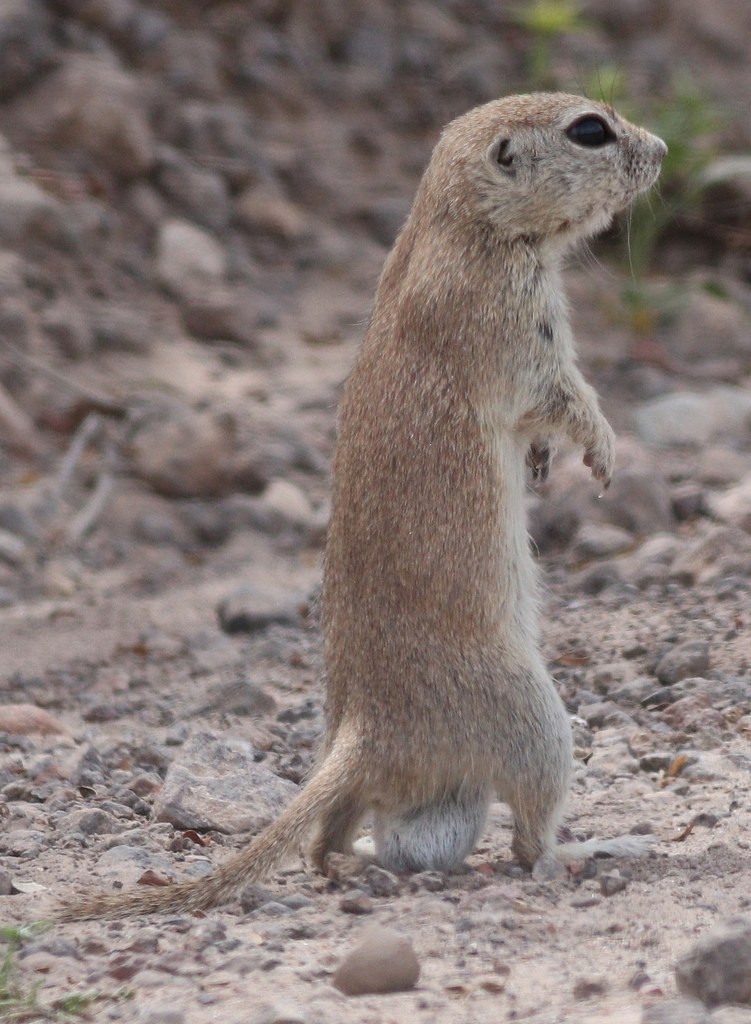
It is a genuinely reliable one. Look for a long, narrow tail that is round in cross section rather than flattened or bushy, and that is sparsely haired. A peer-reviewed genetic study of southern California ground squirrels states the contrast against the nearest look-alike in exactly those terms: the Mohave ground squirrel's tail is relatively short and flat, while the round-tailed ground squirrel's is longer and circular in cross section. The Arizona-Sonora Desert Museum adds that the tail is black-tipped.
The coat is completely unmarked
That separates it from almost everything else in the desert. No stripes, no spots, no flecks, no mottling, and no eye ring. The American Society of Mammalogists monograph describes two color phases in both summer and winter pelage, drab and cinnamon, with a dorsal surface running pinkish cinnamon through ecru drab, more buffy sides, a white belly, dull white sides of the head, and black whiskers. Summer pelage is brighter and coarser than the winter coat, the animal molts twice a year, and older hairs fade under intense sunlight.
Size, exactly
Total length 204 to 278 millimeters, roughly 8.0 to 10.9 inches, including a 60 to 112 millimeter tail, roughly 2.4 to 4.4 inches. Hind foot 32 to 40 millimeters, ear 5.0 to 8.5 millimeters. Body mass swings hard with the season but generally runs 110 to 170 grams, averaging 125 grams, about 4.4 ounces. A sexed series of 17 adults from the Colorado and Imperial valleys gives males a mean total length of 247 millimeters and females 241, so the sexes overlap heavily and size will not tell you which you are looking at.
Two size figures do not fit
Two published size figures do not fit, and both stand as published rather than averaged away. A University of Arizona vertebrate pest paper states adults measure 5 to 6 inches in length including the tail, which cannot be reconciled with the monograph's 8.0 to 10.9 inch total length. The likeliest reading is that 5 to 6 inches is head and body length and the phrase including the tail is an error, since 5 to 6 inches of body plus a 2.4 to 4.4 inch tail lands squarely inside the monograph range. Separately, the Arizona-Sonora Desert Museum gives 6 or 7 ounces, 170 to 200 grams, which sits at and above the top of the monograph's range rather than inside it. The monograph figures are the ones to use, with both outliers noted above.
Mohave ground squirrel, legally
Mohave ground squirrel is the one look-alike with a legal consequence, and it is a serious one. The Mohave ground squirrel is endemic to the western Mojave Desert of California and is state-listed as Threatened under the California Endangered Species Act, first listed as Rare in 1971 and recategorized as Threatened in 1984. It is a congener, it is very similar in external appearance, and the two ranges meet along a contact zone running from Fort Irwin south through the Barstow area and then south along the Mojave River toward Victorville, plus the Hinkley Valley west of Barstow. The tail is the field tell. But the field tell is not always sufficient, and that is the part that matters. In the same study, three animals from the Hinkley Valley identified as round-tailed ground squirrels on the basis of external characteristics were shown by genetic analysis to carry Mohave ground squirrel ancestry, and three animals that looked like Mohave ground squirrels carried round-tailed ancestry. The two hybridize occasionally, at least some hybrids are fertile, and backcrossing runs in both directions. Inside that contact zone, a confident field call based on the tail can still be wrong, and being wrong means taking a state-listed Threatened animal.
Harris's antelope squirrel: the stripe
Harris's antelope squirrel is the everyday confusion in Arizona, and the tell is the stripe. Antelope squirrels carry a white stripe along each side. Round-tailed ground squirrels have no stripe and no spots at all. Habitat helps as a second check: Harris's antelope squirrels prefer rockier ground while round-tailed ground squirrels take lower alluvial fans and open flat valley floors, and Harris's antelope squirrel is the only one of the Sonoran Desert's three squirrels that stays active all year.
Rock squirrel is much larger
It is mottled, and it lives in rock. It is tied to rocky outcrops, boulder piles, and canyon walls, and it is absent from the driest areas of southwestern Arizona, which is exactly where round-tailed ground squirrel is most at home.
California ground squirrel
It is a genuinely different animal with almost no shared ground. It runs 14 to 20 inches total, is mottled brown with white and gray flecking, and carries a distinctive white ring around each eye and a semi-bushy tail. It is a grassland and oak savanna species and is documented as absent from the desert regions of California. Round-tailed ground squirrel is roughly half its length, unmarked, and a low-desert animal.
It is not a prairie dog
It looks like a small prairie dog and is not one. The Desert Museum notes the resemblance and dismisses the relationship in the same breath. Size settles it on sight: an adult round-tailed ground squirrel weighs about 4.4 ounces, while a black-tailed prairie dog is a one to three pound animal of shortgrass and mixed-grass prairie with no low-desert range at all. Older Sonoran Desert field guidance makes the same point about the other common misidentification, that gophers do not forage out on the surface and prairie dogs are much larger.
Pocket gopher: visibility decides
Against a pocket gopher, the animal's visibility decides it. Round-tailed ground squirrels are conspicuously diurnal surface foragers. A pocket gopher is almost never seen above ground. If no animal is in view, the opening answers it: ground squirrel entrances are round and left open, while a gopher mound is crescent shaped with a plugged entrance off to one side.
Signs of Infestation
Open burrows at a shrub base
Open, round, unplugged burrow entrances in flat sandy ground, usually at the base of a shrub. Burrows are frequently sited under creosote. A depth of roughly 3 feet is the only figure found for this species, and it comes from a single museum natural history source rather than from a university, agency, or peer-reviewed account, so treat it as indicative rather than settled. The entrance being left open rather than plugged is the fast separation from pocket gopher workings. Expect several entrances and several animals rather than one of each: this is a semicolonial species that can reach 10 to 100 animals per acre.
The animal upright in daylight
The animal itself, upright, in broad daylight. This is a day-active surface forager, so at a site with any real population the squirrels are the most obvious evidence there is. Activity is bimodal in summer with morning and late-afternoon peaks, and unimodal in fall and spring peaking at midday, and the animals are more active after rain. A 1973 Sonoran Desert study added a useful detail: squirrels ranged widely during the morning bout but seldom moved far from the main burrow entrance during the afternoon bout, when temperatures peaked.
A field test for burrow use
A field test for whether a burrow is actually in use, taken from the researchers who ran the only documented control program on this species. High activity means the entrance is wide open and clean with no debris, a pile of loose soil around it, and squirrel paw prints. Moderate means open but with debris and no loose soil or prints. Low or inactive means filled in or closed, with a large amount of debris, webbing, and firm soil all around. That three-way grading is what lets a property owner tell an active colony from an abandoned one before spending anything.
A single sharp whistle
Most often from a female. The alarm call sends every animal in earshot into a burrow before they turn around and look. Females sound warning whistles more often than males, which researchers attributed to inclusive fitness, since females in a colony are more closely related to their neighbors than males are. It is the most reliable audible sign for this species and it usually means the colony saw you first.
Trip hazards, not structural damage
That is the honest framing. University of Arizona researchers state that burrowing by this species usually does not cause severe damage to people, property, or structures, and is more of an aesthetic concern that may occasionally create trip hazards. That is a meaningfully lighter damage profile than California ground squirrel, whose burrowing is documented to collapse dams and levees, and than pocket gopher.
Where burrowing does matter
Where the burrowing genuinely does matter is buried material. At sites containing buried artifacts or other protected and sensitive features, the same researchers describe burrowing as a more serious concern because it can affect the integrity of delicate structures. That is the one documented situation in which this animal's tunneling is a substantive problem rather than a cosmetic one.
Do not expect it indoors
What you should not expect to find is an animal indoors. No source describes round-tailed ground squirrel entering structures, nesting in wall voids or attics, or living inside a building. This is an outdoor burrowing animal and the fix is always on the outside of the wall.
Snakes where there were no snakes
A productive colony draws predators. University of Arizona researchers name rattlesnakes, coyotes, and feral dogs specifically as part of the human-wildlife concern around this species, and California's account adds gopher snakes, prairie falcons, and house cats. An increase in snake sightings near an active colony is worth taking seriously. One limitation belongs with that: the rattlesnake, coyote, and feral dog wording rests on that single University of Arizona paper, and California's own predator list for this species names gopher snakes rather than rattlesnakes, which is a different animal. Treat it as documented by one source rather than settled by two.
Prevention and When to Call a Pro
Confirm the species in the Mojave
Confirm the species before anything else if you are anywhere in the western Mojave Desert of California, because this is where a mistake has legal weight. The state-listed Threatened Mohave ground squirrel meets round-tailed ground squirrel along a contact zone running from Fort Irwin south through Barstow to Victorville and in the Hinkley Valley, the two are very similar in appearance, and a peer-reviewed genetic study found animals misidentified in both directions on external characteristics alone. If there is any doubt about which squirrel is present, that doubt gets resolved with the California Department of Fish and Wildlife or a licensed operator before a trap is bought.
The Coachella Valley is its own case
The local subspecies, the Palm Springs or Coachella Valley round-tailed ground squirrel, is a Covered Species under a regional multiple-species habitat conservation plan, and California's own account records those populations as restricted to the Coachella Valley in Riverside County and reduced by urbanization, cultivation, and development. Removal questions in that valley belong with the agency, not with a generic control method.
Arizona is permissive, with a catch
Arizona's legal picture is permissive but has a catch worth reading. University of Arizona Cooperative Extension states that certain common species are not protected and can be controlled if they are causing damage, and names ground squirrels among them, controllable by any legal means authorized under Arizona Revised Statutes Title 17, Section 239. Depredation permits for state-regulated species come from the Arizona Game and Fish Department. The catch is the next sentence in that same publication: some species, both protected and non-protected, are subject to release regulations for live-trapped animals. Trapping and driving the animal out to the desert is the step most likely to break a rule. Note also that the extension source addresses ground squirrels as a group and does not name this species individually.
Nevada, stated as reasoning
Nevada's status rests on reasoning rather than on a direct citation. Nevada Administrative Code defines unprotected mammals as every mammal species not classified as game, fur-bearing, protected, sensitive, threatened, or endangered, and no ground squirrel of this genus is enumerated in any of those lists. By elimination that places the species in Nevada's default unprotected category. The code does not name the species. Confirm with the Nevada Department of Wildlife before acting.
Federal status, briefly
No current federal protection applies to the species or to any subspecies. The Coachella Valley subspecies was formerly a candidate for Endangered Species Act listing and was removed from candidate status on November 10, 2010, on the finding that it was more abundant and widespread than previously believed and that threats had been reduced or removed through conservation efforts. The species overall is ranked Least Concern internationally.
Start monitoring in March
Not in June, and not in October. The one documented successful program for this species began monitor trapping early in the active season, in March, specifically to identify active spots and decide where to focus. Because the whole colony is underground from roughly late August or early September to January or February, an effort mounted in autumn is aimed at empty burrows.
Manage the water first
Water is what the desert is not supplying. This species needs food averaging about 80 percent water content in a landscape that gets a few inches of rain a year, and its density tracks winter rainfall directly. The University of Arizona program treated regular monitoring of irrigation to avoid leaks and water pooling in tree basins as a core control measure, and the researchers partly credited a population crash at their site to the loss of adjoining irrigated cropping that had been supplying food and water. A leaking drip line or a chronically wet tree well is a year-round oasis in a desert, and it is the single most correctable thing on most properties.
Clean up what falls
The same program specified prompt disposal of fallen fruits, beans, berries, nuts, and other products of landscape plants so they cannot be used as a food source, plus regular trimming and proper maintenance of landscape trees and shrubs. Mesquite and palo verde litter counts here.
Fill burrows, for two reasons
Fill burrows, and fill them for two reasons. The program listed burrow filling both to reduce the risk of tripping injury and to make new activity detectable. A filled burrow that reopens tells you the colony is still working the area, which a permanently open hole never will.
Consider removing creosote
Do it where it is practical. The program included planned removal of creosote bushes as a favored food and shelter source. Creosote-dominated stands as a whole support lower densities than mixed-shrub stands, so this is a targeted measure around a specific problem area rather than a landscape-wide prescription.
Repellents were actually tested
The results are specific enough to act on. Eleven commercial products were trialed in active burrows against a plain control, scored at 30 and 60 days. Treatments showing consistently little or no activity across all replicates at 60 days were garlic-impregnated clips, predator urine in liquid fox and coyote formulations, and peppermint oil. Neem oil was the worst performer of everything tested, with high activity at every site, and in two cases the sachet was dragged out of the burrow and bitten. Coyote urine granules lost their odor within a month. A solar-powered sonic repeller had no effect at all and was dropped from the trial.
Placement does most of the work
The method is specific. For liquids, soak a cotton ball and secure it in a sachet placed directly inside an active burrow. Spraying the soil does not work, because the product is absorbed, disseminated, or evaporates leaving no trace. For solid formulations, enclose the material in a cloth sachet and place it inside the burrow rather than scattering it on the ground.
The caveats the researchers added
The caveats the researchers themselves attached. The number of treated burrows was too low for statistical significance, efficacy of individual treatments was not conclusive under open field conditions, repellents alone will not manage a high population, they should be combined with regular monitoring and trapping, and effective products must be rotated to avoid the animals habituating to them.
The right goal is not zero animals
In the researchers' own framing: Round-tailed ground squirrels are prominent components of the desert ecosystem, complete eradication may be impossible and unnecessary, and making the habitat unfavorable in multiple ways is the best and most sustainable option. That is a genuinely different objective from zero animals, and it is the one the evidence supports.
One claim that is not supported
It does not hold for this species. Chewing of plastic sprinkler heads and drip lines is well documented for California ground squirrel and appears on plenty of general-audience pages about this species, but no university, agency, or peer-reviewed source documented irrigation line chewing for round-tailed ground squirrel specifically. What is documented for this species is that irrigation leaks and pooled water are an attractant to manage. The distinction is worth keeping.
Call before trapping in the Mojave
Call before trapping anywhere in the western Mojave contact zone or the Coachella Valley. This is the hardest trigger of them all, for the listing and misidentification reasons set out above. It is not a judgment call a homeowner should make from a photograph.
Call for trapping plus relocation
Call for any live trapping that would be followed by relocation, in any state. Arizona applies release regulations to live-trapped animals of both protected and non-protected species, California requires a permit to move wildlife off the property where it was caught, and Nevada's treatment of this species is inferred from the structure of its code rather than stated outright. None of the three is safe to assume.
Call when predators are the problem
Call when the predators have become the problem. Rattlesnakes, coyotes, or feral dogs working a colony next to a house, patio, or play area is a professional situation rather than a weekend project. One caveat, so the safety claim is not overstated: the rattlesnake, coyote, and feral dog wording comes from a single University of Arizona paper, and California's own predator list for this species names gopher snakes, prairie falcons, and house cats instead. One source documents it, not two.
Call for burrowing into artifacts
Call for burrowing into or under buried cultural, historic, or archaeological material, where the damage profile is genuinely different from a nuisance burrow and where chemical options are often unavailable.
Call when they come back
Call when the population comes back after a correctly timed spring effort. The one documented successful program ran for two years with continuous monitoring, trapping, burrow filling, food and water removal, and targeted repellents. A single season of trapping is not what produced that result, and repeating it a third time is usually the wrong response.
Frequently Asked Questions
How do I tell a round-tailed ground squirrel from the other squirrels in my desert yard?
Look at the tail, then look for markings. This animal has a long, narrow, sparsely haired tail that is round in cross section rather than flat or bushy, often with a black tip, and a completely unmarked sandy to cinnamon coat with no stripes, no spots, and no eye ring. Harris's antelope squirrel, the most common Arizona confusion, carries a white stripe along each side. A rock squirrel is much larger, mottled, and tied to rocky ground. A California ground squirrel is roughly twice as long, mottled brown with white and gray flecking, carries a white ring around each eye, and does not live in the desert regions of California. And a pocket gopher is almost never seen above ground at all, which alone rules it out for an animal you are watching in daylight.
Do round-tailed ground squirrels hibernate, or do they sleep through the summer?
Both descriptions are in print, and the honest answer is that the calendar is settled while the label is not. California's own wildlife agency states the animal is dormant from late August or early September to January or February. Animal Diversity Web describes the identical window but says the species does not hibernate and instead enters torpor through the winter months. The Arizona-Sonora Desert Museum splits it into a short summer estivation during the drought, until the monsoon brings new growth, plus winter hibernation with emergence in early February. What all three agree on is the part that matters: this animal goes underground at the hottest, driest point of the year, not at the onset of cold, and reappears in midwinter. The reason is food, not temperature. It needs vegetation averaging about 80 percent water content, and late summer is when the desert stops providing it.
Do round-tailed ground squirrels carry plague?
No source documents a case, and that negative finding is specific rather than assumed. A national survey of plague exposure in western United States wildlife, drawn from samples collected between 2005 and 2018, tested 20 round-tailed ground squirrels by name and found zero positives. That same survey documented exposure across 18 wildlife species and found seropositive animals in every western state, so it was clearly capable of detecting plague where plague was present. What is true is that ground squirrels as a group are documented plague reservoir hosts in the western United States, and that University of Arizona researchers note this species can host fleas and could vector plague or other diseases. That is a statement about capacity, not a case count. Ordinary rodent caution still applies: do not handle live or dead animals, keep pets on flea control, and report an unexplained die-off to public health officials rather than going to look at it.
Are they actually damaging my property, or do they just look busy?
Mostly the latter. University of Arizona researchers state that burrowing by this species usually does not result in severe damage to people, property, or structures, and is more of an aesthetic concern that may occasionally create trip hazards. That is a real difference from California ground squirrel, whose burrowing is documented to weaken and collapse dams and levees, and from pocket gophers. The two situations where it genuinely does matter are trip hazards in walked areas and burrowing into buried cultural or archaeological material. The third real concern is not the squirrel at all. It is what a productive colony attracts, since University of Arizona researchers name rattlesnakes, coyotes, and feral dogs specifically as part of the human-wildlife problem around this species. That one is stated with its limitation: it rests on a single source, and California's own predator list for this species names gopher snakes rather than rattlesnakes.
Why do I suddenly have so many of them this year?
Look at last winter's rain first. Population density in this species is directly correlated with winter rainfall, above-average winter rain increases litter size, and extra rain in December and January advances the whole breeding season, so a wet winter produces earlier and larger litters and a visibly bigger population by spring. Irrigation compounds it. This animal needs forage averaging about 80 percent water content, so a leaking drip line, a chronically wet tree basin, fallen landscape fruit, or an adjoining irrigated field is a year-round food and water supply the surrounding desert cannot match. When University of Arizona researchers ran a control program at an Arizona site, they treated irrigation monitoring and prompt cleanup of fallen fruit as core measures, and they partly credited a population crash from over 1,000 animals to roughly 100 on the loss of adjoining irrigated cropping.
Can I trap them and release them out in the desert?
Not safely, and in places not legally. Arizona applies release regulations to live-trapped animals of both protected and non-protected species, and California requires a permit to relocate wildlife off the property where it was caught. In the western Mojave there is a further problem that has nothing to do with paperwork: the state-listed Threatened Mohave ground squirrel is a close relative that looks so similar to this animal that a peer-reviewed genetic study found squirrels misidentified in both directions on external characteristics alone, including animals field-identified as round-tailed that turned out to carry Mohave ancestry. Confirm the species and the current state rule before moving anything.
Is it true that they eat lizards?
Yes, and it is better documented than most people expect. At a study site southeast of Yuma, Arizona, round-tailed ground squirrels were the primary predator of radio-tagged flat-tailed horned lizards. In 1996, 21 of 54 tagged lizards were killed by predators, and round-tailed ground squirrels accounted for 16 of those 21, with loggerhead shrikes taking three, a kit fox one, and a coachwhip snake one. In 1998 five of 50 tagged lizards were killed, all by ground squirrels. The researchers documented the pattern directly, noting lizards were attacked at the head and that the horns proved an inadequate defense, with cases where the horns had been bitten off or the animal decapitated. California's own state account for the lizard independently reports that about half of known adult mortalities at an Imperial County site were due to ground squirrel predation, and that unusually high lizard survival at another site was attributed to the scarcity of ground squirrel predators there. In that same state account's words, the flat-tailed horned lizard has the smallest range of any horned lizard species occurring in the United States, and it is a California Species of Special Concern, so this is not a trivia item. It is the most consequential ecological fact about the species.
Sources
- Life history account for Round-tailed Ground Squirrel (M074), California Wildlife Habitat Relationships System: California range and elevation, optimum habitats including cropland levees and urban habitat, sandy soil and open flat pattern preference, the creosote density finding, the late August to January or February dormancy window, bimodal and unimodal seasonal activity, home range and density, territoriality, mating and gestation and litter size and weaning and juvenile emergence and dispersal, the winter rainfall reproduction effect, predators, and the Coachella Valley subspecies note California Department of Fish and Wildlife
- Integrated Pest Management Strategies for Round-tailed Ground Squirrels, Proceedings of the 29th Vertebrate Pest Conference, Paper No. 61 (2020): Arizona distribution below 3,200 feet, size and color, sparsely haired tail, matriarchal colonies, March to September active season, the damage and trip hazard assessment, the buried artifact concern, the rattlesnake and coyote second-order risk, the plague vector possibility statement, the full integrated management checklist, site population figures, the eleven product repellent trial with results and placement findings, and the burrow activity grading scheme University of Arizona, Maricopa Agricultural Center and Department of Entomology, with the National Park Service
- Spermophilus tereticaudus, Mammalian Species No. 274 (1987): standard external and cranial measurements, body mass range and average, the two color phases and full pelage description, tail coloration, molt schedule, Lower Sonoran Life Zone habitat and temperature extremes, neonate development milestones, and the growth to adult dimensions figures including the 210 day tail American Society of Mammalogists
- Spermophilus tereticaudus (round-tailed ground squirrel): mass, unmarked pelage, deserts occupied, seasonal diet composition and the 80 percent water content requirement, breeding season and gestation and litter size and neonate mass and weaning and sexual maturity, the torpor rather than hibernation framing with the August or September through January inactivity window, semicolonial organization, seasonal dominance reversal, the female-biased alarm whistle behavior, maximum captive longevity, and IUCN status Animal Diversity Web, University of Michigan Museum of Zoology
- Genetic Structure Across a Contact Zone between Xerospermophilus Ground Squirrels in Southern California, Western North American Naturalist 77(2), 2017: the Mohave ground squirrel California Threatened listing history, the short and flat versus long and round tail distinction, the contact zone geography, documented occasional hybridization with fertile hybrids and bidirectional backcrossing, and the finding that animals identified by external characteristics carried the other species' ancestry Western North American Naturalist, Brigham Young University
- Comparative Ecology of Narrowly Sympatric Horned Lizards Under Variable Climatic Conditions, doctoral dissertation: the Yuma, Arizona radio-telemetry predation data showing round-tailed ground squirrels accounted for 16 of 21 predator kills of tagged flat-tailed horned lizards in 1996 and all five in 1998, the head attack pattern and bitten off horns, the carcass recovered from a squirrel burrow 200 meters from the attack, the predation attribution methodology, and the corrected 0.3 hectare home range figure Utah State University
- Flat-tailed horned lizard (Phrynosoma mcallii) species account, California Amphibian and Reptile Species of Special Concern: independent corroboration that roughly half of known adult lizard mortalities at an Imperial County site were due to ground squirrel predation, the 39 percent Yuma predation figure, and the contrasting low predation site attributed to scarcity of ground squirrel predators California Department of Fish and Wildlife
- Plague exposure in mammalian wildlife across the western United States, Vector-Borne and Zoonotic Diseases 21(9):667-674, 2021: round-tailed ground squirrel (Xerospermophilus tereticaudus) listed among species with zero positive detections at n equals 20, inside a 2005 to 2018 survey that documented exposure across 18 wildlife species in every western state National Institutes of Health, National Library of Medicine (PubMed Central)
- Plague: the sylvatic plague mechanism, key western United States reservoir hosts named at genus level as ground squirrels, prairie dogs, and some chipmunks, Arizona susceptible species context, and homeowner precautions University of Arizona Cooperative Extension
- Managing Wildlife in the Wildland Urban Interface: Arizona legal status, with ground squirrels named among species that are not protected and may be controlled if causing damage under Arizona Revised Statutes Title 17 Section 239, depredation permits available from the Arizona Game and Fish Department, and release regulations applying to live-trapped animals of both protected and non-protected species University of Arizona Cooperative Extension
- Report for Xerospermophilus tereticaudus (TSN 930313) and Xerospermophilus tereticaudus chlorus (TSN 931243): valid name and Spermophilus synonymy, full taxonomic hierarchy including genus Xerospermophilus Merriam 1892, the four recognized subspecies and their common names, and the note that the Coachella Valley subspecies is no longer an Endangered Species Act candidate per the notice of review published at Federal Register volume 75, number 217, pages 69222 to 69294, November 10, 2010 Integrated Taxonomic Information System (ITIS)
- Species profile for Palm Springs round-tailed (Coachella Valley) ground squirrel: current federal listing status U.S. Fish and Wildlife Service, Environmental Conservation Online System
- Coachella Valley Multiple Species Habitat Conservation Plan covered species list, naming Palm Springs round-tailed ground squirrel Xerospermophilus tereticaudus chlorus as a Covered Species California Department of Fish and Wildlife
- Ground Squirrels, from A Natural History of the Sonoran Desert Arizona-Sonora Desert Museum
- Home Range and Daily Activity of the Round-tailed Ground Squirrel, Spermophilus tereticaudus neglectus, American Midland Naturalist 89:287-293 (1973) American Midland Naturalist, University of Notre Dame
- Nevada Administrative Code Chapter 503, section 503.035 unprotected mammals definition, read alongside the enumerated game (503.020), fur-bearing (503.025), and protected, sensitive, threatened and endangered (503.030) mammal sections Nevada Legislative Counsel Bureau
- Small Mammals of the Boulder City Conservation Easement: Xerospermophilus tereticaudus listed among targeted species known or likely to occur based on a 2018 survey, supporting southern Nevada occurrence Clark County, Nevada
- Taxon page for Xerospermophilus tereticaudus: current taxonomy, the note that the species was moved to Xerospermophilus from Spermophilus, and United States subregion distribution across Nevada, Arizona, and California Mammal Diversity Database, American Society of Mammalogists
Image Credits
- Image: Jan Ebr & Ivana Ebrová via iNaturalist. CC BY 4.0.