Seasonal Timeline
Western patch-nosed snakes are day-active and out in the open, with a broad season running March into October. California's two state accounts both put the peak in May and June; no Southwest source names a peak month at all, and Arizona accounts instead describe the snake as out earlier in the spring and later in the fall than the other snakes around it. Whether it goes dormant depends on where you are: high and cold sites see a real winter shutdown, while low desert and coastal southern California produce surface records in almost every month of the year.
Western patch-nosed snakes are day-active and out in the open, with a broad season running March into October. California's two state…
Three sources describe the winter differently, and all three are right about different ground. An Arizona-wide account states the species hibernates during late fall and winter. A museum account says it is active in the daytime year round in warmer climates, and gives an early April to early November season only in milder ones. California's own life history account says snakes may be active all year in the southern part of the state in mild to warm weather. Those are three points on an elevation and latitude gradient rather than a genuine disagreement, but a reader who finds all three deserves to be told that instead of handed one of them.
The month-by-month record is unusually good for a snake this poorly studied. In the Tucson region, this species has been found in every month of the year except January, and it is specifically noted for basking and being active earlier and later in the year than the other snakes around it. In coastal southern California, specimens appear in the published literature in every month except January and February, and federal pitfall trapping between 1995 and 2011 filled even that gap with three January captures and one February capture. Warm and presumably active animals have been found under stones in Ventura County between January and March. Animals found in December and January inside gopher burrows and woodrat nests were cold and presumably dormant.
May and June is the window that matters, and the evidence for it is specifically California. Both California state accounts name those two months independently. No published Southwest source names a peak month at all, so the peak stands as a California finding rather than one extended across the range. It does line up with the breeding calendar: mating April to June, gravid females found May through August, eggs incubating about 85 days in the one laboratory record that exists, and hatchlings appearing from July into October.
Where They're Found
Its range covers two regions: the Southwest and California. The California part of the range rests on two California state agency sources and three federal park records.
Arizona is the core of the range. An Arizona-wide account puts the species across southern Arizona below the Mogollon Rim, along the western edge of the state, and through the northern plateau deserts, running from near sea level on the Colorado River up to about 6,500 feet, in everything from flatlands and low valleys to rocky bajadas, foothills, and mountain slopes. Federal park species records back that up across the state, at Saguaro, Organ Pipe Cactus, Grand Canyon, Chiricahua, Tonto, Tumacacori, Montezuma Castle, Tuzigoot, Walnut Canyon, and Wupatki.
Nevada and Utah are confirmed through federal park records and, for Utah, through the state's own rulebook. Federal records place the species at Lake Mead National Recreation Area and Tule Springs Fossil Beds National Monument in Nevada, and at Zion National Park, Glen Canyon National Recreation Area, and Rainbow Bridge National Monument in Utah. Utah names the species by its full scientific name in its own reptile and amphibian possession rules, which is independent confirmation the state treats it as a Utah animal. Range summaries run the species as far north as northwestern Nevada.
New Mexico is claimed, with a caveat attached. Federal park records list the species at Carlsbad Caverns National Park and White Sands National Park. Both rest on the older treatment of the Big Bend form as a subspecies of this species. If the 2021 revision described below holds, New Mexico's animals belong to a different species and this state needs re-checking.
California is a real addition, not a rounding of the map. The state maintains a full life history account describing the species as widely distributed through the lowlands of southern California from the coast to the eastern border, up to 2,120 meters, about 7,000 feet, ranging north through desert habitats in Owens Valley and reaching the vicinity of Honey Lake in Lassen County. A separate state species assessment covers the coastal form from Ventura and Los Angeles Counties south to the Mexican border, from sea level up to 2,130 meters. Federal park records add Death Valley National Park, Joshua Tree National Park, and Mojave National Preserve. Joshua Tree's own reptile list is precise about which form is where: the Mojave patch-nosed snake is rated common on sandy valley floors in the park's northern section, while the desert patch-nosed snake is rated rare in creosote bush scrub and desert washes in the southern section.
Texas is deliberately left off, and the reason is a live taxonomic dispute. A federal park record does list this species at Big Bend National Park in Texas. That record depends on treating the Big Bend patch-nosed snake as a subspecies of Salvadora hexalepis. A curated taxonomic database, following a 2021 morphological revision of the genus, treats it instead as a separate species, Salvadora deserticola. Arizona-facing sources still list it as one of three Arizona subspecies. If the revision holds, this species does not reach Texas at all, and it has no South Central presence. The same uncertainty is why the New Mexico claim above carries a caveat.
Subspecies counts do not agree either. The federal taxonomic record lists three: the desert, Mojave, and coast patch-nosed snakes. The curated taxonomic database lists four, adding Klauber's patch-nosed snake of Baja California. Arizona sources list three for Arizona alone, including the Big Bend form. None of that changes which snake is in your yard, and the enlarged nose scale identifies all of them.
Habitat splits by form, which is worth knowing before you go looking. The desert forms are open-country animals: creosote bush flats, Sonoran desertscrub, washes, sandy flats, rocky bajadas, grassland, sagebrush, and pinyon-juniper woodland as high as 7,000 feet. The coastal California form is the opposite, showing an apparent preference for brushy chaparral. One historical survey located 35 specimens in heavy brush and chaparral, more than in all other habitat types combined, and unpublished state data describe a preference for chamise and red shank with the snake often basking at or near the tops of bushes. Same species, genuinely different cover, and it changes what advice makes sense in each region.
Everywhere else is out. No published source places this species in the Mountain West, the Midwest, the Northeast, the Southeast, or the Pacific Northwest. It is a warm-desert animal of the southwestern United States, northwestern Mexico, and Baja California, including several Pacific and Gulf of California islands.
Related Pests
Life Cycle
Four sources give four different clutch figures. California's state life history account gives an average of 5 to 6 eggs, sourced to a 1970 survey of reptile reproductive cycles. A Tucson-region account gives 3 to 10. A museum account gives 4 to 10. A standard western field guide gives 4 to 12, and an Arizona-wide account says up to 12. Roughly 4 to 10, averaging 5 or 6, covers all of them without inventing a figure nobody measured.
Two gaps are left visible on purpose. No lifespan figure and no age at sexual maturity was found for Salvadora hexalepis in any published source, and neither is filled in from a related species. Females are also documented as not necessarily reproducing every year, which makes any tidy annual-cycle summary misleading.
This is a poorly studied animal and the state that studies it most says so directly. California's 2016 assessment describes the coastal form as exceedingly poorly known, states that its eggs have never been described, that its diet has never been described, that its movement ecology is unknown, and that no genetic analysis of the subspecies has ever been undertaken. Much of what appears above is drawn from other populations and other members of the genus on the assumption that the life history is similar. That assumption is reasonable. It is still an assumption, and it is the reason the numbers above are hedged.

Courtship and mating
Egg
Hatchling
Adult
Identification
The nose scale and the back stripe
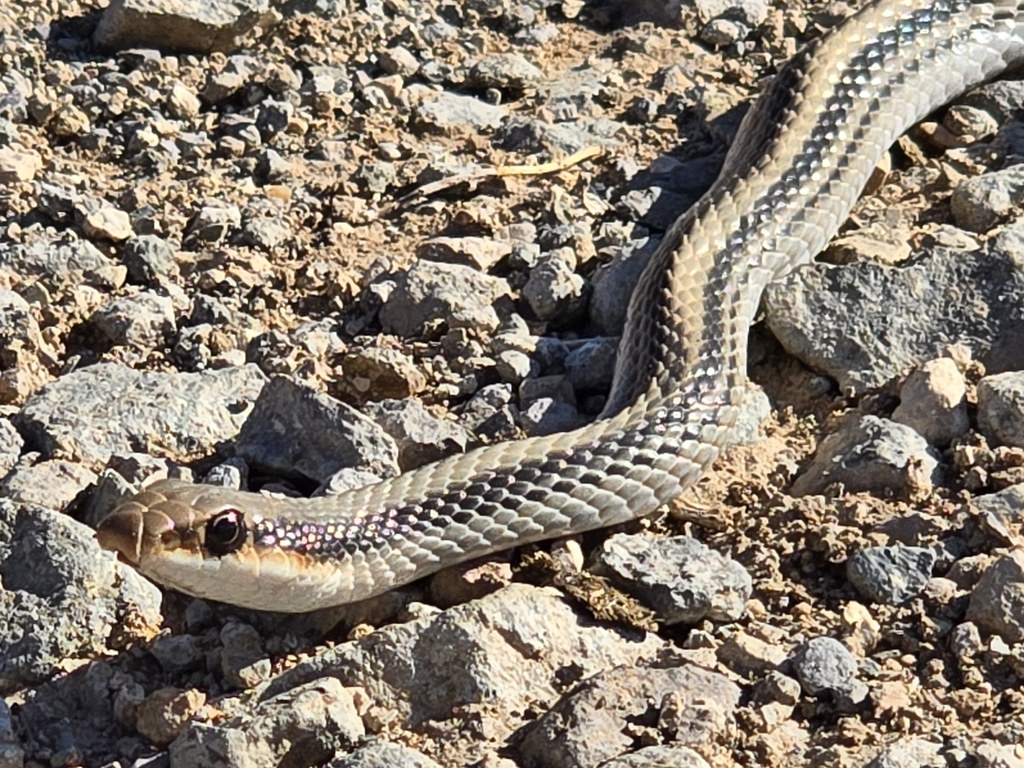
Together they are the identification, and it takes one look. Western patch-nosed snake carries a large, triangular scale over the tip of its snout that curves back over the top of the nose and has free lateral edges lifting away from the surrounding scales. California's own species assessment states that a conspicuously enlarged rostral scale together with a stripe down the middle of the back is enough to separate this snake from every other snake in its range. That is a stronger claim than most identification guides are willing to make, and it comes from a state agency.
Smooth scales, divided anal plate
Smooth scales, 15 to 17 rows at midbody, and a divided anal plate. Run these as the confirmation. There is one exception worth knowing: adult males carry keeled scales at the base of the tail and above the vent, so a keeled patch back there does not rule this species out. Everywhere else on the body the scales are smooth.
The stripe pattern
Pattern: a pale stripe down the spine, a wide dark stripe on each side of it, and a thinner dark stripe lower down. Ground color runs tan, cream, or straw. The lower side stripe sits on the seam between the third and fourth scale rows counting up from the belly, which is a specific enough landmark to check. The belly is pale cream, often washed pink, peach, or faint orange. In the coastal California form the middle stripe is narrower, only 1.5 to 2 scale rows, the sides are dark brown, and the head is olive or brown rather than gray.
Large eyes and round pupils
This is a visually hunting, day-active snake, and the eye size shows it. There is no facial pit and no rattle.
Whipsnakes and racers
They are the confusion that actually happens, and speed is the weak way to tell them apart. Both are fast, alert, day-active snakes, and the striped whipsnake is striped as well, so it shares range and pattern, not just speed. Neither has the enlarged, free-edged nose scale. Size helps as a second check: a patch-nosed snake tops out near 40 inches while a coachwhip commonly runs longer. A museum account puts the behavioral overlap honestly, saying that much like a whipsnake this snake moves quickly on the ground and may climb into the lower branches of vegetation. The overlap is real. The nose scale settles it.
The in-genus look-alike
Eastern or mountain patch-nosed snake is the in-genus look-alike, and the two do occur together. The eastern species has solid, straight-edged dorsal stripes and usually no side stripe, against this species' irregular, jagged, mottled stripe edges plus a distinct side stripe. The scale-level confirmation is the chinshields: in the eastern species the front edges of the rear chinshields are separated by one small scale or none, against two to three in the western species. The two can turn up together on upper bajadas and lower mountain slopes in southeastern Arizona, so this is not a theoretical pairing.
Gartersnakes, and two checks
Gartersnakes are striped and about the same size, and two checks separate them. A gartersnake has keeled dorsal scales, each carrying a raised central ridge, and no enlarged nose scale. A patch-nosed snake has smooth scales and the patch. Texture and snout, in that order.
Another snake has that nose scale
One other Southwest snake has an enlarged nose scale, and it is worth knowing before you over-apply the rule. The spotted leaf-nosed snake also carries an enlarged rostral. It is blotched rather than striped, strictly nocturnal, and much smaller, reaching only about 51 centimeters, 20 inches. If the animal is spotted, out at night, and short, the nose scale is not telling you what you think it is.
This is not a rattlesnake look-alike
A patch-nosed snake is slender, striped, smooth-scaled, round-pupiled, and has no rattle and no facial pit. It performs no rattlesnake mimicry of any kind: no head flattening, no tail buzzing, no loud hiss. The one rule that still applies here applies everywhere: a visible segmented rattle on a short blunt tail means rattlesnake, and anything you cannot verify from a safe distance should be treated as one.
Both spellings, one animal
Both scientific spellings you may see are the same animal. Salvadora hexalepis is the accepted name. The species name is Greek, hex for six and lepis for scale, referring to the sixth upper labial scale reaching the eye in the original type specimen. Older literature also places some of these animals in Phimothyra.
Signs of Infestation
There is no infestation to find
This snake builds no nest, forms no colony, leaves no droppings sign, causes no damage pattern, and produces no odor. What follows is how you would know one is around, not how you would find a problem.
A fast striped snake at midday
A fast, slender, striped snake crossing open ground in the middle of the day. That combination is most of the identification. This species is often seen sunning on roads in the early morning and is active in daylight even in extreme heat. A striped snake moving fast at 2 in the afternoon in the desert is far more likely to be this or a whipsnake than anything nocturnal.
Moving through brush above ground
A snake moving through low brush above ground level. It climbs readily and has been found foraging in brush off the ground, and in coastal California it is described as often basking at or near the tops of bushes. That is not typical behavior for most of the ground snakes it gets confused with.
Whiptail lizards on the property
This is the most useful and most species-specific sign to look for. California's own assessment says members of this complex feed nearly exclusively on whiptails. If the yard supports a whiptail population, it supports exactly the prey base this snake specializes on, and that is the reason it is there.
You will hear nothing
No hiss, no tail buzz, no vocalization of any kind is described for this species in any published source. That is a genuine contrast with the gopher snake, where the sound is the headline.
You will smell nothing
No musk or odor sign is described for this species anywhere.
What is absent is informative
What is absent is as informative as what is present. No burrow it dug itself, since it uses other animals' burrows and rock crevices for shelter. No structural damage, no gnawing, no attic or wall-void activity, no droppings accumulation. Noise or smell coming from inside a wall, attic, or crawl space is a different animal entirely, quite possibly one of the rodents this snake occasionally eats.
Prevention and When to Call a Pro
Leave it alone
The correct default is to leave it alone, and in one of its two regions there is a conservation reason on top of the practical one. This snake is non-venomous, causes no property damage, does not enter structures, and eats lizards. In coastal southern California it is additionally a state Priority 2 Species of Special Concern in documented decline.
The lever is the lizards
If you want fewer sightings, the lever is the lizard population, not the snake. This is the specific prevention step for this species rather than a generic one, because the diet is so narrow. California's assessment says members of this complex feed nearly exclusively on whiptail lizards and take other small lizards mainly when they are moving fast. Open, sunny, sparsely vegetated ground with loose soil is whiptail habitat, and therefore patch-nosed snake habitat. Weigh that against the fact that the whiptails themselves are in decline in coastal California, where both of the local species are already on state watch or special concern lists.
Do not clear brush in coastal California
Do not clear brush reflexively in coastal southern California. This is the one place where the standard snake-prevention advice is actively wrong for this animal. The coastal form prefers chaparral and coastal sage scrub, and conversion of that brush to grassland, driven by development and by increasingly frequent and intense wildfire, is named by the state as the leading cause of its decline. Climate models for 2070 project a 38 to 44 percent decrease in the chaparral and coastal scrub habitat this snake depends on.
Exclusion works, barely needed
Structural exclusion works but this species barely needs it. No published source documents this snake entering a building. If you want a general snake barrier anyway, quarter-inch hardware cloth, sealed foundation cracks, door-bottom flashing, and garage weather stripping all work against snakes as a group.
Herd it out, do not pick it up
If one is in a garage or an enclosed space, herd it out; do not pick it up. It is described as docile, but it will thrash wildly if handled. A broom and an open door is the method. There is no venom risk, but there is no reason to take a bite from any wild animal either.
Arizona, four a year
Arizona: a hunting or combination license is required, and the limit is four a year. Salvadora is not among the species named as exceptions in the current Commission Order, so it falls under the general reptile rule: season open January 1 through December 31 statewide subject to area closures, bag and possession limit four per year of each species, live or dead.
Utah names this snake
The allowance is tight. The western patch-nosed snake appears by its full scientific name in the state's limited possession category: 2 daily and yearly, with 4 in total possession, per species. Before removing any reptile from the wild in Utah you must complete the state's reptile and amphibian orientation course and hold a collection permit or certificate of registration, and there is a mandatory reporting requirement afterward.
Nevada is permissive by default
Nevada has no species-specific rule, and the default is permissive. The state administrative code names its protected reptiles individually, the Gila monster, northern alligator lizard, Mojave fringe-toed lizard, rosy boa, Sonoran mountain kingsnake, western pond turtle, and desert tortoise, then states that all reptile species not classified as protected, sensitive, threatened, or endangered are unprotected. Patch-nosed snake appears on none of those lists. A permit is still required to collect unprotected wildlife for commercial purposes.
California and New Mexico are gaps
California and New Mexico are both gaps in the record. California's Priority 2 Species of Special Concern designation is a conservation status, not a take prohibition by itself, and no California take regulation naming this species could be verified. No New Mexico reptile collection rule was retrieved at all. In either state, check with the state wildlife agency before catching, holding, or moving one, rather than assuming Arizona's or Nevada's treatment carries across.
Call if you cannot identify it
Call a professional when a snake cannot be confidently identified from a safe distance and it is somewhere people or pets use. That is the standing rule for every Southwest snake, and it is the only threshold that genuinely matters for this species. Do not call to have this animal removed from a yard on identification alone.
Call for one that will not leave
Call as well for a snake inside living space that will not leave on its own. And if you are getting repeated sightings, the more useful call is about the prey, not the snake. A property that keeps producing patch-nosed snakes is a property with a healthy lizard population, and that is the thing to survey.
Frequently Asked Questions
Is a western patch-nosed snake venomous?
No. It is a non-venomous colubrid, described in the literature as docile, and no published source reports any human injury from one. There is one nuance worth handling honestly rather than skipping: snakes in this genus have enlarged rear teeth, and California's own species assessment notes this suggests they may envenomate their prey. The saliva has never been studied. The only supporting observation on record is a single whiptail lizard that died shortly after being bitten by a Baja California patch-nosed snake. That is a prey-capture hypothesis about a lizard resting on one observation, not a human-risk finding, and no medical concern of any kind is attached to this species.
What is the big scale on its nose actually for?
Nobody has fully proven it, and the sources split two ways. A museum account states the enlarged rostral scale is useful for burrowing in loose sandy or rocky ground in search of food, and that the snake locates reptile eggs by scent and uses its nose to unearth them. A Tucson-region account says the same thing directly, that it uses the scale to unearth reptile eggs and other buried prey. But California's 2016 species assessment hedges: the scale may be an aid for digging and possibly a specialization for feeding on lizard eggs, and that behavior has never been described in the coastal population at all. A California reference site uses the same hedge, calling it thought to be useful. There is one related observation on the record: a patch-nosed snake in San Bernardino County was watched forcefully ramming its head into the dirt at the base of a creosote bush, opening a small hole and crawling in, after which a rodent bolted from a different hole under the same bush. So the snout does get used as a digging tool. Whether egg-digging specifically is what it evolved for is still open.
What does a patch-nosed snake eat?
Mostly lizards, and probably whiptails in particular. California's assessment says members of this complex feed nearly exclusively on whiptails and take other small lizards mainly when the lizards are moving rapidly, which is an unusually specific thing to know about a snake's hunting. Reptile eggs, including the eggs of other snakes and of lizards, are a real and genuinely unusual part of the diet, but they are not the majority of it. Small mammals including kangaroo rats and mice, grasshoppers, small snakes, and nestling birds fill out the list. It does not constrict. It throws loops of its body on top of prey to pin it down, which is a different mechanism from the constriction used by gopher snakes and kingsnakes.
I saw a fast striped snake in the desert in the middle of the day. Was it a whipsnake or a patch-nosed snake?
Look at the snout, not the speed. Both are fast, alert, day-active, striped snakes, and speed alone will not separate them; the striped whipsnake shares Southwest range and longitudinal striping too. The patch-nosed snake has a large triangular scale on the tip of its nose with edges lifting free of the surrounding scales, which no whipsnake or racer has. Size is a useful second check: a patch-nosed snake tops out around 40 inches, while a coachwhip commonly runs longer than that.
How do I tell one from a gartersnake?
Two quick checks. A gartersnake has keeled dorsal scales, each with a raised ridge running down the middle, giving the animal a rough, matte look. A patch-nosed snake has smooth scales in 15 to 17 rows at midbody. And a gartersnake has no enlarged nose scale. Texture first, then snout.
Should I get rid of one in my yard?
There is no reason to. It is non-venomous, causes no property damage, does not enter structures, does not gnaw, does not nest in walls, and eats lizards. In coastal southern California there is an additional argument against it: the local form is a state Priority 2 Species of Special Concern, scoring 46 out of a possible 85 in the state's own 2016 assessment. Federal pitfall trapping in San Diego, Orange, and Los Angeles Counties between 1995 and 2011 recorded it as 2.6 percent of snake captures, 123 out of 4,680, against 3.8 percent in daytime road records from a 1939 survey, which the state reads as a moderate decline over sixty years. It has disappeared from large parts of the Los Angeles basin and has not been re-documented at Torrey Pines State Park despite intensive trapping.
Is it legal for me to catch or keep one?
It depends entirely on the state, and the answers are not close. Arizona requires a hunting or combination license and sets the general reptile limit that covers this species at four per year, live or dead. Utah names it specifically under limited possession, 2 daily and yearly with 4 in total possession, and requires an orientation course plus a collection permit before anything is removed from the wild. Nevada classifies it as unprotected by default, because it is not named on any protected list. No New Mexico rule could be found, and no California take regulation naming this species was verified, so check with the state wildlife agency in either of those two rather than assuming.
Why is this snake so hard to get a good look at?
Because it may be built to be active in heat that shuts other snakes down. It is fast, it is alert, and it has acute vision that lets it escape before you get close, which one reference notes makes it difficult to observe or capture during the heat of the day. California's own assessment goes further, describing the species as probably active at higher temperatures than most other diurnal colubrids, citing a 1971 laboratory study of temperature physiology in this exact snake. The ecological reading of that study in the secondary literature is that this species and the coachwhip carry the highest preferred and upper critical body temperatures of any snakes tested, which would let the patch-nosed snake be out hunting before and during the activity window of the fast, hot-running whiptail lizards it eats. The state agency's hedged version is the safer working claim.
Sources
- Western Patchnose Snake (Salvadora hexalepis), A Natural History of the Sonoran Desert: size, the patch-like rostral scale, striping, male tail keeling, year-round daylight activity in warm climates against an April to November season in milder ones, the rostral scale used for burrowing in sandy and rocky ground, locating reptile eggs by scent and unearthing them with the nose, non-constricting prey capture by throwing body loops, whipsnake-like speed and shrub climbing, thrashing when picked up, 4 to 10 eggs, and 11-inch hatchlings Arizona-Sonora Desert Museum
- Life history account for Western Patch-nosed Snake (R055), California Wildlife Habitat Relationships System: California distribution to 2,120 m (7,000 ft), Owens Valley and Honey Lake, habitat list, opportunistic feeding on whiptails, banded geckos, kangaroo rats and the eggs of lizards and snakes, opportunistic cover use in bushes, rock crevices and other animals' burrows, diurnal activity with a May and June peak, possible year-round activity in southern California, April to June mating, clutches averaging 5 to 6, gravid females May to August, and 85-day laboratory incubation California Department of Fish and Wildlife, California Interagency Wildlife Task Group
- Coast Patch-nosed Snake (Salvadora hexalepis virgultea) account, California Amphibian and Reptile Species of Special Concern (Thomson et al. 2016): Priority 2 designation scoring 46 of 85, the enlarged rostral plus middorsal stripe as diagnostic against every other snake in range, subspecies and spotted leaf-nosed snake comparisons, March to October activity with a May and June peak plus winter records, late April breeding with hatchlings mid-July to October and the possible second clutch, eggs never described, whiptail specialization and prey selection by rapid movement, the hedged rostral-scale-as-egg-digging statement, enlarged rear teeth and unstudied saliva, activity at higher temperatures than most diurnal colubrids, chaparral and coastal sage scrub preference and bush-top basking, elevation to 2,130 m, the 1995 to 2011 pitfall figures of 123 of 4,680 captures against 3.8 percent in 1939 road records, decline in the Los Angeles basin and non-detection at Torrey Pines, and road mortality, habitat conversion and wildfire as named threats California Department of Fish and Wildlife
- Western Patch-nosed Snake species account: total length under 1,168 mm, the large triangular free-edged rostral scale, posterior chinshields separated by 2 to 3 scales, smooth dorsal scales in 15 to 17 midbody rows, divided anal plate, the Eastern Patch-nosed Snake and gartersnake distinctions, terrestrial and diurnal habits with records in every month except January, 3 to 10 eggs in June or July, hatchlings 210 to 280 mm, females not reproducing every year, active foraging on lizards, small snakes, reptile eggs, rodents and grasshoppers, the rostral scale used to unearth reptile eggs and other buried prey, and IUCN Least Concern Tucson Herpetological Society
- Western Patch-nosed Snake (Salvadora hexalepis), The Reptiles and Amphibians of Arizona: total length to 1,014 mm (40 inches), tan or cream ground color with two wide irregular-edged dark dorsal stripes plus a thin side stripe on the third-to-fourth scale row seam, enlarged triangular protruding rostral scale, large eyes with round pupils and smooth scales, the Eastern Patch-nosed Snake straight-edged-stripe distinction, Arizona distribution below the Mogollon Rim to about 6,500 feet, habitat from flatlands to mountain slopes, diurnal alert and fast-moving behavior with late fall and winter hibernation, diet of lizards, mice and other small mammals, reptile eggs and birds, spring mating with up to 12 eggs and July hatching, and the three Arizona subspecies Reptiles and Amphibians of Arizona, by Thomas C. Brennan
- Desert Patch-nosed Snake (Salvadora hexalepis hexalepis): the enlarged rostral scale described as thought to be useful in excavating buried lizard eggs, the 2013 Herpetological Review 44(2) field note describing a snake in San Bernardino County ramming its head into dirt at the base of a creosote bush to open a hole and pursue a rodent, diurnal activity even in extreme heat, acute vision making the snake difficult to observe or capture, shrub climbing, burrowing into loose soil, enlarged rear teeth, diet of mostly lizards especially whiptails, 4 to 12 eggs between May and August per Stebbins 2003, 9 upper labials with usually only the sixth reaching the eye, and the etymology of hexalepis CaliforniaHerps
- Patch-nosed Snakes found in California, identification key: the three California subspecies compared on head color, middorsal stripe width, loreal scale division and upper labial contact with the eye, the enlarged rostral as the genus-level mark, and the note that this fast-moving snake is active in daytime in deserts, grassland, sagebrush and pinyon-juniper and is often seen sunning on roads in the early morning CaliforniaHerps
- Salvadora hexalepis taxonomic record: family Colubridae and subfamily Colubrinae, the diagnosis including the well-developed rostral scale with free lateral edges, 9 supralabials with the sixth usually contacting the eye, 180 to 213 ventral scales, 75 to 103 subcaudals and a tail 20 to 26 percent of total length, the subspecies hexalepis, mojavensis, klauberi and virgultea, and the treatment of deserticola as a separate species following the 2021 morphological revision of the genus The Reptile Database
- ITIS Report, Salvadora hexalepis (Cope, 1867), TSN 174271: valid taxonomic status, full classification through Squamata, Serpentes, Colubridae and Colubrinae, the Spanish common name Culebra-parchada de cabestrillo, and the three accepted subspecies hexalepis, mojavensis and virgultea Integrated Taxonomic Information System
- NPSpecies profile for Salvadora hexalepis: the National Park Service units holding records for this species, including Death Valley, Joshua Tree and Mojave National Preserve in California, Saguaro, Organ Pipe Cactus, Grand Canyon, Chiricahua, Tonto, Tumacacori, Montezuma Castle, Tuzigoot, Walnut Canyon and Wupatki in Arizona, Lake Mead and Tule Springs Fossil Beds in Nevada, Zion, Glen Canyon and Rainbow Bridge in Utah, Carlsbad Caverns and White Sands in New Mexico, and Big Bend in Texas, with the Mojave National Preserve record listing both the hexalepis and mojavensis subspecies National Park Service, Integrated Resource Management Applications
- Reptiles, Joshua Tree National Park: the Mojave Patch-nosed Snake rated common on sandy valley floors in the park's northern section, and the Desert Patch-nosed Snake rated rare in creosote bush scrub and desert washes in the southern section U.S. National Park Service
- Reptiles, Death Valley National Park: Desert patch-nosed snake recorded in rocky and sandy areas from the lower slopes and washes up to Towne Pass U.S. National Park Service
- Species tables for Utah's reptiles and amphibians: Western patch-nosed snake (Salvadora hexalepis) named by binomial in the limited possession table at 2 daily and yearly with 4 in total possession per species, alongside the prohibited, non-controlled non-native, non-controlled native, and controlled standard categories Utah Division of Wildlife Resources
- Overview of Utah's reptiles and amphibians: the requirement to complete a reptile and amphibian orientation course and obtain a collection permit or certificate of registration before collecting or possessing, and the mandatory reporting requirement Utah Division of Wildlife Resources
- Arizona Reptile and Amphibian Regulations 2026 through 2030, Reptiles Commission Order 43: hunting or combination license required for take of reptiles, general reptile season open January 1 through December 31 statewide subject to area closures, and a bag and possession limit of four per year of each species live or dead for all reptiles other than those specifically named in Subsections B, C, D and E, none of which name Salvadora Arizona Game and Fish Department
- Nevada Administrative Code Chapter 503, NAC 503.080: the named list of protected reptiles including the Gila monster, northern alligator lizard, Mojave fringe-toed lizard, rosy boa, Sonoran mountain kingsnake, western pond turtle and desert tortoise, and the provision that all reptile species not classified as protected, sensitive, threatened or endangered are unprotected, plus the commercial collection permit requirement at NAC 503.095 Nevada Legislature
- Jacobson, E. R., and Whitford, W. G. 1971. Physiological responses to temperature in the patch-nosed snake, Salvadora hexalepis. Herpetologica 27:289-295. Long Term Ecological Research Network bibliography
- Western Patch-nosed Snake (Salvadora hexalepis) species profile: federal taxonomic record confirming the accepted scientific name, the alternate common name Western Patchnose Snake, and the absence of any federal listing status U.S. Fish and Wildlife Service
- Salvadora hexalepis, Amphibian and Reptile Atlas of Peninsular California: the species described as occurring from western Texas to California and from northwestern Nevada to southern Sinaloa, present through southern California and the Baja California peninsula and on islands in the Pacific and the Gulf of California, and identified as non-venomous San Diego Natural History Museum
Image Credits
- Image: photographer not named via iNaturalist. CC0 1.0.
License.