Seasonal Timeline
Coachwhips are strictly daytime hunters, emerging from winter dormancy around mid-March and staying active into November, with a shift from midday activity in spring to a late-morning and late-afternoon split once summer heat sets in.
Coachwhips are strictly daytime hunters, emerging from winter dormancy around mid-March and staying active into November, with a shift from…
Coachwhips emerge from winter dormancy in rodent burrows around mid-March. Early-season activity is concentrated at midday, then expands through spring into a late-morning and late-afternoon split once summer heat makes midday activity impractical. Dormancy begins again in mid to late November. A museum-specimen study of 145 individuals found the male reproductive cycle running April through November and the female season typically April through July, with mating in spring to early summer.
Clutch size is reported somewhat differently across sources, and each figure stands as published: a University of Georgia account gives 4 to 24 eggs on average, a 145-specimen museum study found 2 to 12 eggs with a mean of 7.2 (typically 4 to 20), and a Kansas field guide states 3 to 24. Eggs are laid in warm, dry substrate such as sandy soil or small-mammal burrows, roughly June through July, with incubation running about 76 to 79 days. Hatchlings emerge from late summer into fall, with sources giving July through September depending on region, measuring about 11 to 14 inches at hatching. There is no parental care after hatching, and published accounts consistently describe a single annual clutch, not multiple broods in one season.
Where They're Found
The coachwhip's accepted scientific name is Coluber flagellum (Shaw, 1802), per the Reptile Database and the Integrated Taxonomic Information System. Three recognized US subspecies carry their own common names and occupy different parts of the range: the Eastern Coachwhip (C. f. flagellum) across the Southeast and into the Midwest, the Western Coachwhip (C. f. testaceus) through Texas and the South Central states, and the Red Coachwhip, also called the Red Racer (C. f. piceus), across the Southwest and into California, with a fourth California-only form, the San Joaquin Coachwhip (C. f. ruddocki), in the state's central valley.
This species is one of the most broadly distributed snakes in the southern and central United States. Beyond the Southwest, its range is confirmed by six separate state wildlife agencies and university herpetology programs: the California Department of Fish and Wildlife's own species account places it across southeastern California's deserts and the San Joaquin Valley; Texas Parks and Wildlife documents it as a Texas mainstay and one of the fastest snakes in the state; the Tennessee Wildlife Resources Agency and the University of Georgia's herpetology program place the Eastern Coachwhip subspecies from North Carolina south through Florida; the Missouri Department of Conservation and the Kansas Herpetofaunal Atlas (Fort Hays State University) confirm it across the southern half of Missouri and into Kansas; and Colorado Parks and Wildlife documents it across southeastern Colorado generally below 6,000 feet elevation. Reptile Database's distribution listing further confirms Oklahoma, Arkansas, and Louisiana as part of the same South Central population.
Documented state-level records cover California and the four Southwest states; southeastern Colorado in the Mountain West; Texas, Oklahoma, Arkansas, and Louisiana in the South Central region; the southern half of Missouri and eastern Kansas in the Midwest; and North Carolina south through Florida plus Alabama and Mississippi in the Southeast. Wyoming, Montana, Idaho, the eastern and northern Midwest, Tennessee, Kentucky, Virginia, and West Virginia carry no established coachwhip population.
No published record places the coachwhip in Alaska or Hawaii, and none would be expected. This is a warm-climate, open-country and desert specialist bounded by the continental Sun Belt and northern Mexico, and Hawaii has no native snake species of any kind.
Life Cycle
One clutch a year, and a genuinely wide range. Every available source describes a single annual clutch, with hatchlings emerging from late summer into fall and no second wave later in the season. Clutch size numbers differ somewhat between studies (a mean of 7.2 in one museum study versus a stated range up to 24 eggs elsewhere), which is a real cross-source discrepancy rather than a settled figure. This species is also unusually widespread for a single snake, confirmed by name-brand state wildlife agencies from California to Colorado to Tennessee to Missouri, not just the desert Southwest most people associate it with.

Mating
Egg
Hatchling
Adult
Identification
Two-tone color and a braided tail
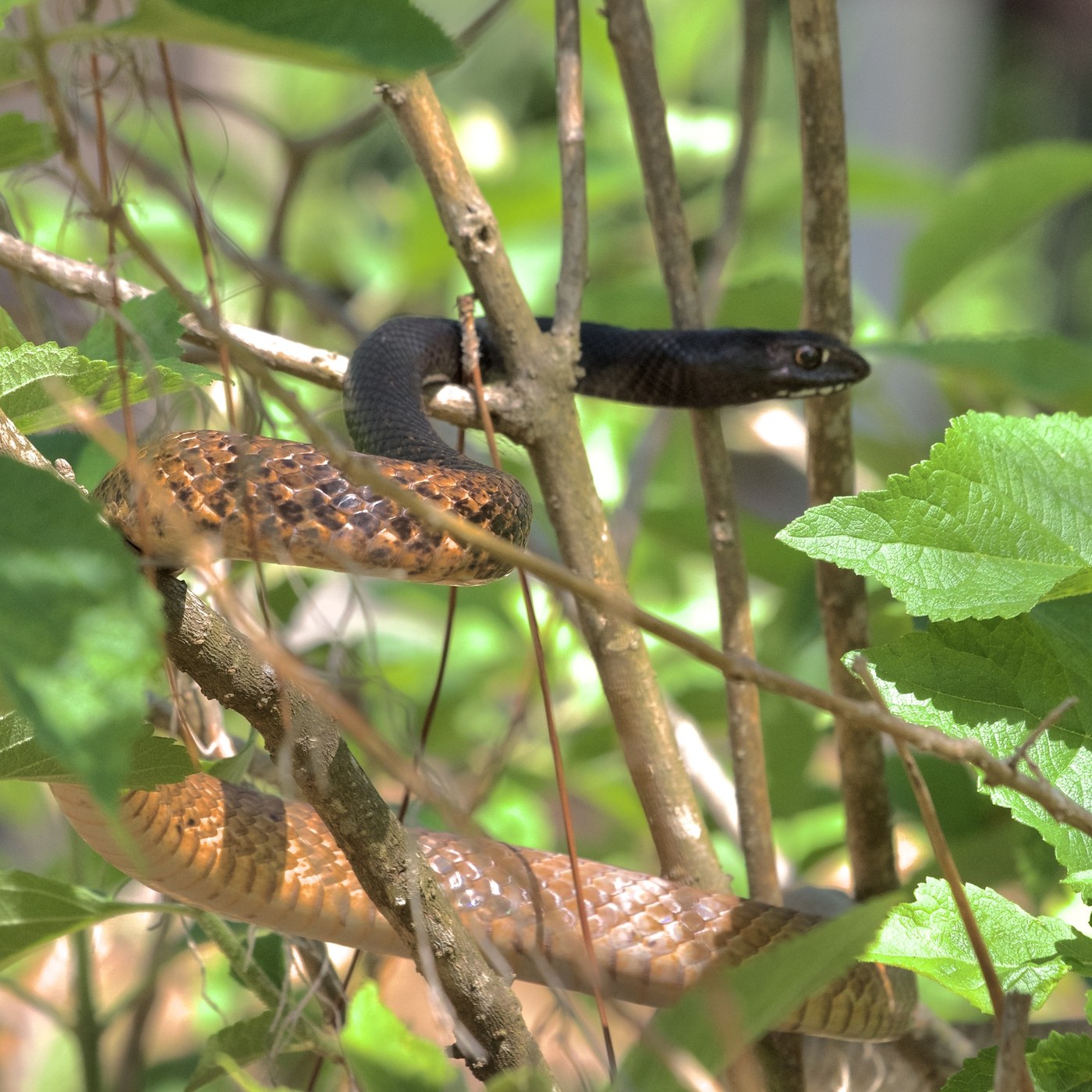
The two-tone coloring and braided tail are the fastest identification anchors. Most coachwhips show a dark brown to black head and neck that fades to a lighter tan, caramel, or reddish-brown toward the tail, and the tail itself is made of large, tapering scales that give it a distinctly braided, whip-like texture, which is exactly where the common name comes from.
The build is long, slender, and fast-moving
Adults typically run 3 to 6 feet with the largest individuals exceeding 8 feet, among the longest snakes found in the United States. The head is narrow with large eyes and round pupils, and the scales are smooth, giving the whole body a glossy look.
Color varies more than the rule
Color varies more than the two-tone rule alone suggests. Some southwestern Missouri individuals are entirely black or dark brown, some individuals show broad pink bands along the back, and the Red Coachwhip subspecies of the Southwest and California is often predominantly reddish-pink, especially in populations from pink-soil areas of west Texas and the Mojave Desert.
A plain racer, settled by the tail
A plain racer is a genuinely different snake, and the tail settles it. The North American Racer lacks the coachwhip's reddish tail tint and stays a more uniform solid color along its whole length, rather than showing the coachwhip's dark-head-to-light-tail transition.
The California Striped Racer
It is a separate species entirely, not a subspecies or a duplicate. It carries a pale stripe down each side of the body that the true coachwhip never has, and tops out around 5 feet versus the coachwhip's 6 to 8-plus feet. The two are easily confused by name alone, especially in Southern California and along the desert edge where their ranges come close, but they are never the same animal under two names.
Round pupils, smooth scales, no rattle, ever
This species has round pupils rather than a pit viper's vertical elliptical pupils, smooth rather than rough or keeled scales, and no rattle under any circumstance.
Signs of Infestation
Seeing it in daylight
Seeing the snake in daylight is the sign, and usually the only one. This species is strictly diurnal and one of the fastest, most surface-active snakes in its range. A snake seen crossing open ground at speed in full daylight fits this species far more than a nocturnal one would.
Open sandy ground, not structures
Sightings cluster in open, sandy, or desert-scrub habitat, not close to structures. Sandhills, prairies, old fields, desert grassland, and cactus-dominated scrub are where this species actually lives and hunts, not wall voids, attics, or crawl spaces.
It flees rather than stands
Fleeing, not standing ground, is the typical response. This species moves away quickly when approached rather than coiling or holding position, a useful contrast against a rattlesnake, which is more likely to hold its ground and rattle.
No damage pattern to look for
There is no gnawing, no burrowing into structures, no droppings to identify, and no chewed wiring associated with this species. A shed skin near a rock pile, brush pile, or burrow entrance is the only physical trace likely to turn up.
Nothing to hear or smell indoors
That holds under normal conditions. This species does not nest or shelter inside a structure. A strong musk odor only appears as a defensive response to being cornered or handled directly, not as an ambient sign of presence.
Prevention and When to Call a Pro
The default is to leave it alone
This species carries no venom and causes no property damage of any kind, and it functions as a beneficial predator of rodents, lizards, and other snakes around a property. For most homeowners, the right response to a sighting is no response at all.
Reduce rodents and fill burrows
If fewer encounters are the goal, reduce rodent activity close to the house and fill in old burrows. Coachwhips are drawn to areas with active rodent prey, so cutting that food source close to structures reduces the draw without requiring elimination of the habitat farther out in the yard where this species is doing genuinely useful work.
General habitat cleanup helps
General habitat cleanup still helps. Clear heavy brush, tall grass, log piles, and lumber stacks close to the foundation and keep weeds mowed down, consistent with standard snake-exclusion guidance used broadly for snakes rather than developed for this species specifically.
Seal gaps a quarter inch and up
Seal gaps of a quarter inch or larger, including the space under garage doors and around utility penetrations, which can admit a young snake even though adults of this species are too large to fit through very small openings.
Check your state rule first
Check state and local wildlife regulations before trapping or relocating any snake. Rules covering the trapping or relocation of native wildlife vary by state and change over time. A licensed nuisance wildlife control operator is the safer default over a do-it-yourself trap.
When to Call a Wildlife Control Operator
Two situations. First, if a snake cannot be confidently identified and is in an area with foot traffic, pets, or children, particularly if a rattlesnake cannot be ruled out (check for a rattle, vertical pupils, and rough or keeled scales, none of which the coachwhip has). Second, if a snake has entered living space and will not leave on its own, though this species does not typically seek indoor shelter in the first place. In both cases a licensed nuisance wildlife control operator is the right call, especially given how aggressively this species defends itself when cornered or handled.
Frequently Asked Questions
Is a coachwhip snake venomous?
No. It is completely non-venomous. A defensive bite can break the skin if the snake is cornered or handled, but it is not medically significant and carries no venom.
Why is it called a "coachwhip"?
Its tail is made of large, tapering scales arranged in a pattern that closely resembles a braided leather whip, which is exactly where the common name comes from.
Is the coachwhip really one of the fastest snakes in North America?
Yes. Multiple state wildlife agencies and university herpetology programs describe it as among the fastest snake species on the continent, and it is one of the most surface-active, visibly fast-moving snakes in its range.
Do coachwhips eat other snakes?
Yes. Documented prey includes other snakes, with cannibalism on its own species also recorded. It is a generalist hunter that also eats lizards, small mammals, birds, and even young desert tortoises in parts of the Southwest, per two independent federal wildlife sources.
How do I tell a coachwhip apart from a rattlesnake or a plain racer?
A coachwhip has round pupils, smooth glossy scales, no rattle under any circumstance, and, except in some all-dark individuals, a distinctive two-tone dark-head-to-light-tail color transition that a plain racer does not show. If those checks cannot be made confidently from a safe distance, do not approach and call a professional instead.
Sources
- Coluber flagellum (Shaw, 1802) species account (taxonomy, synonymy, distribution) The Reptile Database
- Coachwhip Coluber flagellum, California Wildlife Habitat Relationships account R052 California Department of Fish and Wildlife
- Coachwhip (Masticophis flagellum) species account (identification, range, diet, reproduction, behavior) University of Georgia, Savannah River Ecology Laboratory
- Coachwhip species account (habitat, diet, hunting behavior, home range, predators, longevity) Tucson Herpetological Society
- "The Western Coachwhip Moves Like Lightning" Texas Parks and Wildlife Department
- Sonoran Desert Tortoise (Gopherus morafkai) species page (juvenile tortoise predation by coachwhip) U.S. Fish and Wildlife Service
- Fire Effects Information System, Gopherus spp. account (cross-confirms juvenile desert tortoise predation) USDA Forest Service
- Eastern Coachwhip, Field Guide Missouri Department of Conservation
- Coachwhip species account Colorado Parks and Wildlife
- Coachwhip species account (non-venomous confirmation, range, racer look-alike distinction) Tennessee Wildlife Resources Agency
- Coluber (Masticophis) flagellum account Kansas Herpetofaunal Atlas, Fort Hays State University
Image Credits
- Image: James Rogers via iNaturalist. CC BY 4.0.
License.