Seasonal Timeline
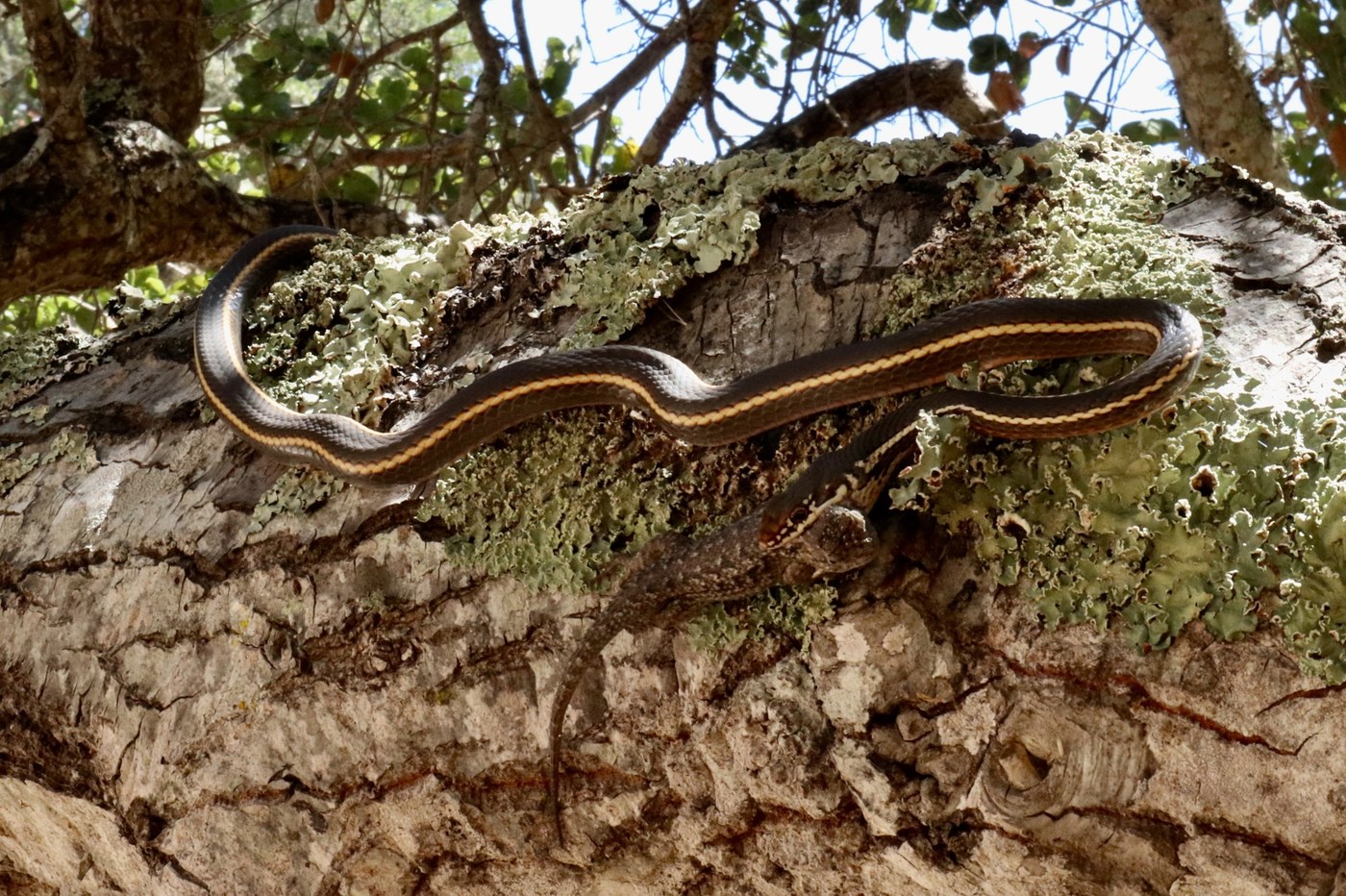
This is a daytime hunter, active from spring mating through late summer and fall hatching, with sightings concentrated wherever its main prey, the western fence lizard, is common: rock walls, woodpiles, and fence posts.
This is a daytime hunter, active from spring mating through late summer and fall hatching, with sightings concentrated wherever its main…
Males store sperm over the winter and mate soon after emerging in spring, with the U.S. Fish and Wildlife Service documenting the mating window as March through June. Studies have recorded 47, 50, and 55 days between first mating and the first egg laid, and yolk deposition itself begins around mid-April. From there incubation runs about three months, with hatchlings turning up above ground from August through November. This is a single annual clutch. No published source documents a second clutch later in the season, so a homeowner who sees hatchlings in October is seeing the one brood produced that year, not the start of a second wave.
Average clutch size across a 19-clutch study sample is 7.21 eggs, ranging from 6 to 11, and larger females tend to produce larger clutches. There is no parental care after the eggs hatch. Young reach sexual maturity at 2 to 3 years and grow toward the adult ceiling of nearly 5 feet. A captive-individual study puts total lifespan at up to 8 years.
Where They're Found
The California striped racer's current scientific name is Masticophis lateralis, though it is also listed in some sources, including one state technical document and a federal taxonomic database, as Coluber lateralis. Both names point to the same animal. A 2002 to 2005 genetic proposal argued for folding the whipsnake genus Masticophis into Coluber entirely, and that view was adopted by several sources for roughly a decade. More recent combined-DNA studies from 2017 and 2018 reversed that conclusion, and the current 2025 national names list for herpetologists uses Masticophis lateralis as the accepted standard.
This species is genuinely confined to California and northern Baja California. The state's own wildlife habitat data describes it as uncommon to common along the length of the Sierra Nevada north to the vicinity of Shasta Lake, throughout the Coast Ranges from Trinity County south the entire length of the state, in the southern California interior west of the true deserts, and only in the northern portion of the Central Valley. It is not found in Nevada, Oregon, Arizona, or anywhere else in the Southwest, despite a similar-looking, similarly named relative, the Desert Striped Whipsnake, ranging broadly across exactly that territory. The two are told apart by scale count, not appearance alone: 17 rows at midbody for the California striped racer versus 15 for the desert species.
The coachwhip is a real and worthwhile point of confusion, and worth settling. The true coachwhip is a separate, full species, Masticophis flagellum, in the same genus. Both snakes are fast, diurnal, and non-venomous, and both get lumped together informally, especially in southern California and along the desert edge where their ranges come close to each other. They are never subspecies of one another and never the same animal under two names. No standard common name "California coachwhip" exists in any source. California's own coachwhip subspecies go by Red Coachwhip and the California-endemic San Joaquin Coachwhip instead.
No published source of any kind places this species in Alaska or Hawaii. Its entire known range is a Mediterranean-climate chaparral, oak-woodland, and grassland specialty confined to California and northern Baja California, conditions found nowhere in either state, and Hawaii has no native snake species at all.
Life Cycle
One clutch a year, and a name history worth knowing. This species produces a single annual clutch each spring and summer, with no second wave of young later in the season. The name itself has shifted more than once. It was long called the California whipsnake, described directly as a former name by the state's own wildlife habitat data, and its scientific name has been argued over between Coluber lateralis and Masticophis lateralis as genetic studies have gone back and forth on where the whipsnake genus belongs. Either name refers to the same animal.

Mating
Egg
Hatchling2
Adult
Identification
A stripe on each side
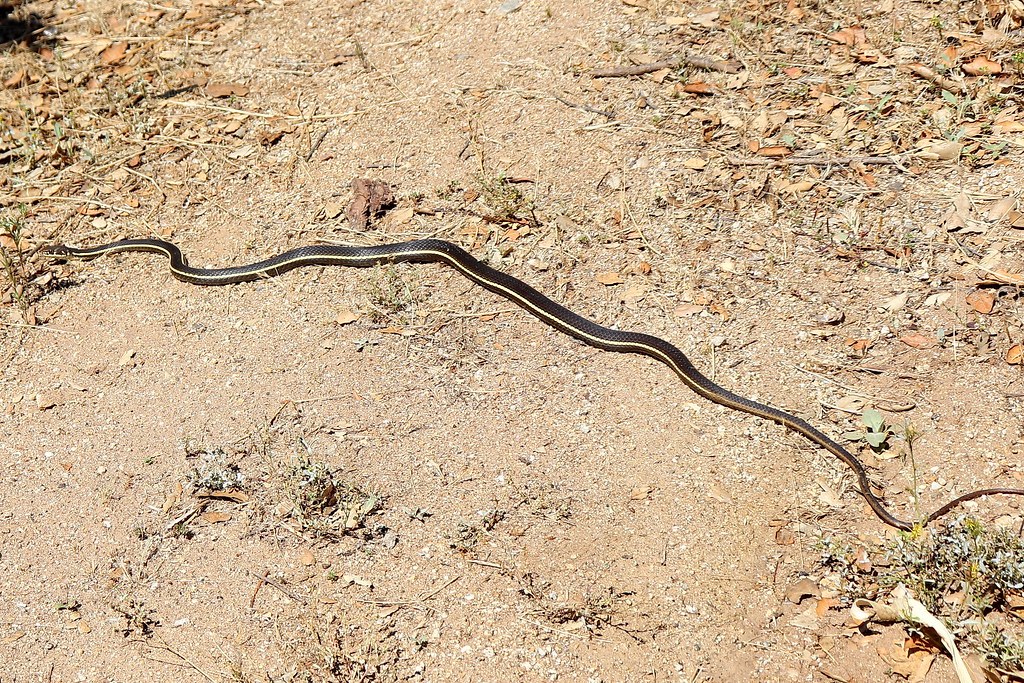
Not down the middle. That is the identification anchor. A single pale cream or yellow stripe runs down each side of the body, from behind the eye toward or beyond the vent. There is no stripe down the center of the back, which is the detail that separates this species at a glance from garter snakes, which do carry a dorsal stripe.
Slender, with glossy scales
The build is slender with smooth, glossy scales. A long thin tail, large eyes, a broad and somewhat elongated head, and a slender neck complete the picture. Dorsal ground color is dark olive-brown, gray, or black. Adults reach nearly 5 feet.
The true coachwhip is another snake
The true coachwhip is a separate species, and the tail and coloring settle it. A true coachwhip has no side stripes at all. Instead it shows a two-tone look, a dark head and neck fading to lighter tan or brown toward the tail, and a distinctive braided-looking tail texture made of large, tapering scales that gives the coachwhip its name. Coachwhips also run measurably larger, with typical adults of 3 to 6 feet and the biggest individuals exceeding 8 feet, well past this species' roughly 5-foot ceiling. Both are fast, diurnal, and non-venomous, which is exactly why the two get confused, but they are not the same animal and never subspecies of one another.
A near-twin outside California
Outside California, a strikingly similar-looking snake is a different species entirely. The Desert Striped Whipsnake also carries longitudinal side stripes and ranges broadly across Nevada, Oregon, and the wider Southwest, territory the California striped racer does not reach at all. The reliable way to separate them is scale count: 17 rows at midbody for the California striped racer versus 15 for the desert species. Anyone outside California searching "striped racer" is very likely looking at this second animal.
There is no "California coachwhip"
No "California coachwhip" exists as a standard name. California's own coachwhip subspecies are the Red Coachwhip and the California-endemic San Joaquin Coachwhip. If a search turned up that phrase, it is almost certainly pointing at generic coachwhip content rather than a distinct animal.
Round pupils, no rattle, ever
This species has round pupils rather than the vertical elliptical pupils of a pit viper, and it has no rattle under any circumstance.
Signs of Infestation
Seeing it in daylight
Seeing the snake in daylight is the sign, and usually the only one. This species is strictly diurnal, active during the day and not at night, and it is fast-moving and alert. A snake seen crossing open ground, working a rock wall, or basking in full sun fits this species far more than a nocturnal one would.
Sightings cluster near lizard cover
Not near the house itself. Because the primary prey is the western fence lizard, and that lizard favors rock walls, woodpiles, and fence posts, sightings tend to concentrate in exactly those spots rather than being spread evenly across a property.
It flees rather than stands
Fleeing, not standing ground, is the typical response. This species moves away quickly when approached rather than coiling or holding position, which is a useful contrast against a rattlesnake, which is more likely to hold its ground and rattle.
No damage pattern to look for
There is no gnawing, no burrowing into structures, no droppings to identify, and no chewed wiring associated with this species. A shed skin in a rock pile or woodpile is the only physical trace likely to turn up.
Nothing to hear or smell indoors
This species does not nest or shelter inside a structure. Sounds or odors from inside a wall, attic, or crawl space point to a different animal entirely.
Prevention and When to Call a Pro
The default is to leave it alone
This species carries no venom, causes no property damage, and functions as a natural predator of the rodents and lizards around a yard. For most homeowners, the right response to a sighting is no response at all.
Target the lizard cover
If fewer encounters are the goal, target the lizard cover close to the foundation rather than the whole yard. Because the primary prey is the western fence lizard, and that lizard specifically favors rock walls, woodpiles, and fence posts, thinning that particular cover right around the house reduces the food draw that brings the snake in close, without requiring elimination of lizard or rodent habitat farther out in the yard where this species is doing genuinely useful work.
General habitat cleanup helps
General habitat cleanup still helps. Clear heavy brush, tall grass, rocks, logs, rotten stumps, and lumber piles, and keep weeds mowed close to the ground. This is standard snake-exclusion guidance from the University of California's statewide pest management program, written broadly for snakes rather than for any one species.
Manage rodents and old burrows
Manage rodents near structures and fill in old burrows. Snakes are drawn to areas with active rodent prey, so reducing rodent activity close to the house and filling in the burrows left behind removes another draw. It is worth saying plainly that this species is itself a rodent control, so eliminating it from the property at large works against what most homeowners actually want.
Seal gaps a quarter inch and up
Seal gaps of a quarter inch or larger, including the space under garage doors, which is often large enough for a young snake to pass through.
Check your state rule first
Check state and local wildlife regulations before trapping or relocating any snake. Rules covering the trapping or relocation of native wildlife vary by state and change over time. A licensed nuisance wildlife control operator is the safer default over a do-it-yourself trap.
When to Call a Wildlife Control Operator
Two situations. First, if a snake cannot be confidently identified and is in an area with foot traffic, pets, or children, particularly if a rattlesnake cannot be ruled out. Second, if a snake has entered living space and will not leave on its own, though this species does not typically seek indoor shelter in the first place. In both cases a licensed nuisance wildlife control operator is the right call.
Frequently Asked Questions
Is a California striped racer the same thing as a coachwhip?
No. They are closely related species in the same genus, but the striped racer carries a pale stripe down each side of the body and stays under about 5 feet, while the true coachwhip has no side stripes at all, shows a two-tone dark-head, light-body look with a braided-looking tail, and can exceed 6 to 8 feet.
Is the California striped racer venomous? Could it hurt my kids or pets?
No. It carries no venom capable of causing serious illness or injury. A defensive bite, which only happens with direct handling or cornering, produces no more than a minor puncture wound.
Why do I keep seeing this snake near my woodpile or rock wall?
Because that is where its primary food source, the western fence lizard, lives. The snake is following prey, not seeking shelter in the structure itself.
Should I remove a striped racer I find in my yard?
Generally no. It is a beneficial predator of rodents and lizards with no venom or property-damage risk, and the standard guidance from wildlife agencies is coexistence rather than removal. If a snake truly needs to be removed, check state and local wildlife regulations first and use a licensed nuisance wildlife control operator.
How do I tell it apart from a rattlesnake in my yard?
Check for a rattle at the tail tip, which this species never has, round pupils rather than vertical slits, and smooth glossy scales rather than the rattlesnake's rougher, keeled, matte-looking scales. If those checks cannot be made confidently from a safe distance, do not approach and call a professional instead.
Sources
- Masticophis lateralis species account (distribution, synonymy, current taxonomic treatment) The Reptile Database
- California Wildlife Habitat Relationships (CWHR) life history account R053, "Striped Racer" (habitat, diet, former common name note) California Department of Fish and Wildlife
- Rattlesnake biology page (distinguishing features used for the look-alike caution) California Department of Fish and Wildlife
- 5-Year Review / Species Assessment, Alameda Whipsnake (life-cycle, size, diet, and lifespan data for the species) U.S. Fish and Wildlife Service
- Alameda Whipsnake Species Profile (diet, prey ecology, mating season, clutch size) U.S. Fish and Wildlife Service
- Pest Notes: Rattlesnakes, UC ANR Publication 74119 (general snake exclusion guidance, rattlesnake-specific ID checklist) University of California Statewide Integrated Pest Management Program
- Coachwhip species account (size, tail pattern, two-tone coloring, used for the look-alike comparison) University of Georgia, Savannah River Ecology Laboratory