Seasonal Timeline
This species is strictly nocturnal and active from roughly late February through November depending on region and weather, spending daylight hours and winter underground in burrows. It is most often seen crossing a warm road or driveway after dark rather than out in the open during the day.
This species is strictly nocturnal and active from roughly late February through November depending on region and weather, spending…
Mating happens in spring soon after winter dormancy ends, with a Kansas-focused account placing courtship and mating specifically from April through June. Eggs are laid a few centimeters below the surface in loose soil, typically from late May through early July, and hatching follows from late August into mid-September. This is a single clutch per year at most, and not every female reproduces annually: one review estimates that roughly a third of females are not reproductively ready to lay eggs in a given year.
Clutch size across the species ranges from 3 to 23 eggs, with a commonly cited mean around 8 to 8.5. Hatchlings measure about 25 cm (roughly 10 inches) at birth, and one source notes females have been observed staying near their offspring for a few days after hatching, though this is brief rather than extended parental care and there is no involvement from males at all. Sexual maturity is generally reached at 3 to 4 years old.
Where They're Found
The glossy snake's scientific name is Arizona elegans, described by Kennicott in 1859 and recognized taxonomically as a single species made up of multiple subspecies spread across a very wide range. Those subspecies carry their own regional common names that turn up in searches: the Kansas Glossy Snake in Kansas and Nebraska, the Texas Glossy Snake and Southern Texas Glossy Snake in Texas, the Painted Desert Glossy Snake and Arizona Glossy Snake in Arizona, and the Desert Glossy Snake and California Glossy Snake across the Mojave, Sonoran Desert, and central California. All of these point to the same species.
The narrowest description of this snake's range gives it a single region, the Southwest. The documented record is considerably wider. California's own wildlife agency describes the glossy snake as common throughout southern California, especially in desert regions, present as far north as Contra Costa County in the interior Coast Ranges, with its own California-endemic subspecies alongside desert subspecies also found in the state. The authoritative national description of the species' range states it runs from southeastern Texas north to southwestern Nebraska, and west to coastal California, which brings in South Central states (documented in Texas and Oklahoma), Midwest states (documented in Kansas and Nebraska), and Mountain West (documented in the eastern and extreme southwestern parts of Colorado). Every one of those additional regions is backed by a state wildlife agency, a national taxonomic reference, or a university herpetology program, so California, South Central, Midwest, and Mountain West all belong in the glossy snake's range alongside the Southwest.
No source of any kind places this species in Alaska or Hawaii. Its entire documented range is arid and semi-arid country across the Southwest, California, the southern Great Plains, and northern Mexico, conditions found in neither state, and Hawaii has no native snake species at all.
Related Pests
Life Cycle
One clutch a year at most, and a wider range than a Southwest-only listing suggests. This species produces at most a single annual clutch, and evidence indicates some females skip a year entirely rather than reproducing every season. Its documented range reaches into California, the southern Great Plains, and the edge of the Rocky Mountain front, well beyond the Southwest.

Mating
Egg
Hatchling
Adult
Identification
Smooth, glossy, unkeeled scales
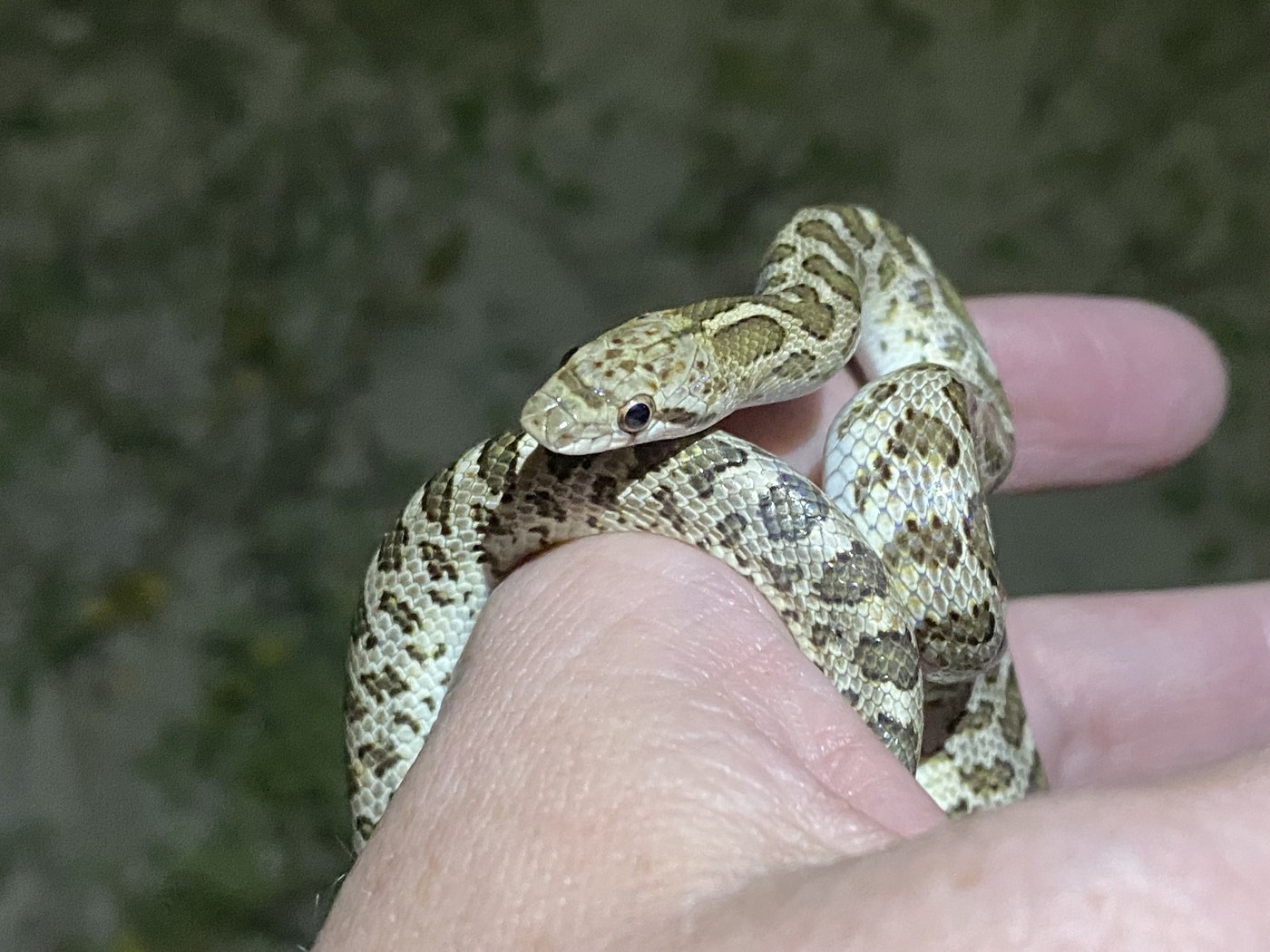
They are the identification anchor. Unlike many similar-looking desert snakes, this species' scales lack the raised center ridge (keel) that gives other snakes a rougher, duller look. That smooth, sometimes faintly iridescent texture is the literal source of the name.
Pale ground, dark-edged blotches
Pale ground color with dark-edged blotches down the back and sides. Coloring ranges from tan to cream, yellowish gray, or pinkish, with a row of dark brown, gray, or olive-gray blotches down the back and a second row of smaller blotches along each side. The underside is plain white to cream and essentially unmarked. A dark stripe runs from each eye back to the corner of the mouth.
The technical tells
A recessed lower jaw and a single anal plate are the technical tells. The lower jaw is countersunk, an adaptation for burrowing through sand and loose soil without letting grit into the mouth, and there is a single anal plate rather than a divided one. The head is only slightly distinct from the neck.
Against the gopher snake
The gopher snake is the species this one gets confused with, and scale texture settles it fastest. The gopher snake's dorsal scales are keeled rather than smooth, giving it a rougher, matte look next to this species' glossy sheen. The gopher snake is also considerably larger and heavier-bodied, typically 3 to 6 feet and occasionally exceeding 7 feet, against this species' more modest 2.5 to 4.25 foot average and roughly 5.8 foot documented maximum. Where scale texture is hard to judge from a distance, prefrontal head-scale count is the technical confirmation: this species typically carries one pair of prefrontal scales versus the gopher snake's usual two pairs.
Behavior separates the two as well
The gopher snake is well known for an elaborate rattlesnake-mimicry display: loud hissing, a flattened triangular head, and a vibrating tail against dry leaves or vegetation. No university extension, state wildlife agency or federal source documents this species performing that same display; it is instead consistently described as secretive, more likely to flee or burrow, and far more strictly nocturnal and fossorial than the gopher snake.
The round-pupil shortcut fails
This species' pupils are documented as slightly vertically elliptical rather than fully round, unlike most harmless snakes. That means the common "round pupils equal harmless" shortcut should not be relied on for this snake specifically.
Signs of Infestation
Seeing it at night, often on a road
Seeing the snake at night, often on a road, is the most common sign. This species is strictly nocturnal and spends the day underground, so a warm road or driveway after dark is one of the few places it turns up in the open.
Sightings cluster on sandy soil
Sightings cluster wherever loose, sandy soil supports easy burrowing. Open desert, grassland, and chaparral with sandy or loamy soil are the preferred microhabitats, rather than dense brush or heavy cover.
A shed skin near a burrow
Surface debris works the same way. It is a secondary, indirect sign. This species uses existing mammal burrows, rock crevices, or burrows it digs itself.
No damage pattern to look for
There is no gnawing, no structural burrowing into a building, no droppings to identify, and no chewed wiring associated with this species.
Nothing to hear or smell indoors
This species does not nest or shelter inside a structure. Sounds or odors from inside a wall, attic, or crawl space point to a different animal entirely, and unlike its gopher-snake look-alike, no loud hissing or tail-vibrating display is documented for this species.
Prevention and When to Call a Pro
The default is to leave it alone
This species carries no venom, causes no property damage, and preys on the rodents and lizards that homeowners generally want fewer of. For most encounters, no action is the correct action.
Reduce the rodents and lizards
Reduce the rodent and lizard activity that draws it close to a structure, rather than targeting the snake itself. Since its diet is built around sleeping lizards and small mammals, thinning rock piles, woodpiles, and debris close to the foundation reduces the prey draw without requiring elimination of habitat farther out in the yard, where this species is doing genuinely useful pest control work.
General habitat cleanup helps
General habitat cleanup still helps. Clear heavy brush, tall grass, rocks, logs, rotten stumps, and lumber piles, and keep weeds mowed close to the ground. This is standard snake-exclusion guidance from the University of California's statewide pest management program, written broadly for snakes rather than for any one species.
Seal gaps a quarter inch and up
Seal gaps of a quarter inch or larger, including the space under garage doors, which can be large enough for a smaller-bodied snake like this one to pass through.
Check your state rule first
Check state and local wildlife regulations before trapping or relocating any snake. Rules covering the trapping or relocation of native wildlife vary by state and change over time. A licensed nuisance wildlife control operator is the safer default over a do-it-yourself trap.
When to Call a Wildlife Control Operator
Two situations. First, if a snake cannot be confidently identified and is in an area with foot traffic, pets, or children, particularly if a rattlesnake cannot be ruled out. This matters more than usual for this species, since its pupils are not the reliably round shape typical of most harmless snakes, so pupil shape alone should not be the deciding factor. A rattle, a triangular head, and rough keeled scales are the more reliable rattlesnake tells. Second, if a snake has entered living space and will not leave on its own, though this species does not typically seek indoor shelter in the first place. In both cases a licensed nuisance wildlife control operator is the right call.
Frequently Asked Questions
Is a glossy snake the same thing as a gopher snake?
No. They are separate species that resemble each other, but the glossy snake has smooth, glossy, unkeeled scales while the gopher snake's scales are keeled and rough, and the glossy snake is smaller, more strictly nocturnal, and more fossorial than the day-active, rattlesnake-mimicking gopher snake.
Is a glossy snake venomous? Could it hurt my kids or pets?
No. It is an entirely non-venomous constrictor, and a defensive bite from handling produces no more than a minor puncture wound.
Why do I only see this snake at night, often on the road?
It is strictly nocturnal and spends the day underground in burrows, so a warm road or driveway after dark is one of the few places it is reliably seen in the open.
Does a glossy snake's pupil shape mean it's dangerous?
Not by itself. Its pupils are documented as slightly elliptical rather than fully round, which is unusual for a harmless snake, but this species still carries no venom. A rattle, triangular head, and rough keeled scales are the reliable rattlesnake tells, not pupil shape.
Should I remove a glossy snake I find in my yard?
Generally no. It is a beneficial predator of rodents and lizards with no venom or property-damage risk. If removal is genuinely needed, check state and local wildlife regulations first and use a licensed nuisance wildlife control operator.
Sources
- California Amphibian and Reptile Species of Special Concern, California Glossy Snake account (identification, gopher snake comparison, distribution, life history) California Department of Fish and Wildlife
- California Wildlife Habitat Relationships (CWHR) System, Glossy Snake (R056) life history account (activity pattern, diet, reproduction, California distribution) California Department of Fish and Wildlife
- Arizona elegans species account (physical description, geographic range, reproduction) Animal Diversity Web, University of Michigan Museum of Zoology
- "Arizona, A. elegans," Catalogue of American Amphibians and Reptiles 179 (taxonomy, diagnosis, range-wide distribution) Society for the Study of Amphibians and Reptiles, hosted by University of Texas Libraries
- Glossy Snake species account (size, identification, Colorado distribution, reproduction) Colorado Partners in Amphibian and Reptile Conservation
- Amphibians, Turtles & Reptiles of Nebraska: Glossy Snake account and range map University of Nebraska-Lincoln
- Pest Notes: Rattlesnakes, UC ANR Publication 74119 (general snake exclusion guidance, rattlesnake-specific identification checklist) University of California Statewide Integrated Pest Management Program
Image Credits
- Image: Meghan Cassidy via iNaturalist. CC BY-SA 4.0. Resized, so this version is offered under the same license.
License.