Seasonal Timeline
San Joaquin kit foxes are active every month of the year and do not hibernate. They are obligate den users, meaning they occupy a den every single day of the year, which is why the den rather than the animal is what most property owners actually run into. The calendar that matters is the pup calendar: pairing October through December, breeding December and January, pups born late January through March, pups above ground about four weeks later, and dispersal beginning in June and peaking in July.
San Joaquin kit foxes are active every month of the year and do not hibernate. They are obligate den users, meaning they occupy a den every…
The fourth card is the one to read twice. The Endangered Species Recovery Program at California State University Stanislaus, which has run the Bakersfield research for decades, states it plainly: unless thorough surveys for dens are conducted first, grading, disking, and any other ground-disturbing activity should never be conducted during January to June, when young pups may be present in dens. The reason is specific rather than sentimental. Pups at that age cannot dig their way out of a collapsed den entrance. After early June, young foxes are better able to escape a den before or after an impact, and the risk drops. Shallow work may be tolerable, roughly 1 to 3 inches for grading and 3 to 6 inches for disking, and mowing is the safe alternative for vegetation control because it does not touch the ground.
The reproductive numbers are well settled for a wild canid, because this animal has been studied harder than almost any other fox in North America. Gestation runs 49 to 55 days. Mean litter size is about 4 pups with a typical range of 1 to 6, and litters of 8 and 9 have been observed. Pups emerge at about 4 weeks and begin foraging with their parents at 3 to 4 months. One litter per year, with no second litter documented under any conditions.
Two sources give different figures. The U.S. Fish and Wildlife Service species profile says females give birth to two to six pups in February or March. The Endangered Species Recovery Program gives births from late January through March and a litter range of 1 to 6 with outliers of 8 and 9. The wider recovery program figures are the ones to trust, outliers included, because rounding a range down is how someone ends up being told their nine-pup den is impossible.
And a note on why this calendar differs from the one for kit foxes in the Southwest deserts. Desert figures give births February through mid-March and dispersal in August or September. The figures above are specific to this subspecies and to California field studies, and they run earlier at both ends. Different populations, different researchers, different numbers. Do not apply the desert calendar here.
Where They're Found
This animal occurs in one region and only one region: California. The San Joaquin kit fox is endemic to the San Joaquin Valley and a handful of arid valleys in the adjacent Coast Ranges. There is no second region to add and no honest way to stretch the map.
The cited range. The U.S. Fish and Wildlife Service puts the subspecies through much of the valley floor and foothills of the San Joaquin Valley, from San Joaquin County in the north to Kern County in the south. On the western side of the valley the range extends to Contra Costa, Alameda, and San Joaquin counties, and on the eastern side to the La Grange area of Stanislaus County. It also takes in the Panoche and Cuyama valleys and the Carrizo Plain in San Luis Obispo County.
The range on paper and the range in practice are no longer the same, and the current federal review says so. The 2025 five-year review states the subspecies is likely extirpated from Alameda and Contra Costa counties and from the Salinas Valley and its adjoining foothills. It also reports that since the previous review there have been no new observations anywhere north of Highway 152, so while dispersing individuals may still cross that ground, resident use of the northern range is now rare. Scent-detection dog surveys in Contra Costa and Alameda counties in 2001 through 2003, and again at Lawrence Livermore in 2018, did not detect the animal at all. The same review confirms continued presence on the Carrizo Plain, in the Panoche Valley, at the Kern National Wildlife Refuge Complex, in the Cholame Valley, and in the cities of Coalinga and Bakersfield.
Three cities, and this is the part that makes the species unusual among endangered animals. Kit foxes are established in the urban environments of Bakersfield, Taft, and Coalinga. Cities that hold them are typically adjacent to natural habitat: Bakersfield is bordered by saltbush scrub, grassland, and riparian ground on 25 to 30 percent of its perimeter, with agriculture on the rest. Kit foxes have not been observed in towns completely surrounded by agricultural land, which is the practical rule for whether a given valley town has them.
Where in a city, specifically. Urban kit foxes commonly use undeveloped land and vacant lots, fallow crop fields, storm water catchment basins, industrial areas such as manufacturing facilities and shipping yards, commercial office and retail complexes, manicured open space including parks, cemeteries, school campuses and golf courses, and linear rights-of-way along canals, railroads, and power lines. Open ground as small as an acre can be used if it connects to other open ground. Residential neighborhoods are the least used urban land type, because of the density of fences and walls, the level of human activity, and the number of dogs.
School and institutional campuses are the strongest predictor there is, and it has been measured. A study of 111 randomly selected one-square-kilometer cells across Bakersfield found kit fox occupancy driven primarily by selection for campuses, meaning schools, churches, and medical centers, followed by avoidance of paved roads. Occupancy probability rose from 0.73 with no campus in a cell to 0.94 with a cell entirely campus, and fell from 0.73 with no paved road to 0.30 with a cell entirely paved road. The researchers attribute the campus effect to large landscaped grounds, denning opportunities under storage containers, modular buildings, sheds and dumpsters, food courts and picnic areas that both drop food and support ground squirrel and pocket gopher prey, and overnight fencing or security that limits human activity exactly when foxes are active while helping keep coyotes out.
Natural habitat requirements, for the non-urban part of the range. Well-drained sandy to loamy soils, which support kangaroo rats and allow digging. Flat to gently rolling terrain: where average slopes exceed 15 percent, abundance drops considerably because predation risk rises. The animal is absent or scarce where soils are shallow because of high water tables, hardpan, or bedrock near the surface. Cattle and sheep grazing are compatible land uses, as is low to moderate oil and gas production. Use of agricultural land is quite limited, generally only where irrigated crops or orchards sit next to natural habitat.
Alaska and Hawaii, checked and answered. Both are confirmed absences rather than gaps. Every range description found for this subspecies confines it to central California. It is a warm-arid valley endemic with a total range smaller than some individual counties, and no published source places it outside California at all.
Life Cycle
A large share of what science knows about kit foxes in general was learned from this animal. Much of the detailed life history for kit foxes generally comes from California work on this endangered subspecies, because that is the population with federal recovery funding behind it. For this animal, that research is the primary record rather than a transplant.
The survival figures are the ones that explain why a single den matters so much. Adult annual survival in California studies ran 44 to 60 percent. Juvenile annual survival ran 14 to 21 percent. Most foxes do not see a third year. Against that, the rangewide picture is a subspecies estimated at 3,616 animals in 2013, against a historical estimate of 8,667 to 12,134 in the 1983 recovery plan. There is no rangewide survey, and the federal review says so directly, so those figures are estimates built from patchwork monitoring rather than a census.
One genuinely encouraging number, from the 2025 review. California Department of Fish and Wildlife spotlight-survey modeling on the Carrizo Plain estimated populations of 496, 908, 1,026, and 1,239 animals across 2021, 2022, 2023, and 2024, an upward trend for that core population. The Bakersfield urban population, hit hard by disease from 2013 onward, stabilized after 2020 and had no mange detected in 2022. The federal review is careful to note this recovery was not the result of any successful intervention.

Natal Den Pup
Emerging Pup
Disperser or Helper
Adult
Identification
You cannot tell it by looking
You cannot tell a San Joaquin kit fox from any other kit fox by looking at it, and that is not a dodge, it is the finding. The federal record describes this animal only as the larger of the two subspecies of kit fox, a difference of degree that gets measured in a lab, not something visible in a yard. The identification is therefore geographic. This subspecies is endemic to the San Joaquin Valley and adjacent Coast Range valleys. California's other kit foxes, the ones that are not federally listed, live in the Mojave and Colorado deserts on the far side of the mountains. If you are in the San Joaquin Valley, the fox in front of you is the endangered one, and nothing about a photograph changes that.
About the size of a house cat
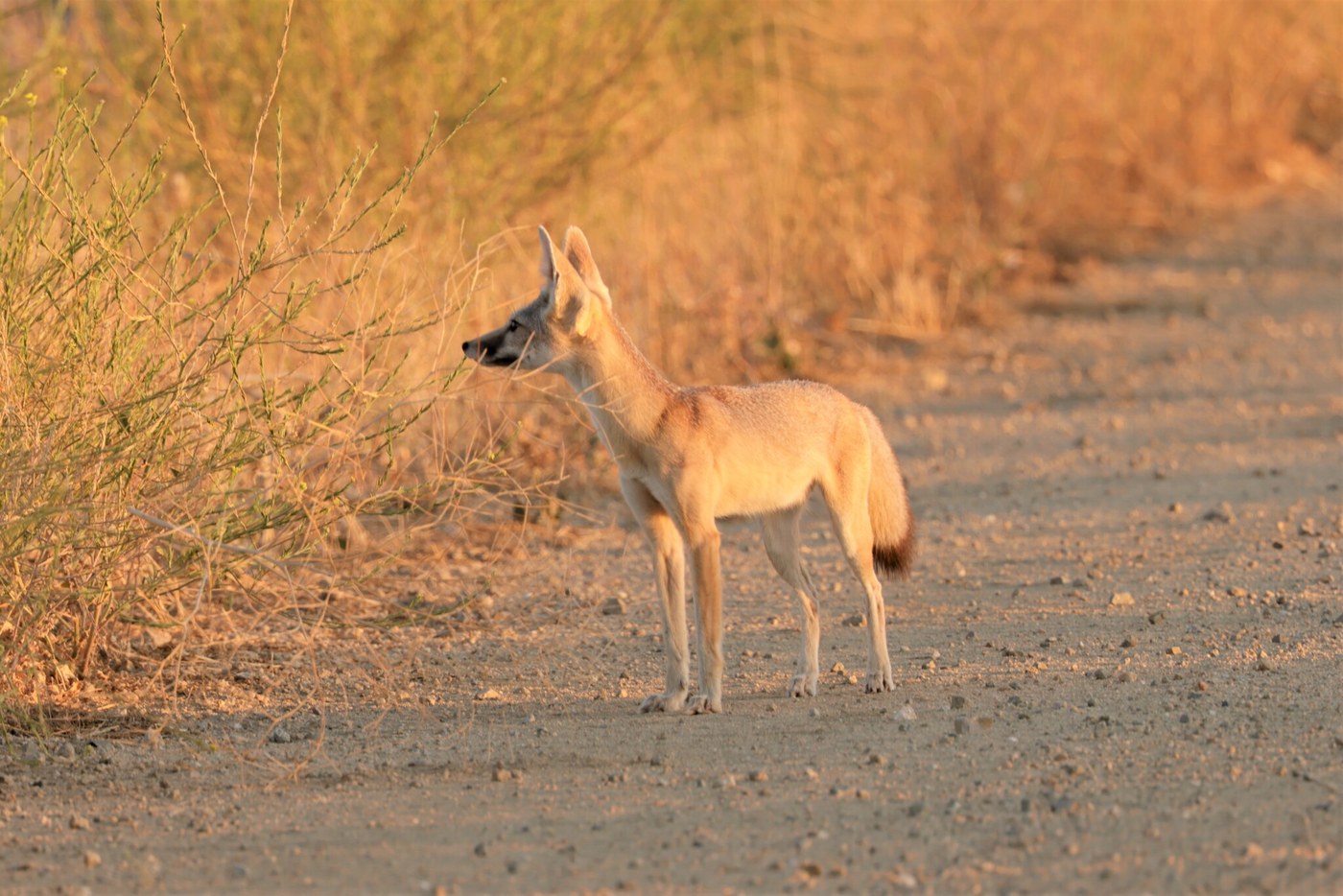
Size: about the size of a house cat, and that comparison comes from the researchers themselves. Roughly 12 inches at the shoulder, about 24 to 33 inches from nose tip to tail tip, with adult males averaging 5 pounds and adult females 4.6 pounds. Small slim body, relatively large ears set close together, narrow nose, long slender legs, and foot pads that are small compared to other wild dogs. Stiff tufts of hair between the toe pads give traction on loose sand, and long dense hairs along the inner edge and base of each ear cover the opening against blowing dust.
Buff to tan, black tail tip
The coat is buff to tan, and the tail tip is black. Remember the tail tip. Federal descriptions give the dorsal coat as buff, tan, grizzled, or yellowish-gray, varying with location and season, on relatively short fur, with a long bushy tail tapering slightly toward the tip. The tip itself is distinctly black.
Red fox, settled by the tail
Red fox is the look-alike that actually matters in Bakersfield, and the tail settles it in one look. Colorado Parks and Wildlife notes that red foxes carry a characteristic white-tipped tail across all four color phases, at 8 to 15 pounds and roughly 3 to 4 feet long including the tail. Black tip means kit fox. White tip means red fox. This is not an academic comparison: non-native red foxes are established in Bakersfield alongside the kit foxes, they are the largest North American fox, they have been documented usurping kit fox dens, and their diet overlaps heavily. The two species share the same ground and separate in time rather than in space, almost never appearing in the same place in the same hours.
Gray fox and coyote, by size
Gray fox and coyote are the other two, and both are separated by size before anything else. A gray fox runs roughly 7 to 11 pounds, carries a salt-and-pepper gray back with reddish-brown on the neck, chest and legs, has normally proportioned ears, and climbs trees. In Bakersfield, gray foxes favor urban edges and tree-covered ground rather than the open landscaped space kit foxes work. A coyote outweighs a kit fox by five to ten times and is the kit fox's main predator across most of the range, which is part of why urban kit foxes survive better than rural ones: coyotes are largely absent from the interior of the city.
A house cat is the night misread
A house cat is the most common night-time misread, and the numbers are closer than you would guess. Kit foxes and cats are close in size structurally, but a cat generally weighs two to three times what a kit fox does. In a driveway at night, look at the tail and the ears rather than the outline.
Identify the den, not the fox
The more useful skill is identifying the den, not the fox. Kit fox den entrances are described by the recovery program as roughly 20 to 25 centimeters high and under 20 centimeters wide, with a characteristic keyhole shape, taller than it is wide, that helps keep coyotes and badgers out. Freshly dug soil forming an apron or berm outside a hole of the right dimensions is called an excellent indicator of a possible kit fox den. The exclusion test is the useful half: California ground squirrel burrows throw a similar apron of soil, but their entrances are generally 4 inches in diameter or less, too small for a kit fox to enter at all.
Two agencies, two den dimensions
Two agencies give den-entrance dimensions that do not match. The 2011 federal ground-disturbance guidance describes typical entrances as approximately 5 to 8 inches in diameter. The recovery program gives 20 to 25 centimeters high, about 8 to 10 inches, and under 20 centimeters wide, under about 8 inches. Those are not the same measurement. The likely reconciliation is that the federal number is a round-hole approximation written for field surveyors while the recovery program is describing the taller-than-wide keyhole cross-section, but neither document says so, so neither figure is presented here as the settled one.
The mistake most people make
The federal guidance also warns against a specific mistake, and it is the one most people make. The Service discourages calling any kit fox den active or inactive, because a great percentage of occupied dens show no evidence of use at all, and because kit foxes change dens often enough that the status of a given den can change frequently and abruptly. An empty-looking hole is not evidence of an empty hole.
Signs of Infestation
This is not an infestation
Urban kit foxes do not cause property damage, they are described by the researchers who study them as virtually silent so noise is not an issue, they have never been reported to attack a person, and they have not been reported to attack pets. The most frequent complaint on record about them comes from golfers, whose balls they occasionally run out and steal. What follows is what a property owner or a technician might actually notice.
A hole with an apron of fresh soil
The apron sits outside it. Kit foxes throw dirt when digging and keep modifying dens, enlarging them and adding entrances, so excavated soil builds into a visible apron or berm at the entrance. The federal den definition adds dirt berms adjacent to entrances, plus tracks, scat, or prey remains nearby, and matted vegetation next to the openings. Dens run from 1 to 24 entrances, most commonly 2 to 7. Tunnels average 2 to 6 meters long and can reach 3 meters deep.
A natal den, and its legal weight
A natal den looks different, and it is the one with the most legal weight. Natal and pupping dens tend to be larger with more entrances than dens used only by adults, with more tracks, scat and prey remains around them and a broader apron of matted dirt or vegetation at one or more openings.
Dens that do not look like dens
In a city that is most of them. Documented urban den sites include under portable classrooms, under sidewalks, between exposed tree roots, in irrigated lawn where grass has grown over the entrance, inside culverts, pipes and sewer openings, in seatrains and junkyard debris and rubble piles, and under dumpsters. The federal definition of an atypical den is any manmade structure occupied by a kit fox, explicitly including diggings beneath concrete slabs and buildings. Sprinkler irrigation erodes and compacts the ground around entrances and makes them harder to spot, and so does regular foot or machinery traffic.
Sightings at night, not in daylight
The animal is primarily nocturnal and spends most of the day underground, though adults and pups do sometimes rest or bask near the entrance in the afternoon. Most above-ground activity starts near sunset. Most road crossings happen late in the evening or early in the morning.
Where on a property to look
Storm water basins, canal and railroad rights-of-way, power line corridors, vacant lots, fallow fields, parks, cemeteries, golf courses, school and institutional campuses, and the landscaped margins of office, retail and industrial complexes. Fenced-in residential back yards are the least likely place of all.
Hair loss and a skeletal look
Hair loss, thickened crusted skin, and a skeletal-looking animal. That is sarcoptic mange, and for this population it is the disease that matters. Do not approach it and do not try to help it. Report it.
What you will not find, stated plainly
No structural entry, no attic or wall-void activity, no chewing damage, no droppings inside a building, no odor, no sound in the walls, and no aggression. If something is getting into your house, it is not this animal.
Prevention and When to Call a Pro
There is no legal DIY option
There is no legal do-it-yourself option with this animal, and there is no situation where there would be. The San Joaquin kit fox is federally endangered and state threatened. Section 9 of the Endangered Species Act prohibits take by any person, defined as to harass, harm, pursue, hunt, shoot, wound, kill, trap, capture, or collect, or to attempt any of it, and the Service states directly that this protects the animal not only from hunting but from actions that damage or destroy its habitat. Under California's own act, take is defined more narrowly as direct mortality, so the federal standard is the broader one and it is what makes a hole in the ground legally untouchable.
A den is protected either way
The single most important thing to know: a den is protected whether or not a fox is inside it. Destroying any known or natal or pupping kit fox den requires authorization or a permit from the Service, and the federal guidance is explicit that a permit is required to destroy these dens even after they have been vacated. California's own public guidance says the same thing in homeowner language: never fill or destroy a burrow that may be used by kit foxes, because state and federal laws protect kit fox burrows. Do not fill it, collapse it, grade it, disk it, block it, flood it, or run a hose down it.
Where this parts from kit fox
This is where the guidance for this animal and for the general kit fox part ways, and the difference is worth naming out loud. The Southwest desert kit fox page tells a homeowner to confirm a shed is empty and then skirt it with buried hardware cloth in the December-to-February window. Perform that same act on a San Joaquin kit fox den and it is federal take. Two pages, two nearly identical-looking animals, opposite instructions. If you are in the San Joaquin Valley, follow the guidance here.
Never touch, chase or feed one
Never touch, handle, chase, corner, feed, or attempt to capture one. Harassing a fox, including trying to frighten, chase or capture it, is illegal and can also kill it by driving it into traffic. It is also the only documented route to a bite: there is no recorded instance of a kit fox attacking a person, and only two recorded bites in the entire literature, one when someone tried to catch a fox by hand and one when a student tried to free a fox tangled in a soccer net. California's own brochure puts it simply: never attempt to touch or handle a kit fox, as they likely will bite in self-defense.
No digging January through June
No ground-disturbing work from January through June unless dens have been surveyed first. The recovery program's guidance is that grading, disking, and any other ground-disturbing activity should never happen in that window without thorough prior den surveys, because pups that age cannot dig out of a collapsed entrance. Shallow work may be tolerable, roughly 1 to 3 inches for grading and 3 to 6 inches for disking, and mowing is the safe substitute for vegetation control year round.
Rodent control is not banned
This is the question Bakersfield property owners actually ask. It is a method problem, not a prohibition. Bait stations must go only where a kit fox physically cannot reach them. Gopher bait must be placed deep in the ground per the label so it is inaccessible. Dead or sick rodents must be collected and disposed of so a fox cannot eat them. The Service goes further for project areas, restricting rodenticide and herbicide use outright to prevent primary or secondary poisoning and to protect the prey base, and naming zinc phosphide as the lower-risk choice if rodent control has to happen. California's homeowner guidance is blunter: avoid rodent poisons in areas used by kit foxes.
The reason is a measurement
The reason for all of that is a measurement, not a worry. Rodenticide exposure has been detected in almost all of the kit foxes tested in Bakersfield, several are known to have died as a direct result, and the most common products found in them were the over-the-counter rat and mouse baits anyone can buy. It is still unclear whether the foxes are eating the bait directly or eating the poisoned rodents. Either way, the urban kit fox diet is pocket gophers, California ground squirrels, beetles, grasshoppers and cockroaches, which is the same list a rodent program is built to eliminate.
A published compliance example
There is a published local example of exactly what compliance looks like, and it is a good model to hand a property manager. California State University, Bakersfield runs a public Rodent Control Standard Operating Procedure for its own 375-acre campus. It requires annual kit fox identification and awareness training for every staff member and contractor doing rodent work, prepared by a qualified biologist, with a carried completion card and an inspection-ready log. It uses no rodenticides at all. It issues crews a current kit fox den map within one week of scheduled work. And it prohibits trapping within 100 feet of a potential den, 200 feet of an active den, or 500 feet of an active natal den. If a kit fox is caught, it is released immediately at the point of capture, campus police are notified immediately, and the licensed trapper notifies the state.
Do not trap stray cats here
Do not trap stray cats in areas used by kit foxes. This is an unusual instruction and it comes straight from the state: trapped foxes can be injured, and their pups are vulnerable when left unattended. If cat trapping has to happen, talk to a professional or the state wildlife agency first about how to avoid catching foxes.
Food, water and trash
Those three are the state's own list. Never feed a kit fox, other wildlife, or stray cats. Keep pet food indoors. Put garbage in tightly closed containers that cannot be tipped over. Remove standing water sources. Put bird feeders away at night, since they concentrate the rodents foxes hunt. Pick up fallen fruit and cover compost piles. Ask the neighbors to do the same, because one property doing this alone accomplishes very little.
Take the sports nets down
This is the cheapest life you will ever save. Researchers documented 66 incidents of kit foxes entangled in sports netting in Bakersfield and Taft from the 1980s through 2022, and 25 of those foxes died. Adults get caught in soccer nets, pups get caught in batting-cage nets, and pups are the ones more likely to die because they have less mass and fewer reserves to spend struggling. The state's brochure carries a photograph of a young female that lost a rear leg in an elementary school volleyball net left on the ground. Store nets furled and out of reach when not in use, especially overnight. Where a net cannot be detached, lift and secure the bottom 2 to 3 feet so a fox can pass under it.
Cover trenches, inspect pipe
Cover trenches and inspect stored pipe. Any excavated steep-walled hole or trench deeper than 2 feet should be covered at the end of each working day or fitted with an escape ramp, and inspected before it is backfilled. Any pipe, culvert, or similar structure 4 inches in diameter or larger left on site overnight has to be checked for a fox before it is buried, capped, moved, or used. Kit foxes are drawn to den-like structures and pipes are exactly that.
Slow down, and leash the dogs
Slow down, and keep dogs and firearms off the site. Federal project speed limits in kit fox habitat are 20 mph in daylight and 10 mph at night, with night work minimized, because that is when the foxes are moving. Vehicles are the leading cause of death for urban kit foxes. The same guidance bars pets from project sites specifically to prevent harassment, mortality, and den destruction, and bars firearms outright.
What you are allowed to do
Things you are actually allowed to do, and they help. Protect a known den in place with signage, caution tape, or permanent fencing rather than removing it. Leave passage: a fence with openings at least 4 inches wide and 6 inches tall, or a bottom gap of at least 4 inches, is permeable to a kit fox, and walls can be built or retrofitted the same way. Artificial dens can be installed voluntarily as habitat enhancement or required as mitigation, and 6-inch pipe works well for the tunnel because it also excludes coyotes, bobcats, adult red foxes, and most dogs. Report new sightings to the state's natural diversity database.
Which professional to call
Call a professional, and understand which professional. No pest management company has authority over a listed species. The federal standard for the person who may survey or monitor a kit fox den is a qualified biologist, defined as someone with at least four years of university training in wildlife biology or a related science, or demonstrated field experience with this animal specifically, who can additionally distinguish coyote, red fox, gray fox and kit fox tracks and has seen a kit fox in person. Resumes go to the Service for approval before any survey work begins. That is why the answer here is a phone call rather than a service ticket.
Stop work if a den turns up
Stop work immediately if a fox or a possible den turns up on a construction, grading, landscaping, canal, or utility project. That is a take-liability situation under both federal and state law. Minimum exclusion zones measured outward from the entrance or cluster of entrances are 50 feet for a potential or atypical den and 100 feet for a known den, and for a natal or pupping den, occupied or unoccupied, the Service must be contacted with no distance stated. If a natal den is found within a project area or within 200 feet of the project boundary, the Service has to be notified immediately, and under no circumstances may the den be disturbed or destroyed without prior authorization.
Injured animals go to the state
Injured or dead animals go to the state, not to you. Do not try to help an injured fox, because helping one is one of the two ways anyone has ever been bitten. Notify a trained professional who can capture it and get it care. The state wildlife agency is the contact for both injured and dead foxes. If there is any suspicion a fox was deliberately killed, leave the carcass and the ground around it undisturbed and call the state or federal agency.
Your parcel coverage changed
Do not rely on what your parcel was covered by, because the coverage changed. The Metropolitan Bakersfield Habitat Conservation Plan, in place since 1994, allowed kit fox habitat inside the city to be developed in exchange for protecting habitat outside it, with mitigation measures for den monitoring and excavation. The 2025 federal review records that this plan expired on June 1, 2023, reducing protected acreage by roughly 15,200 acres. Whatever process a Bakersfield project used to follow, confirm the current one with the agencies rather than with an old permit.
Frequently Asked Questions
Is the little fox in my Bakersfield yard the endangered one?
In the San Joaquin Valley, yes. Vulpes macrotis mutica has been federally listed as endangered since March 11, 1967 and listed as threatened by California since June 27, 1971, and the federal five-year review signed August 18, 2025 concluded it remains endangered with the downlisting criteria unmet. You cannot tell it apart from a non-listed kit fox by sight, so the test is geographic rather than visual. California's non-listed kit foxes live in the Mojave and Colorado deserts on the far side of the mountains, not in the valley. Bakersfield, Taft, and Coalinga all hold established urban populations.
There is a fox den under my shed. How do I get rid of it?
You do not, and you cannot legally do it yourself. Kit fox dens are protected under state and federal law whether or not an animal is inside, and the federal guidance states that destroying a known or natal den requires a permit even after the den has been vacated. Do not fill it, collapse it, grade over it, or block it. Call the state wildlife agency. Note that this is the opposite of the rule for kit foxes in the Southwest deserts, where confirming a space is empty and skirting a shed is a homeowner job. Same-looking animal, different law.
Can I still get rodent control done on my property?
Yes, with real constraints on method. Bait stations have to be placed where a kit fox physically cannot reach them, gopher bait has to go deep into the ground per the label, and dead or sick rodents have to be collected so a fox does not eat them. The Service restricts rodenticide and herbicide use in kit fox project areas outright and names zinc phosphide as the lower-risk product if rodent control must happen. The reason is measurable: rodenticide exposure has been detected in almost all of the kit foxes tested in Bakersfield, several deaths are attributed directly to it, and the products most often found in them were ordinary over-the-counter rat and mouse baits. California State University, Bakersfield runs its whole 375-acre campus rodent program with no rodenticides at all.
Are kit foxes dangerous to my children or my pets?
There is no recorded instance of a kit fox attacking a person. Only two bites have ever been reported, one when someone tried to catch a fox by hand and one when a student tried to free a fox tangled in a soccer net, so the risk is created by handling rather than by the animal. They have not been reported to attack pets either. An adult weighs about 5 pounds, is roughly the size of a house cat, is almost entirely nocturnal, and is described by the researchers who study them as virtually silent. They do not cause property damage. The state's rule still stands, though: never touch or handle one, because they will bite in self-defense and handling is illegal.
How do I tell a kit fox from a red fox, a gray fox, or a coyote?
Start with the tail tip. A kit fox tail is distinctly black-tipped; Colorado Parks and Wildlife notes that a red fox carries a characteristic white-tipped tail in every color phase. Size does the rest. A kit fox is about 5 pounds and house-cat sized, a red fox runs 8 to 15 pounds, a gray fox 7 to 11 pounds with a salt-and-pepper back, reddish-brown on the neck and legs, and the habit of climbing trees, and a coyote outweighs a kit fox five to ten times over. This matters in Bakersfield specifically, because non-native red foxes are established in the city alongside the kit foxes, overlap with them in diet and space, and have been documented taking over their dens.
Is that hole in my landscaping a kit fox den or a ground squirrel burrow?
Measure the opening. Kit fox entrances are given by federal guidance as roughly 5 to 8 inches across, and by the recovery program as about 20 to 25 centimeters high and under 20 centimeters wide with a keyhole shape, taller than it is wide, usually with an apron of freshly dug soil outside. California ground squirrel burrows throw a similar apron but their entrances are generally 4 inches in diameter or less, which is too small for a kit fox to enter. Do not dig either one to find out, and do not assume a quiet hole is empty: the Service warns that a great percentage of occupied kit fox dens show no evidence of use at all.
Did the mange outbreak wipe out the Bakersfield kit foxes?
It came close in places and then eased. Sarcoptic mange was detected in Bakersfield in 2013 and spread fast. At least 454 cases and 90 confirmed deaths had been documented by August 2023, and the authors describe those as a fraction of the real total. Camera-station detection rates across the city fell from 64.8 percent in 2015 to 20.9 percent in 2019. The disease reached Taft, about 50 kilometers west, in early 2019, with at least 56 cases and seven deaths there. Untreated, mange is fatal to kit foxes and they do not appear to develop immunity. The 2025 federal review reports that the decline stabilized after 2020 and that no mange was detected in the population in 2022, while stating plainly that this was not the result of intervention: the one wild treatment attempt, medicated collars, showed no difference between treated and control animals.
Why does it matter if the soccer net stays up overnight?
Because it kills them. Researchers documented 66 incidents of San Joaquin kit foxes becoming entangled in sports netting in Bakersfield and Taft from the 1980s through 2022, and 25 of the foxes died. Adults are more likely to be caught in soccer nets, pups under a year old in batting-cage nets, possibly because natal dens end up under or near batting cages, and pups are more likely to die because they have less body mass to spend struggling. The state's own brochure carries a photograph of a young female that lost a rear leg in an elementary school volleyball net left lying on the ground. Furl the nets and store them out of reach, or lift and secure the bottom 2 to 3 feet so a fox can pass under.
Sources
- San Joaquin Kit Fox (Vulpes macrotis mutica) species profile: endangered status, the March 11, 1967 listing date, the California range from San Joaquin County to Kern County plus the Panoche and Cuyama valleys and the Carrizo Plain, physical description, the two to six pup figure, and the threats list including rabies, canine parvovirus, mange and canine distemper U.S. Fish and Wildlife Service
- San Joaquin Kit Fox 5-Year Review, final, signed at the Sacramento Fish and Wildlife Office on August 18, 2025: the conclusion that the subspecies remains endangered, the California Endangered Species Act threatened listing of June 27, 1971, likely extirpation from Alameda and Contra Costa counties and the Salinas Valley, the absence of new observations north of Highway 152, the 3,616 rangewide estimate from 2013 against the 1983 historical estimate of 8,667 to 12,134, Carrizo Plain estimates of 496, 908, 1,026 and 1,239 for 2021 through 2024, the stabilization of the Bakersfield population and the absence of detected mange in 2022, the failure of flumethrin collars, the expiration of the Metropolitan Bakersfield Habitat Conservation Plan on June 1, 2023 and the resulting loss of about 15,200 protected acres, the urban social group findings of Ralls et al. 2024, the sports netting hazard of Cypher et al. 2024, and the recovery criteria drawn from the 1998 Recovery Plan for Upland Species of the San Joaquin Valley U.S. Fish and Wildlife Service, Sacramento Fish and Wildlife Office
- San Joaquin Kit Fox (Vulpes macrotis ssp. mutica) 5-Year Review: Summary and Evaluation (2010): the description of the subspecies as the larger of the two subspecies of the smallest canid in North America, the urban Bakersfield den site and home range findings, and the California State University Bakersfield disease research concluding that rabies transmission to kit fox presently appears unlikely with no rabies documented in Kern County among the animals at the cat feeding station U.S. Fish and Wildlife Service, Sacramento Fish and Wildlife Office
- Standardized Recommendations for Protection of the Endangered San Joaquin Kit Fox Prior to or During Ground Disturbance, January 2011: the definition of take under Section 9, the den definitions for typical, known, potential, natal or pupping, and atypical dens including diggings beneath concrete slabs and buildings, the 5 to 8 inch entrance dimension, the 50 foot and 100 foot minimum exclusion zones and the requirement to contact the Service for natal dens, the rule that a permit is required to destroy known or natal dens even after they are vacated, the 200 foot natal den notification trigger, the qualified biologist standard, the 20 mph day and 10 mph night speed limits, the 2 foot trench and 4 inch pipe inspection rules, the prohibitions on pets and firearms, the restriction on rodenticide and herbicide use with zinc phosphide named as lower risk, and the caution against calling any den active or inactive U.S. Fish and Wildlife Service, Sacramento Fish and Wildlife Office
- Conservation Strategies for San Joaquin Kit Foxes in Urban Environments, January 16, 2012, prepared for the U.S. Bureau of Reclamation: the house-cat size comparison and 24 to 33 inch length, den entrance dimensions and keyhole shape, the 4 inch California ground squirrel burrow discriminator, the urban den site list including portable classrooms, sidewalks, tree roots, culverts, seatrains, rubble piles and dumpsters, the urban land use preferences and the avoidance of residential neighborhoods, natal den locations in city sumps and golf courses and vacant lots and railroad rights-of-way, litter size and dispersal timing, helper foxes, adult and juvenile survival rates, the January to June ground disturbance restriction and the 1 to 3 inch grading and 3 to 6 inch disking figures, the finding that rodenticide exposure was detected in almost all Bakersfield foxes tested and that over-the-counter rat and mouse products were the most common, the statement that no kit fox has ever been reported attacking a person and only two bites have been reported, the golf ball complaint, the fence and wall passage dimensions, the artificial den specifications, and the Metropolitan Bakersfield Habitat Conservation Plan background Endangered Species Recovery Program, California State University Stanislaus
- Rodent Control Standard Operating Procedure, October 2023: the stated goal of avoiding unauthorized take, the annual San Joaquin kit fox identification and awareness training requirement with completion cards and an inspection-ready log, the statement that no rodenticides will be used, the requirement to issue crews a current kit fox den map within one week of scheduled work, the trapping avoidance zones of 100 feet from potential dens, 200 feet from active dens and 500 feet from active natal dens, the immediate on-site release and notification protocol if a kit fox is captured, and the citation of California Department of Fish and Wildlife Incidental Take Permit No. 2081-2013-058-04 for Metropolitan Bakersfield Urban Development as the source of the 500 foot natal den figure California State University, Bakersfield, Capital and Facilities Management Services
- Keep Me Wild: San Joaquin Kit Fox public brochure: the statement that the subspecies is federally endangered and listed as threatened by the state of California, the identification of Bakersfield, Taft and Coalinga as the urban populations, the statement that it is unlawful to handle a kit fox causing conflict in an urban environment, the warning that a kit fox will likely bite in self-defense, the instruction never to fill or destroy a burrow that may be used by kit foxes because state and federal laws protect kit fox burrows, the instruction not to trap stray cats in kit fox areas, the food, water and trash checklist, the sports netting guidance, the pre-2009 count of 11 net entanglement incidents with 7 deaths plus 7 more incidents in 2009 killing 2 pups, the three-legged fox case from an elementary school volleyball net, and the agency contact numbers California Department of Fish and Wildlife
- Den Use Patterns of Endangered San Joaquin Kit Foxes in Urban Environments May Facilitate Disease Transmission, Animals 15:239, published January 16, 2025: the study conducted on the 375 acre California State University Bakersfield campus, the estimate of three to four dozen kit foxes using part or all of that campus in 2022 and 2023, 152 mange cases documented on the campus since 2013, at least 454 mange cases in Bakersfield including at least 90 confirmed deaths as of August 2023, at least 56 cases and seven fatalities in Taft about 50 kilometers west, the decline in citywide camera detection rates from 64.8 percent in 2015 to 20.9 percent in 2019, the finding that mange is always fatal to untreated kit foxes with no apparent immunity, a mean of 7.6 dens used per collared fox over 120 days, other foxes using the same den in 89.0 percent of monitored sessions, and mite off-host survival in den soil for up to 7 days Endangered Species Recovery Program, California State University Stanislaus
- Urban landscape attributes affect occupancy patterns of the San Joaquin kit fox during an epizootic, Pacific Conservation Biology: the 111 one-square-kilometer cell camera survey of Bakersfield from 2015 to 2019, the finding that occupancy is driven primarily by selection for campuses meaning schools, churches and medical centers, followed by avoidance of paved roads, occupancy probability rising from 0.73 to 0.94 with campus cover and falling from 0.73 to 0.30 with paved road cover, the roughly 40 percent occupancy decline over the study with a 37 to 49 percent extinction probability attributed to mange, the Bakersfield climate and boundary figures, and the reasons campuses attract kit foxes including denning under storage containers, modular buildings, sheds and dumpsters Endangered Species Recovery Program, California State University Stanislaus
- Intraguild Competition between Endangered Kit Foxes and a Novel Predator in a Novel Environment, Animals 12:2727 (2022): non-native red foxes established in Bakersfield alongside kit foxes, high dietary overlap between the two, documented usurping of kit fox dens by red foxes, and the finding that the two species overlap spatially but almost never overlap temporally in the same grid cell Endangered Species Recovery Program, California State University Stanislaus, published in Animals
- A Novel Hazard for an Endangered Fox in a Novel Environment, Journal of Wildlife Diseases 60:519-525 (2024): 66 documented incidents of San Joaquin kit foxes entangled in sports netting in Bakersfield and Taft from the 1980s through 2022 with 25 deaths, adults more likely to be entangled in soccer nets and pups under one year more likely in batting cage nets, higher pup mortality attributed to lower body mass and energy reserves, the suggestion that batting cage incidents may relate to natal dens sited under or near batting cages, and the conclusion that the incidents are easily mitigated by dropping or lifting nets when not in use Endangered Species Recovery Program, California State University Stanislaus, published in the Journal of Wildlife Diseases
- Red Fox species profile, used for the red fox look-alike comparison: adults weighing 8 to 15 pounds and roughly 3 to 4 feet long including the tail, and the characteristic white-tipped tail present across all four color phases Colorado Parks and Wildlife
- Gray Fox species profile, used for the gray fox look-alike weight and coloration figures Colorado Parks and Wildlife
Image Credits
- Image: russnamitz via iNaturalist. CC0 1.0.
License.