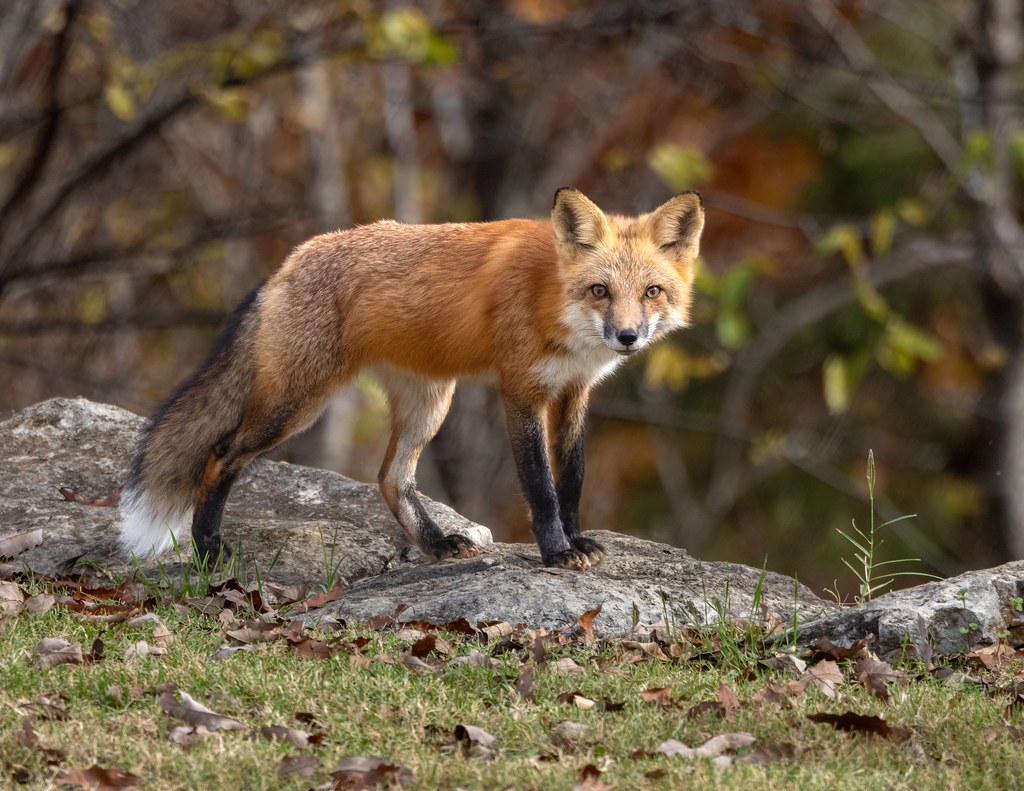
Seasonal Timeline
Red fox is active year round with no dormancy, and the calendar is driven by one litter a year. Breeding runs December through March, kits are born in early spring after about 51 to 53 days, and the family is usually gone from the den site by late June or July. Dispersal starts in mid-September.
Red fox is active year round with no dormancy, and the calendar is driven by one litter a year. Breeding runs December through March, kits…
One litter a year, and the whole year hangs off it. Gestation is 51 to 53 days in the federal species review, in the university museum account, and in Connecticut's own fact sheet, with Alaska giving 51 to 54. That much is settled. The breeding month is not a fixed date but a latitude gradient: Pennsylvania's game commission says February, Alaska says February and March, Virginia says January into February, and Connecticut gives a January to March window. There is no one month to pick, because a fox in Virginia and a fox near Nome are not on the same schedule.
The timing that actually matters to a homeowner is the den timing. Kits stay underground for the first month of life. They emerge about 4 to 5 weeks after birth, which is why the calls cluster in May and June. Minnesota's wildlife agency states the practical version plainly: foxes sometimes den under porches but usually leave by the end of June. That sentence is the whole exclusion schedule. Seal the space after they go, not before.
Alaska runs a separate risk calendar. Rabies case counts in Alaska foxes peak in late winter, and they peak hardest in the year following a lemming or vole population explosion, because more prey means more foxes and more contact between them. That is a genuinely different pattern from the rest of the country, where the rabies risk is not tied to a rodent boom cycle.
Where They're Found
Red fox is the most widely distributed land carnivore on earth and is present in every US state except Hawaii. It is established across Alaska, California, the Midwest, the Mountain West, the Northeast, the Pacific Northwest, the South Central states, and the Southeast. It is absent from Hawaii, and it is not established in the Southwest.
One conflict in the record is worth stating rather than smoothing over, because the explanation is genuinely interesting. The federal species review describes red fox as occurring across most of North America except the Great Plains and the extreme Southeast and Southwest. Connecticut's own account goes further and excludes Oregon, California, the Great Plains, the southwestern desert, and the extreme southeastern United States. Read literally, those two descriptions would exclude several areas where red fox lives today. They are not wrong. They describe natural historical range. Red fox is genuinely established in California, in Oregon, and in the Washington lowlands today in large part because it was introduced there, brought to California in the 1870s for hunting and again in the 1940s for fur farming. In Alaska the same story runs at island scale: red fox is native to Kodiak but was put onto many other islands by early 1900s fox farming. So the older range descriptions and the present-day distribution are both accurate, and the difference between them is a century of human introduction.
Alaska. Found throughout the state except some islands of Southeast Alaska and the western Aleutians, and rare in Prince William Sound. Documented in the Taku and Stikine river valleys, on Mendenhall Flats, and near Douglas Island by Juneau. Red fox also benefits from fire for the first 10 to 20 years afterward, because northern red-backed voles and meadow voles increase.
Pacific Northwest, where two foxes look identical. Washington carries both the common lowland red fox and the Cascade red fox, a subspecies found nowhere else on earth, classified endangered in Washington in 2023. It holds alpine and subalpine ground in the southern Cascades near Mt. Adams, the Indian Heaven and Goat Rocks wilderness areas, and Mount Rainier National Park, with no resident population currently known north of Interstate 90. Washington's own rule says the endangered subspecies cannot be visibly differentiated from the common one. Oregon classifies red fox as a furbearer.
California, where the fox is both the problem and the protected species. The Sierra Nevada red fox is a distinct subspecies, and its Sierra Nevada population segment was listed as federally endangered in 2021 with roughly 18 to 39 animals left, on federal land in Alpine, Fresno, Inyo, Madera, Mono, and Tuolumne counties. Hybridization with introduced lowland red foxes is one of the reasons it was listed. Meanwhile that same introduced lowland fox is documented as a predator of and competitor with the endangered San Joaquin kit fox, which needs the same den sites and the same prey, and as an ongoing threat to ground-nesting birds such as rails in coastal wetlands.
Mountain West. Colorado's wildlife agency puts red fox across most of the state in open woodlands, pasturelands, riparian corridors, and agricultural land, and notes it adapts well to urban margins. The Rocky Mountain animal is its own subspecies.
Midwest. Established, including the Great Plains states the older range accounts leave out. Michigan runs a statewide fox season and Minnesota treats both fox species as protected furbearers. The dispersal-distance research came out of Iowa and Illinois.
Northeast. Statewide in Pennsylvania and Connecticut, and historically the epicenter of fox rabies in the region: New York's public health laboratory records periodic rabies incursions into red fox populations in northern New York counties, arriving from Ontario and Quebec, as the state's most persistent wildlife rabies problem until 1990.
South Central and Southeast, where the legal record is thinner. The animal is present across both. The verified legal record is thinner than the biological one. For South Central, only Texas has a confirmed rule, and it does not extend to Oklahoma, Arkansas, Louisiana, Tennessee, or Kentucky. For the Southeast it rests on Virginia, which reports red fox throughout the entire state except the southeastern corner. No verifiable rule for the Deep South states turned up, so none is stated.
On a property, look at the open edge and at somebody else's hole. Red fox uses habitat edges heavily and prefers a mix of plant communities: farm country with woodlots, marshes, and streams, plus yards, parks, and golf courses next to undeveloped ground. The den is usually not dug from scratch. The federal review, Connecticut, and Pennsylvania all say the same thing independently: a red fox typically enlarges an abandoned woodchuck or badger burrow. Dens have at least two openings, Alaska has records with as many as 19, and a typical Alaska den runs 15 to 20 feet into the side of a knoll. Around houses, that translates to the ground-level crawl space under a deck, a shed, or a porch.
Life Cycle
The den is usually somebody else's, and that is the single most useful field fact about this animal. Three independent sources say it separately: the federal species review, Connecticut's fact sheet, and Pennsylvania's game commission all report that a red fox typically enlarges an abandoned woodchuck or badger burrow rather than digging its own. If there is an active fox den on a property, there is a good chance it started as a groundhog hole.
The litter-size numbers genuinely disagree, and the spread is worth seeing. The federal review reports litters of 4 to 17 with a mean of five. The university museum account gives an average of 5 with a range of 1 to 13. Pennsylvania says average six, range 4 to 10. Colorado says most average 4 to 5, with litters over 15 documented. Alaska says four is typical, range 1 to 10. Virginia says five. Every one of those is a real published figure, so the working statement is 4 to 6 typical against a documented outer range of 1 to 17.
Lifespan works the same way. The federal review says most wild red foxes live 3 or 4 years. Pennsylvania says 10 to 12 years is possible and the museum account gives up to 15 in captivity. Both are true of the same animal, and the gap between them is how much of the population dies young rather than a disagreement about the species.

Den-Bound Kit
Weaning Kit
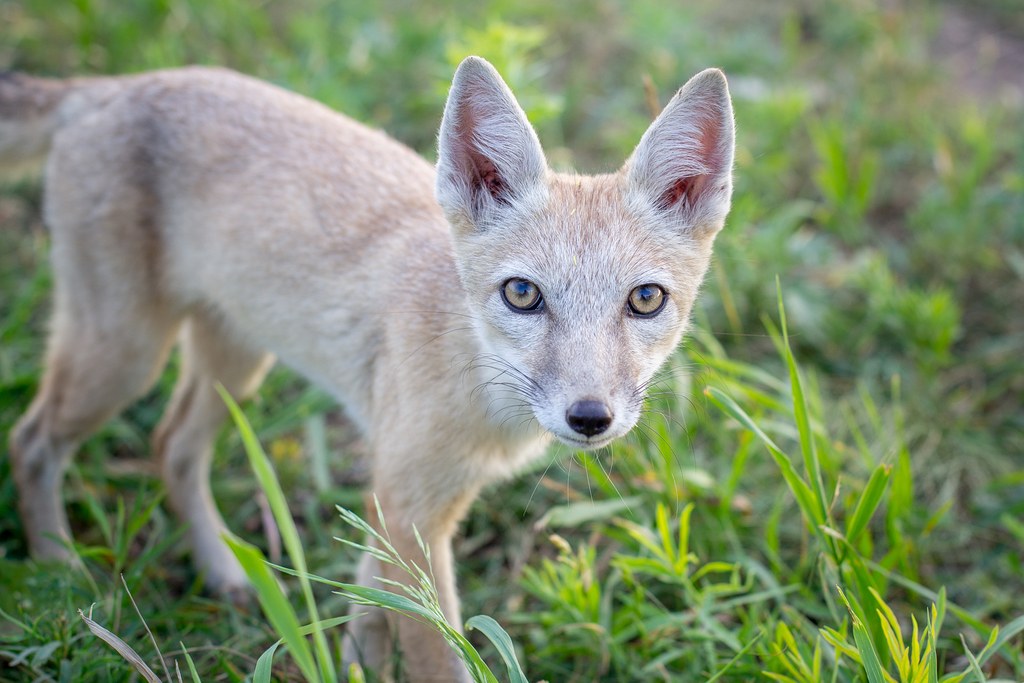
Juvenile2
Disperser
Adult
Identification
Three marks, because coat is unreliable
Three marks, not one, because coat color is unreliable on this species. Look for a white tail tip, black lower legs and feet, and vertical slit-like pupils. The white tail tip is the mark every state wildlife agency reviewed gives independently, from Pennsylvania to Connecticut to Colorado to Alaska, and Alaska specifically calls it the feature that separates red fox from other fox species. The black legs and feet read as socks against the reddish body. Virginia describes the eye as an oval, vertical iris like a cat's.
It is not always red
A red fox is not always red, which is exactly why one mark is not enough. The same species occurs in a cross phase with a dark cross over the back and shoulders, a silver phase, and a black phase. Colorado lists all four phases, and Alaska notes the black-silver phase becomes more common toward northern and northwestern Alaska while still making up under 2 percent of populations. A silver fox sighting is a red fox sighting. Coat runs anywhere from light yellowish to deep auburn.
Red fox versus gray fox, tail tip first
Red fox tail tip is white. Gray fox tail tip is black, with a black stripe running the length of the top of the tail and a mane of stiff black hairs along the back. That single comparison resolves most misidentifications, and it holds no matter what the rest of either animal's coat is doing.
Gray fox: the behavioral tell
Red fox versus gray fox, the behavioral tell that is even harder to get wrong. Pennsylvania's game commission states it directly: red foxes do not climb trees, unlike gray foxes. From the other direction, the federal review of gray fox establishes it as the only North American canid that regularly climbs trees, using semi-retractable claws and rotating wrists, and New York's wildlife agency calls tree climbing one of the most notable adaptations in the gray fox. A fox in a tree is not a red fox.
Red fox versus gray fox, coat and build
Red fox is reddish-orange with a white belly and throat, longer-legged and leaner. Gray fox is grizzled salt-and-pepper gray with reddish-brown on the neck, chest, and legs, stockier, with a shorter muzzle and shorter ears, and round pupils rather than slits.
A habitat tell, with a reason
There is a habitat tell too, and it comes with a reason. New York's wildlife agency ties the two species' coyote tolerance directly to where each one lives: the gray fox's preference for thicker cover, its aggression, and its climbing minimize the effect eastern coyotes have on it, while the red fox's preference for open terrain, more visible and farther from cover, lets coyotes suppress red fox populations where coyotes are abundant. So an open-country fox holding ground in coyote country is more likely a red fox, and a local red fox decline as coyotes move in is a documented pattern rather than a coincidence.
Red fox versus coyote, settled by weight
Red fox runs 7 to 15 pounds and averages 10 to 11. A coyote runs 20 to 45 pounds, with eastern animals at the top of that range. That is a two to four times difference, and it is visible at a distance. Coyote front tracks average 2.5 to 3 inches and are relatively round; Virginia gives red fox prints at about 2 inches with four claws. No stride figure is offered for red fox here, because no published figure was found, and inventing a matching number to sit next to the coyote's 16 to 18 inch trotting stride would be guessing.
Size, stated as the range it actually is
7 to 15 pounds, averaging 10 to 11, and 39 to 43 inches total length including a 14 to 16 inch tail, with males slightly larger. Colorado gives 8 to 15 pounds and 3 to 4 feet, Pennsylvania 8 to 12 pounds, Alaska 6 to 15. One museum account runs to 31 pounds, but that figure covers the species worldwide, including much larger northern Eurasian animals, and is not a US number.
Signs of Infestation
A den under a deck or shed
A den entrance at ground level, often under a deck, shed, or porch. Look for at least two openings, sometimes many more, with a fan of excavated soil. If it looks like a widened groundhog hole, that is normal: red fox usually improves an abandoned woodchuck or badger burrow rather than digging fresh.
Kits above ground in May or June
Young emerge about 4 to 5 weeks after a spring birth, and this is when most people first realize a den is there at all. Seeing them is the signal to start the exclusion clock, not to seal the hole.
Four-toed tracks, 2 inches across
Tracks about 2 inches across with four toes and visible claw marks. Noticeably smaller and narrower than the 2.5 to 3 inch, rounder front track a coyote leaves.
Poultry gone with no carcass
Missing poultry with no carcass left on the property. Red fox caches surplus food and is documented as very good at relocating those caches, so the bird is carried off rather than eaten in place. Scattered feathers and a missing hen is often the entire evidence set.
An adult out in daylight in May
An adult crossing open ground in daylight during May and June. That is a parent provisioning kits, and by itself it is not a rabies sign. What matters is behavior, not the hour: boldness toward people, disorientation or stumbling, unprovoked aggression, or partial paralysis.
Heavy hair loss is mange, not rabies
A fox with heavy hair loss that looks like it is dying has sarcoptic mange, not rabies. Connecticut describes infected animals losing hair and weight and usually dying within 2 to 4 months, and Pennsylvania notes red fox is more susceptible to mange than gray fox. It is a fox health problem and says nothing about your property. Do not handle it either way.
What you will not find is structural damage
No source documents red fox gnawing, nesting in insulation, entering living space, or damaging a building. The only structural interaction on record is denning in the crawl space underneath one.
Prevention and When to Call a Pro
Never handle a red fox
Never attempt a home capture-and-release either. This comes before anything else. Fox is one of the four terrestrial rabies reservoirs in the United States. National surveillance recorded 299 rabid foxes out of 3,760 animal rabies cases in 2023 and 269 out of 3,579 in 2022, roughly 8 percent both years, behind only bats, raccoons, and skunks. Connecticut's health department names bats, raccoons, skunks, and fox as the major reservoirs. New Jersey's wildlife division defines rabies vector species as raccoon, skunk, woodchuck, fox, and bats, and treats it as an operative legal category, banning importation of those species from any state endemic to a non-raccoon rabies variant and requiring rehabilitators who handle them to carry current pre-exposure rabies immunization or an acceptable titer. Any bare-hand contact, or contact with an animal showing unusual boldness, daytime disorientation, unprovoked aggression, or partial paralysis, is a potential exposure. Call animal control or a licensed nuisance wildlife control operator.
Alaska is a different rabies picture
Alaska is a materially different rabies picture, and residents there should read it as such. Arctic fox rabies is enzootic in arctic and red fox populations along Alaska's northern and western coasts, meaning it is always present at some level with periodic outbreaks. Beginning in September 2020, state biologists near Nome responded to foxes shaking or seizuring and entering dog yards to attack dogs. Between October 2020 and May 2021 the state virology lab confirmed rabies in about 15 animals, mostly red and arctic foxes plus two dogs and an otter, and the federal health agency confirmed the virus as the Arctic fox variant. Fox cases peak in late winter, and peak hardest the year after a lemming or vole boom drives fox numbers up.
One source pushes back
The nuance is worth keeping. Connecticut's environmental agency states that most red foxes die from rabies too quickly to spread the disease to other animals or people, and that raccoon rabies is the dominant strain in that state with raccoons as the primary carrier. That is not a contradiction of the vector designation. It describes red fox as a poor onward transmitter of the raccoon variant specifically, which is a separate question from whether a person in direct contact with an infected fox is at risk. Both are true at once.
The vector designation is by state
The rabies vector designation is real but it is set state by state, and one big state's list does not include fox. Connecticut and New Jersey both name fox explicitly. New York's public-facing rabies guidance and its nuisance wildlife control rules foreground bats, raccoons, and skunks instead, and New York's own public health laboratory treats red fox as a former rather than current primary reservoir, describing periodic incursions into northern New York fox populations from Ontario and Quebec as the persistent problem until 1990. So do not assume a uniform regional rule. Confirm with your state or county health department which species it classifies as a rabies vector, because that classification is what drives the handling, testing, and euthanasia requirements a licensed operator has to follow.
Poultry exclusion is the real job
Poultry exclusion is the actual prevention job. Virginia's wildlife agency puts it bluntly: poultry loss to red fox is largely a matter of improper husbandry. A fully enclosed, roofed run with wire buried 12 to 18 inches deep, or an L-shaped footer bent outward at the base, closes both the dig-under and the climb-over route. Bring cats, rabbits, and small poultry in at night, since a 7 to 15 pound fox is a documented cat and chicken predator. Virginia also notes red fox does not exert real pressure on game bird populations, which is worth knowing before assuming the fox is the reason quail numbers are down.
Den exclusion, and the timing
Den exclusion under a deck, shed, or porch, with the timing rule that decides whether it works. Minnesota's wildlife agency states the schedule directly: foxes sometimes den under porches but usually leave by the end of June. Kits emerge about 4 to 5 weeks after a spring birth and the family moves on in June or July. Once the den is confirmed empty, bury an L-shaped hardware cloth footer around the perimeter of the structure. Sealing an active den traps and kills the kits inside, and it also leaves you with a fox trying to dig back in.
Take away the edge, not the hole
Take away the edge, not just the hole. Red fox works habitat edges heavily, so the change that matters is at the boundary: cut dense low cover next to a coop or garden, secure trash in a latched container, never leave pet food outdoors, and pick up fallen fruit. Sealing one den without changing the edge usually just relocates the den.
Texas, do not move a live fox
Under the state rabies control quarantine, transporting a live fox, skunk, coyote, or raccoon is restricted, with narrow exemptions for officials, permitted rehabilitators, and licensed professionals, and with limits on where an exempt handler may release an animal. Penalties and exemptions change, so confirm the current rule with the Texas Department of State Health Services before moving any fox. This is Texas. It does not extend to Oklahoma, Arkansas, Louisiana, Tennessee, or Kentucky, and no comparable rule for those states has been verified.
Washington closes four forests
Washington: fox trapping is closed outright inside four national forests. Red fox trapping runs November 1 through March 31, but is closed within the exterior boundaries of the Mount Baker-Snoqualmie, Okanogan, Wenatchee, and Gifford Pinchot national forests. The reason is stated in Washington's own rule: the state-endangered Cascade red fox cannot be visibly differentiated from lowland red fox. A fox caught in a closed area must be released immediately and reported to the state within 24 hours, and any fox that cannot be released safely must be left in the trap with the agency notified immediately. Washington classified the Cascade red fox as endangered in 2023.
California, it may be endangered
California: the fox may be federally endangered, and you cannot tell by looking. The Sierra Nevada population segment of Sierra Nevada red fox was listed as endangered under the Endangered Species Act in 2021, with roughly 18 to 39 animals remaining, on federal lands in Alpine, Fresno, Inyo, Madera, Mono, and Tuolumne counties. The Southern Cascades population segment was not listed, because it is not expected to see substantial decline. Hybridization with introduced lowland red foxes is one of the reasons for the listing, alongside wildfire, drought, coyote competition, and prey declines. Separately, that introduced lowland fox is itself documented as a predator of and competitor with the endangered San Joaquin kit fox, which needs the same dens and the same prey, and as a threat to ground-nesting birds such as rails in coastal wetlands. In the Sierra Nevada, do not attempt removal of any kind. Contact the state wildlife agency.
The rest of the states
The rest of the verified legal picture, state by state, because it varies this much. Minnesota treats both fox species as protected furbearers with set seasons, and allows a damage take out of season by trapping or shooting only if a Conservation Officer is notified within 24 hours. Michigan runs a statewide red and gray fox hunting season, October 15 through March 1. Colorado requires a small game or furbearer license to hunt red fox on public land. Oregon classifies red fox as a furbearer and deliberately does not include it on the state's unprotected mammal list, which does cover coyote, badger, opossum, striped skunk, and yellow-bellied marmot. In Alaska red fox is a furbearer taken under either hunting or trapping regulations, with a trapping license required for trapping, mandatory hide salvage, and seasons that vary by unit.
Some states have no rule
Some states have no verifiable rule at all. No specific state rule was located for Wyoming, Montana, Idaho, most of the Deep South, or the South Central states other than Texas. Given that the confirmed range for this one species runs from a licensed hunting season to a transport prohibition to a federal endangered listing, sometimes inside a single region, assume nothing. Confirm the current rule with your state wildlife agency, or work through a licensed nuisance wildlife control operator, before trapping, relocating, or taking a fox, including on your own property.
Call for rabies-like behavior
Call immediately, without attempting contact, for any fox showing rabies-consistent behavior. Unusual boldness or no fear of people, daytime activity paired with disorientation or stumbling, unprovoked aggression toward people or pets, or partial paralysis. Alaska's outbreak specifically involved rabid foxes walking into dog yards and attacking dogs, so a fox going after a leashed or penned dog is squarely in this category. This supersedes every other threshold.
Call for any bite or scratch
Call for any bite, scratch, or bare-hand contact, including secondhand through a pet. Connecticut advises wearing gloves even to examine your own pet for wounds after a possible wildlife rabies exposure, and then seeking veterinary care. Do not evaluate a possible exposure yourself.
Call for a den with kits
Call for a den under a structure with kits still present, for repeated poultry or small-pet losses, and for anything where the next step would be a trap. The den case is a timing problem that has to be sequenced around the family leaving. The poultry case is usually an enclosure rebuild rather than an animal removal. And the trap case is where the legal exposure lives: a criminal transport prohibition in Texas, a 24-hour notification requirement in Minnesota, a closed season inside four Washington national forests, and a federally listed subspecies in the Sierra Nevada that no one can identify on sight.
Frequently Asked Questions
How do I tell a red fox from a gray fox?
Three marks, and any one of them will do. The tail tip is white on a red fox and black on a gray fox. A red fox has black lower legs and feet that read like socks, against a gray fox's grizzled salt-and-pepper coat. And red foxes do not climb trees, while the gray fox is the only wild dog in North America that regularly does, using semi-retractable claws and rotating wrists. A fox up a tree is a gray fox. Do not go by coat color alone, because red fox also occurs in cross, silver, and black phases.
Is that a red fox or a coyote in my yard?
Weight settles it fast. A red fox runs 7 to 15 pounds and averages 10 to 11, which is house-cat to small-terrier territory. A coyote runs 20 to 45 pounds, with eastern animals at the top of that range. Tracks agree: coyote front tracks average 2.5 to 3 inches and are relatively round, where red fox prints run about 2 inches with four toes and visible claws.
Do red foxes carry rabies?
Yes, and fox is the fourth terrestrial rabies reservoir in the country. National surveillance recorded 299 rabid foxes out of 3,760 animal rabies cases in 2023, and 269 out of 3,579 in 2022, behind bats, raccoons, and skunks. Connecticut's health department names fox among the major reservoirs, and New Jersey's wildlife division includes fox in its legal definition of rabies vector species. Alaska is the most active picture in the country: the Arctic fox rabies variant is always present in red and arctic fox populations along the northern and western coasts, and an outbreak near Nome in 2020 and 2021 involved rabid foxes attacking dogs in their own yards. Never handle a fox, and treat any bite, scratch, or bare-hand contact as a possible exposure.
There is a fox den under my shed. What should I do?
Wait, then seal. Kits are born in early spring, come above ground about 4 to 5 weeks later, and the family usually moves on by the end of June. Minnesota's wildlife agency says exactly that. Once the den is confirmed empty, bury an L-shaped hardware cloth footer around the perimeter of the shed so it cannot be reused. Sealing while kits are still inside traps and kills them, and it leaves an adult trying to dig back in.
Why does that fox have almost no fur?
Sarcoptic mange, caused by microscopic mites, and it is common in this species. Connecticut describes infected foxes losing hair and weight and usually dying within 2 to 4 months, and Pennsylvania notes red fox is more susceptible to it than gray fox. A peer-reviewed study of a mange outbreak on Fire Island, New York found the disease wiped red foxes out of one section of the island entirely within months. It is not rabies and it is not a sign of anything about your property. Do not handle the animal either way.
Can I trap a fox on my own property?
Check before you do anything, because the rules for red fox vary sharply from state to state. In Texas, moving a live fox is restricted under the state rabies quarantine. In Washington, fox trapping is closed inside four national forests because the state-endangered Cascade red fox cannot be told apart from a common one by sight. In the Sierra Nevada, the animal may be federally endangered. In Minnesota you may take a damaging fox out of season but must notify a Conservation Officer within 24 hours. Confirm the current rule with your state wildlife agency, or work through a licensed nuisance wildlife control operator.
Will a red fox get into my attic or damage my house?
No. Nothing in the documented record shows red fox gnawing, nesting in insulation, entering living space, or damaging a structure. The only building interaction on record is denning in the crawl space underneath a deck, shed, or porch. If something is in the attic, it is not a red fox.
Sources
- Vulpes vulpes, red fox (Fire Effects Information System): North American nativity debate, subspecies, range exclusions, habitat and edge use, woodchuck and badger burrow denning, den entrance counts, gestation, litter range, kit development timeline, dispersal distances, wild lifespan, and vole diet share USDA Forest Service
- The origin of recently established red fox populations in the United States: translocations or natural range expansions? Journal of Mammalogy 93(1):52, finding no Eurasian haplotypes in North America and attributing southeastern populations to natural range expansion rather than colonial European introduction USDA Forest Service Treesearch, with Journal of Mammalogy
- Foxes: red fox size and weight, black ears legs and feet, white-tipped tail, the statement that red foxes do not climb trees unlike gray foxes, February breeding, 51-day gestation, litter average six, kit development, mid-July den departure, and greater mange susceptibility than gray fox Pennsylvania Game Commission
- Red Fox fact sheet: size and weight range, range exclusions including Oregon and California, woodchuck burrow denning, denning under decks and sheds, sarcoptic mange course and mortality, and the statement that most red foxes die from rabies too quickly to spread it Connecticut Department of Energy and Environmental Protection
- Rabies: the statement that bats, raccoons, skunks, and fox are the major reservoirs and a source of potential infection for other animals and people, plus glove and veterinary guidance after a possible pet exposure Connecticut Department of Public Health
- Wildlife Rehabilitator Definitions and Requirements: the operative definition of rabies vector species as raccoon, skunk, woodchuck, fox, and bats, and the pre-exposure immunization requirement for permittees handling them New Jersey Department of Environmental Protection, Division of Fish and Wildlife
- Captive Rabies Vector Species policy: the import ban on raccoons, skunks, fox, woodchucks, and bats from states endemic to a rabies variant other than the raccoon variant New Jersey Department of Environmental Protection, Division of Fish and Wildlife
- Rabies History: terrestrial carnivore rabies cycling in red foxes, skunks, and raccoons since the 1950s, and periodic rabies incursions into red fox populations in northern New York counties from Ontario and Quebec as the state's most persistent problem until 1990 New York State Department of Health, Wadsworth Center
- Gray Fox: tree climbing as one of the most notable gray fox adaptations, the black-tipped tail and black dorsal mane, and the finding that red fox preference for open terrain allows coyotes to suppress red fox populations where coyotes are abundant New York State Department of Environmental Conservation
- Rabies surveillance in the United States during 2023, Journal of the American Veterinary Medical Association 263(10): 3,760 animal rabies cases with foxes at 299 (8.0 percent) behind bats, raccoons, and skunks, drawn from the National Rabies Surveillance System American Veterinary Medical Association, with CDC National Rabies Surveillance System
- Rabies surveillance in the United States during 2022 National Institutes of Health, National Library of Medicine (PubMed)
- Red Fox Species Profile: Alaska statewide distribution and island exclusions, Kodiak nativity against early 1900s fox-farm introductions, the four color phases and the under-2-percent black-silver figure, size and weight, February to March breeding, 51 to 54 day gestation, den dimensions, and food caching Alaska Department of Fish and Game
- Rabies Outbreak in Western Alaska: the September 2020 Nome-area outbreak, foxes shaking and seizuring and entering dog yards to attack dogs, about 15 animals confirmed October 2020 to May 2021 mostly red and arctic foxes, and federal confirmation of the Arctic fox rabies variant Alaska Department of Fish and Game, Alaska Fish and Wildlife News
- Rabies in Alaska's Species: Arctic fox rabies enzootic in arctic and red fox populations along Alaska's northern and western coasts, and the late-winter case peak following lemming and vole population booms Alaska Department of Fish and Game
- Sierra Nevada Red Fox (Vulpes vulpes necator): the Sierra Nevada Distinct Population Segment listed endangered in 2021, the Southern Cascades segment not listed, the 18 to 39 individual estimate, county-level occurrence, and hybridization with non-native foxes among the listed threats U.S. Fish and Wildlife Service
- Endangered and Threatened Wildlife and Plants; Endangered Species Status for the Sierra Nevada Distinct Population Segment of the Sierra Nevada Red Fox, final rule published August 3, 2021 Federal Register, U.S. Fish and Wildlife Service
- Species Status Assessment Report for the San Joaquin kit fox: non-native red fox as a predator of and competitor with the endangered San Joaquin kit fox for den sites and prey, and as a threat to coastal ground-nesting birds U.S. Fish and Wildlife Service, ECOS ServCat
- Cascade red fox (Vulpes vulpes cascadensis): Washington-endemic subspecies, state endangered status, southern Cascades range concentrated near Mt. Adams, Indian Heaven, Goat Rocks, and Mount Rainier, no resident population known north of Interstate 90, and the three color phases Washington Department of Fish and Wildlife
- Furbearer trapping seasons and rules: red fox season November 1 through March 31, the closure within the exterior boundaries of the Mount Baker-Snoqualmie, Okanogan, Wenatchee, and Gifford Pinchot national forests, the statement that Cascade red fox cannot be visibly differentiated from lowland red fox, and the 24-hour incidental-capture reporting requirement Washington Department of Fish and Wildlife
- News release, July 3, 2024: the Cascade red fox classified as endangered in Washington in 2023, and the permanent national forest fox trapping restriction to prevent accidental take Washington Department of Fish and Wildlife
- Red Fox species profile: distribution across most of Colorado, open woodland, pastureland, riparian, and agricultural habitat with urban-margin adaptation, size, the four color phases, single annual litter averaging 4 to 5, and the small game or furbearer license requirement Colorado Parks and Wildlife
- Living with foxes: both fox species protected as furbearers with set seasons, the out-of-season damage take with 24-hour Conservation Officer notification, and the statement that foxes denning under porches usually leave by the end of June Minnesota Department of Natural Resources
- Fur harvester regulations: statewide red and gray fox hunting season, October 15 through March 1 Michigan Department of Natural Resources
- Oregon Furbearer Trapping and Hunting Regulations: red fox classified as a furbearer, and the separate unprotected mammal list that deliberately excludes it Oregon Department of Fish and Wildlife
- Statewide Quarantine, 25 Texas Administrative Code 169.34: the prohibition on transporting any live fox, skunk, coyote, or raccoon indigenous or naturalized to North America, the Class C misdemeanor penalty, the exemption list, and the 10-mile same-county release limit Texas Department of State Health Services, Zoonosis Control
- Red fox: Virginia distribution throughout the state except the southeastern corner, paw print size and claw count, vertical cat-like iris, home range, average litter of five, and the statement that poultry loss is largely due to improper husbandry and that red fox does not exert real pressure on game bird populations Virginia Department of Wildlife Resources
- Vulpes vulpes (red fox): species-wide size range, black lower legs, yellow eye, solitary social structure with a single breeding male and one or two breeding females, 51 to 53 day gestation, litter range 1 to 13, weaning at 8 to 10 weeks, sexual maturity at 10 months, dispersal distances, 28 described vocalizations, and food caching Animal Diversity Web, University of Michigan Museum of Zoology
- Epidemiology of sarcoptic mange in a geographically constrained insular red fox population, Parasites and Vectors: the Fire Island, New York epizootic from 2015, extirpation east of the Old Inlet breach by March 2016, 7 of 36 collared foxes found dead with mange signs, and literature mortality rates of 21 to 100 percent in infected populations National Institutes of Health, National Library of Medicine (PubMed Central)
- Urocyon cinereoargenteus, common gray fox (Fire Effects Information System) USDA Forest Service
- Coyote Ecology and Damage Management, Wildlife Damage Management Technical Series: coyote weight range, oval front track measurement, and trotting stride, used here only for the red fox versus coyote size comparison USDA APHIS Wildlife Services
- Identifying and Preventing Poultry Predators in the Mid-Atlantic Region: buried-wire and L-footer enclosure specifications for fox-proofing backyard poultry University of Maryland Extension
- Alaska Trapping Regulations and Hunting Regulations for Fur Animals and Small Game: red fox as a furbearer takeable under either hunting or trapping rules, the trapping license and hide salvage requirements, and unit-by-unit seasons Alaska Department of Fish and Game
Image Credits
- Image: photographer not named via iNaturalist. CC0 1.0.
- Image: Safina Rezeda via iNaturalist. CC BY 4.0.