Seasonal Timeline
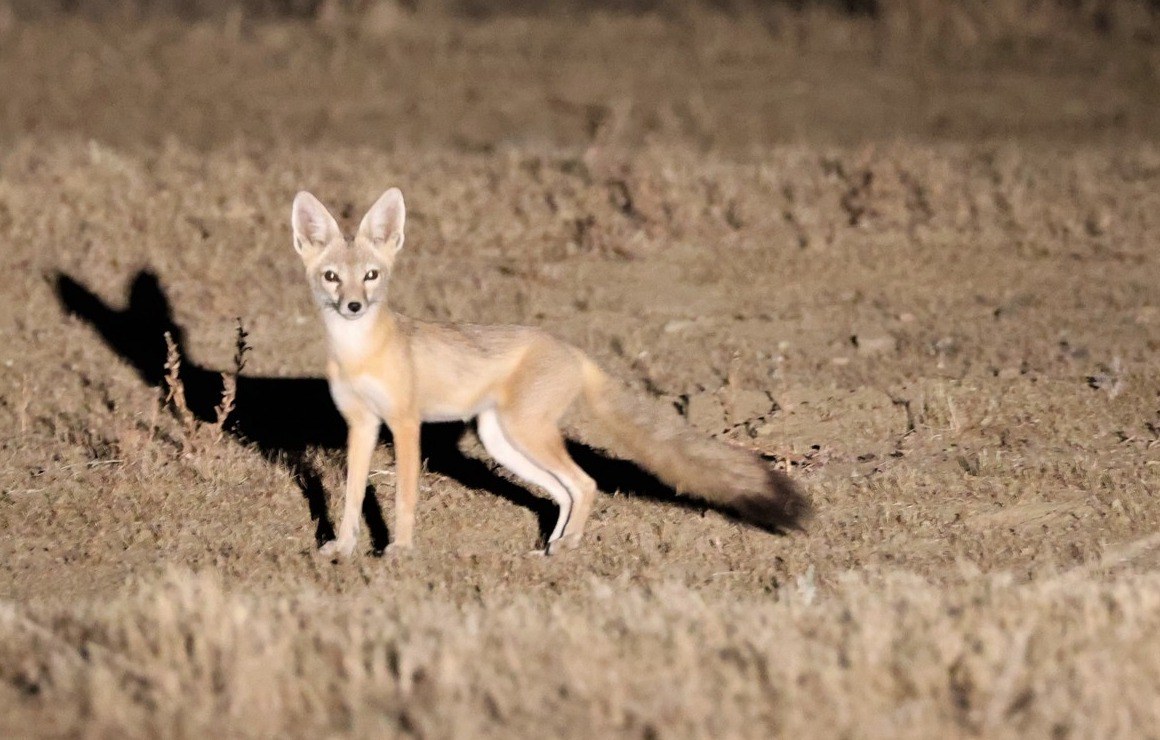
Kit foxes are active all year and do not hibernate, but the calls come in a tight window. Breeding runs mid-December through February, pups are born February through mid-March after a 49 to 55 day gestation, and the young are above ground and visible around four weeks later. That puts the season for sightings, and for a den turning up under a shed, squarely in February through April, with January and May on the shoulders. By late summer the young are dispersing and the animals are much harder to see.
Kit foxes are active all year and do not hibernate, but the calls come in a tight window. Breeding runs mid-December through February, pups…
The reproductive calendar is unusually well settled for a wild canid. Colorado Parks and Wildlife puts breeding in December through February and gestation at 49 to 55 days. The California Department of Fish and Wildlife's life history account gives the same 49 to 55 days, citing Egoscue's Utah fieldwork, and places most births in February through April. Animal Diversity Web narrows the breeding window to mid-December through February and births to February through mid-March. Every published account agrees on one litter per year, and none describes a second litter under any conditions.
One number is genuinely contested. Animal Diversity Web says pups are weaned at about 8 weeks. California's life history account says pups are weaned at about 4 to 5 months. Those are not close. The most likely explanation is that the California account is describing independence rather than the end of nursing, since the federal five-year review for the endangered subspecies says young are born in large natal dens and generally disperse in August or September at 4 or 5 months old, which lines up with the later figure as a dispersal date rather than a weaning date. Both figures are worth knowing: treat 8 weeks as weaning and 4 to 5 months as independence and dispersal, though no single published source states that reconciliation outright.
What that means on the ground. A den that suddenly seems busy in March is a natal den with pups in it. A den that goes quiet in late summer has not necessarily been abandoned because of anything a homeowner did. Dispersal is normal, and so is a kit fox simply moving house, which it does constantly.
Where They're Found
In the Southwest, this fox occurs in Arizona, New Mexico, Nevada, and Utah. Kit fox is a desert-lowland animal across all four, and it is genuinely the fox you are most likely to meet in open low desert, where gray fox is scarce.
Nevada. The Nevada Department of Wildlife runs a species page for kit fox and describes it as present through most of the state's counties, concentrated in the Mojave Desert region and in flat, arid terrain, with cold desert shrubland, sagebrush, and grassland all listed as habitat. Nevada lists it as state protected, with a game status of furbearer.
Utah. The Division of Wildlife Resources runs a statewide kit fox trapping season and, in the same paragraph, names it a Species of Greatest Conservation Need. In Utah it is a Great Basin and desert animal rather than a mountain one.
Arizona. Arizona statute classifies foxes as predatory animals rather than as fur-bearing animals, which in Arizona means muskrats, raccoons, otters, weasels, bobcats, beavers, badgers, and ringtail cats specifically. The statewide season for foxes under Commission Order 13 runs August 1 through March 31. Kit fox occupies the low desert basins, while gray fox holds the higher elevation and riparian ground.
New Mexico. Fox is a furbearer under state rule, with an open season statewide from November 1 through March 15, shared with badger, weasel, ringtail, and bobcat. The rule sets that season for fox as a category and does not name kit fox separately. Eastern New Mexico is also where this species runs into its closest relative.
Three places the range reaches beyond those four states. Animal Diversity Web runs the species from the arid interior of Oregon east to southwestern Colorado and south through Nevada, Utah, southeastern California, Arizona, New Mexico, and into western Texas, at elevations of roughly 400 to 1,900 meters, about 1,300 to 6,200 feet. Southwestern Colorado holds a population from Montrose to Grand Junction that Colorado Parks and Wildlife lists as state endangered and calls one of the state's most vulnerable mammals. West Texas sits at the eastern edge of the desert range, a sliver of a very large region. And California carries two separate kit fox situations at once, which is important enough that it gets its own paragraph.
California is a separate case, and the reason is legal. California's own life history account for the species states plainly that the San Joaquin kit fox, Vulpes macrotis mutica, is Federal Endangered and California Threatened. The U.S. Fish and Wildlife Service confirms the federal side: Vulpes macrotis mutica was listed as endangered on March 11, 1967, and occurs through much of the valley floor and foothills of the San Joaquin Valley from San Joaquin County south to Kern County, plus the Panoche and Cuyama valleys and the Carrizo Plain. That is a different legal situation from the desert kit fox of the Mojave and Colorado deserts in southeastern California, which is not federally listed. Because the two are the same species and cannot be told apart by sight, there is no safe general answer for California. If you are in California, identify the animal carefully and call the state agency.
Alaska and Hawaii. No published record places kit fox in Alaska. Every range description found for this species is confined to the arid interior of the western United States and northern and central Mexico, well south of Alaska. Hawaii has no native or established wild canid of any kind, and no published record places kit fox there. Both are confirmed absences rather than unknowns.
What the habitat looks like. Open, level ground with loose sandy or loamy soil, sparse shrub cover, and short vegetation. California's account is specific about the soil, because the animal has to be able to dig: kit foxes are absent or scarce where soils are shallow because of high water tables, hardpan, or bedrock near the surface, and they do not den in saturated soil or in ground that floods. In practice that means the yards, lots, and golf course edges that back onto open desert, not the irrigated interior of a subdivision.
Life Cycle
Gestation is the one figure nobody disputes. Colorado Parks and Wildlife, California's life history account, and Animal Diversity Web all give 49 to 55 days, and all three trace back through the same Utah fieldwork. Litter size is consistent too, 1 to 7 pups averaging about 4, with Colorado adding that its own litters are believed to run smaller than the four or five reported elsewhere.
The pair bond is stronger than the usual line about foxes suggests, and it has been measured. A study of the endangered California subspecies, summarized in the federal five-year review, found that kit foxes hold pair bonds year round rather than only during breeding and pup rearing, that pairs surviving to the next breeding season generally stay together, and that the researchers concluded the species has a perennially monogamous social system with generally lifelong pair bonds. The reason most pairs do not last is not divorce, it is death: loss of a mate accounted for most bond dissolutions, and because mortality is high, few pairs would be expected to last more than three breeding seasons. Coyotes account for more than 75 percent of kit fox predation.
One caution on which animal these numbers describe. A large share of the detailed life history research on kit fox was done on the San Joaquin subspecies in California, because that is the population with federal recovery funding behind it. The two are the same species, but a reader should know the difference between a Bakersfield finding and an Arizona one.

Natal Den Pup
Emerging Pup
Juvenile Disperser
Adult2
Identification
The ears are the identification
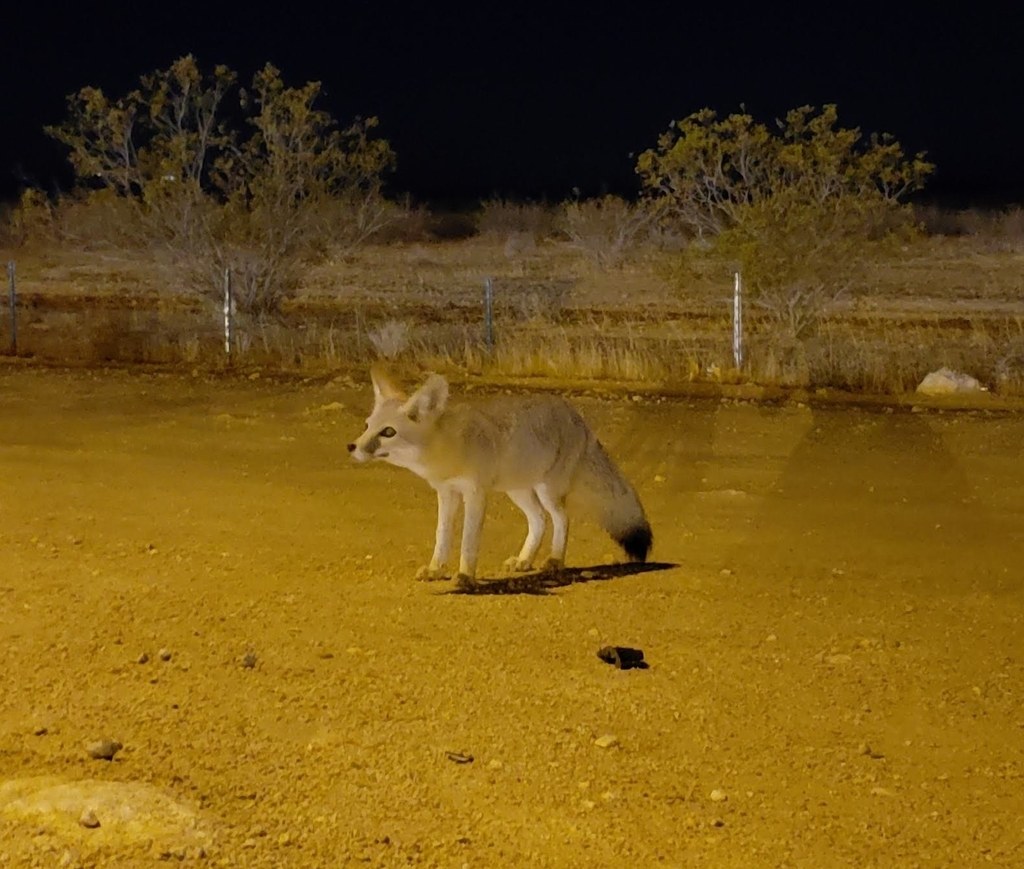
They are measurable. Colorado Parks and Wildlife gives kit fox ears at 78 to 94 millimeters, about 3 to 3.7 inches, and Animal Diversity Web gives 71 to 95 millimeters. On a fox that stands about 12 inches at the shoulder, ears that size are unmistakable and are the single fastest way to separate this animal from anything else in the desert. They serve double duty, dumping body heat and picking up prey in the dark.
Size: the smallest wild dog on the continent
The Nevada Department of Wildlife, Colorado Parks and Wildlife, and the federal five-year review for the endangered subspecies all describe Vulpes macrotis as the smallest fox, or the smallest canid, in North America. Colorado gives 1.5 to 2.5 kilograms, roughly 3 to 6 pounds, and compares the animal to a full-grown jackrabbit. The federal review puts the average at 5 pounds and about 12 inches tall.
Two agencies seem to contradict
Two agencies give length figures that look contradictory, and the likely reason is worth stating. Colorado gives total length of 730 to 840 millimeters, about 29 to 33 inches, with a tail of 260 to 323 millimeters. Nevada gives 12 to 20 inches. Those cannot both be total length. Nevada's figure is almost certainly body length without the tail, and Colorado's is head to tail tip, but neither agency says so explicitly, so both are reported rather than just the tidier one.
Pale and grizzled, black tail tip
Color is pale and grizzled, and the tail tip is black. Colorado describes the coat as light, varying between grizzled gray, yellow-gray, and buff-gray. The federal review describes it as buff to tan or yellowish, varying with location and season, with a small slim body, large close-set ears, and a long bushy tail tapering to a distinctly black tip.
Gray fox, by size and elevation
Gray fox is the look-alike that actually matters in the Southwest, and the tells are size and elevation. A gray fox runs roughly 7 to 11 pounds against a kit fox's 3 to 6, carries a salt-and-pepper gray back with reddish-brown on the neck, chest, and legs, and has ears in normal proportion to its head. It also climbs trees, which no kit fox does. Habitat separates them cleanly most of the time: gray fox holds the higher elevation and riparian country, kit fox holds the open low desert. Which of the two is in the yard is the question this species generates more than any other, and elevation and habitat answer it most of the time.
Swift fox, and where they interbreed
Swift fox is the close relative, and in one part of this region the two actually interbreed. Vulpes velox is a Great Plains animal that Colorado Parks and Wildlife describes as the eastern plains counterpart to the kit fox, and Colorado's kit fox page notes that kit fox ears are notably larger than a swift fox's. That is the field mark. The two species meet in the Trans-Pecos region of New Mexico, where they are known to hybridize, and a review published through New Mexico's own state biota reference system quotes the working figure for that hybrid zone as an area not exceeding 50 to 60 miles in width in the Pecos Basin. The same review notes the contact zone is as enduring as it is broad, having existed for several thousand years, and that abrupt differences in body form between the two persist inside it anyway. For the rest of this region swift fox is simply out of range, and outside the Pecos Basin an animal with ears this large in open desert is a kit fox.
Even specialists have mixed these up
Even the specialists have mixed these two up, which is worth knowing before you trust a casual identification. That same review documents a museum specimen collected in 1928 southwest of Albuquerque, catalogued for decades as a swift fox, that was recently reexamined and identified as a kit fox, and notes a separate northwestern New Mexico kit fox that was mistakenly entered in museum records as a swift fox and helped overstate the swift fox's historical range. If a curated specimen record can get it wrong, a photograph taken at night from a back porch can too.
The San Joaquin legal problem
You cannot tell a San Joaquin kit fox from any other kit fox by looking at it, and that is the whole legal problem. Vulpes macrotis mutica is a subspecies of this same species, listed as federally endangered on March 11, 1967 and listed as threatened by California. The federal five-year review describes it as the larger of the two subspecies, which is a difference of degree measured in a lab, not something visible in a yard. The practical rule is geographic, not visual: in California's San Joaquin Valley and the Bakersfield area, treat any kit fox as the endangered subspecies, do not trap it, harass it, or relocate it, and contact the U.S. Fish and Wildlife Service or the California Department of Fish and Wildlife. In Arizona, Nevada, New Mexico, and Utah, the animal in front of you is not that subspecies.
A coyote is not a large kit fox
This sounds obvious and it is still the most common misreport, usually at night and at distance. A coyote outweighs a kit fox by roughly five to ten times, carries a proportionally much smaller ear, and does not have the black-tipped, heavily furred tail. Coyotes are also the kit fox's main predator, accounting for more than 75 percent of kit fox deaths from predation, so the two are not sharing ground comfortably.
Signs of Infestation
A burrow in open, level, sandy ground
A burrow entrance in open, level, sandy ground. Kit fox dens go into loose sandy or loamy soil in flat open areas, and can run more than 6 feet below the surface. Colorado describes clusters of dens with multiple entrances, up to about 10 dens grouped inside an area of roughly 2 to 3 acres, with shelter dens usually having two entrances and whelping dens two to four.
More dens than you would expect
More than one den, and a lot more than you would expect. This is the fact that changes how a homeowner should read a burrow under a shed. Kit foxes rotate among several dens in a territory and change dens constantly. A 2025 peer-reviewed study of the urban California population tracked 37 marked foxes and found that over a 120-day span a single collared fox used a mean of 7.6 different dens. That same paper collects the published estimates for kit foxes in natural habitat, and the annual mean per fox across those studies runs from 8.4 dens up to 19.4, with one study recording a single animal using 64. A den on your property is one address of many, and the animal may leave on its own within days.
Dens that were somebody else's first
Kit foxes dig their own, but they also take over burrows from prairie dogs, other rodents, and American badgers. A hole that looks too small or too old to be a fox den can still be one.
Sightings at night, mostly
The species is primarily nocturnal and occasionally crepuscular, spending the day in a den and coming out to hunt. California's account notes daytime activity happens mostly in cool weather. A small pale fox out in the open at midday in July is worth a second look, and possibly a call.
Hair loss and a skeletal look
Hair loss, thickened crusted skin, and an animal that looks skeletal. That is sarcoptic mange, and for kit fox it is the disease that matters. Do not approach the animal. Report it to the state wildlife agency.
What you should not expect
No published record documents kit fox causing structural damage, raiding attics or wall voids, tearing into trash the way a raccoon does, or acting aggressively toward people. This is a 4-pound nocturnal rodent hunter. The realistic complaint list is a burrow in an inconvenient place, an animal denning under a shed or deck, and occasional risk to unprotected small poultry.
Prevention and When to Call a Pro
Never handle a fox
That holds living or dead, and never try to capture and release one yourself. Foxes are an established rabies reservoir across this region, and two independent public health sources say so. The Arizona Department of Health Services names bats, skunks, and foxes as the state's most common rabies reservoirs. A study published in the Centers for Disease Control and Prevention's Emerging Infectious Diseases journal states that in New Mexico, skunks, bats, and gray foxes are rabies reservoir hosts and represent a public health risk because of encounters with humans, and that the state carries more than three separate rabies enzootic cycles. That is why this rule comes before every other precaution. No bare-hand contact, no cornering, no home capture, no relocation. If a fox bites or scratches a person or pet, contact a doctor or veterinarian and your local health department the same day.
Arizona has a fox rabies problem
Arizona carries a fox rabies problem that is specific to Arizona, and it is the strongest reason not to guess at fox species. The state's rabies manual describes a unique variant of rabies virus associated with the Arizona gray fox, present in every county except Mohave, and notes it spills over into coyotes, bobcats, javelina, horses, badgers, llamas, and dogs. In the 2025 surveillance year the state confirmed 24 rabid foxes out of 118 positive animals statewide, concentrated in Cochise, Pima, and Santa Cruz counties in the southeast. State reporting counts foxes as one category, so kit fox is not broken out separately and no published report names a rabies-positive kit fox. That is an absence of species-level data, not a clean bill of health. Treat every fox as a rabies risk regardless of which one you think it is.
Nevada is a real exception
The state says so in its own words. The Nevada Department of Agriculture's rabies guidance advises that horses should be vaccinated against rabies if they travel to areas with terrestrial rabies like California or Arizona, which is the state describing itself as outside that category. Nevada's rabies picture is a bat picture, with the Animal Disease Laboratory confirming rabies in 8 to 15 percent of the bats submitted to it. This does not change the never-handle rule. It does mean the fox rabies risk in Nevada is not the same risk it is across the Arizona line.
Sarcoptic mange is the real disease
Sarcoptic mange is the disease actually hitting this species, and it is worth knowing why that matters to a homeowner. Mange was detected in the urban kit fox population in Bakersfield, California in 2013 and significantly reduced the population. As of August 2023 at least 454 cases had been documented there, plus at least 56 more in the nearby town of Taft. The 2025 den-sharing study found that other foxes used the same den as a collared fox in 89 percent of monitored weeks, which is a plausible route for mites that can survive off a host in den soil for days. This is a wildlife health issue, not a pest control service line, but it is the reason to report a visibly sick fox to the state rather than trying to help it yourself, and the reason not to encourage several foxes to share one burrow on your property by feeding them.
Take away the rodents
Take away the food, which for this animal means rodents and open feeding stations, not garbage. Kit fox diet is kangaroo rats, pocket mice, ground squirrels, cottontails, jackrabbits, ground-nesting birds, and seasonal insects. A property with a heavy rodent population next to open desert is the attractant. Outdoor pet food bowls are the other one. The Bakersfield research found kit foxes, feral cats, skunks, and red foxes all using the same cat feeding stations, which is exactly how a shared-den disease problem starts.
Close the crawl spaces early
Close the space under sheds, decks, and outbuildings before denning season, not during it. The window that matters is December through February, ahead of the February to mid-March birth period. Screen or skirt the gap with hardware cloth buried at the base, and check first that nothing is already living under there. Sealing a natal den with pups inside is both cruel and, in the case of a listed population, illegal.
Do not fill an unconfirmed burrow
Do not fill a burrow you have not confirmed is empty, and remember it is probably one of several. Because a single fox may use seven or more dens in four months and switch every few days, patience is a legitimate strategy here in a way it is not for most wildlife. Monitor the entrance, confirm no activity, then exclude.
Protect poultry with the enclosure
The fox is not the variable you control. A 4-pound fox is not getting through a properly built coop. Solid walls, a covered run, hardware cloth rather than chicken wire, and a buried apron are the standard answer, and they work against gray fox, coyote, and bobcat at the same time.
Four states, four classifications
Know your state's classification before you touch a trap, because these four states do not agree. Utah runs a statewide kit fox season from September 15 through March 1 with no bag limit, and prints this alongside it: the kit fox is considered a Species of Greatest Conservation Need in Utah, and the Division encourages trappers to release all kit fox unharmed. Nevada lists the species as state protected with a game status of furbearer. Arizona statute classifies foxes as predatory animals, with a statewide season under Commission Order 13 running August 1 through March 31. New Mexico treats fox as a furbearer with a statewide season of November 1 through March 15. Seasons and rules change annually, so confirm the current year with the state agency rather than relying on a published summary.
Outside them the answer can flip
Outside these four states the answer can flip completely. Colorado lists kit fox as state endangered and calls it one of the state's most vulnerable mammals. California holds the federally endangered San Joaquin subspecies. If your property is in southwestern Colorado or anywhere in California, the correct action is to contact the state wildlife agency before doing anything at all, including exclusion work.
Call a wildlife pro for a den
Call a licensed wildlife control professional, not a general pest technician, for anything involving an occupied den. That is the threshold. A burrow you can screen off in December is a homeowner job. A den with pups in it in March, a fox denning under an occupied structure, an animal that looks sick, or any situation where you are not certain of the species is not.
Call the state if unsure of species
Call your state wildlife agency directly if you are unsure which fox you have and you are anywhere near California. The identification is not something to resolve from a photograph on the internet, because being wrong about a listed subspecies carries federal consequences that being wrong about a gray fox does not.
Frequently Asked Questions
What is the tiny fox with huge ears in my desert yard?
Almost certainly a kit fox, Vulpes macrotis, the smallest wild dog in North America at 3 to 6 pounds. The giveaway is the ears, 78 to 94 millimeters tall per Colorado Parks and Wildlife, on an animal about 12 inches at the shoulder. Those ears shed body heat and pick up prey in the dark. It is nocturnal, it eats kangaroo rats and other small rodents, and it is not a threat to people. The main look-alike in this region is gray fox, which is roughly twice the weight, has normal-sized ears, carries reddish-brown on the neck and legs, climbs trees, and prefers higher and wetter ground than open desert.
Is the kit fox in my yard the endangered one?
In Arizona, Nevada, New Mexico, or Utah, no. The federally endangered animal is the San Joaquin kit fox, Vulpes macrotis mutica, a subspecies of the same species listed as endangered on March 11, 1967 and listed as threatened by California. Its range is California's San Joaquin Valley and adjoining areas, from San Joaquin County south to Kern County plus the Panoche and Cuyama valleys and the Carrizo Plain. You cannot tell the two apart by sight, so the rule is geographic. If you are in that part of California, treat the animal as endangered, do not trap, harass, or relocate it, and contact the U.S. Fish and Wildlife Service or the California Department of Fish and Wildlife. Southeastern California also holds desert kit foxes that are not federally listed, which is another reason not to guess in that state.
Do kit foxes carry rabies?
Treat every fox as if it does. Arizona names bats, skunks, and foxes as its most common rabies reservoirs, and a study in the CDC's Emerging Infectious Diseases journal states that skunks, bats, and gray foxes are rabies reservoir hosts in New Mexico and a public health risk because of encounters with humans. Arizona also has a rabies variant specific to the Arizona gray fox, found in every county except Mohave, with 24 rabid foxes confirmed in the 2025 surveillance year. State reporting does not break foxes out by species, so no kit-fox-specific case has been documented. That is missing data, not evidence of safety. Never handle a fox, and if one bites or scratches a person or pet, call a doctor or veterinarian and your local health department the same day.
There is a fox den under my shed. How do I get rid of it?
First, work out whether it is occupied and whether there are pups. Births run February through mid-March and the young are above ground about four weeks later, so a den that gets busy in spring has a litter in it. Sealing it then traps and kills the pups. Second, understand that kit foxes move constantly: a 2025 study found one fox using an average of 7.6 different dens over 120 days, and published estimates for foxes in natural habitat run from 8.4 to 19.4 dens per animal per year. Waiting is a real option with this species. Once you have confirmed no activity, skirt the shed with buried hardware cloth. If the den is occupied, if there are pups, or if you are not sure of the species, call a licensed wildlife control operator rather than handling it yourself.
Do kit foxes need water? I never see one at my birdbath.
They may not need standing water at all. California's own life history account states the species may not require a source of drinking water and sustains itself on moisture derived from its prey. The Nevada Department of Wildlife says the same thing, that kit foxes absorb sufficient water from the animals and plants they eat. Combined with staying underground through the heat of the day and hunting at night, that is how a 4-pound canid holds a territory in open desert. Removing a water feature will not move a kit fox off your property.
Is it legal for me to trap a kit fox?
It depends entirely on the state, and these four do not agree. Utah runs a statewide season from September 15 through March 1 with no bag limit while printing in the same guidebook that kit fox is a Species of Greatest Conservation Need and that trappers are encouraged to release all kit fox unharmed. Nevada lists it as state protected with a game status of furbearer. Arizona statute treats foxes as predatory animals, with a statewide season running August 1 through March 31. New Mexico treats fox as a furbearer with a November 1 through March 15 season. Outside this region it swings further: Colorado lists kit fox as state endangered, and California holds the federally endangered San Joaquin subspecies. Seasons change every year, so confirm the current rule with your state wildlife agency before doing anything.
Sources
- Kit Fox species profile: state endangered listing in Colorado, ear length of 78 to 94 mm, total length and tail measurements, weight of 1.5 to 2.5 kg, den clusters of up to 10 dens, breeding December to February, gestation of 49 to 55 days, and the note that kit fox ears are notably larger than a swift fox's Colorado Parks and Wildlife
- Swift Fox species profile: swift fox described as the eastern plains counterpart to the kit fox, with size and weight figures used for the look-alike comparison Colorado Parks and Wildlife
- Gray Fox species profile, used for the gray fox weight and coloration figures in the look-alike comparison Colorado Parks and Wildlife
- Life history account for Kit Fox, California Wildlife Habitat Relationships System (M148): diet, den soil requirements, may not require drinking water, nocturnal activity with cool-weather daytime activity, gestation of 49 to 55 days, one litter per year of about 4 pups with a range of 1 to 7, weaning at 4 to 5 months, sexual maturity in the second year, a 7-year known-age Utah animal, and the statement that the San Joaquin kit fox is Federal Endangered and California Threatened California Department of Fish and Wildlife
- Kit Fox species page: Nevada distribution and habitat, 12 to 20 inch and 4 to 5 pound figures, smallest fox species in North America, nocturnal denning behavior, water obtained from food, state protected conservation status, and game status of furbearer Nevada Department of Wildlife
- 2025-26 Utah Furbearer Guidebook: kit fox season of September 15, 2025 through March 1, 2026, statewide, no bag limit, with the printed note that kit fox is considered a Species of Greatest Conservation Need in Utah and that the Division encourages trappers to release all kit fox unharmed Utah Division of Wildlife Resources
- 2026-27 Arizona Hunting Regulations: the statutory definition of predatory animals as foxes, skunks, coyotes and bobcats, the separate fur-bearing animals definition that excludes foxes, and the Commission Order 13 statewide fox season of August 1, 2026 through March 31, 2027 Arizona Game and Fish Department
- 19.32.2 NMAC, Furbearers: the statewide November 1 through March 15 open season for fox, badger, weasel, ringtail and bobcat, and the definition of furbearer by reference to 17-5-2 NMSA 1978 New Mexico State Records Center and Archives, New Mexico Administrative Code
- San Joaquin Kit Fox (Vulpes macrotis mutica) species profile: federal endangered status, the March 11, 1967 listing date, and the California range from San Joaquin County to Kern County plus the Panoche and Cuyama valleys and the Carrizo Plain U.S. Fish and Wildlife Service
- San Joaquin Kit Fox (Vulpes macrotis mutica) 5-Year Review, Summary and Evaluation, Sacramento Fish and Wildlife Office, with the species' federal record at the linked ECOS profile: Vulpes macrotis as the smallest canid species in North America, average weight of 5 pounds and height of 12 inches, dens extending 6 feet or more below ground, soil and flooding constraints on denning, diet, dispersal in August or September at 4 or 5 months, the Ralls et al. finding of perennial monogamy with generally lifelong pair bonds, and the Koopman finding that 33 percent of juveniles dispersed from the natal territory U.S. Fish and Wildlife Service, Sacramento Fish and Wildlife Office
- Vulpes macrotis (kit fox): ear height of 71 to 95 mm, weight of 1.6 to 2.7 kg, range from arid interior Oregon to western Texas at 400 to 1900 meters, dens taken over from prairie dogs, other rodents and American badgers, rotation among several dens in a territory, primarily nocturnal and occasionally crepuscular activity, breeding mid-December to February, births February to mid-March, weaning at 8 weeks, independence at 5 to 6 months, dispersal by 8 months, average wild lifespan of 5.5 years, 74 percent first-year pup mortality, and coyotes accounting for over 75 percent of kit fox predation Animal Diversity Web, University of Michigan Museum of Zoology
- Den Use Patterns of Endangered San Joaquin Kit Foxes in Urban Environments May Facilitate Disease Transmission, Animals 2025: 37 marked foxes tracked, a mean of 7.6 dens used per collared fox over 120 days, the published range of 8.4 to 19.4 dens per fox per year in natural habitat, other foxes using the same den in 89.0 percent of monitored sessions, at least 454 mange cases in Bakersfield as of August 2023 and at least 56 in Taft, and mange mite off-host survival in den soil Endangered Species Recovery Program, California State University Stanislaus
- Divergent Rabies Virus Variant of Probable Bat Origin in 2 Gray Foxes, New Mexico, USA, Emerging Infectious Diseases 28(6), June 2022: the statement that skunks, bats and gray foxes are rabies reservoir hosts in New Mexico and represent a public health risk because of encounters with humans, and that New Mexico carries more than three rabies enzootic cycles including the Arizona gray fox variant Centers for Disease Control and Prevention, Emerging Infectious Diseases
- Historical Range, Current Distribution, and Conservation Status of the Swift Fox in North America: the Trans-Pecos New Mexico range overlap and documented hybridization with kit fox, Hubbard's finding that the hybrid zone is restricted to an area not exceeding 50 to 60 miles in width in the Pecos Basin, the note that the contact zone is as enduring as it is broad, and two museum specimen misidentifications between the two species in New Mexico Sovada et al. 2009, hosted by the Biota Information System of New Mexico, New Mexico Department of Game and Fish
- Manual for Rabies Control and Animal Bite Management: the Arizona gray fox rabies variant, its presence in every county except Mohave, and its spillover into coyotes, bobcats, javelina, horses, badgers, llamas and dogs; also the statement that the most common rabies reservoirs in Arizona are bats, skunks and foxes Arizona Department of Health Services
- 2025 Rabies in Arizona, laboratory confirmed rabies positive animals by type and county: 24 rabid foxes out of 118 positive animals statewide, concentrated in Cochise, Pima and Santa Cruz counties, with foxes reported as a single category rather than by species Arizona Department of Health Services
- Rabies in Nevada Bats: the Animal Disease Laboratory confirming rabies in 8 to 15 percent of bats tested, and the guidance that horses should be vaccinated against rabies if they travel to areas with terrestrial rabies like California or Arizona Nevada Department of Agriculture