Seasonal Timeline
Coyote conflict does not run on one national clock. Two separate behavioral drivers set the timing, and which one dominates depends on where you live. Winter territorial aggression around the mating season drives the calls in some regions, and spring into summer den defense drives them almost everywhere else.
Coyote conflict does not run on one national clock. Two separate behavioral drivers set the timing, and which one dominates depends on…
Coyotes breed once a year, January through March, and carry a single litter of about 5 to 7 pups after roughly 63 days of gestation. Those two events, the mating season and the pup-rearing season that follows it, produce two different kinds of conflict at two different times of year, and regions do not weight them equally.
The Northeast and the Mountain West run on the winter clock. In the Northeast, the larger eastern coyote's midwinter mating season drives territorial aggression toward pets from January through March, with denning and whelping following in April. The Mountain West combines that same winter mating peak with a long spring tail, January through May, because Front Range communities sit directly against coyote habitat and carry high year-round density.
Everywhere else, den defense is the driver. California peaks February through June and the Pacific Northwest February through May, both tied to denning and pup-rearing in park and greenbelt systems inside major metro areas. The Southwest peaks January through April, amplified by subdivisions in the Phoenix, Tucson, and Las Vegas areas built right against desert habitat. South Central runs February through May, shifted earlier than colder regions by a milder late winter. The Southeast peaks March through May and the Midwest March through July, both driven by adults defending a den and provisioning pups.
One distinction worth keeping straight, because conflating the two overstates the risk. The Midwest sees a separate rise in coyote sightings in fall and winter, when vegetation cover drops and the animals are simply easier to see. That is a visibility change, not a behavior change, and it is not a conflict peak.
Alaska is the outlier. Coyotes only expanded into the state during the twentieth century, remain far less numerous and far less urban-adapted than anywhere else in the country, and peak May through August.
Where They're Found
Coyotes occupy virtually every habitat type in North America. Desert, swamp, tundra, grassland, brush, and dense forest, from below sea level to mountain elevations. All 48 contiguous states and Alaska carry populations, though density varies with habitat quality. The highest densities are not in remote country at all. They are in and around urban and suburban areas, where food is reliable and hunting pressure is low.
Dens are dug fresh or enlarged from a burrow made by a smaller animal, run 3 to 50 feet long with multiple entrances, and are sited somewhere concealed and protected. Steep banks, rock crevices, sinkholes, and dense underbrush are typical, usually less than a mile from water. Outside of denning season, coyotes bed in sheltered spots and only seek underground shelter in severe weather or when closely pursued.
The Northeast and parts of the Midwest carry a genealogically distinct population, the eastern coyote, which resulted from historical hybridization with wolves and dogs as the species expanded eastward. Eastern coyotes run noticeably larger than western ones. Alaska's population is a genuinely more recent arrival than the rest of the country's, established in the twentieth century and still secondary to wolves and bears there.
There is no coyote population in Hawaii.
Life Cycle
One litter a year, but that number is not fixed. Documented research shows coyotes are compensatory breeders. They increase both reproduction and immigration in direct response to human-caused reductions in the local population. That single piece of biology is the reason a coyote problem often behaves differently than people expect, and it matters far more for management than it does for identification. See the prevention section below for what it means in practice.
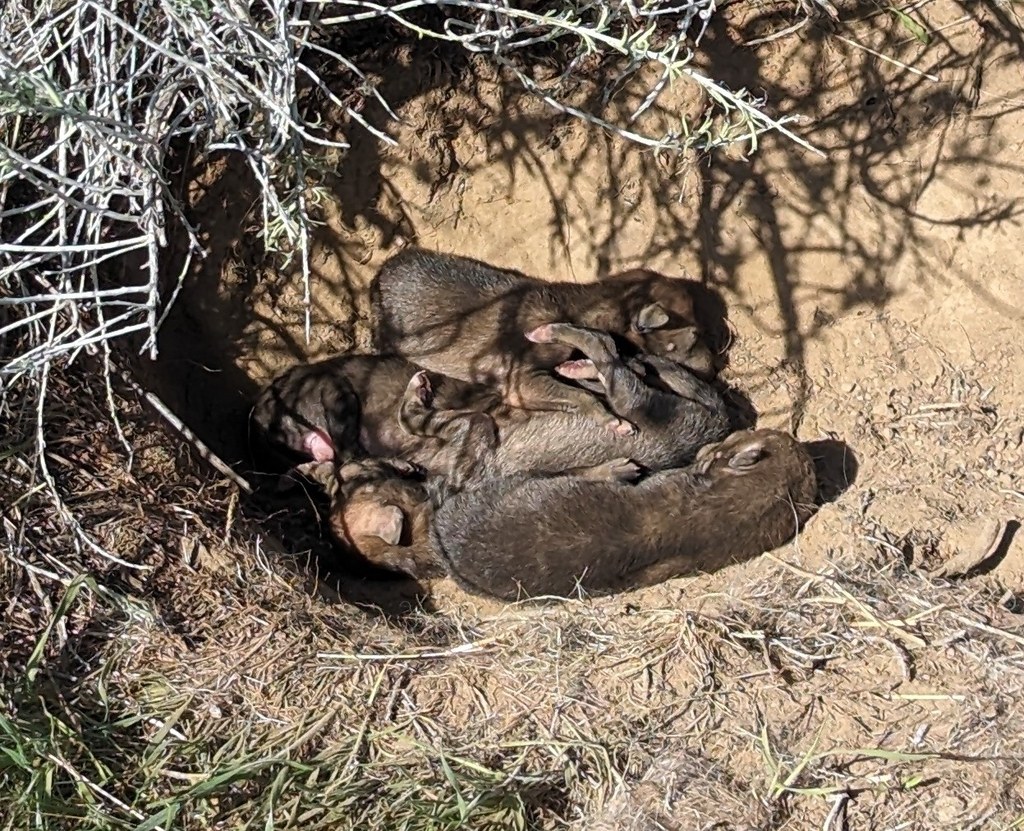
Pup2
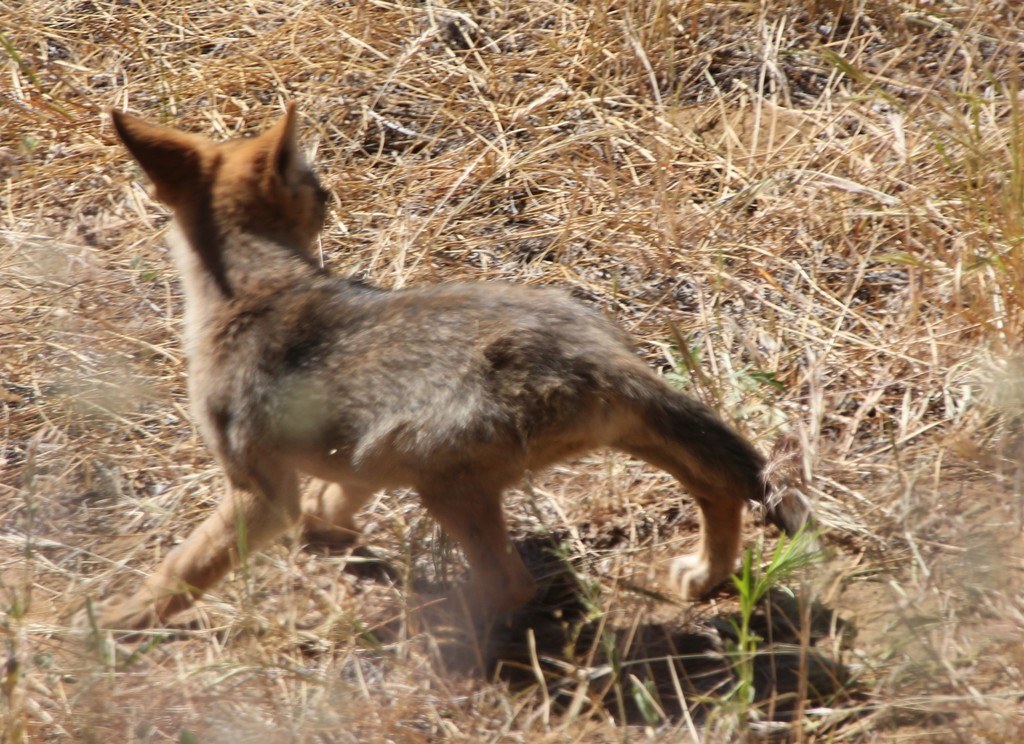
Juvenile / Disperser3
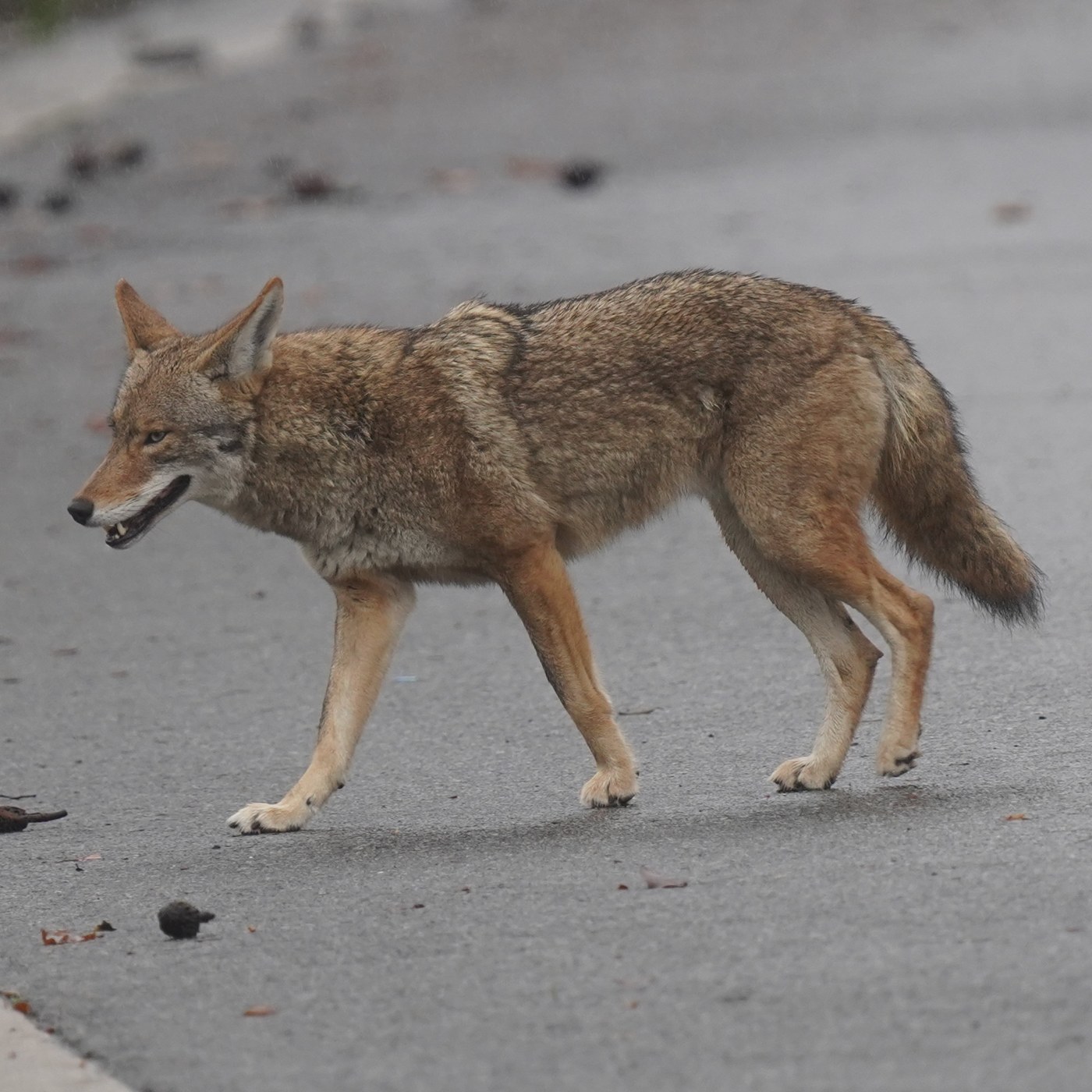
Adult4

Signs of Activity
Identification
Size varies by region
The two authoritative sources frame the split slightly differently. Western coyotes run about 25 to 45 pounds for adult males and 22 to 35 pounds for females. Eastern coyotes are larger because of wolf and dog ancestry. One federal source gives 30 to 38 pounds for eastern populations against 20 to 35 pounds for western ones, while wildlife extension research reports eastern males averaging 45 pounds and females 30. Those are a population range and a stated average, not a contradiction, and both agree eastern animals run larger. Treat 20 to 45 pounds as the working range.
Think small German shepherd
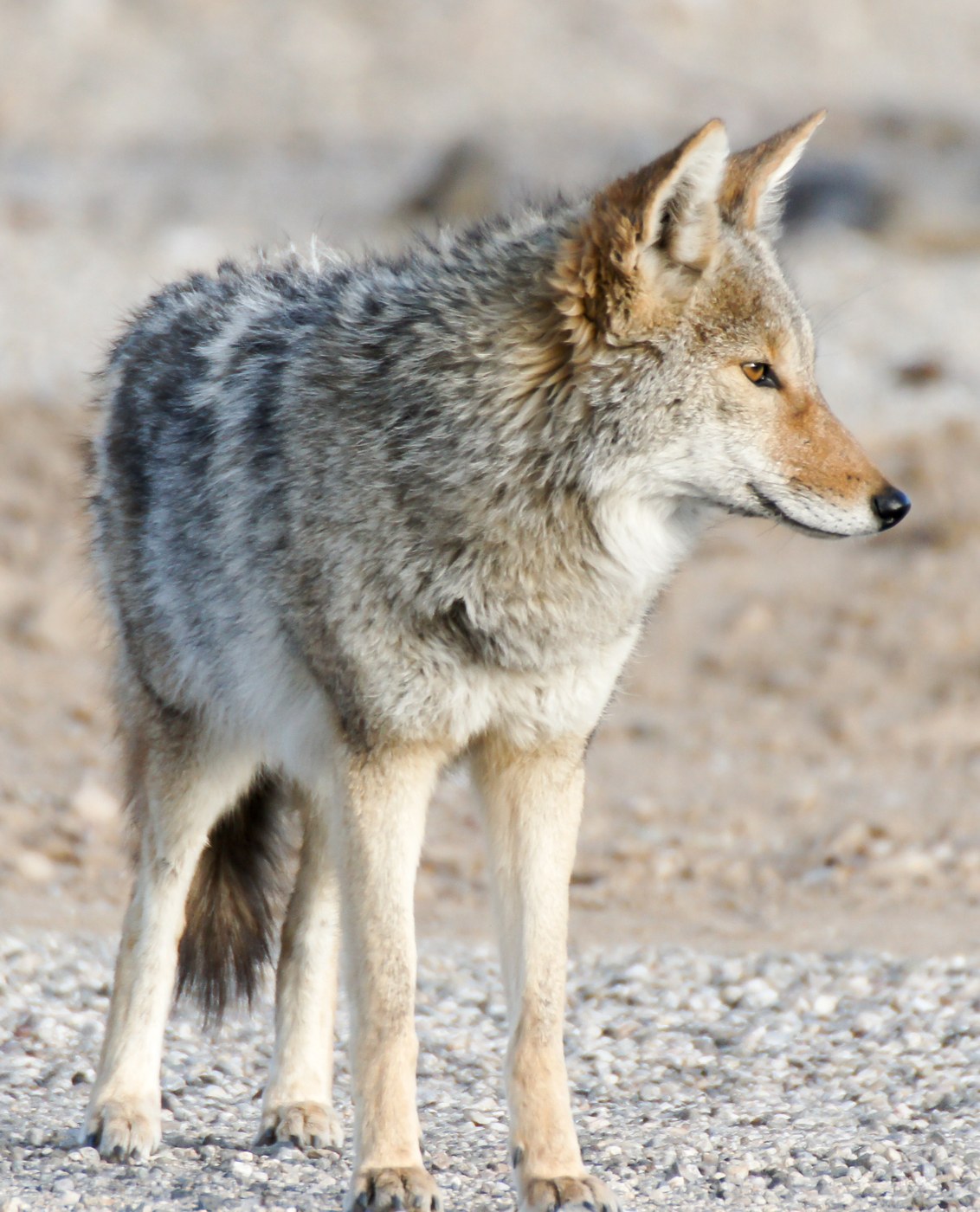
The overall impression is a small German shepherd. Erect pointed ears, a slender pointed muzzle, and a bushy, black-tipped tail. Eyesight, hearing, and sense of smell are all excellent. A coyote can hit 40 miles per hour in a short sprint and hold a slower pace for miles.
Color is not a reliable identifier
The common look is brown-gray with a light gray or cream belly and dark guard hairs over the back and tail, but individual animals range from nearly black to red to nearly white. Do not identify on coat color alone.
Coyote versus wolf
A coyote has pointed ear tips and a pointed nose. A wolf has rounded ear tips, a square nose, and proportionally much longer legs.
Coyote or dog
Coyote versus domestic dog, which is the confusion that actually comes up. Coyote tracks are more oval where a dog's are rounder, and front tracks average 2.5 to 3 inches and run larger than the hind tracks. A trotting coyote's stride, 16 to 18 inches, is typically longer than a similarly sized dog's.
The voice misleads on numbers
The voice is distinctive but misleading about numbers. Barks, flat howls, yips, warbles, and an irregular howl, with a lot of variation. Two coyotes howling together can sound like a much larger group, which is why casual population estimates from sound run high. Silence proves nothing either. Urban coyotes frequently do not vocalize at all.
Signs of Infestation
Oval tracks with claw marks
They show in soft ground. Rounder tracks of similar size are more likely a dog.
Tapered, segmented scat
Tubular, segmented scat tapering to a point at one end, deposited deliberately along trails, at intersections, and on territorial markers rather than dropped at random. Contents vary with the season and diet, and can include fur, bone fragments, feathers, berries, and fruit pits.
Howling that sounds like a pack but is not
Two animals vocalizing together routinely gets reported as six or eight. Conversely, an established urban coyote may never vocalize where you can hear it.
Kill characteristics on livestock
Pet, poultry, or livestock loss with specific kill characteristics. Subcutaneous bleeding at the attack site is what separates a live-animal bite from post-mortem scavenging. Sheep are typically attacked at the throat, calves at the abdomen or anal area. A trotting stride of 16 to 18 inches near the carcass points to a coyote rather than a dog of similar size.
Produce with the center eaten out
Produce damage with a single bitten-through hole and the center eaten out. Watermelons are the classic example. A raccoon leaves a small hole with the pulp scooped out by hand instead, so the damage pattern separates the two.
Chewed drip tubing
Chewed holes in plastic drip-irrigation tubing, which is one of the few property-damage signs coyotes reliably leave.
Heavy hair loss means mange
Heavy hair loss on the animal itself is mange, sarcoptic or demodectic, caused by parasitic mites. It answers the common question about why a coyote looks sick or half-bald. It is a coyote health problem, not evidence of anything about your property.
Prevention and When to Call a Pro
The law varies more than most
Coyote law varies more from state to state than almost any other wildlife species, and the range runs from one extreme to the other. In some states, particularly across the West, coyotes are classified as an unprotected species or a predator and may be taken year-round whether or not they are causing damage. In other states they are protected outside a defined hunting or trapping season, sometimes with a landowner provision for animals causing predation. Some eastern states classify them as a game animal, a furbearer, or a protected species outright. That is not a small variation in the paperwork, it is the difference between essentially unregulated and fully protected. Confirm with your state wildlife agency or a licensed nuisance wildlife control operator before taking any action, including on your own property.
One state, to show how local
One state's example, to show how local this gets. California's wildlife agency notes that feeding coyotes is illegal in some California communities under local ordinance, not under a single statewide law. So even inside one state, the rule can change from one town to the next. That is California's situation specifically and says nothing about what any other state or municipality allows.
A yard problem, not a building one
This is a yard problem and a pet problem, not a building problem. Coyotes are not known to damage structures. You do not need to harden your house against them the way you would for a bear or a rodent. What actually matters is what is available outdoors and how safe your animals are.
Attractant management is the base
Attractant management is the foundation. Keep garbage in a container with a locking lid, secured so it cannot be tipped. Never leave pet food outdoors, and bring small pets in at night. Give poultry and rabbits fully enclosed housing. Pick up fallen fruit and cover compost. Remove standing water in dry climates. Add motion-sensitive lighting and trim ground-level shrubbery so there is less cover close to the house. Never intentionally feed a coyote.
Hazing is what you can do yourself
Hazing is the real difference with this species. There is something you can legitimately do yourself. If a coyote is in your yard or approaching, make loud noise, wave your arms, and throw objects in its direction to reinforce its fear of people. This is not folk advice. USDA Wildlife Services research with captive coyotes showed that hazed animals learn to avoid the behaviors that trigger the hazing. Two conditions decide whether it works. It has to be consistent, and it has to be paired with removing food attractants rather than used as a substitute for it. A coyote that has already been fed by people, or one that is used to being followed by a dog, is more likely to approach anyway.
Fencing helps, not guarantees
Fencing helps but is not a guarantee. Most coyotes will climb, dig under, or otherwise get past conventional fencing. To discourage jumping, a fence needs to be at least 5.5 feet high, ideally with a buried wire apron or an angled overhang to defeat digging and climbing, and horizontal mesh spacing under 6 inches. That is realistic for a livestock enclosure or a determined project, not for a typical property line.
Two things that do not solve it
No repellent is registered for coyote control at all. Frightening devices such as propane cannons, strobe lights, and sirens buy temporary relief at best, because coyotes habituate to them quickly.
Relocation is not the answer
Three separate authorities say so independently. Federal wildlife guidance holds that relocating wildlife is rarely legal and is not considered a viable solution by wildlife professionals, citing legal restrictions, disease, liability, stress on the animal, homing behavior, and the risk of killing it. California's own wildlife agency states plainly that relocating a problem coyote only moves the problem to someone else's neighborhood. Wildlife extension guidance treats relocation as appropriate only for genuine rescues. That is unusually broad agreement, and it should settle the question.
Lethal removal can backfire
Lethal removal on your own can backfire on its own terms, separate from the legal question. Coyotes are compensatory breeders. Documented research shows populations respond to human-caused reductions by increasing both reproduction and immigration. Killing coyotes in an area can produce more coyotes there, not fewer. That is the single strongest reason to route a removal decision to a wildlife professional rather than treating it as a weekend project, and it holds true even in states where doing it yourself would be perfectly legal.
If you meet a coyote, do not run
If you actually encounter a coyote, do not run. California's wildlife agency guidance is to stop, stand tall, and make noise. Do not turn your back and do not run. If the animal follows you, throw rocks in its direction. Pick up small children and small pets immediately. Never approach a coyote and never attempt to feed one. If a coyote attacks a person, contact your state wildlife agency office or law enforcement immediately, or call 911 outside business hours.
Call when behavior escalates
Call a professional when behavior climbs the escalation scale, not when you simply see one. Wildlife researchers evaluate coyote boldness as a progression, and the steps are specific. Appearing on streets at night is the low end. It escalates through routine daytime sightings near homes, approaching people, taking pets on a leash near their owners, chasing joggers or cyclists, showing up in play areas and school grounds during the day, and finally acting aggressively toward adults at midday. Attacks on people are rare, and both primary wildlife sources describe them that way, but they are documented, one has resulted in a human death, and children are at the greatest risk. That is what the upper end of the progression escalates toward, and it is why anything from the middle of that list upward is a call rather than a wait-and-see.
Call for pet or livestock losses
Also call for any confirmed or suspected pet or livestock predation. This is the conflict that drives most legitimate coyote calls, and determining cause of death accurately genuinely takes expertise. Even trained evaluators sometimes cannot confirm it with certainty. Call as well for any situation that would otherwise have you reaching for a trap or a firearm, because in most states that requires a permit or professional involvement, and because of the compensatory-breeding problem above.
Frequently Asked Questions
Why am I seeing a coyote in my yard during the day? Is that a bad sign?
Not by itself. Coyotes are most active at night and early morning in hot summer weather, but daytime activity rises during the mating season, during the denning season, and in cool weather, and it also rises simply when there are fewer people around. A daylight sighting on its own does not mean the animal is sick or aggressive. The actual warning signs are behavioral: a coyote approaching people, taking pets on a leash near their owners, chasing joggers or cyclists, or acting aggressively toward adults in the middle of the day.
Is it legal to trap or shoot a coyote on my property?
It depends on your state more than it does for almost any other wildlife species. Many western states classify coyotes as an unprotected predator that can be taken year-round. Other states, especially in the East, treat them as a protected furbearer or a game animal with a defined season and a permit requirement. There is no national answer. Check your state and local rules, or work through a licensed nuisance wildlife control operator, before doing anything yourself.
If a coyote keeps coming around, why not just have it relocated?
Relocation is rarely legal and rarely effective. California's wildlife agency states directly that relocating a problem coyote only moves the problem to someone else's neighborhood. Federal wildlife guidance agrees that relocation is not considered a viable solution, citing legal restrictions, homing behavior, disease risk, and the real chance the animal dies after release. Wildlife extension guidance reserves relocation for genuine rescue situations.
Can I scare a coyote away myself?
Yes, and it is the one thing you can genuinely do on your own. Hazing means making loud noise, waving your arms, and throwing objects to reinforce a coyote's fear of people. USDA Wildlife Services research with captive coyotes found that hazed animals learn to avoid whatever triggers the hazing. It works best when it is consistent and when it is paired with removing food attractants. One scare on one afternoon is not the technique.
Do coyotes carry rabies?
Rabies does occur in coyotes and can be transmitted to other animals and to people, but coyote is not on the national primary list of rabies vector species. Bats, raccoons, skunks, and foxes account for the large majority of reported wildlife rabies cases. Some regions use treated vaccine baits to manage rabies in wild coyote populations. Regardless, avoid contact with any coyote that looks sick, unusually bold, or unafraid of people.
Sources
- Coyotes (identification, biology, damage identification, prevention and control methods, handling) Internet Center for Wildlife Damage Management (University of Nebraska-Lincoln / USDA APHIS Wildlife Services)
- Coyote Ecology and Damage Management, Wildlife Damage Management Technical Series USDA APHIS Wildlife Services
- Rabies in the United States: Protecting Public Health Centers for Disease Control and Prevention
- Keep Me Wild: Coyote California Department of Fish and Wildlife