Seasonal Timeline
Breeding runs from late winter into early spring, with exact timing shifting by latitude, earlier in southern regions and later in northern ones. Pup-rearing and more visible adult hunting activity follow through spring into early summer, and there is no true winter dormancy, though den use increases during severe weather.
Breeding runs from late winter into early spring, with exact timing shifting by latitude, earlier in southern regions and later in northern…
Kits are born in spring, typically March or April, and emerge from the den roughly 4 to 5 weeks later. That window matters for exclusion timing, covered in the prevention section below: sealing a den before kits are confirmed gone traps and kills them. Young typically disperse from the family group within their first year, most often in late summer or fall, and reach sexual maturity at around 10 months, meaning most animals can breed the winter or spring after their own birth.
Where They're Found
Gray fox range runs from extreme southern Canada to northern Venezuela and Colombia, and the species has expanded northward over the last 50 years into New England, Michigan, Minnesota, Iowa, the Dakotas, Nebraska, Kansas, Oklahoma, and Utah, reclaiming ground it had been extirpated from or moving into territory it had not previously occupied. That expansion is why the gray fox now turns up across the Northeast, Midwest, South Central, and Southwest.
Two regions carry a real nuance worth stating plainly rather than smoothing over. Within the Mountain West, established range is centered on Colorado, where the state wildlife agency describes gray fox as common throughout, occupying rocky canyons, ridges, wooded areas, and grassland or desert habitat statewide. Wyoming, Montana, and Idaho sit largely outside the species' core range. Within the Pacific Northwest, gray fox range leans toward Oregon and the region's drier, southern portions, since the same range data that excludes the northern Rockies also excludes most of Washington. Both patterns fit the species' general habitat preference: gray fox avoids the wettest, most densely forested, or highest-elevation terrain in favor of woodland-brush ecotones.
Typical habitat is woodland and woodland-brush ecotones bordering more open ground, especially near surface water, plus rocky canyons and ridges, open desert, and grassland in the drier western part of the range. The species does poorly in dense urban cores but tolerates suburban forest edges. Den sites include hollow logs and trees (with tree dens documented up to 20 feet above ground), rock outcrops and ledge crevices, underground burrows, cavities under rocks, abandoned buildings, and brush, plus the ground level of decks, sheds, porches, and outbuildings around homes. Gray fox is not a structural home-invasion species the way rodents are; it does not gnaw, nest in insulation, or move into living spaces.
Life Cycle
One litter a year, and the den timing matters. Breeding concentrates in late winter and early spring, kits are born roughly 59 days later (typically March or April), and pups do not emerge from the den until 4 to 5 weeks after birth, with full independence not arriving until around 3 months of age. Exclusion work at a den site should wait until the den is confirmed empty; sealing an active den traps and kills the pups inside.

Newborn Pup
Juvenile Weaning
Sub-adult Dispersal
Adult
Identification
The tail tip, against a red fox
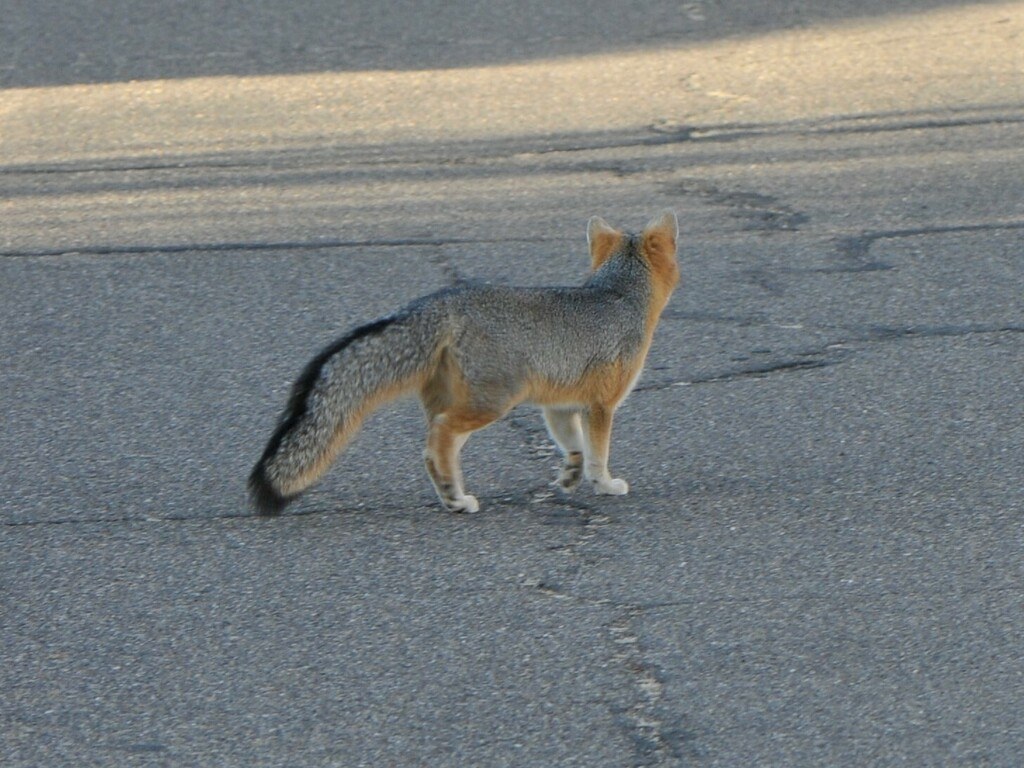
The tail tip is the single reliable field mark against a red fox. A gray fox's tail tip is always black, with a black stripe running the length of the top of the tail. A red fox's tail tip is always white. This holds regardless of the rest of either animal's coat color.
A grizzled salt-and-pepper coat
Coloring is a grizzled, salt-and-pepper gray across the back and sides, with reddish-brown or tawny fur on the neck, chest, legs, and the underside of the tail.
Build and face
A cat-like rounded face with a shorter, less pointed snout than a red fox, and rounded pupils rather than a red fox's slit-like pupils. Shorter legs and a stockier, more compact build than a red fox, which runs leaner with longer legs, white on the chest and belly, and black lower-leg "socks."
Size
Total length including tail runs roughly 31 to 44 inches, with the tail making up about a third of that. Body length alone runs about 21 to 29 inches, slightly shorter than a red fox's 22 to 25 inches. Weight typically runs 3 to 5 kg (about 7 to 11 lb), occasionally up to 9 kg (about 20 lb), generally lighter and more compact than a red fox.
The defining trait is anatomical
It is not just behavioral. Semi-retractable, hooked claws and rotating forearms and wrists let the gray fox grip bark and branches the way a cat does. It is the only North American canid that regularly climbs trees, escaping ground predators such as coyotes and bobcats, foraging for fruit, nuts, and occasionally bird eggs or nestlings, and resting or denning well off the ground. Climbs of 50 feet or more up a trunk are documented, with descent handled either branch to branch like a squirrel or backed down slowly like a house cat.
Signs of Infestation
Den entrances at ground level
They turn up under decks and outbuildings.
Four-toed tracks with claw marks
Tracks showing four toes with visible claw marks, distinguishing gray fox sign from a domestic cat's fully-retractable-claw track even though the fox's own claws are semi-retractable.
Missing poultry with few other visible signs
Foxes typically remove prey from the site rather than leaving a kill behind, so scattered feathers and one or two missing birds from a coop is often the whole picture.
A raspy screech at night
Occasional barking, yipping, or a raspy, screech-like vocalization at night, most often heard during the breeding season or when family groups are communicating. It is not loud or constant, and easy to miss.
A musky scent near a den
A musky scent near an active den site, similar to other wild canids.
Prevention and When to Call a Pro
Never handle a gray fox
Never attempt a home capture-and-release either. Gray fox is one of four terrestrial species nationally recognized as a rabies vector, alongside raccoons, skunks, and bats. CDC's own research journal documents an established, gray-fox-specific rabies virus variant circulating in parts of the Southwest, plus a bat-origin rabies variant that has spilled over into gray foxes in New Mexico. Any bare-hand contact, or contact with an animal behaving abnormally, unusual boldness, daytime activity paired with disorientation or stumbling, unprovoked aggression, or paralysis, is a potential rabies exposure. Contact local animal control or a licensed wildlife control professional. Do not approach or attempt to capture the animal yourself.
Protect poultry and small pets
That is the actual, common nuisance complaint with this species. Fully enclosed, roofed runs with wire buried 12 to 18 inches deep, or an L-shaped footer bent outward, stop both digging-under and climbing-over access. Foxes will stake out a coop for days before attacking, so a secure enclosure installed before a problem starts is more effective than reacting after a loss. Bring cats, rabbits, and small dogs inside at night, since they are close enough in size to a gray fox's natural prey to be at real risk if left outside unattended. Larger pets are not at meaningful risk.
Exclude dens after the litter goes
Exclude den sites at ground level, but only once any litter has left. Hardware cloth buried 12 inches deep with a 12 to 24 inch L-shaped outward-facing footer around the perimeter of a deck, shed, or porch is the standard permanent exclusion method. Kits are born in spring, typically March or April, and do not emerge from the den until 4 to 5 weeks later, so permanent exclusion should wait until the den is confirmed empty. Sealing an active den traps and kills the pups inside.
Reduce cover and easy calories
Clearing dense brush piles and low cover near a coop or garden removes ambush positions and denning appeal. Securing trash, pet food, and fallen fruit reduces the incidental food sources that draw a fox onto a property in the first place.
Who to Call, and When
Immediately, without attempting contact, for any gray fox showing signs consistent with rabies: unusual boldness or lack of fear of people, daytime activity combined with disorientation or stumbling, unprovoked aggression, or partial paralysis. That is the dominant trigger for this species, ahead of any routine nuisance-wildlife threshold. Also call for a den established under a structure, ongoing poultry or small-pet losses, or any situation where exclusion work would need to happen near an active den with pups still present, since timing an exclusion around a litter, and handling repeated visits safely, is professional-grade work rather than a same-day homeowner task.
Frequently Asked Questions
Why do gray foxes climb trees, and is that unusual?
Yes, it is unusual. The gray fox is the only North American canid that regularly climbs trees, using semi-retractable claws and rotating wrists to grip bark like a cat. It climbs both to escape predators such as coyotes and bobcats and to forage for fruit, nuts, or bird eggs, with climbs of 50 feet or more up a trunk documented.
How can I tell a gray fox from a red fox?
The tail tip is the most reliable field mark. A gray fox's tail tip is always black. A red fox's tail tip is always white. This holds regardless of the rest of either animal's coat color, and it is more reliable than comparing size, build, or general coloring.
Are gray foxes dangerous to people?
Gray foxes do not attack people and typically flee rather than fight. The real risk is rabies: gray fox is one of the CDC-recognized rabies vector species, so any fox that is behaving abnormally, aggressively, or with no fear of people should never be approached. Contact animal control instead.
Will a gray fox kill my chickens?
Yes. Gray foxes are documented poultry predators and will take unprotected backyard chickens, usually at night, often after watching a coop for several days. A secure, fully enclosed run with wire buried 12 to 18 inches deep is the standard prevention.
Do gray foxes carry rabies?
Yes. Gray fox is one of four terrestrial species nationally recognized by the CDC as a rabies vector species, alongside raccoons, skunks, and bats, with documented, gray-fox-specific rabies virus variants circulating in parts of the southwestern United States.
Sources
- Urocyon cinereoargenteus, common gray fox (Fire Effects Information System) U.S. Forest Service
- Divergent Rabies Virus Variant of Probable Bat Origin in 2 Gray Foxes, New Mexico, USA (Emerging Infectious Diseases, Vol. 28, No. 6) Centers for Disease Control and Prevention
- Rabies and Wildlife Connecticut Department of Energy and Environmental Protection
- Urocyon cinereoargenteus (gray fox) Animal Diversity Web, University of Michigan Museum of Zoology
- Foxes Pennsylvania Game Commission
- Gray Fox species page Colorado Parks and Wildlife
- Identifying and Preventing Poultry Predators in the Mid-Atlantic Region University of Maryland Extension
- Canine Distemper Virus (CDV) Wisconsin Department of Natural Resources
Image Credits
- Image: Elliott Gordon via iNaturalist. CC BY 4.0.