Seasonal Timeline
Activity runs late March through October at the northern edges of the range, in both North Carolina and Missouri, while Florida and Gulf Coast animals are reported active year round with no true hibernation. Young are born live in late summer and early fall everywhere in the range. Activity skews nocturnal and is moon sensitive, with more movement documented on dark nights than under a full moon.
Activity runs late March through October at the northern edges of the range, in both North Carolina and Missouri, while Florida and Gulf…
One note before the calendar. Every window above comes from a cited state agency or university source, so treat the dates as regional observations rather than fixed ones.
The northern edges of the range agree with each other closely. North Carolina's wildlife agency gives late March through October and describes overwintering in stump cavities and mammal burrows. Missouri's Department of Conservation and University of Missouri Extension both give mid-April to mid-October, and a two-year radiotelemetry study in the Missouri Ozarks ran its field season from late March to mid-November to bracket the animals' activity. Missouri also documents a within-season shift that matters for when people run into one: the snakes bask in open rocky areas in late spring and early summer, then become largely nocturnal through July and August, when they are most often seen crossing roads after dark.
Florida is different, and the difference rests on a single weaker source. One general reference account states that pygmy rattlesnakes in the warm part of the range do not truly hibernate, covering themselves in debris or taking refuge in burrows only when temperatures approach freezing, and emerging again as soon as it warms. That is consistent with the fact that this is Florida's most commonly encountered venomous snake, but no state agency or university extension publishes it, so treat it as indicative rather than settled. Nothing about it changes the practical advice, which does not have an off season in the Deep South.
Late summer is the season to be most careful, for a specific reason. Birth happens in late summer and early fall across the whole range. Newborns arrive at about 5 inches, fully venomous, carrying a bright yellow tail tip they wiggle to lure frogs and lizards, and with no rattle at all until after their first shed. A 5-inch snake in a mulch bed in September has no warning apparatus whatsoever.
Where They're Found
Pygmy rattlesnake is an entirely outdoor animal. It does not enter buildings, does not burrow under foundations, does not chew anything, and leaves no property damage of any kind. What it does do, and heavily, is use residential ground.
The documented range reaches beyond the Southeast label this snake usually gets, into all six South Central states and, at one edge, the Midwest. Within the Southeast that is North Carolina, South Carolina, Georgia, Florida, Alabama, and Mississippi; Virginia and West Virginia carry no documented population. In the South Central region the snake is present across all six states, documented by Tennessee's wildlife agency along the western Highland Rim, by Oklahoma's wildlife department in the southeastern and central part of that state, by Louisiana's wildlife department, by an Arkansas herpetological atlas holding museum vouchers from 36 of 75 counties, by a University of Kentucky identification guide, and in eastern Texas. The Midwest is Missouri alone, and only its southern edge: the counties bordering Arkansas plus the eastern Ozarks and St. Francois Mountains. No other Midwest state has a documented population.
Alaska and Hawaii are confirmed absent. No published source places this species anywhere outside the southeastern and south-central United States. Alaska has no native venomous snakes and Hawaii has no native land snakes at all.
Three subspecies split the range, and they do not want the same ground. The Carolina pygmy rattlesnake holds the Carolinas and northeastern Georgia and favors dry uplands: longleaf pine sandhills and dry flatwoods. The dusky pygmy rattlesnake holds peninsular and northern Florida and runs west into southern Georgia, Alabama, and Mississippi, favoring wetter ground including cypress swamp and marsh edges. The western pygmy rattlesnake holds everything from Mississippi west and north, and Oklahoma's wildlife department makes an interesting point about it: the snake is nearly always associated with forest, but rock outcrops are not a requirement, since it is common in rock-free mixed oak forest in the Cross Timbers. In Florida the working habitat list is pine flatwoods, oak scrub, open pinelands, palm hammocks, hydric hammocks, prairies, and notably the banks of canals running through marshes and prairies.
The single most useful habitat finding comes out of a radiotelemetry study, and it is what the prevention advice is built on. Researchers tracked 19 pygmy rattlesnakes in the Missouri Ozarks over two field seasons and found the snakes concealed within vegetation in 89 percent of observations and beneath surface cover in another 8.5 percent, rather than going underground. They actively selected microhabitats with more vegetative ground cover and more woody debris, and less leaf litter, than random sites nearby. Home ranges were tiny, under 0.001 to 2.6 hectares, and the animals moved rarely and briefly. The authors concluded the species is a habitat generalist that will use any habitat type offering dense cover at ground level. Translated to a property: this is a snake that sits motionless in thick low planting, at exactly the scale of a landscaped bed, and it is not going to move when you walk up.
Shelter and overwintering follow the same logic. Stump holes, root and brush piles, rock crevices, and mammal burrows are the documented refuges across Georgia, North Carolina, and Missouri sources.
Diet is where this snake departs from other rattlesnakes. Prey is frogs and toads, lizards and especially anoles, small snakes, small rodents, birds, and large invertebrates such as centipedes. Florida extension gives the state diet as primarily frogs, toads, and mice. That matters because for larger rattlesnakes a repeat sighting usually points at rodents, and here it can just as easily point at amphibians and lizards. A damp, densely planted, well-irrigated bed that supports treefrogs and anoles supports this snake, and rodent control alone will not change that. One outlier: North Carolina's rattlesnake outreach sheet says this species eats mostly rodents and rabbits. Rabbits are out of scale for a 20-inch snake and no other source lists them, so the majority account is the one to trust.
Life Cycle
The reproductive picture is genuinely thin, and no numbers can be safely borrowed from a better-studied relative. Tennessee's wildlife agency states directly that there is very little reproductive information on this species. What is consistent across every published source is the birth season, late summer into early fall, and the fact that young arrive live, independent, and venomous. What is not consistent is litter size, which runs 3 to 7 in the two western-subspecies state accounts, 3 to 12 in the range-wide account, and 7 to 21 in North Carolina's Carolina-subspecies account. The split lines up with subspecies and latitude rather than with one source being wrong, which is why all three figures appear here instead of one averaged number.
Biennial breeding in at least part of the range is the fact with practical weight. Missouri reports females typically breeding only every other year. Paired with a 16-year lifespan and a home range measured in fractions of a hectare, that describes an animal that is neither prolific nor mobile. A pygmy rattlesnake seen repeatedly in the same bed is very likely the same individual rather than evidence of a growing population.

Mating
Gestation
Neonate
Juvenile
Adult
Identification
The smallest rattlesnake in the US
This is the smallest rattlesnake in the United States, and size alone gets you most of the way there. Most adults run 15 to 24 inches. Florida extension says adults there rarely exceed 20 inches, North Carolina gives an average of 15 to 21, Tennessee gives 15 to 20, and Louisiana gives 10 to 20. The maximum on record across sources is about 31 inches. Females are larger than males, and males have proportionally longer tails. Any rattlesnake in the Southeast under about 2 feet with a stout body and a slender tail is worth treating as this species until something says otherwise.
A plain row of blotches
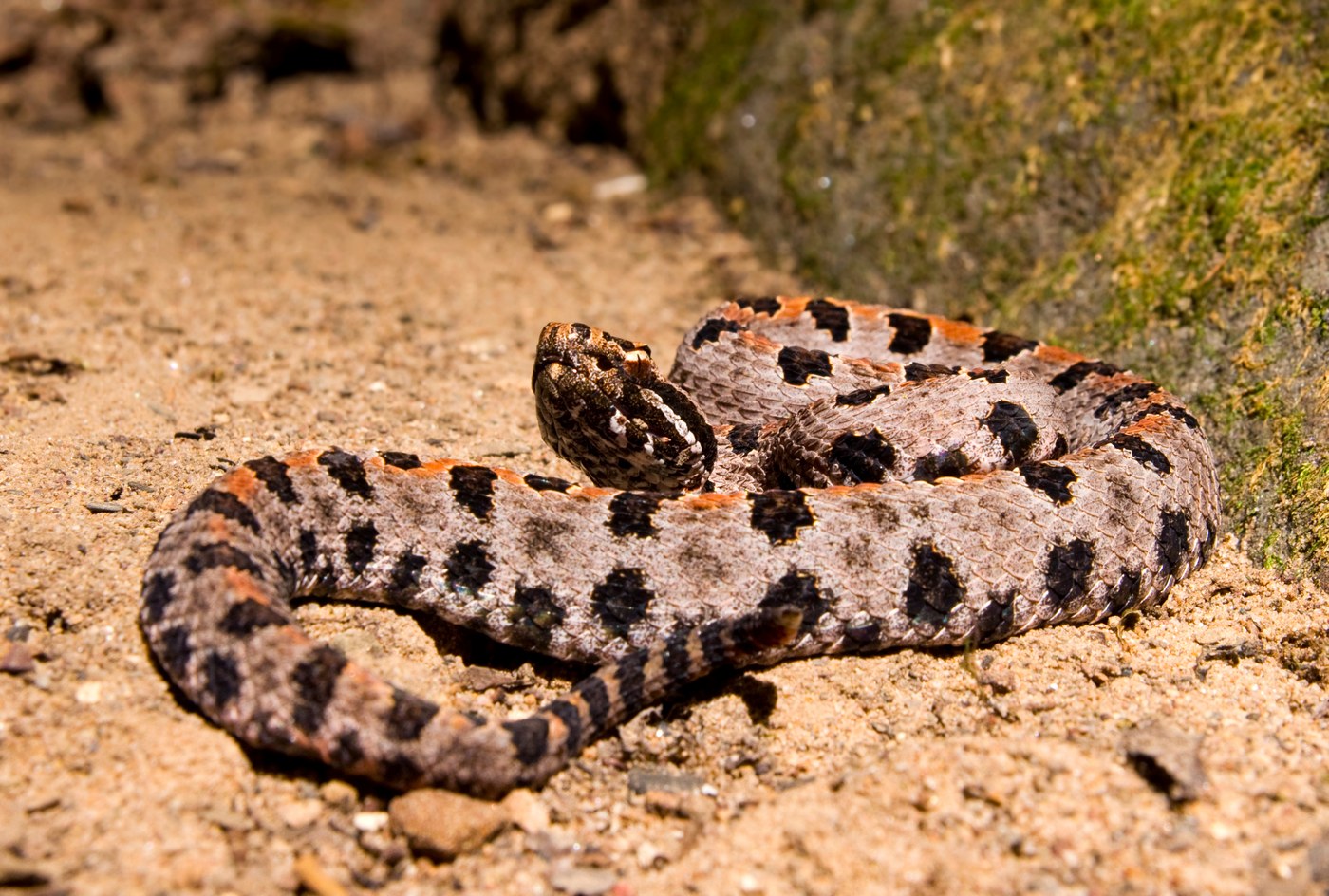
The pattern is a plain row of blotches, not diamonds and not chevrons. Ground color is gray, grayish-brown, or tan, carrying a single row of dark rounded or bar-shaped blotches straight down the spine, plus one or two rows of smaller dark spots along each side. Running between the dorsal blotches, and usually broken by them, is a reddish-brown, orange, or brown stripe down the middle of the back. Georgia, Florida, Tennessee, Oklahoma, and Louisiana sources all report that stripe; its prominence varies by individual. The belly is light or cream, heavily mottled or barred with dark.
The dark bar through the eye
It is the second field mark, and it has a pale line inside it. A wide dark bar runs from each eye back to the corner of the mouth, usually with a narrower white or pale bar running through it. The bar's color ranges from jet black to reddish brown depending on the animal. One museum account describes the overall effect as cat-like.
Nine plates on top of the head
Nine large plates on top of the head. This is the tell that settles everything. Pygmy rattlesnakes belong to the genus Sistrurus, which carries nine large, symmetrically arranged plate-like scales on the crown. Every other rattlesnake in this range, all of them in the genus Crotalus, carries many small, irregular scales on top of the head instead. Mississippi's wildlife agency, Tennessee's, Oklahoma's, and the Florida Museum of Natural History all name this same feature. It is worth knowing about and worth looking for only in a photograph, never by getting closer to the animal.
Do not key on color
Color varies by subspecies, so do not key on it. The dusky pygmy rattlesnake of Florida and the Gulf states runs bluish-gray to nearly black. The Carolina pygmy rattlesnake runs gray to tan, and animals from the outer coastal plain counties of North Carolina are often genuinely red or pinkish. The western pygmy rattlesnake is a paler gray with a bronze or dull-orange stripe rather than a red one. All three are the same species.
The rattle is a poor feature
The rattle is a very poor identification feature and an even worse safety feature. It is tiny, brittle, and easily lost. Mississippi's wildlife agency confirms the mechanism directly: the appendage is small and easily broken off and regained repeatedly throughout the life of the snake. One widely repeated figure puts the share of individuals missing a rattle at any given time at about 40 percent. That number traces to a single general reference account rather than to a state wildlife agency or a peer-reviewed study, so read it as an indication of scale rather than a measured value. The mechanism behind it is well supported either way. Newborns carry a single button at the tail tip, which makes no sound until the first shed adds a segment to work against. Mississippi's wildlife agency spends a paragraph correcting the widespread belief that pygmy rattlesnakes are rattleless and silent: they are not, the rattle is real and functional, it is simply small and fragile.
The venomous look-alikes
Eastern diamondback rattlesnake and timber rattlesnake are the venomous look-alikes, and both are separated by pattern shape and scale. Eastern diamondback averages 3 to 6 feet and carries clean cream-bordered diamonds. Timber rattlesnake carries dark chevron crossbands that run across the body plus a solid black tail. This snake carries discrete blotches running along the body, an orange middorsal stripe, and a rattle you can barely see. Oklahoma's wildlife department specifically warns that juvenile timber rattlesnakes get confused with western pygmy rattlesnakes, since both can show an orange stripe; the crown scalation separates them.
The harmless ones cause more trouble
The harmless look-alikes are the ones that cause real trouble, in both directions. Eastern and southern hognose snakes are stout, blotchy, and regularly mistaken for this species; they have an upturned pointed snout scale, round pupils, no facial pit, and no rattle. And Mississippi's wildlife agency flags a naming trap worth knowing: ground rattler is the most commonly used local name for the pygmy rattlesnake in that state, but it is also the local name for several small harmless gray or brown yard snakes in the genera Storeria, Virginia, and Rhadinaea. Someone reporting a ground rattler in the flower bed could mean either. The name resolves nothing.
Both spellings are correct
Both are in official use. Georgia's own fact sheet is titled Pigmy Rattlesnake and notes the species is also spelled pygmy. Georgia, North Carolina, and the federal wildlife service use pigmy; Florida, Mississippi, Tennessee, Missouri, and Louisiana use pygmy. The scientific name is Sistrurus miliarius, family Viperidae, pit viper subfamily Crotalinae, and the genus contains only the pygmy rattlesnakes and the massasaugas.
Signs of Infestation
There is nothing to inspect for
This species builds nothing, chews nothing, burrows into no structure, and damages no property. There are no gnaw marks, no entry holes, no droppings trail, no tubes, and no odor. The sighting is the evidence and essentially all of it. A shed skin is possible but is general snake sign rather than proof of this species.
Look at dense low cover, not at open ground
The radiotelemetry work in the Missouri Ozarks found these snakes concealed within vegetation in 89 percent of observations and under surface cover in another 8.5 percent, actively selecting spots with more vegetative cover and more woody debris than the surrounding ground. Florida extension puts it in homeowner terms: they are often encountered in flower beds and gardens. Thick, damp, well-planted landscape beds are the specific place to be careful.
The audible sign is nearly useless
The audible sign is real but nearly useless, and that is the most important thing to know. The rattle produces a faint, high buzz that university and state sources compare to a small insect or a grasshopper, audible only within a few feet. One Florida extension publication states it cannot be heard even when the snake shakes it vigorously. On top of that, the rattle breaks off readily and a substantial share of individuals are carrying none at all at any given moment, a share one general reference puts at about 40 percent. If you hear an insect-like buzz coming from mulch, take it seriously. If you hear nothing, that rules nothing out.
It will not leave
The snake will not leave, which is itself diagnostic. Most snakes retreat. This one relies on camouflage and holds its ground. Florida extension describes it as quite defensive, notes it will often stand its ground when approached, and documents it bobbing its head and striking into the air when it feels threatened. A small snake that stays coiled and does not flee as you approach is behaving exactly like a pygmy rattlesnake.
Repeats usually mean one snake
Repeat sightings in one bed usually mean one snake, not many. Home ranges measured in a radiotelemetry study ran from under 0.001 to 2.6 hectares, with short and infrequent movements. Combined with a lifespan of at least 16 years and biennial breeding in at least part of the range, that describes a resident individual rather than a population explosion.
Watch for prey rather than only for rodents
Frogs, toads, and anoles are primary prey for this species alongside small rodents. A yard producing treefrogs and lizards in quantity is producing pygmy rattlesnake food, and that is a different signal than the rodent-driven pattern behind larger rattlesnake species.
In late summer, 5-inch snakes
Late summer and early fall bring 5 inch snakes with no rattle. Young are born live at that season, fully venomous, with a bright yellow tail tip and no rattle at all until after the first shed. A tiny snake in a bed in September is not a harmless one and is not being supervised.
Prevention and When to Call a Pro
Assume you will not hear it
Start from the assumption that you will not hear it. Every practical precaution follows from that. Six independent university and state wildlife sources describe this species' rattle as a faint insect-like buzz audible only within a few feet, one says it cannot be heard even when shaken vigorously, and the rattle itself breaks off readily enough that a substantial share of individuals are carrying none at all, put at roughly 40 percent by a single general reference. Listening is not a safety strategy for this snake the way it partly is for a larger rattlesnake.
Wear leather gloves to garden
Wear leather gloves whenever you garden, and never put an ungloved hand into dense low planting. This is not a generic precaution; it is direct advice from Florida's own extension service, given specifically because pygmy rattlesnakes are so often encountered in flower beds and gardens. It is the highest-value single step you can take.
Thin the ground-level planting
Thin dense ground-level vegetation and clear woody debris away from walkways, beds, and doorways. The radiotelemetry study found these snakes selecting exactly that structure, more vegetative cover and more woody debris than surrounding ground, and concealing themselves in vegetation rather than going underground in nearly nine out of ten observations. Reducing that structure near where people walk is the specific, sourced version of the generic advice to keep the yard tidy.
Remove the stump and brush piles
Remove stump holes, root piles, brush piles, and loose rock near the foundation. Georgia, North Carolina, and Missouri sources all name these as the shelter and overwintering features this species uses.
Reduce the amphibians and lizards
Reduce the amphibian and lizard draw, not just the rodent draw. Frogs, toads, and anoles are primary prey. Standing water in plant saucers, over-irrigated beds, and permanently damp mulch support treefrogs and anoles, and therefore support this snake. Rodent control by itself will not solve a pygmy rattlesnake problem the way it helps with larger rattlesnake species.
Do not reach past blind cover
Do not step over or reach past cover you cannot see into, particularly along canal banks, marsh and prairie edges, and the borders of pine flatwoods and scrub, which are documented habitat.
Never approach for a closer look
Not even to confirm what you are seeing. The snake is not going to leave, it may hold its ground, bob its head, and strike into the air, and there is no version of this identification that changes what you should do next. Closing the distance is the main way people get bitten by an animal that was otherwise going to sit still.
A bite is a 911 call
If someone is bitten, call 911 immediately. This is where the small size misleads people worst. No human death from this species is documented in four independent sources, including a peer-reviewed 20-year clinical review, and Missouri's wildlife agency states outright that the bite is not fatal while still directing victims to immediate medical care. None of that makes it a minor injury. A published case in a peer-reviewed dermatology journal describes a man bitten on a finger by a western pygmy rattlesnake who was graded 3 on the snakebite severity scale, received six vials of antivenom, spent 40 hours in the hospital waiting for his fibrinogen to normalize, developed worsening local tissue death, needed outpatient surgical debridement, and took six weeks of wound care to heal. Another documented case required a ten-vial loading dose plus an 18-hour maintenance protocol. A third developed a clotting disorder. In the 20-year Florida series, two patients bitten by this species needed surgical fasciotomies on the hand.
The platelet crash to know about
The systemic effect to know about is a platelet crash, and it comes back after treatment. A clinical comparison presented at a toxicology conference found that 3 of 10 pygmy rattlesnake bite patients had a platelet count below 100,000 on admission and 6 of 10 dropped below it during their hospital stay, generally without other clotting abnormalities. Pygmy bites in that series consumed an average of 10.6 vials of antivenom against 2.5 for copperhead, and 4 of 5 patients treated with Fab antivenom improved at first but required retreatment after the platelet count rebounded downward. The authors' own conclusion is the line worth repeating: despite the small size of the animal and the modest appearance of the local tissue damage, the average number of vials needed is high compared with copperhead. This finding comes from a conference abstract rather than a full peer-reviewed paper, and is presented as such.
Less severe is not manageable
Yes, it is less medically severe than an eastern diamondback bite. No, that does not make it manageable at home. The comparison is not a guess. A 20-year review of 546 snakebites at a north Florida academic medical center broke results out species by species. Among 152 pygmy rattlesnake bites, the dominant symptom was local swelling at 90.8 percent, with tingling at 18.4 percent and nausea at 12.5 percent, and creatine kinase, creatinine, INR, white cell count, and platelet values stayed relatively low or within normal ranges compared with other species. No seizures and no deaths. By contrast, the same study states that life-threatening symptoms appeared in some patients bitten by timber rattlesnake and eastern diamondback rattlesnake, that most surgical fasciotomies followed eastern diamondback and cottonmouth bites, and that patients bitten by those two large species stayed 7.0 days in the hospital against a 3.1-day average for the whole group. Two patients in that cohort died, both after eastern diamondback bites and neither after a pygmy rattlesnake bite. That is a real difference in severity. It is not a difference between dangerous and harmless.
The same antivenom is used
The fact that ends the argument: the same antivenom is used, and it was tested against this species specifically. CroFab, the standard FDA-approved United States pit viper antivenom, is indicated for the management of North American crotalid envenomation, a term its own label defines as covering the entire pit viper subfamily including rattlesnakes. Pygmy rattlesnake venom is not one of the four venoms used to manufacture it, those being western diamondback, eastern diamondback, Mojave rattlesnake, and cottonmouth. But the label's animal toxicology section reports that the product neutralized the venoms of ten clinically important North American pit vipers in a laboratory model, and Sistrurus miliarius barbouri is one of the ten. Stated plainly for a homeowner: the antivenom used for an eastern diamondback bite is the antivenom used for this one.
No first aid beyond the hospital
Do not attempt first aid beyond getting to a hospital. No cutting, no suction, no tourniquet, no ice. The 20-year Florida review recorded that 9.6 percent of envenomated patients tried a contraindicated self-treatment before seeking care, and that group reached a healthcare provider substantially later than everyone else. Keep the bitten limb still, remove rings and tight clothing before swelling starts, and let emergency medical staff handle the rest.
Call an operator for a sighting
For a live sighting near a home or yard, call a licensed nuisance wildlife control operator or the state wildlife agency rather than handling it yourself. Do not capture, bag, trap, or relocate the animal. Beyond the obvious risk, in at least one state in this range doing so without a permit is illegal, which is covered next.
The law differs by state
The legal picture genuinely differs by state, so check yours before doing anything. Here is what the research found, state by state. In North Carolina the Carolina pygmy rattlesnake is a state-listed Special Concern species under the state Endangered Species Act, protected snakes there cannot be harmed, harassed, or relocated without an endangered species permit, killing is allowed only where the animal poses a clear and imminent threat to health and safety, and the state wildlife commission actively asks the public to report rattlesnake sightings with a photo and location. In Tennessee the western pygmy rattlesnake is listed as Threatened by the state wildlife agency and ranked very rare to rare and imperiled by the state environment department. In Georgia the picture is the opposite: state law protects all nongame wildlife by default but names venomous snakes as one of its explicit exemptions, so taking one is legal, though killing a nonvenomous snake by mistake, including the southern hognose that is regularly confused with this species, is still a misdemeanor with no exception for an honest error. In Alabama this species does not appear on the state's protected nongame reptile list. In Mississippi a hunting or fishing license is required to take nongame snakes, capped at 20 per license year and 4 per species, though a resident may kill a venomous snake presenting a reasonable danger to human life, or any snake on land they own or live on, and the carcass may not be kept or sold. In Florida the species is not state listed, but a permit is required to capture, keep, or possess any venomous reptile, and the state wildlife commission is explicit that a nuisance trapper who will hold a live venomous reptile at any point needs that permit while one who euthanizes on site does not. In South Carolina the species is not on the state threatened or endangered lists, but state regulation gives all native reptiles a base level of protection, and no native reptile may be sold, traded, transferred, or re-homed. In Missouri all native animals are protected as biological diversity elements unless the state wildlife code describes a legal method of take.
Some states have a thin record
In some states the legal record is genuinely thin. No species-specific rule could be located for Louisiana, Arkansas, Oklahoma, Kentucky, or Texas. Rules also change. In any state in this range, confirm the current rule with the state wildlife agency before killing, trapping, or relocating anything, rather than assuming a neighboring state's treatment carries across.
Frequently Asked Questions
Can you actually hear a pygmy rattlesnake rattle?
Barely, and only from a few feet away. Six independent university and state wildlife sources describe the rattle as a faint, insect-like buzz. Georgia's wildlife agency compares it to a small insect buzzing, University of Missouri Extension compares it to a grasshopper, a University of Georgia herpetology program describes a sound often inaudible beyond a few feet and often not heard at all, and one University of Florida extension publication goes further and says it cannot be heard even when the snake shakes it vigorously. On top of that the rattle breaks off readily and regrows, so a substantial share of individuals are carrying none at all at any given moment, a share one general reference puts at about 40 percent, and newborns have none until after their first shed. No university extension or federal source publishes that figure, so treat it as an indication of scale rather than a measured value. Mississippi's wildlife agency does correct the related myth: the rattle is real and functional, it is simply tiny and fragile. The practical answer is that hearing nothing rules nothing out, and this is the one rattlesnake where listening is not a safety strategy.
Is a pygmy rattlesnake bite dangerous?
Yes, and any bite is a 911 emergency. There is also a genuine nuance worth stating accurately. Four independent sources, including a peer-reviewed 20-year clinical review of 546 snakebites, report no documented human death from this species, and Missouri's wildlife agency says the bite is not fatal while still directing victims to immediate medical care. One dissenting source, North Carolina's rattlesnake outreach sheet, says deaths are rare but known, so the disagreement is real. What is not in dispute is the morbidity. Published cases have required six to ten vials of antivenom, hospitalization, surgical debridement, and in one case six weeks of wound care after tissue death on a finger, with digit loss described as a possible outcome. Two patients in the Florida series needed fasciotomies. The systemic signature is a platelet crash that frequently rebounds after initial treatment, which is why one clinical series found pygmy bites consuming an average of 10.6 vials of antivenom against 2.5 for copperhead.
Is a pygmy rattlesnake less dangerous than an eastern diamondback?
Clinically yes, and there is a real study behind that rather than an assumption. A 20-year review at a north Florida academic medical center broke 546 envenomations out by species. Among 152 pygmy rattlesnake bites the dominant finding was local swelling, laboratory values largely stayed within normal ranges, there were no seizures, and no patient died. The same study reports that life-threatening symptoms appeared in some patients bitten by eastern diamondback and timber rattlesnake, that most fasciotomies followed eastern diamondback and cottonmouth bites, and that patients bitten by those two large species stayed 7.0 days in hospital against a 3.1-day average. So the difference is real and measured. What it is not is a difference between dangerous and harmless. The same FDA-approved antivenom covers both species, it was validated against pygmy rattlesnake venom specifically in the manufacturer's own animal testing, and real patients have needed six to ten vials of it.
Why do pygmy rattlesnakes bite so many people if they are so small?
Four separate documented facts stack up, and combining them into one explanation is an interpretation rather than a claim any single source makes. First, the rattle is functionally inaudible at normal distances. Second, the snake does not flee: it relies on camouflage, holds its ground when approached, and will bob its head and strike into the air. Third, it lives where people are. University of Florida extension calls it the most commonly encountered venomous snake in Florida, notes it turns up in a variety of urban settings, and specifically warns about flower beds and gardens. Fourth, the outcome shows up in the clinical record: it was one of the two leading envenomating species in that 20-year Florida series, with 152 bites. A small, silent, well-camouflaged snake that will not move out of your way, living in landscape beds, is a snake people put their hands near without knowing it.
What is a ground rattler?
In Mississippi, Missouri, and much of the western part of this species' range, ground rattler is the everyday name for the pygmy rattlesnake. Mississippi's own wildlife agency calls it the most commonly heard name for the snake in that state. It also warns that the same name is applied locally to several small, harmless gray or brown yard-and-garden snakes in the genera Storeria, Virginia, and Rhadinaea. So the name identifies nothing on its own. If someone tells you there is a ground rattler in the flower bed, that could be a venomous pit viper or a brownsnake, and you need a photograph rather than a name.
Where do pygmy rattlesnakes turn up around a house?
In dense, low ground cover, sitting still. A two-year radiotelemetry study of 19 snakes in the Missouri Ozarks found them concealed within vegetation in 89 percent of observations and beneath surface cover in another 8.5 percent, rather than underground, and actively selecting spots with more vegetative cover and more woody debris than surrounding ground. Home ranges were tiny and movements infrequent. Florida extension translates that to the homeowner scale: these snakes are often encountered in flower beds and gardens, and the recommendation is to wear leather gloves at all times while gardening. Thinning dense low planting and clearing woody debris near walkways and doorways is the specific, sourced version of yard cleanup for this species.
Sources
- Pigmy Rattlesnake (Sistrurus miliarius): size range and 31 inch maximum, subspecies coloration and habitat split, dorsal blotch row and eye-to-jaw bar, faint rattle inaudible beyond a few feet, sit-and-wait ambush behavior and lunar activity pattern, litter size, sexual maturity, caudal luring, and the no-documented-death statement Savannah River Ecology Laboratory, University of Georgia
- Dusky Pygmy Rattlesnake (Sistrurus miliarius barbouri), Florida Snake ID: adult size and record length, pattern description, the nine large plate-like crown scales, facial pit and elliptical pupil, Florida range and habitat, motionless defensive behavior, and hognose look-alike separation Florida Museum of Natural History, University of Florida
- Pygmy Rattlesnake information sheet, publication UW229: Florida adults rarely exceeding 20 inches, the statement that the rattle cannot be heard even when shaken vigorously, statewide Florida range and habitat list, and the note that this is one of the most commonly encountered venomous snakes in residential neighborhoods and will hold its ground and strike into the air University of Florida IFAS Extension
- Dealing with Snakes in Florida's Residential Areas, EDIS UW258: the most commonly encountered venomous snake in Florida, found in a variety of urban settings, the barely audible insect-like buzz, the frogs toads and mice diet, the quite defensive characterization, and the leather gloves while gardening recommendation University of Florida IFAS Extension, EDIS
- Pigmy Rattlesnake (Sistrurus miliarius), Kentucky Snake Identification: Kentucky occurrence, pattern and dorsal stripe, dark eye-to-jaw stripe, and the rattle described as sounding like the buzzing of an insect University of Kentucky
- Pygmy Rattlesnake: the nine large symmetrical crown scales contrasted against the small random scales of larger rattlers, average length, Mississippi range and habitat, the ground rattler name and its overlap with harmless Virginia, Storeria and Rhadinaea snakes, and the correction of the myth that pygmy rattlesnakes are rattleless and silent Mississippi Department of Wildlife, Fisheries, and Parks
- Pigmy Rattlesnake venomous snakes fact sheet: smallest of Georgia's three rattlesnakes, both spellings noted, two Georgia subspecies, 31 inch largest individual, stump holes and root piles and crevices and animal burrows as shelter, and the very faint rattle compared to a small insect buzzing Georgia Department of Natural Resources, Wildlife Resources Division
- Sistrurus miliarius (Pigmy Rattlesnake): the rattle breakage rate of about 40 percent of individuals, rattle development beginning after the first shed, tail color change from yellow to brown with maturity, the cat-like facial stripe description, and the report of year-round activity without true hibernation in the warm part of the range Animal Diversity Web, University of Michigan Museum of Zoology
- Rattlesnake Sightings Wanted: Carolina Pigmy Rattlesnake average size of 15 to 21 inches, late March to October activity, overwintering in stump cavities and mammal burrows, litter of 7 to 21 young in fall, the Special Concern listing under the state Endangered Species Act, the deaths are rare but known wording recorded here as the dissenting severity claim, and the agency's request for sighting reports North Carolina Wildlife Resources Commission
- Protected Wildlife Species of North Carolina: Carolina pigmy rattlesnake (Sistrurus miliarius miliarius) listed among Special Concern reptiles North Carolina Wildlife Resources Commission
- Pygmy Rattlesnake: Tennessee range along the western Highland Rim, 15 to 20 inch size, the nine large crown plates, pattern and orange middorsal stripe, the statement that very little reproductive information exists and that spring breeding is presumed, 3 to 7 young born in late summer, and the state Threatened listing Tennessee Wildlife Resources Agency
- Snakes: Information for Missouri Homeowners, publication G9450: the ground rattler name, 15 to 20 inch size, cedar glade and wooded hillside habitat, the mid-April to mid-October activity window, the rattle described as a faint buzz sounding like a grasshopper, and the statement that no human deaths are known from this species University of Missouri Extension
- Western Pygmy Rattlesnake field guide: Missouri range along the Arkansas border and the eastern Ozarks and St. Francois Mountains, glade and rock ledge habitat, the spring basking to July and August nocturnal shift, biennial breeding by females, 3 to 7 young at about 5 inches, maternal defense of newborns, a lifespan of at least 16 years, and the instruction that a bite victim should seek immediate medical attention Missouri Department of Conservation
- Pygmy Rattlesnake: Louisiana occurrence, 10 to 20 inch size, dorsal blotch rows, reddish or orange mid-back band, wide black band on the side of the head, and the 21 to 23 keeled scale rows Louisiana Department of Wildlife and Fisheries
- Western Pygmy Rattlesnake field guide: Oklahoma range, the large crown scales contrasted against western diamondback and timber rattlesnake, the orange to orange-red middorsal stripe, the juvenile timber rattlesnake and eastern hognose look-alike warning, and the finding that rock outcrops are not a habitat requirement in the Cross Timbers Oklahoma Department of Wildlife Conservation
- Spatial Ecology and Microhabitat Selection of the Pygmy Rattlesnake (Sistrurus miliarius) in the Missouri Ozarks, Herpetological Conservation and Biology 17(2), 2022: concealment within vegetation in 89 percent of observations and beneath surface cover in 8.5 percent, selection for more vegetative cover and woody debris and less leaf litter, home ranges under 0.001 to 2.6 hectares, and the five-fold increase in female movement after parturition Herpetological Conservation and Biology
- Snake envenomation in Florida, a 20-year analysis of epidemiology and clinical outcomes at a tertiary medical center: 152 Sistrurus miliarius bites with 90.8 percent local edema, 18.4 percent paresthesia and 12.5 percent nausea, laboratory values relatively low or within reference ranges, two fasciotomies, no deaths, against life-threatening presentations and 7.0 day hospitalizations for eastern diamondback and timber rattlesnake, plus the 9.6 percent contraindicated self-treatment finding National Library of Medicine, PubMed Central
- Pygmy rattlesnake envenomation treated with Crotalidae Polyvalent Immune Fab Antivenom, 2012: the statement that there have been no documented fatalities while several older case reports describe significant morbidity, and a case requiring a ten vial loading dose plus an 18 hour maintenance protocol National Library of Medicine, PubMed
- Western Pygmy Rattlesnake Envenomation and Bite Management, Cutis, October 2024: a finger bite graded 3 on the snakebite severity scale, six vials of antivenom, 40 hour hospitalization for fibrinogen recovery, worsening local necrosis, outpatient debridement, six weeks of wound care, and the statement that envenomation often results in hospitalization and tissue necrosis with possible loss of digit Cutis
- What's eating you? Dusky pigmy rattlesnake envenomation and management: a left index finger bite producing coagulopathy and treated with crotalidae polyvalent immune fab antivenom National Library of Medicine, PubMed
- Venom Week abstracts, Journal of Medical Toxicology, 2008: 3 of 10 pygmy rattlesnake patients with admission platelets under 100k rising to 6 of 10 during hospitalization, an average of 10.6 antivenom vials against 2.5 for copperhead, retreatment required in 80 percent of Fab-treated cases due to rebound thrombocytopenia, and the authors' conclusion about high vial counts despite small snake size and modest local damage. Conference abstract rather than a full peer-reviewed paper Journal of Medical Toxicology
- CROFAB (crotalidae polyvalent immune fab, ovine) prescribing information: the indication for North American crotalid envenomation covering the Crotalinae subfamily, the four source venoms used in manufacture, and the animal toxicology finding that the product neutralized the venoms of ten clinically important North American crotalids in a murine lethality model including Sistrurus miliarius barbouri U.S. Food and Drug Administration, DailyMed
- Georgia Code 27-1-28, Taking of Nongame Species: all nongame wildlife protected by default with venomous snakes named as an explicit exemption, and no exception provided for misidentifying a protected nonvenomous species Georgia General Assembly, via Justia
- Nongame Reptiles Protected by Alabama Regulations, Ala. Admin. Code r. 220-2-.92: the protected nongame reptile list, which does not include the pygmy rattlesnake Alabama Department of Conservation and Natural Resources
- 40 Miss. Code R. 5-2.3, Regulations Regarding Non-Game Wildlife in Need of Management: the 20 per year and 4 per species take limits, the license requirement, and the resident exceptions permitting the killing of a venomous snake presenting a reasonable danger to human life or any snake on one's own land Mississippi Department of Wildlife, Fisheries, and Parks, via Cornell Legal Information Institute
- Venomous Reptiles captive wildlife permitting: the requirement of a permit to possess any venomous reptile for any reason, and the rule that nuisance trappers holding a live venomous reptile at any point need the permit while those euthanizing on site do not Florida Fish and Wildlife Conservation Commission
- Florida Statutes 379.372: capturing, keeping, possessing, transporting, or exhibiting venomous reptiles requires a special permit or license from the state wildlife commission Florida Legislature
- South Carolina Reptile and Amphibian Laws, Regulations and Permits: regulation 123-151.3(A) prohibiting the sale, purchase, trade, exchange, barter, export, shipment, transfer or re-homing of any native reptile, and the state threatened and endangered reptile lists, which do not include the pygmy rattlesnake South Carolina Department of Natural Resources
- Missouri Species and Communities of Conservation Concern Checklist: the statement that all native animal species in Missouri are protected as biological diversity elements unless a method of legal harvest, harm or take is described in the state Wildlife Code Missouri Department of Conservation
- North Carolina Snake FAQ: lists the pigmy rattlesnake among state Threatened snakes, recorded here as the classification that dissents from the state wildlife commission's own Special Concern designation North Carolina Museum of Natural Sciences
- Sistrurus miliarius streckeri, Western Pygmy Rattlesnake: 173 Arkansas records from 24 sources, museum vouchered in 36 of 75 counties, distributed through the Ozark Highlands, Boston Mountains, Ouachita Mountains, and South Central Plains Herps of Arkansas
- Sistrurus miliarius taxonomic report: valid species under family Viperidae, subfamily Crotalinae, genus Sistrurus, with the three recognized subspecies Integrated Taxonomic Information System (ITIS)
Image Credits
- Image: Adobe Stock, licensed.