Seasonal Timeline
Active roughly April through September or October between a spring emergence and a fall return to solitary winter hibernation, with day activity in spring and fall shifting toward nighttime activity during the hottest weeks of summer.
Active roughly April through September or October between a spring emergence and a fall return to solitary winter hibernation, with day…
This species' calendar is built around a single winter hibernation site, and unlike some other rattlesnakes, it hibernates alone rather than in a shared den. Snakes emerge in April as the ground thaws, moving from crayfish burrows or similar below-frost refuges into nearby wetland and upland habitat to bask and feed. Spring and fall activity is mostly by day, matching the daytime activity of its rodent, frog, and small-reptile prey; during the hottest part of summer the species shifts toward nocturnal activity instead.
Accounts differ on when mating happens. Michigan's natural features inventory puts it across spring, summer and fall; other accounts narrow it to late summer. August and early September is the birth window, which is where some of that confusion starts. Females do not reproduce every year, commonly skipping one to two years between litters, and pregnant females spend the summer basking at dry, sparsely vegetated upland sites rather than feeding heavily, giving birth to live young in late summer or early fall before the whole population returns to hibernation as temperatures drop.
Where this species turns up matters as much as when. Its range is now a fraction of its historic extent, concentrated in specific, well-documented wetland and prairie-fen remnants rather than spread evenly across either of its two regions. Michigan holds this species' strongest remaining population base in the Midwest; in the Northeast, only a small number of closely tracked populations remain in New York and Pennsylvania, a genuine range-edge presence rather than a widespread one.
Where They're Found
Eastern massasauga rattlesnake is an outdoor wetland-and-prairie species, not a structural pest, but homeowners near its remaining habitat can encounter one in a yard, field, or wetland edge. Historically it used wet prairies, marshes, fens, sedge meadows, bogs, peatlands, and low ground along rivers and lakes, moving into adjacent uplands, shrubland, open woodland, and old fields, during part of the year for basking, feeding, and giving birth.
Winter hibernation sites are a defining habitat fact for this species. It most often overwinters alone in crayfish burrows that reach below the frost line to unfrozen groundwater, and sometimes in small-mammal burrows or rock and root crevices. That hydrology dependence cuts both ways: drought-driven drawdown and artificial flooding can each damage a hibernation or gestation site, and federal wildlife officials specifically name both as active pressures on the species' remaining populations.
The habitat-loss story here is not historical background, it is the actual, current reason this species is federally listed. Wetland drainage and the conversion of native prairie and grassland to farmland and development have destroyed and fragmented most of its former range, and federal reviewers found nearly 40 percent of its known historical populations already extirpated, with an additional 15 percent of uncertain status. Michigan holds the species' largest remaining population base, concentrated in specific Lower Peninsula wetlands and on a couple of Lake Huron islands. In the Northeast, New York and Pennsylvania each retain only a small, closely monitored number of populations, both states treating the species as endangered and neither anticipating it will ever be delisted there.
A homeowner near any of this habitat should treat a known wetland, fen, or prairie remnant, not just an individual snake sighting, as something to leave undisturbed. Habitat destruction, not direct encounters with people, is the documented driver of this species' decline.
Life Cycle
Slow, infrequent reproduction is the thread that runs through this species' entire biology and explains why it is federally listed. Females often skip 1 to 2 years between litters, and a population that loses breeding-age females or a hibernation site to habitat disturbance can take a very long time to recover. Nearly 40 percent of this species' known historical populations are already extirpated, with an additional 15 percent of uncertain status, which is the direct reason the practical guidance is to leave the animal and its habitat alone rather than to prevent or exclude it.

Mating and Gestation
Neonate
Juvenile2
Adult
Hibernation
Identification
Bowtie blotches and a thick body
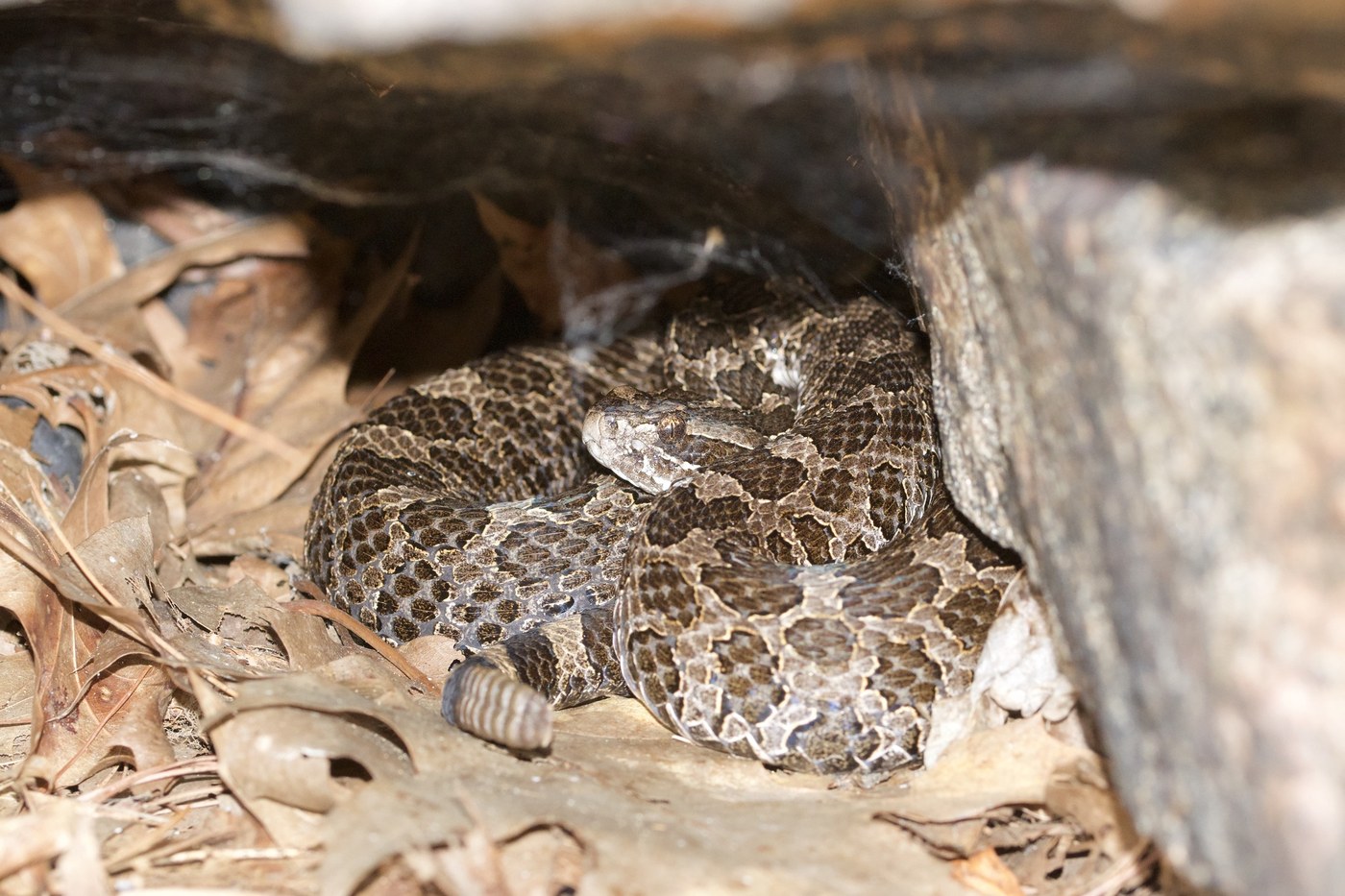
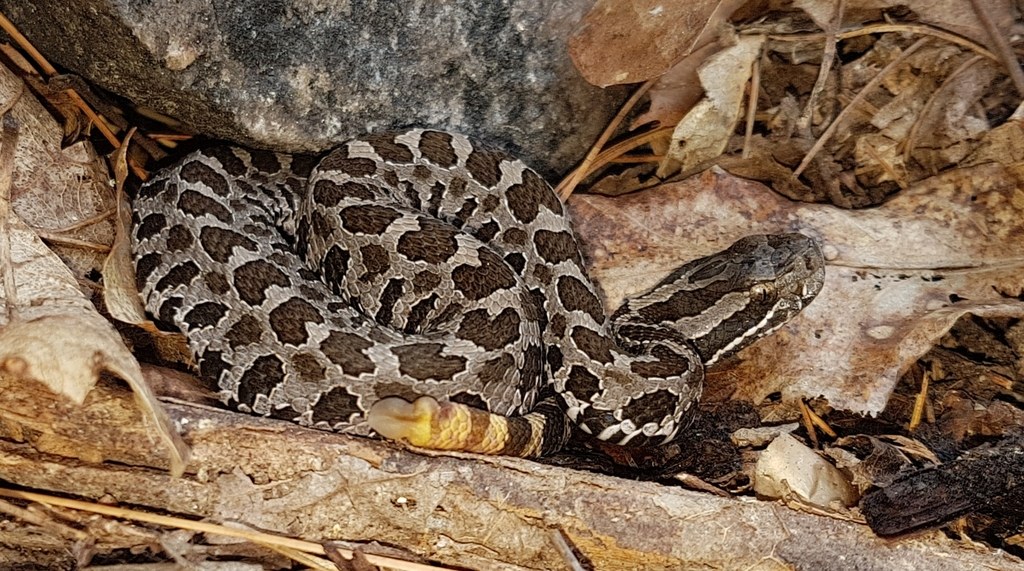
The bowtie blotch pattern and thick body are the tells, not just "gray snake with spots." Ground color is gray or light brown, occasionally black, with large, light-edged chocolate brown to black blotches down the back in a bowtie or video-game-controller shape, smaller blotches along the sides, and a marbled dark gray or black belly with a narrow light stripe on the head.
Head, pupils, and rattle
The head, pupils, and rattle are the fastest field checks. A triangular head clearly set off from a narrower neck, vertical elliptical pupils, and a keratinized, segmented rattle at the tail tip. The rattle produces a distinctly high-pitched, buzzy sound, easily mistaken for an insect, and is often barely audible past about 5 feet, so a quiet or silent tail is never proof a snake isn't there.
Size stays modest for a rattlesnake
Adults typically run 18 to 30 inches, thick-bodied for that length, with a maximum recorded length near 39.5 inches. Newborns are about 9 inches long and carry a tail button rather than a working rattle.
A tell for each look-alike
Species it gets confused with, and the specific tell for each. Eastern hognose snake is non-venomous, has an upturned, pointed snout scale for digging, no true rattle at all, and a theatrical defense routine (flattening its neck cobra-style, hissing, eventually rolling over and playing dead) that this species does not perform. Eastern fox snake and gopher/bull snakes are also non-venomous and can vibrate the tail tip against dry leaves to fake a rattling sound, but they lack a true segmented rattle, have a narrower head not clearly set off from the neck, and have round rather than vertical pupils.
A second massasauga, now separate
There is a second massasauga, and it is a different species now. The U.S. Fish and Wildlife Service states it directly on this species' own profile: the eastern massasauga was originally believed to be a subspecies of the western massasauga rattlesnake, and genetic analysis has since demonstrated it to be a distinct species, reclassified in 2011 as Sistrurus catenatus. The western animal is Sistrurus tergeminus and it ranges across the Great Plains and Southwest from Iowa and Nebraska south and west into Colorado, New Mexico and Arizona. The two are largely separated geographically, but not cleanly at the state level. Iowa's endangered species rule lists both by name and binomial as separate endangered species. In Missouri, the western animal's prairie subspecies persists in five isolated populations while this species has not been confirmed since 1941 and is considered likely extirpated there. The legal picture differs too, since only this species carries a federal Threatened listing.
Mimicry cuts both ways
That is the point. Several harmless snakes in this species' own range copy the warning behavior it is known for, which means a homeowner or yard crew that kills a "rattling" snake on sight risks killing a harmless mimic, or just as easily the real, federally protected species. Identifying calmly before acting, or simply not acting at all and calling a professional instead, is the safer choice either way.
Signs of Infestation
Not a structural pest
This is not a structural or property pest, and it leaves no property-damage signs. There are no droppings, gnaw marks, nests, or entry points to look for. The only sign is the animal itself, or the wetland, fen, or prairie-edge habitat it depends on.
Bowtie blotches and a thick build
The visual sign is the bowtie blotch pattern and thick build. A gray or light-brown snake with dark, light-edged blotches, a triangular head, and a segmented tail rattle, seen in or near wet prairie, marsh, fen, sedge meadow, or adjacent upland habitat.
The audible sign is easy to miss
A high-pitched, buzzy rattle that sounds more like an insect than a classic rattlesnake buzz, and one that is often inaudible past about 5 feet. Treat silence as no evidence either way, not as reassurance.
Where you actually run into one
Wetland-adjacent yards, fields bordering prairie fen or marsh remnants, and low ground near rivers or lakes within this species' now-limited range. Encounters are rare overall, since the species' remaining populations are small, isolated, and concentrated in specific, well-documented sites rather than spread broadly.
Prevention and When to Call a Pro
No homeowner prevention step
The restriction comes first, because there is no homeowner-level prevention or exclusion step for this species. Do not handle, capture, trap, or kill an eastern massasauga rattlesnake. Two narrow exceptions come from the listing rule itself: you may use a broom or a pole to move one off a walkway or out of a yard, because that is not take, and federal law preserves the right to act in defense of human life. It is federally listed as Threatened under the Endangered Species Act, and every state where it still occurs treats it as protected in some form. There is nothing to exclude or prevent here, only a rare animal to leave alone.
Leave it alone and call the state
If you see one, leave it alone and call your state wildlife agency or a licensed wildlife professional. That is the entire instruction, and it holds regardless of exactly where in this species' range a sighting happens. Several state wildlife agencies maintain reporting lines specifically for rare-species sightings; use one instead of attempting to identify, approach, or move the animal yourself.
Never disturb a hibernation site
Never disturb a suspected hibernation site. This species overwinters alone, most often in a crayfish burrow reaching below the frost line, and hibernation-site disturbance is one of the specific pressures federal wildlife officials cite as harmful to remaining populations. A burrow or crevice suspected of sheltering one over winter should be reported, not investigated or filled in.
Distance from a den proves nothing
Do not assume distance from a den means safety, and do not assume the reverse either. This species avoids confrontation by default and rarely strikes unless directly handled or stepped on, but any venomous snake bite is a medical emergency regardless of the species' generally shy temperament.
If someone is bitten
Do this immediately. Move away from the snake so a second strike isn't possible. Treat every bite as a medical emergency and get to emergency care right away, regardless of how mild it looks or whether the snake could be identified. Do not delay care to photograph or capture the animal. Keep the bitten limb still and at or below heart level, remove rings or tight clothing before swelling starts, and let emergency medical staff handle everything else.
When a Bite Is an Emergency, Who to Call
Call for emergency medical care immediately for any bite. For any sighting near a home, yard, or trail, do not attempt to identify, approach, handle, or move the animal yourself; contact your state wildlife agency or a licensed nuisance wildlife control professional and let a permitted party decide what happens next.
Frequently Asked Questions
Is the eastern massasauga rattlesnake actually endangered?
It is federally listed as Threatened under the Endangered Species Act since 2016, and every state in its range lists it as Endangered except Michigan, where it is Special Concern and protected from take by a state Director's Order.
Are eastern massasauga rattlesnakes aggressive?
No. State wildlife agencies describe the species as shy and mild-mannered, relying on camouflage and stillness rather than confrontation, and it rarely strikes unless handled or stepped on directly.
How do I tell a massasauga from a harmless look-alike snake?
A true massasauga has a segmented rattle, a triangular head clearly set off from the neck, and vertical pupils. Hognose, fox, and gopher/bull snakes lack a true rattle, though some vibrate their tail tips to imitate one, and have round pupils; hognose snakes also have a distinctive upturned snout scale.
What should I do if I see one in my yard?
Leave it alone and contact your state wildlife agency or a licensed wildlife control professional. Do not attempt to handle, trap, or move it yourself; this species is protected in every state where it still occurs.
How dangerous is a massasauga bite?
It is a genuine medical emergency, but fatalities are extremely rare. Michigan's wildlife agency reports no confirmed human deaths from this species' bite in that state in over 100 years, and 25 to 50 percent of bites deliver no venom at all.
Sources
- Eastern Massasauga (Sistrurus catenatus) species profile (physical description, habitat, diet, behavior, range) U.S. Fish & Wildlife Service
- Species at Risk: Eastern Massasauga Rattlesnake (identification, look-alike species, temperament, Pennsylvania population count) Western Pennsylvania Conservancy
- DNR urges public to give eastern massasauga rattlesnake its space (identification, bite statistics, no confirmed deaths in 100+ years) Michigan Department of Natural Resources
- Eastern Massasauga (=rattlesnake) (Sistrurus catenatus) species profile (federal listing status, taxonomy, solitary hibernation) USFWS Environmental Conservation Online System (ECOS)
- Endangered and Threatened Wildlife and Plants; Threatened Species Status for the Eastern Massasauga Rattlesnake (final listing rule, state-by-state legal status, stressors, extirpation rate) U.S. Fish and Wildlife Service, Federal Register
- Eastern Massasauga Rattlesnake species account (litter size, birth season, breeding-age range) Michigan Natural Features Inventory, Michigan State University
- Species Assessment for Eastern massasauga (breeding season, gestation, litter frequency) New York State Department of Environmental Conservation
- Eastern Massasauga Guide (New York population status, state-endangered listing history) New York Natural Heritage Program
- Eastern Massasauga Rattlesnake species account (state-by-state legal status roundup) The Rattlesnake Conservancy
- Prairie Massasauga (Sistrurus tergeminus tergeminus) field guide: the two-species split narrated by the state agency, the 1941 last confirmed eastern massasauga record in Missouri, and the five remaining prairie massasauga populations Missouri Department of Conservation
- Iowa Administrative Code, Natural Resource Commission [571] Chapter 77, rule 571-77.2(1), listing Eastern Massasauga (Sistrurus catenatus) and Western Massasauga (Sistrurus tergeminus) as separate endangered animal species Iowa Legislature
Image Credits
- Image: Owen Strickland via iNaturalist. CC BY 4.0.
License. - Image: Dan Riley via iNaturalist. CC BY 4.0.