Seasonal Timeline
Activity follows a spring emergence and fall return pattern tied to communal winter dens, with Northeast populations running a longer single warm-season window and the other three regions showing a dual spring-and-fall pattern around the hottest summer weeks.
Activity follows a spring emergence and fall return pattern tied to communal winter dens, with Northeast populations running a longer…
The calendar is built around one behavior: this species dens communally in the same rocky location, often for many years or generations, and its entire activity season is bracketed by leaving that den in spring and returning to it in fall. Snakes generally emerge in early spring to bask near the den, then disperse into the surrounding forest and rock terrain for the warm months before returning as temperatures drop. Where a dual peak is documented, the summer lull reflects the hottest weeks rather than reduced snake activity generally.
Where this species actually turns up matters as much as when. In the Midwest, activity concentrates around specific, well-mapped rocky den sites in forested, hilly terrain rather than being spread evenly across the region. In South Central, it concentrates in the wooded eastern part of the region, the Arkansas Ozarks and Ouachitas, East Texas, and Louisiana. In the Southeast, it favors forested, mountainous, and river-bottom terrain over open, developed yards.
The Northeast is the exception in both timing and population size. Its populations run a single, longer warm-season window rather than a dual peak, and several of the region's states now hold only a handful of known, closely tracked populations rather than a landscape-wide presence. That range contraction is a real and current fact, not a historical footnote, and it is a direct reason several Northeast states list this species as endangered rather than merely regulated.
Where They're Found
Timber rattlesnake is an outdoor, forest-and-rock-terrain species, not a structural invader in the way a raccoon or a mouse is. Its documented range runs from central New England south to northern Florida and west to eastern Texas, central Oklahoma, and the eastern edge of the Great Plains. Deciduous or mixed forest on rugged, hilly ground is the consistent theme almost everywhere it occurs: rocky outcroppings, ledges, and rockslides for denning, and forested ridgelines nearby. In the lowland Southeast and South Central parts of its range, it also uses a distinctly different habitat, canebrakes, swamp margins, and bottomland hardwoods near water, which is where the regional name "canebrake rattlesnake" comes from.
Denning is the single most important habitat fact here. This species reuses the same rocky den site, sometimes for many years or across generations, rather than denning wherever is convenient each winter. That fidelity is why several states point to loss or disturbance of a specific, known den site, not individual snake encounters, as the actual driver behind a local population's decline. A homeowner who identifies a rock outcrop as a den site should treat the location itself, not just the snake seen there, as something to leave undisturbed and report rather than modify.
Around a property, encounters happen at rock piles, ledges, and wooded property edges bordering the kind of terrain described above, and less often near hiking trails that pass close to a known den. This species does not enter structures looking for shelter the way a rodent or bat does, and it leaves no property damage of any kind. The entire practical concern here is the animal itself and, in the states where it is protected, the ground it dens on.
Life Cycle
Slow reproduction is the thread that runs through every stage, and it explains the legal picture. A female typically breeds only once every 2 to 4 years and, in colder parts of the range, may not reach sexual maturity for close to a decade. Combined with strong, multi-year fidelity to a single communal den, a population that loses breeding-age females or its den site to disturbance can take a very long time to recover, which is exactly the mechanism several state wildlife agencies point to when they describe this species' decline.

Mating and Denning
Neonate
Juvenile2
Adult
Identification
Chevrons and a black tail
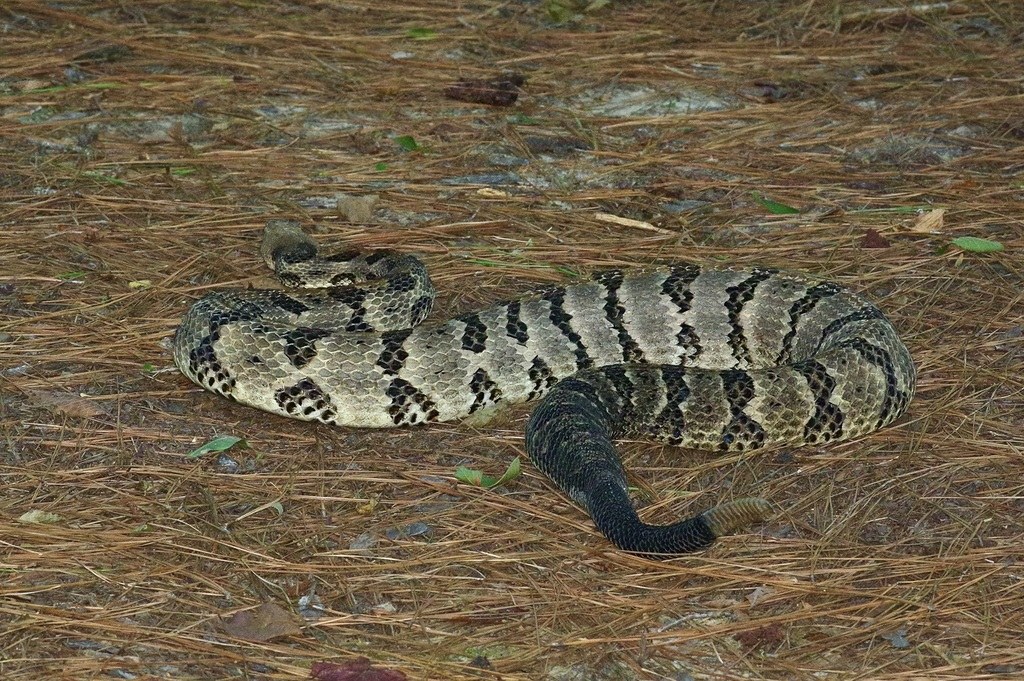
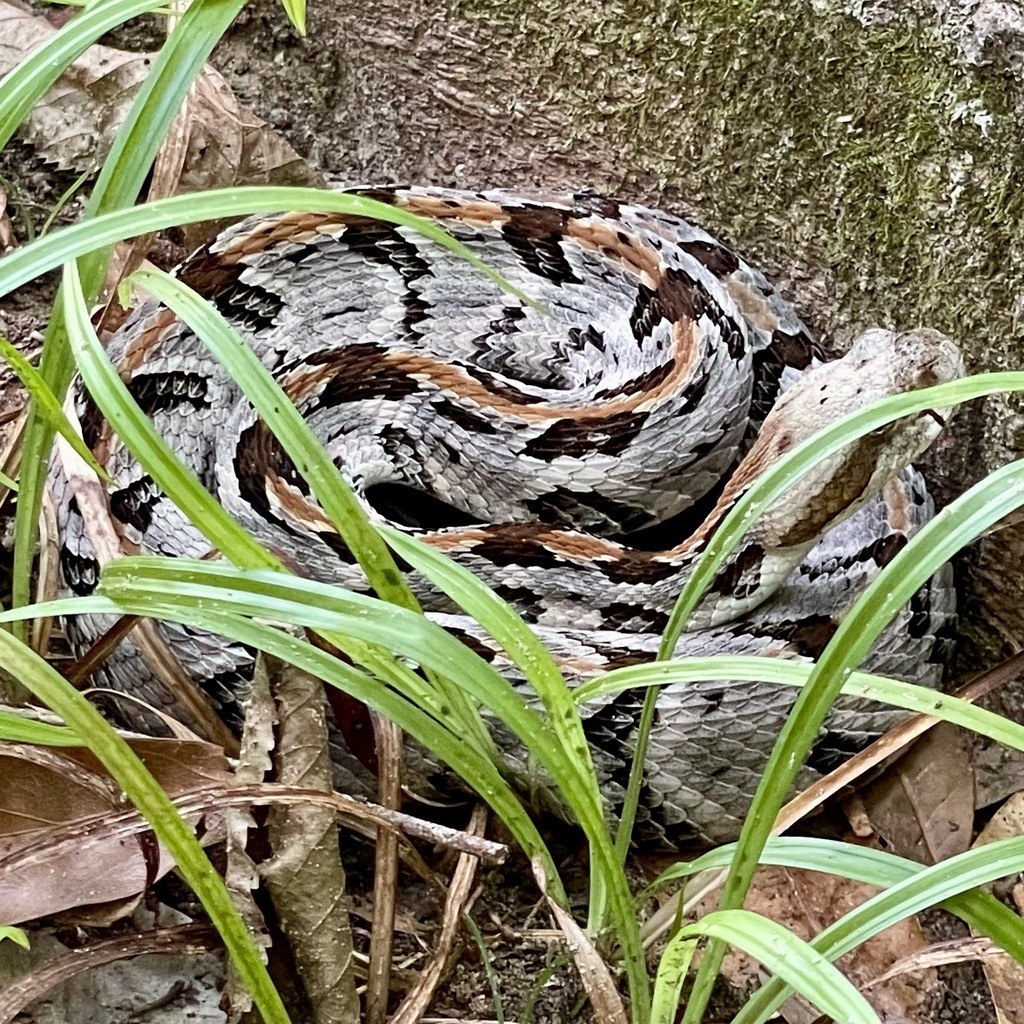
The chevron pattern and black tail are the tells, not the ground color. Ground color ranges widely, yellow, tan, gray, or brown, sometimes with a rust or orange stripe down the back, crossed by dark brown-to-black chevron or zigzag crossbands. Regardless of ground color, adults carry a solid, uniformly black tail tip, commonly described as velvet-tailed.
A black phase, not a species
A genuine black color phase exists and is not a different species. Especially common in the species' northern populations, a melanistic individual can read as nearly solid black except at close range, where the underlying chevron pattern is still faintly visible. Do not assume an all-black snake in this species' range must be something else.
Head, scales, and build
The head is broad and triangular, distinct from a narrower neck, with many small, irregular scales across the crown rather than large plates. Pupils are vertical and elliptical, with a heat-sensing pit between the eye and nostril, standard pit viper traits. Adults typically run 36 to 60 inches, with individuals recorded up to 74 to 75 inches.
A tell for each look-alike
Species it gets confused with, and the specific tell for each. Eastern massasauga rattlesnake, where ranges overlap, is smaller, rarely exceeding 3 feet, and carries 9 large plate-like scales on the crown rather than many small ones. Copperhead and cottonmouth neonates carry a bright yellow tail tip that a newborn timber rattlesnake never has, which is useful for telling young snakes of these species apart. Eastern hognose snake, a harmless mimic that flattens its neck to look cobra-like and hisses loudly, has an upturned, pointed snout scale and no rattle at all. Gray ratsnake and milk snake are sometimes mistaken for this species on blotchy pattern alone, but neither has heat-sensing pits or elliptical pupils, neither has a true rattle, and a young ratsnake's blotching fades with age in a way this species' pattern does not.
"Canebrake" is a regional name
It is not a separate species, with one legal exception. Southeastern and South Central lowland populations are still widely called canebrake rattlesnake, a name tied to their historic association with canebrake thickets along rivers. Genetic research does not support treating canebrake and upland timber rattlesnake populations as separate subspecies. Virginia is the one state where the name carries independent legal weight: its Coastal Plain population is state-endangered under the canebrake name specifically, while its separate western population is not independently listed.
It does not always rattle before it strikes
Multiple state wildlife agencies describe this species as shy and quick to retreat, and rattling is a common warning display. But it can also lie silent and motionless and strike without the usual buzz if it feels unseen. Treat the absence of a rattle as no evidence of safety, not as reassurance.
Signs of Infestation
This species leaves no structural damage
It does not chew, burrow, gnaw wiring, or damage buildings, and there is no droppings pattern, entry hole, or odor to look for. The sign is the snake, or the den site, and nothing else.
Chevrons and a black tail
The visual sign is the chevron pattern and black tail. A yellow, tan, gray, or brown snake with dark, zigzag-shaped crossbands and a solid black tail tip is this species in any of its typical color phases; an all-black snake in the same range may be the black color phase rather than something else.
Where you actually run into one
Rocky outcrops, ledges, and talus slopes used for denning; forested ridgelines and hilly terrain generally; and in the Southeast and South Central lowland range, also swamp margins, bottomland hardwoods, and canebrake vegetation near water. Encounters near a home are less common than with a species like copperhead, since this snake favors undeveloped forest and rock terrain over open yards.
A warning, but not a guaranteed one
Rattling is a common warning, not a guaranteed one. A buzzing rattle from the leaves or rocks is a strong indicator of this species, but it is documented as capable of striking without any warning sound at all when it feels unseen, so silence should never be read as an all-clear.
A den site is its own kind of sign
A specific rock outcrop or ledge with repeated sightings across a season, or across years, is likely a known den rather than a coincidence, and that location matters as much as the individual snake seen there.
Prevention and When to Call a Pro
The restriction comes first
It is the only instruction that holds everywhere in this species' range. Do not handle, capture, trap, relocate, or kill a timber rattlesnake, in any state. Three of the four regions this species occupies carry a formally endangered or threatened status across a meaningful share of their states, and even the fourth region includes a state with a formal threatened listing. A snake in a yard cannot tell you which state's rule applies to it, so leave it alone is the standard everywhere, not something that changes region by region.
It avoids people by default
This species avoids people by default, and distance is what keeps an encounter uneventful. State wildlife agencies from several different parts of this species' range independently describe it as shy and mild-tempered, inclined to flee or hide rather than confront a person. Do not approach for a closer look, and do not assume the absence of a rattle means the absence of risk, since this species can strike without any warning sound when it feels unseen.
Reduce the draw, not the snake
What is legitimate everywhere is reducing the draw, not removing the snake. Keep brush piles, woodpiles, and other ground-level debris away from the foundation, since these substitute for the natural rock and log cover this species uses away from its den. Address any existing rodent activity on the property, since rodents are this species' primary prey and are the more likely reason a snake showed up in the first place.
A repeat sighting means a den
Treat a repeat sighting location as a den site, not a coincidence. Because this species can reuse the same communal den for many years or across generations, a rock outcrop or ledge with repeated sightings across a season or multiple years is worth reporting to a state wildlife agency rather than disturbing, since den-site loss is a documented driver of population decline in this species specifically.
No protection is not no seriousness
Do not assume a lack of formal state protection means a lack of seriousness. Some states in this species' range offer it no special legal status at all, and two states run a narrow, permitted hunting or collection season with strict size and bag limits rather than an open invitation to take one. None of that changes the fact that this is a venomous pit viper whose bite is a medical emergency; a permitted season is a tightly bounded, state-run exception, not a reason for a homeowner to attempt anything themselves.
If someone is bitten
Do this immediately. Move away from the snake so a second strike is not possible. Treat every bite as a medical emergency and get to emergency care right away, regardless of how mild it looks at first, and regardless of whether the snake could be identified. Do not delay care to photograph or capture the snake. Keep the bitten limb still and at or below heart level, remove rings or tight clothing before swelling starts, and let emergency medical staff handle everything else.
When a Bite Is an Emergency, Who to Call
Call for emergency medical care immediately for any bite. For a sighting near a home, yard, or trail, do not attempt to identify, approach, handle, or move the animal yourself; contact your state wildlife agency or a licensed nuisance wildlife control professional and let a permitted party decide what happens next, since the legally correct answer depends on exactly which state you are in.
Frequently Asked Questions
Are timber rattlesnakes endangered?
It depends entirely on which state you're in. There is no federal listing, and the species' overall conservation rank is considered secure, but it is formally endangered in states such as New Hampshire, Vermont, Massachusetts, Connecticut, New Jersey, and Ohio, and formally threatened in states such as New York, Illinois, Minnesota, and Texas. Treat it as protected unless you have confirmed otherwise for your specific state.
Do timber rattlesnakes always rattle before they strike?
No. Wildlife agencies describe this species as generally shy and quick to retreat, but it is also documented as capable of lying silent and motionless and striking without the usual warning buzz if it feels it hasn't been seen. Never treat the absence of a rattle as evidence that a snake isn't there or isn't a threat.
What's the difference between a timber rattlesnake and a canebrake rattlesnake?
None taxonomically. Genetic research does not support treating them as separate subspecies; "canebrake" is simply the regional name used for this species' lowland Southeast and South Central populations. Virginia is the one state where the name carries separate legal weight, since its Coastal Plain population is state-endangered under that name while its western population is not independently listed.
Is it ever legal to hunt or collect a timber rattlesnake?
In a narrow, permitted way, in a small number of states. A couple of states in this species' range run a tightly bounded collection season with a permit, a strict bag limit, and minimum size requirements, even though neither considers the species endangered. Nearly everywhere else in its range, taking one is prohibited outright, so never assume a season exists without confirming it for your specific state.
Why does this species take so long to recover after a local population is disturbed?
Females typically breed only once every 2 to 4 years and, depending on the region, may not reach sexual maturity for 4 to 10 years. Combined with strong, multi-generation fidelity to a single den site, a population that loses breeding-age females or its den site can take many years to rebuild, which is why several states specifically cite den-site disturbance as a driver of decline.
Sources
- Timber Rattlesnake species profile (taxonomy, range, conservation status, global rank) NatureServe Explorer
- Timber Rattlesnake field guide (size, color, bite epidemiology, state status) Missouri Department of Conservation
- Canebrake (Timber) Rattlesnake species page (reproduction, denning ecology, venom composition, state protection contrast) University of Georgia Savannah River Ecology Laboratory
- Timber Rattlesnake species page (size records, look-alike species, denning ecology, reproduction, lifespan) Virginia Herpetological Society
- Canebrake Rattlesnake Conservation Plan (split Virginia population legal status) Virginia Department of Wildlife Resources
- West Virginia's State Reptile: Timber Rattlesnake (temperament, activity season, legal protection) West Virginia Department of Natural Resources, via USDA Forest Service Monongahela National Forest
- Timber Rattlesnake Conservation (regulated hunting season, permit, bag limit, size requirements) Pennsylvania Fish and Boat Commission
- Venomous Snakes: A Neglected Hazard for Outdoor Workers (bite epidemiology, long-term injury rate, first-aid guidance) Centers for Disease Control and Prevention, National Institute for Occupational Safety and Health
- New York Snakes: Identification Guide (head scalation, massasauga comparison) State University of New York College of Environmental Science and Forestry
- Timber Rattlesnake species page (New Hampshire population status) New Hampshire Fish and Game Department
Image Credits
- Image: Michelle W. (鍾偉瑋) via iNaturalist. CC BY 4.0.
- Image: John P Friel via iNaturalist. CC BY 4.0.
License.