Seasonal Timeline
Eastern diamondback rattlesnake is most active in the evenings and early mornings, hunting from ambush and using heat-sensing pits to locate prey. The birth season runs from late July through early October, when live young arrive fully formed and already venomous. Females breed only once every two to four years, a slow cycle the sourcing ties directly to the species' vulnerability to population decline.
Eastern diamondback rattlesnake is most active in the evenings and early mornings, hunting from ambush and using heat-sensing pits to…
The reproductive calendar on this species matters more than the daily one, and it is the single biological fact that explains why a population that gets knocked down does not bounce back. Females do not breed every year. The sourcing describes them as breeding often only once every two to four years, and it ties that slow cycle directly to the species' vulnerability to population decline. A litter runs 7 to 25 live young, averaging around 12, with a wider reported range of 4 to 28 that centers on the same average. Gestation lasts roughly six to seven months, and the young are born live rather than hatched, which is standard for pit vipers.
Put those numbers together and the arithmetic is unforgiving. A landscape holding a given number of adult females produces litters at somewhere between a third and a half the rate a yearly breeder would, so losses to road mortality, habitat conversion, and intentional killing are replaced slowly or not at all. That is the mechanism behind the federal status review, and it is the reason every individual snake is worth leaving in place rather than removing.
Where They're Found
Eastern diamondback rattlesnake is an entirely outdoor, wild species. It is not a structural invader the way a rodent or a bat is, and nothing in its biology gives it a reason to get inside a building. Its whole range sits in one region, the Southeast.
The range runs from southeastern North Carolina south through peninsular Florida and the Florida Keys, then west along the Gulf Coast through southern Mississippi and Alabama to southeastern Louisiana. What that sentence hides is how uneven the picture is inside those borders. The U.S. Fish and Wildlife Service's own species data lists the current known or believed occurrence as Alabama, Florida, Georgia, and South Carolina, with Louisiana, Mississippi, and North Carolina appearing in the historical range. On the ground the species runs from a stronghold in Florida and southern Georgia, to populations eliminated from most of their historic extent in Mississippi, to a single remaining known locality in North Carolina, to functionally extirpated in Louisiana, where it is considered critically imperiled and the last verifiable sightings are more than a decade old. A range map for this snake is closer to a historical document than a current one. No published source places the species in Alaska or Hawaii, and every range description confines it to the Southeastern coastal plain.
The habitat is specific and it is disappearing, which is most of the story. This is a longleaf pine animal, at home in pine flatwoods, sandhills, and scrub communities that depend on regular fire to keep the understory open, plus coastal dune systems and palmetto and wiregrass communities. Fire suppression closes that understory in, and a closed understory stops being habitat. Decades of longleaf pine loss combined with decades of fire suppression have removed most of what this snake evolved to live in, and that habitat loss is the first driver cited behind the federal status review. One widely repeated figure puts current populations at roughly 3 percent of historical levels. That number traces to a single general reference rather than to a primary federal or state source, so read it as an indication of scale rather than a settled measurement.
The most interesting habitat detail is a relationship rather than a place. Eastern diamondback rattlesnake is named specifically as a priority commensal of gopher tortoise burrows, meaning it uses tortoise-dug burrows as a primary shelter site: refuge from temperature extremes, refuge from predators, refuge from fire, and winter shelter. That single fact ties this snake's future to a separately protected species' habitat. Where gopher tortoises persist and their burrows persist, this snake has somewhere to go. Where they do not, it does not.
Diet fills in the rest and explains most repeat sightings. Prey is small to medium mammals, rabbits, cotton rats, mice, and squirrels, taken with a strike-and-release tactic where the snake envenomates, lets go, and tracks the animal down by scent afterward. Young snakes favor rats and mice specifically. Birds are occasional. As with every rattlesnake, a property producing repeated sightings is usually a property producing rodents.
Related Pests
Life Cycle
The life-cycle detail that explains the federal status review is reproductive frequency, not litter size. A litter of 12 sounds like plenty until you pair it with the breeding interval. Females are described as breeding often only once every two to four years, so the population's actual replacement rate is a fraction of what a headcount of adult females suggests, and the sourcing draws that connection to decline vulnerability directly rather than leaving it to inference. That is why a single snake removed from a landscape is not a neutral act on this species the way it might be on a more prolific animal, and it is the biological reason the practical advice reduces to leaving the animal where it is.

Mating
Gestation
Birth
Neonate
Juvenile and Adult
Identification
Size is the first and best clue
That is unusual for a snake. This is the largest rattlesnake species in the world and the heaviest venomous snake in North America. Average adults run 3 to 6 feet, individuals over 7 feet are recorded, and the maximum length reaches about 8 feet. The best-documented single specimen is a 1946 animal at 7.9 feet and 34 pounds. Typical weight is where the sourcing genuinely disagrees: Florida's state wildlife agency gives 2 to 4 pounds for Florida animals, a broader general average runs about 5 pounds, and the Smithsonian National Zoo gives 10 pounds for adults generally. Read the Florida figures as the conservative baseline and the higher number as reflecting larger individuals or a species-wide average rather than a typical Florida snake. Either way, a genuinely heavy-bodied rattlesnake in the Southeastern coastal plain is a strong indicator for this species.
The pattern is the namesake and it is clean
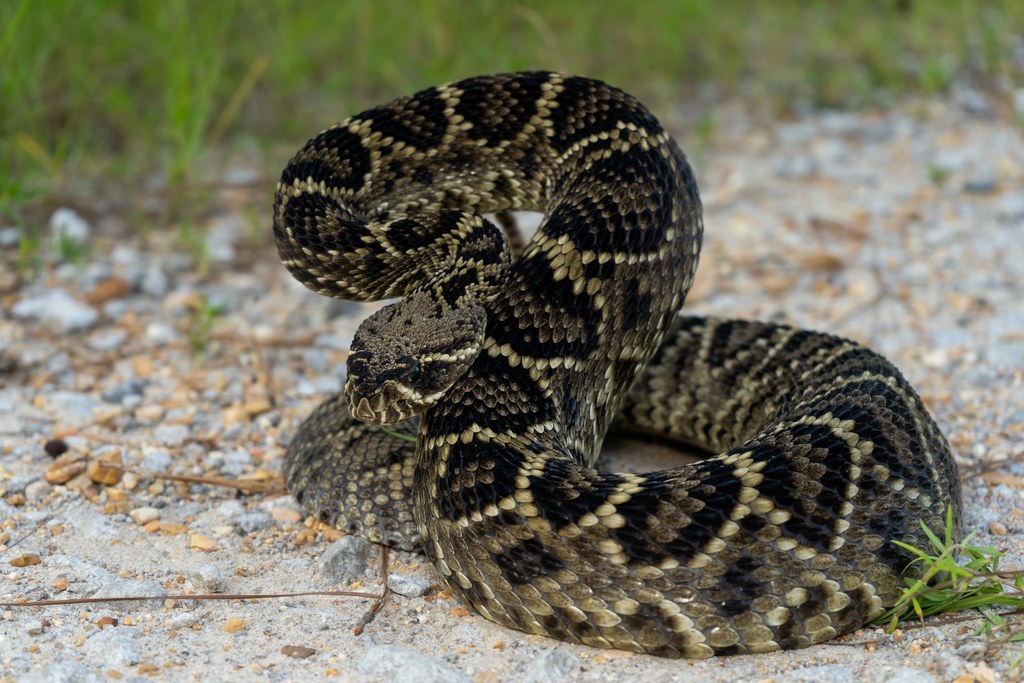
The ground color is brown, yellow, or tan, carrying a row of large dark diamond blotches down the back. Each diamond is centered brown or black and bordered in cream or yellowish scales, and that pale border is the detail that makes the diamonds read as diamonds rather than as vague dark patches. Unlike western diamondback rattlesnake, the pattern is present from birth rather than developing with age.
The head carries two marks worth knowing
The head is large, broad, and triangular, and a dark diagonal stripe bordered in white or cream runs through the eye and back toward the jaw. Between the eye and the nostril sits the heat-sensing pit that puts this animal in the pit viper family, the same family-level mark shared by copperhead, cottonmouth, and the other rattlesnakes.
How the rattle is built
The rattle is a segmented keratin structure that gains one segment per shed. Segment count is not an age count in years, because sheds do not happen on an annual schedule, and segments break off. Treat the rattle as confirmation of the family rather than as a measurement of anything.
Against timber rattlesnake
The look-alike with the widest overlap is timber rattlesnake. Timber rattlesnake shows dark crossbands rather than diamonds on a lighter ground color, often with a rust-colored dorsal stripe down the back and a black tail, and it tops out around 5.5 feet against the eastern diamondback's 6 to 8. Pattern shape is the reliable separator: bands run across the body, diamonds sit as discrete bordered shapes along it.
Against dusky pygmy, it is size
The other look-alike is dusky pygmy rattlesnake, and size settles it. Pygmy rattlesnakes are dramatically smaller, carry dark blotches rather than clean diamonds, and have a rattle faint enough to be barely audible. In practice nobody confuses a 5-foot animal with a pygmy rattlesnake once both are in view. The mix-up happens on a brief or partial sighting.
Why neither mix-up should worry you
Here is why neither mix-up should worry you, and it is the most useful thing on this list. Timber rattlesnake, dusky pygmy rattlesnake, and eastern diamondback rattlesnake are all venomous pit vipers, so the correct response is identical for all three: do not approach, do not handle, give it distance, and call someone if it is somewhere people or pets cross. Getting the species wrong changes nothing about what you should do. That is a genuinely lower-stakes identification problem than telling western diamondback from Mojave rattlesnake, where the distinction can change what an emergency department watches for. It also means there is no safety justification for moving closer to compare pattern details.
Names you may hear
Diamondback rattler, diamond-back, and coon-tail rattler all turn up in general Southeast usage, though none is documented as tied to a specific state the way coontail attaches to western diamondback. The scientific name is Crotalus adamanteus, in the family Viperidae and the pit viper subfamily Crotalinae.
Signs of Infestation
Nothing to inspect
There is no inspection checklist for this snake, because it leaves nothing to inspect. Eastern diamondback rattlesnake builds nothing, chews nothing, and never gets into a wall or a crawlspace. There are no gnaw marks, no entry holes, no droppings trail, and no damage mechanism to work backward from. The sighting is the evidence, and essentially all of it.
Visual sign comes down to two things
The animal itself, or a shed skin. Shed skins turn up near gopher tortoise burrow mouths, rock and debris piles, and brush cover, which are the shelter features this species is documented to use. A shed skin is general rattlesnake sign rather than proof of this species specifically.
A rattle is a warning, not an ID
The rattle is a warning, not an identification. Other rattlesnakes share parts of this range and all of them rattle when threatened, so the sound tells you to move away rather than telling you what you are moving away from. It also fails in the other direction. Newborns are born with a rattle button, and general rattlesnake biology means a very young or freshly shed individual can be effectively silent. Hearing nothing rules nothing out.
No odor
No distinctive smell is documented, so there is no olfactory sign to look for and nothing to infer from its absence.
Note the burrows, from a distance
Look at where the burrows are, from a distance. Gopher tortoise burrows are a documented priority shelter site for this species, and rock piles, woodpiles, and accumulated debris serve the same function. Noting those features on a property is useful context. Investigating them by hand is not, and it is the single most avoidable way to put a hand where a rattlesnake already is.
Repeat sightings usually point at rodents
Prey is small to medium mammals, rabbits, cotton rats, mice, and squirrels, with young snakes favoring rats and mice. A property producing regular snake sightings is generally a property producing regular rodent activity, which reframes the situation as a food-source question.
Prevention and When to Call a Pro
There are no removal steps here
There are no removal, relocation, trapping, or exclusion instructions for this snake, and that is deliberate. Eastern diamondback rattlesnake is under an open federal status review and is state-listed Endangered in North Carolina, and the documented population decline behind that review is severe enough that the correct instruction here is different from the one for every other snake. Do not handle it. Do not capture it. Do not kill it. Do not attempt to move it. Give it distance and let it leave on its own, which it will. Every other step sits underneath that rule rather than alongside it.
Retreat is the whole technique
It works because the animal wants the same thing you do. Back away deliberately rather than casually, keep people and pets away from the area, and do not turn your back on a snake you have not yet put real distance between yourself and. Distance ends nearly every encounter with a rattlesnake without anything else happening.
Reduce the draw, not the snake
What a homeowner can legitimately do is reduce the draw, not remove the snake. Two things are genuinely within reach. Reduce rodent activity around the property, because rodents are this species' documented prey base and are the usual reason a snake is present at all. And keep brush, woodpiles, and accumulated debris away from the foundation, because those piles supply the ground-level shelter the animal would otherwise find in a burrow or under natural cover. Neither of these is exclusion in the legal or technical sense, and neither is framed here as a way to keep the species off a property. They are the only levers available that do not involve touching the animal, and they address the food and shelter that made the property attractive in the first place.
Never approach for a closer look
Not even to confirm what you are seeing. This is worth stating plainly because the impulse is so common. There is no version of this identification that changes your next move. Eastern diamondback, timber rattlesnake, and dusky pygmy rattlesnake are all venomous, and the correct action for all three is identical: leave it alone and call someone. Since the answer does not change, there is no safety reason to close the distance, and closing the distance is the main way people get bitten by an animal that was otherwise going to leave.
No listing is not permission
Do not treat the absence of a formal listing in your state as permission. The legal picture across this snake's range is uneven and it is easy to misread. North Carolina lists the species as Endangered under the state Endangered Species Act. South Carolina applies a Species of Concern label that its own wildlife agency describes as non-regulatory. Georgia treats it as a high-priority species in the State Wildlife Action Plan, a conservation-planning document rather than a regulatory listing. Alabama, Mississippi, and Louisiana carry conservation-concern classifications without a formal state legal listing, and in Louisiana the species is considered critically imperiled and likely already gone. None of that establishes that killing or removing the animal is appropriate anywhere in its range. A species under active federal review, in documented decline across its entire range, is one to leave in place and report, not one to act on because a particular state has not yet written a rule.
What the venom does
This is stated at the level the sourcing supports. It is hemotoxic, and it is chemically complex: over 100 distinct toxins have been identified in it, of which roughly 40 have been characterized. The mechanism documented in the peer-reviewed pharmacology literature is a defibrinogenating, thrombin-like venom enzyme that disrupts the blood's ability to clot, and the same work notes that it does this without directly affecting platelets in humans. That is a clotting-system injury rather than a nerve injury, which is why the clinical concerns around a bite from this species run toward bleeding, tissue damage, and coagulopathy that can return after initial treatment. Two figures often quoted alongside this deserve their caveat: venom yields commonly given as 400 to 450 milligrams average and up to about 1,000 milligrams maximum, against an estimated human lethal dose of 100 to 150 milligrams, and an untreated mortality estimate of 10 to 20 percent, each currently trace to a single source that has not been independently re-verified. They are directionally consistent with everything else here, and they are not settled numbers.
Any bite is a 911 emergency
When to call, first case: any bite is a 911 emergency, immediately and without exception. Call 911 and get emergency care regardless of how mild the bite looks in the first minutes, and regardless of whether anyone identified the snake. Do not delay care to confirm the species, photograph the animal, or look for it. This species' venom is one of the four used to manufacture CroFab, the standard United States pit viper antivenom, so treatment for a confirmed or suspected bite from it is squarely within standard emergency practice. With prompt treatment, fatalities from this species are described as rare. The gap between that and the untreated outcome is the entire argument for speed.
Call for any sighting near people
When to call, second case: any live sighting near a structure, in a yard, or anywhere people and pets routinely cross. Do not approach, capture, trap, or attempt to relocate the animal. Contact a licensed nuisance wildlife control operator or your state wildlife agency and let a permitted professional decide what happens next. Depending on where you are, that agency is the Florida Fish and Wildlife Conservation Commission, the Georgia Department of Natural Resources, the Alabama Department of Conservation and Natural Resources, the South Carolina Department of Natural Resources, the Mississippi Department of Wildlife, Fisheries, and Parks, the Louisiana Department of Wildlife and Fisheries, or the North Carolina Wildlife Resources Commission.
North Carolina, a reportable case
North Carolina is a special case, and a sighting there is reportable rather than merely actionable. The species is state-listed Endangered in North Carolina, the population is extremely rare and confined to a very small part of the Coastal Plain, and some sources suggest possible extirpation as early as the mid-1990s. The North Carolina Wildlife Resources Commission actively solicits sighting reports to support tracking, independent of any nuisance question. If you are in North Carolina and you see one, report it, whether or not it is anywhere near a building.
Why the rule is tighter here
The rule here is deliberately tighter than it is for other venomous snakes. With copperhead, cottonmouth, western diamondback, Mojave, and prairie rattlesnake, habitat modification and exclusion are reasonable homeowner work. That does not apply to eastern diamondback rattlesnake, and the reason is its population status rather than any difference in how the animal behaves. Instead of a checklist, the answer here is a phone call.
Frequently Asked Questions
Is the eastern diamondback rattlesnake endangered?
Not federally, and the precise answer matters here because this one gets overstated constantly. The U.S. Fish and Wildlife Service's own species database lists this snake's status as Under Review. That is a distinct and less advanced category than Candidate, and the agency's Candidate Species Report was checked directly: the eastern diamondback rattlesnake does not appear on it. The species is not Listed, not Proposed, and not a Candidate. What did happen is that a petition to list it as threatened was filed in 2011, and the Service published a positive 90-day finding in 2012 determining that listing may be warranted and opening a status review that remains open. At the state level the picture varies sharply and should not be generalized. North Carolina is the only state in the range with a genuine legal Endangered designation, under the state Endangered Species Act. South Carolina applies a Species of Concern label that is explicitly non-regulatory. Georgia treats it as a high-priority species in its State Wildlife Action Plan, which is a planning document rather than a legal listing. Alabama, Mississippi, and Louisiana have no formal state legal listing, relying on conservation-concern classifications instead, and in Louisiana the species is considered critically imperiled and likely already extirpated. Under review is not the same as protected, but the decline behind the review is real, which is why the advice is to leave the animal alone regardless of which category applies where you live.
How big does an eastern diamondback rattlesnake get?
This is the largest rattlesnake species in the world and the heaviest venomous snake in North America. Average adults run 3 to 6 feet, individuals over 7 feet are on record, and the maximum reaches about 8 feet. The best-documented single specimen is a 1946 animal at 7.9 feet and 34 pounds. Typical weight is less settled than length. Florida's state wildlife agency gives 2 to 4 pounds for Florida animals, a broader general average runs about 5 pounds, and the Smithsonian National Zoo gives 10 pounds for adults generally, which is a real disagreement between sources rather than a rounding difference. The Florida figures are the more conservative baseline for a typical animal in that state.
How dangerous is an eastern diamondback rattlesnake bite?
Serious enough that it should always be treated as a medical emergency, with two supporting facts of very different strength. The strong one: this species' venom is one of the four source venoms used to manufacture CroFab, the standard FDA-approved pit viper antivenom in the United States, alongside cottonmouth, Mojave rattlesnake, and western diamondback rattlesnake. That is confirmed in the product's own FDA labeling, which makes it a direct marker of the species' clinical significance rather than an inference. Case reports also document that envenomation by this species can require multiple doses of antivenom to manage complications including compartment syndrome and recurrent coagulopathy. The weaker facts deserve their caveat. Commonly cited venom yields of 400 to 450 milligrams average and up to about 1,000 milligrams maximum, against an estimated human lethal dose of 100 to 150 milligrams, and an untreated mortality estimate of 10 to 20 percent, each trace to a single source that no other publication has independently confirmed. They are widely repeated and directionally consistent with the rest of the picture, but they are not settled. With prompt treatment, fatalities are described as rare. Nothing about the uncertainty in those numbers changes the instruction, which is to call 911 for any bite without waiting to identify the snake.
Is eastern diamondback venom stronger than western diamondback venom?
In one specific laboratory measurement, yes. A peer-reviewed comparative study using a chick embryo model found eastern diamondback venom more acutely toxic than western diamondback venom in that model, at 3.96 micrograms per egg against 11.73. That is a real finding from a controlled comparison. It is also narrower than it sounds. A chick embryo model measures acute toxicity in that system, not clinical outcome in a person, and the same study found western diamondback venom produced more pronounced bleeding with faster onset, which the authors attribute to its hemotoxic component profile. Different venoms do different damage in different ways. The practical answer for a homeowner is that both are medical emergencies and the comparison does not change anyone's next move.
Why do gopher tortoise burrows matter to this snake?
Because they are the shelter. Eastern diamondback rattlesnake is named specifically as a priority commensal of gopher tortoise burrows, meaning it depends on burrows another animal dug for refuge from temperature extremes, from predators, and from the fires that maintain its habitat, including as winter shelter. That relationship ties this snake's future directly to a separately protected species and to the same longleaf pine ecosystem both depend on. It also explains part of the decline. Where fire suppression and habitat conversion have removed the open pine understory that supports gopher tortoises, the burrows go too, and this snake loses the shelter network it relies on rather than simply losing open ground.
Sources
- Species Profile for Eastern diamondback rattlesnake (Crotalus adamanteus): Listing Status recorded as Under Review, no Candidate designation or Candidate assessments on file, current and historical range by state, and the single logged Federal Register document U.S. Fish and Wildlife Service, Environmental Conservation Online System
- Candidate Species Report: the authoritative list of species currently holding formal Candidate status, which does not include the eastern diamondback rattlesnake U.S. Fish and Wildlife Service, Environmental Conservation Online System
- 90-Day Finding on a Petition To List the Eastern Diamondback Rattlesnake as Threatened, 77 FR 27403, published 2012-05-10: the substantial-information determination and the initiation of the status review Federal Register, U.S. Fish and Wildlife Service
- CroFab (Crotalidae Polyvalent Immune Fab) package insert: the four source venoms used in manufacture, including Crotalus adamanteus U.S. Food and Drug Administration
- Eastern Diamondback Rattlesnake species profile: size and weight ranges, color and pattern, the diagonal eye stripe, the heat-sensing pit, and the rattle Florida Fish and Wildlife Conservation Commission
- Gopher Tortoise Commensals: the eastern diamondback rattlesnake named as a priority commensal of gopher tortoise burrows Florida Fish and Wildlife Conservation Commission
- Eastern Diamondback Rattlesnake (Crotalus adamanteus) species account: longleaf pine and sandhill habitat, fire dependence, burrow use, diet, range, state-by-state population variation, gestation, birth window, and litter size Savannah River Ecology Laboratory, University of Georgia
- Florida Snake ID: eastern diamond-backed rattlesnake and timber rattlesnake species pages, used for the look-alike identification tells Florida Museum of Natural History, University of Florida
- Eastern Diamondback Rattlesnake: adult weight, crepuscular activity pattern, ambush hunting, neonate size, breeding interval of once every two to four years, and diet of young snakes Smithsonian National Zoo and Conservation Biology Institute
- Eastern Diamondback Rattlesnake: state-listed Endangered status under the North Carolina Endangered Species Act, extreme rarity in the state, and the agency's solicitation of sighting reports North Carolina Wildlife Resources Commission
- Eastern Diamond-backed Rattlesnake species status: the Species of Concern designation and its explicitly non-regulatory character South Carolina Department of Natural Resources
- State Wildlife Action Plan: the high-priority species classification, a conservation-planning designation rather than a regulatory listing Georgia Department of Natural Resources, Wildlife Resources Division
- Eastern Diamondback Rattlesnake: elimination of populations from most of the historic range within the state, with no formal state listing identified Mississippi Department of Wildlife, Fisheries, and Parks
- Ruthenium Antivenom Inhibits the Defibrinogenating Activity of Crotalus adamanteus Venom in Rabbits: the defibrinogenating, thrombin-like coagulopathy mechanism National Center for Biotechnology Information, PubMed Central
- A Comparative Analysis of the Cytotoxic and Vascular Activity Effects of Western Diamondback Rattlesnake (Crotalus atrox) and Eastern Diamondback Rattlesnake (Crotalus adamanteus) Venoms Using a Chick Embryo Model: the 3.96 versus 11.73 micrograms per egg acute toxicity comparison National Center for Biotechnology Information, PubMed Central
Image Credits
- Image: evangrimes via iNaturalist. CC BY 4.0.
License.