Seasonal Timeline
Pine voles are active year-round and do not hibernate. What changes is the diet. Roots and green forage carry them through spring and summer, seeds and fruit through fall, and bark and roots through winter, which is why the serious plant damage lands in fall and winter and why the plant does not visibly fail until the following growing season.
Pine voles are active year-round and do not hibernate. What changes is the diet. Roots and green forage carry them through spring and…
Region-specific peak and shoulder windows are not established for this species. The calendar comes entirely from published extension and federal sources, and it is a damage calendar rather than an activity calendar, because the animal itself never stops.
Population numbers move seasonally in a way that is worth knowing before you panic. The USDA Forest Service's southern account records cyclic seasonal fluctuation with peak numbers in spring and fall and fewer animals in summer. A year-long live-trapping study in two Virginia apple orchards found the same shape, most pine voles captured in winter and spring and the fewest in summer and early fall, though the authors were careful to note that summer trappability may explain part of that rather than a real crash.
Breeding runs longer here than it does up north, and that is a genuine Southeast difference. The Forest Service states that regional populations probably breed throughout the year, with most activity March through October, while farther north reproduction may decline or cease by early winter. A published species account gives February to November and says plainly that the breeding season is longer in southern parts of the range.
Where They're Found
Across the Southeast, this species is close to fully present rather than at the edge of its range. The USDA Forest Service's regional account places the woodland vole in all of Virginia, where three separate subspecies are recognized inside one state, and through Kentucky, Tennessee, North Carolina, and South Carolina. In Georgia it occurs statewide except the extreme southeastern coast. It runs throughout Alabama and Mississippi apart from the coastal strip along the Gulf of Mexico. In Florida it is restricted to the northern panhandle and the north-central peninsula, reaching south to about the Ocala area and no farther.
The coastal absence is real and repeated, not a gap in the record. Survey work describes the species as rare or missing in coastline dune and maritime forest habitats and absent from the barrier islands. Elevation is no barrier in the other direction: there are records above 1,300 meters in the southern Appalachians, though 600 meters is the more usual mountain figure, and the species runs right down to near sea level on the Atlantic coastal plain.
On the ground, look at soil and cover rather than at grass. Preferred habitat is deciduous forest interior and forest edge with a heavy accumulation of leaf litter, and the species spends most of its time below that litter and humus layer. It also takes readily to mulched landscape beds and gardens, hedgerows, fencerows, railroad rights-of-way, old fields, cropland, nurseries, Christmas tree plantations, and above all orchards, which one published account calls excellent habitat outright. Orchards concentrate this animal far above forest densities, which is the single best explanation of why it is an orchard pest rather than a forest problem.
The soil question produces a genuine disagreement among good sources, with no clear winner. NC State says soils with substantial clay content support pine voles better than sandy soils, because clay lets tunnels and nest chambers hold their shape. University of New Hampshire Extension says the most favorable soils are sandy with enough silt or clay to keep tunnels from collapsing. The Forest Service says mesic and well-drained. What all of them actually agree on is tunnel-wall stability: the soil has to be loose enough to dig and cohesive enough not to cave in. A small confirming detail from the orchard literature makes the point better than any soil triangle. Pine vole tunnels almost never cross a compacted driveway.
Beyond the Southeast. The map shows four regions because the woodland vole occupies the whole temperate deciduous forest zone of the eastern United States, from southern Maine south to north-central Florida and west to central Wisconsin and eastern Texas, plus extreme southern Ontario and Quebec. That takes in the Northeast (Pennsylvania, New York, New Jersey, the Mid-Atlantic, and southern New England), the eastern Midwest (Ohio and Indiana across to Iowa, Missouri, and the eastern Great Plains margin), and the northern tier of the South Central region (Kentucky, Tennessee, Arkansas, and eastern Oklahoma and Texas). The orchard, nursery, and mulched-bed damage pattern described above applies across all of it, not only in the Southeast. Meadow vole overlaps the same ground, but the two animals are separated by behavior rather than by geography.
Related Pests
Life Cycle
The most useful thing to know about pine vole reproduction is what it does not do. Voles have a reputation for exploding in numbers, and for meadow vole that reputation is earned. For this species it is not. Virginia Cooperative Extension states it directly: population eruptions in woodland voles are uncommon because of their lower reproductive output, and their numbers remain relatively stable over time. A long-running Adirondack account says the same thing in different words, calling densities relatively stable compared to the meadow vole. Smaller litters, fewer of them, and later maturity add up to a steadier animal.
Treat that as a disagreement rather than a settled fact, because plenty of good sources say otherwise. South Carolina's own wildlife agency says vole population levels generally peak every 2 to 5 years and can reach 4,000 animals per acre in an irruption. A federal orchard bulletin gives a three to five year irruption cycle. A New Jersey orchard fact sheet gives 2 to 4 years. Read carefully, all three of those are written about voles as a group, with meadow vole driving the pattern, while the two accounts written about this species specifically both describe it as the steadier of the pair. If you find both claims in the same afternoon, that is why.
None of which means low numbers in an orchard. Density in forest habitat runs about 6 to 25 animals per hectare depending on the source. In orchards it climbs hard: a Virginia live-trapping study estimated 243 to 798 pine voles per hectare in a single maintained orchard across one year, and one published orchard figure reaches 625 per hectare, about 250 per acre. The animal is steady, not scarce, and a managed orchard is the best habitat it will ever find.

Newborn Pup
Weanling
Adult
Pine Vole vs Mole
Signs of Activity
Identification
Tail against hind foot
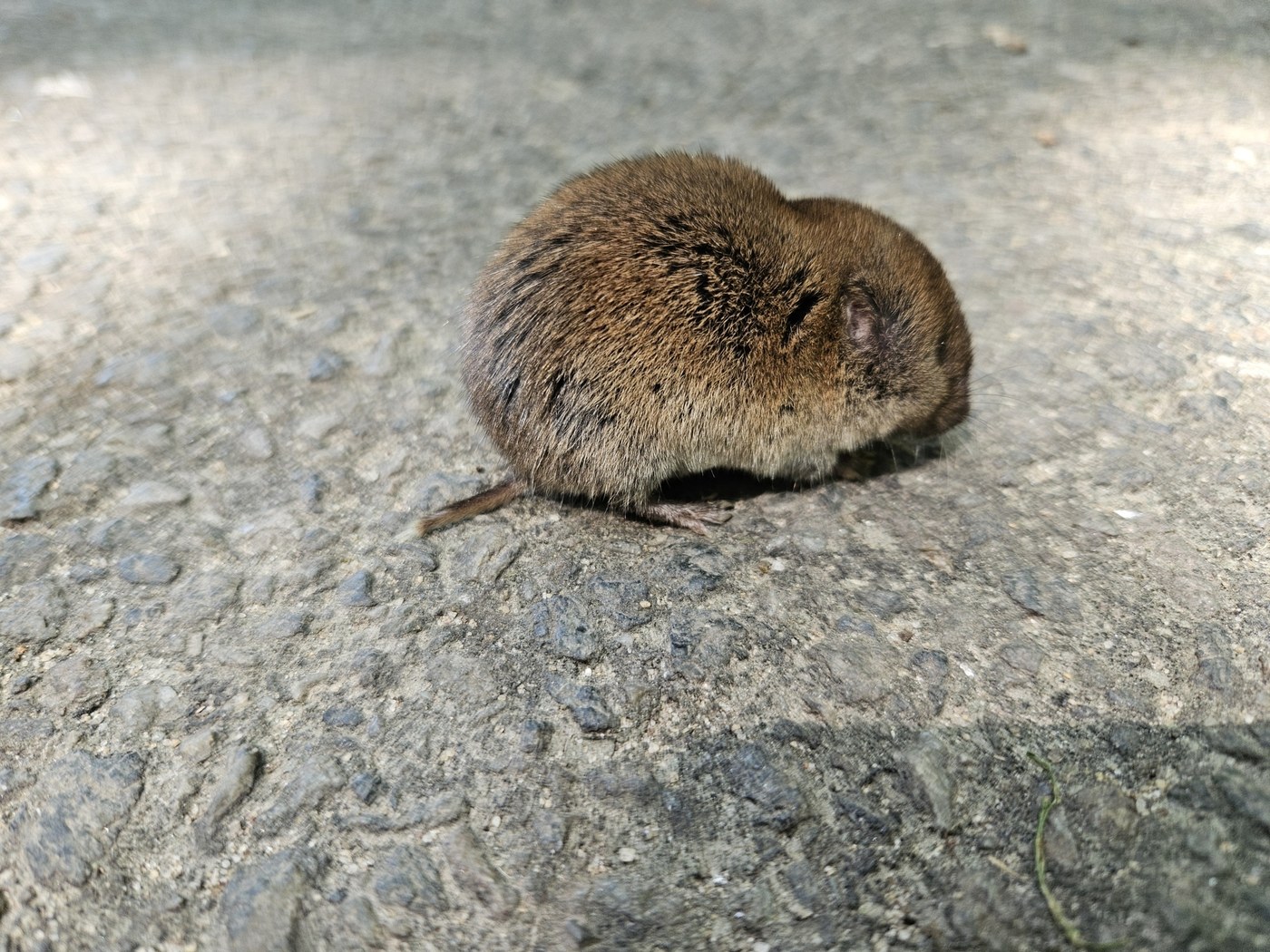
The tail against the hind foot is the field mark, and it is a comparison rather than a measurement. South Carolina's wildlife agency states the rule cleanly: if the tail is longer than the hind foot, it is a meadow vole, and if the tail is shorter than the hind foot, it is a pine vole. Penn State gives the same test. In numbers, the tail runs about 17 to 25 millimeters against a hind foot of 13 to 20 millimeters, which is less than a fifth of body length. No other rodent likely to turn up in a Southeast yard has a tail that short.
Small, and about an ounce
Small, roughly 3 to 5.5 inches total length and about an ounce. Published figures vary depending on whether the writer measured head and body or total length, running from 81 to 145 millimeters, at 17 to 38 grams. Penn State calls it that state's smallest vole. NC State rounds it to about 3 inches and an ounce or less.
Eyes as specks, ears invisible
Eyes reduced to specks, ears effectively invisible. NC State puts it bluntly: the eyes and ears are not visible. Virginia describes nondescript ears. These are not incidental, they are fossorial adaptations, the same reduction you see in any animal that spends its life in a tunnel.
Velvet-like fur, no guard hairs
Smooth, silky, velvet-like fur without the usual guard hairs, reddish to chestnut brown above and buffy to silvery gray below, noticeably darker and duller in the winter coat. The tail is barely bicolored or uniform in color rather than sharply two-toned. That velvety, guard-hair-poor coat is the same convergence that gives a mole its nap, and it is one of the reasons the two animals get confused.
Tubular body and digging claws
Tubular body, blunt snout, short legs, and visible digging claws on the front feet. The claws are worth looking for. They are the reason this animal can build its own tunnel system rather than only borrowing a mole's.
Against the meadow vole
The giveaway is the tail. Meadow voles wear an obvious surface runway network 1 to 2 inches wide through grass and thatch. Pine voles do not use surface runways at all. Meadow voles also carry larger, plainly visible eyes and ears and a distinctly bicolored tail. Both species occur across the Southeast and extension services in Virginia, the Carolinas, and Georgia all treat telling them apart as step one, because the two need different management.
Against a house or deer mouse
Against a house mouse or deer mouse, the standard vole rule applies and then some. A mouse tail is long, thin, and nearly as long as the body. A pine vole's tail is shorter than its own foot. Mice are also sharp-faced and bright-eyed where this animal is blunt-nosed with almost no visible eye.
Against a mole, use the diet
Moles are carnivores that eat insects, grubs, and earthworms and do not eat plant roots. Voles are herbivores. Clemson and Georgia extension both point to the same practical consequence: if plants are wilting and falling over with their roots gnawed off, you have voles even if a mole dug the tunnel first.
A shrew in your trap is not a vole problem
Short-tailed shrews use both vole and mole tunnels and are commonly caught during vole trapping. They cause little or no damage. Do not count one as evidence.
Both names are correct
On the names, both are correct and the correction runs one direction. Woodland vole is the accepted standard common name used by the federal government and the taxonomic checklists. Pine vole is what Southeast growers, nurseries, and extension horticulture material actually say, and it is an accepted common name too. Virginia Cooperative Extension words it as woodland vole, formerly known as the pine vole. Pine mouse, mole mouse, and potato mouse all refer to the same animal.
An older genus you may see
One more naming note, because you may see a different genus in older material. This animal has been placed in the genus Pitymys, and some European literature still treats that as a full genus. Current practice does not. Taxonomic authorities list Pitymys pinetorum as a synonym and treat Pitymys as a subgenus within Microtus, a ranking that morphological, chromosomal, and molecular studies all support. The Forest Service calls it a recent generic synonym, and the Canadian federal assessment states that genetic data do not support the separation. The valid name is Microtus pinetorum.
Signs of Infestation
The damage is invisible until late
Start with the honest headline: most pine vole damage is invisible until the plant is already failing. Penn State says damage from pine voles is harder to detect because it happens underground, and that by the time an orchardist notices weak, unhealthy trees the damage is already extensive. A New Jersey fact sheet is blunter still, noting the damage is difficult to notice until growth declines, by which point the tree is difficult to save.
Plant symptoms show up before the cause does
Watch for reduced vigor, poor shoot growth, dwarf leaves lacking dark green color, a sudden flush of suckers around the base (gnawing along a large root triggers sucker rows), and a severe drop in fruit yield.
The tree or shrub sits loose in the ground
In serious cases the top of a small tree or shrub can be pulled straight out of the soil because the trunk has been severed from the roots. Clemson describes the residential version exactly: one day a plant is beautiful, and a few days later it has fallen over with the roots gnawed off.
Gnaw marks just under the soil line
Scrape back an inch of soil at the base of a failing plant. Roots stripped of bark and small roots chewed to a point, described in the orchard literature as looking sharpened with a pencil sharpener, are the signature.
Soil that feels spongy or soft underfoot
A shallow tunnel network directly under the surface changes how the ground feels when you walk on it, and that is one of the few reliable above-ground cues for this species.
Small holes and earth piles
Roughly 1.5 inch holes and small earth piles 3 to 4 inches wide, often opening into an existing mole run. Clemson calls them golf-ball-sized exit holes. Compare that against a mole's own work, which is volcano-shaped mounds up to 9 inches high and raised surface ridges.
Probe for the tunnels
NC State gives a method anyone can use: a network of tunnels about 3 inches under the soil can be located by probing with a half-inch to three-quarter-inch rod or stick. Sudden easy penetration means you found the run.
Apples hollowed from underneath
Hollowed apple shells eaten from the underside, in orchards and around fruit trees.
No surface runways, and that is a tell
No surface runways, and their absence is diagnostic. If you find worn 1 to 2 inch trails through matted grass, you are looking at meadow vole, not this animal.
Confirm with an apple slice
It is the method the research centers actually use. Place a 1 inch apple slice in a hole or run, cover it against birds and pets, and check after 24 hours for tooth marks. The technique is the Apple Activity Index, developed by Dr. Ross Byers at Virginia Tech's Alson H. Smith Jr. Agricultural Research and Extension Center, later refined by Dr. Leonard Askham at Washington State University into a five-category Foraging Activity Index that scores how much of each slice was eaten and maps that to a treatment decision. NC State's orchard protocol runs 30 stations per acre, laid out as three rows of ten shingles about 30 to 40 feet apart, with the shingle laid flat over a vole hole for pine voles, repeated at least twice a year in fall and early spring.
Sound and smell are not useful here
South Carolina's wildlife agency does record that pine voles make a high-pitched noise that may serve as a warning signal, but that is a single-source note and no other published source mentions it. No distinctive odor is documented. Do not wait to hear or smell anything.
Prevention and When to Call a Pro
Mulch and weed barrier come first
The mulch and weed-barrier combination is the single biggest thing a homeowner controls, and the advice is stronger than you would expect. Virginia Cooperative Extension calls landscaped beds that lay a physical weed barrier under mulch notorious for harboring and actually enhancing vole activity, because the fabric hides the animals from detection and blocks predators from reaching them. Its recommendation is to refrain from using any form of weed barrier in landscape beds and to hold mulch to no more than an inch. Clemson's version allows three to four inches of mulch but insists it be cleared away from tree and shrub bases.
The ground covers that do not host
Coarse stone and large chunks of pine bark are the ground covers that do not become vole habitat. South Carolina's wildlife agency states that about the only mulches that will not support a vole tunnel system are coarse stone or large chunks of pine bark, and notes that voles will happily tunnel under shredded pine bark. The orchard version of the same idea: a gravel or crushed stone collar 3 to 4 inches deep, extending 12 to 18 inches out from the trunk. Gravel collapses in on a vole tunnel, which is why it works.
Keep bare ground at the base
That means anything you care about. Vegetation-free zones extending at least 2 feet from the trunk are the standard orchard spec, widening to a 4 foot weed-free strip on each side of the row in mature plantings. Do not let mulch, prunings, or decaying vegetation pile up at tree bases, and pick up dropped fruit promptly.
Bury a trunk guard deeper
If you install a trunk guard, bury it deeper than the meadow vole spec calls for. Quarter-inch mesh hardware cloth 18 to 24 inches tall is the usual build, but for pine vole the burial depth is the part that matters. A New Jersey fact sheet is explicit that the hardware cloth must be buried at least 6 inches below the surface to control both meadow and pine voles. Georgia's own extension handbook goes further for landscape plantings and calls for quarter-inch mesh buried 1 to 2 feet deep. Leave room inside the cylinder for several years of trunk growth.
What a trunk guard cannot do
Be clear-eyed about what a trunk guard cannot do. A federal orchard bulletin states directly that wrapping quarter-inch hardware cloth around a trunk prevents meadow voles from girdling trees but does not prevent pine voles from girdling the roots and trunk below the mesh. This is the most important correction to make against generic vole advice. Anyone whose whole plan is a trunk wrap has protected the one part of the plant that was never really at risk.
Mowing is close to useless here
Mowing is the meadow vole answer, and it is close to useless here. University of New Hampshire Extension calls a closely mowed orchard floor the single most effective technique against meadow vole, then says of pine vole that it has little or no effect. Weed-free strips under the trees help this species only somewhat, and only over years, because what they actually remove is the under-tree weed roots the animals feed on. If a source leads you to mowing as the fix for this animal, it is describing the wrong vole.
Cultivation works, with a number
Cultivation does work, and there is a real number behind it. A Virginia orchard experiment ran three cultivations in one season, in May, July, and November, and cut active pine vole sites to about 8 percent against 88 percent in the untreated check. Breaking up the tunnel system physically is one of the few habitat measures this species genuinely responds to. Cultivating soil to destroy burrows appears in South Carolina's and Georgia's own guidance too.
Trap inside the tunnel
Not on top of it. For pine voles, locate a run, excavate enough that a standard wooden snap trap sits flush with the tunnel floor, set it perpendicular to the run, bait with peanut butter or an apple slice with skin attached, and cover it with a bent shingle or a box to keep it dark and to protect pets and non-target animals. Virginia's homeowner guidance suggests at least one trap per 100 square feet across the suspected area, checked daily, continuing until catches drop to zero. Fall and late winter are the best trapping windows.
Bait behaves differently here
Bait behaves differently for this species, and the reason is behavioral. Broadcast can work on pine voles, but only with the right pellet and the right ground. Extension guidance rates paraffinized chlorophacinone pellets as well suited to broadcast at 20 pounds per acre, and is specific that the pellets have to land in vegetative cover rather than on bare ground. Hand placement directly into runs and burrow openings, or under cover objects such as shingles or boards that have sat long enough for the voles to tunnel beneath them, is the method that performs. Georgia's handbook adds a second reason baits underperform: voles hoard food and may cache toxic bait instead of eating it. One published comparison rates zinc phosphide as more effective against meadow voles and chlorophacinone as more effective against pine voles.
The economic threshold is zero
The economic threshold for this pest is effectively zero. A federal orchard bulletin puts it plainly: the economic threshold for voles is very low, and any sighting indicates the need for control measures. Letting a population build makes future control harder and pushes more bait into the environment than early action would have.
Straightforward, with two caveats
Legally this is a straightforward animal, with two caveats. South Carolina's Department of Natural Resources states that voles are non-game mammals and can be controlled whenever they are causing damage, and the species carries no federal listing and no state listing anywhere in the Southeast. The two caveats: relocation is specifically not recommended, and several of the rodenticides labeled for vole control are restricted-use materials that only a certified applicator may apply. Rules vary by state and change, so confirm current local regulations before trapping or treating.
Call when plants decline
Call a professional when plants are declining and you cannot find a cause above the soil line. By the time pine vole damage is visible in the canopy it is already extensive, and diagnosis means probing and excavating the root zone rather than inspecting a trunk. A misdiagnosis here costs you the plant.
Call before buying rodenticide
Restricted-use materials require a certified applicator, hand placement into active tunnels is the only application method that reliably works on this species, and secondary poisoning of hawks, owls, cats, and other predators is a documented risk with rodent baits. This is a licensed step, not a retail purchase.
Call for recurring orchard damage
Call when the damage is recurring across an orchard, nursery, Christmas tree planting, or a whole landscape rather than showing up on one or two plants. At that scale the answer is a monitoring program built on the apple test, run at least twice a year, not a one-time treatment.
Call before replanting
Do it before replanting ground that already has voles. Virginia warns that freshly cut planting trenches hand voles a ready-made travel network between new seedlings, and recommends full site preparation before anything goes in the ground.
On health risk, mostly reassuring
On health risk, the honest answer is mostly reassuring, with one flagged caution. No significant species-specific disease concern is documented for the woodland vole, and the two well-established risks from this animal are both property risks. South Carolina's wildlife agency does note, about voles as a group rather than this species specifically, that they may carry plague and tularemia and that ectoparasites such as mites and ticks feed on them, and advises protective gloves when handling voles. That is a single genus-level caution rather than a documented woodland vole case, and it should be read as exactly that. Wearing gloves around any wild rodent is sound practice regardless.
Frequently Asked Questions
Do I have moles or voles?
Diet decides it. Moles are carnivores that eat insects, grubs, and earthworms and never touch a plant root. Voles are herbivores that eat roots, bark, and bulbs. Georgia extension gives a field test anyone can run: tie a string to an apple slice, drop it in the hole, and check back in a couple of days. Apple gone means voles. Apple untouched means moles. Volcano-shaped mounds and raised surface ridges mean mole. Golf-ball-sized exit holes punched into an existing tunnel mean vole. If plants are dying with their roots gnawed off, it is a vole even if a mole dug the tunnel first.
What is the difference between a pine vole and a meadow vole?
Compare the tail to the hind foot. If the tail is longer than the hind foot, it is a meadow vole. If the tail is shorter, it is a pine vole. Behavior confirms it. Meadow voles wear obvious surface runways 1 to 2 inches wide through the grass. Pine voles build no surface runways at all and live in shallow tunnels roughly 1 to 3 inches underground. Meadow voles also have visibly larger eyes and ears and a sharply bicolored tail.
Why is my shrub dying when the trunk looks fine?
Because pine vole damage is below the soil line. They sever small roots and strip bark from large roots and from the root crown, and the first things you notice are indirect: loss of vigor, dwarf pale leaves, a flush of suckers at the base, a drop in yield, or a plant that suddenly sits loose in the ground and lifts out by hand. Scrape back an inch of soil at the base and look for gnaw marks and roots chewed to a point.
Will a tree guard stop pine voles?
Not on its own. A federal orchard bulletin states that quarter-inch hardware cloth wrapped around a trunk prevents meadow voles from girdling trees but does not prevent pine voles from girdling the roots and trunk below the mesh. For this species the guard has to be buried at least 6 inches, and Georgia's extension handbook calls for 1 to 2 feet in landscape plantings. Even then it works alongside mulch reduction, bare ground at the trunk, and gravel collars rather than instead of them.
Does mowing the lawn get rid of them?
That is the standard advice for meadow vole, and University of New Hampshire Extension says flatly that it has little or no effect on pine vole. What actually works against this species is pulling mulch back to an inch or less, removing weed-barrier fabric from landscape beds, keeping bare ground at trunk bases, using coarse stone or gravel where mulch would otherwise sit, and cultivating to break up the tunnel network.
Do pine voles explode in numbers the way other voles do?
Less so, and this is one of the real differences between the two Southeast voles. Virginia Cooperative Extension states that population eruptions in woodland voles are uncommon because of their lower reproductive output, and that their numbers remain relatively stable over time. The boom and bust cycles people associate with voles are largely a meadow vole story. That said, this animal concentrates heavily in orchards, where measured densities run several hundred per hectare against a couple of dozen in forest, so steady does not mean scarce.
How much damage do pine voles actually cause?
Enough to be tracked in dollars. NC State puts the estimated annual loss from vole damage to apple growers in North Carolina at $2.5 million, with nursery operations sustaining significant losses on top. Virginia Cooperative Extension puts combined meadow and woodland vole damage across the commonwealth above $5 million a year, spanning orchards, vegetable and grain crops, flowering bulb production, nurseries, Christmas tree plantations, residential landscape plantings, and replanted woodland, with per-acre losses in commercial fruit orchards running from $100 to as much as $2,700 an acre. In home landscapes the usual casualties are hosta, boxwood, azalea, holly, bulbs, and young trees.
Do pine voles carry disease?
No significant species-specific disease risk is documented for the woodland vole, and the two well-established risks from this animal are both property risks. South Carolina's wildlife agency does note, about voles generally rather than this species in particular, that they may carry plague and tularemia and that mites and ticks feed on them, and it advises wearing protective gloves when handling voles. That is a single genus-level caution, not a documented woodland vole case. Gloves around any wild rodent are sound practice anyway.
Is it legal to control voles myself?
In South Carolina, voles are non-game mammals and can be controlled whenever they are causing damage. The species carries no federal listing and no state listing anywhere in the Southeast. Two caveats: relocation is specifically not recommended, and several rodenticides labeled for vole control are restricted-use materials that require a certified applicator. Rules vary state to state and change, so check current local regulations first.
Do pine voles get into houses?
No. This is an entirely outdoor animal with no structural pest profile at all. No source documents pine voles establishing indoors. Sealing a house does nothing for a pine vole problem, and the effort belongs in the landscape beds and around the trunks instead.
Sources
- Managing Human-Wildlife Interactions: Woodland (Microtus pinetorum) and Meadow (Microtus pennsylvanicus) Voles, publication CNRE-181: measurements, reproduction, the population-stability finding, the mulch and weed-barrier warning, the Apple Activity Index and Foraging Activity Index, and the $5 million and $100 to $2,700 per acre damage figures Virginia Cooperative Extension, Virginia Tech
- Controlling Voles: homeowner trapping method and trap density, mole soil-pile height for comparison, and the shrew note Virginia Cooperative Extension, York County
- Voles in Commercial Orchard and Ornamental Nurseries: the $2.5 million North Carolina apple loss estimate, tunnel depth and diameter, the 1,000 square foot lifetime home range, clay soil preference, the 30-station apple sign test protocol, and the soil-probing method NC State Extension
- Microtus pinetorum (woodland vole), in The Land Manager's Guide to Mammals of the South: the state-by-state Southeast range account, measurements, conservation status by state, seasonal population pattern, seasonal diet, and the statement that Pitymys is a recent generic synonym USDA Forest Service, Southern Research Station
- Orchard Wildlife: Integrated Management of Voles in Orchards: pine vole size against meadow vole, the tail-to-hind-foot rule, the underground-damage-is-invisible statement, gravel and vegetation-free zone specs, and in-tunnel trap and hand-bait placement Penn State Extension
- Managing Voles in New Hampshire Orchards and Highbush Blueberries: the explicit fossorial-species statement, tunnel depth and width and drip-line geometry, the compacted-driveway finding, the sucker and loose-tree symptom list, and the finding that mowing has little or no effect on pine vole University of New Hampshire Extension
- Voles, New England Tree Fruit Management Guide: the same fossorial and tunnel-geometry account, hosted alongside the regional orchard guide University of Massachusetts Amherst, Center for Agriculture, Food, and the Environment
- Voles, state species information chapter: legal status as non-game mammals controllable when causing damage, the tail-versus-hind-foot rule, the no-surface-runways statement, the coarse-stone mulch finding, the relocation caution, and the genus-level plague and tularemia note South Carolina Department of Natural Resources
- How to Tell the Difference Between Moles and Voles, HGIC 2366: mole and vole diet, size, feet, mounds and ridges, the golf-ball-sized exit hole detail, the two South Carolina vole species, fencing spec, and trapping season Clemson Cooperative Extension Home & Garden Information Center
- Pine vole feeding damage: head-and-body measurement, the lack of guard hairs, the inconspicuous ears, and the South Carolina hosta damage pattern Clemson Cooperative Extension Home & Garden Information Center
- Vertebrate Pest Control, Georgia Pest Management Handbook: the quarter-inch hardware cloth burial spec for Georgia landscapes, the food-hoarding reason baits underperform, and the secondary-poisoning caution University of Georgia Cooperative Extension
- Moles and Voles: the front-paw and tunnel-reuse difference, and the apple-on-a-string field test for telling moles from voles University of Georgia Cooperative Extension, Towns and Union County
- Voles in the Orchard, fact sheet FS1293: pine vole against meadow vole size and tail length, the soft-soil-underfoot detection cue, the 6 inch minimum hardware cloth burial depth for pine vole, the gravel collar spec, and the rodenticide species-effectiveness contrast Rutgers New Jersey Agricultural Experiment Station
- Meadow Vole and Pine Vole, in Prevention and Control of Wildlife Damage: tunnel depth, the pencil-sharpener root-damage description, the finding that hardware cloth does not prevent pine vole root girdling, and the very low economic threshold U.S. Fish and Wildlife Service, with Cornell University
- Woodland Vole (Microtus pinetorum) COSEWIC assessment and status report 2010: communal social groups, the 45 square meter mean home range, cooperative breeding by young that stay in the natal burrow, bi-parental care, and the genetic rejection of Pitymys as a separate genus Committee on the Status of Endangered Wildlife in Canada, Environment and Climate Change Canada
- Woodland Vole (Microtus pinetorum) species page: federal confirmation of the accepted binomial, the woodland vole and pine vole common name pair, and the Microtus (Pitymys) subgenus placement U.S. Fish and Wildlife Service
- Microtus pinetorum (Le Conte, 1830), taxonomic serial number 180314: the valid name, the Microtus (Pitymys) subgenus, Pitymys pinetorum listed as a synonym, and both Woodland Vole and Pine Vole as accepted English common names Integrated Taxonomic Information System
- Microtus (Pitymys) pinetorum, Mammal Species of the World 3rd edition: the Liberty County, Georgia type locality, the full range statement from southern Maine to north-central Florida, and the summary of the Pitymys genus versus subgenus question Bucknell University, hosting Wilson & Reeder
- Microtus pinetorum (woodland vole): the 100 millimeter maximum burrow depth, nest dimensions, and the eye, ear, and tail reduction described as fossorial adaptations Animal Diversity Web, University of Michigan Museum of Zoology
- Woodland Vole, Adirondack Mammals: the note that the pine vole name refers to a habitat this species occupies only in the Southeast, tunnel and nest dimensions, the communal-nest and shared-tunnel observations, and the forest versus orchard density contrast State University of New York College of Environmental Science and Forestry
- Analysis of Seasonal Dynamics of Pine Vole Populations in Two Virginia Orchards: measured orchard densities of 243 to 798 pine voles per hectare, the seasonal capture pattern, and the one-year survival figure Proceedings of the Eastern Pine and Meadow Vole Symposium, University of Nebraska DigitalCommons
- Pine Vole Control Research in Virginia: the cultivation experiment that cut active pine vole sites from 88 percent to about 8 percent, and the finding that surface bait stations work less well for pine vole than for meadow vole Proceedings of the Eastern Pine and Meadow Vole Symposium, University of Nebraska DigitalCommons
- Woodland vole species account, Handbook of the Mammals of the World, Volume 7, Rodents II: subspecies distribution state by state, head-body and tail and hind foot measurements, the February to November breeding window with a longer season farther south, litter and lactation figures, densities, loose non-territorial social groups, and the description of apple orchards as excellent habitat Wilson, Mittermeier, and Lacher, archived at Zenodo
- Woodland vole species reports, Gap Analysis Program: southeastern habitat description, the coastal dune and barrier island absence, state conservation ranks, and the 30 foot foraging radius North Carolina State University, Southeast Gap Analysis Project
Image Credits
- Image: Alexa Hoffman via iNaturalist. CC BY 4.0.
License.