Seasonal Timeline
Eastern moles are active year-round and day and night, with no hibernation and no dormant stretch. What changes through the year is depth, since cold weather pushes the animal down into its deep permanent tunnels rather than into dormancy.
Eastern moles are active year-round and day and night, with no hibernation and no dormant stretch. What changes through the year is depth…
There is no quiet season with this animal, and the reason is metabolic rather than behavioral. Digging costs an enormous amount of energy, and a mole has to eat constantly to pay for it. Connecticut's own state wildlife guidance states the practical consequence directly: moles search for food, mainly earthworms, day and night, all year long. A mole working at 2 a.m. in January is normal, not remarkable.
What the calendar actually changes is depth. Shallow surface tunnels, the raised winding ridges you feel underfoot, get used spring through fall while the animal hunts near the turf. When the surface soil turns cold, activity shifts down into the deep permanent tunnels, 6 to 12 inches or more below grade, which stay in use all twelve months for travel, winter foraging, and raising young. Ridge activity going quiet in December does not mean the mole left. It usually means the mole went down.
Breeding runs late winter into spring. University of Missouri Extension and University of Illinois Extension independently report a single litter a year, and Illinois states it plainly: moles reproduce in the spring and apparently only have one litter per year. That is a meaningfully slower reproductive rate than most other yard wildlife, and it is part of why a lawn full of ridges is usually one animal rather than a population.
Where They're Found
The eastern mole has the broadest range of any North American mole. It covers most of the central and eastern United States, from the Great Plains east to the Atlantic, north to the Great Lakes and southern New England, and south through Florida, with the Everglades a documented exception. The range continues into northern Mexico, and a small isolated native population survives in three municipalities of southern Ontario. Its western boundary sits at the eastern edge of Texas, Kansas, Nebraska, and South Dakota.
What limits this animal is soil, and specifically soil moisture. It needs moist, loose, well-drained ground, sandy loam and similar textures, that is easy to tunnel through and that supports the invertebrate prey base it depends on. Heavy, compacted, bone-dry, or waterlogged soils are poor mole ground, because both the digging and the food supply depend on moisture. That is a different limiting factor than the one governing pocket gophers, which care primarily about soil texture being friable and tolerate a wider moisture range. It is also why a well-watered, well-amended lawn is frequently the only property on a street with a mole problem.
The Northeast counts as real range, and it is worth stating why, because this species is often described as a Midwest and Southern animal. The USDA Forest Service's own regional mammal guide puts the range from the Great Lakes region and southern New England south to Florida. Animal Diversity Web states that eastern moles are most common along the east coast, as far north as Massachusetts. University of Connecticut's Integrated Pest Management program publishes a dedicated management page treating this species as Connecticut's standard mole, without qualification. Canadian federal status assessments, which have no reason to overstate a U.S. state's range, independently rank the species Secure in Connecticut, Massachusetts, New York, New Jersey, Pennsylvania, Delaware, Maryland, and Washington, D.C.
Two boundary details inside that Northeast claim, stated rather than smoothed over. Massachusetts is the stated northern edge on the eastern seaboard, not a waypoint. No published record places eastern moles in Maine, New Hampshire, or Vermont, so a map lighting up the whole Northeast is broader than the real animal. Rhode Island sits in the same federal status table as unranked, which is genuinely unassessed rather than confirmed either way.
One more edge-of-range finding is worth naming precisely, because it is real and still narrower than it sounds. Environment and Climate Change Canada's 2015 management plan describes the U.S. range as extending eastward from Texas, Kansas, and the southeastern corner of Wyoming, and separately ranks the species Imperiled in both Colorado and Wyoming, explicitly calling that the edge of its range in the northwest. An imperiled, edge-of-range toehold in the corner of one state does not make the Mountain West mole country, and no published record covers Montana or Idaho.
The species is confirmed absent from California, the Southwest, the Pacific Northwest, Alaska, and Hawaii. No published record places any Scalopus population west of the Great Plains and Rocky Mountain front, and the genus range is bounded by the continental interior, the eastern United States, Mexico, and that one small Ontario population.
Life Cycle
The number that explains this animal: a mole eats close to its own body weight every day. University of Georgia Cooperative Extension puts it at 70 to 100 percent of body weight daily, to pay for the tremendous energy cost of excavating tunnels. University of Missouri Extension independently gives 70 to 80 percent. That is the reason there is no hibernation, no dormant season, and no safe time of day to assume the animal is idle. It simply cannot go long without eating.
Two numbers are missing on purpose. University extension and government publications do not give a lifespan figure for this species, so none is stated. A peer-reviewed age-structure study on eastern moles is cited in the scientific literature, but its figure is unverified, and an unverified number is worse than no number at all. Litter size gets the same treatment, an approximate range with the uncertainty stated rather than a settled figure.

Pup
Juvenile
Adult
Identification
Not a rodent, and not a gopher
Start here: a mole is not a rodent, and not a gopher. Eastern moles belong to the order Eulipotyphla and the family Talpidae, the true moles. Their nearest relatives are shrews and hedgehogs, not squirrels, rats, or gophers. The scientific name is a documented misnomer on both halves. Linnaeus assigned aquaticus because the type specimen turned up dead in a well with partly webbed front feet, and he inferred an aquatic animal that does not exist. The genus name Scalopus comes from a Greek word meaning blind rat, and the animal is neither blind nor a rat.
Size, with the reported spread
Size, disclosed with the spread the sources actually report. The Internet Center for Wildlife Damage Management gives males an average of about 7 inches total length and 4 ounces, with females slightly smaller at about 3 ounces, and a tail of roughly 1.25 inches. Tennessee Wildlife Resources Agency publishes a wider statewide range: 5.5 to 8.0 inches long, a 0.8 to 1.5 inch tail, and 1.0 to 5.0 ounces. Both are credible, they were measured on different populations, and both ranges are worth knowing rather than averaged into a single number no source stands behind.
The front feet are the identification tell
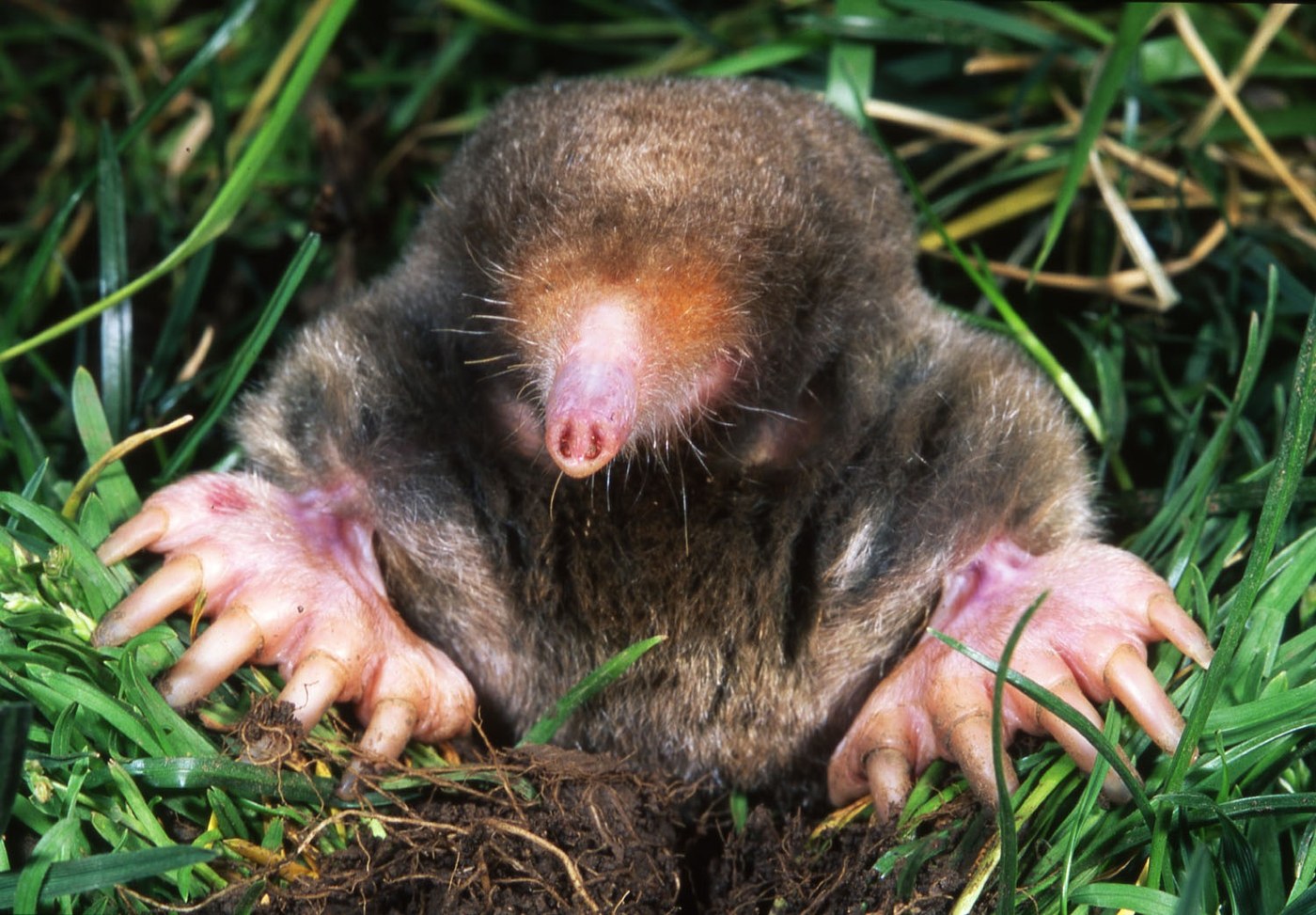
Broad, paddle-like, webbed nearly to the base of the claws, with palms wider than they are long, turned permanently outward for a sideways digging stroke. That is a completely different tool from a pocket gopher's, whose identification instead centers on external fur-lined cheek pouches and smaller claws built for a different digging style. If you ever get a look at either animal, the front feet settle it immediately.
Velvety fur with no nap
Velvety fur with no directional nap, and that is functional. Short, dense, grayish-brown to nearly black above and silvery below. The fur lies equally well in either direction, which lets the animal reverse through a tunnel as easily as it goes forward. A pocket gopher solves the same problem differently, using its sparsely haired tail as a guide when backing up.
Eyes and ears look absent but are not
The eyes are tiny and covered by fur and skin, and there is no visible external ear at all. The species is described as nearly blind rather than blind. It can tell light from dark but has no meaningful image-forming vision. The hairless, pointed, mobile snout extending about half an inch past the mouth is the real sensory organ, packed with touch receptors and paired with an exceptional sense of smell, with the nostrils positioned to help judge which direction a scent is coming from. The animal carries 36 teeth.
Two non-issues, and the real one
The two look-alikes that are not the issue, and the one that is. The star-nosed mole is ruled out instantly by its ring of 22 fleshy nasal tentacles, which nothing else has. The hairy-tailed mole is ruled out by its longer, hairy tail against the eastern mole's short, sparsely furred one. Neither is the common confusion. The common confusion is the pocket gopher, because both animals are almost never seen and both leave mounds. That one gets settled below, by the mound and by the diet.
Diet is the fundamental split
Diet is the fundamental biological split, not a detail. University of Georgia Cooperative Extension states it plainly: moles are carnivores, feeding on insects and other invertebrates, with only small amounts of vegetable matter consumed inadvertently. A pocket gopher is the opposite, a strict herbivore working on roots and fleshy plant parts. So a mole tunneling through a flower bed is not eating the flowers, and a gopher in the same bed is. This is also why grub-control insecticide is a real mole tactic with no gopher equivalent, and it is the single most useful thing to understand before spending money on either problem.
The larder, and the venom dispute
The earthworm larder is real. Whether the mole is venomous is disputed. Eastern moles store earthworms underground, paralyzed but still alive, to eat later. Arkansas Game and Fish Commission notes that researchers have found larders holding more than 1,000 worms. That behavior is independently documented and not in question. What is in question is how it happens. The common explanation is that mole saliva carries a toxin, and a 2024 peer-reviewed study of salivary gland anatomy across this group of mammals found no granular gland segments in the eastern mole specifically, in contrast to the European mole, which does carry the enlarged granular submandibular glands associated with venom production. So the storage behavior is settled and the venom mechanism is not. One more piece of feeding mechanics worth knowing: before eating an earthworm, a mole pulls it between its front paws to squeeze the dirt out of the worm's gut.
Signs of Infestation
Winding ridges a gopher never makes
Raised winding ridges in the turf, and this sign is the one a gopher never produces. These are shallow surface feeding tunnels running just beneath the grass, pushed up as the animal hunts. University of Missouri Extension states directly that raised ridges, or surface tunnels, are unique to moles. If you have ridges you can feel underfoot, you have a mole, and you can stop wondering about gophers.
Volcano-shaped hills
Volcano-shaped molehills, and the shape is the tell against a gopher mound. A mole mound is more circular, volcano shaped in profile, with the plug in the center. A gopher mound is crescent shaped or horseshoe shaped viewed from above, with the entrance hole set off to one side and usually plugged. Molehills are cones of loose, often coarse soil pushed up from the deep tunnel system, which is why they appear without a ridge attached to them.
Two tunnel systems, two damages
Two tunnel systems, which is why the damage comes in two forms. The shallow surface tunnels are the winding feeding runs used spring through fall. The deep tunnels sit 6 to 12 inches or more below grade and serve as the permanent network for winter activity, travel, and raising young. The Internet Center for Wildlife Damage Management adds a third pattern, long straight surface runs connecting feeding areas to the permanent burrows and denning areas. Deep tunnels can outlast the mole that dug them, getting reused by later moles or traveled by shrews and voles.
Uneven, bumpy turf
The combined ridge and mound damage makes a lawn hard to mow evenly, and on managed turf such as golf courses, athletic fields, parks, and cemeteries it becomes an equipment-rut and footing hazard rather than just a cosmetic problem.
Plants drying without being eaten
Plants drying out or lifting, without being eaten. Tunneling separates roots from the surrounding soil and exposes them to drying air, and bulbs and small plants get dislodged. The mole is not feeding on them. That mechanism matters, because it is easy to see a wilting plant, assume something is eating the roots, and go buy the wrong control product for the wrong animal.
Nothing you will hear
Rarely anything you hear, though the dog might. Tunneling is not typically audible to people. University of Missouri Extension and others note that cats and dogs will detect and react to activity underground that a person cannot hear. No distinctive odor is documented for this species, so if something smells, look for a different cause.
Prevention and When to Call a Pro
Public health risk is low
That is a documented finding rather than a reassurance. No published source was found attributing any disease-vector or public health risk to eastern moles specifically. They do carry ectoparasites, including fleas, mites, and the American dog tick, but no source frames the animal itself as a meaningful vector-borne disease risk to people. Nor is a bite hazard documented for this species, which is a real contrast with pocket gophers, whose strong jaws and incisors are explicitly flagged.
Trapping is the best home method
Trapping is the most reliably effective homeowner-level method. University of Connecticut names harpoon, scissor-jaw, and choker-loop traps as the standard tools. The critical detail is where the trap goes. Set it in an active surface tunnel, not an abandoned one. Test a tunnel by flattening a short section of the ridge and checking the next day to see whether it has been pushed back up. If it has, the run is in use and the set is worth making there.
Grub control, and its real limit
Grub control is a real tactic with a real limit, and the limit is the part competitors leave out. University of Missouri Extension recommends applying grub-control insecticide from mid-June through mid-July, when white grubs are small and most vulnerable, to reduce one food source. But University of Georgia Cooperative Extension reports that 80 to 90 percent of a mole's diet consists of beneficial earthworms, and concludes that spraying insecticides for grub control may have little impact on the mole. Stomach-content studies show the balance genuinely shifts by region, with one South Carolina study finding grub larvae in 70.6 percent of stomachs against 32.2 percent in an Indiana study. Both sources are credible, and neither one settles it. The honest conclusion: grub control targets a real food source and may help, but earthworms remain available in any moist healthy soil, so grub control alone does not reliably end an existing mole problem.
Buried barriers for a small area
Buried barriers work for a defined area, not usually for a whole yard. Hardware cloth or fine mesh buried around the perimeter of a garden bed and extending well below normal tunnel depth is the standard approach for protecting a confined planting. It is a bed-scale and raised-bed-scale fix. It is not the practical whole-property solution that underground exclusion can be for a pocket gopher problem.
What does not reliably work
This is worth stating plainly, so you do not spend money finding out. No published source supports vibrating stakes, ultrasonic devices, pinwheels, or home-remedy repellents as a dependable standalone fix. Castor-oil-based products come closest to an exception and still fall short of a solution. University of Missouri Extension's own wording is that they may prevent eastern mole damage under certain circumstances, which is not the same as working.
Check your state rule first
Check your state's rules before you trap, because the baseline is not universal. The Internet Center for Wildlife Damage Management states that moles are unprotected in most states, and no protective statute turned up for the Midwest or South Central states reviewed. Georgia is a documented exception. University of Georgia Cooperative Extension states that in Georgia moles are protected and may not be taken, with exceptions when the animal is damaging a person's property. Rules like that vary state by state and they change, so verify your own state's current rule with its wildlife agency before setting a trap, and treat a licensed nuisance wildlife control operator as the safer default over a trap purchase if you are unsure.
How fast this animal works
Arkansas Game and Fish Commission states that moles push 10 to 20 feet of surface foraging tunnel per hour. That is a state wildlife agency figure rather than a measured research finding. It is still the useful mental model: new ridges appearing across a lawn overnight are entirely normal for one animal, and are not evidence that the yard is overrun.
Moles do something useful
It is worth weighing before you act. Tunneling aerates soil and improves water percolation, and moles measurably suppress populations of the soil insects they eat. On a large property with a tolerable amount of damage, doing nothing is a defensible choice. The case for control is strongest where the damage has a real cost, which is turf you have to mow, play on, or maintain to a standard.
Who to Call, and When
Call when ridge and mound activity keeps spreading across a large area after a genuine trapping effort, since a single mole's home range can run 1 to almost 3 acres and continued activity usually means either a tunnel network you cannot reach or a new animal moving in quickly. Call for athletic fields, golf courses, and other high-traffic managed turf, where equipment ruts and footing risk make professional removal the more responsible option than do-it-yourself trapping. And call, or check with your state wildlife agency first, anywhere in the Southeast or any other state where you are not certain whether take or trapping methods are restricted, since at least one real restriction exists inside a region otherwise running on an unprotected baseline.
State-regulated - verify locally
Frequently Asked Questions
Is a mole the same thing as a gopher?
No, and they are not even close relatives. A mole is an insectivore and carnivore in the order Eulipotyphla, related to shrews, and it eats earthworms, grubs, and other soil invertebrates. A pocket gopher is a rodent and a strict herbivore that eats roots and plant parts. They also leave differently shaped mounds. A mole mound is more circular, volcano shaped in profile, with the plug in the center. A gopher mound is crescent or horseshoe shaped from above, with the entrance off to one side and usually plugged. One more shortcut: raised winding ridges in the turf are unique to moles. A gopher does not make them.
Will killing the grubs in my lawn get rid of my moles?
It may help, and it is not a guaranteed fix. Grub-control insecticide targets one real food source, and University of Missouri Extension recommends it from mid-June through mid-July when grubs are most vulnerable. But University of Georgia Cooperative Extension reports that 80 to 90 percent of a mole's diet is earthworms, and concludes grub control may have little impact on the mole. Regional stomach-content studies land in between. Earthworms stay available in any moist, healthy soil no matter what you do about grubs, so plan on grub control as a partial measure rather than the answer.
How much does a mole actually eat?
An extraordinary amount for its size. University of Georgia Cooperative Extension puts it at 70 to 100 percent of the mole's own body weight in food every day, to pay for the energy cost of digging. University of Missouri Extension independently gives 70 to 80 percent. That single number explains most of this animal's behavior, including why it never hibernates and why it forages day and night in every season.
Are moles venomous?
This is genuinely unsettled, and it is worth knowing why. Popular and state-agency sources widely report that mole saliva contains a toxin that paralyzes earthworms without killing them, letting a mole store still-living worms in an underground larder for later. Arkansas Game and Fish Commission illustrates the claim with an eastern mole and notes that researchers have found larders holding more than 1,000 earthworms. The larder behavior itself is real and independently documented. The mechanism is the disputed part. A 2024 peer-reviewed study of salivary gland anatomy across this group of mammals found no granular gland segments in the eastern mole specifically, in contrast to the European mole, which does carry the enlarged granular submandibular glands associated with venom production. So whether this species' own saliva is truly venomous, or the worm paralysis happens some other way, remains an open question rather than a settled fact.
Can I legally trap or remove a mole on my own property?
In most states, yes, and with no special permit, since moles are generally unprotected wildlife. Georgia is a documented exception. University of Georgia Cooperative Extension states that Georgia law protects moles and they may not be taken, with exceptions when the animal is damaging your property. State wildlife rules vary and they change, so check your own state's current rule before you set a trap, and use a licensed nuisance wildlife control operator if the answer is not clear.
Will a mole get into my house?
No. Like the pocket gopher, this is one of the wildlife animals that stays entirely outdoors and entirely underground. No published record places eastern moles indoors, in attics, or in structural voids. Every kind of damage a mole causes happens in soil and turf, which is why the whole prevention conversation is about your lawn and beds rather than about sealing your home.
My ridges disappeared in winter. Did the mole leave?
Probably not. Moles do not hibernate, and their metabolism does not let them go dormant. When surface soil turns cold, activity moves down into the deep permanent tunnels, which sit 6 to 12 inches or more below grade and stay in use year-round. Surface feeding ridges are a spring-through-fall sign. Their absence in January says the animal went deeper, not that it went away.
How many moles do I have if my whole lawn is tunneled?
Almost certainly fewer than it looks. Moles are solitary and territorial outside the breeding season, a single animal's home range can run 1 to almost 3 acres, and it can push 10 to 20 feet of surface tunnel per hour. University of Illinois Extension notes that mole tunnels in one residential lawn are most likely the work of one animal. They also breed slowly for yard wildlife, one litter a year in late winter or spring. A yard that looks overrun is usually one mole having a productive week.
Sources
- Moles: biology, damage identification, tunnel systems, and damage prevention and control methods Internet Center for Wildlife Damage Management (University of Nebraska-Lincoln / USDA APHIS Wildlife Services)
- Managing Wildlife Damage: Moles, Wildlife Damage Publication Series No. 5 (biology, carnivorous diet, metabolic rate, Georgia legal status, damage) University of Georgia Cooperative Extension
- Controlling Nuisance Moles, Publication G9440: surface versus deep tunnels, diet, grub-control timing, repellents University of Missouri Extension
- Eastern Mole, Plant Problems: single annual litter, home range, one-animal-per-lawn finding University of Illinois Extension
- Management Of Moles: year-round activity, turf damage, trap types and active-tunnel test University of Connecticut, College of Agriculture, Health and Natural Resources, Integrated Pest Management Program
- Eastern Mole, Scalopus aquaticus, in The Land Manager's Guide to Mammals of the South USDA Forest Service, Northern Research Station
- Scalopus aquaticus species account: anatomy, home range, regional stomach-content studies, ecosystem role Animal Diversity Web, University of Michigan Museum of Zoology
- Eastern Mole: statewide size range and description Tennessee Wildlife Resources Agency
- Hole-y mole-y! Surface tunneling rate, territoriality, and the paralyzed-earthworm larder account Arkansas Game and Fish Commission
- Eastern mole (Scalopus aquaticus): management plan 2015, including state-by-state conservation status ranks and the Wyoming and Colorado edge-of-range finding Environment and Climate Change Canada
- Eastern mole (Scalopus aquaticus): COSEWIC assessment and status report 2010 Environment and Climate Change Canada / COSEWIC
- Proteins from shrews' venom glands play a role in gland functioning and venom production, Zoological Letters 10:12 (submandibular gland histology, no granular segments found in Scalopus aquaticus) Kowalski et al., peer-reviewed, hosted by the National Library of Medicine (PubMed Central)
Image Credits
- Image: Kenneth Catania, Vanderbilt University, via Wikimedia Commons. CC BY-SA 3.0. This resized copy is offered under the same license.
License.