Seasonal Timeline
Burrow activity runs year-round, since mountain beavers do not hibernate and stay active underground through winter, leaving no true off-season. The damage that gets noticed is more concentrated: in forestry and replanting settings, seedling damage clusters in the first 3 to 4 months after spring conifer planting, before other forage greens up and gives the animals an alternative.
Burrow activity runs year-round, since mountain beavers do not hibernate and stay active underground through winter, leaving no true…
The month range for peak seedling damage comes from forestry-damage literature and should be treated as approximate rather than a fixed calendar window.
Where They're Found
Mountain beavers are entirely outdoor, burrowing animals of moist forest. Look for them in shaded forest understory, ferny slopes, damp ravines, brushy hillsides, and the margins of forest edges and clearcuts in Douglas-fir and western hemlock coastal forest. They also turn up in damp ravines inside urban areas where a pocket of forest edge survives. A single animal's burrow system can run from about half a foot to 6 feet deep, spread across a quarter acre or more, and carry 10 to 30 open entrance and exit holes.
The wet-habitat preference is a hard physiological limit, not a matter of taste. Mountain beavers have unusually simple, inefficient kidneys that cannot concentrate urine effectively, a trait cited in the peer-reviewed literature as evidence of an ancient, unspecialized lineage. A dedicated water-balance study measured a daily water intake of roughly a third of body weight, and Washington Department of Fish and Wildlife gives the same figure as drinking. That requirement is what confines the species to high-rainfall country with wet soil and near-saturated humidity inside the burrow. One wildlife-damage source states the opposite, that mountain beavers do not require free water and get enough moisture from their food. That claim is contradicted by both the physiology study and the state wildlife agency, so the high-water-need finding is the better-supported one here.
The species' documented range is a narrow Pacific Coast corridor: coastal lowlands and coastal mountains from southern British Columbia through western Washington and western Oregon into northern California, reaching inland into parts of the Cascades, the Sierra Nevada, and the extreme western edge of Nevada in some descriptions. It is a genuine regional endemic rather than a nationally distributed animal. No published record places an established population in Alaska or in Hawaii.
Life Cycle
This species is thinly studied compared with common nuisance wildlife, and several figures genuinely conflict between sources. Litter size is given as 2 to 4, as 2 to 3 and rarely four, and as 2 to 6 averaging under 3, depending on which source you read. The breeding window is placed at February through April, mainly January through March, or February through May. Eye-opening is reported at about 50 days by one source and 7 to 8 weeks by another. None of these changes anything practical about identification or timing, so treat each figure as a range rather than a fixed number.

Newborn Pup
Juvenile
Sub-adult
Adult
Signs of Activity
Identification
Body length
Body length is most commonly cited at 12 to 14 inches, though a university natural-history database reports a wider measured range of roughly 11.8 to 19.7 inches. Average weight is around 28 ounces, with documented individuals up to 49 ounces.
The coat
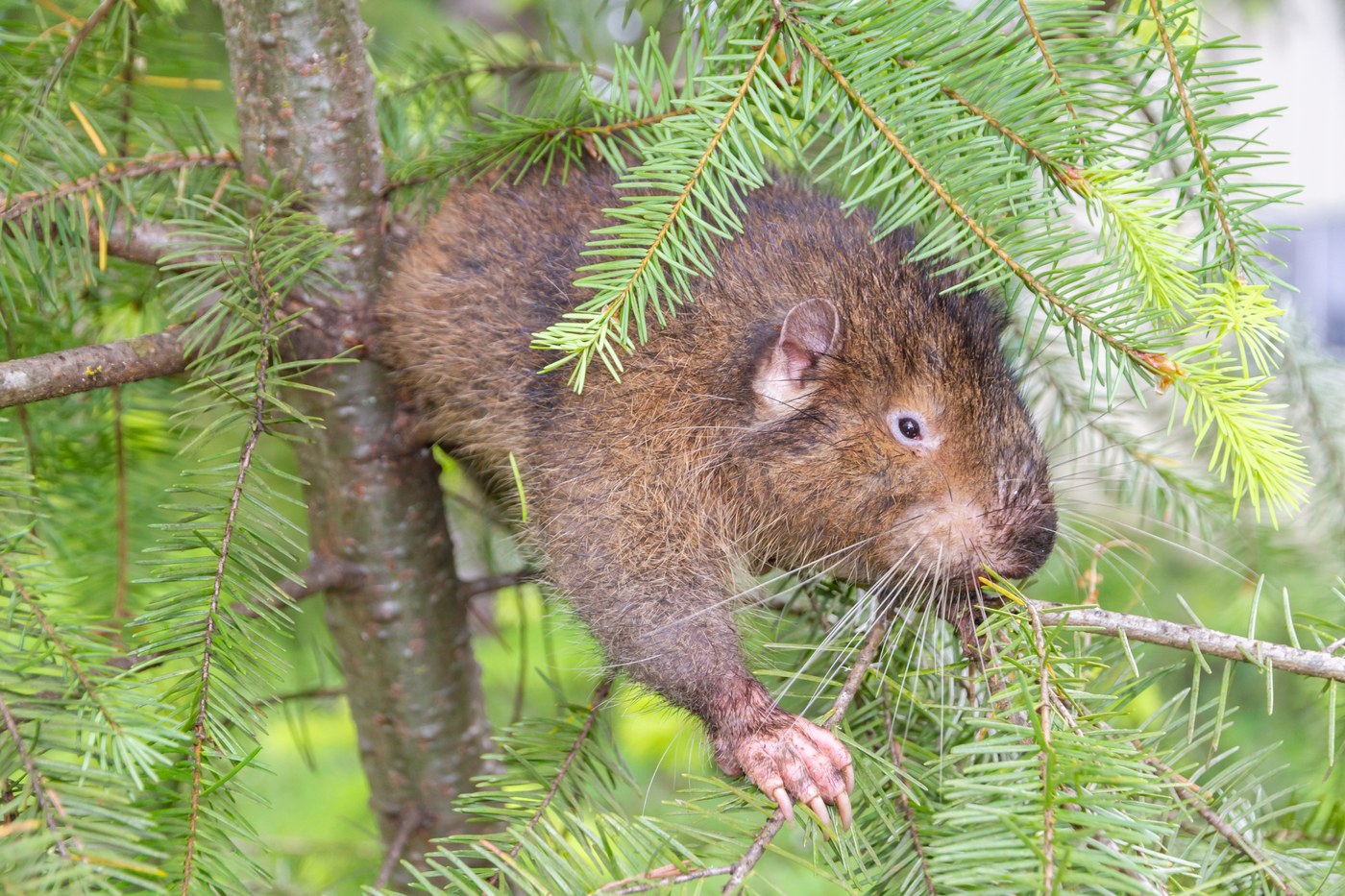
Blackish-brown to brown-black coat, coarse and dense, with guard hairs over the top.
A white spot at each ear
A white spot at the base of each ear is a specific, documented field mark and one of the more useful things to look for on a clear photo.
Small eyes and ears
Small eyes and small ears, nearly buried in the fur.
An almost vestigial tail
The tail is short, stubby, and almost vestigial, under an inch long and fully furred. It is nothing like a true beaver's flat, scaly paddle tail, and it is the fastest way to rule out a beaver in a photo.
Front claws built for digging
Large, strongly curved front claws built for digging, grasping, and climbing. Mountain beavers will climb red alder trees to harvest young, protein-rich leaves, clipping small limbs on the way up.
An overgrown hamster in build
Stocky and cylindrical, more or less an overgrown hamster in build.
The pocket gopher, in the field
The look-alike that matters in the field is the pocket gopher, not the true beaver. Both are burrowing rodents that push up soil and are rarely seen above ground. The burrow entrance settles it: a mountain beaver leaves a large open hole, roughly 6 to 8 inches across and unplugged, often with a haypile of drying vegetation nearby, while a pocket gopher's fan-shaped mound has its entrance sealed with a soil plug. Only one wildlife-damage guide describes the gopher mound that way.
Signs of Infestation
Large, round, open burrow entrances
Roughly 6 to 8 inches across. They are left unplugged, usually appear in clusters, and are typically tucked under shrubs or other cover. A single animal's system can carry 10 to 30 of them.
Haypiles
Piles of freshly cut vegetation left near a burrow entrance to wilt before being hauled underground and stockpiled. This is a distinctive, specifically documented behavior for this species and one of the strongest positive identifications available without seeing the animal.
Clipped conifer seedlings
Clipped and girdled conifer seedlings and saplings. Cut stems run up to about 3/4 inch in diameter on branches, and girdling shows up on trunks up to roughly 6 inches in diameter on larger saplings.
Undermining at the base of big trees
Root damage and undermining at the base of larger, established trees, along with damage to garden and ornamental plants on properties at the forest edge.
No distinctive sound
No characteristic vocalization or audible sign is documented for this species. It is quiet, solitary, nocturnal, and almost entirely underground.
Odor is not a reliable sign either
No usable odor sign has been documented for this species. The musky scent-mound marking that true beavers use to hold territory is not described for this animal, so a smell is not what will tip you off.
Prevention and When to Call a Pro
Protect plants, not the property
Protect individual plants, not the property line. Wire mesh or hardware cloth cylinders around young trees and valued seedlings are the standard documented barrier method. They work, but they are applied one plant at a time, which is why cost is the limiting factor at any real scale.
Cut back the burrow-friendly cover
Cut back burrow-friendly cover near the plants you care about. Clearing dense fern and shrub understory immediately around a planting area removes the moist, hidden-entrance conditions mountain beavers prefer. Treat it as a partial measure. In a naturally wet Pacific Northwest forest setting it reduces pressure rather than eliminating it.
Sealing the house does not apply
Standard seal-the-house advice does not apply here, and following it would waste your time. There is no documented pattern of mountain beavers entering attics, walls, or crawl spaces. This is not a structural pest. Everything worth doing happens at ground level, out among the trees and beds you are trying to keep.
Trapping is the standard method
Trapping is the standard direct-control method cited in forestry-damage-management literature, sometimes paired with a registered toxicant bait in commercial forestry settings. Both are described as effective and costly, and both are professional or commercial-forestry-grade work rather than a homeowner weekend project.
Who to Call, and When
Bring in a licensed nuisance wildlife control operator or a forestry-damage-management professional once burrow systems are established near valued ornamental trees, a garden bed, or a young conifer planting on acreage, and fencing individual plants is no longer practical at the scale of the damage. Because this is a burrowing animal rather than one you can exclude from a building, professional trapping is the normal next step when barrier measures stop containing the problem.
Frequently Asked Questions
Is a mountain beaver actually a beaver?
No. Despite the name, it is the only living member of its own family, Aplodontiidae, and molecular phylogenetic work places it closer to squirrels than to true beavers. It does not build dams or lodges.
Why is it called a mountain beaver if it isn't one?
The name picked up on superficial resemblances only: a roughly similar size, a musky smell, and a shared preference for very wet ground. None of that reflects an actual biological relationship.
Do mountain beavers build dams like regular beavers?
No. They are burrowing animals that live in extensive underground tunnel systems. They do not dam water, do not build lodges, and do not flood property.
What is the actual damage risk from mountain beavers?
Forestry and garden damage, not structural damage. They clip and girdle young conifer seedlings and saplings and undermine the roots of larger trees. Within their Pacific Northwest range they are documented as causing more conflict with conifer forest regeneration than any other vertebrate.
What are haypiles, and why do mountain beavers make them?
A haypile is a mound of freshly cut vegetation left near a burrow entrance to dry out before it gets hauled underground and stored for winter. It is a distinctive behavior for this species and a reliable visual sign that a burrow is active.
Sources
- Mountain beaver (Aplodontia rufa) species page Washington Department of Fish and Wildlife
- Mountain Beaver Biology Internet Center for Wildlife Damage Management (University of Nebraska-Lincoln / USDA APHIS Wildlife Services)
- Molecular phylogeny of an ancient rodent family (Aplodontiidae) Journal of Mammalogy
- B-53 Mountain Beavers, Olympia Field Station USDA Wildlife Services
- Recent approaches to controlling mountain beavers in Pacific Northwest forests eScholarship, University of California
- Aplodontia rufa (mountain beaver) Animal Diversity Web, University of Michigan Museum of Zoology
- Water balance and maximum concentrating capacity in the primitive rodent, Aplodontia rufa Comparative Biochemistry and Physiology, via ScienceDirect
Image Credits
- Image: Adobe Stock, licensed.