Seasonal Timeline
Milk snakes are active from roughly April through October, and they are nocturnal and crepuscular rather than day-active, so even a healthy local population produces very few sightings. Wyoming's wildlife agency notes they are usually seen in the open only on humid nights or after rain.
Milk snakes are active from roughly April through October, and they are nocturnal and crepuscular rather than day-active, so even a healthy…
Nocturnal is the fact that explains why nobody sees this snake. Montana's field guide describes the species as mostly crepuscular and nocturnal, occasionally active by day under moist surface conditions. Wyoming's account is blunter: primarily nocturnal, very secretive, hidden under cover during daylight, and usually observed in the open on humid nights or after rains. Montana goes further and states that detection inside known occupied areas is problematic for exactly this reason, and that the data are sparse enough that the species may be as rare as the records suggest or significantly more common than they suggest. Nobody knows.
The seasonal figures come from three separate state agencies and do not fully agree, which is a data gap rather than a real biological difference. Colorado has the most complete calendar because Colorado has the most complete research record for the species. Wyoming gives a clean April to October. Montana can only say its records run late May to October and calls its own active period poorly documented. All three stand as given rather than blended into a single window that no agency actually published.
Where They're Found
This is a Mountain West snake, and it does not occupy all of that region.
Colorado is the stronghold. Colorado Parks and Wildlife describes the milksnake as found throughout the state, below 8,000 feet, in almost every habitat: prairie, sandhills, canyons, river valleys, ponderosa pine, and pinyon-juniper.
Wyoming is restricted and rare. Wyoming Game and Fish places the pale milksnake in counties east of the Continental Divide, generally below 8,000 feet, in scarp woodlands of the plains and foothills zones, and also in dry conifer forests in montane areas. Animals have been found at roughly 7,000 feet in the Seminoe Mountains, and incidental reports have pushed the known Wyoming distribution westward into higher country. Statewide abundance is listed as rare. Two full years of reptile and amphibian surveys across southeast Wyoming in 2011 and 2012 turned up exactly one pale milksnake.
Montana holds only the central and eastern half of the state, and holds it thinly. The Montana Field Guide calls the species apparently rare across much of central and eastern Montana even in suitable habitat, with a statewide observation database of roughly 163 records. Montana habitat is open sagebrush-grassland and ponderosa pine savannah with sandy soils, most often in or near rocky outcrops, hillsides, or badland scarps. The same account notes records from inside city limits.
Idaho has no documented milksnake population. NatureServe's distribution record for this species is flagged as complete and lists twelve US states: Arizona, Arkansas, Colorado, Kansas, Louisiana, Montana, Nebraska, New Mexico, Oklahoma, Texas, Utah and Wyoming. Idaho is not among them. Idaho State University's museum of natural history separately puts Idaho's native snake fauna at 12 species. This is a Great Plains, desert Southwest and Rocky Mountain foothills animal that stops short of Idaho.
Alaska and Hawaii are confirmed absent. Neither appears in that complete distribution record, and no record places any milksnake in either state.
Related Pests
Life Cycle
One clutch a year, and the whole calendar sits inside a short active season. Breeding follows shortly after spring emergence, generally in May. Eggs go down mid-June to mid-July, incubate 6 to 9 weeks, and hatch late August into September, which leaves the young only a few weeks above ground before the dens close for winter.
The clutch numbers do not agree across state lines. Montana's account gives 2 to 17 eggs across the species with 4 to 6 typical in Colorado and adjacent areas. Wyoming Game and Fish gives 4 to 13 for Wyoming. Both are state agency figures, neither is wrong, and averaging them would produce a number nobody measured. Both are stated.
Almost none of this was measured in the region it describes. Montana's own field guide says no reproductive information specific to Montana milksnakes exists, and that its food habits in the state have never been reported or studied. The age at maturity comes from Kansas. The activity calendar comes largely from Colorado. This is a poorly studied snake, and these numbers are not settled Mountain West field data.

Egg
Hatchling
Juvenile
Adult
Identification
Ringed, not blotched
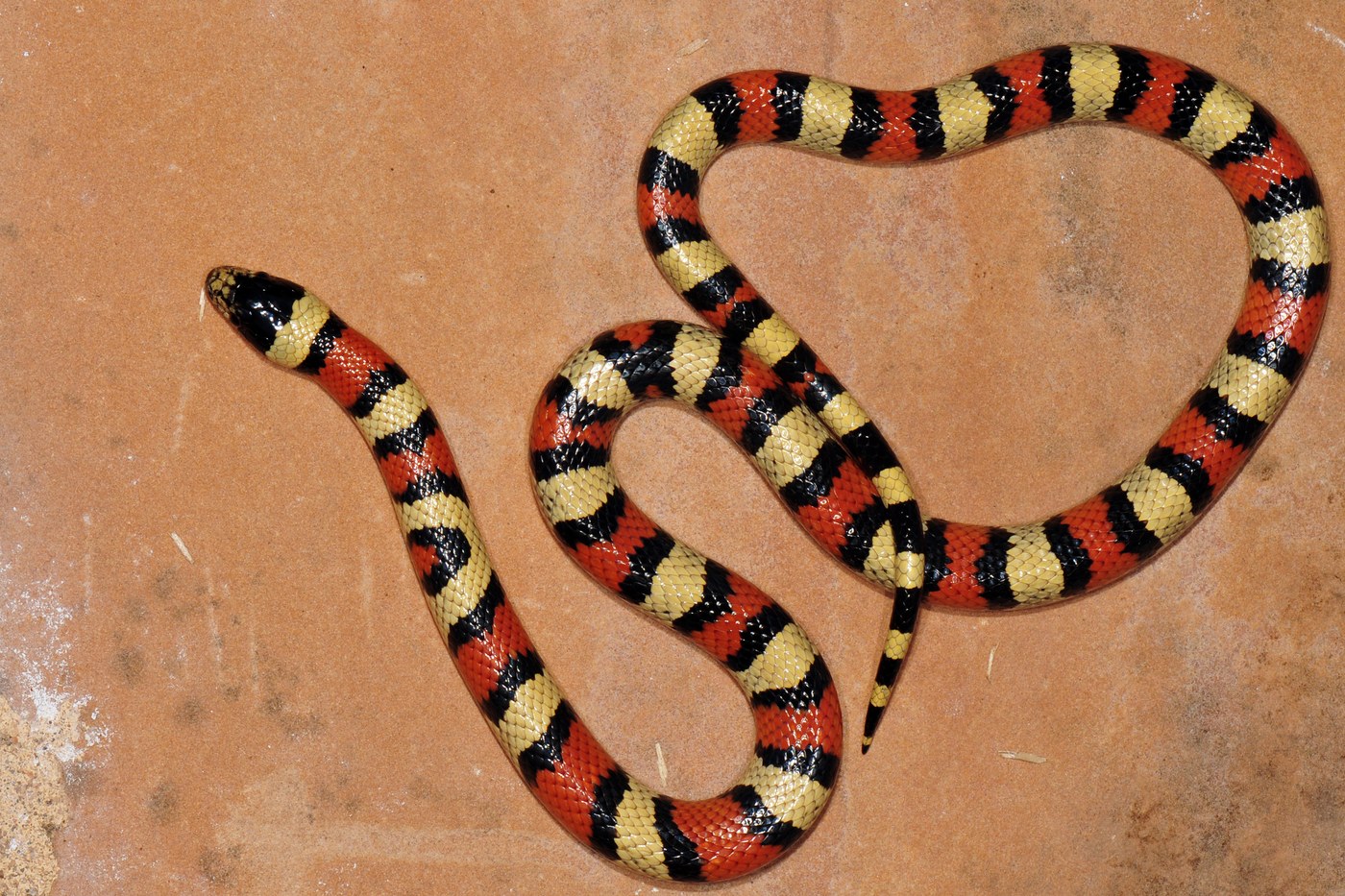
It is ringed, not blotched, and that single word separates it from the eastern milksnake. The back and sides carry whitish, black, and reddish to orange bands, with the red or orange bands bordered in black. The snout is blackish, sometimes with whitish flecking. Colorado Parks and Wildlife states the sequence as red, black, white, black, red, with red the widest section and the black and white sections similar in width or the black thinner. The eastern milksnake, by contrast, is a gray to tan snake with dark blotches. Side by side they do not look like the same animal, and under current taxonomy they are not.
The belly is a second contrast
The belly is a second point of contrast with the eastern milksnake. On this snake the bands often continue right across the belly. Where they are incomplete or absent, the belly is simply whitish. It does not carry the bold black-and-white checkerboard belly that the eastern milksnake uses as its main tell, so do not go looking for one.
Scales and anal plate confirm it
Dorsal scales are smooth and unkeeled, and the anal scale is undivided, as are most of the scales under the tail. The neck is short and thick.
In Montana, no look-alike at all
In Montana it has no look-alike at all. The Montana Field Guide says the whitish, black and reddish to orange banding, the undivided anal scale and the smooth dorsal scales distinguish this snake from every other snake native to Montana. That is unusual. Most harmless snakes get killed because someone confused them with something dangerous. This one gets killed without being confused with anything.
No coral snake lives here
Coral snake is the name people reach for, and no coral snake lives here. Colorado Parks and Wildlife acknowledges that milksnakes are often mistaken for coral snakes and then states plainly that coral snakes do not occur in Colorado. None occurs in Wyoming, Montana or Idaho either. The red touch yellow rhyme is a Southeast and South Central tool, and in this region it answers a question nobody needs answered. If the band order matters to you anyway, Colorado's version is the useful one: this snake runs red, black, white with red the widest band, while US coral snakes run red, yellow or white, black with the red and black rings roughly equal and the pale ring thin.
The pit vipers here look nothing like it
The venomous snakes that actually share this ground are pit vipers and look nothing like it. Prairie rattlesnake occurs across all three states where this snake is found, and midget faded rattlesnake in Colorado and Wyoming. Colorado Parks and Wildlife describes the prairie rattlesnake with a heat-sensitive pit on each side of the head between the nose and the eye, a pupil vertically elongate like a cat's in bright light, a head much broader than the neck, keeled upper scales, and a horny rattle or button on the end of the tail. Montana State University Extension gives the same set as the features that separate an adult rattlesnake from every non-venomous snake in Montana: triangular head, heat-sensing pit between nostril and eye, elliptical eyes, and the rattle. A milk snake has none of them. Round pupils, no pit, no rattle, smooth scales, no fangs.
Do not lean on the rattle alone
This caution comes from the extension service. Montana State University Extension notes that rattlesnakes sometimes lack or lose their rattles, and that pattern and coloration vary too widely across species and regions to be a determining factor by themselves. The pit and the pupil are the reliable checks. That cuts both ways, because a milk snake buzzing its tail in dry grass is producing a rattlesnake sound without a rattle, and a rattlesnake can turn up without one too.
Three agencies, three names
Three state agencies, three different names, one snake. Montana calls it the western milksnake, Lampropeltis gentilis. Wyoming calls it the pale milksnake, Lampropeltis triangulum multistriata. Colorado's public species page just says milksnake, Lampropeltis triangulum, though Colorado's own 2026 regulations write it as western milksnake with both scientific names in one parenthesis. Federally it is the Central Plains milksnake. All four refer to the same animal. The reason for the mess is a 2014 study that split the old milksnake into seven species, a split that is accepted by the current standard names list and still argued over in the journals.
Signs of Infestation
No damage signature
There is no damage signature, because this snake does not damage anything. It does not gnaw, burrow into structures, or nest indoors. There is no droppings pattern, entry hole, tunnel or odor to work backward from. The sign is the animal itself.
Most sightings are at night, after rain
Most sightings happen at night, in the open, after rain. Wyoming Game and Fish describes milksnakes as usually observed in the open on humid nights or after rains. A snake crossing a driveway or road on a warm damp evening is the classic encounter. Daylight sightings usually mean somebody moved a board, rock, log or sheet of debris the snake was sheltering under.
A tail buzz is a bluff
A tail buzz in dry material is a bluff, not a rattle. When disturbed, this species rears up and strikes or rapidly vibrates its tail, which against dry leaves or grass produces a passable rattlesnake sound. It has no rattle. Montana's account notes the same animals are usually docile when handled.
Repeat sightings mean rodents
Repeat sightings around a structure usually mean rodents. Small mammals are a major part of the diet across the region, and in Wyoming they are believed to make up the majority of it. A milk snake working a barn, shed, rock pile or foundation is generally there because mice already are.
A den may not be only this snake's den
Wyoming notes that milksnakes may hibernate communally with other snake species, so a hibernaculum found on a property is worth leaving alone rather than opening up.
Prevention and When to Call a Pro
The step is not killing it
The prevention step for this snake is not killing it, and the reasoning is specific to this region. For the eastern milksnake, the risk is mistaking a harmless snake for a copperhead. Here the risk is simpler and less excusable: assuming that a brightly ringed snake must be venomous in a region that contains no ringed venomous snake. Check the five pit viper marks. Heat pit, vertical pupils, triangular head, keeled scales, rattle. This snake fails all five.
Reduce the rodents
The visits stop. Mammals are a major and, in Wyoming, apparently dominant part of the diet, so harborage reduction and rodent control around barns, sheds and foundations is the durable way to see fewer snakes.
Clear the ground-level cover
Clear ground-level cover next to structures. Boards, sheet metal, rock piles and log piles are exactly the daytime shelter this species uses. Removing them from immediately around a foundation reduces sightings without touching the snake.
Do not relocate it, and in Colorado
Do not catch it and let it go somewhere else, and in Colorado that is now a legal point rather than a preference. Colorado Parks and Wildlife adopted new herpetofauna regulations effective May 1, 2026 under which it is unlawful to release live herpetofauna in Colorado without Division authorization, and native animals taken from the wild must be rehomed rather than released. The stated reasons are disease transmission and invasive species risk. Wyoming and Montana rules differ and should be checked with those agencies directly rather than assuming Colorado's wording carries across a state line.
Do not collect it either
Under the same 2026 Colorado regulations, collecting native herpetofauna requires a Resident Herpetofauna Collection and Possession License obtained after an online education course, with collected animals reported online. Western milksnake is on the collectible list but capped at four individuals per license year and twelve in possession at any time, and all commercial activity in those species is prohibited. Colorado also specifically excludes the western milksnake from the captive-bred exemption it grants other kingsnakes and milksnakes, because this one is native. In Montana, state law lists native reptiles among the nongame wildlife that may not be taken for commercial purposes without department authorization, and Montana's own species account names pet-trade collection as a threat and recommends regulating commercial harvest.
In Wyoming, report the sighting
That is the ask there, instead of removal. Wyoming Game and Fish names lack of basic distribution data as this species' first listed problem and explicitly encourages incidental observations to be reported to its herpetology program. Reports have already extended the known Wyoming range westward. For this species, the most useful thing a homeowner can do is submit the observation.
Leave a den alone
If you find one, that is the whole instruction. Protecting hibernacula is the only management action Montana currently suggests for this species, and dens may be shared with other snakes.
Three states, three pictures
The conservation picture is genuinely different in each of the three states, so do not generalize. The species is globally secure at G5 and nationally secure at N5, but the state ranks inside this one region run S2 in Montana, S3 in Wyoming and S5 in Colorado. Montana lists it as a Species of Concern, also BLM Sensitive and a state wildlife action plan priority. Wyoming ranks it NSS3, population status vulnerable due to restricted numbers, abundance rare. Colorado treats it as a secure, nongame native. Same snake, one region, three different answers. Montana adds a further caveat of its own: its accepted S2 rank disagrees with its own calculated rank of S3, and the rank was scheduled for committee review in 2026, so even Montana's number is not settled.
When to Call a Pest Control Professional
The threshold is identification confidence, not danger. If you cannot check the pit viper marks confidently from a safe distance, that uncertainty is the reason to call a licensed pest control or wildlife control professional to identify the snake rather than handling or killing it. In Colorado, call before removing or relocating anything, because the 2026 rules put licensing, reporting and a no-release requirement around handling native reptiles. And if the same snake keeps turning up, the more useful call may be a rodent inspection than a snake removal.
Frequently Asked Questions
Is this the same snake as the eastern milksnake?
Under the currently accepted treatment, no. A 2014 study applied genetic species delimitation to 276 milksnakes and found the old Lampropeltis triangulum was really seven species. The eastern animal kept that name and every Mountain West population moved to Lampropeltis gentilis. The split is still argued in the journals, and Colorado's public species page still uses the older name, but the two are different lineages under every analysis reviewed and they do not look alike: the eastern one is blotched, this one is ringed.
Are there coral snakes in Colorado, Wyoming or Montana?
No. Colorado Parks and Wildlife notes that milksnakes are often mistaken for coral snakes and then says directly that coral snakes do not occur in Colorado. None occurs in Wyoming, Montana or Idaho either. The red touch yellow rhyme is a Southeast and South Central identification tool with no application in this region.
Do milk snakes eat rattlesnakes?
They eat other snakes, which both Montana and Wyoming wildlife agencies document for this species, and the kingsnake genus is well known for it. But no published account documents a Mountain West milk snake taking a rattlesnake specifically, and the venom-resistance research is laboratory work across the whole genus showing wide variation between species. Wyoming believes small mammals make up the majority of the diet in that state. So this snake eats snakes and rodents, and the rattlesnake part is genus reputation rather than a documented local fact.
Why have I never seen one if the map says they live in my county?
Because it is nocturnal, crepuscular and cryptic. Montana's field guide says detection inside known occupied areas is problematic for exactly that reason, and that the species may be as rare as the sparse data suggest or significantly more common. Wyoming says they are usually seen in the open only on humid nights or after rain. Two full years of reptile surveys across southeast Wyoming produced one.
Can I catch one and move it off my property?
In Colorado, not the way most people mean. Since May 1, 2026 collecting native reptiles there requires a Resident Herpetofauna Collection and Possession License with an education course and online reporting, take is capped at four animals per license year, and releasing live herpetofauna without Division authorization is unlawful. Wyoming and Montana have their own rules and should be checked with those agencies. In all three states the better move is to leave it alone and deal with the rodents that drew it in.
Is a milk snake dangerous to children or pets?
No. Colorado Parks and Wildlife lists it as non-venomous, it has no fangs, and Montana's account describes it as usually docile when handled. Rearing up, striking and buzzing its tail against dry grass are bluffs. It has no rattle and no venom.
Sources
- Western Milksnake (Lampropeltis gentilis), Montana Field Guide: conservation status and the S2 versus S3 rank disagreement, measurements, diagnostic characteristics, habitat, food habits, nocturnal and crepuscular activity, reproduction, species range, and Montana observation records Montana Natural Heritage Program and Montana Fish, Wildlife and Parks
- Milksnake species profile: non-venomous status, band order and the coral snake comparison, statewide range and the 8,000-foot elevation limit, maximum lengths east and west of the divide, hatchling size, habitat, diet, and reproduction Colorado Parks and Wildlife
- Chapter W-7 herpetofauna regulations as approved March 2026: the Resident Herpetofauna Collection and Possession License, education course and reporting requirements, the four-per-year and twelve-in-possession limits, the prohibition on commercial activity, and the no-release and rehoming policy Colorado Parks and Wildlife
- Wildlife Aren't Pets: the western milksnake exception to the captive-bred kingsnake and milksnake allowance, written with both scientific names, plus the resident collection and possession license limits Colorado Parks and Wildlife
- Pale Milksnake (Lampropeltis triangulum multistriata) Species of Greatest Conservation Need account, 2017: Wyoming distribution east of the Continental Divide, April to October activity, clutch size and nest sites, diet and the mammal-majority note, nocturnal and secretive behavior, communal hibernation, NSS3 and S3 status, rare abundance, the 2011 to 2012 survey result, and the request to report incidental observations Wyoming Game and Fish Department
- Central Plains Milksnake (Lampropeltis gentilis) species profile: accepted scientific name, alternate common names, and taxonomic placement U.S. Fish and Wildlife Service
- Lampropeltis gentilis (TSN 1082855): valid species status, and the synonymy folding the gentilis, multistriata, taylori, celaenops and amaura subspecies names into it Integrated Taxonomic Information System, U.S. Geological Survey
- Coalescent Species Delimitation in Milksnakes (Genus Lampropeltis) and Impacts on Phylogenetic Comparative Analyses, Systematic Biology 63(2):231-250: the 2014 study that split Lampropeltis triangulum into seven species Ruane, Bryson, Pyron and Burbrink, Systematic Biology (Oxford Academic)
- Lampropeltis triangulum taxon page quoting the SSAR Standard English Names 9th Edition commentary: the ongoing dispute between Burbrink et al. 2022 and 2024, which support species status, and Chambers and Hillis 2020 and Chambers et al. 2023, which argue for synonymy Center for North American Herpetology
- Snakes of Idaho exhibit: Idaho's native snake fauna given as 12 species, with no milksnake among them Idaho Museum of Natural History, Idaho State University
- Prairie Rattlesnake species profile: pit viper identification features that separate a rattlesnake from a milk snake, plus Colorado range and habitat Colorado Parks and Wildlife
- Rattlesnake Safe in Montana (MontGuide): the four features that separate an adult rattlesnake from Montana's non-venomous snakes, triangular head, heat-sensing pit between nostril and eye, elliptical eyes and rattle, plus the caution that rattles are sometimes lost or absent and that color and pattern are not reliable on their own Montana State University Extension
- Prairie Rattlesnake (Crotalus viridis) species account: triangular head, blunt nose, narrow neck, the heat-sensing pit between nostril and eye, hinged fangs, and the rattle Montana Natural Heritage Program and Montana Fish, Wildlife and Parks, Montana Field Guide
- Western Milksnake (Lampropeltis gentilis) conservation status record, flagged as a complete distribution: global rank G5, US national rank N5, and state ranks including Montana S2, Wyoming S3 and Colorado S5, with Idaho absent from the twelve-state distribution list NatureServe Explorer
- Variability of venom-neutralizing properties of serum from snakes of the colubrid genus Lampropeltis, Journal of Herpetology 26:452-461, indexed as record 6082: the genus-level laboratory finding that venom-neutralizing capacity varies widely between Lampropeltis species Weinstein, DeWitt and Smith, indexed by the Florida Fish and Wildlife Conservation Commission
- Montana Code Annotated 87-5-116, limited taking of certain nongame wildlife for commercial purposes, listing reptiles native to Montana Montana Legislature
Image Credits
- Image: Tom Kennedy via iNaturalist. CC BY 4.0.
License.