Seasonal Timeline
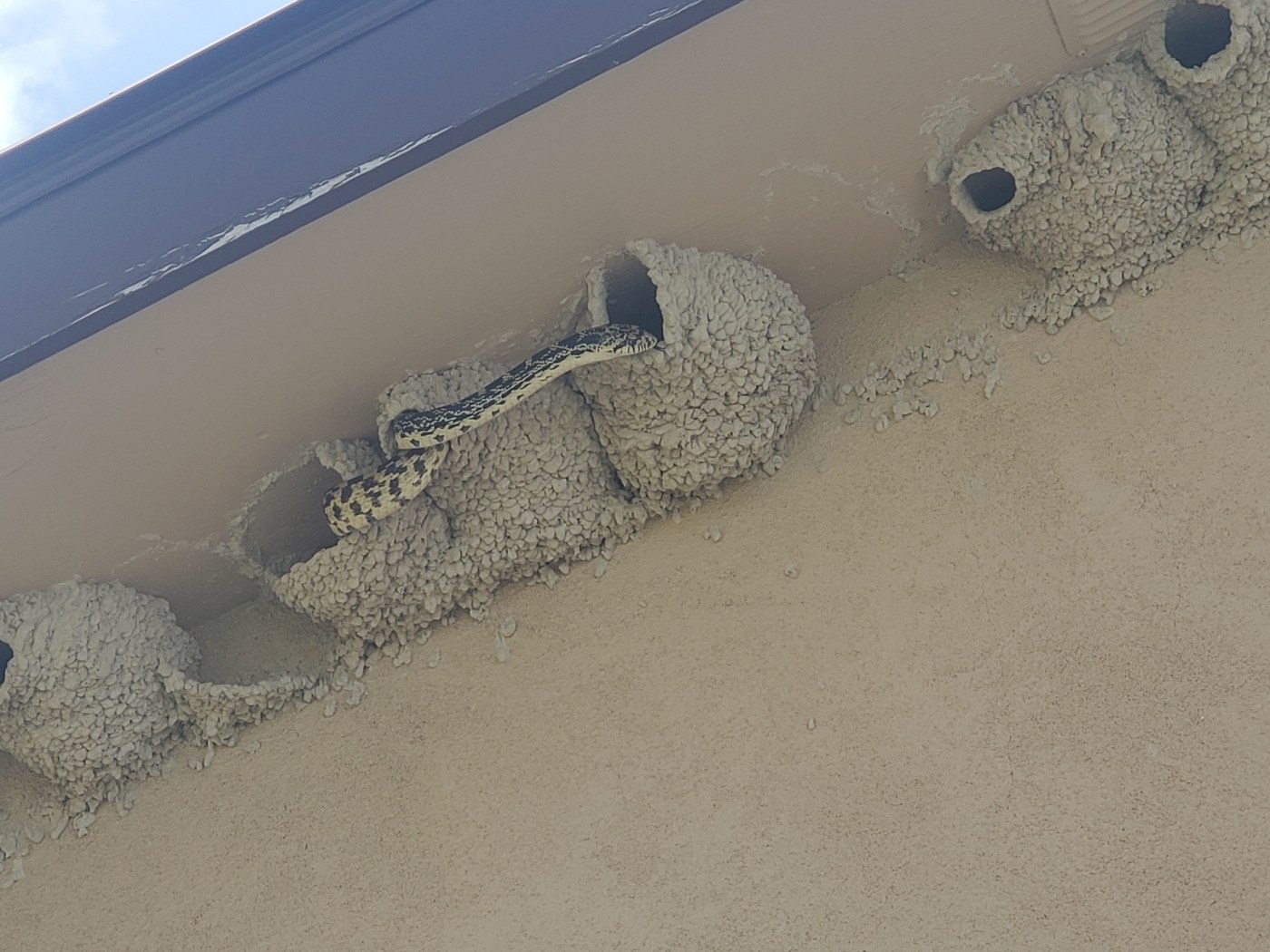
Bullsnakes are day-active animals of the warm months, roughly May through October across the Great Plains, and they spend the winter underground in burrows and rock crevices. The reproductive calendar slides about two months from the southern to the northern end of the range: mating runs March and April in Texas but late May into June in Montana. Eggs are laid in loose soil in late June and July and hatch in late August and September.
Bullsnakes are day-active animals of the warm months, roughly May through October across the Great Plains, and they spend the winter…
The two-month spread in the breeding calendar is latitude, not a source conflict. Texas Parks and Wildlife gives mating in March and April. Montana's field guide gives late May to June. The University of Nebraska-Lincoln herpetology account gives simply spring, with an active season of May through October. Those three cover about 1,300 miles of range, and they line up in the order you would expect. Egg laying converges much more tightly, late June through July in Montana, Colorado, and Texas alike, and hatching lands in late August and September.
One number does not fit, and two Montana state sources are the ones that disagree. Montana's Department of Agriculture bulletin states that females lay on average 12 to 13 eggs in late June to July and that the eggs hatch about 30 days later. But Montana's own field guide, and Colorado Parks and Wildlife independently, both give laying in late June to July and hatching in late August to September, which is roughly 60 to 75 days rather than 30. The late-August-to-September hatch window is the better supported one, since two independent agencies agree on it, and the 30-day figure is the outlier.
The season that actually matters for a property owner is spring and fall, and the reason is dens. Montana's Department of Agriculture states that property owners encountering many snakes of the same species in spring or fall is often a sign that a hibernaculum is nearby. Nebraska Game and Parks documents where those dens usually are for this species: abandoned prairie dog and badger burrows. Prairie rattlesnake uses that same overwintering resource, which is exactly why a snake at a burrow mouth in April or October should not be assumed to be either animal.
Where They're Found
Bullsnake is an entirely outdoor, wild animal with no structural damage mechanism. It builds nothing, chews nothing, and has no reason to get into a wall void. Its range covers three regions: Midwest, Mountain West, and South Central.
First, the name question, because it decides the map. Bullsnake and gopher snake are the same species, Pituophis catenifer, split by subspecies. Colorado Parks and Wildlife states it for one state: Colorado holds both Pituophis catenifer sayi, the bullsnake, on the eastern plains, and Pituophis catenifer deserticola, the Great Basin gophersnake, on the western slope, with the two intermixing in south-central Colorado and especially the San Luis Valley. University of Wyoming Extension describes the identical arrangement in Wyoming, bullsnake in the eastern and north-central parts of the state and Great Basin gophersnake in the southwest. Montana's field guide names P. c. sayi as the Montana subspecies. The bullsnake is the subspecies in question.
Midwest is the core. Nebraska Game and Parks calls the bullsnake the largest snake in Nebraska and describes it throughout the state in sandy prairies, grasslands, and areas with rocky outcrops. Kansas State University publishes a county-level Kansas range map for it. The University of Nebraska-Lincoln herpetology account gives its Nebraska habitat as grasslands, open woodlands, farmland, rocky outcrops, and sandy soils.
Mountain West is claimed on three of its four states, on purpose. Colorado Parks and Wildlife puts the species throughout most of Colorado below roughly 8,500 feet and mostly below 7,000, across plains grassland, sandhills, riparian areas, marsh and pond edges, rocky canyons, semidesert and mountain shrubland, pinyon-juniper woodland, ponderosa pine forest, and rural residential ground. University of Wyoming Extension places the bullsnake in eastern and north-central Wyoming. Montana's field guide calls it the largest snake in Montana, and Montana's Department of Agriculture places it primarily in central and eastern Montana with valley populations in the west up to 5,000 feet. Idaho is deliberately left off. Idaho's gophersnake is the Great Basin subspecies rather than the bullsnake, and no published source places P. c. sayi in Idaho.
Only the western half of South Central holds bullsnakes. Texas Parks and Wildlife describes the species as very common throughout Texas except the extreme east and the extreme western Trans-Pecos, in sandy soils in fields, brushlands, and grasslands. Oklahoma's wildlife department places it in woodlands and prairies across the western two-thirds of that state. No published source places the bullsnake in Arkansas, Louisiana, Tennessee, or Kentucky, so it should not be expected in those four states.
New Mexico and the far west belong to other subspecies. Bullsnake range does reach New Mexico, in the Southwest. Gophersnakes elsewhere in the Southwest belong to the Sonoran end of the same species complex. In the Pacific Northwest and California the subspecies present are the Pacific and San Diego gophersnakes rather than the bullsnake.
Two absences are confirmed rather than assumed. No published source of any kind places Pituophis catenifer in Alaska. Every published range description confines this subspecies to the Great Plains, the eastern Rocky Mountain slope, and the southern plains into Mexico. Hawaii has no native snake of any kind.
On the ground, look at the burrows. Nebraska Game and Parks states that bullsnakes normally hibernate in abandoned prairie dog and badger burrows. Texas Parks and Wildlife states they are frequently associated with prairie dog towns and burrowing animal systems, where they eat ground squirrels, rabbits, prairie dogs, and ground-nesting birds. The enlarged, shovel-shaped rostral scale on the tip of the snout is the anatomy behind that habit, adapted for digging and for working rodent tunnels. Bullsnakes are also capable climbers and occasionally go up trees, which surprises people who assume a heavy-bodied plains snake stays on the ground.
Related Pests
Life Cycle
The most interesting thing about this animal's biology is not reproductive. It is the noise. Everyone repeats that a bullsnake fakes a rattle by vibrating its tail. Fewer people know that the hiss is a separate and much stranger piece of equipment. Colorado Parks and Wildlife lists a vertical plate at the opening of the windpipe among its diagnostic characters for this species, which is genuinely unusual for a state agency species description to bother with. The herpetological literature calls that structure the epiglottal keel. What is unique to Pituophis among snakes is a vocal cord, and that turns out to be a different structure again.
And here the sources disagree, which is worth stating rather than smoothing. A 1971 study in Copeia concluded that the epiglottal keel was what altered the exhaled airstream to make the sound, and that explanation is still the one usually repeated. A 1995 study in the Journal of Experimental Zoology took it apart and found otherwise: the keel plays only a small role in amplifying the sound, and the harmonics that make these calls unusual come from a different structure entirely, a flexible horizontal shelf of tissue inside the larynx that the authors described as a vocal cord and named the laryngeal septum. Remove it and the harmonics disappear. It is unique among all described vertebrate vocal cords in being a single structure rather than a bilaterally paired one, and in being supported by the cricoid rather than the arytenoid cartilage. The same work separated two distinct defensive sounds, a hiss and a bellow, measured them at roughly 65 to 90 decibels with a significant 10 to 20 decibel gap between them, and found the animal produces louder hisses with its mouth only partly open.
One limit on that, stated rather than hidden. The acoustic work was done on Pituophis melanoleucus, the pine snake, a congener rather than the bullsnake itself. The epiglottal keel is a genus-level feature and Colorado's own description of the bullsnake names it, so the anatomy carries over. The decibel figures were measured on the other species, not on the bullsnake.

Mating
Egg
Hatchling
Juvenile
Adult
Identification
No rattle is the real difference
The absent rattle is the one true structural difference, and Montana's field guide states it in a single line. Writing about the prairie rattlesnake, it says no other snake in Montana has rattles, and then points the reader at the two animals people confuse with it: gophersnake and western hog-nosed snake. A bullsnake's tail tapers to a point. The rattling sound comes entirely from vibrating that tail against dry vegetation or loose ground, so there is no rattle structure on the tail to find.
Round pupils, no facial pit, and no eye mask
University of Wyoming Extension puts all three together: gopher snakes have round pupils and, unlike the prairie rattlesnake, do not have an eye mask or a heat-sensing pit between the eyes and nostrils. Of those three, the eye mask is the one you can actually see at a distance. A prairie rattlesnake carries a brown eye mask bordered by white. A bullsnake carries something different in the same place, a black band in front of and extending below the eye, per Montana's field guide.
The pupil tell, and its limit
The pupil tell comes with a limit almost nobody prints, and it is in a state agency's own wording. Colorado Parks and Wildlife describes the prairie rattlesnake's pupil as vertically elongate, like a cat's, in bright light. A reptile's pupil dilates when the light drops. At dusk, in deep shade, or in a phone photo taken under overcast sky, the vertical slit can open toward round. Do not stake a decision on pupil shape alone.
Watch the tail, do not listen to it
Tail position beats tail sound, and this is the tell that genuinely works from a safe distance. Montana's Department of Agriculture: rattlesnakes hold their tails vertically so the rattle can be clearly heard, while non-venomous snakes shake their tails side to side to strike objects such as leaves and make the rattle sound. A vibrating tail held up in the air is a rattlesnake. A tail thrashing sideways into dry grass or leaf litter is a mimic. That is observable at range without approaching anything.
Size will not settle it
Size is not a reliable tell, but the numbers are worth knowing. Nebraska Game and Parks calls this the largest snake in Nebraska at 40 to 70 inches. Kansas State University gives 37 to 72 inches. Montana's field guide calls it the largest snake in Montana, most 3 to 5 feet, reaching 7. Colorado Parks and Wildlife publishes the outer bound at about 254 cm or 100 inches, rarely more than 180 cm or 71 inches. A prairie rattlesnake in Colorado is rarely greater than 39 inches. So a very large blotched snake is more likely to be this one, but a small one proves nothing.
What the counting characters are worth
The counting characters are real anatomy and this is what they are worth. Strongly keeled dorsal scales, a single undivided anal scale, four prefrontal head scales, and an enlarged triangular rostral scale on the snout tip are all documented for the bullsnake. But keeled scales are shared: Colorado Parks and Wildlife's own prairie rattlesnake description also gives keeled upper scales, so that character separates nothing between these two animals. And no published source gives the prairie rattlesnake's anal scale condition at all, so that character offers no published contrast between the two.
The tell that fails hardest
The scale row under the tail is the tell that gets recommended most and fails hardest, and a state agency explains why in two clauses. Montana's Department of Agriculture, on the belly-scale pattern below the cloaca: this identification tip has limited usefulness because, first, it requires handling of the snake, and second, some snakes violate the pattern, meaning a venomous snake may have single banding and vice versa. Two independent reasons it fails, and one of them is that using it requires exactly the contact a homeowner must not make.
One caveat over the whole list
The whole tell list carries one caveat, and it is the same agency's. On the pupil and pit clues, Montana's Department of Agriculture writes that these clues do require viewers to have strong vision or be very close to the snake, perhaps too close. That is a state wildlife bulletin telling you its own identification advice can put you in range. If you cannot be certain from a safe distance, treat the animal as the rattlesnake and back away. Nothing else you need to do about this snake depends on identifying it.
Bullsnake and gopher snake
They are the same species, and the difference is subspecies. Both are Pituophis catenifer. Colorado has bullsnake, P. c. sayi, on the eastern plains and Great Basin gophersnake, P. c. deserticola, on the western slope, and they intermix in the San Luis Valley. Wyoming has the same pair, bullsnake east and north-central, Great Basin gophersnake southwest. The species name catenifer means chain-bearing, which is a direct description of the dorsal blotch row.
A juvenile racer, and it runs
A juvenile racer is the third look-alike, and it runs the other way. University of Wyoming Extension notes that young North American racers look remarkably different from the plain adults and carry a pattern similar to a bullsnake's for camouflage. Montana's Department of Agriculture illustrates juvenile racer patterning as itself confusable with a rattlesnake. So in this range a small blotched snake could be a bullsnake or a young racer. Neither is venomous, which makes getting that particular pair wrong harmless.
Signs of Infestation
Nothing to inspect
The usual inspection checklist does not apply, because a snake leaves nothing to inspect. Bullsnake builds nothing, chews nothing, and does not get inside a wall or crawlspace to nest. There are no gnaw marks, entry holes, droppings trails, or odors to work backward from. The sighting is the evidence.
One of three things gets noticed
What a homeowner actually notices is one of three things. The snake itself, a shed skin, or the sound. That is the whole list.
The sound is also the hazard
The sound is the sign and the hazard at the same time. Nebraska Game and Parks documents both halves of it: bullsnakes will rattle their tail when disturbed or threatened, and will also exhale through their open mouths making a loud hiss like sound, similar to a rattlesnake. The same source supplies the correction, that only rattlesnakes have the specialized sound-producing rattle on the tip of the tail.
Look at the burrows
Nebraska Game and Parks states this species normally hibernates in abandoned prairie dog and badger burrows. Texas Parks and Wildlife states it is frequently associated with prairie dog towns and burrowing animal systems. Prairie rattlesnake uses the same burrows, documented on its own page here, which is exactly why a snake at a burrow mouth should not be assumed to be either species. Do not investigate a burrow by hand.
Repeat sightings point at rodents
Kansas State University describes this snake as feeding on large quantities of rodents, and Texas Parks and Wildlife lists mice, cotton rats, gophers, ground squirrels, rabbits, and prairie dogs. A property producing regular bullsnake sightings is usually a property producing regular rodent activity.
Several in spring or fall means a den
Several snakes of the same species in spring or fall means a den, not a coincidence. Montana's Department of Agriculture states that property owners encountering many snakes of the same species during spring or fall is often a sign that a hibernaculum is nearby. That is a call for a professional rather than a closer look, and if the suspected den is in a foundation, it is specifically a reason not to seal it.
Prevention and When to Call a Pro
The first rule is do not kill it
The first rule is the opposite of the usual one: do not kill it. Two independent sources document what happens when people do. Kansas State University states that many of these beneficial snakes are killed because they are mistaken for rattlesnakes. Colorado Parks and Wildlife states that the mimicry can cause them to be killed erroneously by humans thinking they are threats. What gets killed is a non-venomous predator of mice, pocket gophers, ground squirrels, prairie dogs, and rabbits.
The second rule protects you
It protects you rather than the snake, and it is the reason the first rule is not merely sentimental. University of Wyoming Extension states that most venomous snakebites in the United States occur when people harass or try to kill the snake. Montana's Department of Agriculture reports the same pattern with federal numbers: of 7,000 to 8,000 venomous snakebites a year nationally, approximately 50 percent occurred to people handling snakes, hunting snakes, or failing to move away once they noticed one nearby, and up to 25 percent of venomous bites are dry. Trying to kill an unidentified snake is at once a major cause of beneficial-snake deaths and the leading cause of snakebite. Backing away solves both, and it does not require identifying anything.
Safe distance is a number
It is not a feeling. Montana's Department of Agriculture states a snake can only reach out to half of its body length, so a three-foot snake reaches about 18 inches. The exception matters: a snake backed against a wall or a tuft of grass can strike its full length. Do not corner one.
Remove the cover and the prey
Remove the cover, and remove the prey. University of Wyoming Extension calls eliminating habitat and food source the first and most important step, naming piles of brush, leaves, and rocks and other clutter as attractive hiding for both snakes and their prey. It adds the step most snake advice skips: store grain, bird seed, and pet food in tightly sealed containers, and keep grass mowed short where possible. Montana's Department of Agriculture adds a planting rule, avoid low-growing shrubs and ivy and choose shrubs whose trunk clears the ground before branching, so you can see the ground under them.
Seal gaps a quarter inch and up
Seal gaps of a quarter inch or larger, and there is a shortcut for a pest-control audience. Montana's Department of Agriculture specifies securing gaps that provide snakes cover, at least a quarter inch or larger, with silicone-based sealant for gaps under half an inch and stainless or copper mesh fill plus sealant for larger ones. Its own summary line: in general terms, follow guidelines for excluding mice and insects and you will also exclude snakes.
Do not seal a winter den shut
Do not seal a foundation you suspect snakes are wintering behind. This one is a warning, not a tip. Montana's Department of Agriculture states that where hibernacula may be in a basement or foundation, do not secure openings, because that can trap snakes inside the structure and push them to find other ways into living space. It directs that case to a state vertebrate pest specialist or a professional wildlife control operator. Sealing before the fact is the version that works: University of Wyoming Extension notes a sealed foundation under a home, garage, shed, or barn helps keep snakes from denning under the building in the first place.
Fencing has a published spec
Fencing has a published specification, and it matters who it was written for. University of Wyoming Extension gives quarter-inch mesh, 36 inches high, tightly enclosed, no perimeter vegetation a snake could climb over, and tight-closing gates. Montana's Department of Agriculture describes drift fencing from erosion fabric or 20-inch aluminum flashing set vertically in a shallow groove. Neither spec was written for bullsnake. Both were written for rattlesnakes, and both work on this species as a side effect. That is stated rather than implied.
Repellents, in the state's words
Repellents, in a state agency's own words. Montana's Department of Agriculture: most research on the efficacy of repellents on snakes is not promising, and if considering repellents, it suggests having low expectations and consulting the product's return policies before buying.
No chemical option exists
There is no chemical option, and in one state the popular workaround is specifically illegal. Montana's Department of Agriculture states that no toxicants or fumigants are registered for the control of any snake native to Montana. Oklahoma goes further and prohibits the practice outright: it is unlawful to introduce, deposit, place, or drain any deleterious, noxious, toxic, or petroleum-based substance into or around any underground dens or rock crevices for the purpose of taking reptiles. Pouring anything down a burrow is not a control method here.
The law varies and it changes
The law varies by state, it varies inside a single region, and it changes. Check before you act. Rules for taking, trapping, relocating, or killing this snake are set state by state. Verify the current rule with your state wildlife agency, and treat a licensed nuisance wildlife control operator as the safer default over a trap you bought yourself. Four states across these three regions publish rules specific enough to quote, and they are genuinely different from each other.
Colorado is the most restrictive
It is the most restrictive of the four, and the rule is brand new. Colorado's herpetofauna regulations, approved in March 2026 and effective May 1, 2026, list Gophersnake/Bullsnake by name and binomial among the species that may be taken from the wild only under a valid Resident Herpetofauna Collection and Possession License. Getting that license requires Colorado residency and passing a state-provided herpetofauna education course with a score of 75 percent or higher within the prior twelve months. The license caps take at four individuals per license year across all listed species, caps simultaneous possession at 12, restricts method to hand, dip net, handheld loop, snake hook, or snake tong, and runs no more than three years. The regulation's own stated purpose notes these rules previously sat across eight separate chapters and were hard to find and interpret correctly, which means anyone who looked up a Colorado bullsnake rule before 2026 read a superseded one.
Kansas, Oklahoma and Texas
All three allow take, with three different structures. Kansas requires a hunting license, runs the season year round, and caps possession at five reptiles total and no more than two individuals of any one reptile species per person or domicile. Oklahoma requires a hunting license for land-dwelling reptiles, runs a year-round season for all reptiles except rattlesnakes, and sets a limit of six per day or in possession for each species. Texas requires a hunting license for nongame take and sets no closed season, bag limit, or possession limit on private property, but separately makes it unlawful to capture, trap, take, collect, or kill any wild animal on a public road or the right-of-way of a public road. That last one is worth naming here, because Texas Parks and Wildlife identifies road mortality as one of two things that plague this species.
Six states with no citable rule
Six states in these regions produced no citable species-specific rule. No bullsnake-specific take rule could be found for Nebraska, Montana, Wyoming, South Dakota, North Dakota, or the remaining Midwest states. Nebraska's regulations make it unlawful to take a nongame species in need of conservation outside an authorized open season, but no published source places the bullsnake on or off that list by name. If you are in one of those states, call the state wildlife agency rather than assuming Colorado's license requirement or Oklahoma's daily limit applies to you. No federal protection was found, and Montana ranks the species S5, secure in state.
Call if you cannot rule out a rattler
Call a professional for any snake you cannot separate from a rattlesnake from a safe distance. That threshold is deliberately low. The imitation is built to be convincing, two sources document people killing the wrong animal because of it, and two more document that trying to kill or handle a snake is how most venomous bites happen. Uncertainty is a reason to hand the job to someone equipped for it, not a reason to get closer.
Call for several snakes, or a den
Call a professional for several snakes of one species appearing in spring or fall, and for any suspicion of a den in a foundation, crawl space, or basement. The first is the signature of a hibernaculum. The second is the case where the obvious fix, sealing the opening, is the wrong move.
One snake is usually not a call
A single bullsnake in a yard is usually not a call at all. Colorado Parks and Wildlife describes gophersnakes and bullsnakes as non-venomous and harmless to humans. Texas Parks and Wildlife adds that they will not strike unless severely provoked. No published source documents any property-damage mechanism for this species. When identification is confident, leaving it alone is the correct answer.
Frequently Asked Questions
How do I tell a bullsnake from a prairie rattlesnake?
From a distance, watch what the tail does rather than listening to it. Montana's Department of Agriculture states that rattlesnakes hold their tails vertically so the rattle can be clearly heard, while non-venomous snakes shake their tails side to side to strike objects such as leaves and make the rattle sound. A vibrating tail held up in the air is a rattlesnake; a tail thrashing sideways into dry grass is a mimic. Up close, a bullsnake has no rattle at all, has round pupils, has no heat-sensing pit between eye and nostril, and carries a black band in front of and below the eye rather than the rattlesnake's white-bordered brown eye mask. But the same Montana bulletin warns that the pupil and pit clues do require strong vision or being very close to the snake, perhaps too close. If you cannot be certain from a safe distance, treat it as the rattlesnake and back away.
Why does a bullsnake sound like a rattlesnake if it has no rattle?
Two separate things happening at once. It vibrates its tail against dry vegetation, and it hisses with its mouth open in a way Nebraska Game and Parks describes as a loud hiss like sound, similar to a rattlesnake. The hiss is not an ordinary snake hiss. Colorado Parks and Wildlife lists a vertical plate at the opening of the windpipe among this species' diagnostic characters, a structure unique to this genus among snakes, and peer-reviewed acoustic work on a pine snake congener found the sound's unusual harmonics come from something rarer still, a single vocal cord inside the larynx called the laryngeal septum. That work measured these defensive sounds at roughly 65 to 90 decibels and found the animal produces louder hisses with its mouth only partly open.
Are bullsnakes dangerous to people, kids, or pets?
No. Colorado Parks and Wildlife calls gophersnakes and bullsnakes non-venomous and harmless to humans. University of Wyoming Extension confirms they are non-venomous despite imitating a rattlesnake convincingly. Texas Parks and Wildlife adds that they will not strike unless severely provoked. In this scenario the greater danger runs the other way: University of Wyoming Extension states that most venomous snakebites in the United States happen to people who harass or try to kill the snake, and Montana's Department of Agriculture reports that about half of all venomous bites nationally involve handling, hunting, or failing to move away from a snake already noticed.
Should I kill a bullsnake in my yard?
No, for two documented reasons. First, it is a rodent specialist. Kansas State University describes it as feeding on large quantities of rodents, and state agency sources list mice, cotton rats, pocket gophers, ground squirrels, prairie dogs, and rabbits, several of which are themselves common yard and pasture pests. Kansas State University's own summary of the outcome is that many of these beneficial snakes are killed because they are mistaken for rattlesnakes. Second, in some states it is now regulated: Colorado's herpetofauna rules effective May 1, 2026 list this species by name and require a license plus a passed education course before it can be taken from the wild.
Is a bullsnake the same thing as a gopher snake?
At the species level, yes. Both are the same animal, and the difference is subspecies. Colorado Parks and Wildlife describes both in one state: bullsnake on the eastern plains and Great Basin gophersnake on the western slope, intermixing in south-central Colorado and especially the San Luis Valley. University of Wyoming Extension describes the same pair in Wyoming, bullsnake in the east and north-central parts of the state, Great Basin gophersnake in the southwest. Farther west the subspecies present are the Pacific and San Diego gophersnakes rather than the bullsnake.
Why do I keep seeing bullsnakes around the prairie dog holes?
Because for this snake a burrow complex is both the pantry and the bedroom. Texas Parks and Wildlife states the species is frequently associated with prairie dog towns and burrowing animal systems, where it eats ground squirrels, rabbits, prairie dogs, and ground-nesting birds. Nebraska Game and Parks states that bullsnakes normally hibernate in abandoned prairie dog and badger burrows. The enlarged, shovel-shaped scale on the tip of its snout is the anatomy behind the habit. The important caution: prairie rattlesnake uses the same burrows for the same reason, so a snake at a burrow mouth should not be assumed to be either species, and no burrow should be investigated by hand.
Is it legal to trap or remove a bullsnake myself?
It depends on the state, and the four states with citable rules handle it four different ways. Colorado now requires a Resident Herpetofauna Collection and Possession License, which means Colorado residency plus passing a state education course at 75 percent or better, with take capped at four animals a license year and possession at 12. Kansas requires a hunting license and caps possession at five reptiles total and two of any one species. Oklahoma requires a hunting license and caps take at six per day per species, and separately makes it illegal to pour any toxic or petroleum-based substance into a den or rock crevice to take reptiles. Texas requires a hunting license with no bag limit on private property, but prohibits taking wild animals on public roads and rights-of-way. No published source gives a bullsnake-specific rule for Nebraska, Montana, Wyoming, South Dakota, or North Dakota, so in those states check with the state wildlife agency first rather than assuming a neighboring state's rule carries over.
Sources
- Bullsnake account, Amphibians, Turtles & Reptiles of Nebraska: total length 76.0 to 279.0 cm, strongly keeled scales, single anal scale, enlarged triangular rostral scale, back and belly color, one to two clutches of 2 to 24 eggs, spring breeding, May to October active season, diurnal habit, diet and habitat University of Nebraska-Lincoln, School of Natural Resources
- Bull snake (Pituophis catenifer): 37 to 72 inches, rattlesnake mimicry, the rattle sound actually being a hiss, feeding on large quantities of rodents, diurnal habit, Kansas county range map, and the statement that many of these beneficial snakes are killed because they are mistaken for rattlesnakes Kansas State University, Division of Biology
- Know Your Neighbors (especially the reptilian kind), Barnyards & Backyards Fall 2022: round pupils, absent eye mask and heat-sensing pit, absent rattle, hiss resembling a rattle, seven-foot maximum, Wyoming subspecies distribution, diet, the finding that most venomous snakebites occur when people harass or try to kill the snake, the quarter-inch-mesh 36-inch snake fencing spec, and habitat and food-source mitigation University of Wyoming Extension
- Gophersnake (Pituophis catenifer) species account: P. c. sayi as the Montana subspecies, Montana's largest snake at up to 7 feet with most 3 to 5 feet, keeled scales, four prefrontals, undivided anal plate, the black head band in front of and below the eyes, tail vibration and hissing producing a rattlesnake-like sound, active foraging and diet, mating late May to June, eggs late June to July, hatching late August to September, 2 to 24 eggs averaging 12.4, and the northern Utah 92 percent hatching success and 88 percent adult versus 25 percent juvenile overwinter survival figures Montana Field Guide, Montana Natural Heritage Program and Montana Fish, Wildlife and Parks
- Prairie Rattlesnake (Crotalus viridis) species account: the statement that no other snake in Montana has rattles, cross-referencing gophersnake and western hog-nosed snake, plus the heat-sensing pit between nostril and eye Montana Field Guide, Montana Natural Heritage Program and Montana Fish, Wildlife and Parks
- Living with Montana's Snakes, Vertebrate Pest Program bulletin revised 10/30/2025: rattlesnake mimicry and misidentification, the gophersnake tail-banding confusion, the caveat that pupil and pit clues require strong vision or being very close to the snake, the limited usefulness of belly-scale patterning, vertical versus side-to-side tail shaking, half-body-length strike distance, national bite statistics including the 50 percent handling and hunting figure and the 25 percent dry-bite figure, quarter-inch gap sealing, the do-not-seal warning for foundation hibernacula, 20-inch aluminum flashing drift fencing, repellent efficacy, and the finding that no toxicants or fumigants are registered for control of any snake native to Montana Montana Department of Agriculture
- Gophersnake/Bullsnake species profile: both Colorado subspecies and the San Luis Valley intermixing, keeled upper-back scales, single anal scale, the vertical plate at the opening of the windpipe, maximum total length about 254 cm or 100 inches and rarely more than 180 cm or 71 inches, elevation below about 8,500 feet, habitats, diet, eggs late June to mid-July and hatching late August to September, the non-venomous and harmless statement, and the finding that the rattlesnake mimicry can cause these snakes to be killed erroneously by humans thinking they are threats Colorado Parks and Wildlife
- Prairie Rattlesnake species profile: rattle or button on the tail, head much broader than neck, the pit between eye and nostril, keeled upper scales, the pupil described as vertically elongate like a cat's in bright light, and the rarely-greater-than-100-cm Colorado length Colorado Parks and Wildlife
- Final Regulations Chapter W-7 Herpetofauna, as approved 03/04/2026 and effective May 1, 2026: Appendix C listing of Gophersnake/Bullsnake (Pituophis catenifer deserticola/sayi), regulation 704 Resident Herpetofauna Collection and Possession License, the 75 percent education-course requirement, the four-per-license-year take cap and 12-individual possession cap, the hand, dip net, handheld loop, snake hook, and snake tong method restriction, the three-year license term, and the basis-and-purpose note that these rules previously sat across eight chapters Colorado Parks and Wildlife, Colorado Wildlife Commission
- Bullsnake species page: three to five feet, beige to light brown with dark blotches and a yellowish black-spotted belly, diet including mice, cotton rats, gophers, ground squirrels, rabbits and prairie dogs, the prairie dog town association, sandy soils in fields, brushlands and grasslands, Texas distribution excepting the extreme east and extreme western Trans-Pecos, mating in March and April, five to 19 eggs in June and July, hatchlings in early autumn, loud hissing and the S-shaped posture, the statement that they will not strike unless severely provoked, road mortality and habitat destruction as the two elements that plague the species, and the 22-year captive longevity record Texas Parks and Wildlife Department
- Nongame, Exotic, Endangered, Threatened and Protected Species, Outdoor Annual: the hunting license requirement for nongame take, the absence of closed seasons, bag limits and possession limits on private property, and the prohibition on hunting, capturing, trapping, taking, collecting or killing any wild animal on a public road or the right-of-way of public roads Texas Parks and Wildlife Department
- Reptiles, Amphibians and Other Species hunting regulations: hunting license requirement, year-round season, the five-reptile and two-per-species possession caps per person or domicile, and the prohibition on taking threatened, endangered or species-in-need-of-conservation under a hunting license Kansas Department of Wildlife and Parks
- Reptile and Amphibian Regulations: hunting license requirement for land-dwelling reptiles, year-round season for all reptiles excluding rattlesnakes, the six-per-day-or-in-possession limit for each species, take by hand or other legal means, the statewide closed-season species list, and the prohibition on introducing any deleterious, noxious, toxic or petroleum-based substance into or around underground dens or rock crevices for the purpose of taking reptiles Oklahoma Department of Wildlife Conservation
- Bullsnake, Snakes of Nebraska: Nebraska's largest snake at 40 to 70 inches, yellow ground color with black, brown or reddish blotches, tail rattling when disturbed, exhaling through the open mouth to produce a loud hiss like sound similar to a rattlesnake, the note that only rattlesnakes have the specialized sound-producing rattle, sandy prairie, grassland and rocky outcrop habitat, and hibernation in abandoned prairie dog and badger burrows Nebraska Game and Parks Commission
- Bullsnake field guide entry: woodlands and prairies of the western two-thirds of Oklahoma, beige background with dark brown blotches and a banded tail, and a rodent diet hunted in and around burrows Oklahoma Department of Wildlife Conservation
- Sound Production in Pituophis melanoleucus (Serpentes: Colubridae) With the First Description of a Vocal Cord in Snakes, Journal of Experimental Zoology 273:472-481 (Young, Sheft and Yost, 1995): the two distinct defensive sounds, the finding that the epiglottal keel plays only a small role in amplifying bellows, the laryngeal septum described as a vocal cord and unique among described vertebrate vocal cords in being single and cricoid-supported, defensive sound amplitudes of roughly 65 to 90 decibels with a significant 10 to 20 decibel gap, and louder hisses produced with the mouth only partly open. Study species is the pine snake congener rather than the bullsnake, which limits the finding National Institutes of Health, National Library of Medicine (PubMed)
- The Function of the Epiglottis in Sound Production (Hissing) of Pituophis melanoleucus, Copeia 1971(4):752-754 (Martin and Huey, 1971): the earlier claim that the epiglottal keel alters the exhaled airstream to produce the defensive sound, superseded by the 1995 acoustic study and cited here only to document the disagreement American Society of Ichthyologists and Herpetologists, Copeia
Image Credits
- Image: Rory O'Shea via iNaturalist. CC BY 4.0.
License.