Seasonal Timeline
Common kingsnakes are active through the warm season, roughly mid-April through early October in the northern part of this range, with breeding from March into summer and eggs laid and incubating through the middle of the season. Activity is primarily during the day, though Oklahoma's state wildlife agency documents the speckled kingsnake shifting toward dusk and nighttime movement as summer temperatures climb.
Common kingsnakes are active through the warm season, roughly mid-April through early October in the northern part of this range, with…
Spring is when this snake is most visible. Breeding runs March through August depending on latitude and lineage, with most sources centering it on March through May or June, and males will engage in ritual combat for access to a female. Nebraska's own herpetology reference lists the species as diurnal and sometimes nocturnal, active from mid-April into early October, which is a fair summary of the northern end of the range.
Midsummer is the egg and incubation window, and it is also when daytime sightings drop off in the hotter parts of the range. Oklahoma's Department of Wildlife Conservation describes speckled kingsnakes as primarily daytime-active in spring, then shifting toward dusk and night activity as summer heat builds. Hatchlings emerge after roughly 50 to 80 days of incubation, most commonly cited at 60 to 65 days, so late summer and early fall is when the smallest individuals turn up. They already wear the adult pattern for their lineage rather than a distinct juvenile look, which makes them easier to identify than most young snakes.
Where They're Found
The range spans five regions: South Central, Southeast, Southwest, Midwest, and Northeast. Range inside each region is narrower than the region itself, and the states worth naming are the ones the sources actually name. In the Southeast, the Eastern Kingsnake is documented from Virginia south through the Carolinas, Georgia, Florida, and Alabama, and the University of Georgia's Savannah River Ecology Laboratory places the Black Kingsnake north to West Virginia, west to Illinois, and south to northwest Georgia and southeastern Louisiana, which is what confirms West Virginia specifically. Mississippi sits geographically between named states, but no state agency, university, or taxonomic source names it outright, so treat it as an unconfirmed gap rather than a documented state.
In the South Central states, Oklahoma's Department of Wildlife Conservation profiles the speckled kingsnake directly in its own field guide, Tennessee's Wildlife Resources Agency documents all three eastern lineages occurring in that state and intergrading in the west, and Texas and Louisiana appear in the current taxonomic distribution listings for the desert and eastern lineages. Arkansas and Kentucky sit inside those same documented lineage ranges, the speckled kingsnake's Central Plains and South Central range and the black kingsnake's range west of the Appalachians and east of the Mississippi, without being broken out separately by any state agency. In the Midwest, the speckled kingsnake is presumed to occur statewide in Missouri per that state's Department of Conservation, occupies most of Kansas, extends into southern Iowa and southwestern Illinois, and carries a dedicated species page and range map at the University of Nebraska-Lincoln's own herpetology reference for Nebraska. In the Northeast, the current distribution listing for the eastern lineage names New Jersey, Delaware, and Maryland, and New Jersey's Department of Environmental Protection carries the Eastern Kingsnake on its own endangered, threatened, and special concern species list with a status of special concern.
Three exclusions and one edge case are worth stating. In the Southwest, the range covers Arizona and New Mexico only, with the desert lineage documented in extreme southeastern Arizona and across New Mexico. Nevada and Utah are not included, because those states sit inside the range of the California Kingsnake, which is a genuinely separate species covered separately. Colorado is the edge case. A current taxonomic distribution listing does include Colorado, and a Colorado herpetological reference describes speckled kingsnakes in three southeastern counties at 3,800 to 5,000 feet of elevation. That reads as a narrow edge-of-range presence in three counties rather than a Mountain West establishment. Alaska and Hawaii have no population. Every distribution source confines all five species in this complex to the continental United States and northern Mexico, with nothing in the taxonomic literature suggesting any population, historic or introduced, in either state.
On a specific property, this is a habitat generalist and a ground dweller, not a climber into attics. It turns up in pinelands, hardwood forests, prairies, marshes, estuaries, floodplains, rocky wooded hillsides, farm edges, and suburban lots, often near water and almost always under cover: rotting logs, stumps, loose bark, rock piles, and debris piles. Missouri documents the speckled kingsnake on rocky wooded hillsides with openings, and Nebraska documents it in wet prairies, bogs, and marshes. The desert lineage occupies Chihuahuan Desert habitat but is not strictly arid-adapted, and is frequently found near water tanks and other water sources where its prey concentrates. No source documents this species entering a structure the way rat snakes and watersnakes do.
Life Cycle
Unlike most snakes, a kingsnake does not change its appearance as it grows up. Hatchlings emerge already wearing their lineage's adult pattern, which removes the juvenile-versus-adult identification problem that drives so many misidentification calls with other snakes. The variation that does exist here runs across geography rather than across age. An eastern kingsnake in Virginia, a speckled kingsnake in Missouri, and a desert kingsnake in New Mexico are all the same common kingsnake, and they do not look much alike. The one age-related shift worth knowing is that juvenile speckled kingsnakes, and some western Missouri adults, wear a blotched chainlike pattern that fades toward the salt-and-pepper speckling with age.

Mating
Eggs
Hatchling
Juvenile
Adult2
Identification
Start with the naming
Four species share this name and a fifth does not. Until 2009, every North American kingsnake in this group was treated as one wildly variable species, Lampropeltis getula. A peer-reviewed revision published in Zootaxa that year, using mitochondrial DNA, ecological niche modeling, and morphology, split it into five separate species. Four of those five carry the common kingsnake name: L. getula, the Eastern Kingsnake; L. nigra, the Black Kingsnake; L. holbrooki, the Speckled Kingsnake; and L. splendida, the Desert Kingsnake. The fifth, L. californiae, is the California Kingsnake, and it is a genuinely distinct, currently recognized species. It is not the same animal. The split is not universally accepted: a 2020 paper in Herpetological Review argues that the mitochondrial evidence overstated genetic distinctness and understated the fact that these lineages interbreed where their ranges meet, as they do in western Tennessee. The disagreement is worth knowing rather than resolving, and "common kingsnake" remains the consumer-facing name most state wildlife agencies still use.
Pattern varies by lineage
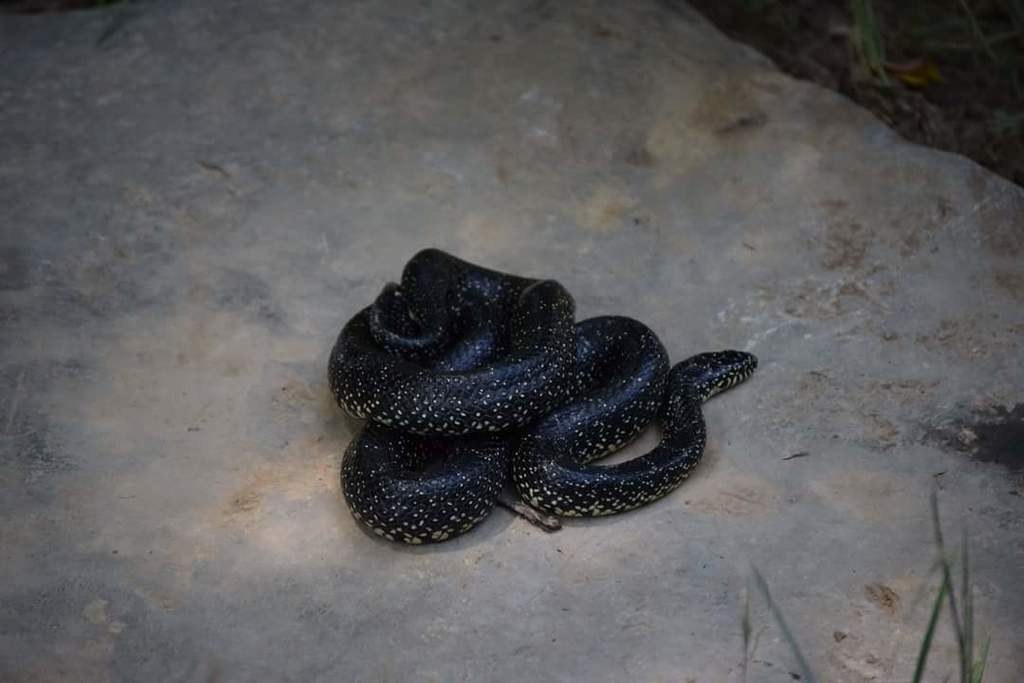
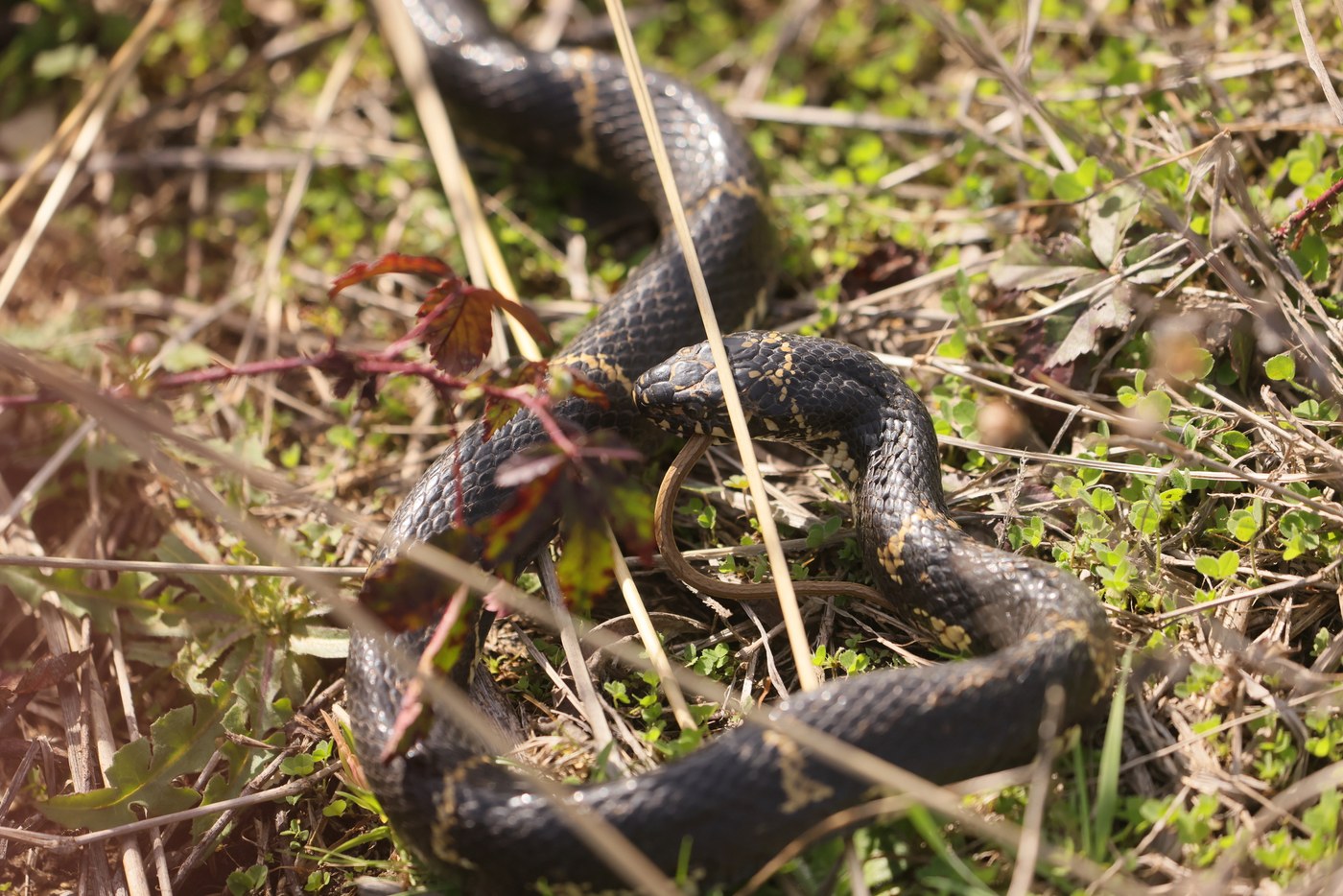
Pattern is the field tell, and it changes mostly by lineage rather than by age. Eastern Kingsnake: solid glossy black to dark brown with narrow yellow or whitish crossbands that link into a chain-link pattern down the back, which is where the names chain kingsnake and chain snake come from. Black Kingsnake: black or dark brown with small scattered white or yellow spots rather than continuous chains. Speckled Kingsnake: black or dark brown with one light yellow speck on nearly every dorsal scale, giving a salt-and-pepper look, though juveniles and some western Missouri adults show a blotched chainlike pattern that fades with age. Desert Kingsnake: black to dark brown with heavy yellow stippling forming a row of dark saddle-shaped blotches, sometimes with a yellowish collar effect near the head. If the pattern does not match the lineage expected in your state, check the range before you check the species.
Scales and head shape hold
The scales and the head shape hold across all four. Dorsal scales are smooth and glossy. The genus name Lampropeltis literally means shiny shield, from the Greek lampros and pelta, and the shine is a genuine field characteristic rather than a decorative fact. The anal plate is single and undivided. The head is comparatively small and not much wider than the neck, which is a real difference from the pit vipers this species gets confused with.
In the Southwest, coral snakes
In the Southwest, the coral snake resemblance is real, documented, and worth knowing how to resolve. The U.S. National Park Service's Fort Bowie National Historic Site page in Arizona states that kingsnakes and coral snakes both occur at the site, that the two species are not closely related, and that the resemblance helps the kingsnake avoid becoming a meal for mammals and birds of prey. That is documented mimicry of a venomous model, not folklore. The tell the Park Service gives: the kingsnake has narrower stripes bordered by black, while the western coral snake has broader stripes with the red stripes bordered by white. The same question applies in parts of the Southeast and South Central range where the eastern coral snake occurs.
Pit vipers, ratsnakes, milk snakes
Copperheads, rattlesnakes, and, in the other direction, ratsnakes and milk snakes. Kingsnakes get called copperheads and rattlesnakes on pattern alone, and the reverse also happens: young ratsnakes and milk snakes get called kingsnakes. This is a genuine two-way misidentification problem, and it runs from the ratsnake side as well. The reliable checks are the ones that do not depend on pattern. A kingsnake has round pupils, no heat-sensing pit between the eye and the nostril, smooth glossy scales, and a head not much wider than the neck. A copperhead or rattlesnake has vertical elliptical pupils, a heat pit, and a head clearly wider than its neck.
How absolute is the venom resistance
The venom resistance is real, and the sources genuinely disagree on how absolute it is. The University of Georgia's Savannah River Ecology Laboratory describes Eastern and Black Kingsnakes as well known for their ability to eat venomous pit vipers such as copperheads and rattlesnakes, and for their resistance to their venom. The U.S. National Park Service goes further and describes kingsnakes as completely immune to the venom of other snakes, and as pound for pound the strongest constrictors in the world. A university herpetology program and a federal agency, using genuinely different strength language for the same underlying claim. The honest framing is highly resistant to pit viper venom, with university and federal sources ranging from resistant to completely immune, rather than a single flat immunity claim. Peer-reviewed toxicology going back to a 1950 serum-neutralization study supports real neutralizing activity in kingsnake blood serum, and the comparative work since then indicates the degree of it varies by kingsnake population and by which venom is tested rather than being uniform across the species.
Shared and regional names
The names are shared and regional, and none of them changes what the animal is. Chain kingsnake, chain snake, and black kingsnake are widely used across the Southeast and South Central states. Carolina kingsnake turns up in the Carolinas. Thunder snake, thunderbolt, thunder-and-lightning snake, wampum snake, and wamper are older Southeastern folk names. Speckled kingsnake is the South Central and Midwest name for the holbrooki lineage, and Oklahoma's and Nebraska's own wildlife agency pages both note that people locally call it a common kingsnake. Desert kingsnake is the Southwest name for the splendida lineage. None of these names points to a venomous animal.
Signs of Infestation
No structural damage to find
There is no structural damage to find, because this species does not cause any. It does not chew wiring, insulation, or wood, it does not burrow into foundations, and it does not nest destructively. No source documents it entering a structure at all, the way rat snakes and watersnakes are documented doing. There is no gnaw pattern, no droppings trail, and no repair to plan for. The sign is the snake, and the only question worth answering is whether it was identified correctly.
The snake, and where you find it
The snake itself, and where you find it, is the primary sign. This is a ground dweller, so look low and look under cover: rotting logs, boards, rocks, debris piles, and the edges of brush. It is also frequently seen crossing open ground during daylight, which is how most homeowners meet one. A shed skin near cover is a secondary sign, the same as with any snake, and it means a snake is using the area rather than that anything is wrong.
A dry buzz names no species
A dry buzzing sound in the leaves does not tell you which snake you have. Disturbed, a kingsnake will vibrate its tail rapidly against leaf litter or dry ground, and the Virginia Herpetological Society documents that the resulting buzz can mimic a rattlesnake even though the kingsnake has no rattle. So the sound on its own will not separate a kingsnake from a rattlesnake. Back off, then use the marks that do not depend on sound: round pupils, no heat-sensing pit between the eye and the nostril, and a head not much wider than the neck.
A musky odor means it was handled
A sharp musky odor means someone picked the snake up. Handled or captured, a kingsnake releases musk from glands at the base of the tail, which the Virginia Herpetological Society documents alongside the tail vibration. If you can smell it, the encounter has already gone further than it needed to. The odor is unpleasant and harmless.
Prevention and When to Call a Pro
It eats venomous snakes
Start with what sets this snake apart: it eats venomous snakes. The U.S. National Park Service states that kingsnakes prey on other snakes, including rattlesnakes, and that they can do so because of two abilities: their resistance to snake venom, described in the identification section above, and exceptional constriction strength. The 2014 study in Herpetologica hosted by the USDA Forest Service found a statistically controlled negative relationship between kingsnake abundance and copperhead abundance across the southeastern United States, consistent with kingsnakes suppressing copperhead populations where kingsnakes are common. That same paper noted localized kingsnake declines across the Southeast for unclear reasons. State wildlife agencies in Oklahoma, Missouri, Tennessee, and New Jersey all give some version of the same guidance: leave a resident kingsnake alone rather than removing it reflexively.
Work on cover and prey
If you want fewer encounters, work on cover and prey, not on the snake. Because this species does not enter structures, exclusion in the pest control sense does not apply here. There are no entry points to seal for this animal. What does work is habitat-level: reduce rodent activity around the property, and remove unnecessary ground debris, log piles, boards, and dense low cover near walkways, doorways, and play areas. That takes away both the food source and the hiding cover, which is the only durable way to reduce sightings.
Check your state rule first
Check your own state's rules before trapping, moving, or handling this snake, because they genuinely differ. Texas requires a Nongame Collection Permit to collect, sell, or exchange nongame wildlife, including reptiles taken from the wild. New Jersey's Department of Environmental Protection lists the Eastern Kingsnake as a species of special concern on its own endangered, threatened, and special concern list, and southern New Jersey is the northeastern limit of the species' range. Those are two state examples, not a national rule, and other states set their own rules. Regulations on trapping, possessing, and relocating native wildlife vary by state and change over time, so verify the current rule where you live before acting, and treat a licensed nuisance wildlife control operator as the safer default over a do-it-yourself trap purchase.
If you are bitten
Clean it and watch it. This species has no venom, and every available source agrees on that with no dissent. A bite can still break skin. The Virginia Herpetological Society notes that many individuals will constrict an arm and chew rather than bite outright when held, while other accounts describe genuine and sometimes repeated bites from a startled or cornered snake. Clean the wound thoroughly with an antiseptic, then watch it for increasing redness, swelling, warmth, or pus, the same guidance that applies to a bite from any other harmless snake.
When to Call a Wildlife Control Operator
The honest answer for a confidently identified kingsnake is that no removal is generally warranted. Call a licensed nuisance wildlife control operator when identification is genuinely uncertain and there is any chance the snake is a venomous look-alike: a coral snake in the Southwest or in the parts of the South Central and Southeast range where the eastern coral snake occurs, a copperhead, or a rattlesnake. Identification uncertainty is by itself a good reason to bring in a professional rather than approach the animal or attempt a do-it-yourself catch and release. And if there is any chance a bite came from a venomous snake, treat it as an emergency and call 911 rather than waiting to settle the identification question.
Frequently Asked Questions
Why is it called a "king" snake?
Because it eats other snakes, including venomous ones. The U.S. National Park Service states directly that the common name is a reference not to the snake's looks but to its diet, the same way the king cobra's name works. Kingsnakes are documented preying on rattlesnakes and rat snakes, killing prey by constriction, and they are unusually powerful constrictors for their size because reptile prey survives interrupted blood flow longer than mammal prey does.
Is a common kingsnake dangerous or venomous?
No. It has no venom and it is not aggressive by nature. Cornered or handled, one may vibrate its tail against leaf litter to produce a buzz that sounds like a rattlesnake despite having no rattle, release a foul-smelling musk, or bite defensively. The Virginia Herpetological Society notes that many individuals will constrict an arm and chew rather than strike when held. A bite carries no venom but can break skin, so clean it with an antiseptic and watch it for signs of infection.
Can a kingsnake really eat a rattlesnake or a copperhead?
Yes. Kingsnakes are documented predators of pit vipers. The University of Georgia's Savannah River Ecology Laboratory describes them as well known for eating venomous pit vipers such as copperheads and rattlesnakes and for their resistance to their venom, while the U.S. National Park Service describes them as completely immune to the venom of other snakes. Those two tier-one sources use genuinely different strength language, so the honest answer is highly resistant rather than a flat immunity claim. Peer-reviewed toxicology going back to a 1950 study confirms that kingsnake blood serum neutralizes pit viper venom, and later comparative work indicates how much it neutralizes varies by kingsnake population and by which venom is tested.
Is a "common kingsnake" the same snake as a "California kingsnake"?
No. A 2009 taxonomic revision published in Zootaxa split the old, single, wide-ranging species into five separate species. California Kingsnake, Lampropeltis californiae, is the distinct western lineage, and it is a separate species. It does not occur in the common kingsnake's South Central, Southeast, Southwest, Midwest, or Northeast range, which is also why Nevada and Utah are not among the common kingsnake's states.
Should I remove a kingsnake I find on my property?
Usually not. It is not a structure-invading species, it causes no property damage, and state wildlife agencies in Oklahoma, Missouri, Tennessee, and New Jersey all recommend some version of leaving a resident kingsnake alone, because of its role controlling both rodents and venomous snakes. Removal is also regulated in some states, so check your local rules first. If you cannot confidently rule out a coral snake, copperhead, or rattlesnake, do not approach the animal. Call a licensed nuisance wildlife control operator and let someone qualified answer the identification question.
Sources
- Systematics of the Common Kingsnake (Lampropeltis getula): the 2009 revision splitting the historic species into five, using mitochondrial DNA, ecological niche modeling, and morphology Pyron & Burbrink, Zootaxa 2241(1):23-32, hosted by Fort Hays State University
- Lampropeltis getula species page: current post-split taxonomy and distribution, including New Jersey, Delaware, Maryland, Virginia, the Carolinas, Georgia, Alabama, Louisiana, and Florida The Reptile Database
- Lampropeltis splendida, Desert Kingsnake: distribution across New Mexico and extreme southeastern Arizona, and niche-modeled suitable habitat The Reptile Database
- Lampropeltis californiae species page: the California Kingsnake as a separate, currently recognized species rather than a subspecies The Reptile Database
- Kingsnakes at Fort Bowie: predation on other snakes including rattlesnakes, venom resistance and constriction strength, the origin of the name, and how to separate a kingsnake from a western coral snake U.S. National Park Service, Fort Bowie National Historic Site
- Copperheads are common when kingsnakes are not: relationships between the abundances of a predator and one of their prey, Herpetologica 70(1):69-76 Steen et al., hosted by the USDA Forest Service Research and Development
- Eastern Kingsnake species profile: size, genus etymology, clutch and egg measurements, incubation, tail vibration, musk release, and nonvenomous bite care Virginia Herpetological Society
- Eastern Kingsnake and Black Kingsnake species account: size records, nonvenomous status, predation on copperheads and rattlesnakes with resistance to their venom, and the Black Kingsnake range north to West Virginia, west to Illinois, and south to northwest Georgia and southeastern Louisiana Savannah River Ecology Laboratory Herpetology Program, University of Georgia
- Speckled Kingsnake field guide entry: Oklahoma range, the alternate name common kingsnake, seasonal shift from daytime to dusk activity, and guidance to leave the snake alone Oklahoma Department of Wildlife Conservation
- Speckled Kingsnake field guide: presumed statewide Missouri occurrence, rocky wooded hillside habitat, blotched-to-speckled pattern change with age, and guidance to leave the snake alone Missouri Department of Conservation
- Speckled Kingsnake species account and range map: Nebraska occurrence, the alternate name common kingsnake, wet prairie and marsh habitat, and the mid-April through early October activity window University of Nebraska-Lincoln, Amphibians, Turtles and Reptiles of Nebraska
- Common Kingsnake species page: Tennessee occurrence of multiple lineages and their intergradation in the western part of the state Tennessee Wildlife Resources Agency
- New Jersey's Endangered, Threatened, and Special Concern Species list: Eastern Kingsnake carried as a species of special concern New Jersey Department of Environmental Protection, Division of Fish and Wildlife
- Nongame and Other Species: the Texas Nongame Collection Permit requirement for collecting, selling, or exchanging nongame wildlife including reptiles taken from the wild Texas Parks and Wildlife Department
- Lampropeltis getula, Common Kingsnake: reproduction, hatchling size and mass, sexual maturity, time to independence, and longevity records Animal Diversity Web, University of Michigan Museum of Zoology
Image Credits
- Image: Robert Harris via iNaturalist. CC BY 4.0.
- Image: allan5519 via GBIF. CC BY 4.0.
License.