Seasonal Timeline
Both species are active by day from spring through fall, with the heaviest caching push in autumn as animals build the food stores that carry them through winter. Timing is set by elevation and snow rather than by the calendar, which matters a great deal here, because a single Colorado mountain can hold sagebrush-basin chipmunks and alpine chipmunks on completely different schedules. Breeding begins within about a week of emergence, whenever snowmelt reaches that elevation. Through winter the animals cycle in and out of torpor rather than sleeping straight through, and some come above ground when the weather is mild.
Both species are active by day from spring through fall, with the heaviest caching push in autumn as animals build the food stores that…
No source publishes region-by-region seasonality for either species. The timing below comes from published biology instead.
Elevation, not the date, is what sets local timing. A study at 3,018 meters in Colorado found males emerging as snow-free ground appeared, and at the height of snowmelt in mid-May, 80 percent of 30 males were in breeding condition and were believed to be the only males that would breed that year. Of 18 females taken at that same peak-snowmelt moment, 4 were already pregnant, 9 were in estrus, and 5 were nonbreeders. Females enter estrus within about a week of emergence, meaning their reproductive organs prepare for breeding while the animal is still sealed in its winter den. In Wyoming, mating ran from 8 April to mid-May with the latest birth on 16 June. Across Colorado as a whole, most breeding is placed from late March to early July, and that wide window is the elevation spread, not sloppy data.
The same logic runs horizontally across the range. Aboveground activity was recorded from 30 April to 17 October in northern Alberta, from mid-April to November in Manitoba, and from mid-March to early November in Wisconsin. Latitude and snow cover set the onset and end of torpor bouts. In the Mountain West that gradient runs vertically instead, up a single mountainside.
Where They're Found
Both animals are outdoor, ground-level residents. No source documents either species nesting inside a structure, in an attic, or in a wall void, which is the single most useful thing a homeowner can know before calling anyone.
Inside the Mountain West, the two species divide the map. Colorado Parks and Wildlife states that the least chipmunk lives over most of the central and western parts of the state and is the most widespread chipmunk in Colorado, while the Colorado chipmunk lives in southern Colorado and northward along the foothills of the Eastern Slope nearly to Wyoming. Colorado holds five chipmunk species in all: Colorado, Hopi, Uinta, cliff, and least. The state's own profile is blunt that chipmunks are not easy to tell apart from each other in the field, which is exactly why the two most likely species are treated together rather than split with a precision the state itself does not claim.
Elevation is where the two really separate. Least chipmunks have been recorded above 3,500 meters, roughly 11,500 feet, and Rocky Mountain National Park runs them from the lowest park elevations to timberline and above. The American Society of Mammalogists species account for Colorado chipmunk states that its elevational range on the eastern slope of the Rockies is more restricted than the least chipmunk's. Where the two occur together, the Colorado chipmunk is the one recognized by its larger size and its affinity for rocky sites rather than wooded ones.
On the ground, look at the cover, not the lawn. Least chipmunk habitat across a huge range has one common element: it is relatively open near ground level. Studies found the species selecting habitat where cover in the first 15 centimeters above the surface was sparse, which allows fast escape from aerial predators. Documented Mountain West specifics include streamside, rock cliff, rock slide, and alpine habitats within the sagebrush, spruce-fir, and pine belts of the Uinta Mountains in Utah and Wyoming; aspen groves and rocky outcrops; and in Nevada's Ruby Mountains a distribution limited only by the absence of sagebrush. Notably, least chipmunks were rarely taken in fir and spruce forest in Colorado. Colorado chipmunk is the coniferous woodland and rock animal of the pair, and at lower elevations in pinyon-juniper woodland it is tied specifically to rock.
The burrow itself is small and easy to miss. In Colorado, entrances dug by least chipmunks averaged 3.7 centimeters across, about an inch and a half, with a standard deviation of 1.1 centimeters across 29 measured entrances, and burrows averaged just 1.3 entrances apiece. Interior chambers run about 15 centimeters across. Around a home the same conditions come from rock walls, retaining walls, boulder and talus edges, woodpiles, brush piles, log heaps, and unbroken shrub or ground-cover plantings running from wild ground straight up to the foundation.
Beyond the Mountain West. Both species range well outside the Mountain West. Least chipmunk runs from west-central Yukon south along the east base of the Rockies and east to Hudson Bay, James Bay, southeastern Ontario, and Michigan's Upper Peninsula, taking in eastern Montana, South Dakota, Minnesota, southern Idaho, eastern Washington, east-central California, southern Nevada, central Utah, northeastern Arizona, and northern New Mexico, with disjunct populations farther south. Colorado chipmunk runs the mountains of Colorado and eastern Utah south to northeastern Arizona and southern New Mexico. The eastern chipmunk, covered on its own page here, is a different genus entirely and does not occur in the Mountain West.
Related Pests
Life Cycle
Neither species hibernates the way the animals people compare them to actually hibernate, and the difference is measurable rather than semantic. A golden-mantled ground squirrel carries heavy fat deposits by late summer and goes under with the first snows. The least chipmunk does not. The American Society of Mammalogists species account states it directly: although some related chipmunks develop fat deposits before becoming dormant in autumn, this one seemingly does not, with Minnesota body fat averaging 4.4 percent of body mass in July and 6.2 percent in October, and Idaho animals rising only from about 2.2 percent in July to about 3.8 percent in November. Because it does not fatten, it must depend in winter on stored food, which it consumes between bouts of torpor, and the timing of those bouts depends on latitude and amount of snow cover.
The federal record says the same thing in plainer language. The species status assessment behind the 2024 endangered listing of the Peñasco least chipmunk describes the species as one that does not develop additional fat deposits in the fall but relies primarily on brief periods of activity to consume cached food for survival over the winter, overwintering with periods of both torpor and activity in special underground chambers. Rocky Mountain National Park describes its own least chipmunks entering a state of torpor from which they occasionally arouse to feed on stored food.
Where the sources disagree. Several otherwise sound sources use the bare word hibernate for both species, including a short professional-society profile for least chipmunk and the standard reference account for Colorado chipmunk, which is paraphrased in current peer-reviewed work as hibernating through the colder months while relying on food gathered the prior autumn and stored in the burrow. Those statements are loose in vocabulary rather than contradictory in substance, because every one of them ties winter survival to cached food instead of body fat. Torpor plus caching is the accurate description, and it is what the two most detailed sources actually describe.

Spring Emergence and Mating
Newborn Nest Young
Juvenile
Adult2
Winter Torpor and Cached Food
Identification
Count the dark stripes
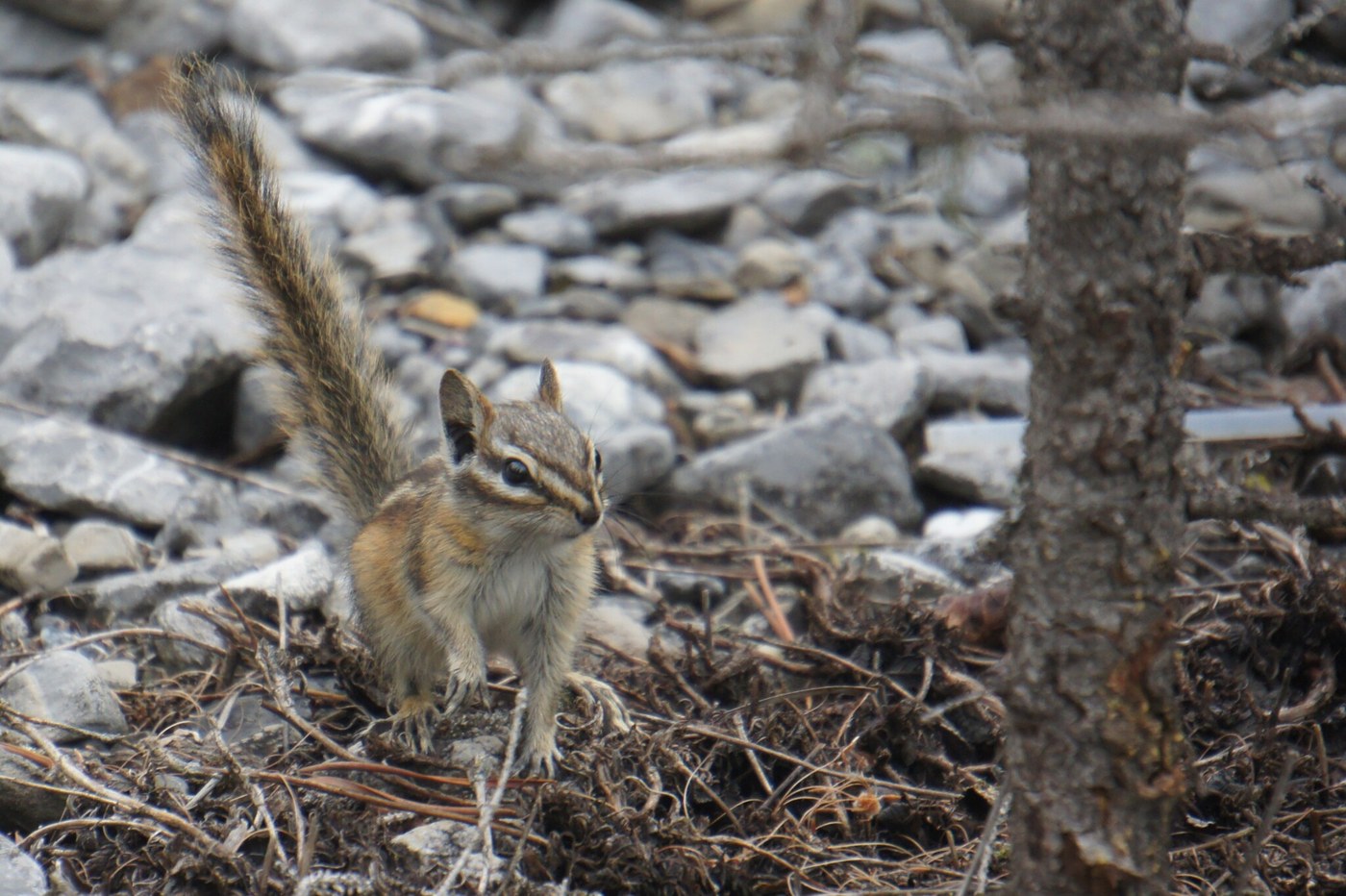
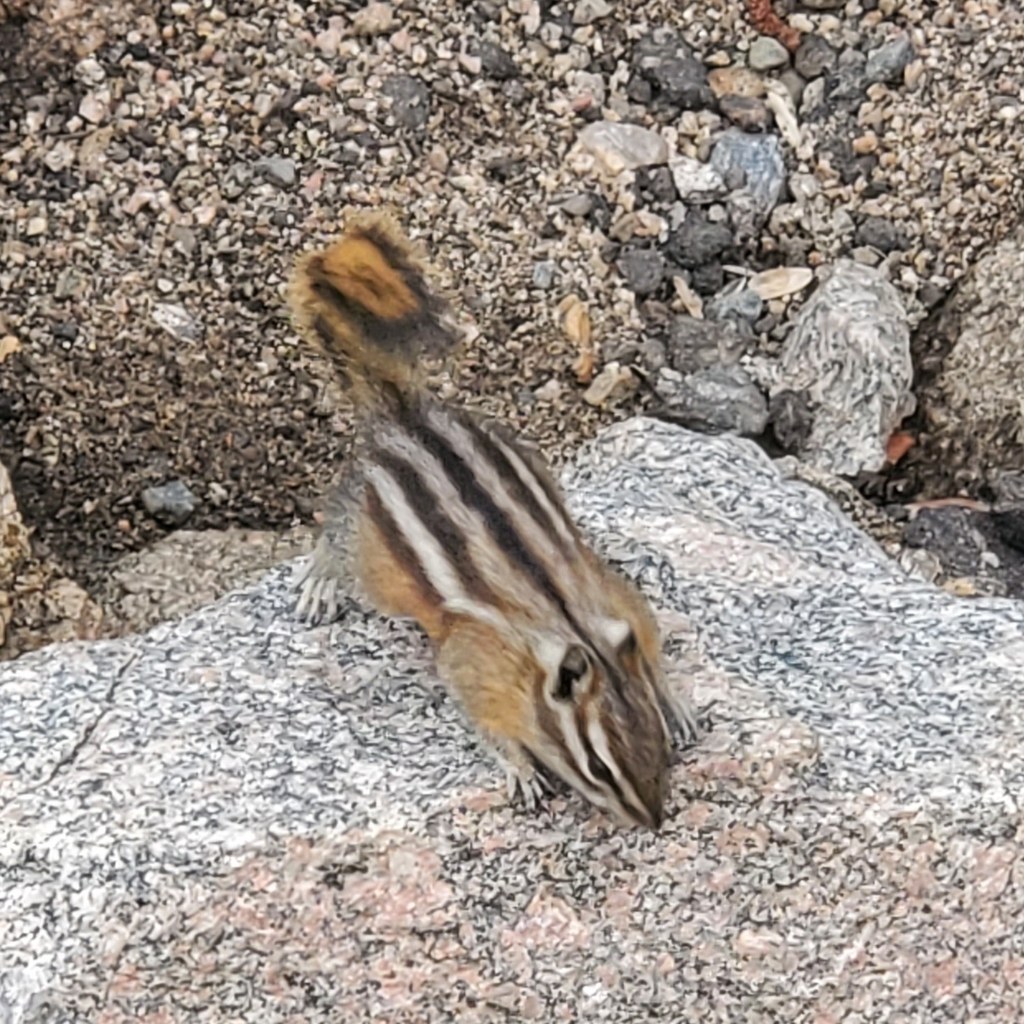
Count them down the back. That one habit settles which of the two you have. Least chipmunk carries 5 dark and 4 light stripes running the length of the back, from the nape to the base of the tail. Colorado chipmunk carries 3 prominent dark dorsal stripes, black with yellowish-orange margins, plus fainter brown outer stripes. The American Society of Mammalogists species account puts the comparison in one sentence: compared with least chipmunk, Colorado chipmunk has bright orange on the shoulders, and has three prominent dark dorsal stripes while least chipmunk has five.
The face separates chipmunks
The face is what separates any chipmunk from the animal it gets confused with. Least chipmunk carries 2 light and 2 dark stripes running from the nose pad to the ear, with the uppermost dark stripe passing straight through the eye. Colorado Parks and Wildlife states the rule from the other direction: chipmunks differ from the other striped squirrels, the golden-mantled and antelope ground squirrels, by having stripes on the face and a more pointed muzzle.
Golden-mantled ground squirrel
It is the look-alike that actually causes trouble out here, and it has no head stripes at all. Its two white side stripes bordered in black stop at the shoulder and never reach the head. It is also larger and heavier-bodied, 9 to 12 inches and 7.4 to 11 ounces, with a shorter tail and a russet to golden mantle over head, neck, and shoulders. Bryce Canyon National Park reduces it to a single line: the primary difference is that the golden-mantled ground squirrel does not have striping around its eyes. A second tell if the animal will not hold still: the ground squirrel is a genuine fat-storing hibernator, so an animal above ground on a mild winter day is far more likely to be a chipmunk.
Size, with real numbers
Least chipmunk is the smallest chipmunk in North America, though its size overlaps other species. Measured Colorado adults ran 184 to 212 millimeters nose to tail tip in the north-central part of the state and 186 to 200 in the south-central part, with tails of 80 to 96 millimeters; Wyoming animals ran 178 to 190 and Utah animals 175 to 200. Mass ranges published across western states run 30 to 54 grams. In inches that is roughly 7 to 8.5 inches long at 1 to 1.9 ounces. Yellowstone gives 7.5 to 8.5 inches and 1.2 ounces. Colorado chipmunk is the larger animal, averaging about 54 grams, and its skull is larger than that of any other chipmunk within its range.
Color runs warm and varies by country
Least chipmunk sides, rump, and thighs range from pinkish buff through clay and brown to a tawny ochre, with a whitish belly, and the animal molts twice a year so summer pelage is brighter than the grayer winter coat. Populations in wetter country run reddish or orange, and populations in dry country are much paler and grayer. Colorado chipmunk's base color is orange, with the bright orange shoulders that name it, a cinnamon head shading to pale drab or smoke gray on the crown, and a fuscous black stripe through the eye.
Tail carriage is a fast behavioral tell
The least chipmunk runs excitedly with its long tail held vertical, and both Yellowstone and the national phenology record list vertical tail carriage as a working field mark. The yellow-pine chipmunk, by contrast, holds the tail more horizontally or angled only slightly upward.
A real limit on precision
The other Colorado chipmunks are a real limit on how precise anyone can be. Uinta, Hopi, and cliff chipmunk all occur in the state alongside these two. Where Colorado and Uinta chipmunk ranges approach each other, the Uinta chipmunk takes the higher life zones, and wherever either occurs alone on a mountain it occupies both the high and low zones. Base color is orange in Colorado chipmunk and brown in Uinta chipmunk. A homeowner cannot reliably split those two in the field, and the state does not claim otherwise, saying outright that chipmunks are not easy to distinguish from each other in the field.
Wyoming ground squirrel
It is the other animal Front Range homeowners mean when they say they have a problem. It is a solid brownish gray with no stripes at all, sits in an upright alert posture, and leaves a real mound of excavated dirt. A chipmunk leaves no mound, because it carries the excavated soil away in its cheek pouches.
A note on the scientific names
You will see both. These two are often printed as Tamias minimus and Tamias quadrivittatus. The federal taxonomic database still carries genus Tamias with Neotamias as a subgenus, and U.S. Fish and Wildlife Service species pages use Tamias. The American Society of Mammalogists' current species database and the 2024 federal listing rule for the Peñasco least chipmunk both use Neotamias, while Colorado Parks and Wildlife's own chipmunk page still lists the genus as Tamias. Both forms mean the same animals. The eastern chipmunk, Tamias striatus, is a genuinely different group rather than a spelling variant, and it does not occur in the Mountain West at all.
Signs of Infestation
A burrow entrance, usually just one
A burrow entrance about an inch and a half across, usually just one of them. Measured entrances dug by least chipmunks in Colorado averaged 3.7 centimeters in diameter across 29 openings, and the burrows averaged only 1.3 entrances apiece. Look under rocks, logs, woodpiles, stone and retaining walls, stairs, patios, and deck edges rather than out in open lawn.
No mound of dirt at the opening
The animal carries excavated soil away in its cheek pouches instead of piling it up, which is the fastest way to rule out a pocket gopher or a Wyoming ground squirrel, both of which leave obvious mounds.
Dug-up bulbs and a fast-emptying feeder
Dug-up bulbs, stripped seed beds, and a bird feeder that empties faster than it should. Recorded single caches held 528.5 grams of seeds and grain, 799.39 grams of acorns, and 465 grams of mixed seed, so one animal moves a serious volume of food. Cached seed sometimes turns up under stumps and logs.
The chipping and clucking calls
Sharp repeated chipping calls, plus a clucking call. Both are daytime sounds, since both species are diurnal. Anything scratching overhead in a ceiling or attic at night is not a chipmunk.
No characteristic odor
No smell-based sign is documented for either species.
One useful negative
Least chipmunks commonly do not respond to lip squeaking, the squeaking noise that brings other chipmunk species out into view. If the trick is not working, that itself is weak evidence for this species.
Prevention and When to Call a Pro
Break the cover corridor
It runs between wild ground and the foundation. Continuous plantings of trees, shrubs, and ground cover that run unbroken from a wood line, rock outcrop, or field edge to the house give a chipmunk a protected travel corridor to the exact ground it will burrow under. Keep vegetation back from sidewalks, driveways, and foundations for the same reason.
Close entry points at the wall
Close entry points at the structure with quarter-inch hardware cloth or caulk. That covers gaps under decks, stairs, and patios, and around foundation penetrations. Quarter-inch mesh is the specified size, not a rounded guess.
Protect bulbs and seed beds
After planting, lay hardware cloth flat on the soil, top-dress it with a thin layer of soil or mulch, and extend the cloth at least one foot past every margin of the planting.
Move the bird feeders
Move bird feeders well away from the house and garden and store the seed in rodent-proof containers. Spilled seed at the foundation is a direct draw onto the exact ground being undermined, and the cache figures above show how much a single animal is capable of hauling.
Site woodpiles away from buildings
Keep them clear of vegetation and field edges as well. Extension guidance notes that chipmunk burrows are difficult to even detect when woodpiles and debris provide enough cover, so a woodpile against the house hides the problem as well as causing it.
Mountain West, mow the dandelions
Mountain West specific: mow the dandelions. At one Colorado study site, dandelion made up roughly 80 percent of the June through August diet, and dandelion flower heads were described as particularly relished. A lawn full of flowering dandelion next to a rock wall is a food source no generic chipmunk page will mention.
Exclusion beats trapping
The toxicant question has a clear answer too. Where populations are high, exclusion is often less expensive than trapping. Fumigants are generally ineffective because the gas is hard to distribute through a complex burrow, and there are no toxic baits registered for chipmunks. Colorado's own toxicant list bears that out: it permits poisons for Richardson's ground squirrel, rock squirrel, thirteen-lined ground squirrel, pocket gopher, marmot, prairie dogs, and most rats and mice, and does not name chipmunks anywhere on it.
Wyoming and Utah are permissive
Wyoming and Utah are the permissive states, and both name the situation precisely. Wyoming Game and Fish Commission Regulation Chapter 52 lists least chipmunk, Neotamias minimus, by name among nongame mammals that may be taken without a permit for personal use, and state guidance separately notes that least chipmunks may be possessed without a permit unless imported. Utah's administrative rule on taking nongame mammals requires a certificate of registration only for a specific list of species that does not include chipmunks, so under that rule they may be taken year-round, without a certificate, and without bag or possession limits.
Colorado is a real gap
Colorado is the gap, and it is a real one. The state's damage-take list names marmots, prairie dogs, pocket gophers, Richardson's ground squirrels, rock squirrels, thirteen-lined ground squirrels, tree squirrels, a generic ground squirrels entry, and various rats, mice, and voles. Chipmunks are not named anywhere on it, and the Colorado State University Extension summary of the same statute and regulations reproduces the list with the same omission. Since the state's own species profile treats chipmunks as distinct from striped ground squirrels, reading them into the ground squirrels line is an assumption rather than a citation. Colorado also allows only live traps for listed species, requires that small game and furbearers taken in live traps be killed or released on site, and permits relocation without a permit only for tree squirrels, cottontail rabbits, and raccoons. If you are in Colorado and planning to trap, call the state wildlife agency before you buy the trap.
One legal fact at the south edge
One legal fact that surprises people at the southern edge of the range. The Peñasco least chipmunk, a subspecies of least chipmunk in the Sacramento and White Mountains of New Mexico, was listed as an endangered species under the Endangered Species Act effective 9 January 2025, with 4,385.94 acres of critical habitat designated in Lincoln County. Two Colorado chipmunk subspecies in southern New Mexico, in the Organ Mountains and the Oscura Mountains, are listed as threatened under that state's own wildlife conservation act. Those populations are geographically tiny and sit outside the Mountain West, but they mean the blanket statement that chipmunks are unprotected is wrong somewhere.
Call once burrowing hits structure
Call a professional once burrowing reaches a structural element rather than the yard. A foundation, a retaining wall footing, or the base of a stair or patio showing settling or gaps is the threshold. So is burrow density high enough that exclusion and habitat changes are not keeping pace, because a conditioned site draws in new animals after the resident ones are removed.
Call public health for dead rodents
Call public health, not pest control, if you find multiple dead rodents on the property. A rodent die-off is the specific condition that pushes hungry fleas onto people and pets in plague country, which is most of the Mountain West. Do not handle dead or visibly sick animals.
Frequently Asked Questions
How do I tell a chipmunk from a golden-mantled ground squirrel?
Look at the face. Chipmunks have stripes on the face and a more pointed muzzle. The golden-mantled ground squirrel's white side stripes bordered in black stop at the shoulder, and it has no head or face striping at all. It is also larger and heavier, 9 to 12 inches and 7.4 to 11 ounces, with a shorter tail and a russet to golden mantle over the neck and shoulders. Bryce Canyon National Park puts it in one line: the primary difference is that the golden-mantled ground squirrel does not have striping around its eyes.
Which chipmunk do I have, least or Colorado?
Count the dark stripes down the back. Least chipmunk has 5 dark and 4 light stripes running from the nape to the base of the tail. Colorado chipmunk has 3 prominent dark dorsal stripes and bright orange shoulders, is the larger of the two, and favors rocky sites over wooded ones where the two overlap. Least chipmunk is the most widespread chipmunk in Colorado and runs from sagebrush basins to above timberline. Colorado chipmunk holds southern Colorado and the Eastern Slope foothills, on a more restricted elevation band.
Do Mountain West chipmunks hibernate?
Not the way a marmot or a golden-mantled ground squirrel does. The least chipmunk does not lay down meaningful fat in the fall; measured body fat rose only from about 2.2 percent of body mass in July to about 3.8 percent in November in one study. It caches food instead, then spends winter cycling in and out of torpor and waking to eat from the cache. How long that lasts depends on latitude, elevation, and snow cover, and animals may come above ground on mild days. Some sources use the bare word hibernate for both species, but every one of them still ties winter survival to cached food rather than body fat.
Can a chipmunk damage my foundation?
It will not chew into the structure, and it will not nest in a wall or an attic. The real risk is burrowing under foundations, patios, stairs, and retaining walls, which can undermine them over time. Any single burrow is small, about an inch and a half across with usually just one entrance, so the risk builds from density across seasons rather than from one hole.
Are chipmunks a disease risk in Colorado, Utah, or Wyoming?
Two documented ones. CDC lists chipmunks among the rodents that plague can affect in the semi-arid West and names Arizona, Colorado, New Mexico, and Utah specifically; a Utah state agricultural pest manual produced with the state university lists chipmunks the same way; and CDC's guidance is to avoid dead or ill animals and never feed squirrels, chipmunks, or other rodents. Chipmunks are also among the main reservoirs for Colorado tick fever virus, which is spread by the Rocky Mountain wood tick between 4,000 and 10,000 feet. In Rocky Mountain National Park, that virus was isolated from 31 of 169 least chipmunks examined, 18.3 percent, and 37.9 percent carried antibodies, with the highest infection rate in July.
Can I trap and relocate a chipmunk myself?
It depends on the state, and Colorado is the strict one. Wyoming names the least chipmunk explicitly among nongame mammals that may be taken without a permit. Utah allows take of chipmunks year-round without a certificate of registration and without bag limits. Colorado's damage-take list does not name chipmunks at all, allows only live traps for listed species, and permits relocation without a permit only for tree squirrels, cottontail rabbits, and raccoons. In Colorado, call the state wildlife agency before you trap.
How long do these chipmunks live?
Not long. The average life span of male and female least chipmunks combined, drawn from a long-running study population followed for 22 years, was 0.66 years. The maximum recorded was 6 years 4 months, and that was a captive animal. Longevity for the Colorado chipmunk has not been reported. That short average is worth knowing before paying for removal, because the resident population turns over on its own faster than most people assume, while the habitat conditions that attracted it do not.
Sources
- Chipmunks species profile: the five Colorado chipmunk species, the least chipmunk as most widespread, the Colorado chipmunk's southern and Eastern Slope foothill range, the face-stripe rule against golden-mantled and antelope ground squirrels, diet, and general litter figures Colorado Parks and Wildlife
- Common Human-Wildlife Conflict Species: the damage-take species list that does not name chipmunks, the toxicant-permitted species list, live-trap restrictions, and the three species that may be relocated without a permit Colorado Parks and Wildlife
- Squirrels and Chipmunks: least chipmunk size, five back stripes with two extending onto the head, elevation from the lowest park elevations to timberline and above, torpor with periodic arousal to feed on stored food, and the golden-mantled ground squirrel comparison including its fat deposition National Park Service, Rocky Mountain National Park
- Least Chipmunk: size of 7.5 to 8.5 inches at 1.2 ounces, the golden-mantled ground squirrel comparison, vertical tail carriage, chipping and clucking calls, and the note that it hibernates but stores food and probably arouses frequently National Park Service, Yellowstone National Park
- Golden-mantled Ground Squirrel: 9 to 12 inches at 7.4 to 11 ounces, stripes that do not extend onto the sides of the head, and hibernation from October to March or April National Park Service, Yellowstone National Park
- Golden-mantled Ground Squirrel and Uinta Chipmunk: the primary difference being that the golden-mantled ground squirrel does not have striping around its eyes National Park Service, Bryce Canyon National Park
- Tamias minimus, Mammalian Species No. 653: stripe counts on dorsum and face, state-by-state measurements including Colorado and Wyoming, mass ranges, the finding that this species does not develop autumn fat and depends on cached food consumed between bouts of torpor, Colorado breeding and litter data, burrow entrance dimensions from Colorado, home range and density, diet composition including the dandelion figure, cache masses, the 0.66-year average life span, and the Colorado tick fever isolation rate from Rocky Mountain National Park American Society of Mammalogists, Verts and Carraway 2001, hosted by Smith College
- Tamias quadrivittatus, Mammalian Species No. 466: the three-versus-five dark dorsal stripe diagnosis against least chipmunk, bright orange shoulders, larger skull than any chipmunk in its range, larger ears and hind feet, rocky rather than wooded site affinity where the two co-occur, the more restricted elevational range on the eastern slope, and the Uinta chipmunk comparison American Society of Mammalogists, Best, Burt and Bartig 1994
- Endangered Species Status for the Peñasco Least Chipmunk and Designation of Critical Habitat, Final Rule, 89 FR 99656, effective 9 January 2025, and the supporting species status assessment describing the absence of autumn fat deposition and overwintering with periods of both torpor and activity U.S. Fish and Wildlife Service
- Least Chipmunk species profile: appearance and stripe conspicuousness, regional color variation, vertical tail carriage against the yellow-pine chipmunk, open-near-ground habitat requirement, variable winter dormancy by latitude and elevation with periodic waking to feed on stored food, Colorado breeding from late March to early July, litters of 3 to 8, and emergence of young at about one month USA National Phenology Network, Nature's Notebook
- Nuisance Wildlife Laws in Colorado: the statute 33-6-107(9) damage-take species list, live-trap-only restriction, relocation limited to tree squirrels, cottontail rabbits and raccoons, and the toxicant-permitted species list Colorado State University Extension, Boulder County
- Administrative rule R657-19, Taking Nongame Mammals: species requiring a certificate of registration, and the provision that all nongame mammals not on that list may be taken without a certificate, year-round, and without bag or possession limits Utah Division of Wildlife Resources
- Chapter 52, Take of Nongame Wildlife from within Wyoming: least chipmunk, Neotamias minimus, named in the list of mammals that may be taken without a permit for personal use Wyoming Game and Fish Department
- Chipmunk and Ground Squirrel Ecology and Damage Management, G3997-011: quarter-inch hardware cloth exclusion, the one-foot hardware cloth margin for bulbs and seed beds, the unbroken-planting cover corridor, bird feeder and woodpile placement, exclusion being less expensive than trapping at high densities, ineffectiveness of fumigants in complex burrows, and the absence of any toxic bait registered for chipmunks University of Wisconsin-Madison Division of Extension
- Colorado Tick Fever Virus, Transmission: Dermacentor andersoni as the vector, the 4,000 to 10,000 foot elevation band in the western United States and western Canada, and small rodents such as squirrels, chipmunks and mice as the most important reservoirs Centers for Disease Control and Prevention
- How Plague Spreads, and Plague Ecology in the United States: chipmunks named among the animals plague can affect, and the semi-arid grasslands and scrub woodlands of Arizona, Colorado, New Mexico and Utah named as the core focus Centers for Disease Control and Prevention
- Human Plague, United States, 2015, MMWR: the guidance to avoid direct contact with ill or dead animals and never feed squirrels, chipmunks, or other rodents, and to reduce rodent habitat around the home Centers for Disease Control and Prevention
- Vertebrate Animal Pest Control Study Manual: sylvatic plague transmission through fleas and burrowing rodents, with chipmunks named among affected wildlife, and the treatment of nonprotected nongame species Utah Department of Agriculture and Food with Utah State University Extension
- Microhabitat selection by the Oscura Mountains Colorado Chipmunk, Journal of Mammalogy 105: the Colorado chipmunk's association with coniferous woodland and with rock at lower pinyon-juniper elevations, its reliance on autumn-cached food stored in burrows, and the New Mexico state threatened listing of the Oscura Mountains subspecies Journal of Mammalogy, O'Connell and Frey 2024
- Burrowing animals: Determining species by burrows and damage, fact sheet 6.521: Wyoming ground squirrel appearance and elevation band, and the mound-versus-no-mound distinction among Colorado burrowing rodents Colorado State University Extension
- Tamias quadrivittatus, Animal Diversity Web: average mass of about 54 grams, three median dark dorsal stripes with yellowish-orange margins and brown outer stripes, ponderosa and mixed coniferous habitat, litters of 2 to 7, and the note that longevity has not been reported University of Michigan Museum of Zoology