Seasonal Timeline
Chipmunks are active by day from spring through fall, with the heaviest foraging and caching push in early autumn as animals build up the food stores that carry them through winter. They do not disappear once the weather turns. Through winter, individuals cycle in and out of torpor rather than staying in one continuous dormant state, and some stay active above ground on mild winter days. Emergence from winter dormancy is commonly placed around early March.
Chipmunks are active by day from spring through fall, with the heaviest foraging and caching push in early autumn as animals build up the…
No local seasonality records exist for this species, so the seasonal picture rests on published biology rather than on observed activity. That biology is consistent everywhere the species is found: spring and fall are the two visible activity peaks, and winter is a dormant-but-not-absent period built on cached food rather than body fat.
Where They're Found
Eastern chipmunks are entirely outdoor animals of open deciduous and mixed forest, favoring mature oak and beech-maple woodland, timbered edge rather than deep unbroken forest, wooded banks, log heaps, brush piles, and stone or rock walls. Around a home, foundation plantings, ornamental shrub beds, woodpiles, retaining walls, and stone walls next to the house provide the same cover and burrowing conditions the species uses in the wild. Burrows sit less than about 3 feet below the surface, with interconnected tunnels reported anywhere from roughly 10 to 30 feet long, and entrances run about 2 inches across with no obvious mound of excavated soil, since the animal carries loose dirt away in its cheek pouches instead of piling it at the opening.
Documented range runs from Nova Scotia west to Saskatchewan and south to eastern Oklahoma, and includes eastern Louisiana and the Florida Panhandle. The species is absent from peninsular Florida and from the Atlantic coastal plain running from Florida up through North Carolina, so its Southeast presence is concentrated inland and toward the northern part of the region rather than spread evenly across it. No established population has been documented in Alaska or Hawaii.
Related Pests
Life Cycle
This species does not truly hibernate, and that distinction changes what to expect of it in winter. Rather than building fat reserves the way a hibernating woodchuck does, the eastern chipmunk caches food all summer and fall and spends winter cycling through torpor, a lowered-metabolism dormant state, waking every few days to feed from its cache and eliminate waste before returning to torpor. On mild winter days some individuals emerge above ground. State wildlife agency sources describe this as genuinely variable between individuals, some nearly dormant all winter, some active only in mild weather, some active through most of the season, rather than a fixed schedule. One extension source describes the species simply as hibernating. The more precise torpor description is better supported across sources, and it is the one to trust.

Mating
Newborn (Nest) Young
Juvenile
Adult
Signs of Activity
Identification
Size
Body roughly 5 to 6 inches with a 3 to 4 inch tail, for a nose-to-tail-tip total most commonly cited at 8 to 10 inches, some sources reporting up to 12 inches. Weight 2 to 5 ounces.
Color and pattern
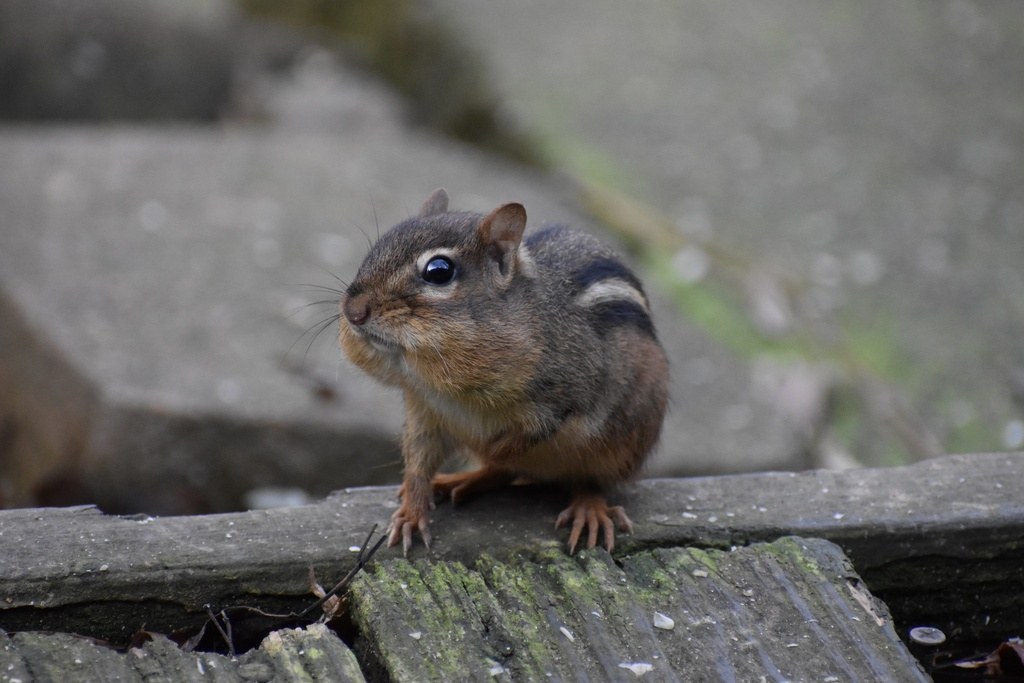
Grizzled reddish-brown upperparts with a yellowish to reddish-brown patch on the rump, white to buff underside, and five dark stripes running down the back separated by tan or whitish stripes, plus a light and dark stripe on each side of the face. The back stripes stop before the rump patch rather than continuing to the base of the tail.
Cheek pouches
Cheek pouches are a genuine field mark when visible, expandable pouches on either side of the mouth used to carry food back to the burrow. The genus name Tamias literally means "a storer."
Tail carriage is a fast behavioral tell
When alarmed, a chipmunk holds its tail upright, unlike a ground squirrel, which typically carries the tail low and horizontal while running.
The thirteen-lined ground squirrel
The look-alike that matters most in shared range is the thirteen-lined ground squirrel, not another chipmunk. The ground squirrel's back shows broken rows of light spots and dashes rather than the chipmunk's solid, continuous stripes, and it has no facial stripes at all.
In the far northern Midwest
Where ranges overlap in the far northern Midwest, in Minnesota, Wisconsin, and Michigan's Upper Peninsula, the least chipmunk (a different genus, Neotamias minimus) is the real look-alike. It is noticeably smaller, and its back stripes, including the dark middle stripe, run all the way from the crown of the head to the base of the tail, while the eastern chipmunk's stripes stop short of the rump patch. The two species also tend to split habitat where they overlap: eastern chipmunk favors oak woodland, least chipmunk favors conifer forest.
Red squirrel
Red squirrel is ruled out by build alone: no back stripes, a noticeably bushier tail, and far more time spent in trees than on the ground.
Gray squirrels, at any age
Gray squirrels of any age, including juveniles, are a quick visual mismatch rather than a real identification puzzle: they carry no back or face stripes at all and have a large, bushy gray tail, while every chipmunk life stage past the nest keeps the full striped pattern.
Signs of Infestation
Small burrow entrances
About 2 inches across. Unlike a mole or vole hole, there is no obvious mound of excavated soil at the opening, since the chipmunk carries loose dirt away in its cheek pouches instead of piling it up.
Chewed bulbs and seeds
Chewed or missing garden bulbs and seeds, and occasional gnawed bark on young shrubs, where a burrow system runs through or near a planted bed.
The chip call
A sharp, repeated chip or chuck-chuck-chuck call, and a distinctive high, trilling wee sound reported as a response to a perceived threat. Both are daytime sounds, matching the species' diurnal activity pattern.
No characteristic odor
No smell-based sign is documented for this species.
Prevention and When to Call a Pro
Break the cover connection
It runs between wooded areas and the foundation. Continuous plantings of ground cover, shrubs, and trees running unbroken from a wood line to the house give chipmunks the same protected travel corridor they use in natural habitat. An open, unplanted strip between the two removes that corridor.
Seal the entry points
Seal likely entry points at the structure itself. Close gaps into crawl spaces and the areas under decks, stairs, and patios, and around foundation penetrations, using 1/4-inch hardware cloth or caulk. Open downspouts are a specific, documented entry point, so gutter guards and downspout covers matter here too.
Protect bulbs and seed beds
Cover planted bulbs and seed beds with 1/4-inch hardware cloth extending at least 1 foot past the planted area on every side, then cover the cloth itself with soil or mulch.
Move the bird feeders
Move bird feeders away from the house. Place feeders at least 20 to 30 feet from the building and use squirrel guards on feeder poles. Spilled seed near the foundation is a documented food draw that keeps chipmunks working the exact ground they are burrowing under.
Confirm a burrow is empty
Sealing an occupied one is the mistake. Once activity at an entrance has clearly stopped for a period, fill it with soil and cap it with a rock or paver so it is not easily reopened.
When to Call a Pest Control Professional
Bring in a licensed nuisance wildlife or pest control operator once burrowing is undermining a structural element itself, a foundation, a retaining wall footing, or a stair or patio base showing settling or gaps, rather than just cosmetic yard damage, or once burrow density is high enough that exclusion and habitat changes alone are not keeping pace. If trapping and relocation come up, checking current state wildlife regulations first is the safer path, since rules on relocating trapped wildlife vary by state and change over time; a licensed operator is the simpler default for anyone unsure of the current local rules.
Frequently Asked Questions
Do chipmunks actually hibernate?
Not in the true sense. They do not build fat reserves the way a hibernating woodchuck does. Instead they cache food and enter torpor, a multi-day lowered-metabolism dormant state, waking periodically through winter to eat from their stores before going back into torpor.
Can chipmunks damage my house's foundation?
They do not chew into a structure the way a rodent pest does, but their burrowing under foundations, patios, stairs, and retaining walls can undermine those structures over time, which is the real property risk with this species.
How do I tell a chipmunk from a similar-looking ground squirrel?
Look at the back pattern and the tail. A chipmunk has solid, continuous stripes down its back and face and holds its tail upright when alarmed. A thirteen-lined ground squirrel shows broken rows of spots and dashes rather than solid stripes, has no facial stripes, and carries its tail low.
Are chipmunks dangerous to have around, disease-wise?
Rabies risk is essentially negligible. Small rodents including chipmunks are almost never found rabid and are not considered a documented rabies-transmission risk to humans. Direct handling is still not recommended, since wild rodents in general can carry fleas capable of transmitting plague in some parts of the country.
How many chipmunks might be living around my property?
An individual's home range runs from roughly a fifth of an acre up to a bit over an acre, and one regional source documents 2 to 4 animals sharing a single acre depending on available food and cover, so more than one active burrow system on a typical residential lot is common.
Will trapping just remove the problem for good?
Not reliably on its own. Sealing entry points and removing the cover connection to nearby woods is described as more cost-effective than trapping, especially where more than one chipmunk is present, because open habitat and easy foundation access will simply draw in new animals after trapped ones are gone.
Sources
- Tamias striatus (eastern chipmunk) Animal Diversity Web, University of Michigan Museum of Zoology
- Chipmunks Internet Center for Wildlife Damage Management (University of Nebraska-Lincoln / USDA APHIS Wildlife Services)
- Chipmunks Cornell Cooperative Extension, Rockland County
- Chipmunk Damage Prevention and Control Methods Internet Center for Wildlife Damage Management (University of Nebraska-Lincoln / USDA APHIS Wildlife Services)
- Eastern Chipmunk Missouri Department of Conservation
- Chipmunk Minnesota Department of Natural Resources
- Controlling Nuisance Chipmunks (G9527) University of Missouri Extension
- Eastern Chipmunk, Living with Wildlife Indiana Department of Natural Resources
- Eastern Chipmunk (Tamias striatus) U.S. Fish & Wildlife Service
Image Credits
- Image: northerly via iNaturalist. CC BY 4.0.