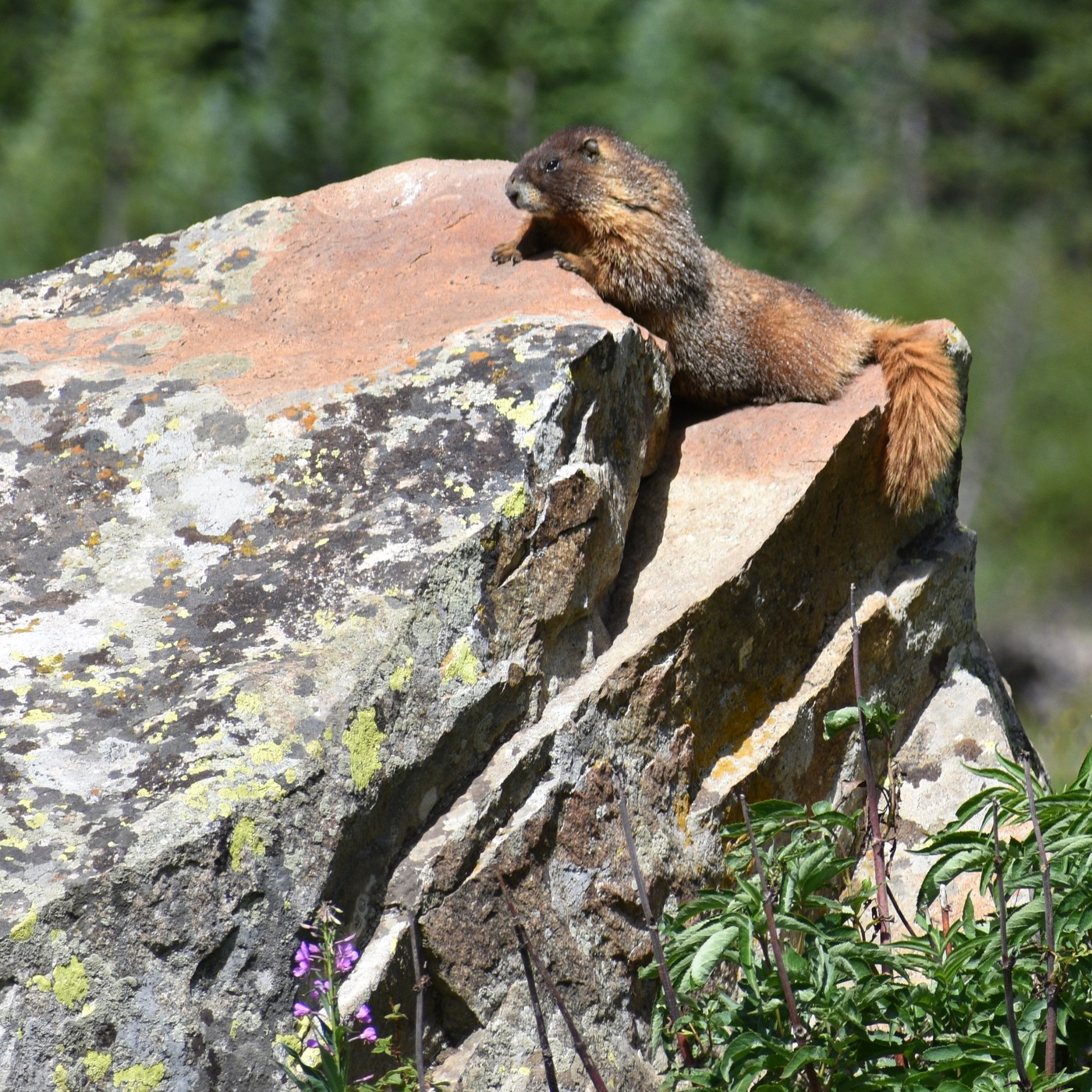
Seasonal Timeline
Yellow-bellied marmots are underground and hibernating for most of the year, roughly 7 to 8 months, and the calendar shifts hard with elevation. High Rocky Mountain colonies go under in September or early October and do not surface again until April or May. Lower and more northerly populations, such as those in central Oregon, can be out by the last week of February. Everything else, breeding, birth, and fattening, is compressed into the short active window in between.
Yellow-bellied marmots are underground and hibernating for most of the year, roughly 7 to 8 months, and the calendar shifts hard with…
The hibernation is the fact that explains this animal. Washington's state wildlife agency states that marmots go without eating or drinking for seven to eight consecutive months, fall to late spring. A peer-reviewed hibernation study built on the Colorado research colony puts it the same way, 7 to 8 months per year, with torpor accounting for 88.6 percent of that period and an average energy saving of 83.3 percent against a fully active adult. Animal Diversity Web gives about eight months, early September to May. The National Park Service, describing its Rocky Mountain National Park colonies, says animals enter their burrows in September to early October and do not emerge again until the following April or May, and that they spend over half their lives in hibernation.
One number does not fit. The Rocky Mountain Biological Laboratory's own public announcement about its Colorado marmots describes the same population's hibernation more loosely as about five months. That figure sits well outside the 7 to 8 month range given by every scientific and state agency account, including the peer-reviewed study built on that exact population. The most likely explanation is that a general-audience press release rounded a technical figure rather than that two bodies of research disagree. Treat 7 to 8 months as the working figure and the five-month statement as an outlier, because anyone who finds both should know the discrepancy exists.
Elevation, not the calendar date, is what actually sets local timing. Central Oregon animals surface in a strict order, adult males first, then adult females, then yearling females, then yearling males, in the last week of February or the first week of March. Colonies at 9,500 feet in Colorado may still be sealed in through April. A study of juveniles at the Colorado site measured an average hibernation of 229.6 days, about 7.5 months, and survivors came out having lost an average 32 percent of their body mass at about 2.3 grams a day. That is the reason autumn weight matters so much to this animal, and the reason its entire active season reads like a race.
Where They're Found
Yellow-bellied marmot is a western mountain animal. Its range covers four regions: Mountain West, Pacific Northwest, California, and Southwest.
Mountain West is the core of the range. Colorado Parks and Wildlife calls it the largest of the Colorado ground squirrels and puts it from as low as 1,600 meters, about 5,400 feet, to over 4,300 meters, about 14,000 feet. Federal range accounts run the species from western Montana south to northern New Mexico, taking in Wyoming's montane and basin country, and Montana's own natural heritage program has built a predicted suitable habitat model specifically for it. Idaho's wildlife classification appendix lists the species by name and binomial as unprotected wildlife, and active colonies have been documented in the Frank Church River of No Return Wilderness in the center of the state.
Pacific Northwest. Washington's Department of Fish and Wildlife runs its own species page, describing the marmot as common at low elevations in central and eastern Washington. Oregon's Department of Fish and Wildlife is more precise still: the species occurs in suitable habitat east of a line connecting Mount Hood in Hood River County and Mount Mazama in Klamath County, except for the Columbia Basin.
California. The state's own wildlife habitat relationships account calls it common and widespread in or near rocky areas in the Sierra Nevada, the Cascades, and the White Mountains. The Mineral King area of Sequoia National Park, in the southern Sierra Nevada, is the single most documented site in the country for the vehicle-damage behavior described below.
Southwest, with one state deliberately left off. Nevada's Department of Wildlife runs a species page listing the marmot as unprotected and non-game, and a Great Basin distribution study documented 62 marmot burrow sites across 18 Nevada and Utah mountain ranges. Utah is confirmed through a university extension account citing the state's own wildlife division listing. New Mexico holds the literal southern edge of the entire species range, in the San Juan and Sangre de Cristo Mountains, and a 2019 peer-reviewed paper documented a small, isolated, relict population newly confirmed in the Jemez Mountains. NatureServe ranks the species imperiled in New Mexico alone, purely because that southern-edge distribution is so limited and so fragmented. Arizona is not claimed here. A federal account notes that NatureServe did not provide an Arizona ranking even though the state also sits at the southern range edge, which hints at presence without establishing it, and no state agency page, specimen record, or occurrence study confirms Arizona. Rather than round the map off, Arizona stays an open question.
Two absences are confirmed. No record places this species in Alaska. Alaska's own marmot is a genuinely different animal, the Alaska marmot of the Brooks Range, and the two should not be conflated. Hawaii has no marmot of any kind. Every range description found for this species is confined to the mountains and semi-arid basins of western North America. Northward, the range runs on into southcentral British Columbia and Alberta.
On the ground, look at the rock, not the field. Marmots occupy vegetated slopes and rock outcrops in meadows, using the rock for shelter, for sunning, and as an observation post. California's account is blunt about the preference: rocky outcrops and talus slopes with grasses and forbs nearby. A Great Basin habitat study found them concentrated in rocky meadows on well-drained slopes between roughly 6,900 and 9,800 feet, with burrows dug into talus, talus-like rock piles, or clusters of massive boulders, and attributed the species' patchy regional distribution directly to the absence of suitable rocky substrate next to succulent vegetation. The burrow itself follows the rock: the main entrance drops about 2 feet and runs 12 to 14 feet horizontally into a hillside, with short branch tunnels connecting to other burrows. Elevation substitutes for latitude across the range, which is why southern populations sit on a series of isolated montane islands with unsuitable valley ground in between.
Life Cycle
One litter a year, and the whole reproductive calendar hangs off the emergence date. Breeding is concentrated in the first one to two weeks after animals come out of hibernation, timed to green forage becoming available, so a colony that surfaces in late February breeds in a different month than one that surfaces in May. Gestation is about 30 days and is consistent across published accounts.
A note on the numbers above. Litter size is reported as 3 to 8 across sources, with means clustering between 4.1 and 4.32. One state profile rounds it to approximately five offspring, California gives usually 4 to 6, and the 32-year Colorado demographic study measured a mean of 4.1 with no meaningful difference across female age classes. The supported figure is 3 to 8 averaging about 4, rather than a blend nobody actually measured. Size is treated the same way: published ranges run roughly 18 to 28 inches and 3 to 11 pounds, with the most granular breakdown giving males an average of about 8.6 pounds against 6.2 pounds for females.
The long-term record behind these figures is unusual. The colony at the Rocky Mountain Biological Laboratory in Gothic, Colorado has been followed by researchers for decades, a record begun by Kenneth Armitage and continued by Daniel Blumstein, which is what makes a 32-year demography of a wild rodent possible at all. That study found no litters at all from females over age 10.

Pup
Weanling
Yearling
Adult
Identification
Rock chuck is the same animal
So is whistle-pig. The National Park Service lists yellow-bellied marmot, rockchuck, and whistle-pig together as common names for the species. Whistler is a fourth. All four refer to Marmota flaviventris.
Woodchuck is not one of its names
Woodchuck is not one of those names, and the correction runs one direction only. The National Park Service states it plainly: the yellow-bellied marmot is often called a woodchuck, which is incorrect. A woodchuck can be called a marmot, because it is one. A marmot cannot be called a woodchuck, because woodchuck refers specifically to Marmota monax, a genuinely different species. The two do not share a region.
Size runs a real range
Males are the heavier sex. Published figures span roughly 18 to 28 inches total length including a 5 to 8 inch tail, at 3 to 11 pounds. The most detailed breakdown available gives males an average of about 8.6 pounds, range 6.5 to 11.5, against females at about 6.2 pounds, range 3.5 to 7.9. The large body itself is described by the National Park Service as an adaptation to the cold, high-elevation sites these animals live in.
The yellow belly is the name and the tell
Grizzled brown to yellowish-brown fur with white-tipped guard hairs that give a frosted look, a yellow to reddish-yellow belly and chest, a white patch between the eyes and the nose, dark brown to blackish feet, and a dark bushy tail. No color difference between the sexes is documented, only the size difference above.
A rock-adapted build
The build is short-legged and rock-adapted rather than field-adapted. Heavy-bodied with a short broad head and small round fur-covered ears, on short powerful legs suited to climbing rock and talus. That is a meaningful contrast with a groundhog's open-ground digging build, and it is why habitat is such a reliable identifier for this species.
The whistle identifies it without a sighting
A sharp piercing alarm call from a sentry animal, given to warn a colony of an approaching predator so members can reach the nearest burrow entrance. It is the origin of both the whistle-pig and whistler names, and it is documented independently by the National Park Service and Washington's state wildlife agency.
Hoary marmot, and the ranges overlap
Hoary marmot is the one genuine look-alike, and the ranges really do overlap. The two species share a small area in northwestern Montana and western Washington, and hoary marmot presence can actually suppress yellow-bellied marmot distribution where both compete for the same subalpine and alpine ground. The practical tell inside that overlap: hoary marmot is larger, carries a grayer, frosted head and shoulders instead of a yellow belly, and holds the higher, more northerly terrain. Yellow-bellied marmot is the smaller, warmer-colored, lower-elevation animal of the pair.
A note on the scientific name
A small note on the scientific name, in case you see both spellings. Every state wildlife agency uses Marmota flaviventris, which is the name used above. The taxonomically current spelling, reflecting a correction to the original 1841 description, is Marmota flaviventer, and it appears in some current scientific literature. Both refer to the same animal.
Signs of Infestation
Burrows set into rock
Burrow entrances set into rock, not into open ground. Look at talus slopes, boulder piles, and vegetated rock outcrops in meadows rather than at fields and lawn edges. The main entrance drops about 2 feet and runs 12 to 14 feet horizontally into the hillside, with short branch tunnels linking to neighboring burrows.
A worn perch on a nearby boulder
A well-worn observation perch on a boulder near the entrance. Marmots use the rock for sunning and for sentry duty, so the flattest, most exposed rock next to a burrow tends to show visible wear and repeated use.
Several animals rather than one
Colonies run 10 to 20 individuals. Repeated sightings of multiple animals working the same slope are normal for this species, and are one of the fastest ways to tell it apart from the solitary burrow system a groundhog leaves.
A piercing whistle from a rock above you
That is a sentry, and it means the colony has already seen you. It is the most reliable audible sign for this species.
Chewed hoses in a parked vehicle
Chewed radiator hoses, wiring, and insulation in a parked vehicle. This is the property sign that actually costs money, and it is covered in full below. A check-engine light after a day parked at a high-elevation trailhead is worth taking seriously.
Do not expect foundation damage
What you should not expect to find is foundation damage. Yellow-bellied marmot is not documented undermining foundations, sidewalks, or farm equipment the way a groundhog does. The burrowing is anchored in rock and talus rather than open, cultivated, or paved ground, which appears to be exactly why that risk does not carry over.
Prevention and When to Call a Pro
Protecting a parked vehicle
It is the single most important step with this animal, and the guidance is the National Park Service's own. Sequoia and Kings Canyon National Parks states it directly: from spring through mid-summer, the marmots of Mineral King have been known to dine on radiator hoses and car wiring, and they can disable a vehicle. Attraction is driven by the scent of coolant and wire insulation specifically, not by food odor generally, which is why a spotless car interior does nothing to help.
Wash the vehicle before you go
Undercarriage and engine compartment included. That is the step that removes the scent doing the attracting, and it is the first thing the park asks visitors to do.
Block access with a tarp
Block access physically, with a tarp rather than wire. The park's method is to drive over a large tarp and wrap it up and around the entire vehicle, covering the wheel wells. Chicken wire used to be the recommendation and is no longer advised, in the park's own words, because marmots have learned to get around the wire.
Inspect before you start it
Inspect the engine compartment before you start the vehicle, not after. Check hoses, belts, electrical wiring, insulation, and radiator fluid level, and look for signs of coolant or brake fluid leaking. There is a second reason to look: the park notes that on several occasions marmots trapped in an engine compartment have ridden along with unsuspecting drivers as far as southern California.
Use only non-toxic deterrents
That holds around vehicles and campsites. The park is explicit that no poison or substance posing a risk to human, animal, or environmental health may be used for this.
Keep food sealed at trailheads
That includes campgrounds. Marmots at busy sites become conditioned to human presence, and ordinary backcountry food storage practice, sealed containers and nothing left accessible in a pack or a vehicle interior, reduces both general nuisance behavior and the vehicle problem. This one is a reasonable extension of the vehicle guidance rather than a separately documented recommendation.
No reliable fencing spec exists
There is no reliable fencing specification for this animal. No homeowner-level fencing spec is documented for yellow-bellied marmot, unlike the detailed dimensions available for groundhog. That is consistent with the fact that structural burrowing is not a documented risk for this species. Borrowing a spec built for a different animal would be worse than leaving the gap visible.
Where you park matters most
Where you park matters more than how high you are. Yellow-bellied marmots live across a wide elevation band, from about 5,400 feet in Colorado to over 14,000 feet, and Washington's wildlife agency describes them as common at low elevations in the central and eastern part of that state, so there is no elevation below which the vehicle problem can be ruled out. The documented chewing damage is concentrated at high-elevation trailheads and campgrounds, which is where the risk is highest.
Colorado is clear and permissive
Colorado is the clearest legal picture, and it is permissive. Colorado Parks and Wildlife lists marmots by name among the species a landowner or their agent may hunt, trap, or take without a permit on land experiencing damage, alongside coyotes, badgers, and jackrabbits, and separately permits toxicant use on private property under its own wildlife commission regulation. A 2021 petition asking the commission to set yellow-bellied marmot bag limits was formally reviewed and denied, so this is a restriction the state considered and declined rather than one it never thought about.
Idaho and Nevada agree
Idaho and Nevada say the same thing in plainer language. Idaho's wildlife classification appendix lists yellow-bellied marmot by name and binomial as unprotected wildlife. Nevada's Department of Wildlife lists its state conservation status as unprotected and its game status as non-game. Neither state imposes a closed season, bag limit, or species-specific permit requirement.
Wyoming and Montana are a gap
Wyoming and Montana are a real gap in the record. Neither Wyoming Game and Fish nongame mammal materials nor Montana Fish, Wildlife and Parks nongame wildlife pages name yellow-bellied marmot specifically. Montana's statute defines nongame wildlife by exclusion, meaning anything not classified as game, furbearer, or predator, and marmot appears on neither of that state's furbearer nor predator lists, which places it in the nongame default by the statute's own logic. But that is an inference from the statute rather than an explicit statement. If you are in either state, verify the current rule with the state wildlife agency before trapping or relocating anything, rather than assuming Colorado's or Idaho's treatment applies.
No federal protection or listing
No federal protection, no rabies vector designation, no listing. A federal account ranks the species secure globally and nationally under NatureServe and least concern under IUCN, and notes it is not recognized as needing conservation measures in the western state wildlife action plans it examined. New Mexico's imperiled state ranking is a conservation status rank tied to that state's tiny southern-edge population, not a hunting or trapping restriction, and no published source gives a New Mexico permit requirement or take restriction attached to it.
Rabies looks different here
Rabies looks genuinely different here than it does for groundhog, and the wording matters. A federal health study of rabies in rodents and lagomorphs covering 2011 through 2020 broke out species-level results including groundhog at 368 positives out of 9,084 tested, beaver at 21 of 283, cottontail rabbit at 8 of 1,364, Alaska marmot at 2 of 109, gray squirrel at 2 of 6,195, and rat at 0 of 1,052. Yellow-bellied marmot does not appear as a separate line item in that dataset at all, and no CDC source, state wildlife agency, or veterinary guidance classifies it as a rabies vector species anywhere in its range. Stated precisely: that decade-long national surveillance study documents no cases, and no rabies vector classification exists for this species. That is not the same as proving the animal cannot carry rabies, and ordinary caution around any wild mammal still applies.
Plague, on one source only
Plague is worth knowing about, on a single source. One species account records that sylvatic plague has had a significant documented impact on California marmot populations in recent years. Plague is a real concern associated with rodent die-offs and flea vectors in the western United States. This particular finding rests on a single account rather than on multiple independent ones, so treat it as documented rather than settled, and keep away from any dead or visibly sick marmot regardless.
No aggression is documented
No species-specific aggressive behavior is documented, which is itself worth stating. Unlike groundhog, which is documented bluff-charging when cornered, no bite or charge account for yellow-bellied marmot is documented. General wild-mammal caution applies by default: do not handle, do not corner, do not feed.
Call a mechanic for chewed wiring
Call an automotive technician first if a vehicle is disabled or shows chewed wiring after parking in marmot country. The repair itself is a mechanic's job rather than a wildlife control job, though a shop familiar with the pattern, as shops near Mineral King and Colorado's La Plata Canyon are, will diagnose it faster than one seeing it for the first time.
Call for a colony under a structure
Call a professional for any colony established under a structure, a deck, or a paved surface. Even though no source documents a foundation-undermining risk comparable to groundhog, an inspection is the safer default before assuming there is no structural exposure.
Call before acting in hibernation
Call before attempting anything during hibernation or the post-emergence breeding window. That is roughly September or October through April or May, varying sharply with elevation, plus the brief breeding period right after animals surface. A trapped or disturbed animal in an active colony can create more disruption than the original nuisance did.
Route removal to the state
Route removal questions to a state wildlife agency or a licensed nuisance wildlife control operator rather than following a generic method. State-specific removal guidance is thin across its four regions. Colorado is the exception and names marmots on its damage-take list, so start with the rule where you live rather than with a generic method. Where the record is that thin, the right move is a phone call, not a trap purchase.
Frequently Asked Questions
Is a yellow-bellied marmot the same thing as a groundhog?
No. Both are marmots, but they are genuinely different species, Marmota flaviventris against Marmota monax, and their US ranges do not overlap. The National Park Service states the correction plainly: calling a yellow-bellied marmot a woodchuck is incorrect, even though the reverse, calling a woodchuck a marmot, is technically accurate. Rock chuck, whistle-pig, and whistler are the correct alternate names for this species.
Why do marmots chew on car wires and hoses at trailheads?
They are drawn to the scent of coolant and wire insulation specifically, not to food odor in general, which is why cleaning out the cabin does nothing. It is a documented seasonal pattern, spring through mid-summer, at high-elevation trailheads and campgrounds, most famously at Mineral King in Sequoia National Park, where the park maintains a dedicated page on protecting a vehicle. Its advice is to wash the undercarriage and engine compartment before arriving, drive onto a large tarp and wrap it up around the whole vehicle including the wheel wells, and skip chicken wire, which the park no longer recommends because marmots learned to get around it.
How long do yellow-bellied marmots hibernate?
Roughly 7 to 8 months a year, which is an unusually long hibernation. Washington's state wildlife agency describes seven to eight consecutive months without eating or drinking, and a peer-reviewed hibernation study built on Colorado's long-running research colony gives the same 7 to 8 months. The National Park Service says its Rocky Mountain National Park colonies enter their burrows in September to early October and do not emerge until the following April or May, spending over half their lives asleep. Elevation moves the dates: central Oregon animals can be out by late February while high Colorado colonies are still under.
Do yellow-bellied marmots carry rabies?
A decade-long federal surveillance study of rabies in rodents and lagomorphs, covering 2011 through 2020, documents no cases for this species. The study broke out results species by species, including groundhog, beaver, cottontail rabbit, Alaska marmot, gray squirrel, and rat, and yellow-bellied marmot does not appear as a line item at all. No state wildlife agency or veterinary guidance classifies it as a rabies vector species anywhere in its range. That is a genuinely different picture from groundhog, which accounted for over 90 percent of rabies cases among rodents and lagomorphs in that same study and carries a formal rabies vector classification in at least two Northeast states. It is not proof the animal cannot carry rabies, so ordinary caution around any wild mammal still applies.
Is it legal to trap a nuisance marmot myself?
It depends on the state, and the record has real gaps. Colorado lists marmots among the species a landowner or their agent may take without a permit on land experiencing damage. Idaho classifies the species as unprotected wildlife by name. Nevada lists it as unprotected and non-game. No published source gives a species-specific rule for Wyoming or Montana, so in those two states check with the state wildlife agency before trapping or relocating anything rather than assuming the permissive treatment carries across.
Where do yellow-bellied marmots actually live on a property?
In rock, which is the fastest way to tell this animal apart from a groundhog. Marmots build into talus slopes, boulder piles, and vegetated rock outcrops with grasses and forbs nearby, using the rock itself for shelter, sunning, and sentry duty. A Great Basin habitat study tied the species' patchy distribution directly to the absence of suitable rocky ground next to succulent vegetation. Expect a colony of 10 to 20 animals rather than a single resident, a burrow dropping about 2 feet and running 12 to 14 feet into a hillside, and a worn lookout boulder near the entrance.
Sources
- Yellow-Bellied Marmot Species Profile: Colorado elevation range, harem social structure, litter size, gestation, and post-hibernation breeding timing Colorado Parks and Wildlife
- Common Human-Wildlife Conflict Species: marmots listed among species a landowner or agent may take without a permit on land experiencing damage Colorado Parks and Wildlife
- Marmot: Rocky Mountain National Park colony size, sentry and alarm-whistle behavior, September to April or May hibernation window, and the over-half-their-lives figure National Park Service, Rocky Mountain National Park
- Marmots, Protecting Your Vehicle: the Mineral King radiator hose and wiring problem, the tarp method, why chicken wire is no longer advised, and the pre-start engine inspection National Park Service, Sequoia and Kings Canyon National Parks
- Yellow-bellied Marmot (Marmota flaviventris): common names including rockchuck and whistle-pig, and the woodchuck naming correction National Park Service, Jewel Cave National Monument
- Yellow-bellied marmot (Marmota flaviventris): Washington range and elevation, size and weight, the seven to eight month hibernation figure, and the alarm whistle Washington Department of Fish and Wildlife
- Yellow-bellied marmot in Oregon: the Mount Hood to Mount Mazama range line, and the documented order and timing of spring emergence in central Oregon Oregon Department of Fish and Wildlife
- Life history account for Yellow-bellied Marmot, California Wildlife Habitat Relationships System: California range, rocky outcrop and talus habitat preference, birth timing by elevation, lactation and weaning, and yearling dispersal California Department of Fish and Wildlife
- Yellow-bellied Marmot: Nevada state conservation status listed as unprotected and game status as non-game, plus size and lifespan figures Nevada Department of Wildlife
- Marmota flaviventris (yellow-bellied marmot): burrow architecture, litter size mean, hoary marmot range overlap and competition, social hibernation across the genus, predation mortality, and the California sylvatic plague note Animal Diversity Web, University of Michigan Museum of Zoology
- Hibernation slows epigenetic ageing in yellow-bellied marmots, Proceedings of the Royal Society B: the 7 to 8 months per year hibernation figure, torpor as 88.6 percent of the period, and 83.3 percent average energy saving National Institutes of Health, National Library of Medicine (PubMed Central)
- Rabies in Rodents and Lagomorphs in the USA, 2011 to 2020: species-level positivity data for groundhog, beaver, cottontail rabbit, Alaska marmot, gray squirrel, and rat, with no yellow-bellied marmot line item National Institutes of Health, National Library of Medicine (PubMed Central)
- Marmots, golden eagle prey species account: range from western Montana to northern New Mexico, NatureServe secure and IUCN least concern rankings, the unranked Arizona note, and the isolated montane island distribution pattern U.S. Fish and Wildlife Service, ECOS ServCat
- Discovery of the yellow-bellied marmot (Marmota flaviventris) in the Jemez Mountains, New Mexico: Examining competing hypotheses for range extension, Western North American Naturalist 79(3) U.S. Geological Survey, with Brigham Young University ScholarsArchive
- Marmot Distribution and Habitat Associations in the Great Basin, Western North American Naturalist 64(4): 62 burrow sites across 18 Nevada and Utah mountain ranges, elevation band, and the rocky substrate finding Western North American Naturalist, Brigham Young University, archived at NPS History Electronic Library
- The yellow-bellied marmots of the Rocky Mountain Biological Laboratory: the long-term Colorado study colony, wild lifespan of up to 15 to 16 years, and the hosted juvenile growth and survival record Rocky Mountain Biological Laboratory, with the University of California, Los Angeles
- Press Releases, including the Fat Marmot Week announcement describing Gothic, Colorado marmot hibernation as about five months, an outlier against the 7 to 8 month figure Rocky Mountain Biological Laboratory
Image Credits
- Image: John Powers via iNaturalist. CC BY 4.0.
License.